
Hydrofluoric Acid พันโท ฐิติศักดิ์ กิจทวีสิน พบ .,  วว .( อายุรศาสตร์ )  วว .( อายุรศาสตร์โรคไต ),  อว .( อายุรศาสตร์เวชเภสัชวิทยาและพิษวิทยา ) กองอายุรกรรม โรงพยาบาลพระมงกุฎเกล้า
HF Hydrofluoric acid Hydrofluoride  Hydrogen fluoride Fluoric acid Fluorine monohydride
Hydrogen fluoride Colorless, fuming liquid or gas Strong irritating odor Dissolves in water    Hydrofluoric acid Visibly indistinguishable from water
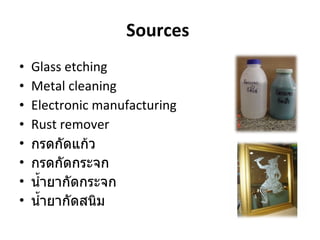
Sources  Glass etching Metal cleaning Electronic manufacturing Rust remover กรดกัดแก้ว กรดกัดกระจก น้ำยากัดกระจก น้ำยากัดสนิม
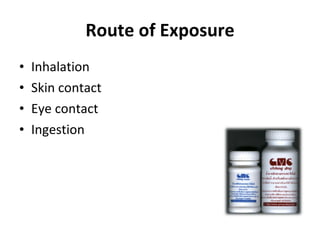
Route of Exposure Inhalation  Skin contact Eye contact Ingestion
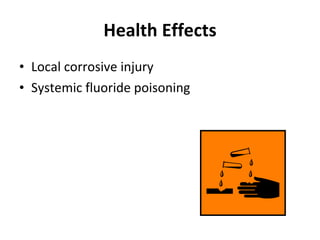
Health Effects Local corrosive injury Systemic fluoride poisoning
Pathophysiology   Liberated  H +     liquefactive necrosis of skin, mucosa and systemic acidosis Fluoride ( F - ) binds tissue Ca ++  and Mg ++ Forming insoluble salts    pain, hypoCa ++ , hypoMg ++ F -  disrupts Na/K-ATPase and K channel    hyperkalemia
Clinical Presentation Dermal exposure Pain out of proportion  to examination  Erythema, edema, whitish-blue discoloration Exposure to diluted HF S/S may be delayed up to 24 hrs Lesions : blister, eschar, firm white areas
Onset of Symptoms Time of exposure to onset of symptoms Solution of less than 7% several hours Solution of 12% up to 1 hour Solution > 14.5% immediately
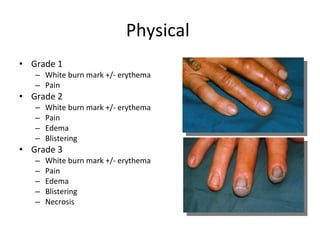
Physical  Grade 1 White burn mark +/- erythema  Pain Grade 2 White burn mark +/- erythema  Pain Edema  Blistering  Grade 3 White burn mark +/- erythema  Pain Edema  Blistering Necrosis
Clinical Presentation Inhalation Inhaled HF initially affects nose, throat, eyes Mucous membrane irritation, cough, choking Airway obstruction Lung injury may be delayed 12-36 hrs
Clinical Presentation Ingestion  Intentional ingestion of large volume Abdominal pain, vomiting, UGIH Potential absence of GI symptoms with dilute ingestion Systemic poisoning may occurs within 1-4 hrs
Clinical Presentation Systemic toxicity Massive exposure to conc. HF...syncope,death May be delayed up to 4 hrs after ingestion of diluted or dermal exposures to conc. HF Hypocalcemia, coma, seizure, shock, VT,VF  Fatalities Severe hypocalcemia Hypomagnesemia Hyperkalemia Acute pulmonary injury
Treatment
Pre-hospital Care Assess and manage acute life-threatening conditions Remove soiled clothing Decontaminated with water irrigation Ice pack on affected area Calcium gluconate gel Mg containing antacid Latex glove and iced water immersion
Emergency Department Care Initial care Treatment of burn or inhalation exposure Treatment of systemic poisoning
Initial cares ABC Remove soiled clothing Decontamination *** Assess & manage life-threatening conditions Comprehensive monitor Hypocalcemia    calcium gluconate IV Bolus 10%  Calcium gluconate  0.2 mL/kg Empiric IV calcium added to iv. fluid 10% Ca-gluconate 20mL in 1L of crystalloid > 1 hr
Treatment of Burns 2.5% calcium gluconate gel 10% calcium gluconate 10 mL  Diluted with K-Y jelly or water  30 mL (1:3) Subcutaneous infiltration 10% calcium gluconate  0.5 mL per sq.cm. Do not inject calcium chloride to treat skin burns
Treatment of Burns IV regional 10% calcium gluconate 10 mL plus heparin 5000 U Diluted in 5% dextrose 40 mL Use Bier ischemic arm block technique Intra-arterial 10% calcium gluconate 10 mL diluted in 5% dextrose 40 mL Infuse over 4 hours in radial or brachial artery via arteial catheter Digital block with local anesthesia
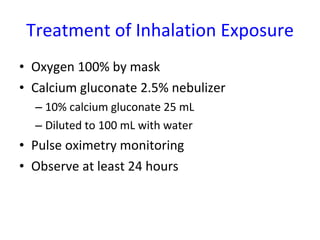
Treatment of Inhalation Exposure Oxygen 100% by mask Calcium gluconate 2.5% nebulizer  10% calcium gluconate 25 mL  Diluted to 100 mL with water Pulse oximetry monitoring Observe at least 24 hours
Treatment of Systemic Poisoning Hypocalcemia  Hyperkalemia  Hypomagnesemia
THANK YOU FOR YOUR ATTENTION

Hydrofluoric acid

  • 1.
    Hydrofluoric Acid พันโทฐิติศักดิ์ กิจทวีสิน พบ ., วว .( อายุรศาสตร์ ) วว .( อายุรศาสตร์โรคไต ), อว .( อายุรศาสตร์เวชเภสัชวิทยาและพิษวิทยา ) กองอายุรกรรม โรงพยาบาลพระมงกุฎเกล้า
  • 2.
    HF Hydrofluoric acidHydrofluoride Hydrogen fluoride Fluoric acid Fluorine monohydride
  • 3.
    Hydrogen fluoride Colorless,fuming liquid or gas Strong irritating odor Dissolves in water  Hydrofluoric acid Visibly indistinguishable from water
  • 4.
    Sources Glassetching Metal cleaning Electronic manufacturing Rust remover กรดกัดแก้ว กรดกัดกระจก น้ำยากัดกระจก น้ำยากัดสนิม
  • 5.
    Route of ExposureInhalation Skin contact Eye contact Ingestion
  • 6.
    Health Effects Localcorrosive injury Systemic fluoride poisoning
  • 7.
    Pathophysiology Liberated H +  liquefactive necrosis of skin, mucosa and systemic acidosis Fluoride ( F - ) binds tissue Ca ++ and Mg ++ Forming insoluble salts  pain, hypoCa ++ , hypoMg ++ F - disrupts Na/K-ATPase and K channel  hyperkalemia
  • 8.
    Clinical Presentation Dermalexposure Pain out of proportion to examination Erythema, edema, whitish-blue discoloration Exposure to diluted HF S/S may be delayed up to 24 hrs Lesions : blister, eschar, firm white areas
  • 9.
    Onset of SymptomsTime of exposure to onset of symptoms Solution of less than 7% several hours Solution of 12% up to 1 hour Solution > 14.5% immediately
  • 10.
    Physical Grade1 White burn mark +/- erythema Pain Grade 2 White burn mark +/- erythema Pain Edema Blistering Grade 3 White burn mark +/- erythema Pain Edema Blistering Necrosis
  • 11.
    Clinical Presentation InhalationInhaled HF initially affects nose, throat, eyes Mucous membrane irritation, cough, choking Airway obstruction Lung injury may be delayed 12-36 hrs
  • 12.
    Clinical Presentation Ingestion Intentional ingestion of large volume Abdominal pain, vomiting, UGIH Potential absence of GI symptoms with dilute ingestion Systemic poisoning may occurs within 1-4 hrs
  • 13.
    Clinical Presentation Systemictoxicity Massive exposure to conc. HF...syncope,death May be delayed up to 4 hrs after ingestion of diluted or dermal exposures to conc. HF Hypocalcemia, coma, seizure, shock, VT,VF Fatalities Severe hypocalcemia Hypomagnesemia Hyperkalemia Acute pulmonary injury
  • 14.
  • 15.
    Pre-hospital Care Assessand manage acute life-threatening conditions Remove soiled clothing Decontaminated with water irrigation Ice pack on affected area Calcium gluconate gel Mg containing antacid Latex glove and iced water immersion
  • 16.
    Emergency Department CareInitial care Treatment of burn or inhalation exposure Treatment of systemic poisoning
  • 17.
    Initial cares ABCRemove soiled clothing Decontamination *** Assess & manage life-threatening conditions Comprehensive monitor Hypocalcemia  calcium gluconate IV Bolus 10% Calcium gluconate 0.2 mL/kg Empiric IV calcium added to iv. fluid 10% Ca-gluconate 20mL in 1L of crystalloid > 1 hr
  • 18.
    Treatment of Burns2.5% calcium gluconate gel 10% calcium gluconate 10 mL Diluted with K-Y jelly or water 30 mL (1:3) Subcutaneous infiltration 10% calcium gluconate 0.5 mL per sq.cm. Do not inject calcium chloride to treat skin burns
  • 19.
    Treatment of BurnsIV regional 10% calcium gluconate 10 mL plus heparin 5000 U Diluted in 5% dextrose 40 mL Use Bier ischemic arm block technique Intra-arterial 10% calcium gluconate 10 mL diluted in 5% dextrose 40 mL Infuse over 4 hours in radial or brachial artery via arteial catheter Digital block with local anesthesia
  • 20.
    Treatment of InhalationExposure Oxygen 100% by mask Calcium gluconate 2.5% nebulizer 10% calcium gluconate 25 mL Diluted to 100 mL with water Pulse oximetry monitoring Observe at least 24 hours
  • 21.
    Treatment of SystemicPoisoning Hypocalcemia Hyperkalemia Hypomagnesemia
  • 22.
    THANK YOU FORYOUR ATTENTION