HYDRAULIC
ENGINEERING
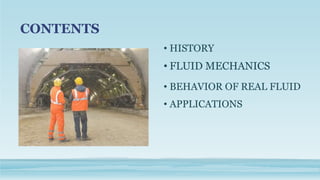
CONTENTS
• BEHAVIOR OF REAL FLUID
• HISTORY
• FLUID MECHANICS
• APPLICATIONS
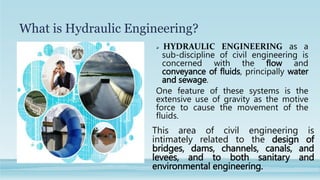
What is Hydraulic Engineering?
 HYDRAULIC ENGINEERING as a
sub-discipline of civil engineering is
concerned with the flow and
conveyance of fluids, principally water
and sewage.
One feature of these systems is the
extensive use of gravity as the motive
force to cause the movement of the
fluids.
This area of civil engineering is
intimately related to the design of
bridges, dams, channels, canals, and
levees, and to both sanitary and
environmental engineering.
HISTORY
Earliest uses of hydraulic
engineering were to irrigate crops
and dates back to the Middle East,
Egypt and Africa. Controlling the
movement and supply of water for
growing food has been used for
many thousands of years.
• One of the earliest hydraulic
machines, the WATER CLOCK
was used in the early 2nd
millennium BC.
HISTORY
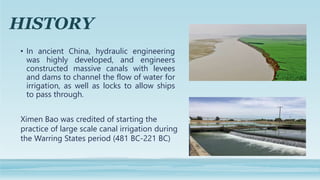
• In ancient China, hydraulic engineering
was highly developed, and engineers
constructed massive canals with levees
and dams to channel the flow of water for
irrigation, as well as locks to allow ships
to pass through.
Ximen Bao was credited of starting the
practice of large scale canal irrigation during
the Warring States period (481 BC-221 BC)
HISTORY
• Hydraulic engineering was highly
developed in Europe under the aegis of
the Roman Empire where it was especially
applied to the construction and
maintenance of aqueducts to supply
water to and remove sewage from their
cities.
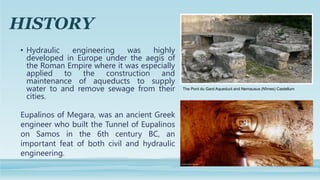
Eupalinos of Megara, was an ancient Greek
engineer who built the Tunnel of Eupalinos
on Samos in the 6th century BC, an
important feat of both civil and hydraulic
engineering.
The Pont du Gard Aqueduct and Nemausus (Nîmes) Castellum
HISTORY
• Further advances in hydraulic engineering occurred in
the Muslim world between the 8th to 16th centuries,
during what is known as the Islamic Golden Age. Of
particular importance was the 'water management
technological complex' which was central to the Islamic
Green Revolution and by extension, a precondition for
the emergence of modern technology
HISTORY
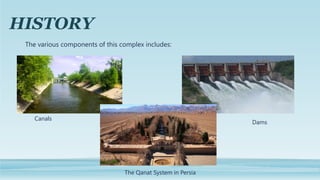
The various components of this complex includes:
Canals
Dams
The Qanat System in Persia
HISTORY
In many respects the fundamentals of hydraulic
engineering haven't changed since ancient times. Liquids
are still moved for the most part by gravity through
systems of canals and aqueducts, though the supply
reservoirs may now be filled using pumps.
MODERN TIMES
• Isaac Newton (1642–1727)
- by formulating the laws of motion and his law of
viscosity, in addition to developing the calculus, paved
the way for many great developments in fluid mechanics.
HISTORY
• The modern hydraulic engineer uses the same kinds of computer-
aided design (CAD) tools as many of the other engineering
disciplines while also making use of technologies like
computational fluid dynamics to perform the calculations to
accurately predict flow characteristics, GPS mapping to assist in
locating the best paths for installing a system and laser-based
surveying tools to aid in the actual construction of a system.
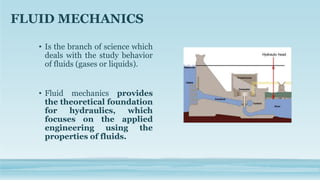
• Is the branch of science which
deals with the study behavior
of fluids (gases or liquids).
• Fluid mechanics provides
the theoretical foundation
for hydraulics, which
focuses on the applied
engineering using the
properties of fluids.
FLUID MECHANICS
DENSITY
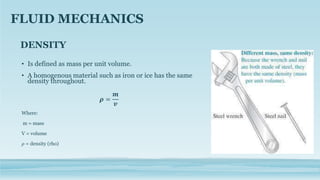
• Is defined as mass per unit volume.
• A homogenous material such as iron or ice has the same
density throughout.
𝝆 =
𝒎
𝒗
Where:
m = mass
V = volume
𝜌 = density (rho)
FLUID MECHANICS
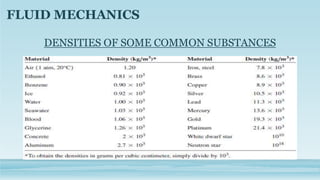
DENSITIES OF SOME COMMON SUBSTANCES
FLUID MECHANICS
PRESSURE
FLUID MECHANICS
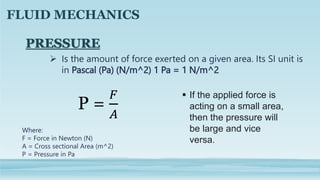
 Is the amount of force exerted on a given area. Its SI unit is
in Pascal (Pa) (N/m^2) 1 Pa = 1 N/m^2
Where:
F = Force in Newton (N)
A = Cross sectional Area (m^2)
P = Pressure in Pa
P =
𝐹
𝐴
 If the applied force is
acting on a small area,
then the pressure will
be large and vice
versa.
ATMOSPHERIC PRESSURE
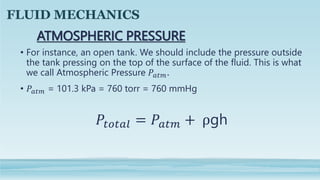
• For instance, an open tank. We should include the pressure outside
the tank pressing on the top of the surface of the fluid. This is what
we call Atmospheric Pressure 𝑃𝑎𝑡𝑚.
• 𝑃𝑎𝑡𝑚 = 101.3 kPa = 760 torr = 760 mmHg
𝑃𝑡𝑜𝑡𝑎𝑙 = 𝑃𝑎𝑡𝑚 + ρgh
FLUID MECHANICS
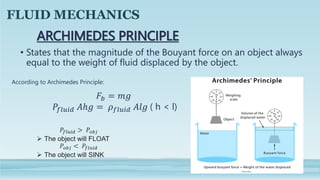
ARCHIMEDES PRINCIPLE
• States that the magnitude of the Bouyant force on an object always
equal to the weight of fluid displaced by the object.
𝑃𝑓𝑙𝑢𝑖𝑑 > 𝑃𝑜𝑏𝑗
 The object will FLOAT
𝑃𝑜𝑏𝑗 < 𝑃𝑓𝑙𝑢𝑖𝑑
 The object will SINK
FLUID MECHANICS
𝐹𝑏 = 𝑚𝑔
𝑃𝑓𝑙𝑢𝑖𝑑 𝐴ℎ𝑔 = 𝜌𝑓𝑙𝑢𝑖𝑑 𝐴𝑙𝑔 ( h < l)
According to Archimedes Principle:
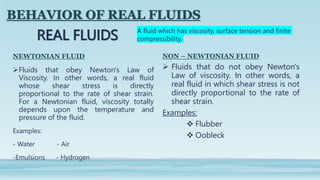
REAL FLUIDS
NEWTONIAN FLUID
Fluids that obey Newton's Law of
Viscosity. In other words, a real fluid
whose shear stress is directly
proportional to the rate of shear strain.
For a Newtonian fluid, viscosity totally
depends upon the temperature and
pressure of the fluid.
Examples:
- Water - Air
-Emulsions - Hydrogen
NON – NEWTONIAN FLUID
 Fluids that do not obey Newton's
Law of viscosity. In other words, a
real fluid in which shear stress is not
directly proportional to the rate of
shear strain.
Examples:
 Flubber
 Oobleck
BEHAVIOR OF REAL FLUIDS
A fluid which has viscosity, surface tension and finite
compressibility.
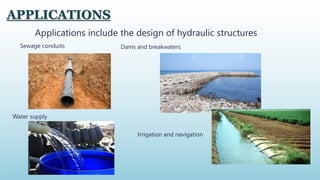
APPLICATIONS
Applications include the design of hydraulic structures
Sewage conduits Dams and breakwaters
Water supply
Irrigation and navigation
To preserve our natural
environment and meeting the
needs of the people.
APPLICATIONS
Hydroelectric-power
development
The management of waterways
THANK YOU!
PADAYON, FUTURE ENGINEERS!
Submitted by:
Layson, Razel Mae A.
Labro. Leomar D.
Jabien, Jhon Paul L.
BSCE – 1B
Submitted to:
Engr. Gladys C. Dela-Cruz
Instructor
Civil Engineering Orientation

HYDRAULICENGINEERING_BSCE1B.pptx

  • 1.
  • 2.
    CONTENTS • BEHAVIOR OFREAL FLUID • HISTORY • FLUID MECHANICS • APPLICATIONS
  • 3.
    What is HydraulicEngineering?  HYDRAULIC ENGINEERING as a sub-discipline of civil engineering is concerned with the flow and conveyance of fluids, principally water and sewage. One feature of these systems is the extensive use of gravity as the motive force to cause the movement of the fluids. This area of civil engineering is intimately related to the design of bridges, dams, channels, canals, and levees, and to both sanitary and environmental engineering.
  • 4.
    HISTORY Earliest uses ofhydraulic engineering were to irrigate crops and dates back to the Middle East, Egypt and Africa. Controlling the movement and supply of water for growing food has been used for many thousands of years. • One of the earliest hydraulic machines, the WATER CLOCK was used in the early 2nd millennium BC.
  • 5.
    HISTORY • In ancientChina, hydraulic engineering was highly developed, and engineers constructed massive canals with levees and dams to channel the flow of water for irrigation, as well as locks to allow ships to pass through. Ximen Bao was credited of starting the practice of large scale canal irrigation during the Warring States period (481 BC-221 BC)
  • 6.
    HISTORY • Hydraulic engineeringwas highly developed in Europe under the aegis of the Roman Empire where it was especially applied to the construction and maintenance of aqueducts to supply water to and remove sewage from their cities. Eupalinos of Megara, was an ancient Greek engineer who built the Tunnel of Eupalinos on Samos in the 6th century BC, an important feat of both civil and hydraulic engineering. The Pont du Gard Aqueduct and Nemausus (Nîmes) Castellum
  • 7.
    HISTORY • Further advancesin hydraulic engineering occurred in the Muslim world between the 8th to 16th centuries, during what is known as the Islamic Golden Age. Of particular importance was the 'water management technological complex' which was central to the Islamic Green Revolution and by extension, a precondition for the emergence of modern technology
  • 8.
    HISTORY The various componentsof this complex includes: Canals Dams The Qanat System in Persia
  • 9.
    HISTORY In many respectsthe fundamentals of hydraulic engineering haven't changed since ancient times. Liquids are still moved for the most part by gravity through systems of canals and aqueducts, though the supply reservoirs may now be filled using pumps. MODERN TIMES • Isaac Newton (1642–1727) - by formulating the laws of motion and his law of viscosity, in addition to developing the calculus, paved the way for many great developments in fluid mechanics.
  • 10.
    HISTORY • The modernhydraulic engineer uses the same kinds of computer- aided design (CAD) tools as many of the other engineering disciplines while also making use of technologies like computational fluid dynamics to perform the calculations to accurately predict flow characteristics, GPS mapping to assist in locating the best paths for installing a system and laser-based surveying tools to aid in the actual construction of a system.
  • 11.
    • Is thebranch of science which deals with the study behavior of fluids (gases or liquids). • Fluid mechanics provides the theoretical foundation for hydraulics, which focuses on the applied engineering using the properties of fluids. FLUID MECHANICS
  • 12.
    DENSITY • Is definedas mass per unit volume. • A homogenous material such as iron or ice has the same density throughout. 𝝆 = 𝒎 𝒗 Where: m = mass V = volume 𝜌 = density (rho) FLUID MECHANICS
  • 13.
    DENSITIES OF SOMECOMMON SUBSTANCES FLUID MECHANICS
  • 14.
    PRESSURE FLUID MECHANICS  Isthe amount of force exerted on a given area. Its SI unit is in Pascal (Pa) (N/m^2) 1 Pa = 1 N/m^2 Where: F = Force in Newton (N) A = Cross sectional Area (m^2) P = Pressure in Pa P = 𝐹 𝐴  If the applied force is acting on a small area, then the pressure will be large and vice versa.
  • 16.
    ATMOSPHERIC PRESSURE • Forinstance, an open tank. We should include the pressure outside the tank pressing on the top of the surface of the fluid. This is what we call Atmospheric Pressure 𝑃𝑎𝑡𝑚. • 𝑃𝑎𝑡𝑚 = 101.3 kPa = 760 torr = 760 mmHg 𝑃𝑡𝑜𝑡𝑎𝑙 = 𝑃𝑎𝑡𝑚 + ρgh FLUID MECHANICS
  • 17.
    ARCHIMEDES PRINCIPLE • Statesthat the magnitude of the Bouyant force on an object always equal to the weight of fluid displaced by the object. 𝑃𝑓𝑙𝑢𝑖𝑑 > 𝑃𝑜𝑏𝑗  The object will FLOAT 𝑃𝑜𝑏𝑗 < 𝑃𝑓𝑙𝑢𝑖𝑑  The object will SINK FLUID MECHANICS 𝐹𝑏 = 𝑚𝑔 𝑃𝑓𝑙𝑢𝑖𝑑 𝐴ℎ𝑔 = 𝜌𝑓𝑙𝑢𝑖𝑑 𝐴𝑙𝑔 ( h < l) According to Archimedes Principle:
  • 18.
    REAL FLUIDS NEWTONIAN FLUID Fluidsthat obey Newton's Law of Viscosity. In other words, a real fluid whose shear stress is directly proportional to the rate of shear strain. For a Newtonian fluid, viscosity totally depends upon the temperature and pressure of the fluid. Examples: - Water - Air -Emulsions - Hydrogen NON – NEWTONIAN FLUID  Fluids that do not obey Newton's Law of viscosity. In other words, a real fluid in which shear stress is not directly proportional to the rate of shear strain. Examples:  Flubber  Oobleck BEHAVIOR OF REAL FLUIDS A fluid which has viscosity, surface tension and finite compressibility.
  • 19.
    APPLICATIONS Applications include thedesign of hydraulic structures Sewage conduits Dams and breakwaters Water supply Irrigation and navigation
  • 20.
    To preserve ournatural environment and meeting the needs of the people. APPLICATIONS Hydroelectric-power development The management of waterways
  • 21.
  • 22.
    Submitted by: Layson, RazelMae A. Labro. Leomar D. Jabien, Jhon Paul L. BSCE – 1B Submitted to: Engr. Gladys C. Dela-Cruz Instructor Civil Engineering Orientation