Hydraulic Fracturing
“Fracking”
Definition
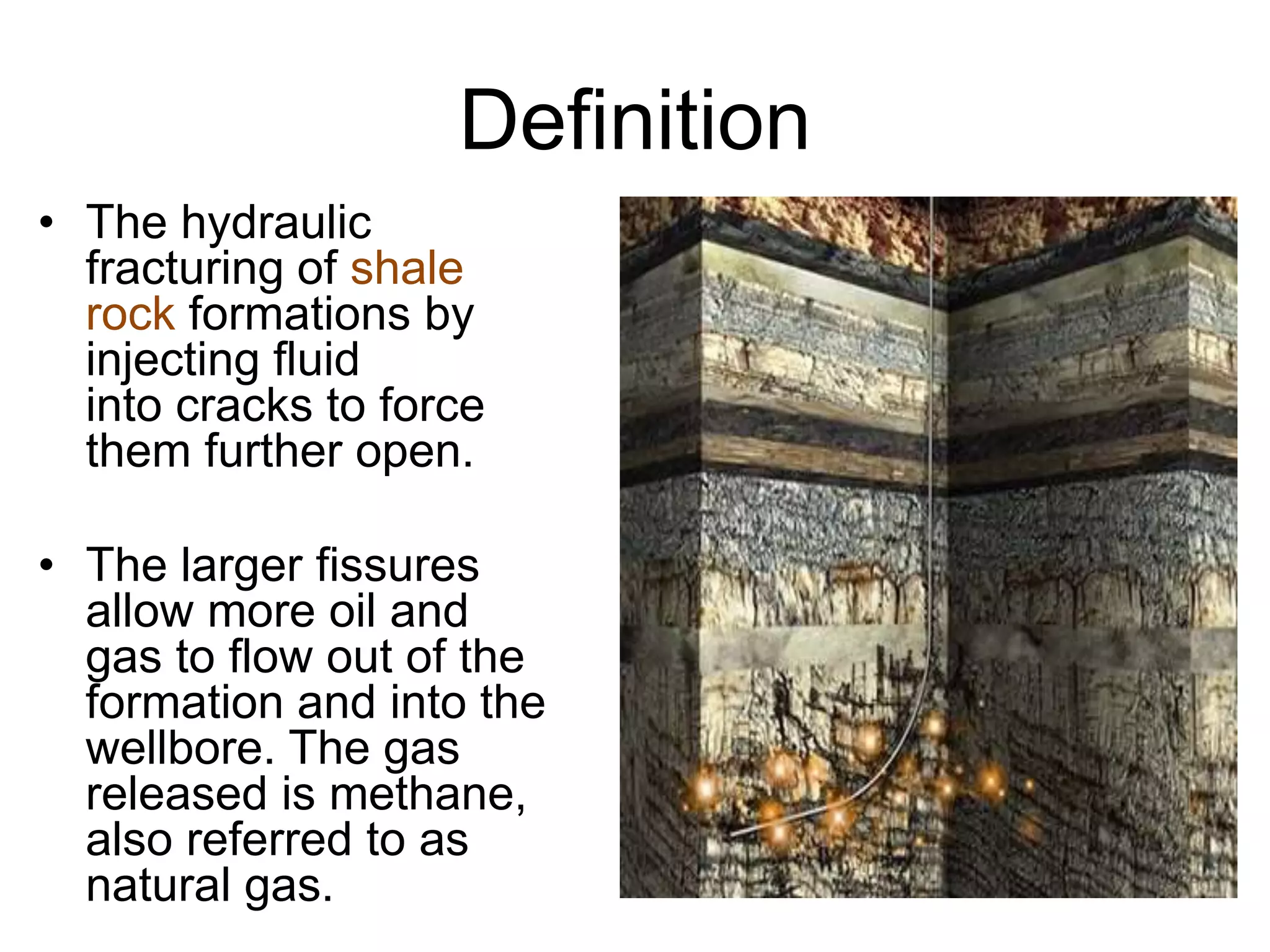
• The hydraulic
fracturing of shale
rock formations by
injecting fluid
into cracks to force
them further open.
• The larger fissures
allow more oil and
gas to flow out of the
formation and into the
wellbore. The gas
released is methane,
also referred to as
natural gas.
History
• 1840’s: Natural Gas first used in Fredonia, New York.
• 1860’s: Fracturing, using nitroglycerin, used as a method to
stimulate shallow, hard rock oil wells. (1)
• 1947: Floyd Farris of performs experiments that become the
basis of hydraulic fracturing. (2)(6)
• 1970’s: The United States government initiated the Eastern
Shales Project, a set of dozens of public-private hydraulic
fracturing pilot demonstration projects. The Gas Research
Institute receives funding from the Federal Energy Regulatory
Commission. (3)
• 1997 – present: Development of "slickwater fracturing.” This
process involves adding chemicals to water to increase the fluid
flow, that makes shale gas extraction economical.
Justification
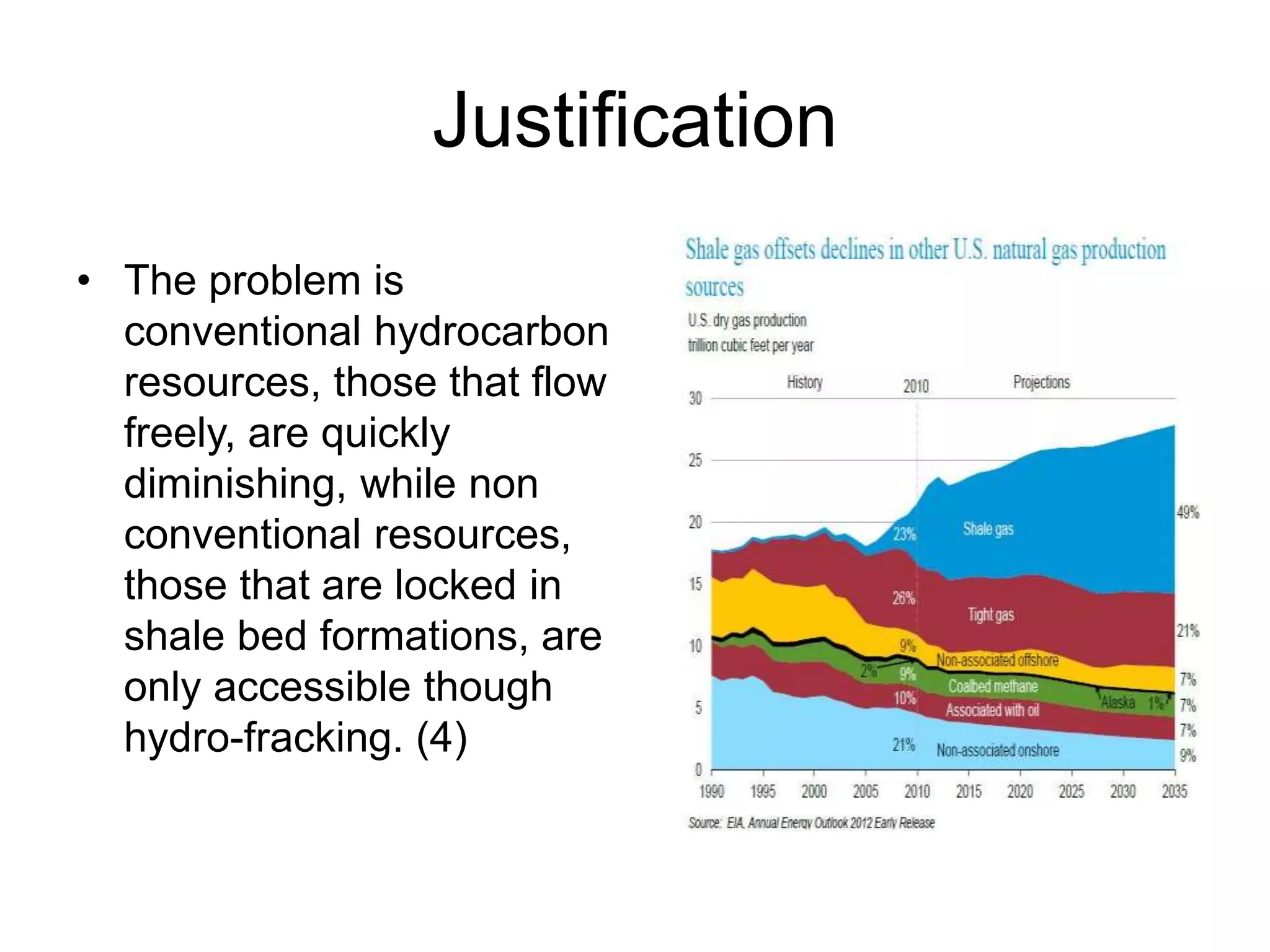
• The problem is
conventional hydrocarbon
resources, those that flow
freely, are quickly
diminishing, while non
conventional resources,
those that are locked in
shale bed formations, are
only accessible though
hydro-fracking. (4)
Materials Used
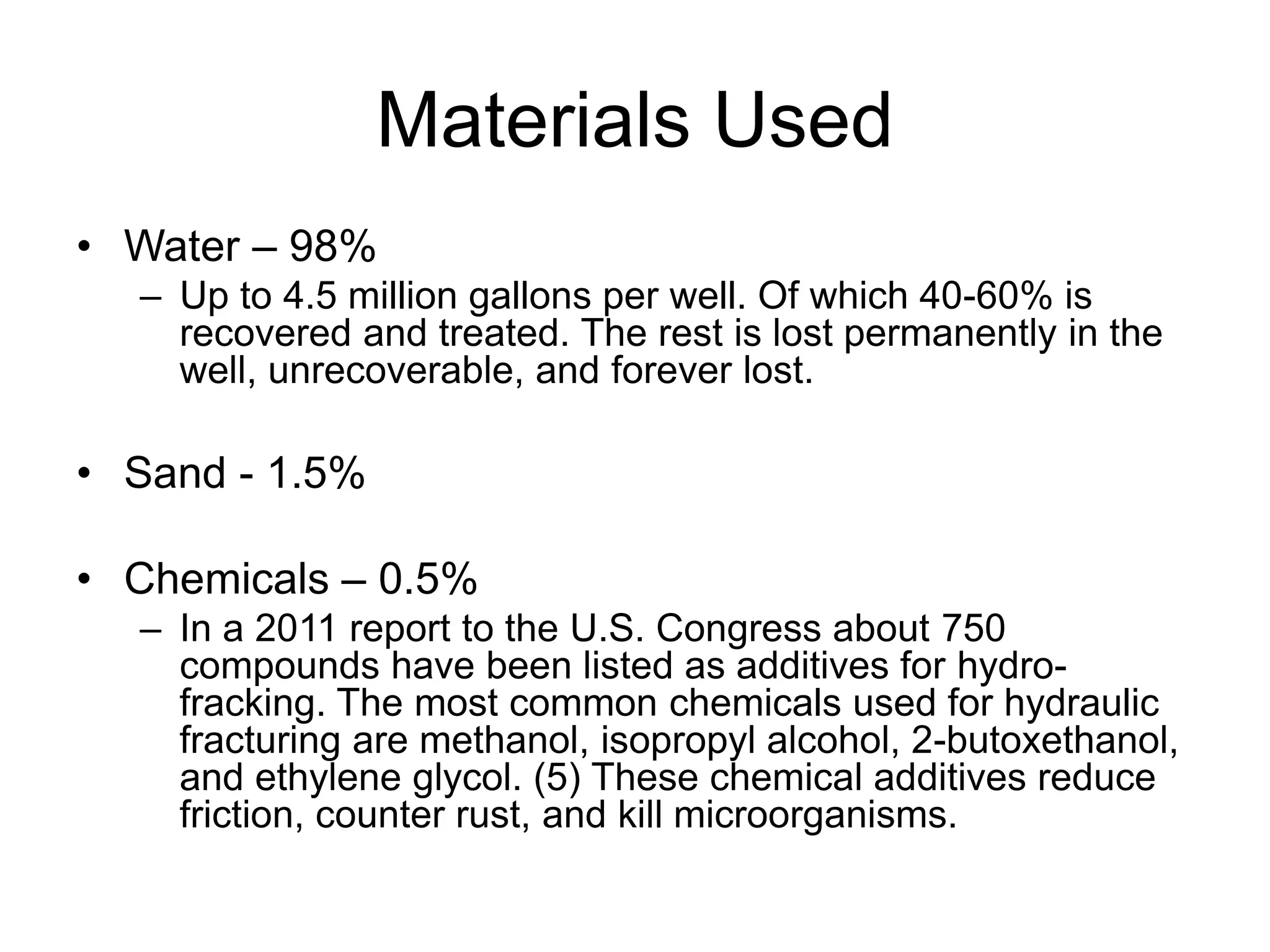
• Water – 98%
– Up to 4.5 million gallons per well. Of which 40-60% is
recovered and treated. The rest is lost permanently in the
well, unrecoverable, and forever lost.
• Sand - 1.5%
• Chemicals – 0.5%
– In a 2011 report to the U.S. Congress about 750
compounds have been listed as additives for hydro-
fracking. The most common chemicals used for hydraulic
fracturing are methanol, isopropyl alcohol, 2-butoxethanol,
and ethylene glycol. (5) These chemical additives reduce
friction, counter rust, and kill microorganisms.
Process - Overview
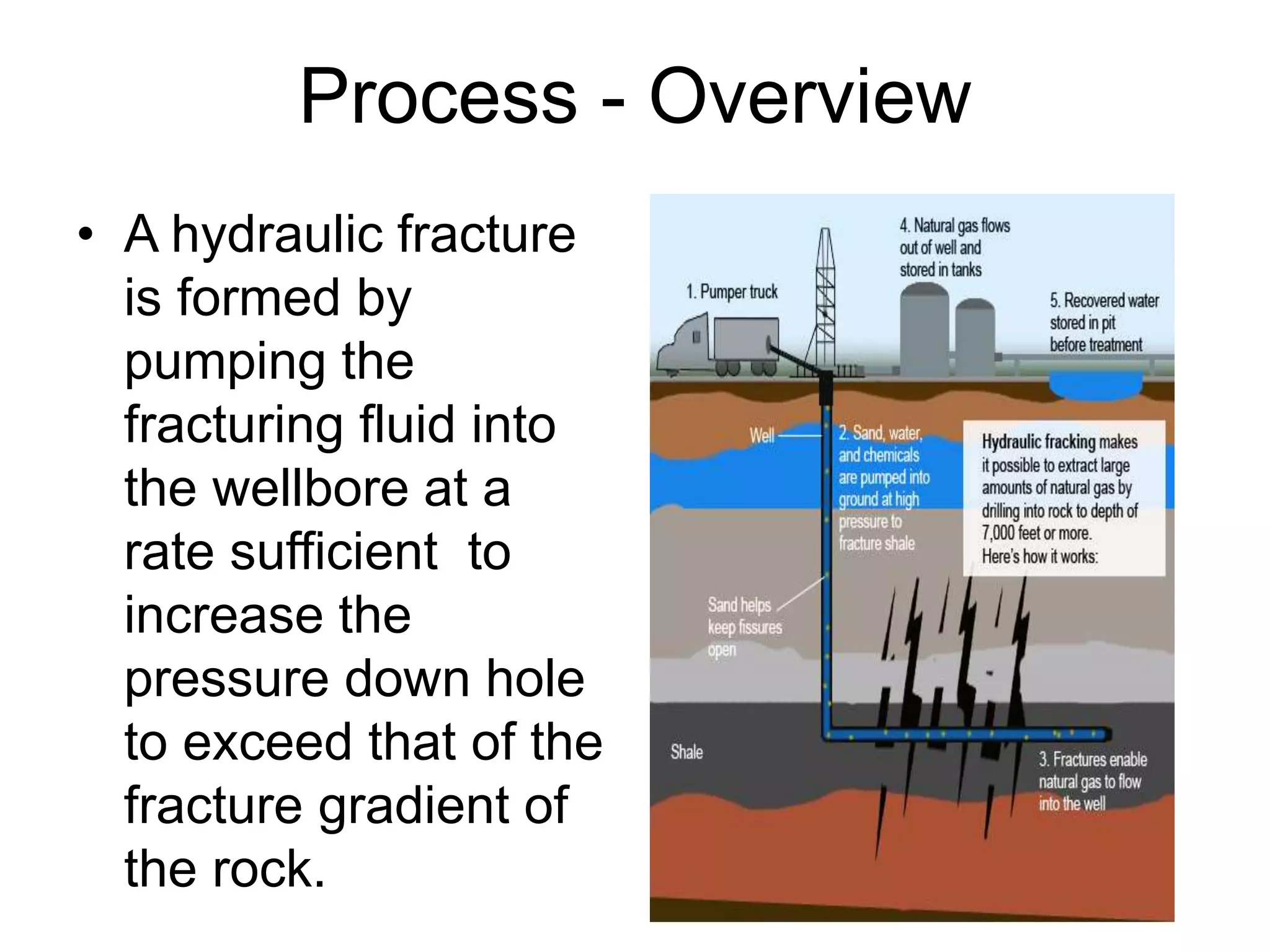
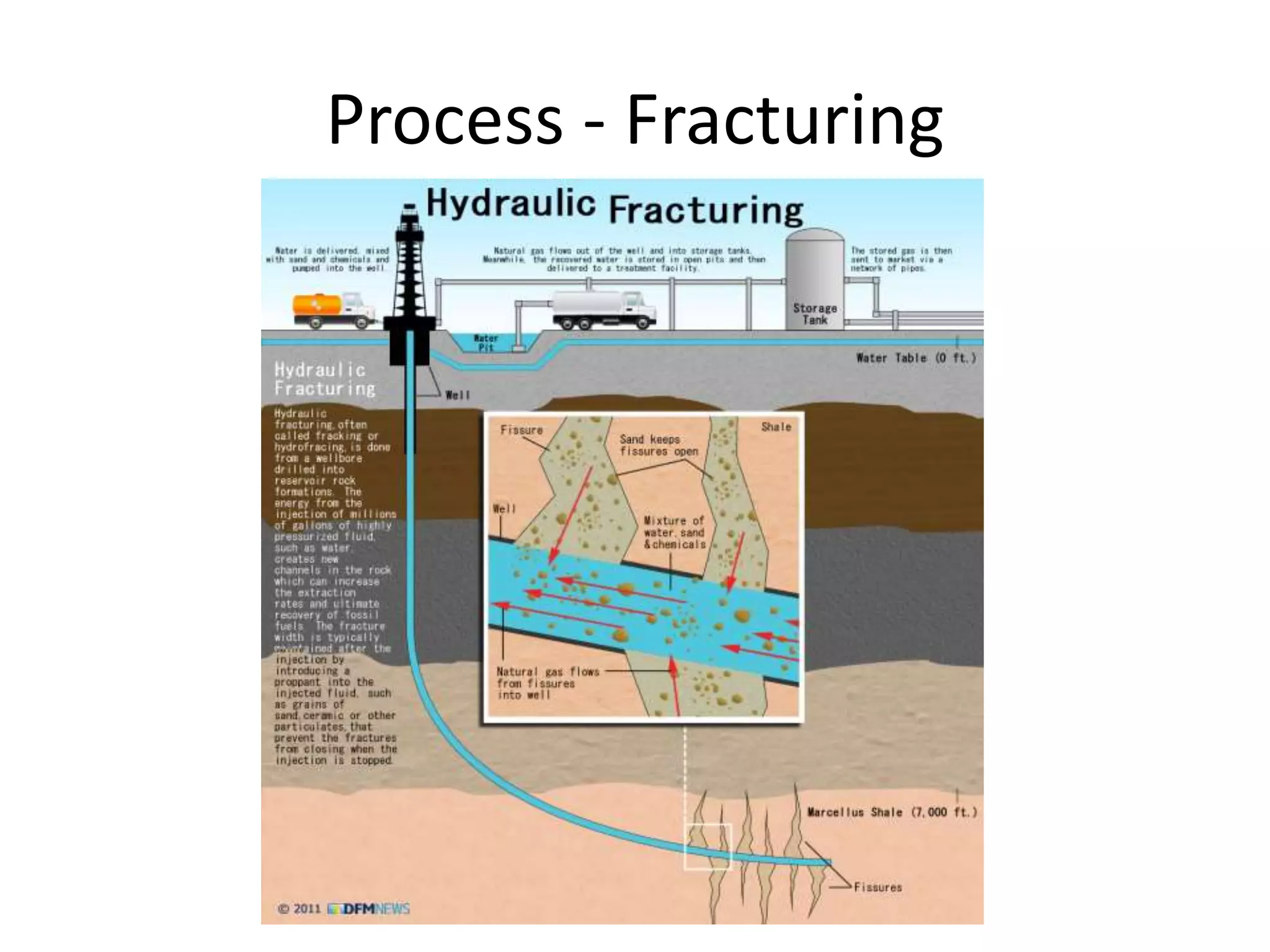
• A hydraulic fracture
is formed by
pumping the
fracturing fluid into
the wellbore at a
rate sufficient to
increase the
pressure down hole
to exceed that of the
fracture gradient of
the rock.
Process - Drilling
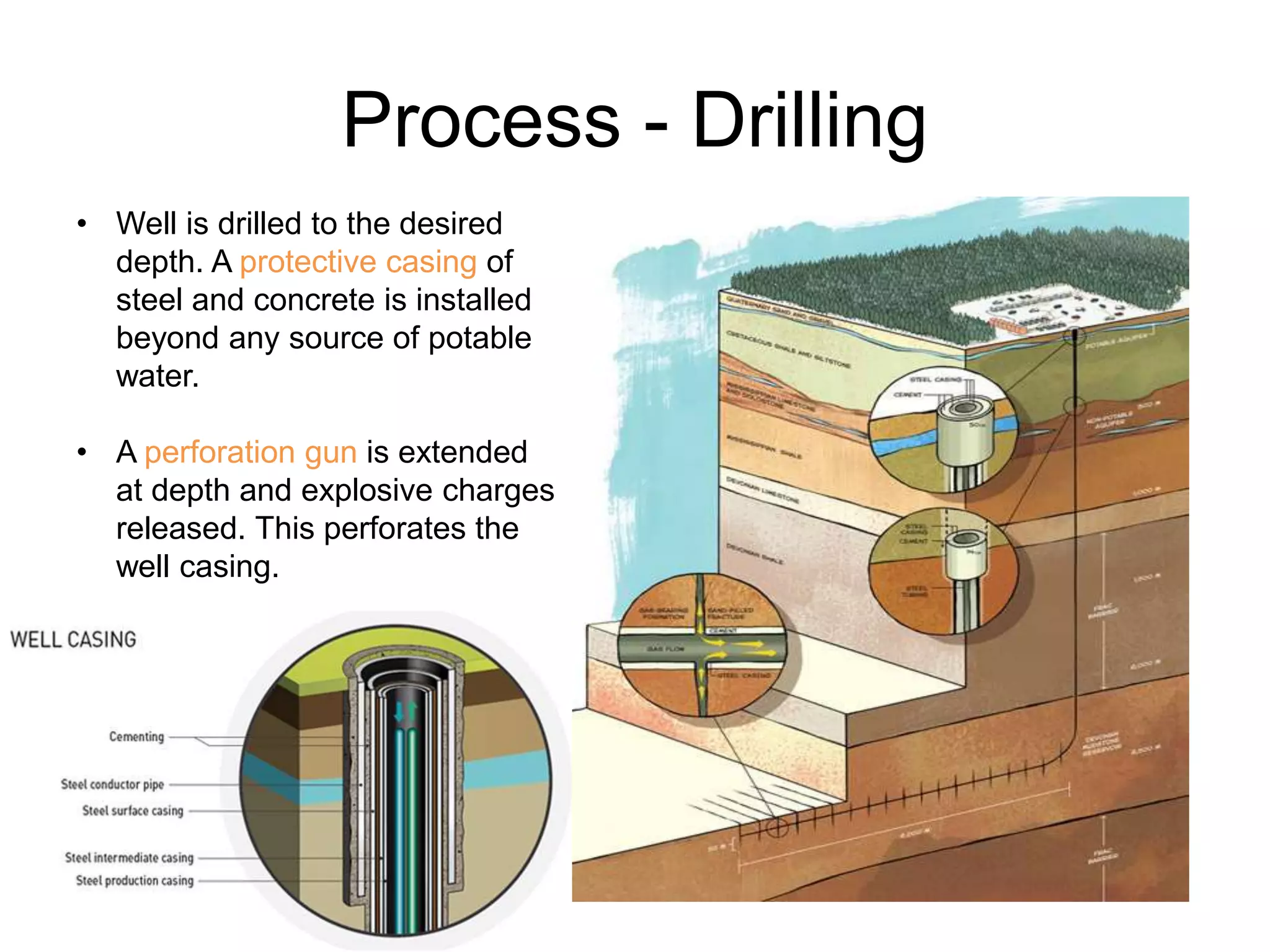
• Well is drilled to the desired
depth. A protective casing of
steel and concrete is installed
beyond any source of potable
water.
• A perforation gun is extended
at depth and explosive charges
released. This perforates the
well casing.
Process - Injection
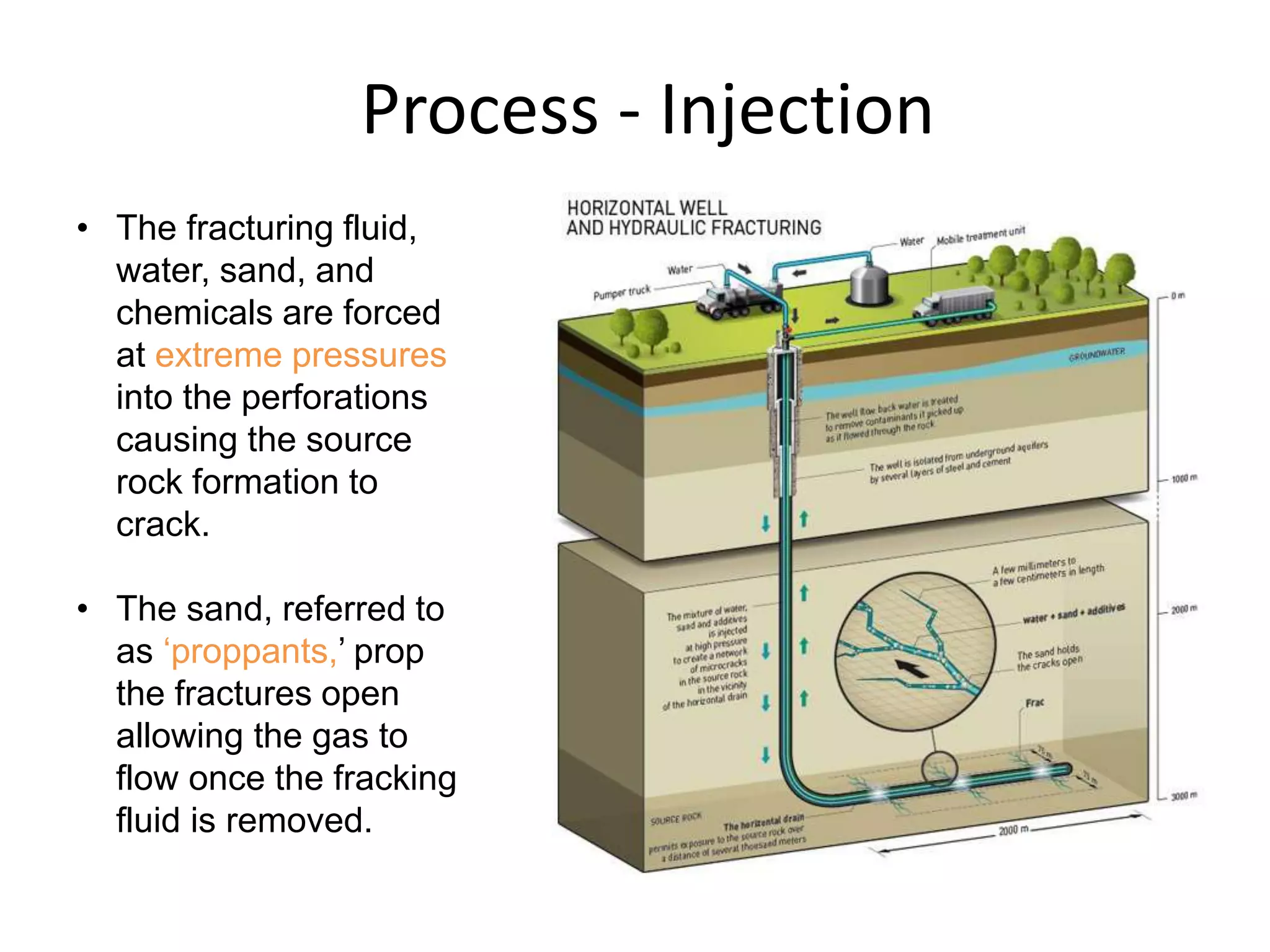
• The fracturing fluid,
water, sand, and
chemicals are forced
at extreme pressures
into the perforations
causing the source
rock formation to
crack.
• The sand, referred to
as ‘proppants,’ prop
the fractures open
allowing the gas to
flow once the fracking
fluid is removed.
Process - Fracturing
Process – Disposal
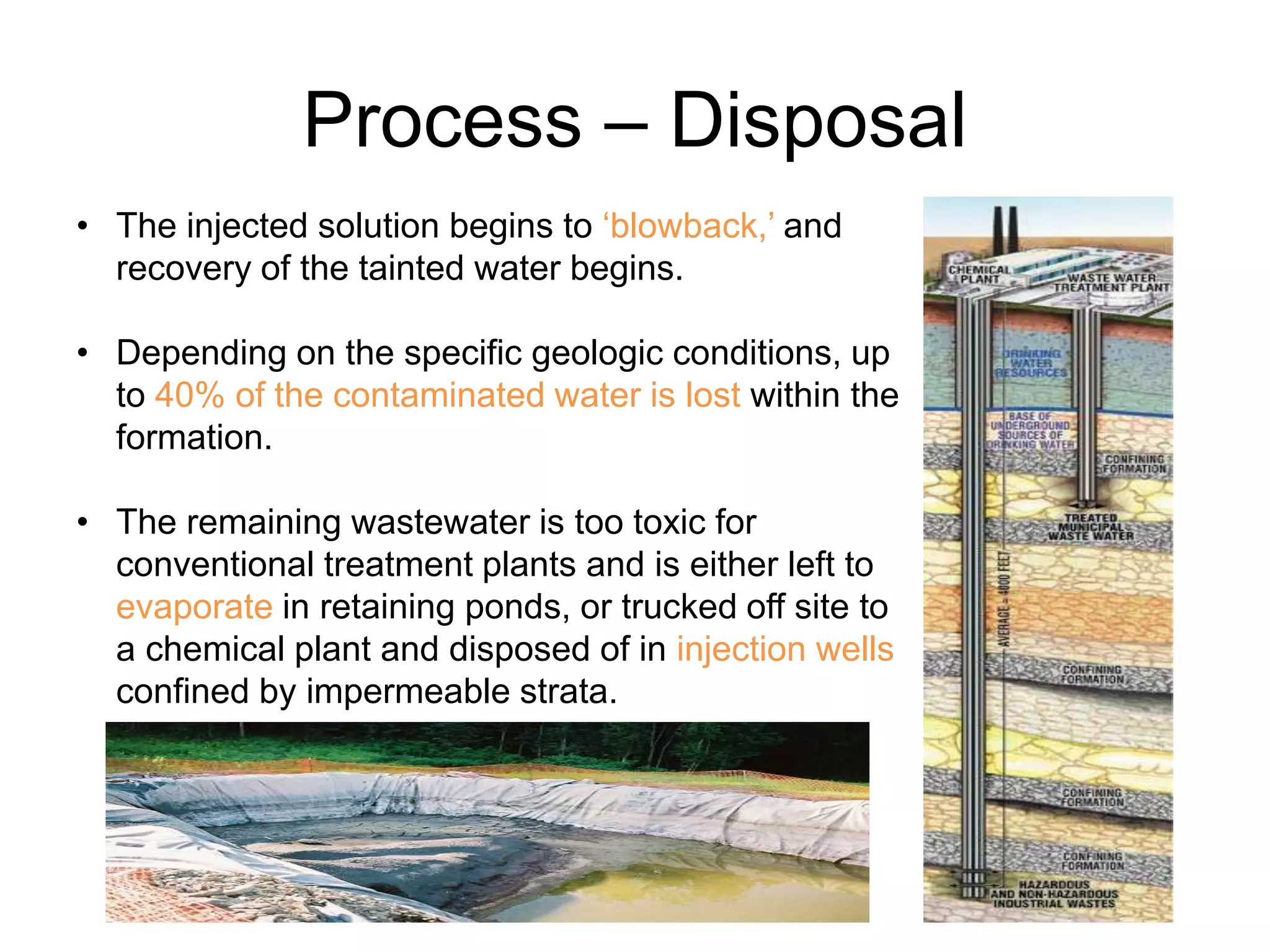
• The injected solution begins to ‘blowback,’ and
recovery of the tainted water begins.
• Depending on the specific geologic conditions, up
to 40% of the contaminated water is lost within the
formation.
• The remaining wastewater is too toxic for
conventional treatment plants and is either left to
evaporate in retaining ponds, or trucked off site to
a chemical plant and disposed of in injection wells
confined by impermeable strata.
Pros and Cons
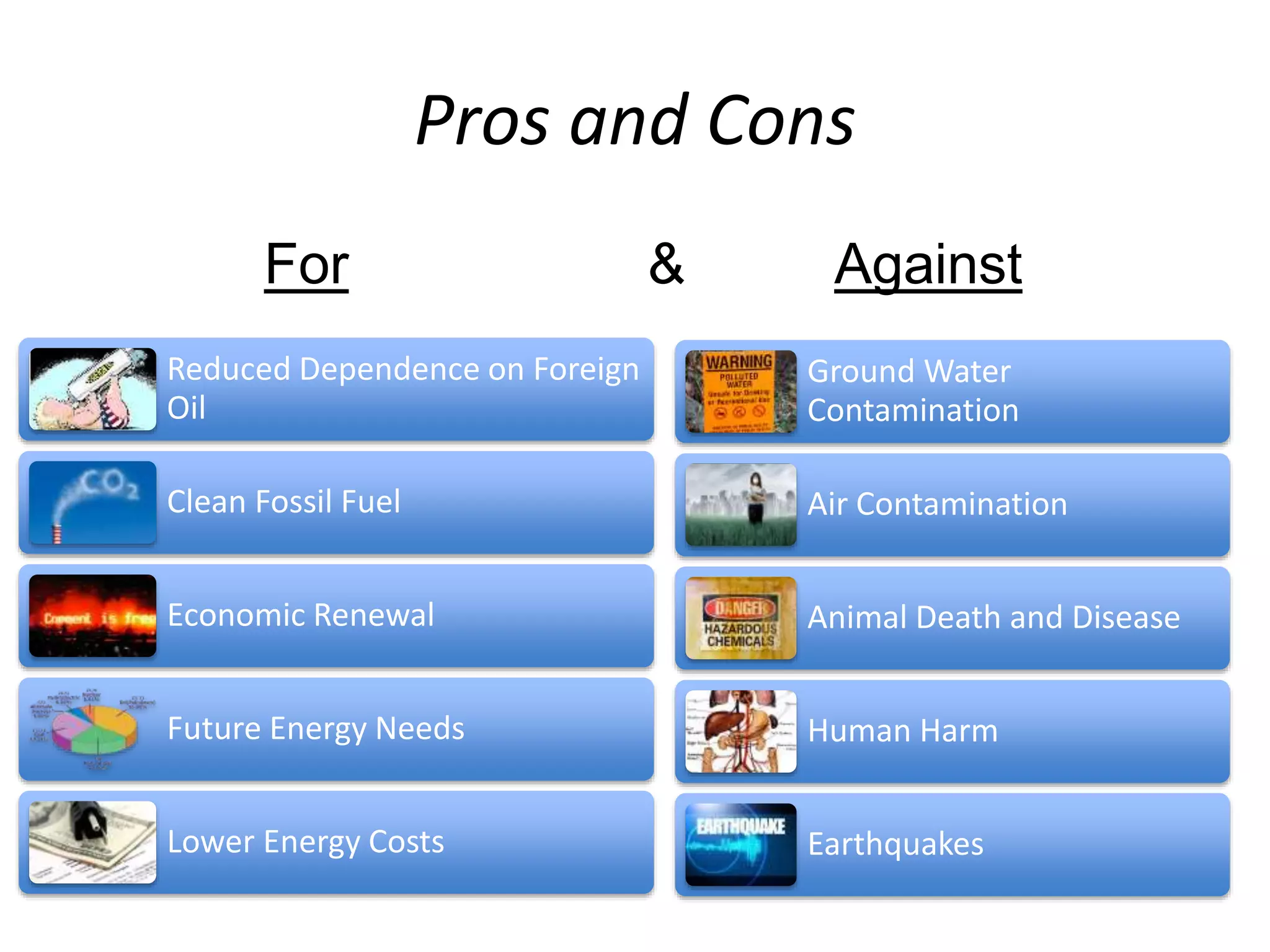
For & Against
Reduced Dependence on Foreign
Oil
Clean Fossil Fuel
Economic Renewal
Future Energy Needs
Lower Energy Costs
Ground Water
Contamination
Air Contamination
Animal Death and Disease
Human Harm
Earthquakes
Reduced Dependence on Foreign Oil
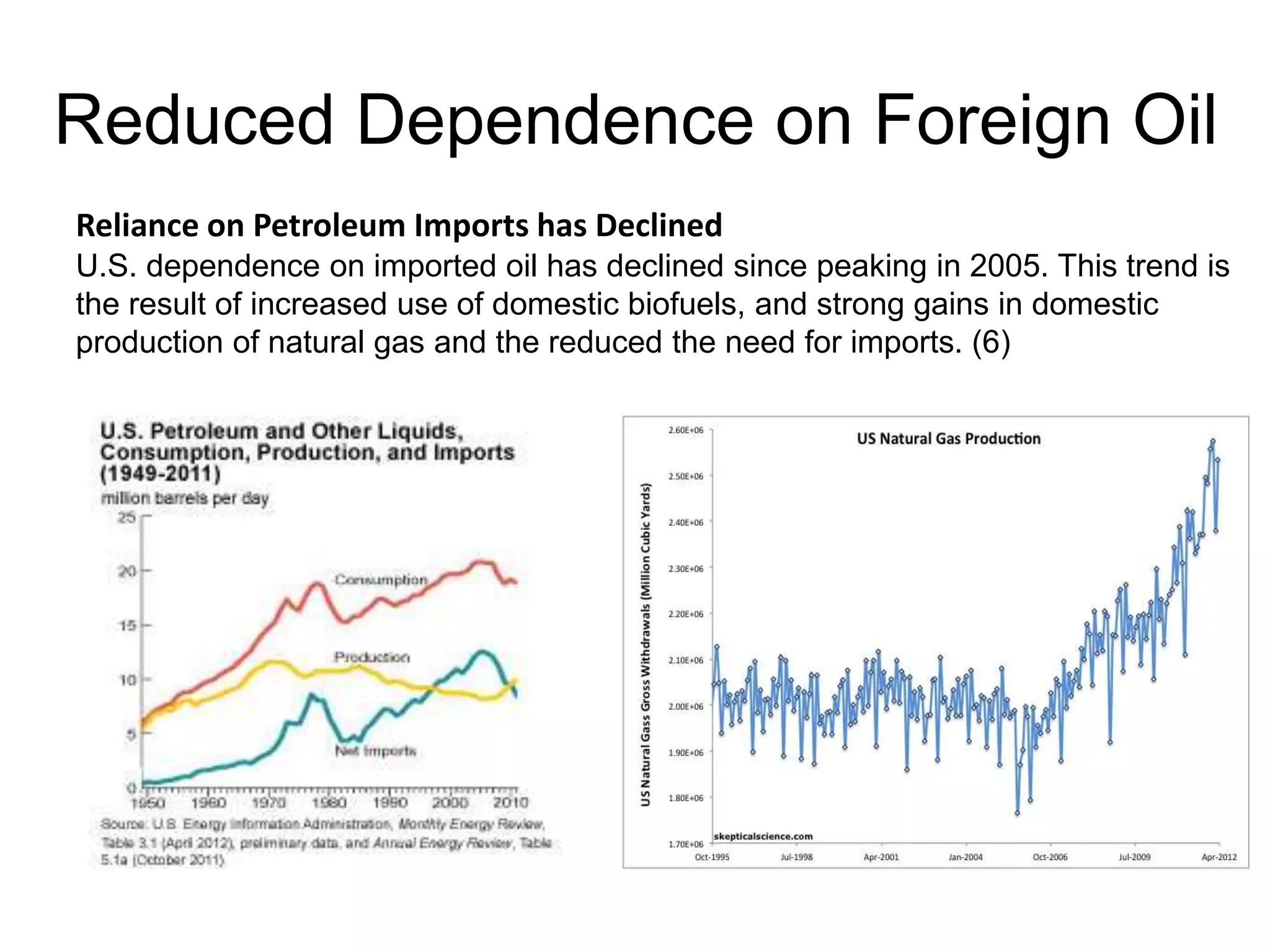
Reliance on Petroleum Imports has Declined
U.S. dependence on imported oil has declined since peaking in 2005. This trend is
the result of increased use of domestic biofuels, and strong gains in domestic
production of natural gas and the reduced the need for imports. (6)
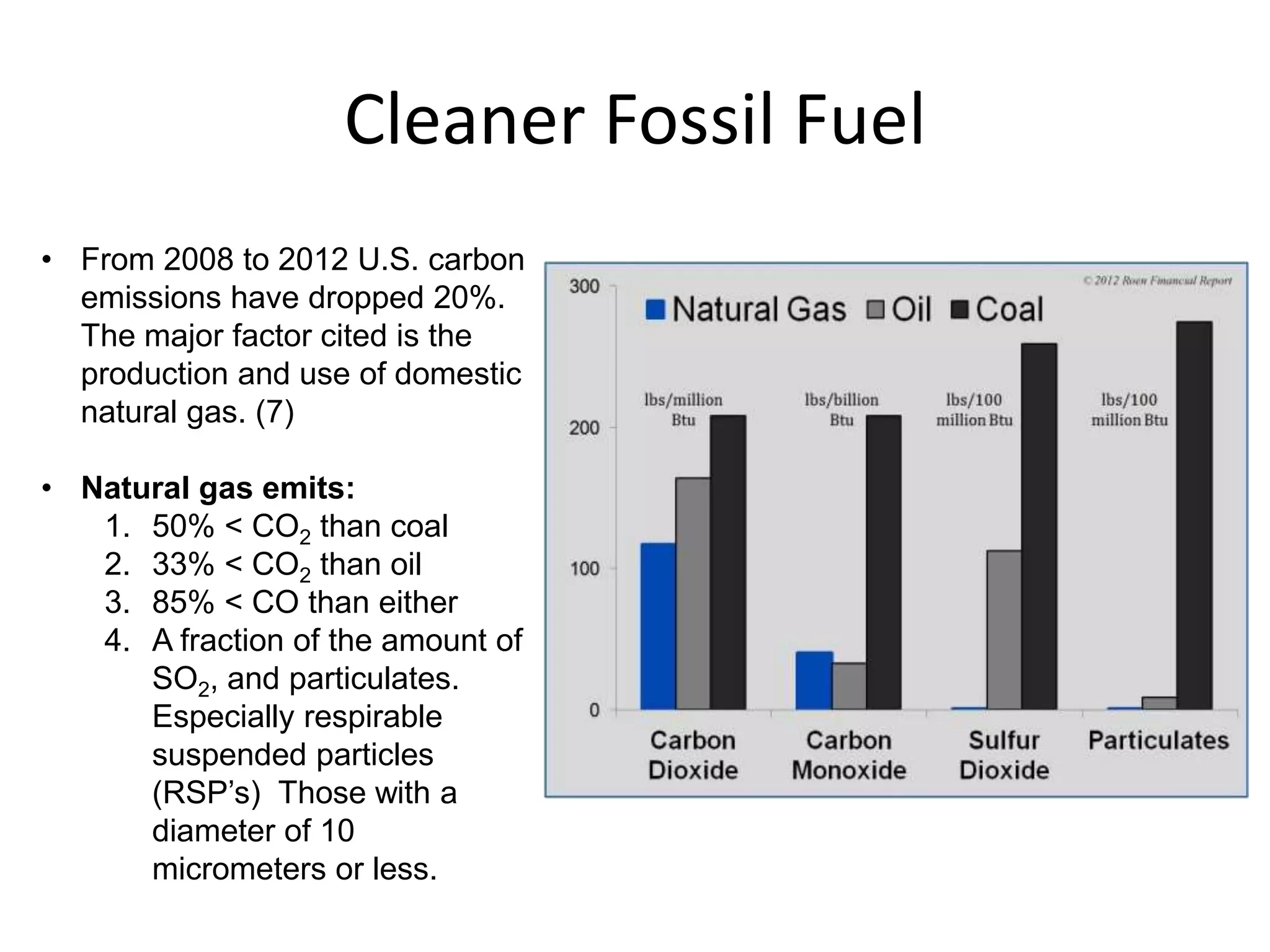
Cleaner Fossil Fuel
• From 2008 to 2012 U.S. carbon
emissions have dropped 20%.
The major factor cited is the
production and use of domestic
natural gas. (7)
• Natural gas emits:
1. 50% < CO2 than coal
2. 33% < CO2 than oil
3. 85% < CO than either
4. A fraction of the amount of
SO2, and particulates.
Especially respirable
suspended particles
(RSP’s) Those with a
diameter of 10
micrometers or less.
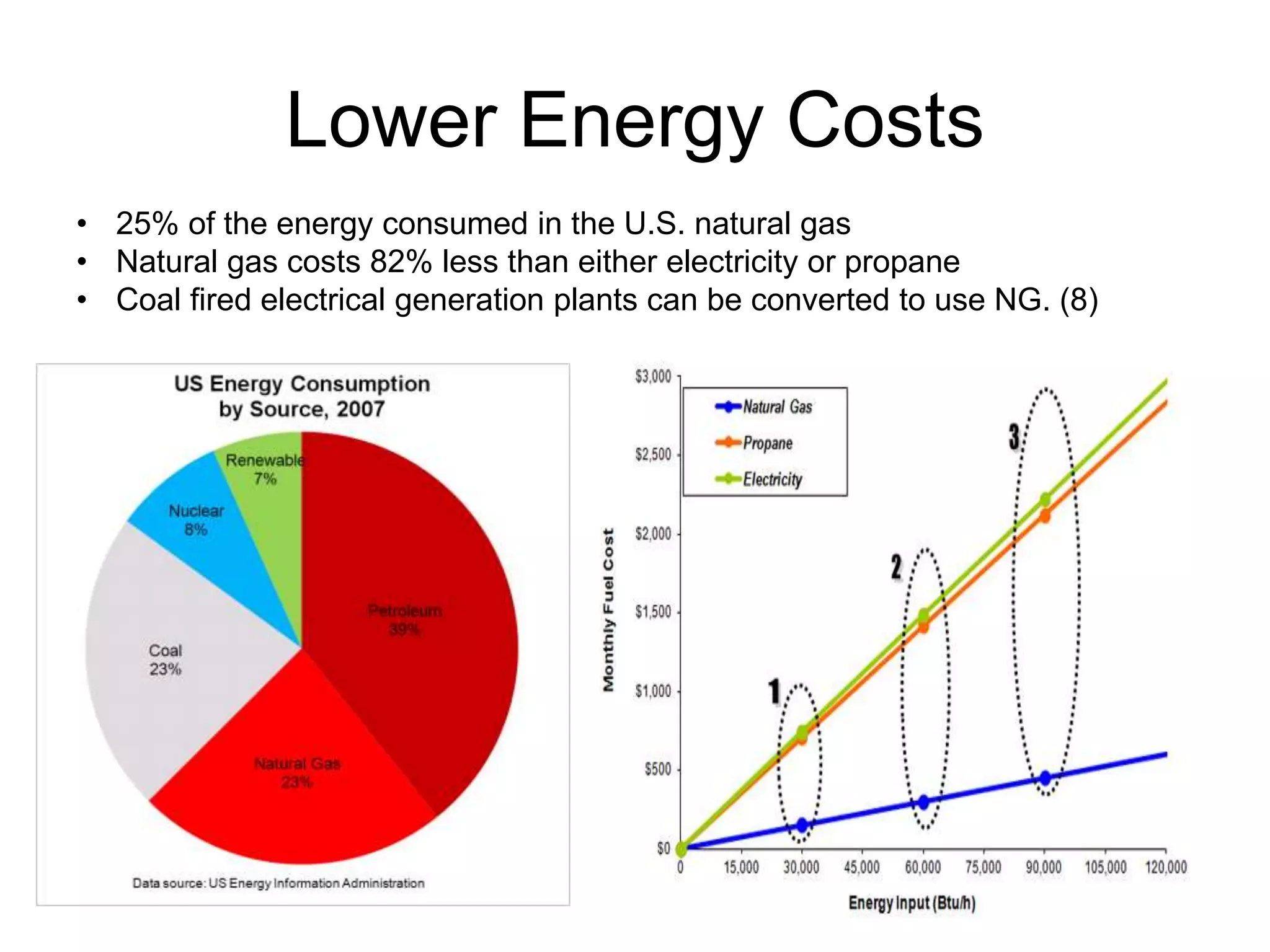
Lower Energy Costs
• 25% of the energy consumed in the U.S. natural gas
• Natural gas costs 82% less than either electricity or propane
• Coal fired electrical generation plants can be converted to use NG. (8)
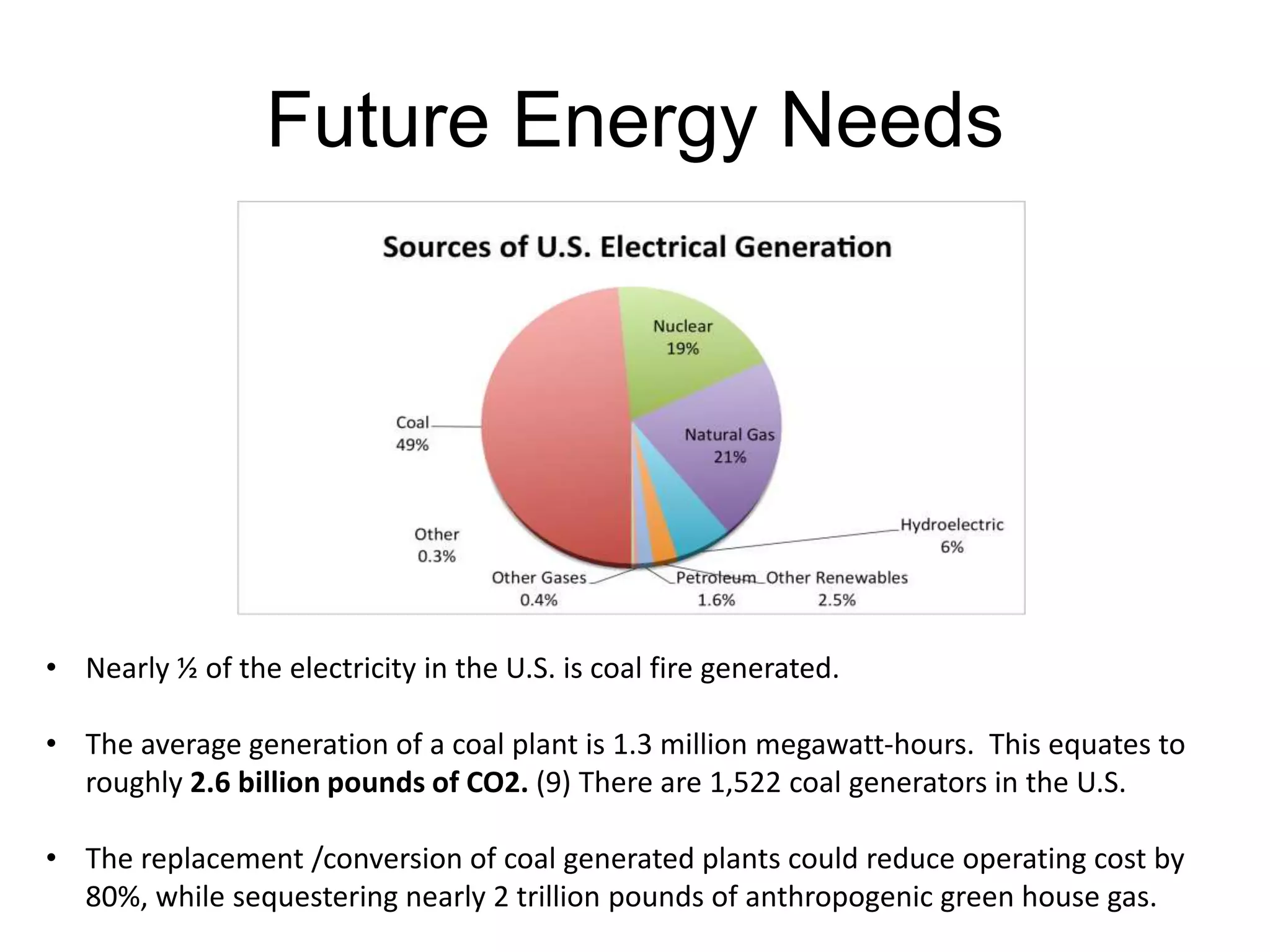
Future Energy Needs
• Nearly ½ of the electricity in the U.S. is coal fire generated.
• The average generation of a coal plant is 1.3 million megawatt-hours. This equates to
roughly 2.6 billion pounds of CO2. (9) There are 1,522 coal generators in the U.S.
• The replacement /conversion of coal generated plants could reduce operating cost by
80%, while sequestering nearly 2 trillion pounds of anthropogenic green house gas.
Economic Benefit
Employment
• Currently there are:
– 1.7 million jobs in the NG field
• Projected increase:
– 3 million jobs by 2020
– 3.5 million by 2035
Tax Revenue
• Fiscal Year 2011-2012 in Pennsylvania alone:
– $2.6 billion in tax receipts
• Projected Federal, State and Local tax receipts by 2035
– $5.1 trillion
Groundwater Contamination
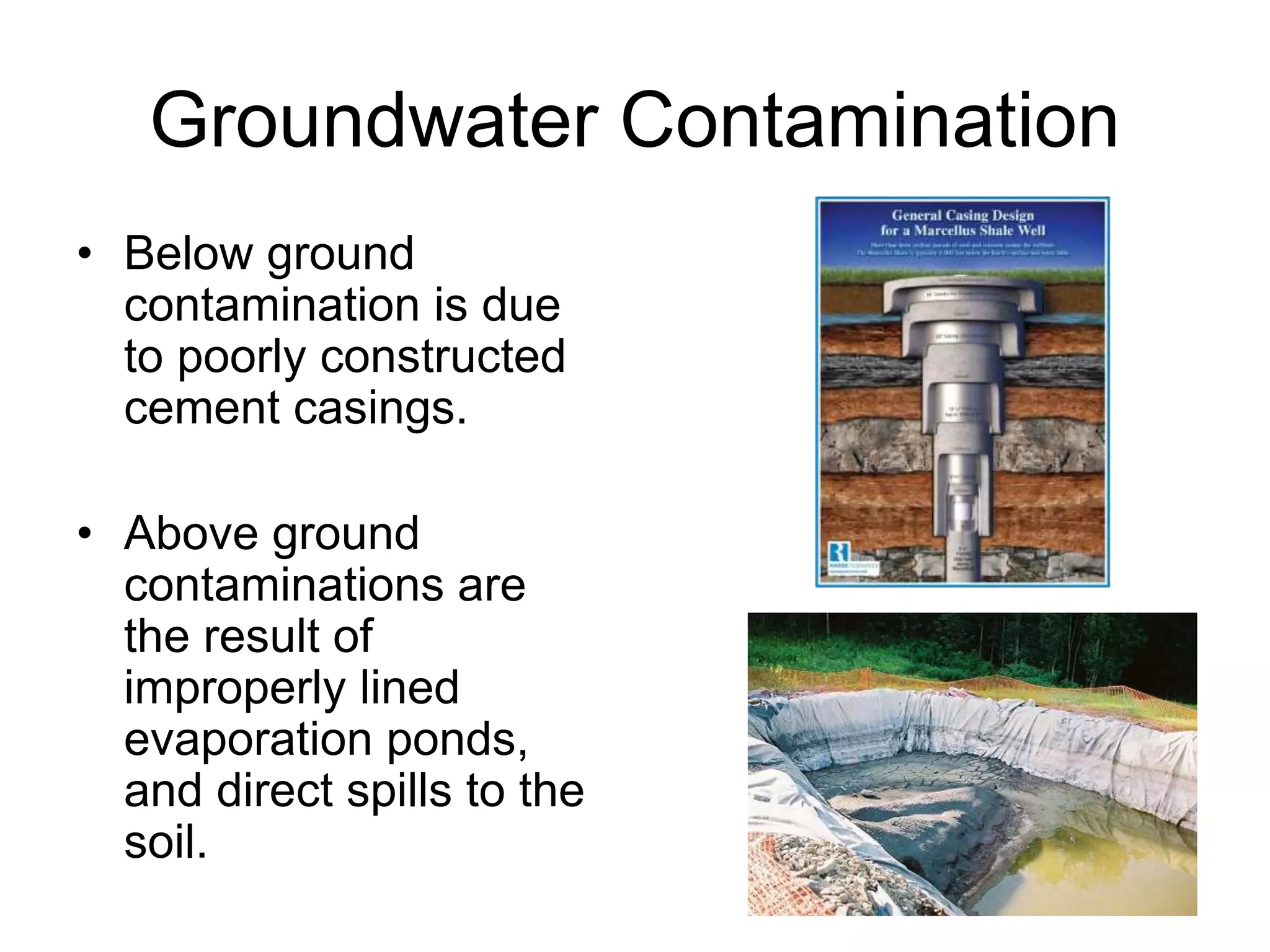
• Below ground
contamination is due
to poorly constructed
cement casings.
• Above ground
contaminations are
the result of
improperly lined
evaporation ponds,
and direct spills to the
soil.
Air Contamination
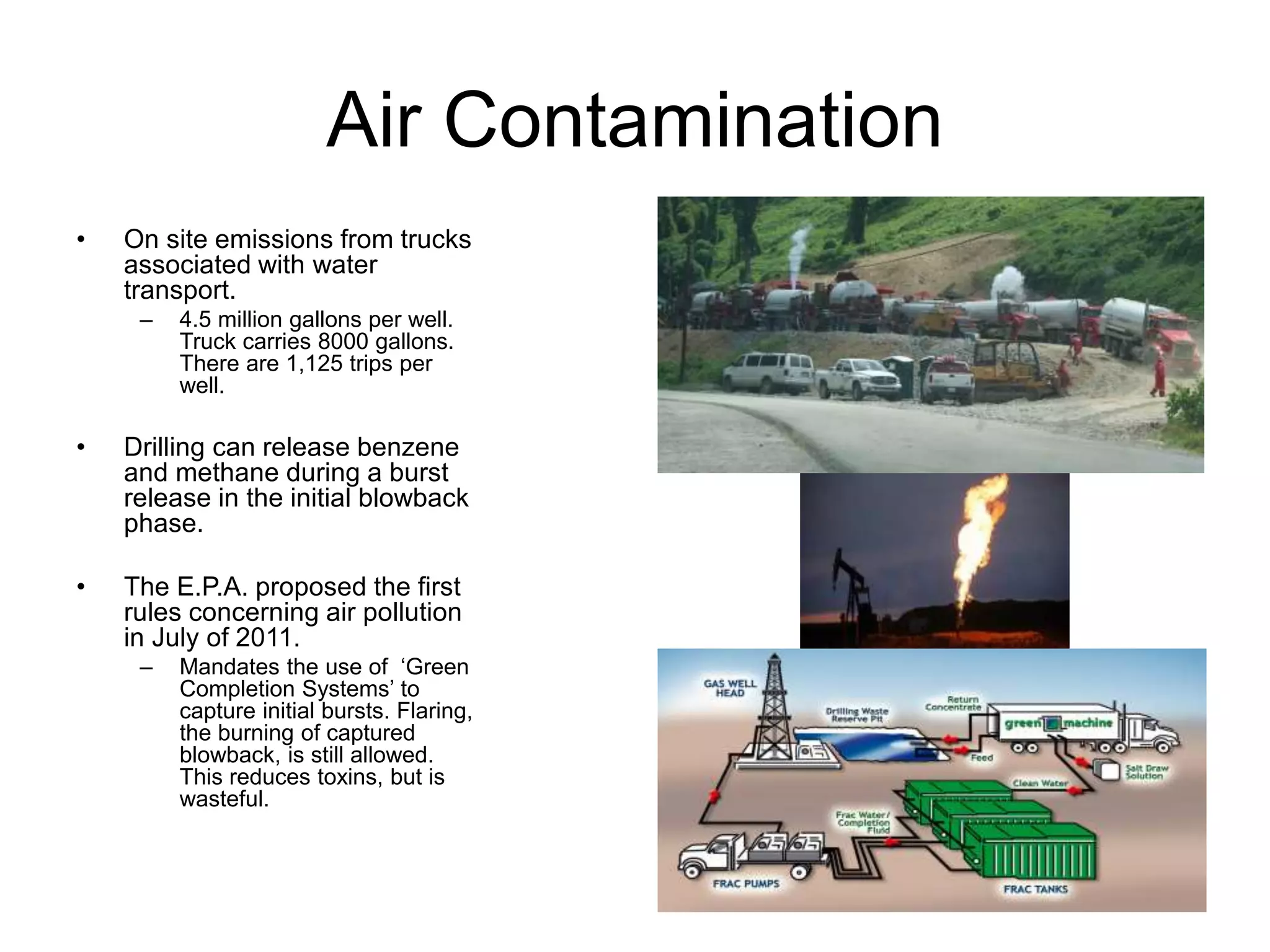
• On site emissions from trucks
associated with water
transport.
– 4.5 million gallons per well.
Truck carries 8000 gallons.
There are 1,125 trips per
well.
• Drilling can release benzene
and methane during a burst
release in the initial blowback
phase.
• The E.P.A. proposed the first
rules concerning air pollution
in July of 2011.
– Mandates the use of ‘Green
Completion Systems’ to
capture initial bursts. Flaring,
the burning of captured
blowback, is still allowed.
This reduces toxins, but is
wasteful.
Animal Death and Disease
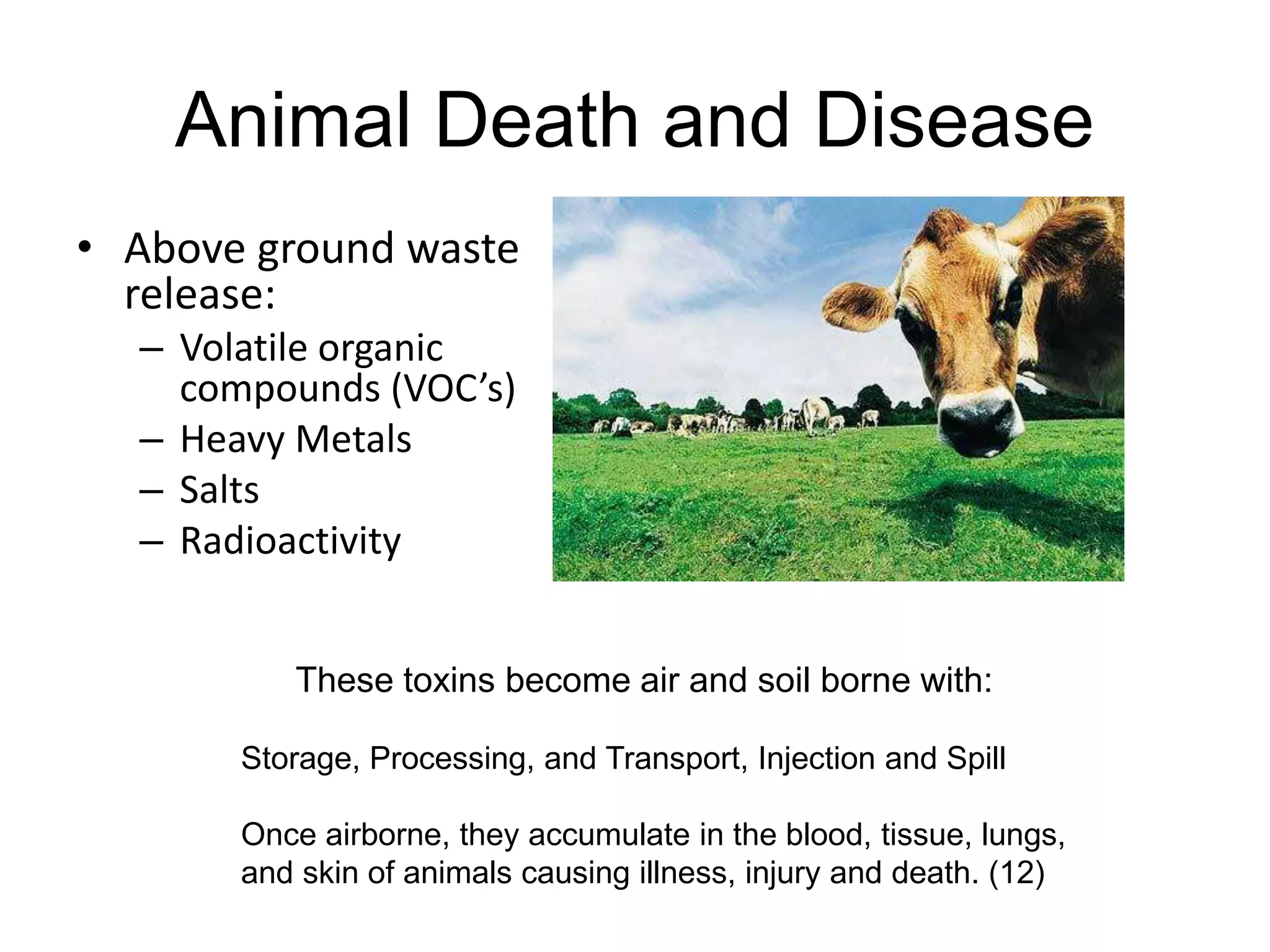
• Above ground waste
release:
– Volatile organic
compounds (VOC’s)
– Heavy Metals
– Salts
– Radioactivity
These toxins become air and soil borne with:
Storage, Processing, and Transport, Injection and Spill
Once airborne, they accumulate in the blood, tissue, lungs,
and skin of animals causing illness, injury and death. (12)
Human Health Concerns
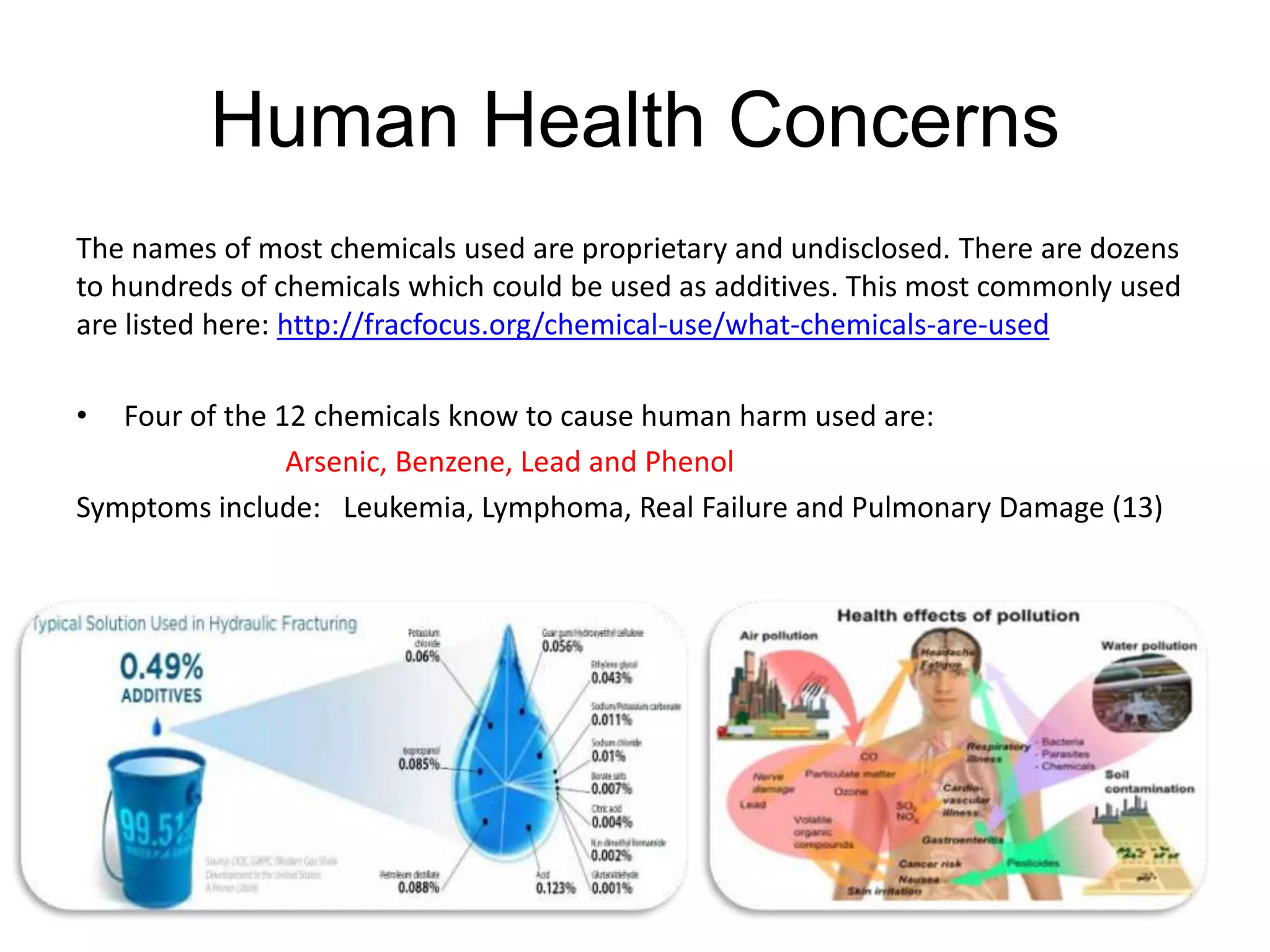
The names of most chemicals used are proprietary and undisclosed. There are dozens
to hundreds of chemicals which could be used as additives. This most commonly used
are listed here: http://fracfocus.org/chemical-use/what-chemicals-are-used
• Four of the 12 chemicals know to cause human harm used are:
Arsenic, Benzene, Lead and Phenol
Symptoms include: Leukemia, Lymphoma, Real Failure and Pulmonary Damage (13)
Earthquakes
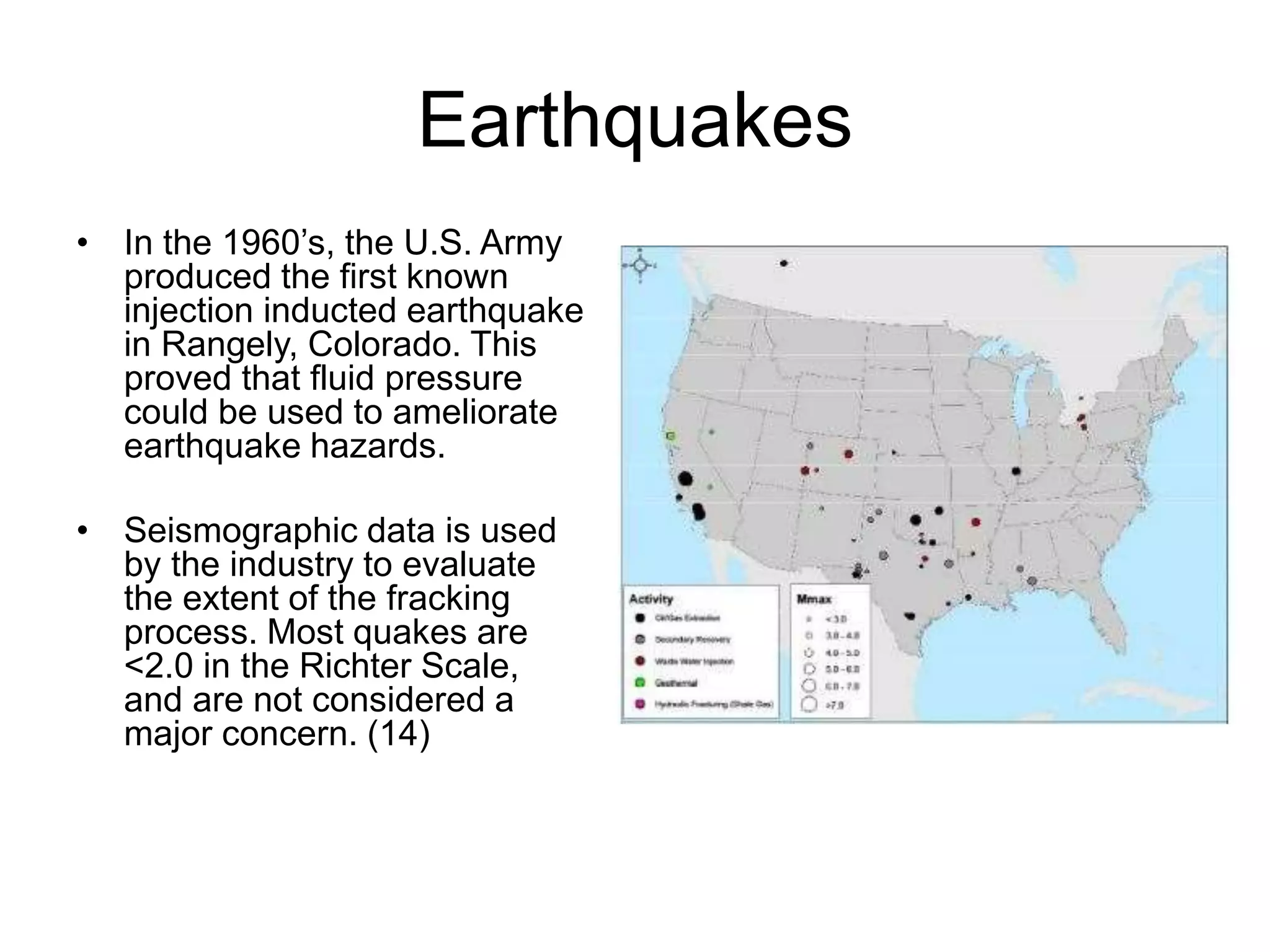
• In the 1960’s, the U.S. Army
produced the first known
injection inducted earthquake
in Rangely, Colorado. This
proved that fluid pressure
could be used to ameliorate
earthquake hazards.
• Seismographic data is used
by the industry to evaluate
the extent of the fracking
process. Most quakes are
<2.0 in the Richter Scale,
and are not considered a
major concern. (14)
Earthquakes II
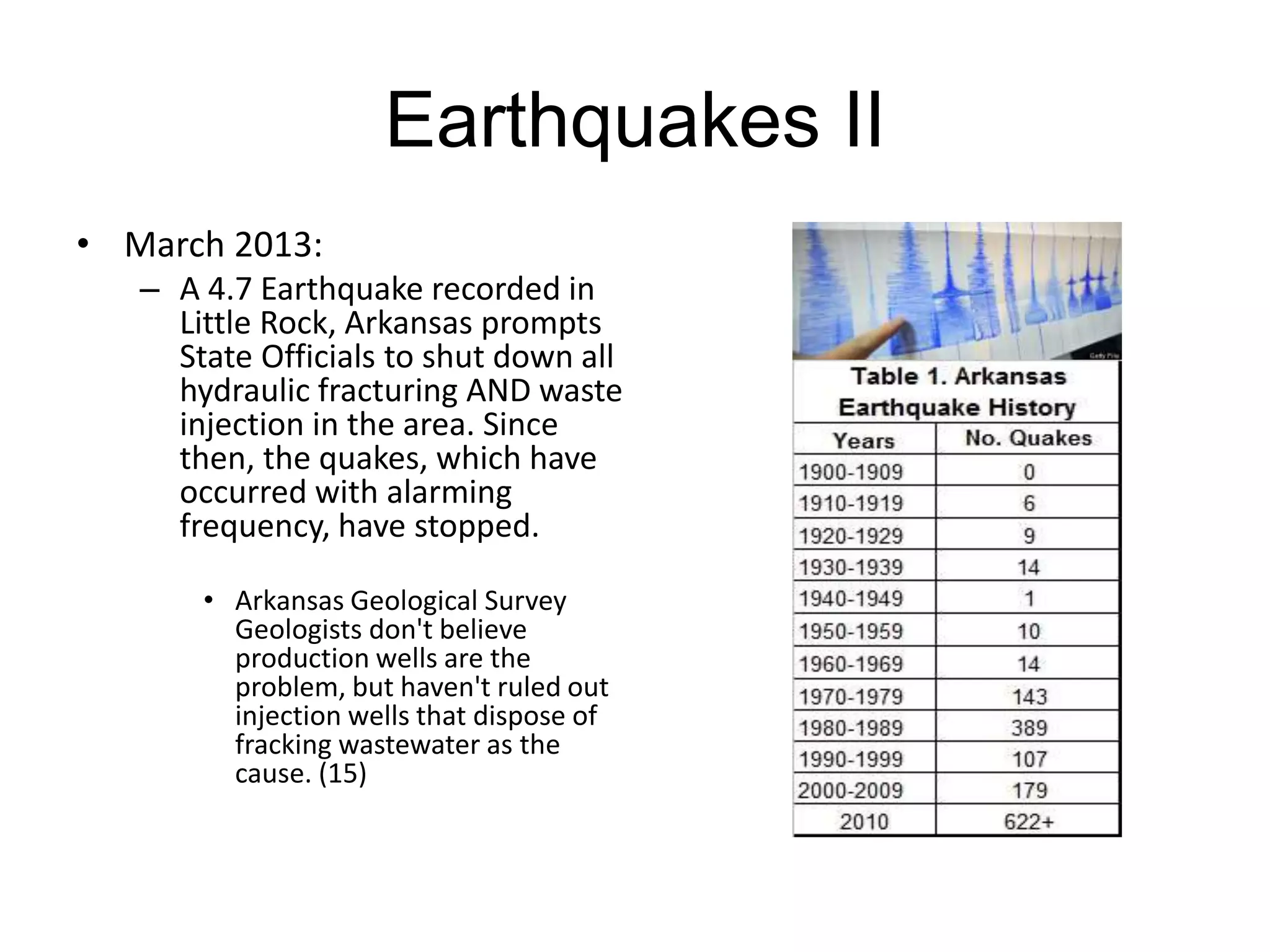
• March 2013:
– A 4.7 Earthquake recorded in
Little Rock, Arkansas prompts
State Officials to shut down all
hydraulic fracturing AND waste
injection in the area. Since
then, the quakes, which have
occurred with alarming
frequency, have stopped.
• Arkansas Geological Survey
Geologists don't believe
production wells are the
problem, but haven't ruled out
injection wells that dispose of
fracking wastewater as the
cause. (15)
Conclusion:
• The dangers of fracking
are apparent. While
the reality of its
usefulness becomes
clear.
– Replacing coal fired
plants with natural
gas:
• Reduces carbon
emissions in the long
run.
• Buys time needed to
develop even cleaner
renewable resources.
References:
1. Charlez, Philippe A. (1997)Rock Mechanics: Petroleum Applications. Paris: Editions Technip. p. 239. ISBN 9782710805861. Retrieved 2012-05-14.
2. Montgomery, Carl T.; Smith, Michael B. (2010-12-105). "Hydraulic fracturing. History of an enduring technology" (PDF). JPT Online (Society of Petroleum Engineers): 26–41. Retrieved 13 May 2012.
3. EPA Report on Coal Bed Fracking, 2004.
4. Gas Resource Institute, 2004.
5. Chemicals Used in Hydraulic Fracturing (Report). Committee on Energy and Commerce U.S. House of Representatives. April 18, 2011. p. ?.
6. Stevens, Paul (August 2012)"The 'Shale Gas Revolution': Developments and Changes". Chatham House. Retrieved 2012-08-15.
7. David Holt, Fixfuel.com, 2013
8. "Natural gas power generation matches coal’s for first time" Steve Gelsi, The Wall Street Journal, July 12, 2012.
9. http://www.eia.doe.gov/cneaf/electricity/page/co2_report/co2report.html
10. IHS Study: America’s Energy Future, Volume 1, 2013
11. Penn State Study, 2012
12. Mary Menadace, R.N. Upstate Medical University, 2013
13. Dr. Sheila Bushkin, Director of CME Program Committee of Physicians, Scientists, and Engineers for Healthy Energy
14. U.S.G.S. Seismological Research Letter: March/April 2013 Vol. 84, No. 2
15. The Huffington Post First Posted: 02/28/11 09:33 AM ET Updated: 05/25/11 07:35 PM ET

Fracking Pros and Cons

  • 1.
  • 2.
    Definition • The hydraulic fracturingof shale rock formations by injecting fluid into cracks to force them further open. • The larger fissures allow more oil and gas to flow out of the formation and into the wellbore. The gas released is methane, also referred to as natural gas.
  • 3.
    History • 1840’s: NaturalGas first used in Fredonia, New York. • 1860’s: Fracturing, using nitroglycerin, used as a method to stimulate shallow, hard rock oil wells. (1) • 1947: Floyd Farris of performs experiments that become the basis of hydraulic fracturing. (2)(6) • 1970’s: The United States government initiated the Eastern Shales Project, a set of dozens of public-private hydraulic fracturing pilot demonstration projects. The Gas Research Institute receives funding from the Federal Energy Regulatory Commission. (3) • 1997 – present: Development of "slickwater fracturing.” This process involves adding chemicals to water to increase the fluid flow, that makes shale gas extraction economical.
  • 4.
    Justification • The problemis conventional hydrocarbon resources, those that flow freely, are quickly diminishing, while non conventional resources, those that are locked in shale bed formations, are only accessible though hydro-fracking. (4)
  • 5.
    Materials Used • Water– 98% – Up to 4.5 million gallons per well. Of which 40-60% is recovered and treated. The rest is lost permanently in the well, unrecoverable, and forever lost. • Sand - 1.5% • Chemicals – 0.5% – In a 2011 report to the U.S. Congress about 750 compounds have been listed as additives for hydro- fracking. The most common chemicals used for hydraulic fracturing are methanol, isopropyl alcohol, 2-butoxethanol, and ethylene glycol. (5) These chemical additives reduce friction, counter rust, and kill microorganisms.
  • 6.
    Process - Overview •A hydraulic fracture is formed by pumping the fracturing fluid into the wellbore at a rate sufficient to increase the pressure down hole to exceed that of the fracture gradient of the rock.
  • 7.
    Process - Drilling •Well is drilled to the desired depth. A protective casing of steel and concrete is installed beyond any source of potable water. • A perforation gun is extended at depth and explosive charges released. This perforates the well casing.
  • 8.
    Process - Injection •The fracturing fluid, water, sand, and chemicals are forced at extreme pressures into the perforations causing the source rock formation to crack. • The sand, referred to as ‘proppants,’ prop the fractures open allowing the gas to flow once the fracking fluid is removed.
  • 9.
  • 10.
    Process – Disposal •The injected solution begins to ‘blowback,’ and recovery of the tainted water begins. • Depending on the specific geologic conditions, up to 40% of the contaminated water is lost within the formation. • The remaining wastewater is too toxic for conventional treatment plants and is either left to evaporate in retaining ponds, or trucked off site to a chemical plant and disposed of in injection wells confined by impermeable strata.
  • 11.
    Pros and Cons For& Against Reduced Dependence on Foreign Oil Clean Fossil Fuel Economic Renewal Future Energy Needs Lower Energy Costs Ground Water Contamination Air Contamination Animal Death and Disease Human Harm Earthquakes
  • 12.
    Reduced Dependence onForeign Oil Reliance on Petroleum Imports has Declined U.S. dependence on imported oil has declined since peaking in 2005. This trend is the result of increased use of domestic biofuels, and strong gains in domestic production of natural gas and the reduced the need for imports. (6)
  • 13.
    Cleaner Fossil Fuel •From 2008 to 2012 U.S. carbon emissions have dropped 20%. The major factor cited is the production and use of domestic natural gas. (7) • Natural gas emits: 1. 50% < CO2 than coal 2. 33% < CO2 than oil 3. 85% < CO than either 4. A fraction of the amount of SO2, and particulates. Especially respirable suspended particles (RSP’s) Those with a diameter of 10 micrometers or less.
  • 14.
    Lower Energy Costs •25% of the energy consumed in the U.S. natural gas • Natural gas costs 82% less than either electricity or propane • Coal fired electrical generation plants can be converted to use NG. (8)
  • 15.
    Future Energy Needs •Nearly ½ of the electricity in the U.S. is coal fire generated. • The average generation of a coal plant is 1.3 million megawatt-hours. This equates to roughly 2.6 billion pounds of CO2. (9) There are 1,522 coal generators in the U.S. • The replacement /conversion of coal generated plants could reduce operating cost by 80%, while sequestering nearly 2 trillion pounds of anthropogenic green house gas.
  • 16.
    Economic Benefit Employment • Currentlythere are: – 1.7 million jobs in the NG field • Projected increase: – 3 million jobs by 2020 – 3.5 million by 2035 Tax Revenue • Fiscal Year 2011-2012 in Pennsylvania alone: – $2.6 billion in tax receipts • Projected Federal, State and Local tax receipts by 2035 – $5.1 trillion
  • 17.
    Groundwater Contamination • Belowground contamination is due to poorly constructed cement casings. • Above ground contaminations are the result of improperly lined evaporation ponds, and direct spills to the soil.
  • 18.
    Air Contamination • Onsite emissions from trucks associated with water transport. – 4.5 million gallons per well. Truck carries 8000 gallons. There are 1,125 trips per well. • Drilling can release benzene and methane during a burst release in the initial blowback phase. • The E.P.A. proposed the first rules concerning air pollution in July of 2011. – Mandates the use of ‘Green Completion Systems’ to capture initial bursts. Flaring, the burning of captured blowback, is still allowed. This reduces toxins, but is wasteful.
  • 19.
    Animal Death andDisease • Above ground waste release: – Volatile organic compounds (VOC’s) – Heavy Metals – Salts – Radioactivity These toxins become air and soil borne with: Storage, Processing, and Transport, Injection and Spill Once airborne, they accumulate in the blood, tissue, lungs, and skin of animals causing illness, injury and death. (12)
  • 20.
    Human Health Concerns Thenames of most chemicals used are proprietary and undisclosed. There are dozens to hundreds of chemicals which could be used as additives. This most commonly used are listed here: http://fracfocus.org/chemical-use/what-chemicals-are-used • Four of the 12 chemicals know to cause human harm used are: Arsenic, Benzene, Lead and Phenol Symptoms include: Leukemia, Lymphoma, Real Failure and Pulmonary Damage (13)
  • 21.
    Earthquakes • In the1960’s, the U.S. Army produced the first known injection inducted earthquake in Rangely, Colorado. This proved that fluid pressure could be used to ameliorate earthquake hazards. • Seismographic data is used by the industry to evaluate the extent of the fracking process. Most quakes are <2.0 in the Richter Scale, and are not considered a major concern. (14)
  • 22.
    Earthquakes II • March2013: – A 4.7 Earthquake recorded in Little Rock, Arkansas prompts State Officials to shut down all hydraulic fracturing AND waste injection in the area. Since then, the quakes, which have occurred with alarming frequency, have stopped. • Arkansas Geological Survey Geologists don't believe production wells are the problem, but haven't ruled out injection wells that dispose of fracking wastewater as the cause. (15)
  • 23.
    Conclusion: • The dangersof fracking are apparent. While the reality of its usefulness becomes clear. – Replacing coal fired plants with natural gas: • Reduces carbon emissions in the long run. • Buys time needed to develop even cleaner renewable resources.
  • 24.
    References: 1. Charlez, PhilippeA. (1997)Rock Mechanics: Petroleum Applications. Paris: Editions Technip. p. 239. ISBN 9782710805861. Retrieved 2012-05-14. 2. Montgomery, Carl T.; Smith, Michael B. (2010-12-105). "Hydraulic fracturing. History of an enduring technology" (PDF). JPT Online (Society of Petroleum Engineers): 26–41. Retrieved 13 May 2012. 3. EPA Report on Coal Bed Fracking, 2004. 4. Gas Resource Institute, 2004. 5. Chemicals Used in Hydraulic Fracturing (Report). Committee on Energy and Commerce U.S. House of Representatives. April 18, 2011. p. ?. 6. Stevens, Paul (August 2012)"The 'Shale Gas Revolution': Developments and Changes". Chatham House. Retrieved 2012-08-15. 7. David Holt, Fixfuel.com, 2013 8. "Natural gas power generation matches coal’s for first time" Steve Gelsi, The Wall Street Journal, July 12, 2012. 9. http://www.eia.doe.gov/cneaf/electricity/page/co2_report/co2report.html 10. IHS Study: America’s Energy Future, Volume 1, 2013 11. Penn State Study, 2012 12. Mary Menadace, R.N. Upstate Medical University, 2013 13. Dr. Sheila Bushkin, Director of CME Program Committee of Physicians, Scientists, and Engineers for Healthy Energy 14. U.S.G.S. Seismological Research Letter: March/April 2013 Vol. 84, No. 2 15. The Huffington Post First Posted: 02/28/11 09:33 AM ET Updated: 05/25/11 07:35 PM ET

Editor's Notes

  • #5 4. Gas Resource Institute, 2004.
  • #6 5. Chemicals Used in Hydraulic Fracturing (Report). Committee on Energy and Commerce U.S. House of Representatives. April 18, 2011. p. ?.
  • #13 6. U.S. Energy Information Administration, This Week in Petroleum, May 25, 2011.
  • #14 7. David Holt, Fixfuel.com, 2013
  • #15 8. "Natural gas power generation matches coal’s for first time" Steve Gelsi, The Wall Street Journal, July 12, 2012.
  • #16 9. http://www.eia.doe.gov/cneaf/electricity/page/co2_report/co2report.html#electric
  • #17 9. http://www.eia.doe.gov/cneaf/electricity/page/co2_report/co2report.html#electric 10. IHS Study: America’s Energy Future, Volume 1, 2013 11. Penn State Study, 2012 12. Mary Menadace, R.N. Upstate Medical University, 2013 13. Dr. Sheila Bushkin, Director of CME Program Committee of Physicians, Scientists, and Engineers for Healthy Energy 14. U.S.G.S. Seismological Research Letter: March/April 2013 Vol. 84, No. 2 15. The Huffington Post   First Posted: 02/28/11 09:33 AM ET Updated: 05/25/11 07:35 PM ET
  • #20 12. Mary Menadace, R.N. Upstate Medical University, 2013
  • #21 13. Dr. Sheila Bushkin, Director of CME Program Committee of Physicians, Scientists, and Engineers for Healthy Energy
  • #22 14. U.S.G.S. Seismological Research Letter: March/April 2013 Vol. 84, No. 2
  • #23 15. The Huffington Post   First Posted: 02/28/11 09:33 AM ET Updated: 05/25/11 07:35 PM ET