Hydraulic Fracturing
Myths and Maneuvers
Presented by
Cindy Bishop
1
August 26, 2012
Hydraulic Fracturing:
Myths and Maneuvers
I. Hydraulic Fracturing 101
1. What is it?
2. Why do we care?
3. What’s the problem?
II. Regulations – Who’s on First?
1. Texas
2. EPA
III. Myths (Studies)
IV. Maneuvers
1. US v. Range Production Company
2. Maryland v. Chesapeake Energy Corp.
3. Town of Dish v. Atmos Energy, et al.
2
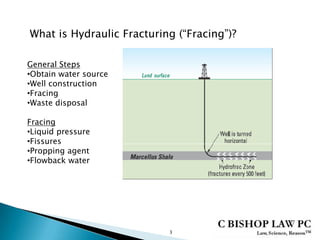
General Steps
•Obtain water source
•Well construction
•Fracing
•Waste disposal
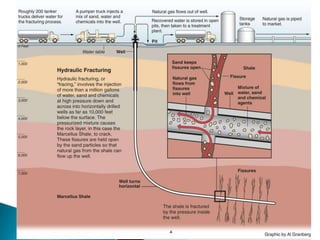
Fracing
•Liquid pressure
•Fissures
•Propping agent
•Flowback water
3
What is Hydraulic Fracturing (“Fracing”)?
4
5
6
•Natural gas heats ½ of US homes
•Natural gas fuels more than 20% of
annual electricity production
•Natural gas use will increase as coal
plants are retired
•20% of U.S. gas supply will be from
shale gas by 2020
Why do we care?
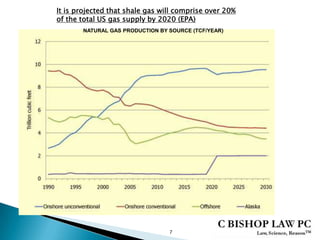
NATURAL GAS PRODUCTION BY SOURCE (TCF/YEAR)
It is projected that shale gas will comprise over 20%
of the total US gas supply by 2020 (EPA)
7
•Since 2003 15,675 gas wells drilled
and fracked in North Texas
•2,000 wells in Fort Worth
8
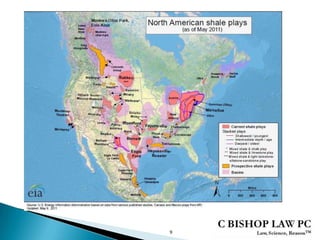
Effect Locally
9
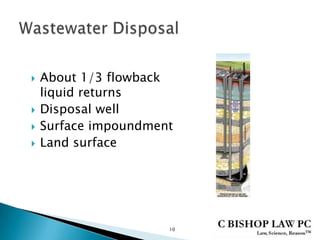
 About 1/3 flowback
liquid returns
 Disposal well
 Surface impoundment
 Land surface
10
11
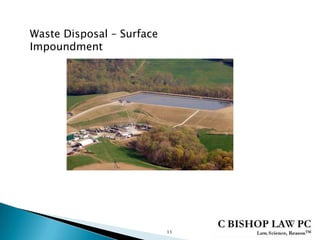
Waste Disposal – Surface
Impoundment
12
WHAT’S THE PROBLEM?

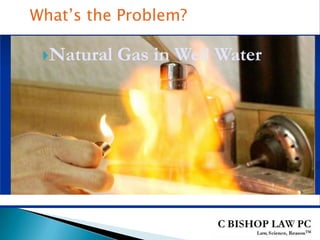
Natural Gas in Well Water
What’s the Problem?
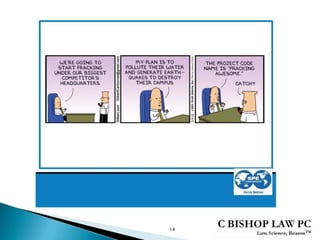
14
15
•Water for fracing
•Fracing
•Chemicals in frac water
•Methane release
•Disposal of flowback water
•Air emissions
•Noise, light, odor
•Earthquakes
What’s the Problem?
Regulating Fracing
Who’s on First?
16
 The Texas Railroad Commission has
primary jurisdiction over oil and gas
drilling.
 Tex. Nat. Res. Code 81.051; 16 Tex. Admin Code 3.5
 Texas Commission on Environmental
Quality has primary jurisdiction over
conservation of natural resources and
protection of the environment
 30 Tex. Admin Code 5.012
17
• Well Drilling/re-completion
• Disposal wells
• Pits for storage of oil field fluids or oil
and gas wastes.
• Spills associated with production
• Oil and Gas Waste
• Applicable Regs: 16 Tex. Admin. Code 3.8 (Water Protection); 3.13
(Casing, Cementing, Drilling, and Completion Requirements); RRC
Rule 38; 40 CFR 261.4(a)(12)
• Surface casing program (eff. 9/1/11)
18
 Disclosure of Fracing Chemicals (16 TAC
 § 3.29)
◦ Applies to fracturing operations where RRC has issued
an initial drilling permit on or after Feb. 1, 2012
◦ Supplier/service company to operator – 15 days after
completion of fracing
◦ Operator to RRC – disclose into online database on or
before submission of well completion report to RRC
 (30 days after well completion)
19
 Disclosure of Fracing Chemicals (16 TAC
 § 3.29)
◦ Disclose:
 Volume of water used
 Each fracing chemical
 Concentrations
 Suppliers
◦ Exception for trade secrets
20
 Surface water use
 Spills of hazardous substances
 Nuisance Odor Complaints
 Air Emissions
◦ Permit by Rule (30 TAC §106.352)
 New PBR: applies to Barnett Shale operations constructed
or modified after April 1, 2011
◦ Existing operations in Barnett Shale claiming old PBR
must notify TCEQ by Jan. 1, 2013
21
 Memorandum of Understanding:
16 TAC § 3.30
22
 Wastewater discharges
 Stormwater
 Underground injection wells involving diesel
 TSCA § 8(c)
 NSPS/NESHAP revisions (final rule 8/16/12)
23
 Energy Policy Act of 2005 specifically
excludes hydraulic fracturing operations.
◦ Exemption for: “The underground injection of
fluids or propping agents (other than diesel
fuels) pursuant to hydraulic fracturing
operations related to oil, gas, or geothermal
production activities.”
 42 U.S.C. 300h(d)(1)(B)(ii).
24
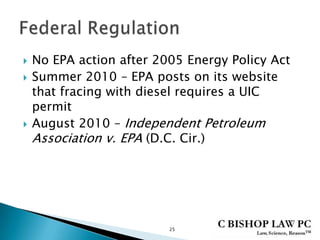
 No EPA action after 2005 Energy Policy Act
 Summer 2010 – EPA posts on its website
that fracing with diesel requires a UIC
permit
 August 2010 – Independent Petroleum
Association v. EPA (D.C. Cir.)
25
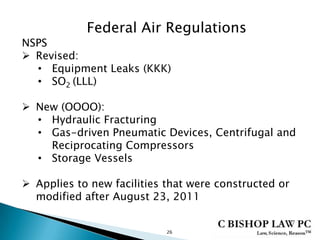
Federal Air Regulations
NSPS
 Revised:
• Equipment Leaks (KKK)
• SO2 (LLL)
 New (OOOO):
• Hydraulic Fracturing
• Gas-driven Pneumatic Devices, Centrifugal and
Reciprocating Compressors
• Storage Vessels
 Applies to new facilities that were constructed or
modified after August 23, 2011
26
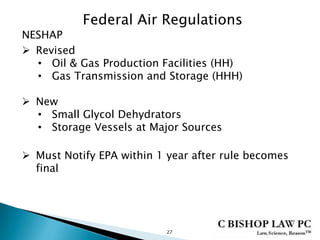
Federal Air Regulations
NESHAP
 Revised
• Oil & Gas Production Facilities (HH)
• Gas Transmission and Storage (HHH)
 New
• Small Glycol Dehydrators
• Storage Vessels at Major Sources
 Must Notify EPA within 1 year after rule becomes
final
27
28
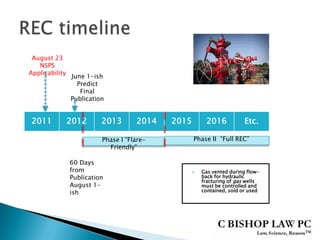
August 23
NSPS
Applicability
June 1-ish
Predict
Final
Publication
Phase I “Flare-
Friendly”
2011 2012 2013 2014 2015 2016 Etc.
Phase II “Full REC”
60 Days
from
Publication
August 1-
ish
 Gas vented during flow-
back for hydraulic
fracturing of gas wells
must be controlled and
contained, sold or used
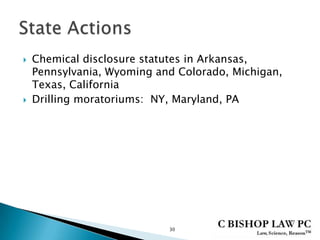
 Chemical disclosure statutes in Arkansas,
Pennsylvania, Wyoming and Colorado, Michigan,
Texas, California
 Drilling moratoriums: NY, Maryland, PA
30
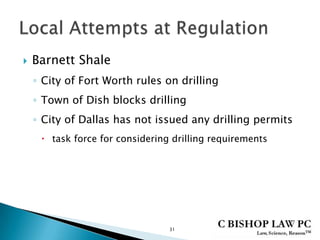
 Barnett Shale
◦ City of Fort Worth rules on drilling
◦ Town of Dish blocks drilling
◦ City of Dallas has not issued any drilling permits
 task force for considering drilling requirements
31
32
 Sampled 68 drinking water wells in PA
and NY
 Methane concentrations were 17 times
higher in water wells near active vs.
inactive wells
 Methane was thermogenic
 “Methane Contamination of Drinking
Water Accompanying Gas Well Drilling
and Hydraulic Facturing”
33
 85% of wells sampled contained
thermogenic methane – regardless of
location
 No fracing fluid detected in shallow
water
 Water properties consistent with
historical data
 Methane likely did not come from actual
fracing
34
 Methane is a GHG
 Fracing has a higher carbon footprint than
coal
 3.6 to 7.9% escapes in fracing
 1.7 to 6% escapes in regular drilling
 “Hogwash”
35
 January 6, 2012 New Cornell Study
 Prior study was “seriously flawed”
 Fracing has a carbon footprint that is half to
a third that of coal
36
 2012 - EPA proposed year to release
interim results
 2012 to 2014 - additional results to be
released as particular investigations
completed
 2014 - EPA proposed year to release
another report
37
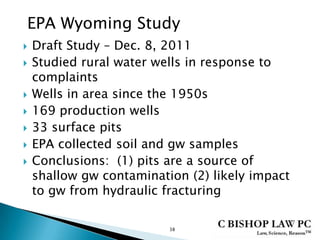
 Draft Study – Dec. 8, 2011
 Studied rural water wells in response to
complaints
 Wells in area since the 1950s
 169 production wells
 33 surface pits
 EPA collected soil and gw samples
 Conclusions: (1) pits are a source of
shallow gw contamination (2) likely impact
to gw from hydraulic fracturing
38
EPA Wyoming Study
 Draft Study – no peer review
 Area has a shallow gas field
 EPA drilled monitoring wells into a gas
reservoir and found natural gas – duh
 Results from water well tests do not exceed
drinking water standards
 Pits are already in remediation program
 May 2012 - An independent review concluded
federal regulators had insufficient data to
suggest the natural gas drilling technique
allowed methane to contaminate groundwater
39
EPA Wyoming Study - Problems
 UT Energy Institute
 Groundwater study in Barnett, Haynesville
and Marcellus formations
 Findings – no direct link between fracing
and groundwater contamination
 Undergoing independent review
40
UT Study
 Austin American-Statesman :
 “Study links fracking and earthquakes”
 Lubbock Avalanche Journal:
 “Study finds no relation between fracking,
earthquakes”
41
UT Study – Part 2
Earthquakes (August 2012)
LITIGATION
42
• 12/7/10 – EPA issued Emergency
Administrative Order against Range under
SDWA
• Methane in 2 drinking water wells in Parker
County “likely” due to fracing from Range
wells in the area
43
 4/19/11 – Chesapeake well blowout
releases flowback water onto
neighboring farmlands and into nearby
creek
 4/29/11 – Maryland files Notice of Intent
to Sue under RCRA and CWA
◦ Injunctive relief
◦ Attorneys’ fees
 5/17/11 – Chesapeake Settles with PA
for $1 million
44
 February 2011, Town of Dish, Texas sued
six natural gas pipeline companies that own
and operate compressor stations near the
town for releasing harmful substances into
the air
45
 Allegations of Drinking Water
Contamination
◦ 4 cases in TX
46
 Lone Pine Order
◦ Expert Opinion on Causation
◦ Data Showing Contamination
◦ Medical Records
◦ Evidence of Diminution in Value
47
 Where’s the science?
 Evolution of Regulations/Laws
48
Hydraulic Fracturing
Myths and Maneuvers
Presented by
Cindy Bishop
49
214-893-5646
cbishop@cbishoplaw.com
www.cbishoplaw.com

Hydraulic Fracturing - Myths and Maneuvers

  • 1.
    Hydraulic Fracturing Myths andManeuvers Presented by Cindy Bishop 1 August 26, 2012
  • 2.
    Hydraulic Fracturing: Myths andManeuvers I. Hydraulic Fracturing 101 1. What is it? 2. Why do we care? 3. What’s the problem? II. Regulations – Who’s on First? 1. Texas 2. EPA III. Myths (Studies) IV. Maneuvers 1. US v. Range Production Company 2. Maryland v. Chesapeake Energy Corp. 3. Town of Dish v. Atmos Energy, et al. 2
  • 3.
    General Steps •Obtain watersource •Well construction •Fracing •Waste disposal Fracing •Liquid pressure •Fissures •Propping agent •Flowback water 3 What is Hydraulic Fracturing (“Fracing”)?
  • 4.
  • 5.
  • 6.
    6 •Natural gas heats½ of US homes •Natural gas fuels more than 20% of annual electricity production •Natural gas use will increase as coal plants are retired •20% of U.S. gas supply will be from shale gas by 2020 Why do we care?
  • 7.
    NATURAL GAS PRODUCTIONBY SOURCE (TCF/YEAR) It is projected that shale gas will comprise over 20% of the total US gas supply by 2020 (EPA) 7
  • 8.
    •Since 2003 15,675gas wells drilled and fracked in North Texas •2,000 wells in Fort Worth 8 Effect Locally
  • 9.
  • 10.
     About 1/3flowback liquid returns  Disposal well  Surface impoundment  Land surface 10
  • 11.
    11 Waste Disposal –Surface Impoundment
  • 12.
  • 13.
     Natural Gas inWell Water What’s the Problem?
  • 14.
  • 15.
    15 •Water for fracing •Fracing •Chemicalsin frac water •Methane release •Disposal of flowback water •Air emissions •Noise, light, odor •Earthquakes What’s the Problem?
  • 16.
  • 17.
     The TexasRailroad Commission has primary jurisdiction over oil and gas drilling.  Tex. Nat. Res. Code 81.051; 16 Tex. Admin Code 3.5  Texas Commission on Environmental Quality has primary jurisdiction over conservation of natural resources and protection of the environment  30 Tex. Admin Code 5.012 17
  • 18.
    • Well Drilling/re-completion •Disposal wells • Pits for storage of oil field fluids or oil and gas wastes. • Spills associated with production • Oil and Gas Waste • Applicable Regs: 16 Tex. Admin. Code 3.8 (Water Protection); 3.13 (Casing, Cementing, Drilling, and Completion Requirements); RRC Rule 38; 40 CFR 261.4(a)(12) • Surface casing program (eff. 9/1/11) 18
  • 19.
     Disclosure ofFracing Chemicals (16 TAC  § 3.29) ◦ Applies to fracturing operations where RRC has issued an initial drilling permit on or after Feb. 1, 2012 ◦ Supplier/service company to operator – 15 days after completion of fracing ◦ Operator to RRC – disclose into online database on or before submission of well completion report to RRC  (30 days after well completion) 19
  • 20.
     Disclosure ofFracing Chemicals (16 TAC  § 3.29) ◦ Disclose:  Volume of water used  Each fracing chemical  Concentrations  Suppliers ◦ Exception for trade secrets 20
  • 21.
     Surface wateruse  Spills of hazardous substances  Nuisance Odor Complaints  Air Emissions ◦ Permit by Rule (30 TAC §106.352)  New PBR: applies to Barnett Shale operations constructed or modified after April 1, 2011 ◦ Existing operations in Barnett Shale claiming old PBR must notify TCEQ by Jan. 1, 2013 21
  • 22.
     Memorandum ofUnderstanding: 16 TAC § 3.30 22
  • 23.
     Wastewater discharges Stormwater  Underground injection wells involving diesel  TSCA § 8(c)  NSPS/NESHAP revisions (final rule 8/16/12) 23
  • 24.
     Energy PolicyAct of 2005 specifically excludes hydraulic fracturing operations. ◦ Exemption for: “The underground injection of fluids or propping agents (other than diesel fuels) pursuant to hydraulic fracturing operations related to oil, gas, or geothermal production activities.”  42 U.S.C. 300h(d)(1)(B)(ii). 24
  • 25.
     No EPAaction after 2005 Energy Policy Act  Summer 2010 – EPA posts on its website that fracing with diesel requires a UIC permit  August 2010 – Independent Petroleum Association v. EPA (D.C. Cir.) 25
  • 26.
    Federal Air Regulations NSPS Revised: • Equipment Leaks (KKK) • SO2 (LLL)  New (OOOO): • Hydraulic Fracturing • Gas-driven Pneumatic Devices, Centrifugal and Reciprocating Compressors • Storage Vessels  Applies to new facilities that were constructed or modified after August 23, 2011 26
  • 27.
    Federal Air Regulations NESHAP Revised • Oil & Gas Production Facilities (HH) • Gas Transmission and Storage (HHH)  New • Small Glycol Dehydrators • Storage Vessels at Major Sources  Must Notify EPA within 1 year after rule becomes final 27
  • 28.
  • 29.
    August 23 NSPS Applicability June 1-ish Predict Final Publication PhaseI “Flare- Friendly” 2011 2012 2013 2014 2015 2016 Etc. Phase II “Full REC” 60 Days from Publication August 1- ish  Gas vented during flow- back for hydraulic fracturing of gas wells must be controlled and contained, sold or used
  • 30.
     Chemical disclosurestatutes in Arkansas, Pennsylvania, Wyoming and Colorado, Michigan, Texas, California  Drilling moratoriums: NY, Maryland, PA 30
  • 31.
     Barnett Shale ◦City of Fort Worth rules on drilling ◦ Town of Dish blocks drilling ◦ City of Dallas has not issued any drilling permits  task force for considering drilling requirements 31
  • 32.
  • 33.
     Sampled 68drinking water wells in PA and NY  Methane concentrations were 17 times higher in water wells near active vs. inactive wells  Methane was thermogenic  “Methane Contamination of Drinking Water Accompanying Gas Well Drilling and Hydraulic Facturing” 33
  • 34.
     85% ofwells sampled contained thermogenic methane – regardless of location  No fracing fluid detected in shallow water  Water properties consistent with historical data  Methane likely did not come from actual fracing 34
  • 35.
     Methane isa GHG  Fracing has a higher carbon footprint than coal  3.6 to 7.9% escapes in fracing  1.7 to 6% escapes in regular drilling  “Hogwash” 35
  • 36.
     January 6,2012 New Cornell Study  Prior study was “seriously flawed”  Fracing has a carbon footprint that is half to a third that of coal 36
  • 37.
     2012 -EPA proposed year to release interim results  2012 to 2014 - additional results to be released as particular investigations completed  2014 - EPA proposed year to release another report 37
  • 38.
     Draft Study– Dec. 8, 2011  Studied rural water wells in response to complaints  Wells in area since the 1950s  169 production wells  33 surface pits  EPA collected soil and gw samples  Conclusions: (1) pits are a source of shallow gw contamination (2) likely impact to gw from hydraulic fracturing 38 EPA Wyoming Study
  • 39.
     Draft Study– no peer review  Area has a shallow gas field  EPA drilled monitoring wells into a gas reservoir and found natural gas – duh  Results from water well tests do not exceed drinking water standards  Pits are already in remediation program  May 2012 - An independent review concluded federal regulators had insufficient data to suggest the natural gas drilling technique allowed methane to contaminate groundwater 39 EPA Wyoming Study - Problems
  • 40.
     UT EnergyInstitute  Groundwater study in Barnett, Haynesville and Marcellus formations  Findings – no direct link between fracing and groundwater contamination  Undergoing independent review 40 UT Study
  • 41.
     Austin American-Statesman:  “Study links fracking and earthquakes”  Lubbock Avalanche Journal:  “Study finds no relation between fracking, earthquakes” 41 UT Study – Part 2 Earthquakes (August 2012)
  • 42.
  • 43.
    • 12/7/10 –EPA issued Emergency Administrative Order against Range under SDWA • Methane in 2 drinking water wells in Parker County “likely” due to fracing from Range wells in the area 43
  • 44.
     4/19/11 –Chesapeake well blowout releases flowback water onto neighboring farmlands and into nearby creek  4/29/11 – Maryland files Notice of Intent to Sue under RCRA and CWA ◦ Injunctive relief ◦ Attorneys’ fees  5/17/11 – Chesapeake Settles with PA for $1 million 44
  • 45.
     February 2011,Town of Dish, Texas sued six natural gas pipeline companies that own and operate compressor stations near the town for releasing harmful substances into the air 45
  • 46.
     Allegations ofDrinking Water Contamination ◦ 4 cases in TX 46
  • 47.
     Lone PineOrder ◦ Expert Opinion on Causation ◦ Data Showing Contamination ◦ Medical Records ◦ Evidence of Diminution in Value 47
  • 48.
     Where’s thescience?  Evolution of Regulations/Laws 48
  • 49.
    Hydraulic Fracturing Myths andManeuvers Presented by Cindy Bishop 49 214-893-5646 cbishop@cbishoplaw.com www.cbishoplaw.com