CASE STUDY: Haiti vs. Chile quake comparison

CHILE                                                                                         HAITI

Date and Magnitude:                                               Date and Magnitude:
   3:34 a.m., Sat. Feb. 27th.                                         Tues. Jan. 12th.
   8.8, epicentre 35km deep.                                          7.0 (with 52 aftershocks, all greater than
                                                                      magnitude 4), epicentre 13km deep.
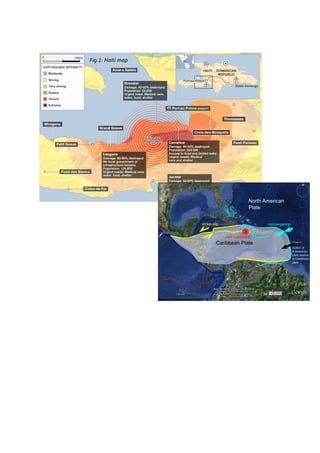
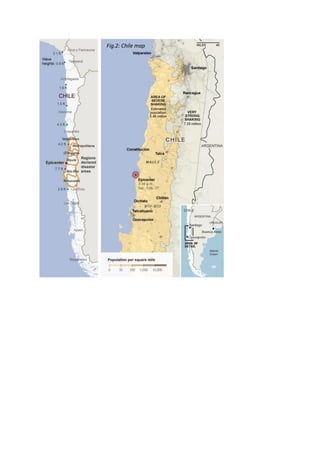
Location: (Fig.2)                                                 Location: (Fig.1)
    Chile is an HIDC with the lowest birth rate in South              Epicentre near the town of Léogâne,
    America and a GDP per capita of almost $15,000.                   approximately 25 km west of Port-au-
    World’s largest copper producer. Majority of industry             Prince, Haiti's capital.
    based in north of country.                                        Haiti is a poor LEDC with little
    Booming wine, fruit and forestry industries. Economic             infrastructure.
    growth of around 5% per annum before quake.
    90% of pop. lives in urban areas.
Geology:                                                          Geology:
    Chile lies on Pacific Rim’s ‘ring of fire’ – NAZCA PLATE is      On the ENRIQUILLO-PLANTAIN GARDEN
    subducting beneath the SOUTH AMERICAN PLATE at                   fault zone (EDPZ) is a system of coaxial
    80mm per year. Gives rise to the Andes Mountains. Plate          left lateral-moving strike slip faults
    boundary marked by a trench 100km offshore.                      which runs along the southern side of
    Epicentre deep + far from population centres.                    the island of Hispaniola, where the
                                                                     Dominican Republic and Haiti are
                                                                     located.
                                                                     The quake occurred in the vicinity of the
                                                                     northern boundary where the
                                                                     CARIBBEAN PLATE shifts eastwards by
                                                                     about 20mm per year in relation to the
                                                                     NORTH AMERICAN plate. The strike-slip
                                                                     fault system in the region has two
                                                                     branches in Haiti, the Septentrional-
                                                                     Orient fault in the north and the
                                                                     Enriquillo-Plaintain Garden fault in the
                                                                     south; both its location and focal
                                                                     mechanism suggest that the January
                                                                     2010 quake was caused by a rupture of
                                                                     the Enriquillo-Plaintain Garden fault,
                                                                     which had been locked for 250 years,
                                                                     gathering stress.
Preparedness:                                                     Preparedness:
   Quake-prone region, so preparedness high.                         The Pacific Tsunami Warning Center
   Quake awareness among public.                                     issued a tsunami warning immediately
   Building codes require shake-resistant construction and           after the initial quake, but quickly
   rapid emergency response systems.                                 cancelled it
   Country withstood the global economic recession very well
   due to policy of saving profits from soaring copper prices.
   $16bn still available, which new president Sebastián
   Piñera can use to rebuild roads, bridges, ports and the
   1.5m homes affected.
Effects:                                                         Effects:
    350 deaths in coastal town of Constitución.                      Confirmed Death toll: 230,000.
    400 killed elsewhere.                                            Injuries: 300,000.
    500,000 houses made uninhabitable.                               All hospitals in the capital were
    Estimated $15-30bn of damage – up to 15% of Chile’s GDP.         destroyed as well as all air, sea and land
    Looting in Concepción, Chile’s second biggest city and the       transport facilities. Three ‘Medecins
    one closest to the epicentre.                                    Sans Frontiers’ medical facilities were
    25 boats washed into Talcahuano by powerful waves                damaged, with one completely
    caused by the quake.                                             destroyed. Petionville hospital also
    Bridges + roads destroyed. Telecommunications +                  destroyed as well as St. Michel District
    electricity down.                                                Hospital in Jacmel (largest referral
    Most of Chile’s copper mines, its biggest industry, were         hospital in South-East Haiti).
    unaffected – mines located in north. However, two mines          Control tower at Toussaint L’Ouverture
    which together account for 1/5th of Chile’s copper exports       International Airport damaged.
    were temporarily closed  spike in global copper prices.         Debris blocked roads including main
    Challenges for presidential successor Sebastián Piñera,          road between Port-au-Prince and
    who will replace Michelle Bachelet on March 11th.                Jacamel.
    In the long run, it could be positive for the country’s          Communications infrastructure
    development because the rebuilding effort “will require          destroyed – public telephones not
    large investment and demand for capital goods and that           available + country’s two main mobile
    has a dynamising effect”.                                        operators Digicel and Comcel Haiti,
                                                                     reported loss of services. Most radio
                                                                     stations also went off-air.
                                                                     250,000 residences and 30,000
                                                                     commercial buildings severely damaged
                                                                     and need to be demolished.
                                                                     Léogâne – 90% of town buildings
                                                                     destroyed.
                                                                     Palace of Justice, National Assembly, The
                                                                     Supreme Court and Port-au-Prince
                                                                     Cathedral either damaged or destroyed.
                                                                     Education system “totally collapsed”
                                                                     (Minister for education). Three main
                                                                     universities effected, as well as nursing
                                                                     school in the capital and country’s
                                                                     primary midwifery school.
                                                                     World Bank and UN offices destroyed.
                                                                     Citibank building destroyed.
Short-term responses:                                            Short-term responses:
   Govt. vows to deliver aid quickly to worst-hit areas +            President Préval and government
   reassign budget funds to help rebuild. $16bn from windfall        ministers used police headquarters near
   profits of copper, the main export, could quickly unlock          the Toussaint L'Ouverture International
   budget funds.                                                     Airport as their new base of operations,
   Firefighters comb rubble for survivors.                           although their effectiveness was
   Army sending 10,000 troops. Curfew imposed to prevent             extremely limited; several
   looting. Fuel supplies rationed.                                  parliamentarians were still trapped in
   Communications in Santiago, the capital, were largely             the Presidential Palace, and offices and
   restored within 4 days.                                           records had been destroyed.
   President Bachelet’s govt. has been sluggish in its               Appeals for humanitarian aid made.
   response – quake on Saturday but state of emergency not           Dominican Republic, first country to
   declared until Sunday afternoon.                                  give aid to Haiti. Dominican Republic
hospitals made available. Dominican
Institute of Telecommunications
(Indotel) helped with the restoration of
some telephone services. The Dominican
Red Cross coordinated early medical
relief in conjunction with the
International Red Cross.
International agencies also gave aid, and
provided medical support e.g. ICE-SAR
(Iceland).
The International Charter on Space and
Major Disasters was activated, allowing
satellite imagery of affected regions to
be shared with rescue and aid
organisations.
The American Red Cross set a record for
mobile donations, raising US$7 million in
24 hours when they allowed people to
send US$10 donations by text messages
Haitians were granted Temporary
Protected Status in the U.S.
Several orphanages were destroyed in
the earthquake. After the process for
the adoption of 400 children by families
in the U.S. and the Netherlands was
expedited.
The U.S. military took charge of the
national airport and certain private aid
agencies had issues landing and hence,
providing supplies. Acknowledged the
non-governmental organisations'
complaints concerning flight-operations
bias and promised improvement while
noting that up to 17th January, 600
emergency flights had landed and 50
were diverted; by the first weekend of
disaster operations diversions had been
reduced to three on Saturday and two
on Sunday.
Traffic congestion and blocked roads
hampered relief efforts.
Over the first weekend 130,000 food
packets and 70,000 water containers
were distributed to Haitians, as safe
landing areas and distribution centres
such as golf courses were secured.
Fig.1: Haiti map
Fig.2: Chile map

Chile Vs Haiti Quake Comparison

  • 1.
    CASE STUDY: Haitivs. Chile quake comparison CHILE HAITI Date and Magnitude: Date and Magnitude: 3:34 a.m., Sat. Feb. 27th. Tues. Jan. 12th. 8.8, epicentre 35km deep. 7.0 (with 52 aftershocks, all greater than magnitude 4), epicentre 13km deep. Location: (Fig.2) Location: (Fig.1) Chile is an HIDC with the lowest birth rate in South Epicentre near the town of Léogâne, America and a GDP per capita of almost $15,000. approximately 25 km west of Port-au- World’s largest copper producer. Majority of industry Prince, Haiti's capital. based in north of country. Haiti is a poor LEDC with little Booming wine, fruit and forestry industries. Economic infrastructure. growth of around 5% per annum before quake. 90% of pop. lives in urban areas. Geology: Geology: Chile lies on Pacific Rim’s ‘ring of fire’ – NAZCA PLATE is On the ENRIQUILLO-PLANTAIN GARDEN subducting beneath the SOUTH AMERICAN PLATE at fault zone (EDPZ) is a system of coaxial 80mm per year. Gives rise to the Andes Mountains. Plate left lateral-moving strike slip faults boundary marked by a trench 100km offshore. which runs along the southern side of Epicentre deep + far from population centres. the island of Hispaniola, where the Dominican Republic and Haiti are located. The quake occurred in the vicinity of the northern boundary where the CARIBBEAN PLATE shifts eastwards by about 20mm per year in relation to the NORTH AMERICAN plate. The strike-slip fault system in the region has two branches in Haiti, the Septentrional- Orient fault in the north and the Enriquillo-Plaintain Garden fault in the south; both its location and focal mechanism suggest that the January 2010 quake was caused by a rupture of the Enriquillo-Plaintain Garden fault, which had been locked for 250 years, gathering stress. Preparedness: Preparedness: Quake-prone region, so preparedness high. The Pacific Tsunami Warning Center Quake awareness among public. issued a tsunami warning immediately Building codes require shake-resistant construction and after the initial quake, but quickly rapid emergency response systems. cancelled it Country withstood the global economic recession very well due to policy of saving profits from soaring copper prices. $16bn still available, which new president Sebastián Piñera can use to rebuild roads, bridges, ports and the 1.5m homes affected.
  • 2.
    Effects: Effects: 350 deaths in coastal town of Constitución. Confirmed Death toll: 230,000. 400 killed elsewhere. Injuries: 300,000. 500,000 houses made uninhabitable. All hospitals in the capital were Estimated $15-30bn of damage – up to 15% of Chile’s GDP. destroyed as well as all air, sea and land Looting in Concepción, Chile’s second biggest city and the transport facilities. Three ‘Medecins one closest to the epicentre. Sans Frontiers’ medical facilities were 25 boats washed into Talcahuano by powerful waves damaged, with one completely caused by the quake. destroyed. Petionville hospital also Bridges + roads destroyed. Telecommunications + destroyed as well as St. Michel District electricity down. Hospital in Jacmel (largest referral Most of Chile’s copper mines, its biggest industry, were hospital in South-East Haiti). unaffected – mines located in north. However, two mines Control tower at Toussaint L’Ouverture which together account for 1/5th of Chile’s copper exports International Airport damaged. were temporarily closed  spike in global copper prices. Debris blocked roads including main Challenges for presidential successor Sebastián Piñera, road between Port-au-Prince and who will replace Michelle Bachelet on March 11th. Jacamel. In the long run, it could be positive for the country’s Communications infrastructure development because the rebuilding effort “will require destroyed – public telephones not large investment and demand for capital goods and that available + country’s two main mobile has a dynamising effect”. operators Digicel and Comcel Haiti, reported loss of services. Most radio stations also went off-air. 250,000 residences and 30,000 commercial buildings severely damaged and need to be demolished. Léogâne – 90% of town buildings destroyed. Palace of Justice, National Assembly, The Supreme Court and Port-au-Prince Cathedral either damaged or destroyed. Education system “totally collapsed” (Minister for education). Three main universities effected, as well as nursing school in the capital and country’s primary midwifery school. World Bank and UN offices destroyed. Citibank building destroyed. Short-term responses: Short-term responses: Govt. vows to deliver aid quickly to worst-hit areas + President Préval and government reassign budget funds to help rebuild. $16bn from windfall ministers used police headquarters near profits of copper, the main export, could quickly unlock the Toussaint L'Ouverture International budget funds. Airport as their new base of operations, Firefighters comb rubble for survivors. although their effectiveness was Army sending 10,000 troops. Curfew imposed to prevent extremely limited; several looting. Fuel supplies rationed. parliamentarians were still trapped in Communications in Santiago, the capital, were largely the Presidential Palace, and offices and restored within 4 days. records had been destroyed. President Bachelet’s govt. has been sluggish in its Appeals for humanitarian aid made. response – quake on Saturday but state of emergency not Dominican Republic, first country to declared until Sunday afternoon. give aid to Haiti. Dominican Republic
  • 3.
    hospitals made available.Dominican Institute of Telecommunications (Indotel) helped with the restoration of some telephone services. The Dominican Red Cross coordinated early medical relief in conjunction with the International Red Cross. International agencies also gave aid, and provided medical support e.g. ICE-SAR (Iceland). The International Charter on Space and Major Disasters was activated, allowing satellite imagery of affected regions to be shared with rescue and aid organisations. The American Red Cross set a record for mobile donations, raising US$7 million in 24 hours when they allowed people to send US$10 donations by text messages Haitians were granted Temporary Protected Status in the U.S. Several orphanages were destroyed in the earthquake. After the process for the adoption of 400 children by families in the U.S. and the Netherlands was expedited. The U.S. military took charge of the national airport and certain private aid agencies had issues landing and hence, providing supplies. Acknowledged the non-governmental organisations' complaints concerning flight-operations bias and promised improvement while noting that up to 17th January, 600 emergency flights had landed and 50 were diverted; by the first weekend of disaster operations diversions had been reduced to three on Saturday and two on Sunday. Traffic congestion and blocked roads hampered relief efforts. Over the first weekend 130,000 food packets and 70,000 water containers were distributed to Haitians, as safe landing areas and distribution centres such as golf courses were secured.
  • 4.
  • 5.