GENEVA EVALUATION NETWORK

             WORKSHOP

     CONFERENCE EVALUATION


Organized by Laetitia Lienart & Glenn O’Neil

          Geneva, 16 March 2011
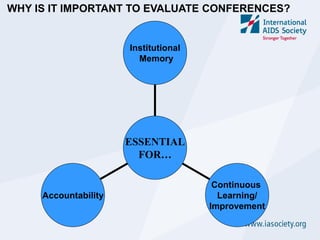
WHY IS IT IMPORTANT TO EVALUATE CONFERENCES?


                      Institutional
                        Memory


                      ESSENTIAL
                        FOR…

                                       Continuous
     Accountability                     Learning/
                                      Improvement
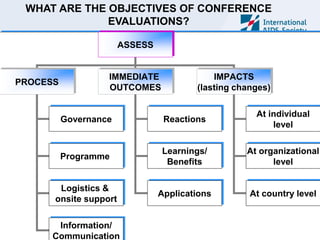
WHAT ARE THE OBJECTIVES OF CONFERENCE
              EVALUATIONS?

                       ASSESS


                   IMMEDIATE                IMPACTS
PROCESS
                   OUTCOMES             (lasting changes)

                                                     At individual
          Governance             Reactions
                                                         level

                                Learnings/         At organizational
          Programme
                                 Benefits                level

       Logistics &
                                Applications        At country level
      onsite support

       Information/
      Communication
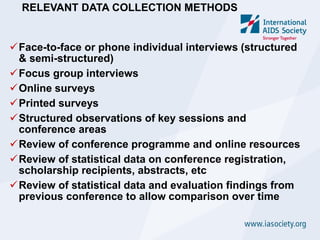
RELEVANT DATA COLLECTION METHODS


Face-to-face or phone individual interviews (structured
 & semi-structured)
Focus group interviews
Online surveys
Printed surveys
Structured observations of key sessions and
 conference areas
Review of conference programme and online resources
Review of statistical data on conference registration,
 scholarship recipients, abstracts, etc
Review of statistical data and evaluation findings from
 previous conference to allow comparison over time
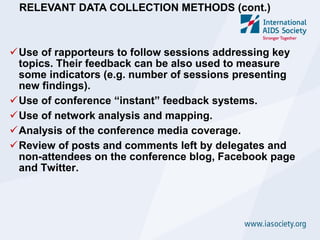
RELEVANT DATA COLLECTION METHODS (cont.)


Use of rapporteurs to follow sessions addressing key
 topics. Their feedback can be also used to measure
 some indicators (e.g. number of sessions presenting
 new findings).
Use of conference “instant” feedback systems.
Use of network analysis and mapping.
Analysis of the conference media coverage.
Review of posts and comments left by delegates and
 non-attendees on the conference blog, Facebook page
 and Twitter.
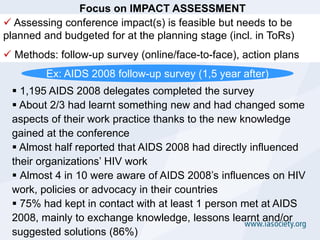
Focus on IMPACT ASSESSMENT
 Assessing conference impact(s) is feasible but needs to be
planned and budgeted for at the planning stage (incl. in ToRs)
 Methods: follow-up survey (online/face-to-face), action plans
         Ex: AIDS 2008 follow-up survey (1,5 year after)
  1,195 AIDS 2008 delegates completed the survey
  About 2/3 had learnt something new and had changed some
 aspects of their work practice thanks to the new knowledge
 gained at the conference
  Almost half reported that AIDS 2008 had directly influenced
 their organizations’ HIV work
  Almost 4 in 10 were aware of AIDS 2008’s influences on HIV
 work, policies or advocacy in their countries
  75% had kept in contact with at least 1 person met at AIDS
 2008, mainly to exchange knowledge, lessons learnt and/or
 suggested solutions (86%)
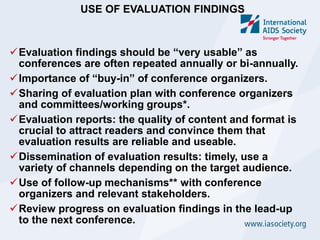
USE OF EVALUATION FINDINGS


Evaluation findings should be “very usable” as
 conferences are often repeated annually or bi-annually.
Importance of “buy-in” of conference organizers.
Sharing of evaluation plan with conference organizers
 and committees/working groups*.
Evaluation reports: the quality of content and format is
 crucial to attract readers and convince them that
 evaluation results are reliable and useable.
Dissemination of evaluation results: timely, use a
 variety of channels depending on the target audience.
Use of follow-up mechanisms** with conference
 organizers and relevant stakeholders.
Review progress on evaluation findings in the lead-up
 to the next conference.
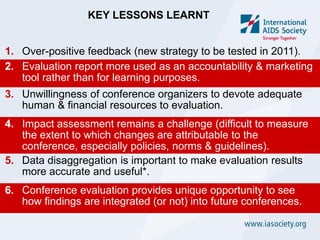
KEY LESSONS LEARNT


1. Over-positive feedback (new strategy to be tested in 2011).
2. Evaluation report more used as an accountability & marketing
   tool rather than for learning purposes.
3. Unwillingness of conference organizers to devote adequate
   human & financial resources to evaluation.
4. Impact assessment remains a challenge (difficult to measure
   the extent to which changes are attributable to the
   conference, especially policies, norms & guidelines).
5. Data disaggregation is important to make evaluation results
   more accurate and useful*.
6. Conference evaluation provides unique opportunity to see
   how findings are integrated (or not) into future conferences.
Further information


Proceedings (slides & handouts) of a 1-day workshop on
conference evaluation held in Nov 2010 are available on
request (email Laetitia.Lienart@iasociety.org)


Feel free to join the Conference Evaluation Google Group:
http://groups.google.com/group/conference_evaluation


Glenn’s blog has more resources on conference evaluation,
see category “event evaluation:
http://intelligentmeasurement.wordpress.com/category/event-evaluation/

Conference evaluation at a glance

  • 1.
    GENEVA EVALUATION NETWORK WORKSHOP CONFERENCE EVALUATION Organized by Laetitia Lienart & Glenn O’Neil Geneva, 16 March 2011
  • 2.
    WHY IS ITIMPORTANT TO EVALUATE CONFERENCES? Institutional Memory ESSENTIAL FOR… Continuous Accountability Learning/ Improvement
  • 3.
    WHAT ARE THEOBJECTIVES OF CONFERENCE EVALUATIONS? ASSESS IMMEDIATE IMPACTS PROCESS OUTCOMES (lasting changes) At individual Governance Reactions level Learnings/ At organizational Programme Benefits level Logistics & Applications At country level onsite support Information/ Communication
  • 4.
    RELEVANT DATA COLLECTIONMETHODS Face-to-face or phone individual interviews (structured & semi-structured) Focus group interviews Online surveys Printed surveys Structured observations of key sessions and conference areas Review of conference programme and online resources Review of statistical data on conference registration, scholarship recipients, abstracts, etc Review of statistical data and evaluation findings from previous conference to allow comparison over time
  • 5.
    RELEVANT DATA COLLECTIONMETHODS (cont.) Use of rapporteurs to follow sessions addressing key topics. Their feedback can be also used to measure some indicators (e.g. number of sessions presenting new findings). Use of conference “instant” feedback systems. Use of network analysis and mapping. Analysis of the conference media coverage. Review of posts and comments left by delegates and non-attendees on the conference blog, Facebook page and Twitter.
  • 6.
    Focus on IMPACTASSESSMENT  Assessing conference impact(s) is feasible but needs to be planned and budgeted for at the planning stage (incl. in ToRs)  Methods: follow-up survey (online/face-to-face), action plans Ex: AIDS 2008 follow-up survey (1,5 year after)  1,195 AIDS 2008 delegates completed the survey  About 2/3 had learnt something new and had changed some aspects of their work practice thanks to the new knowledge gained at the conference  Almost half reported that AIDS 2008 had directly influenced their organizations’ HIV work  Almost 4 in 10 were aware of AIDS 2008’s influences on HIV work, policies or advocacy in their countries  75% had kept in contact with at least 1 person met at AIDS 2008, mainly to exchange knowledge, lessons learnt and/or suggested solutions (86%)
  • 7.
    USE OF EVALUATIONFINDINGS Evaluation findings should be “very usable” as conferences are often repeated annually or bi-annually. Importance of “buy-in” of conference organizers. Sharing of evaluation plan with conference organizers and committees/working groups*. Evaluation reports: the quality of content and format is crucial to attract readers and convince them that evaluation results are reliable and useable. Dissemination of evaluation results: timely, use a variety of channels depending on the target audience. Use of follow-up mechanisms** with conference organizers and relevant stakeholders. Review progress on evaluation findings in the lead-up to the next conference.
  • 8.
    KEY LESSONS LEARNT 1.Over-positive feedback (new strategy to be tested in 2011). 2. Evaluation report more used as an accountability & marketing tool rather than for learning purposes. 3. Unwillingness of conference organizers to devote adequate human & financial resources to evaluation. 4. Impact assessment remains a challenge (difficult to measure the extent to which changes are attributable to the conference, especially policies, norms & guidelines). 5. Data disaggregation is important to make evaluation results more accurate and useful*. 6. Conference evaluation provides unique opportunity to see how findings are integrated (or not) into future conferences.
  • 9.
    Further information Proceedings (slides& handouts) of a 1-day workshop on conference evaluation held in Nov 2010 are available on request (email Laetitia.Lienart@iasociety.org) Feel free to join the Conference Evaluation Google Group: http://groups.google.com/group/conference_evaluation Glenn’s blog has more resources on conference evaluation, see category “event evaluation: http://intelligentmeasurement.wordpress.com/category/event-evaluation/