An overview
 insuring

"freedom from want" and "freedom
from fear“ and “freedom to live in dignity”
for all persons is the best path to tackle the
problem of global insecurity
 In order for human security to challenge
global inequalities, there has to be
cooperation between a country’s foreign
policy and its approach to global health
 Emerged

 UN

as a concept post Cold War

Development programme’s 1994
Human Development Report a
groundbreaking work in Human Security.
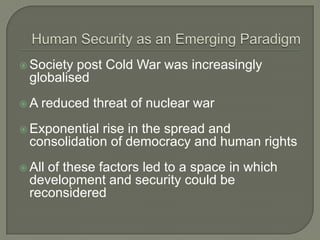
 Society

post Cold War was increasingly
globalised

A

reduced threat of nuclear war

 Exponential

rise in the spread and
consolidation of democracy and human rights

 All

of these factors led to a space in which
development and security could be
reconsidered
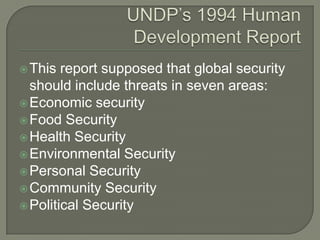
 This

report supposed that global security
should include threats in seven areas:
 Economic security
 Food Security
 Health Security
 Environmental Security
 Personal Security
 Community Security
 Political Security


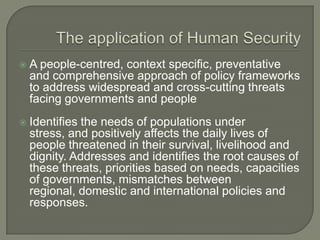
A people-centred, context specific, preventative
and comprehensive approach of policy frameworks
to address widespread and cross-cutting threats
facing governments and people



Identifies the needs of populations under
stress, and positively affects the daily lives of
people threatened in their survival, livelihood and
dignity. Addresses and identifies the root causes of
these threats, priorities based on needs, capacities
of governments, mismatches between
regional, domestic and international policies and
responses.
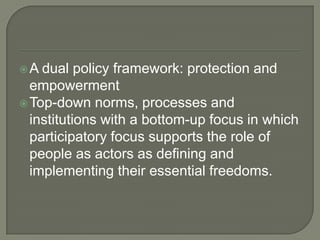
A

dual policy framework: protection and
empowerment
 Top-down norms, processes and
institutions with a bottom-up focus in which
participatory focus supports the role of
people as actors as defining and
implementing their essential freedoms.
Transitions to peace and sustainable development in
fragile and conflict affected communities
 Victims of human trafficking, their protection and
empowerment
 Responding to the multidimensional consequences of
climate-related threats
 Urban violence and its impact on health, education,
economic, personal and community security.
 Poverty reduction, social inclusion and communitybased development in isolated areas.
 Economic, environmental and social components of
health-related insecurities.


Human security basic overview

  • 1.
  • 2.
     insuring "freedom fromwant" and "freedom from fear“ and “freedom to live in dignity” for all persons is the best path to tackle the problem of global insecurity  In order for human security to challenge global inequalities, there has to be cooperation between a country’s foreign policy and its approach to global health
  • 3.
     Emerged  UN asa concept post Cold War Development programme’s 1994 Human Development Report a groundbreaking work in Human Security.
  • 4.
     Society post ColdWar was increasingly globalised A reduced threat of nuclear war  Exponential rise in the spread and consolidation of democracy and human rights  All of these factors led to a space in which development and security could be reconsidered
  • 5.
     This report supposedthat global security should include threats in seven areas:  Economic security  Food Security  Health Security  Environmental Security  Personal Security  Community Security  Political Security
  • 6.
     A people-centred, contextspecific, preventative and comprehensive approach of policy frameworks to address widespread and cross-cutting threats facing governments and people  Identifies the needs of populations under stress, and positively affects the daily lives of people threatened in their survival, livelihood and dignity. Addresses and identifies the root causes of these threats, priorities based on needs, capacities of governments, mismatches between regional, domestic and international policies and responses.
  • 7.
    A dual policy framework:protection and empowerment  Top-down norms, processes and institutions with a bottom-up focus in which participatory focus supports the role of people as actors as defining and implementing their essential freedoms.
  • 8.
    Transitions to peaceand sustainable development in fragile and conflict affected communities  Victims of human trafficking, their protection and empowerment  Responding to the multidimensional consequences of climate-related threats  Urban violence and its impact on health, education, economic, personal and community security.  Poverty reduction, social inclusion and communitybased development in isolated areas.  Economic, environmental and social components of health-related insecurities. 