The World Programme for Human
       Rights Education
        (2005-ongoing)
The World Programme for Human Rights Education
                (2005-ongoing)


The plan of Action of the World Programme for Human
Rights Education was adopted by all Members States of the
United States of the United Nations General Assembly on
14 July 2005.

It highlights key actions to be undertaken by ministries of
education and other school and civil society actors
working in partnership to integrate human rights
education effectively in the primary and secondary
school systems.
The World Programme for Human Rights Education
                    (2005-ongoing)
Human rights education activities should convey fundamental human
rights principles, such as equality and non-discrimination, while affirming
their interdependence, indivisibility and universality. At the same
time, activities should be practical, relating human rights to learners’ real-
life experience and enabling them to build on human rights principles found in
their own cultural context.

Through such activities, learners are empowered to identify and address
their human rights needs and to seek solutions consistent with human
rights standards. Both what is trained and the way in which it is trained
should reflect human rights values, encourage participation and foster a
learning environment free from want and fear.
The Plan of Action:
                            key elements

   •     Educational policies
   •     Policy implementation
   •     The learning environment
   •     Teaching and learning
   •     Education and professional development of school
         personnel
Whatever the status of human rights education or the situation or type of
education system, the development of human rights education should be
on each country’s agenda. That is why each country should establish
realistic goals and means for action in accordance with national
context, priorities and capacity.
Human Rights Education
       Topics
Human Rights Topics

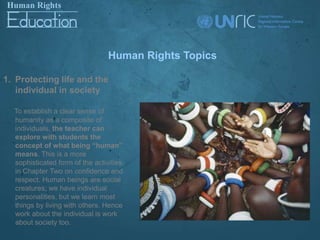
1. Protecting life and the
   individual in society

  To establish a clear sense of
  humanity as a composite of
  individuals, the teacher can
  explore with students the
  concept of what being “human”
  means. This is a more
  sophisticated form of the activities
  in Chapter Two on confidence and
  respect. Human beings are social
  creatures; we have individual
  personalities, but we learn most
  things by living with others. Hence
  work about the individual is work
  about society too.
Human Rights Topics

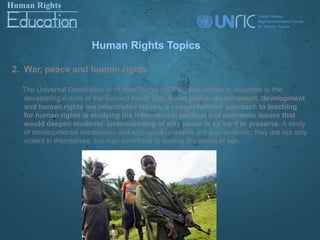
2. War, peace and human rights

  The Universal Declaration of Human Rights (UDHR) was written in response to the
  devastating events of the Second World War. Since peace, disarmament, development
  and human rights are interrelated issues, a comprehensive approach to teaching
  for human rights is studying the international political and economic issues that
  would deepen students’ understanding of why peace is so hard to preserve. A study
  of developmental imbalances and ecological problems are also endemic; they are not only
  violent in themselves, but may contribute to sowing the seeds of war.
Human Rights Topics


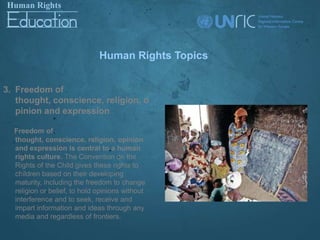
3. Freedom of
   thought, conscience, religion, o
   pinion and expression

  Freedom of
  thought, conscience, religion, opinion
  and expression is central to a human
  rights culture. The Convention on the
  Rights of the Child gives these rights to
  children based on their developing
  maturity, including the freedom to change
  religion or belief, to hold opinions without
  interference and to seek, receive and
  impart information and ideas through any
  media and regardless of frontiers.
Human Rights Topics


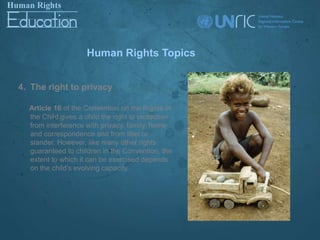
4. The right to privacy

  Article 16 of the Convention on the Rights of
  the Child gives a child the right to protection
  from interference with privacy, family, home
  and correspondence and from libel or
  slander. However, like many other rights
  guaranteed to children in the Convention, the
  extent to which it can be exercised depends
  on the child’s evolving capacity.
Human Rights Topics

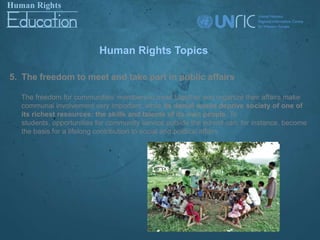
5. The freedom to meet and take part in public affairs

  The freedom for communities’ members to meet together and organize their affairs make
  communal involvement very important, while its denial would deprive society of one of
  its richest resources: the skills and talents of its own people. To
  students, opportunities for community service outside the school can, for instance, become
  the basis for a lifelong contribution to social and political affairs.
Human Rights Topics
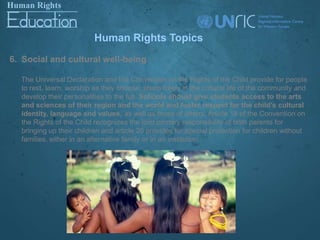
6. Social and cultural well-being

  The Universal Declaration and the Convention on the Rights of the Child provide for people
  to rest, learn, worship as they choose, share freely in the cultural life of the community and
  develop their personalities to the full. Schools should give students access to the arts
  and sciences of their region and the world and foster respect for the child’s cultural
  identity, language and values, as well as those of others. Article 18 of the Convention on
  the Rights of the Child recognizes the joint primary responsibility of both parents for
  bringing up their children and article 20 provides for special protection for children without
  families, either in an alternative family or in an institution.
Human Rights Topics
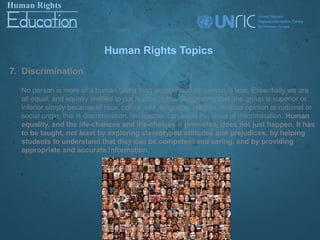
7. Discrimination

  No person is more of a human being than another and no person is less. Essentially we are
  all equal, and equally entitled to our human rights. Suggesting that one group is superior or
  inferior simply because of race, colour, sex, language, religion, political opinion or national or
  social origin, this is discrimination. No teacher can avoid the issue of discrimination. Human
  equality, and the life-chances and life-choices it promotes, does not just happen. It has
  to be taught, not least by exploring stereotyped attitudes and prejudices, by helping
  students to understand that they can be competent and caring, and by providing
  appropriate and accurate information.
Human Rights Topics


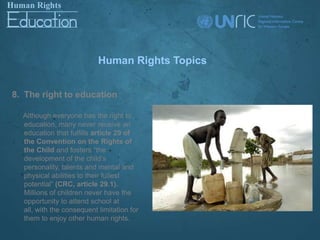
8. The right to education

  Although everyone has the right to
  education, many never receive an
  education that fulfills article 29 of
  the Convention on the Rights of
  the Child and fosters “the
  development of the child’s
  personality, talents and mental and
  physical abilities to their fullest
  potential” (CRC, article 29.1).
  Millions of children never have the
  opportunity to attend school at
  all, with the consequent limitation for
  them to enjoy other human rights.
Human Rights Topics
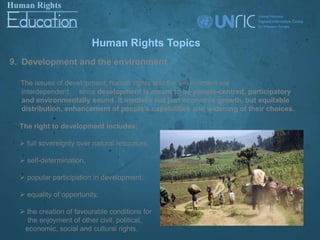
9. Development and the environment

  The issues of development, human rights and the environment are
  interdependent, since development is meant to be people-centred, participatory
  and environmentally sound. It involves not just economic growth, but equitable
  distribution, enhancement of people’s capabilities and widening of their choices.

  The right to development includes:

   full sovereignty over natural resources,

   self-determination,

   popular participation in development,

   equality of opportunity,

   the creation of favourable conditions for
    the enjoyment of other civil, political,
   economic, social and cultural rights.

Human rights education (part 3)

  • 1.
    The World Programmefor Human Rights Education (2005-ongoing)
  • 2.
    The World Programmefor Human Rights Education (2005-ongoing) The plan of Action of the World Programme for Human Rights Education was adopted by all Members States of the United States of the United Nations General Assembly on 14 July 2005. It highlights key actions to be undertaken by ministries of education and other school and civil society actors working in partnership to integrate human rights education effectively in the primary and secondary school systems.
  • 3.
    The World Programmefor Human Rights Education (2005-ongoing) Human rights education activities should convey fundamental human rights principles, such as equality and non-discrimination, while affirming their interdependence, indivisibility and universality. At the same time, activities should be practical, relating human rights to learners’ real- life experience and enabling them to build on human rights principles found in their own cultural context. Through such activities, learners are empowered to identify and address their human rights needs and to seek solutions consistent with human rights standards. Both what is trained and the way in which it is trained should reflect human rights values, encourage participation and foster a learning environment free from want and fear.
  • 4.
    The Plan ofAction: key elements • Educational policies • Policy implementation • The learning environment • Teaching and learning • Education and professional development of school personnel Whatever the status of human rights education or the situation or type of education system, the development of human rights education should be on each country’s agenda. That is why each country should establish realistic goals and means for action in accordance with national context, priorities and capacity.
  • 5.
  • 6.
    Human Rights Topics 1.Protecting life and the individual in society To establish a clear sense of humanity as a composite of individuals, the teacher can explore with students the concept of what being “human” means. This is a more sophisticated form of the activities in Chapter Two on confidence and respect. Human beings are social creatures; we have individual personalities, but we learn most things by living with others. Hence work about the individual is work about society too.
  • 7.
    Human Rights Topics 2.War, peace and human rights The Universal Declaration of Human Rights (UDHR) was written in response to the devastating events of the Second World War. Since peace, disarmament, development and human rights are interrelated issues, a comprehensive approach to teaching for human rights is studying the international political and economic issues that would deepen students’ understanding of why peace is so hard to preserve. A study of developmental imbalances and ecological problems are also endemic; they are not only violent in themselves, but may contribute to sowing the seeds of war.
  • 8.
    Human Rights Topics 3.Freedom of thought, conscience, religion, o pinion and expression Freedom of thought, conscience, religion, opinion and expression is central to a human rights culture. The Convention on the Rights of the Child gives these rights to children based on their developing maturity, including the freedom to change religion or belief, to hold opinions without interference and to seek, receive and impart information and ideas through any media and regardless of frontiers.
  • 9.
    Human Rights Topics 4.The right to privacy Article 16 of the Convention on the Rights of the Child gives a child the right to protection from interference with privacy, family, home and correspondence and from libel or slander. However, like many other rights guaranteed to children in the Convention, the extent to which it can be exercised depends on the child’s evolving capacity.
  • 10.
    Human Rights Topics 5.The freedom to meet and take part in public affairs The freedom for communities’ members to meet together and organize their affairs make communal involvement very important, while its denial would deprive society of one of its richest resources: the skills and talents of its own people. To students, opportunities for community service outside the school can, for instance, become the basis for a lifelong contribution to social and political affairs.
  • 11.
    Human Rights Topics 6.Social and cultural well-being The Universal Declaration and the Convention on the Rights of the Child provide for people to rest, learn, worship as they choose, share freely in the cultural life of the community and develop their personalities to the full. Schools should give students access to the arts and sciences of their region and the world and foster respect for the child’s cultural identity, language and values, as well as those of others. Article 18 of the Convention on the Rights of the Child recognizes the joint primary responsibility of both parents for bringing up their children and article 20 provides for special protection for children without families, either in an alternative family or in an institution.
  • 12.
    Human Rights Topics 7.Discrimination No person is more of a human being than another and no person is less. Essentially we are all equal, and equally entitled to our human rights. Suggesting that one group is superior or inferior simply because of race, colour, sex, language, religion, political opinion or national or social origin, this is discrimination. No teacher can avoid the issue of discrimination. Human equality, and the life-chances and life-choices it promotes, does not just happen. It has to be taught, not least by exploring stereotyped attitudes and prejudices, by helping students to understand that they can be competent and caring, and by providing appropriate and accurate information.
  • 13.
    Human Rights Topics 8.The right to education Although everyone has the right to education, many never receive an education that fulfills article 29 of the Convention on the Rights of the Child and fosters “the development of the child’s personality, talents and mental and physical abilities to their fullest potential” (CRC, article 29.1). Millions of children never have the opportunity to attend school at all, with the consequent limitation for them to enjoy other human rights.
  • 14.
    Human Rights Topics 9.Development and the environment The issues of development, human rights and the environment are interdependent, since development is meant to be people-centred, participatory and environmentally sound. It involves not just economic growth, but equitable distribution, enhancement of people’s capabilities and widening of their choices. The right to development includes:  full sovereignty over natural resources,  self-determination,  popular participation in development,  equality of opportunity,  the creation of favourable conditions for the enjoyment of other civil, political, economic, social and cultural rights.