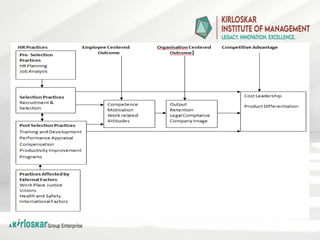
MANAGING HUMAN CAPITAL
INTRODUCTION TO HUMAN CAPITAL MANAGEMENT
DR.KIRAN SAWANT
Do people matter in the organizations ???
WIPRO, another software leader, has excellent human resource policies and
practices. One such is the way a potential job-hopper is handled. Exit interviews
are held when people quit WIPRO. Reasons why people leave WIPRO are
ascertained and interestingly, the company helps them find placements in other
firms with a guarantee that the doors of WIPRO would always be kept open to
those willing to come back, and a few did come back.
Toyota is one company which has benefited immensely from employee
suggestions scheme. The company’s suggestions scheme, operational for decades
now, nets almost 2,00,000 suggestions per year, that is 33 suggestions per
employee every year. Interestingly, 95% of these are implemented. That makes
about 5,000 improvements per day. Employee suggestions helped British Airways
cut its costs by ÂŁ4.5 million. HSBC saved upto 50 lakh per annum just by adopting
a single useful suggestion made by an employee. Gujarat Narmada Fertiliser
received 5,000 suggestions over five years, with savings of 65 lakh per annum.
SOME RELEVANT EXAMPLES :
How do people lend competitive advantage ?
 People offer skills , capabilities , system, practices , language , bonding and behaviour
 Strategy implementation can not be done by physical resources such as technology ,
building , machine and material. Its people who can craft strategies and execute them
effectively
 By aligning HR Plans with Business Plans . HR managers are now becoming HR Business
Partners
 Innovation is the key to competitive advantage.
Ex. Wall street journal Asia conducted survey – Bharati Airtel, ICICI Bank and Infosys
known for their innovativeness,
Ex. Google’s 70/20/10 principle of innovativeness
 HR functions seeks to converts adverse situations into opportunities. HR usually gets
trapped in functional roles such as policy roles, mediating employees, grievances handling
, monitoring performance, compliances with labor laws etc. The most important function
of HR is to provide support and help to workers to overcome difficulties and obstacles
that hinder their performance.
What is Human Resource Management?
Human resource management (HRM) is the process of employing people,
training them, compensating them, developing policies relating to them, and
developing strategies to retain them.
Human Resource Management is a strategic role crucial to the success of the
organization than administrative role.
Jack Welch, former CEO of General Electric and management guru, sums up the
new role of HRM: “Get out of the parties and birthdays and enrollment forms.…
Remember, HR is important in good times, HR is defined in hard times” (Frasch,
et. al., 2010).
What is Human Resource Management?
HRM refers to acquisition, retention, motivation and maintenance of Human
Resources in an organization.
Glueck : “HRM is concerned with the most effective use of people to achieve
organisational and individual goals.”
Edwin B Flippo: “HRM is the planning, organising, directing & controlling of the
procurement, development, compensation integration, maintenance and
separation of human resources to accomplish individual, organizational and
social objectives.
The concept of Human Capital
 Human capital comprises the knowledge, skills and abilities of the people
employed in an organization.
 Individuals generate, retain and use knowledge and skill (human capital) and create
intellectual capital.
 Human capital ‘defines the link between HR practices and business performance in
terms of assets rather than business processes’ (Scarborough and Elias, 2002).
Constituents of Human Capital
Human capital consists of:
 Intellectual capital – the stocks and flows of knowledge available to an
organization, i.e. the intangible resources associated with people.
 Social capital – the knowledge derived from networks of relationships within and
outside the organization.
 Organizational capital – the institutionalized knowledge possessed by an
organization that is stored in databases, manuals, etc.
Significance of Human Capital
Human capital theory regards people as assets and stresses that investment by
organizations in people will generate worthwhile returns.
Basic difference between Human Resource Management and Human Capital
Management
When looking at Human Capital Management and Human Resource Management,
you can see that they overlap, but they differ in their primary focus.
While Human Capital Management maximizes employees’ economic value to
the organization, human resource management focuses on developing and
managing systems and processes that enable employees to perform their roles
effectively.
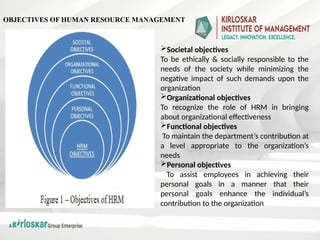
OBJECTIVES OF HUMAN RESOURCE MANAGEMENT
Societal objectives
To be ethically & socially responsible to the
needs of the society while minimizing the
negative impact of such demands upon the
organization
Organizational objectives
To recognize the role of HRM in bringing
about organizational effectiveness
Functional objectives
To maintain the department’s contribution at
a level appropriate to the organization’s
needs
Personal objectives
To assist employees in achieving their
personal goals in a manner that their
personal goals enhance the individual’s
contribution to the organization
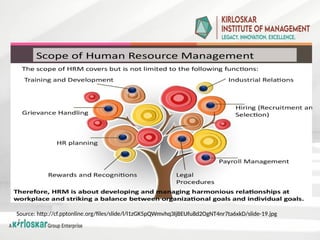
Source: http://cf.pptonline.org/files/slide/l/l1zGK5pQWmvhq3IjBEUfu8d2OgNT4nr7ta6xkD/slide-19.jpg
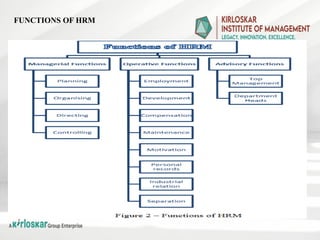
FUNCTIONS OF HRM
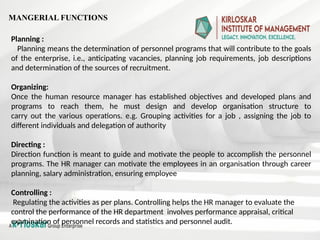
Planning :
Planning means the determination of personnel programs that will contribute to the goals
of the enterprise, i.e., anticipating vacancies, planning job requirements, job descriptions
and determination of the sources of recruitment.
Organizing:
Once the human resource manager has established objectives and developed plans and
programs to reach them, he must design and develop organisation structure to
carry out the various operations. e.g. Grouping activities for a job , assigning the job to
different individuals and delegation of authority
Directing :
Direction function is meant to guide and motivate the people to accomplish the personnel
programs. The HR manager can motivate the employees in an organisation through career
planning, salary administration, ensuring employee
Controlling :
Regulating the activities as per plans. Controlling helps the HR manager to evaluate the
control the performance of the HR department involves performance appraisal, critical
examination of personnel records and statistics and personnel audit.
MANGERIAL FUNCTIONS
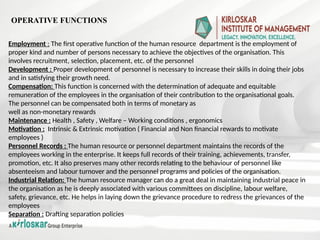
Employment : The first operative function of the human resource department is the employment of
proper kind and number of persons necessary to achieve the objectives of the organisation. This
involves recruitment, selection, placement, etc. of the personnel
Development : Proper development of personnel is necessary to increase their skills in doing their jobs
and in satisfying their growth need.
Compensation: This function is concerned with the determination of adequate and equitable
remuneration of the employees in the organisation of their contribution to the organisational goals.
The personnel can be compensated both in terms of monetary as
well as non-monetary rewards
Maintenance : Health , Safety , Welfare – Working conditions , ergonomics
Motivation : Intrinsic & Extrinsic motivation ( Financial and Non financial rewards to motivate
employees )
Personnel Records : The human resource or personnel department maintains the records of the
employees working in the enterprise. It keeps full records of their training, achievements, transfer,
promotion, etc. It also preserves many other records relating to the behaviour of personnel like
absenteeism and labour turnover and the personnel programs and policies of the organisation.
Industrial Relation: The human resource manager can do a great deal in maintaining industrial peace in
the organisation as he is deeply associated with various committees on discipline, labour welfare,
safety, grievance, etc. He helps in laying down the grievance procedure to redress the grievances of the
employees
Separation : Drafting separation policies
OPERATIVE FUNCTIONS
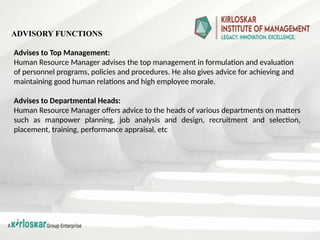
Advises to Top Management:
Human Resource Manager advises the top management in formulation and evaluation
of personnel programs, policies and procedures. He also gives advice for achieving and
maintaining good human relations and high employee morale.
Advises to Departmental Heads:
Human Resource Manager offers advice to the heads of various departments on matters
such as manpower planning, job analysis and design, recruitment and selection,
placement, training, performance appraisal, etc
ADVISORY FUNCTIONS
Strategic HRM
Strategic Management is defined as
The set of managerial decisions and actions that determine the long-term performance of
a corporation.
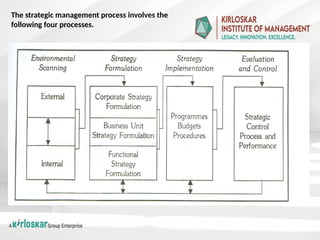
It includes environmental scanning, strategy formulation, strategy implementation and
evaluation and control.
The study of strategic management, therefore, emphasizes monitoring and evaluating
environmental opportunities and threats in the light of a corporation’s strengths and
weaknesses.’
 Strategic Human Resource Management
The linking of HRM with strategic goals and objectives in order to improve business
performance and develop organizational cultures that foster innovation and flexibility.
Formulating and executing HR systems—HR policies and activities—that produce the
employee competencies and behaviors the company needs to achieve its strategic
aims.
HR AS STRATEGIC BUSINESS PARTNER
The strategic management process involves the
following four processes.
Thank You

Managing Human Capital_Human Resoursce.pptx

  • 1.
    MANAGING HUMAN CAPITAL INTRODUCTIONTO HUMAN CAPITAL MANAGEMENT DR.KIRAN SAWANT
  • 2.
    Do people matterin the organizations ???
  • 3.
    WIPRO, another softwareleader, has excellent human resource policies and practices. One such is the way a potential job-hopper is handled. Exit interviews are held when people quit WIPRO. Reasons why people leave WIPRO are ascertained and interestingly, the company helps them find placements in other firms with a guarantee that the doors of WIPRO would always be kept open to those willing to come back, and a few did come back. Toyota is one company which has benefited immensely from employee suggestions scheme. The company’s suggestions scheme, operational for decades now, nets almost 2,00,000 suggestions per year, that is 33 suggestions per employee every year. Interestingly, 95% of these are implemented. That makes about 5,000 improvements per day. Employee suggestions helped British Airways cut its costs by £4.5 million. HSBC saved upto 50 lakh per annum just by adopting a single useful suggestion made by an employee. Gujarat Narmada Fertiliser received 5,000 suggestions over five years, with savings of 65 lakh per annum. SOME RELEVANT EXAMPLES :
  • 4.
    How do peoplelend competitive advantage ?  People offer skills , capabilities , system, practices , language , bonding and behaviour  Strategy implementation can not be done by physical resources such as technology , building , machine and material. Its people who can craft strategies and execute them effectively  By aligning HR Plans with Business Plans . HR managers are now becoming HR Business Partners  Innovation is the key to competitive advantage. Ex. Wall street journal Asia conducted survey – Bharati Airtel, ICICI Bank and Infosys known for their innovativeness, Ex. Google’s 70/20/10 principle of innovativeness  HR functions seeks to converts adverse situations into opportunities. HR usually gets trapped in functional roles such as policy roles, mediating employees, grievances handling , monitoring performance, compliances with labor laws etc. The most important function of HR is to provide support and help to workers to overcome difficulties and obstacles that hinder their performance.
  • 6.
    What is HumanResource Management? Human resource management (HRM) is the process of employing people, training them, compensating them, developing policies relating to them, and developing strategies to retain them. Human Resource Management is a strategic role crucial to the success of the organization than administrative role. Jack Welch, former CEO of General Electric and management guru, sums up the new role of HRM: “Get out of the parties and birthdays and enrollment forms.… Remember, HR is important in good times, HR is defined in hard times” (Frasch, et. al., 2010).
  • 7.
    What is HumanResource Management? HRM refers to acquisition, retention, motivation and maintenance of Human Resources in an organization. Glueck : “HRM is concerned with the most effective use of people to achieve organisational and individual goals.” Edwin B Flippo: “HRM is the planning, organising, directing & controlling of the procurement, development, compensation integration, maintenance and separation of human resources to accomplish individual, organizational and social objectives.
  • 8.
    The concept ofHuman Capital  Human capital comprises the knowledge, skills and abilities of the people employed in an organization.  Individuals generate, retain and use knowledge and skill (human capital) and create intellectual capital.  Human capital ‘defines the link between HR practices and business performance in terms of assets rather than business processes’ (Scarborough and Elias, 2002).
  • 9.
    Constituents of HumanCapital Human capital consists of:  Intellectual capital – the stocks and flows of knowledge available to an organization, i.e. the intangible resources associated with people.  Social capital – the knowledge derived from networks of relationships within and outside the organization.  Organizational capital – the institutionalized knowledge possessed by an organization that is stored in databases, manuals, etc. Significance of Human Capital Human capital theory regards people as assets and stresses that investment by organizations in people will generate worthwhile returns.
  • 10.
    Basic difference betweenHuman Resource Management and Human Capital Management When looking at Human Capital Management and Human Resource Management, you can see that they overlap, but they differ in their primary focus. While Human Capital Management maximizes employees’ economic value to the organization, human resource management focuses on developing and managing systems and processes that enable employees to perform their roles effectively.
  • 11.
    OBJECTIVES OF HUMANRESOURCE MANAGEMENT Societal objectives To be ethically & socially responsible to the needs of the society while minimizing the negative impact of such demands upon the organization Organizational objectives To recognize the role of HRM in bringing about organizational effectiveness Functional objectives To maintain the department’s contribution at a level appropriate to the organization’s needs Personal objectives To assist employees in achieving their personal goals in a manner that their personal goals enhance the individual’s contribution to the organization
  • 12.
  • 13.
  • 14.
    Planning : Planning meansthe determination of personnel programs that will contribute to the goals of the enterprise, i.e., anticipating vacancies, planning job requirements, job descriptions and determination of the sources of recruitment. Organizing: Once the human resource manager has established objectives and developed plans and programs to reach them, he must design and develop organisation structure to carry out the various operations. e.g. Grouping activities for a job , assigning the job to different individuals and delegation of authority Directing : Direction function is meant to guide and motivate the people to accomplish the personnel programs. The HR manager can motivate the employees in an organisation through career planning, salary administration, ensuring employee Controlling : Regulating the activities as per plans. Controlling helps the HR manager to evaluate the control the performance of the HR department involves performance appraisal, critical examination of personnel records and statistics and personnel audit. MANGERIAL FUNCTIONS
  • 15.
    Employment : Thefirst operative function of the human resource department is the employment of proper kind and number of persons necessary to achieve the objectives of the organisation. This involves recruitment, selection, placement, etc. of the personnel Development : Proper development of personnel is necessary to increase their skills in doing their jobs and in satisfying their growth need. Compensation: This function is concerned with the determination of adequate and equitable remuneration of the employees in the organisation of their contribution to the organisational goals. The personnel can be compensated both in terms of monetary as well as non-monetary rewards Maintenance : Health , Safety , Welfare – Working conditions , ergonomics Motivation : Intrinsic & Extrinsic motivation ( Financial and Non financial rewards to motivate employees ) Personnel Records : The human resource or personnel department maintains the records of the employees working in the enterprise. It keeps full records of their training, achievements, transfer, promotion, etc. It also preserves many other records relating to the behaviour of personnel like absenteeism and labour turnover and the personnel programs and policies of the organisation. Industrial Relation: The human resource manager can do a great deal in maintaining industrial peace in the organisation as he is deeply associated with various committees on discipline, labour welfare, safety, grievance, etc. He helps in laying down the grievance procedure to redress the grievances of the employees Separation : Drafting separation policies OPERATIVE FUNCTIONS
  • 16.
    Advises to TopManagement: Human Resource Manager advises the top management in formulation and evaluation of personnel programs, policies and procedures. He also gives advice for achieving and maintaining good human relations and high employee morale. Advises to Departmental Heads: Human Resource Manager offers advice to the heads of various departments on matters such as manpower planning, job analysis and design, recruitment and selection, placement, training, performance appraisal, etc ADVISORY FUNCTIONS
  • 17.
    Strategic HRM Strategic Managementis defined as The set of managerial decisions and actions that determine the long-term performance of a corporation. It includes environmental scanning, strategy formulation, strategy implementation and evaluation and control. The study of strategic management, therefore, emphasizes monitoring and evaluating environmental opportunities and threats in the light of a corporation’s strengths and weaknesses.’  Strategic Human Resource Management The linking of HRM with strategic goals and objectives in order to improve business performance and develop organizational cultures that foster innovation and flexibility. Formulating and executing HR systems—HR policies and activities—that produce the employee competencies and behaviors the company needs to achieve its strategic aims. HR AS STRATEGIC BUSINESS PARTNER
  • 18.
    The strategic managementprocess involves the following four processes.
  • 19.