HUMAN
RESOURCES
PLANNING
AND
ANALYTICS
FIONA GARBO
ELMERA JEAN TAMAYO
BSBA – FM III
CHAPTER II
OUTLINE
 Human Resources Planning and
Strategy
 The HR Planning Process
 Forecasting Demand for Labour
 HR Demand Forecasting Method
 Human Resources Supply
 HR Response and Plan for Supply and
Demand
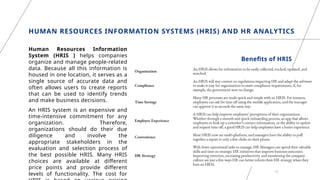
 Human Resources Information Systems
(HRIS) and HR Analytics
 HR Analytics
 HR Analytics Application
2
HUMAN RESOURCES PLANNING AND STRATEGY
HR Planning is a strategic process that helps companies plan for future human resources
that are needed to support the growth or downsizing of production demands. It allows
companies to predict the future, analyze the needs of the company, decide the market
availability of candidates for specific jobs, and make decisions when and how to adapt and
use human resources (people.)
In today’s rapidly changing workplace, companies need to respond quickly to
the market trends and changes. The HR Plan helps them to respond efficiently.
It is often coined that companies need to have “the right people in the right
place at the right time.” To compliment this saying, it is also important for
companies to have a plan, practices and policies.
The strategic plan is developed by internal and external forces that help with
success. When developing the HR Plan it is important that it aligns with the
strategic plan, and bring the two together with a focus on the longer term
success of the company.
HR departments begin an HR Plan by predicting or anticipating the number of
employees they will need with the expansion, and what skills the new
employees will need to possess.
3
THE HR PLANNING PROCESS
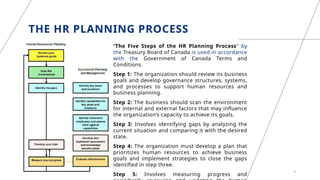
“The Five Steps of the HR Planning Process” by
the Treasury Board of Canada is used in accordance
with the Government of Canada Terms and
Conditions.
Step 1: The organization should review its business
goals and develop governance structures, systems,
and processes to support human resources and
business planning.
Step 2: The business should scan the environment
for internal and external factors that may influence
the organization’s capacity to achieve its goals.
Step 3: Involves identifying gaps by analyzing the
current situation and comparing it with the desired
state.
Step 4: The organization must develop a plan that
prioritizes human resources to achieve business
goals and implement strategies to close the gaps
identified in step three.
Step 5: Involves measuring progress and
4
FORECASTING DEMAND FOR LABOUR
Companies and people are constantly changing. It is a challenge to identify future
labour demands. However, an HR Plan can reduce the risk of companies being caught
with a labour shortage or an excess supply of labour. HR departments need to forecast
the need of people for its company. A forecast is an estimate of future human
resources that a company needs to be successful. How companies forecast is weighted
on several factors.
Strategic Plan
This plan determines the long-term objectives of the company related to growth,
products/services, markets, and how many employees it needs to meet these
objectives.
Legal Issues
The political, legal and social changes within an economy help companies predict the
future. The Human Rights Act has impacted how employers hire and treat employees.
Major lawsuits against employers can change how companies conduct business.
Demographics change, and so do the attitudes of employees ie. Baby boomer’s needs
are very difference than Gen Y’s employment needs. Federal and provincial laws impact
HR planning ie. Equity programs.
Competition
In today’s workplace, the global market is expanding. What a domestic company could
5
FORECASTING DEMAND FOR LABOUR
Technology
Technological changes affect supply and demand. While technology has reduced the need
for some jobs, it has created more jobs in other fields of work. It was predicted the creation
of computers would eliminate masses of employees. Automation has changed how
employees perform their jobs and have higher skill levels. Yet, there has been little change
in the demand for employees. In fact, high tech jobs are one of the highest demands fields
in the world of work.
Turnover of Employees
Turnover is when an employee leaves the company through resignation, layoff or firing.
Sometimes the employee makes the decision to leave, while other times it is the employer
who decides if the employee will leave. In some cases, temporary layoffs, or other leaves of
absence only create a temporary gap for the employer.
Demographics
Most companies have a demographic profile. Think about Facebook. It tends to hire younger
employers. In the field of women’s fashion, these companies would tend to hire females. The
Baby Boomers, generally, now reaching retirement age, are going to continue to leave gaps
in the workplace. Companies need to use data to predict who will retire and when they will
retire to ensure they have enough replacement employees.
Budgets
Company budgets may increase or decrease. Companies plan their human resources based
6
HR DEMAND FORECASTING METHOD
Forecasting Methods:
• Nominal Group Method: a focus group of experts work face-to-face or
virtually. They are presented with a problem such as “What will change
our demand for employees?” They write down all their ideas and share
them with each other. All the ideas are recorded. They rank the ideas by
priority and vote for the top 3-5 ideas.
• Delphi Method: a group of experts predict specific future events
through surveys and opinions (Ramachandran, 2023). Usually, HR
summarizes the results and creates a report. The experts continue to
use surveys until they start to see where there is agreement on the
responses. The process continues until there is agreement on future
trends.
• Trend Projections: Two methods are used with trend projections.
Extrapolation uses past information related to change. Example: We
hired 10 carpenters last year, so we likely will need 10 more carpenters
this year with the growth of the company. Indexation matches
employment growth with specific indices (such as the ratio of sales to 7
HR DEMAND FORECASTING METHOD
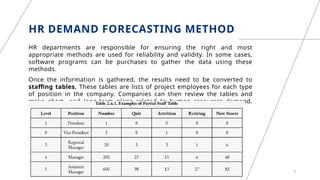
HR departments are responsible for ensuring the right and most
appropriate methods are used for reliability and validity. In some cases,
software programs can be purchases to gather the data using these
methods.
Once the information is gathered, the results need to be converted to
staffing tables. These tables are lists of project employees for each type
of position in the company. Companies can then review the tables and
make short- and long-term plans related to human resources demand.
They also help HR departments to develop objectives.
8
HUMAN RESOURCES SUPPLY
Once HR departments have established the future predictions related to HR
demands and developed the staffing tables, the next problem that needs solved
is: how do we fill the need for the demand? There are two ways to solve this need
internally and externally.
• Internal supply are the existing employees who can be promoted to new
positions, transferred offices and other departments or satellite offices and
could be demoted.
• External supply is hiring from outside the company.
Estimating Internal Supply
HR needs to determine the talents of the existing employees. This allows them to
plan how many people can fill gaps with these employees. Employees transition
throughout companies all the time. Keeping track of these transitions is
important. There are several methods HR departments use to track the supply of
employees.
• Markov analysis: is often used which is the company’s future human
resources needs that uses transitional probability matrices based on past data.
(It defines the future based on the current state of numbers. It follows the
internal movement of employees. With a population of 50-60 year olds and
9
HUMAN RESOURCES SUPPLY
• Human Resources Inventories: This is completed through HR audits of
summaries of employees’ knowledge, skills and abilities (KSAs). This allows HR to
make decisions about replacing employees through replacement summaries.
The information collected could include years of experience, education, training,
successes and accomplishments. They track the employee’s history with the
company and HR departments can decide if these employees can fill gaps in the
company. These inventories need constant updating to ensure the employee
information is up to date.
• Leadership and Management Inventories: These inventories are similar to
employee Human Resources Inventories. The KSAs are recorded. In addition, the
employee’s potential for promotion to management is monitored. These
inventories need constant updating to ensure the employee information is up to
date.
• Replacement Charts: are charts that are like a “picture” that help to determine
who can replace who when the need arises through a job opening. It is similar to
an organizational, hierarchical chart which shows different jobs in the company,
status of the employee. As well, it shows if the employee is promotable or has
the potential to be promoted. HR may help with promotion decisions by offering
employees leadership and management tests, or psychological tests. As well,
employees may be interviewed to gather information about their interest in
10
HUMAN RESOURCES SUPPLY
Estimating External Supply: Labour Market
• Labour market analysis studies the companies labour market to assess the
present and future availability of employees. In Canada, the unemployment
rates are a quick way to determine how many people are actively seeking
work, and what types of work they are looking for in their careers. Other
ways to find employees is to target those employed in other companies.
• Community Attitudes: The attitude of the local, national and international
community affects the labour market. Employers are fickle in the global
market. They can move their business to another region or country because
of attitudes. Other examples include the social justice shifts of minority
groups in hiring practices.
• Demographics: Demographics affect the labour market in planning and
trends for the future. Often the government tracks trends in the labour
market years in advance. This is helpful information for HR departments to
access. Some of these data sources include Statistics Canada and
Employment and Social Development Canada (ESDC) and Conference Board
of Canada. These sources publish ongoing reports related to the labour
market specifically demographics, occupational variables, income, results of 11
HR RESPONSE AND PLAN FOR SUPPLY AND
DEMAND
HR departments should be prepared and have strategies in place to meet workforce supply and demand
needs. They can either: reduce the workforce due to over-supply, or increase the workforce in response to
labour shortages.
Plan for Reducing Employees
• Leaves Without Pay
Employee is offered a temporary leave of absence to save wages. The employee would not be paid
during the temporary leave. Other leaves may be a sabbatical where the employee is offered time
without pay for personal leave or to return to school.
• Incentives to Leave
Employers may offer employees an incentive to leave the company. This is often called a buyout. There
is a cash incentive offered to the employee ie. A year’s extra wages.
• Termination
This is a permanent separation from the company due to a turndown in the economy. The company
has no intention of re-hiring the employee.
• Layoff
This is a temporary separation from the company because of a short-term surplus of employees. The
separation could last only a few weeks, or several months depending on the need of the company.
Employees are generally on a recall list and when there is a job available, the employees are called
back to work based on seniority or need.
• Attrition
This is when an employee resigns, retires or dies. It is initiated by the employee. A position is created
12
HR RESPONSE AND PLAN FOR SUPPLY AND
DEMAND
• Hiring Freeze
This process stops all hiring until further notice by the company.
• Job Sharing
The number of hours is reduced by employees, however, the job is split, generally, two people.
The job responsibilities are divided up between the employees. This helps to avoid layoffs, and
keeps employees working, even if part time.
• Early Retirement
The employee separates from the company through retirement. If the regular retirement age is
65 years old, the employer may offer the employee an incentive to retire before this age. Other
employers offer a phased retirement which allows them to work fewer hours for a period of
time, and then finally retire completely from the company.
• Part-time Employment
Sometimes employers reduce the work force by eliminating full time jobs and replacing them
with part time employees. This is a cost savings for the employer. Often, part time employees
are paid less wages and receive fewer or no benefits. This is not always good for part time
workers as it limits not only their pay cheques and high costs of health services, it also may
reduce their entitlements to government sponsored programs ie. Employment insurance,
disability insurance.
• Plan for Labour Shortages
A labour shortage is not enough supply of employees to meet the demand for the company,
and/or people do not have specific skills that company needs to operate the business.
13
HR RESPONSE AND PLAN FOR SUPPLY AND
DEMAND
• Hiring New Employees
This approach is straight forward in that HR department attracts and retains new employees with the
skills required for the job. The employer either hires full time or part time employees.
• Contract Work
The employer does not want to hire full time or part time workers. Rather, they hire a contract worker
for a specific amount of time at a specific rate of pay. They perform a specific job while employed.
Sometimes they are called contingent workers. Contract workers are not considered employers.
• Outsourcing
Sometimes employers choose to or need skilled workers that are not employed by the company to
perform specific work. A formal agreement is decided upon by the worker and the employer. Often
these jobs required special knowledge or skills. The employer saves costs by not having long term
employees, nor do they pay benefits. With international companies they may outsource work to a
different country called Offshoring.
• Crowdsourcing
This is when a company decides to take a function of the organization and send out an open call to
help the organization solve some type of problem or provide a service to the company. It is generally
advertised through social media and can attract a wide pool of people. If there are good results, the
company may pay the people for their efforts. Or the work might be volunteer. Often, through
crowdsourcing many innovative ideas are shared at a reduced cost to the company. Ie. Waze
subscribers report on traffic accidents.
• Overtime
This is a method where existing employees are asked to work beyond their regular hours of work.
14
HUMAN RESOURCES INFORMATION SYSTEMS (HRIS) AND HR ANALYTICS
Human Resources Information
System (HRIS ) helps companies
organize and manage people-related
data. Because all this information is
housed in one location, it serves as a
single source of accurate data and
often allows users to create reports
that can be used to identify trends
and make business decisions.
An HRIS system is an expensive and
time-intensive commitment for any
organization. Therefore,
organizations should do their due
diligence and involve the
appropriate stakeholders in the
evaluation and selection process of
the best possible HRIS. Many HRIS
choices are available at different
price points and provide different
levels of functionality. The cost for
15
Benefits of HRIS
HR ANALYTICS
HR analytics is the process of analyzing this data in order to improve an organization’s
workforce performance. The process can also be referred to as talent analytics, people
analytics, or even workforce analytics.
• HR analytics: HR analytics specifically deals with the metrics of the HR function, such as
time to hire, training expense per employee, and time until promotion. All these metrics
are managed exclusively by HR for HR.
• People analytics: People analytics, though often used as a synonym for HR analytics, is
technically applicable to “people” in general. It can encompass any group of individuals
even outside the organization. For instance, the term “people analytics” may be applied
to analytics about the customers of an organization and not necessarily only employees.
Data
As a result of high-performance HRIS and new technology such as employee tracking, HR
managers now have a great deal of information at their disposal. Here is a list of the type of
data that is commonly collected in organizations:
• Revenue per employee: Obtained by dividing a company’s revenue by the total number
of employees in the company. This indicates the average revenue each employee
generates. It is a measure of how efficient an organization is at enabling revenue
generation through employees.
• Offer acceptance rate: The number of accepted formal job offers (not verbal) divided by
the total number of job offers given in a certain period. A higher rate (above 85%)
indicates a good ratio. If it is lower, this data can be used to redefine the company’s
16
HR ANALYTICS
• Training expenses per employee: Obtained by dividing the total training expense by the total number
of employees who received training. The value of this expense can be determined by measuring the
training efficiency. Poor efficiency may lead you to re-evaluate the training expense per employee.
• Training efficiency: Obtained from the analysis of multiple data points, such as performance
improvement, test scores, and upward transition in employees’ roles in the organization after training.
Measuring training efficiency can be crucial to evaluating the effectiveness of a training program.
• Voluntary turnover rate: Voluntary turnover occurs when employees voluntarily choose to leave their
jobs. It is calculated by dividing the number of employees who left voluntarily by the total number of
employees in the organization. This metric can lead to the identifying gaps in the employee experience
that are contributing to voluntary attrition.
• Involuntary turnover rate: When an employee is terminated from their position, it is termed
“involuntary.” The rate of involuntary turnover is calculated by dividing the number of employees who
left involuntarily by the total number of employees in the organization. This metric can be tied back to
the recruitment strategy and used to develop a plan to improve the quality of hires to avoid
involuntary turnover.
• Time to fill: The number of days between advertising a job opening and hiring someone to fill that
position. By measuring the time to fill, recruiters can alter their recruitment strategy to identify areas
where the most time is being spent.
• Time to hire: The number of days between approaching a candidate and the candidate’s acceptance of
the job offer. Just like time to fill, data-driven analysis of time to hire can benefit recruiters and help
them improve the candidate experience to reduce this time.
• Absenteeism: Absenteeism is a productivity metric, which is measured by dividing the number of days
missed by the total number of scheduled workdays. Absenteeism can offer insights into overall
employee health and can also serve as an indicator of employee happiness.
17
HR ANALYTICS
Analytics and the Law
The sort of data collection that HR analytics uses is governed heavily by compliance laws.
Some legal considerations to keep in mind when implementing an HR analytics solution are:
1. Employee privacy and anonymity
2. Consent from employees about the amount and type of data collected
3. Establishing the goal of data collection and informing employees accordingly
4. IT security when using third-party software to run HR analytics
5. Location of the HR analytics vendor – with whom the data will be stored – and their
compliance with local laws
The people analytics company Sociometric Solutions offers electronic badges that capture
information from employee conversations as they go about their day, including the length of
the conversation, the tone of voice involved, how often people interrupt, how well they show
empathy, and so on. Using this technology, a major bank noticed that its top-performing call
centre workers were those who took breaks together and let off steam collectively. Based on
this knowledge, the bank implemented group break policies. The result? Performance
improved by 23% and stress levels dropped by 19% (Kuchler, 2014).
While it is easy to see the benefits of using this type of data which can lead to fantastic
insights, there is also a legal and ethical angle to consider. How would you feel if your
organization used these badges? What could the company do to make you comfortable with
18
HR ANALYTICS APPLICATION
HR analytics is the process of analyzing and using data to make informed business
decisions. Analytics can help you determine which qualities are most important for a
certain position, then sift through applications and find the candidates that best match
those qualities. Analytics can also tell you when a certain quality or data point actually
has little to do with an employee’s success.
Job Design
Job design helps to structure jobs to make them more motivating and to increase the
performance of employees. Data, and more specifically data analytics, can allow HR
Managers to pinpoint areas that facilitate or impede motivation or performance.
Recruitment
The objective of recruitment is to generate the maximum number of quality
applications possible; recruitment analytics borrows heavily from marketing science.
Recruiters that use analytical tools rely on segmentation, statistical analysis, and the
development of optimal people models (i.e., ideal candidates). Since an increasing
majority of recruitment occurs electronically, there is a vast amount of data available
to recruiters to seek to optimize their processes.
Talent Acquisition
The objective of talent acquisition is to find the best employee for a specific job. This
can be a daunting task. People are complex and evaluating them is fraught with
19
HR ANALYTICS APPLICATION
Training
With the rise of online learning, corporate learning and development is becoming
increasingly personalized to individual learners. Fueled by data and analytics,
‘adaptive’ learning technology allows courses, course segments, activities, and test
questions to be personalized to suit the learner’s preference, in terms of pace and
method of learning. Individual, self-paced online learning is also arguably more cost
effective than pulling employees out of their job for a day or week to send them on
expensive training courses. Importantly, self-directed learning helps integrate ongoing
development into employees’ everyday routines.
Compensation
Whether it is managing job candidate salary expectations or looking for evidence of
pay equity, data allows HR managers to make decisions based on facts. The key word
here is instinct, which can lead to costly mistakes: intuition can cause even the best
managers and HR professionals to make poor judgment calls. The way to mitigate this
risk is to look to the data: to find out how the employee compares to the rest of their
team and what the market is paying for a similar role.
Performance Management
UPS has taken the use of data and analytics in performance management to an
entirely new level. In addition, UPS trucks are fitted with more than 200 sensors that
gather data on everything from whether the driver is wearing a seatbelt to how many
20
HR ANALYTICS APPLICATION
Health and Safety
Safety-oriented companies rely on analysis of historical safety incidents to identify
potential trends. They rely on lagging information and is limited to data related to the
incident. It can tell what happened, but not why it happened. Companies need
information that helps them predict future incidents, and predict the likelihood of the
incident happening. This information is not captured in individual incident reporting.
Through advanced analytics, companies can use predictive modelling techniques to
identify the factors of incidents. The goal is effective prevention. Analytics makes it
easy to sift through the data to find clues. Companies can analysis things like the
weather, the job site, maintenance scheduling, and production measurements that
affect workers. This allows them to take prevention action to reduce risk. An example
is adjusting equipment maintenance scheduling, where machines are place, or
scheduling of different tasks at different times.
21
ANSWER THE FOLLOWING QUESTIONS (10 POINTS
EACH)
1. Why are staffing tables important to Human Resources? President?
2. Do you believe crowdsourcing is a good idea? Why? Why not?
3. How do HR analytics impact job design? Recruitment? Training? Compensation?
Explain.
4. What is the purpose of replacement charts? And who would use them in the
company? What would they use them for? Explain.
5. In your own words, describe HR analytics and why is their significance in
managing a company?
22

THANK YOU FOR
COOPERATING!
23

Human Resources Plannning and Analytics_Chapter 2 (BSBA-FM)

  • 1.
  • 2.
    CHAPTER II OUTLINE  HumanResources Planning and Strategy  The HR Planning Process  Forecasting Demand for Labour  HR Demand Forecasting Method  Human Resources Supply  HR Response and Plan for Supply and Demand  Human Resources Information Systems (HRIS) and HR Analytics  HR Analytics  HR Analytics Application 2
  • 3.
    HUMAN RESOURCES PLANNINGAND STRATEGY HR Planning is a strategic process that helps companies plan for future human resources that are needed to support the growth or downsizing of production demands. It allows companies to predict the future, analyze the needs of the company, decide the market availability of candidates for specific jobs, and make decisions when and how to adapt and use human resources (people.) In today’s rapidly changing workplace, companies need to respond quickly to the market trends and changes. The HR Plan helps them to respond efficiently. It is often coined that companies need to have “the right people in the right place at the right time.” To compliment this saying, it is also important for companies to have a plan, practices and policies. The strategic plan is developed by internal and external forces that help with success. When developing the HR Plan it is important that it aligns with the strategic plan, and bring the two together with a focus on the longer term success of the company. HR departments begin an HR Plan by predicting or anticipating the number of employees they will need with the expansion, and what skills the new employees will need to possess. 3
  • 4.
    THE HR PLANNINGPROCESS “The Five Steps of the HR Planning Process” by the Treasury Board of Canada is used in accordance with the Government of Canada Terms and Conditions. Step 1: The organization should review its business goals and develop governance structures, systems, and processes to support human resources and business planning. Step 2: The business should scan the environment for internal and external factors that may influence the organization’s capacity to achieve its goals. Step 3: Involves identifying gaps by analyzing the current situation and comparing it with the desired state. Step 4: The organization must develop a plan that prioritizes human resources to achieve business goals and implement strategies to close the gaps identified in step three. Step 5: Involves measuring progress and 4
  • 5.
    FORECASTING DEMAND FORLABOUR Companies and people are constantly changing. It is a challenge to identify future labour demands. However, an HR Plan can reduce the risk of companies being caught with a labour shortage or an excess supply of labour. HR departments need to forecast the need of people for its company. A forecast is an estimate of future human resources that a company needs to be successful. How companies forecast is weighted on several factors. Strategic Plan This plan determines the long-term objectives of the company related to growth, products/services, markets, and how many employees it needs to meet these objectives. Legal Issues The political, legal and social changes within an economy help companies predict the future. The Human Rights Act has impacted how employers hire and treat employees. Major lawsuits against employers can change how companies conduct business. Demographics change, and so do the attitudes of employees ie. Baby boomer’s needs are very difference than Gen Y’s employment needs. Federal and provincial laws impact HR planning ie. Equity programs. Competition In today’s workplace, the global market is expanding. What a domestic company could 5
  • 6.
    FORECASTING DEMAND FORLABOUR Technology Technological changes affect supply and demand. While technology has reduced the need for some jobs, it has created more jobs in other fields of work. It was predicted the creation of computers would eliminate masses of employees. Automation has changed how employees perform their jobs and have higher skill levels. Yet, there has been little change in the demand for employees. In fact, high tech jobs are one of the highest demands fields in the world of work. Turnover of Employees Turnover is when an employee leaves the company through resignation, layoff or firing. Sometimes the employee makes the decision to leave, while other times it is the employer who decides if the employee will leave. In some cases, temporary layoffs, or other leaves of absence only create a temporary gap for the employer. Demographics Most companies have a demographic profile. Think about Facebook. It tends to hire younger employers. In the field of women’s fashion, these companies would tend to hire females. The Baby Boomers, generally, now reaching retirement age, are going to continue to leave gaps in the workplace. Companies need to use data to predict who will retire and when they will retire to ensure they have enough replacement employees. Budgets Company budgets may increase or decrease. Companies plan their human resources based 6
  • 7.
    HR DEMAND FORECASTINGMETHOD Forecasting Methods: • Nominal Group Method: a focus group of experts work face-to-face or virtually. They are presented with a problem such as “What will change our demand for employees?” They write down all their ideas and share them with each other. All the ideas are recorded. They rank the ideas by priority and vote for the top 3-5 ideas. • Delphi Method: a group of experts predict specific future events through surveys and opinions (Ramachandran, 2023). Usually, HR summarizes the results and creates a report. The experts continue to use surveys until they start to see where there is agreement on the responses. The process continues until there is agreement on future trends. • Trend Projections: Two methods are used with trend projections. Extrapolation uses past information related to change. Example: We hired 10 carpenters last year, so we likely will need 10 more carpenters this year with the growth of the company. Indexation matches employment growth with specific indices (such as the ratio of sales to 7
  • 8.
    HR DEMAND FORECASTINGMETHOD HR departments are responsible for ensuring the right and most appropriate methods are used for reliability and validity. In some cases, software programs can be purchases to gather the data using these methods. Once the information is gathered, the results need to be converted to staffing tables. These tables are lists of project employees for each type of position in the company. Companies can then review the tables and make short- and long-term plans related to human resources demand. They also help HR departments to develop objectives. 8
  • 9.
    HUMAN RESOURCES SUPPLY OnceHR departments have established the future predictions related to HR demands and developed the staffing tables, the next problem that needs solved is: how do we fill the need for the demand? There are two ways to solve this need internally and externally. • Internal supply are the existing employees who can be promoted to new positions, transferred offices and other departments or satellite offices and could be demoted. • External supply is hiring from outside the company. Estimating Internal Supply HR needs to determine the talents of the existing employees. This allows them to plan how many people can fill gaps with these employees. Employees transition throughout companies all the time. Keeping track of these transitions is important. There are several methods HR departments use to track the supply of employees. • Markov analysis: is often used which is the company’s future human resources needs that uses transitional probability matrices based on past data. (It defines the future based on the current state of numbers. It follows the internal movement of employees. With a population of 50-60 year olds and 9
  • 10.
    HUMAN RESOURCES SUPPLY •Human Resources Inventories: This is completed through HR audits of summaries of employees’ knowledge, skills and abilities (KSAs). This allows HR to make decisions about replacing employees through replacement summaries. The information collected could include years of experience, education, training, successes and accomplishments. They track the employee’s history with the company and HR departments can decide if these employees can fill gaps in the company. These inventories need constant updating to ensure the employee information is up to date. • Leadership and Management Inventories: These inventories are similar to employee Human Resources Inventories. The KSAs are recorded. In addition, the employee’s potential for promotion to management is monitored. These inventories need constant updating to ensure the employee information is up to date. • Replacement Charts: are charts that are like a “picture” that help to determine who can replace who when the need arises through a job opening. It is similar to an organizational, hierarchical chart which shows different jobs in the company, status of the employee. As well, it shows if the employee is promotable or has the potential to be promoted. HR may help with promotion decisions by offering employees leadership and management tests, or psychological tests. As well, employees may be interviewed to gather information about their interest in 10
  • 11.
    HUMAN RESOURCES SUPPLY EstimatingExternal Supply: Labour Market • Labour market analysis studies the companies labour market to assess the present and future availability of employees. In Canada, the unemployment rates are a quick way to determine how many people are actively seeking work, and what types of work they are looking for in their careers. Other ways to find employees is to target those employed in other companies. • Community Attitudes: The attitude of the local, national and international community affects the labour market. Employers are fickle in the global market. They can move their business to another region or country because of attitudes. Other examples include the social justice shifts of minority groups in hiring practices. • Demographics: Demographics affect the labour market in planning and trends for the future. Often the government tracks trends in the labour market years in advance. This is helpful information for HR departments to access. Some of these data sources include Statistics Canada and Employment and Social Development Canada (ESDC) and Conference Board of Canada. These sources publish ongoing reports related to the labour market specifically demographics, occupational variables, income, results of 11
  • 12.
    HR RESPONSE ANDPLAN FOR SUPPLY AND DEMAND HR departments should be prepared and have strategies in place to meet workforce supply and demand needs. They can either: reduce the workforce due to over-supply, or increase the workforce in response to labour shortages. Plan for Reducing Employees • Leaves Without Pay Employee is offered a temporary leave of absence to save wages. The employee would not be paid during the temporary leave. Other leaves may be a sabbatical where the employee is offered time without pay for personal leave or to return to school. • Incentives to Leave Employers may offer employees an incentive to leave the company. This is often called a buyout. There is a cash incentive offered to the employee ie. A year’s extra wages. • Termination This is a permanent separation from the company due to a turndown in the economy. The company has no intention of re-hiring the employee. • Layoff This is a temporary separation from the company because of a short-term surplus of employees. The separation could last only a few weeks, or several months depending on the need of the company. Employees are generally on a recall list and when there is a job available, the employees are called back to work based on seniority or need. • Attrition This is when an employee resigns, retires or dies. It is initiated by the employee. A position is created 12
  • 13.
    HR RESPONSE ANDPLAN FOR SUPPLY AND DEMAND • Hiring Freeze This process stops all hiring until further notice by the company. • Job Sharing The number of hours is reduced by employees, however, the job is split, generally, two people. The job responsibilities are divided up between the employees. This helps to avoid layoffs, and keeps employees working, even if part time. • Early Retirement The employee separates from the company through retirement. If the regular retirement age is 65 years old, the employer may offer the employee an incentive to retire before this age. Other employers offer a phased retirement which allows them to work fewer hours for a period of time, and then finally retire completely from the company. • Part-time Employment Sometimes employers reduce the work force by eliminating full time jobs and replacing them with part time employees. This is a cost savings for the employer. Often, part time employees are paid less wages and receive fewer or no benefits. This is not always good for part time workers as it limits not only their pay cheques and high costs of health services, it also may reduce their entitlements to government sponsored programs ie. Employment insurance, disability insurance. • Plan for Labour Shortages A labour shortage is not enough supply of employees to meet the demand for the company, and/or people do not have specific skills that company needs to operate the business. 13
  • 14.
    HR RESPONSE ANDPLAN FOR SUPPLY AND DEMAND • Hiring New Employees This approach is straight forward in that HR department attracts and retains new employees with the skills required for the job. The employer either hires full time or part time employees. • Contract Work The employer does not want to hire full time or part time workers. Rather, they hire a contract worker for a specific amount of time at a specific rate of pay. They perform a specific job while employed. Sometimes they are called contingent workers. Contract workers are not considered employers. • Outsourcing Sometimes employers choose to or need skilled workers that are not employed by the company to perform specific work. A formal agreement is decided upon by the worker and the employer. Often these jobs required special knowledge or skills. The employer saves costs by not having long term employees, nor do they pay benefits. With international companies they may outsource work to a different country called Offshoring. • Crowdsourcing This is when a company decides to take a function of the organization and send out an open call to help the organization solve some type of problem or provide a service to the company. It is generally advertised through social media and can attract a wide pool of people. If there are good results, the company may pay the people for their efforts. Or the work might be volunteer. Often, through crowdsourcing many innovative ideas are shared at a reduced cost to the company. Ie. Waze subscribers report on traffic accidents. • Overtime This is a method where existing employees are asked to work beyond their regular hours of work. 14
  • 15.
    HUMAN RESOURCES INFORMATIONSYSTEMS (HRIS) AND HR ANALYTICS Human Resources Information System (HRIS ) helps companies organize and manage people-related data. Because all this information is housed in one location, it serves as a single source of accurate data and often allows users to create reports that can be used to identify trends and make business decisions. An HRIS system is an expensive and time-intensive commitment for any organization. Therefore, organizations should do their due diligence and involve the appropriate stakeholders in the evaluation and selection process of the best possible HRIS. Many HRIS choices are available at different price points and provide different levels of functionality. The cost for 15 Benefits of HRIS
  • 16.
    HR ANALYTICS HR analyticsis the process of analyzing this data in order to improve an organization’s workforce performance. The process can also be referred to as talent analytics, people analytics, or even workforce analytics. • HR analytics: HR analytics specifically deals with the metrics of the HR function, such as time to hire, training expense per employee, and time until promotion. All these metrics are managed exclusively by HR for HR. • People analytics: People analytics, though often used as a synonym for HR analytics, is technically applicable to “people” in general. It can encompass any group of individuals even outside the organization. For instance, the term “people analytics” may be applied to analytics about the customers of an organization and not necessarily only employees. Data As a result of high-performance HRIS and new technology such as employee tracking, HR managers now have a great deal of information at their disposal. Here is a list of the type of data that is commonly collected in organizations: • Revenue per employee: Obtained by dividing a company’s revenue by the total number of employees in the company. This indicates the average revenue each employee generates. It is a measure of how efficient an organization is at enabling revenue generation through employees. • Offer acceptance rate: The number of accepted formal job offers (not verbal) divided by the total number of job offers given in a certain period. A higher rate (above 85%) indicates a good ratio. If it is lower, this data can be used to redefine the company’s 16
  • 17.
    HR ANALYTICS • Trainingexpenses per employee: Obtained by dividing the total training expense by the total number of employees who received training. The value of this expense can be determined by measuring the training efficiency. Poor efficiency may lead you to re-evaluate the training expense per employee. • Training efficiency: Obtained from the analysis of multiple data points, such as performance improvement, test scores, and upward transition in employees’ roles in the organization after training. Measuring training efficiency can be crucial to evaluating the effectiveness of a training program. • Voluntary turnover rate: Voluntary turnover occurs when employees voluntarily choose to leave their jobs. It is calculated by dividing the number of employees who left voluntarily by the total number of employees in the organization. This metric can lead to the identifying gaps in the employee experience that are contributing to voluntary attrition. • Involuntary turnover rate: When an employee is terminated from their position, it is termed “involuntary.” The rate of involuntary turnover is calculated by dividing the number of employees who left involuntarily by the total number of employees in the organization. This metric can be tied back to the recruitment strategy and used to develop a plan to improve the quality of hires to avoid involuntary turnover. • Time to fill: The number of days between advertising a job opening and hiring someone to fill that position. By measuring the time to fill, recruiters can alter their recruitment strategy to identify areas where the most time is being spent. • Time to hire: The number of days between approaching a candidate and the candidate’s acceptance of the job offer. Just like time to fill, data-driven analysis of time to hire can benefit recruiters and help them improve the candidate experience to reduce this time. • Absenteeism: Absenteeism is a productivity metric, which is measured by dividing the number of days missed by the total number of scheduled workdays. Absenteeism can offer insights into overall employee health and can also serve as an indicator of employee happiness. 17
  • 18.
    HR ANALYTICS Analytics andthe Law The sort of data collection that HR analytics uses is governed heavily by compliance laws. Some legal considerations to keep in mind when implementing an HR analytics solution are: 1. Employee privacy and anonymity 2. Consent from employees about the amount and type of data collected 3. Establishing the goal of data collection and informing employees accordingly 4. IT security when using third-party software to run HR analytics 5. Location of the HR analytics vendor – with whom the data will be stored – and their compliance with local laws The people analytics company Sociometric Solutions offers electronic badges that capture information from employee conversations as they go about their day, including the length of the conversation, the tone of voice involved, how often people interrupt, how well they show empathy, and so on. Using this technology, a major bank noticed that its top-performing call centre workers were those who took breaks together and let off steam collectively. Based on this knowledge, the bank implemented group break policies. The result? Performance improved by 23% and stress levels dropped by 19% (Kuchler, 2014). While it is easy to see the benefits of using this type of data which can lead to fantastic insights, there is also a legal and ethical angle to consider. How would you feel if your organization used these badges? What could the company do to make you comfortable with 18
  • 19.
    HR ANALYTICS APPLICATION HRanalytics is the process of analyzing and using data to make informed business decisions. Analytics can help you determine which qualities are most important for a certain position, then sift through applications and find the candidates that best match those qualities. Analytics can also tell you when a certain quality or data point actually has little to do with an employee’s success. Job Design Job design helps to structure jobs to make them more motivating and to increase the performance of employees. Data, and more specifically data analytics, can allow HR Managers to pinpoint areas that facilitate or impede motivation or performance. Recruitment The objective of recruitment is to generate the maximum number of quality applications possible; recruitment analytics borrows heavily from marketing science. Recruiters that use analytical tools rely on segmentation, statistical analysis, and the development of optimal people models (i.e., ideal candidates). Since an increasing majority of recruitment occurs electronically, there is a vast amount of data available to recruiters to seek to optimize their processes. Talent Acquisition The objective of talent acquisition is to find the best employee for a specific job. This can be a daunting task. People are complex and evaluating them is fraught with 19
  • 20.
    HR ANALYTICS APPLICATION Training Withthe rise of online learning, corporate learning and development is becoming increasingly personalized to individual learners. Fueled by data and analytics, ‘adaptive’ learning technology allows courses, course segments, activities, and test questions to be personalized to suit the learner’s preference, in terms of pace and method of learning. Individual, self-paced online learning is also arguably more cost effective than pulling employees out of their job for a day or week to send them on expensive training courses. Importantly, self-directed learning helps integrate ongoing development into employees’ everyday routines. Compensation Whether it is managing job candidate salary expectations or looking for evidence of pay equity, data allows HR managers to make decisions based on facts. The key word here is instinct, which can lead to costly mistakes: intuition can cause even the best managers and HR professionals to make poor judgment calls. The way to mitigate this risk is to look to the data: to find out how the employee compares to the rest of their team and what the market is paying for a similar role. Performance Management UPS has taken the use of data and analytics in performance management to an entirely new level. In addition, UPS trucks are fitted with more than 200 sensors that gather data on everything from whether the driver is wearing a seatbelt to how many 20
  • 21.
    HR ANALYTICS APPLICATION Healthand Safety Safety-oriented companies rely on analysis of historical safety incidents to identify potential trends. They rely on lagging information and is limited to data related to the incident. It can tell what happened, but not why it happened. Companies need information that helps them predict future incidents, and predict the likelihood of the incident happening. This information is not captured in individual incident reporting. Through advanced analytics, companies can use predictive modelling techniques to identify the factors of incidents. The goal is effective prevention. Analytics makes it easy to sift through the data to find clues. Companies can analysis things like the weather, the job site, maintenance scheduling, and production measurements that affect workers. This allows them to take prevention action to reduce risk. An example is adjusting equipment maintenance scheduling, where machines are place, or scheduling of different tasks at different times. 21
  • 22.
    ANSWER THE FOLLOWINGQUESTIONS (10 POINTS EACH) 1. Why are staffing tables important to Human Resources? President? 2. Do you believe crowdsourcing is a good idea? Why? Why not? 3. How do HR analytics impact job design? Recruitment? Training? Compensation? Explain. 4. What is the purpose of replacement charts? And who would use them in the company? What would they use them for? Explain. 5. In your own words, describe HR analytics and why is their significance in managing a company? 22

  • 23.