P R E P A R E D B Y G R O U P 4 :
A N D R E W M O L L O Y
A M Y M I L L E R
M I K E E L I C K E R
The Balanced Scorecard: Customer
Perspective, Internal Processes,
Learning and Growth
What is the balanced scorecard?
 Developed in the early 1990’s by Dr. Robert Kaplan
and David Norton
 "The balanced scorecard retains traditional financial measures.
But financial measures tell the story of past events, an
adequate story for industrial age companies for which
investments in long-term capabilities and customer
relationships were not critical for success. These financial
measures are inadequate, however, for guiding and evaluating
the journey that information age companies must make to
create future value through investment in customers,
suppliers, employees, processes, technology, and innovation."
What is the balanced scorecard?
 The Balanced scorecard is a management system
that enables organizations to clarify their
vision and strategy and translate them into
action.
 Provides an organization with feedback of both the
internal business processes and external outcomes,
which allows for continuous improvement of
strategic performance and results.
 Nerve center of an enterprise
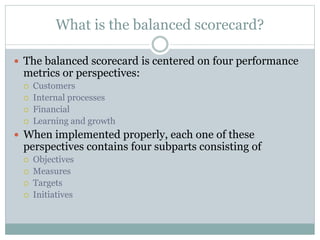
What is the balanced scorecard?
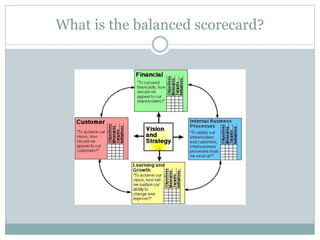
 The balanced scorecard is centered on four performance
metrics or perspectives:
 Customers
 Internal processes
 Financial
 Learning and growth
 When implemented properly, each one of these
perspectives contains four subparts consisting of
 Objectives
 Measures
 Targets
 Initiatives
What is the balanced scorecard?
 Objectives - what the strategy is to achieve in that perspective
 Measures - how progress for that particular objective will be
measured
 Targets - refer to the target value that the company seeks to
obtain for each measure
 Initiatives - what will be done to facilitate the reaching of the
target
What is the balanced scorecard?
 The term “scorecard” signifies quantified
performance measures and “balanced” signifies the
system is balanced between:
 Short-term and long term objectives
 Financial and non-financial measures
 Lagging and leading indicators
 Internal and external performance perspectives
What is the balanced scorecard?
 Kaplan and Norton defined a four-step process that has
been used across a wide range of organizations
 Defining the measurement architecture
 For example will the system be used at the strategic business unit level
rather than the corporate level.
 Specify strategy objectives.
 These should be carefully decided upon and selected as those deemed
critical in achieving breakthrough competitive performance and
limited in number to 15 to 20, or 3 to 4 in each perspective to avoid
information overload.
 Choose strategic measures
 These measures should be closely related to the actual performance
drivers and will later be used for evaluating the progress made toward
achieving the objectives
 Develop an implementation plan to integrate the scorecard into
management.
Customer Needs
 Who is your customer?
 What age, gender, group does our product appeal to?
 What services or products do they expect from you?
 Do we provide personal services, do your products serve as advertised?
 How do you listen to and learn from your customers?
 Do we provide feedback calls or emails?
 How do you retain and acquire new customers?
 Do we use new advertisement and how do we advertise?
 How do you meet customers’ needs?
 Do we provide help lines and how can we provide help to customers?
 How do you measure customer satisfaction and dis-satisfaction?
 Do we use surveys to find out how customers feel about us?
Customer Concerns
 There are four major categories that managers need to address when
concerning their customers.
 Quality
 Are there often recalls or problems with defects with our products.
 Time
 Do we save time by limiting defects and do we provide fast on time delivery.
 Performance and service
 Do we perform up to customers standards and do we provide fast and adequate
services.
 Cost
 Do we try to minimize cost when dealing with ordering, scheduling delivery, and
paying for materials in order to lower cost of our products to our consumers.
Customer Perspective
 With customer perspective managers and companies have to be careful
and make sure they are setting up their balance scorecard to help
customers.
 Examples of things that don’t concern customers are profit per
customer, revenue per customer, and improve profit per customer.
 These objectives don’t necessarily protean to the customer perspective
but rather the companies perspective of the customer.
 Managers need to take a step back and look at how customers perceive
your company and what they want to get out of your company.
Examples of Customers Perspective
 Two main questions that a company should ask itself to
protean to their customers are:
 How should we appear to our customers
 Do we show a promising future
 Do we show a strong sense of concern
 What is our differentiating value proposition to our targeted
customers
 How are we different from our competitors
 What makes us better than our competitors
Perspectives of Kaplan and Norton
 There are four broad categories that Kaplan and Norton base the
customer perspective around.
 Best buy
 Companies that supply services and products at low prices and fast service.
 Product leadership and innovation
 Companies that focus on customer that buy the newest and most advanced
cutting edge technology.
 Customer complete solutions
 Companies that try to sell things like computers where customers customize
them to their liking.
 Lock in
 Companies that will make a product then to buy accessories for that product you
have to buy the same brand name because other brands out work with that
product.
Successful balanced Scorecards
 When using critical thinking of strategy, objectives, and
measures companies can get a feel for who their customers
are and what they can offer them.
 Strategy gurus, like Michael Porter stress the fact that it is
more important to accomplish more with less.
 Don’t try to please everyone when setting up your balanced
scorecard because you can’t.
Internal Processes
 Internal business process objectives address the
question of which processes are the most
critical for satisfying customers and
shareholders
 A firm must concentrate its efforts to excel in these areas
 Metrics based on this prospective allow the
managers to know how well their business is running
and whether its products and services conform to
customer requirements
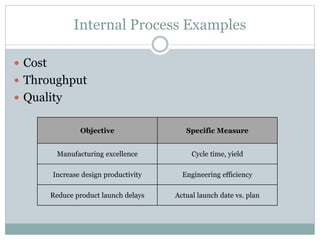
Internal Process Examples
 Cost
 Throughput
 Quality
Objective Specific Measure
Manufacturing excellence Cycle time, yield
Increase design productivity Engineering efficiency
Reduce product launch delays Actual launch date vs. plan
Internal Processes
 In addition to the strategic management process two
kinds of business processes may be identified, these
include:
 Mission-oriented processes - special functions of government
offices which often involve many unique problems in their
processes
 Support processes - more repetitive in nature.
Financial Performance
 The financial performance perspective of the
balanced scorecard addresses the question of how
shareholders view the firm and which
financial goals are desired from the
shareholder’s perspective.
 These financial goals are dependent on the
company’s stage in the business life cycle.
Financial Performance: Business Life Cycle
 There are three main stages to this cycle which
include:
 Growth stage -goal of the company is growth
 An example of a growth goal would be revenue growth.
 Sustain stage - the goal of the firm is profitability
 Measures in this stage may include ROE, ROCE, and EVA.
 Harvest stage - the goal of the firm is cash flow and reduction
in capital requirements.
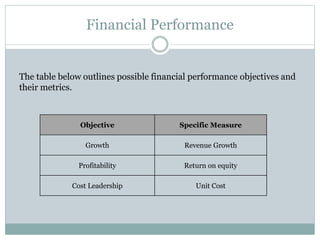
Financial Performance
Objective Specific Measure
Growth Revenue Growth
Profitability Return on equity
Cost Leadership Unit Cost
The table below outlines possible financial performance objectives and
their metrics.
Learning & Growth
“How much a company
must learn, improve, and
innovate to meet
objectives.”
Use of the scorecard:
 To set objectives
 To determine measures
 To predict outcomes
 To determine initiatives
 To gain the big picture
Key performance indicators include:
 Illness rate/days of absence
 Employee turnover
 Gender/racial ratios
 Internal promotion %
A learning & growth example:
 Objective: increase internal promotions
 Measure: bigger % of in house promotions
 Target: +10% in 2 years
 Additional classes and training
“A balanced scorecard system
provides a basis for executing good
strategy well and managing
change.”
 -Howard Rohm
Learning & growth must
focus on measurable
outcomes to move the
company forward.
Scorecard allows for
actionable terms derived
from company strategy.
Balanced Scorecard
Makes it easier for
management to carry out
strategy.
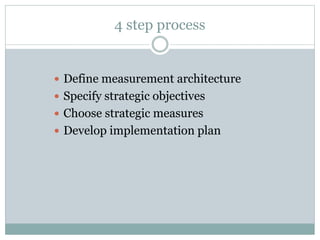
4 step process
 Define measurement architecture
 Specify strategic objectives
 Choose strategic measures
 Develop implementation plan
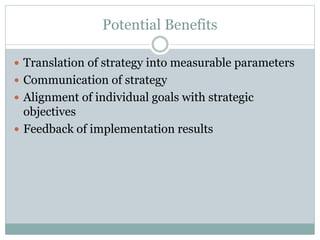
Potential Benefits
 Translation of strategy into measurable parameters
 Communication of strategy
 Alignment of individual goals with strategic
objectives
 Feedback of implementation results
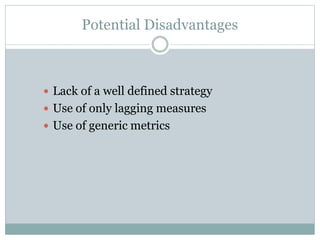
Potential Disadvantages
 Lack of a well defined strategy
 Use of only lagging measures
 Use of generic metrics
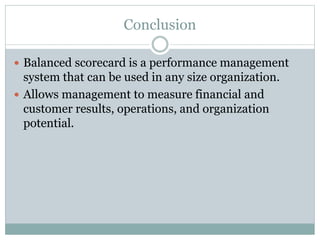
Conclusion
 Balanced scorecard is a performance management
system that can be used in any size organization.
 Allows management to measure financial and
customer results, operations, and organization
potential.

Human resource - Performance Management -The Balanced Scorecard

  • 1.
    P R EP A R E D B Y G R O U P 4 : A N D R E W M O L L O Y A M Y M I L L E R M I K E E L I C K E R The Balanced Scorecard: Customer Perspective, Internal Processes, Learning and Growth
  • 2.
    What is thebalanced scorecard?  Developed in the early 1990’s by Dr. Robert Kaplan and David Norton  "The balanced scorecard retains traditional financial measures. But financial measures tell the story of past events, an adequate story for industrial age companies for which investments in long-term capabilities and customer relationships were not critical for success. These financial measures are inadequate, however, for guiding and evaluating the journey that information age companies must make to create future value through investment in customers, suppliers, employees, processes, technology, and innovation."
  • 3.
    What is thebalanced scorecard?  The Balanced scorecard is a management system that enables organizations to clarify their vision and strategy and translate them into action.  Provides an organization with feedback of both the internal business processes and external outcomes, which allows for continuous improvement of strategic performance and results.  Nerve center of an enterprise
  • 4.
    What is thebalanced scorecard?  The balanced scorecard is centered on four performance metrics or perspectives:  Customers  Internal processes  Financial  Learning and growth  When implemented properly, each one of these perspectives contains four subparts consisting of  Objectives  Measures  Targets  Initiatives
  • 5.
    What is thebalanced scorecard?  Objectives - what the strategy is to achieve in that perspective  Measures - how progress for that particular objective will be measured  Targets - refer to the target value that the company seeks to obtain for each measure  Initiatives - what will be done to facilitate the reaching of the target
  • 6.
    What is thebalanced scorecard?  The term “scorecard” signifies quantified performance measures and “balanced” signifies the system is balanced between:  Short-term and long term objectives  Financial and non-financial measures  Lagging and leading indicators  Internal and external performance perspectives
  • 7.
    What is thebalanced scorecard?
  • 8.
    What is thebalanced scorecard?  Kaplan and Norton defined a four-step process that has been used across a wide range of organizations  Defining the measurement architecture  For example will the system be used at the strategic business unit level rather than the corporate level.  Specify strategy objectives.  These should be carefully decided upon and selected as those deemed critical in achieving breakthrough competitive performance and limited in number to 15 to 20, or 3 to 4 in each perspective to avoid information overload.  Choose strategic measures  These measures should be closely related to the actual performance drivers and will later be used for evaluating the progress made toward achieving the objectives  Develop an implementation plan to integrate the scorecard into management.
  • 9.
    Customer Needs  Whois your customer?  What age, gender, group does our product appeal to?  What services or products do they expect from you?  Do we provide personal services, do your products serve as advertised?  How do you listen to and learn from your customers?  Do we provide feedback calls or emails?  How do you retain and acquire new customers?  Do we use new advertisement and how do we advertise?  How do you meet customers’ needs?  Do we provide help lines and how can we provide help to customers?  How do you measure customer satisfaction and dis-satisfaction?  Do we use surveys to find out how customers feel about us?
  • 10.
    Customer Concerns  Thereare four major categories that managers need to address when concerning their customers.  Quality  Are there often recalls or problems with defects with our products.  Time  Do we save time by limiting defects and do we provide fast on time delivery.  Performance and service  Do we perform up to customers standards and do we provide fast and adequate services.  Cost  Do we try to minimize cost when dealing with ordering, scheduling delivery, and paying for materials in order to lower cost of our products to our consumers.
  • 11.
    Customer Perspective  Withcustomer perspective managers and companies have to be careful and make sure they are setting up their balance scorecard to help customers.  Examples of things that don’t concern customers are profit per customer, revenue per customer, and improve profit per customer.  These objectives don’t necessarily protean to the customer perspective but rather the companies perspective of the customer.  Managers need to take a step back and look at how customers perceive your company and what they want to get out of your company.
  • 12.
    Examples of CustomersPerspective  Two main questions that a company should ask itself to protean to their customers are:  How should we appear to our customers  Do we show a promising future  Do we show a strong sense of concern  What is our differentiating value proposition to our targeted customers  How are we different from our competitors  What makes us better than our competitors
  • 13.
    Perspectives of Kaplanand Norton  There are four broad categories that Kaplan and Norton base the customer perspective around.  Best buy  Companies that supply services and products at low prices and fast service.  Product leadership and innovation  Companies that focus on customer that buy the newest and most advanced cutting edge technology.  Customer complete solutions  Companies that try to sell things like computers where customers customize them to their liking.  Lock in  Companies that will make a product then to buy accessories for that product you have to buy the same brand name because other brands out work with that product.
  • 14.
    Successful balanced Scorecards When using critical thinking of strategy, objectives, and measures companies can get a feel for who their customers are and what they can offer them.  Strategy gurus, like Michael Porter stress the fact that it is more important to accomplish more with less.  Don’t try to please everyone when setting up your balanced scorecard because you can’t.
  • 15.
    Internal Processes  Internalbusiness process objectives address the question of which processes are the most critical for satisfying customers and shareholders  A firm must concentrate its efforts to excel in these areas  Metrics based on this prospective allow the managers to know how well their business is running and whether its products and services conform to customer requirements
  • 16.
    Internal Process Examples Cost  Throughput  Quality Objective Specific Measure Manufacturing excellence Cycle time, yield Increase design productivity Engineering efficiency Reduce product launch delays Actual launch date vs. plan
  • 17.
    Internal Processes  Inaddition to the strategic management process two kinds of business processes may be identified, these include:  Mission-oriented processes - special functions of government offices which often involve many unique problems in their processes  Support processes - more repetitive in nature.
  • 18.
    Financial Performance  Thefinancial performance perspective of the balanced scorecard addresses the question of how shareholders view the firm and which financial goals are desired from the shareholder’s perspective.  These financial goals are dependent on the company’s stage in the business life cycle.
  • 19.
    Financial Performance: BusinessLife Cycle  There are three main stages to this cycle which include:  Growth stage -goal of the company is growth  An example of a growth goal would be revenue growth.  Sustain stage - the goal of the firm is profitability  Measures in this stage may include ROE, ROCE, and EVA.  Harvest stage - the goal of the firm is cash flow and reduction in capital requirements.
  • 20.
    Financial Performance Objective SpecificMeasure Growth Revenue Growth Profitability Return on equity Cost Leadership Unit Cost The table below outlines possible financial performance objectives and their metrics.
  • 21.
  • 22.
    “How much acompany must learn, improve, and innovate to meet objectives.”
  • 23.
    Use of thescorecard:  To set objectives  To determine measures  To predict outcomes  To determine initiatives  To gain the big picture
  • 24.
    Key performance indicatorsinclude:  Illness rate/days of absence  Employee turnover  Gender/racial ratios  Internal promotion %
  • 25.
    A learning &growth example:  Objective: increase internal promotions  Measure: bigger % of in house promotions  Target: +10% in 2 years  Additional classes and training
  • 26.
    “A balanced scorecardsystem provides a basis for executing good strategy well and managing change.”  -Howard Rohm
  • 27.
    Learning & growthmust focus on measurable outcomes to move the company forward.
  • 28.
    Scorecard allows for actionableterms derived from company strategy.
  • 29.
    Balanced Scorecard Makes iteasier for management to carry out strategy.
  • 30.
    4 step process Define measurement architecture  Specify strategic objectives  Choose strategic measures  Develop implementation plan
  • 31.
    Potential Benefits  Translationof strategy into measurable parameters  Communication of strategy  Alignment of individual goals with strategic objectives  Feedback of implementation results
  • 32.
    Potential Disadvantages  Lackof a well defined strategy  Use of only lagging measures  Use of generic metrics
  • 33.
    Conclusion  Balanced scorecardis a performance management system that can be used in any size organization.  Allows management to measure financial and customer results, operations, and organization potential.