D
DOMINANCE
VALUE TO THE TEAM:
 Bottom-line organizer
 Forward-looking
 Challenge-oriented
 Initiates activity
 Innovative
POSSIBLE LIMITATIONS:
 Overuse of position
 Sets standards too high
 Lacks tact and diplomacy
 Takes on too much, too soon,
too fast
DESCRIPTORS:
(Above 50)
 Adventuresome
 Competitive
 Daring
 Decisive
 Direct
 Innovative
 Persistent
 Problem Solver
 Result-oriented
 Self-starter
OBSERVABLE BEHAVIOR:
 Change: Love change
 Conflict response: Fight back
 Driving: Fast, always somewhere to get
to in a hurry
 Gesture: Lot of hand movement and
big
gestures
 Goal setting: Sets many goals - usually
high risk, not written down
 Risk Factor: High risk taker
 Rules: May tend to break the rules
 Talk to others: Direct
 Walk: Fast, always going somewhere
POSSIBLE STRENGTHS:
 Ego
 Problem-solver
 Likes challenging assignments
 Drive for results
 Positive, likes confrontation
 Power and authority
 Motivated by direct answers
NEEDS DRIVEN BEHAVIOUR:
 High need for control
FEAR OF THE HIGH D:
 Being taken advantage of
EMOTION OF THE HIGH D:
 Anger
DESCRIPTORS
I
INFLUENCE
VALUE TO THE TEAM:
 Optimism and enthusiasm
 Creative problem solving
 Motivates others towards goals
 Team player
 Negotiates conflicts
POSSIBLE LIMITATIONS:
 Inattentive to details
 Unrealistic in appraising people
 Trust people indiscriminately
 Situational listener
DESCRIPTORS:
(Above 50)
 Charming
 Confident
 Convincing
 Enthusiastic
 Inspiring
 Optimistic
 Persuasive
 Popular
 Sociable
 Trusting
OBSERVABLE BEHAVIOR:
 Change: May not notice change
 Conflict response: Non confronting,
puts things under the carpet
 Driving: Visual, looks around, radio on
 Gesture: Big gestures & facial
expressions
 Goal setting: Not good at setting
goals.
 Risk Factor: Moderate
 Rules: Not aware of rules and may
break them unintentionally
 Walk: Casual, lazy walk, looks in
different
directions, nodding & acknowledging
POSSIBLE STRENGTHS:
 Socially and verbally aggressive
 Very optimistic
 Good at persuading people
 Can see the "big dream" and
communicate it
 People-oriented
 Team-oriented
 Motivated by praise & strokes
NEEDS DRIVEN BEHAVIOUR:
 High need to verbalize ideas
FEAR OF THE HIGH I:
 Social Rejection
EMOTION OF THE HIGH I:
 Optimism
DESCRIPTORS
S
STEADINESS
VALUE TO THE TEAM:
 Dependable team player
 Work for a leader and a cause
 Patient and empathetic
 Logical step-wise thinker
 Service-oriented
POSSIBLE LIMITATIONS:
 Yield to avoid controversy
 Difficulty in establishing
priorities
 Dislike of unwarranted change
 Difficulty dealing with
diverse situations
DESCRIPTORS:
(Above 50)
 Amiable
 Friendly
 Good Listener
 Patient
 Relaxed
 Sincere
 Stable
 Steady
 Team Player
 Understanding
OBSERVABLE BEHAVIOR:
 Change: Does not like unwarranted
change
 Conflict response: Tolerate, put up with
it or give in to ensure harmony
 Driving: Relaxed pace, no hurry
 Gesture: Will gesture with hands, no big
gestures
 Goal setting: Short term low risk
 Risk Factor: Moderate, low risk taker
 Rules: Time tested, proven rules
 Walk : Steady, easy pace
POSSIBLE STRENGTHS:
 Loyal to those they identify with
 Good listener
 Patient and empathetic
 Likes a team environment
 Long service deemed important
 Geared towards family
 Motivated by
traditional procedures
NEEDS DRIVEN BEHAVIOUR:
 High need to accommodate
FEAR OF THE HIGH S:
 Loss of Security
EMOTION OF THE HIGH S:
 Non-Expressive of Emotions
DESCRIPTORS
C
COMPLIANCE
VALUE TO THE TEAM:
 Maintains high standards
 Conscientious and steady
 Defines, clarifies, gets data and tests
 Objective - "the anchor of reality"
 Comprehensive problem solver
POSSIBLE LIMITATIONS:
 Be defensive when criticized
 Get bogged down in details
 Be overly intense for the
situation
 Appear somewhat aloof/cool
DESCRIPTORS:
(Above 50)
 Accurate
 Analytical
 Conscientious
 Courteous
 Diplomatic
 Fact-finder
 High Standards
 Mature
 Patient
 Precise
OBSERVABLE BEHAVIOR:
 Change: Concerned about effects
of change
 Conflict response: Avoidance, will
use SOPs/frameworks
 Driving: Careful, follow rules, best
drivers
 Gesture: Little or no gestures
 Goal setting: Good at setting goals
 Risk Factor: Very low
 Rules: By the book. Knows and follows
the rules
 Walk : Straight line
POSSIBLE STRENGTHS:
 Critical thinker
 High standards for self
and subordinates
 Well disciplined
 Maintain high standards
 Motivated by the right way
to proceed
 Accurate
NEEDS DRIVEN BEHAVIOUR:
 High need to follow rules
FEAR OF THE HIGH C:
 Criticism of their Work
EMOTION OF THE HIGH C:
 Fear
DESCRIPTORS
HIGH D IS LOOKING FOR :
RESULTS
COMMUNICATING EFFECTIVELY WITH THE D
 High risk taker - will need to slow down and look at
data
 Low attention to detail - will need to spend time
looking at data and facts
 Needs to listen before acting
HIGH I IS LOOKING FOR : THE
EXPERIENCE
COMMUNICATING EFFECTIVELY WITH THE I
 High D needs to add a little fun to the task and
slow down just a bit
 High D must allow the High I to verbalize
 High D will need to give time to the High I to
discuss and
then take decisions
HIGH C IS LOOKING FOR :
INFORMATION
COMMUNICATING EFFECTIVELY WITH THE C
 High D needs to slow down and get the facts
 High D needs to reduce aggression or being pushy
with the High C
 High D needs to give time to the High C to
assimilate and take decisions
HIGH S IS LOOKING FOR :
SECURITY
COMMUNICATING EFFECTIVELY WITH THE S
 High D needs to slow down and build a
trust relationship
 High D should reduce aggression and allow the
High S to verbalize
 High D needs to listen
D
COMMUNICATION TIPS
HIGH D IS LOOKING FOR :
RESULTS
COMMUNICATING EFFECTIVELY WITH THE D
 High I will need to be more direct with the High D
 The High I needs to allow the High D to take charge
of the conversation
 Being aware that the High D will be aggressive, the
High
I should maintain his position
HIGH I IS LOOKING FOR : THE
EXPERIENCE
COMMUNICATING EFFECTIVELY WITH THE I
 Needs to prioritize through logical analysis
 Set strict schedules and deadlines - time
management
HIGH C IS LOOKING FOR :
INFORMATION
COMMUNICATING EFFECTIVELY WITH THE C
 The High I will have to slow down, control
emotions
 The High I will need to provide data, facts and
figures
 Personal talk, extra verbalization, over
enthusiasm, emotions needs to be reduced
HIGH S IS LOOKING FOR :
SECURITY
COMMUNICATING EFFECTIVELY WITH THE S
 High I will need to tone down his approach, talk less
and encourage the High S to interact
 Non-emotional nature of the High S should not be
taken by the High I as an indication of agreement
 The High I needs to ask more questions
I
COMMUNICATION TIPS
HIGH D IS LOOKING FOR :
RESULTS
COMMUNICATING EFFECTIVELY WITH THE D
 The High S needs to pick up the pace and be direct
 The High S should not allow the High D to
overpower him and hence go along with the High
D
 The High S needs to ask more questions, forcing
the
High D to defend his position
HIGH I IS LOOKING FOR : THE
EXPERIENCE
COMMUNICATING EFFECTIVELY WITH THE I
 High S needs to loosen up with the High I for more
freedom and fun
 Allow the High I to verbalize
 Encourage creativity and innovation through
verbalization
HIGH C IS LOOKING FOR :
INFORMATION
COMMUNICATING EFFECTIVELY WITH THE C
 The High S will need to prioritize and deal with
change effectively
 Needs to manage/handle multiple tasks
 The High S will need to provide data to the High C
HIGH S IS LOOKING FOR :
SECURITY
COMMUNICATING EFFECTIVELY WITH THE S
 Needs to pick up the pace to achieve entire potential
 Needs to help with prioritization of tasks
 Needs to know when to stop thinking and start
implementing
S
COMMUNICATION TIPS
HIGH D IS LOOKING FOR :
RESULTS
COMMUNICATING EFFECTIVELY WITH THE D
 The High C needs to come up to the expectations of
the High D
 The High C needs to ask for data against the High D’s
need to get into action
 The High C should relax and not become over critical
HIGH I IS LOOKING FOR : THE
EXPERIENCE
COMMUNICATING EFFECTIVELY WITH THE I
 The High C will need to loosen up and accept the
High
I’s need to verbalize
 The High C needs to pick up the pace
 Use questions which will allow the High I to
verbalize
HIGH C IS LOOKING FOR :
INFORMATION
COMMUNICATING EFFECTIVELY WITH THE C
 The High C needs to reduce perfectionist
tendencies
HIGH S IS LOOKING FOR :
SECURITY
COMMUNICATING EFFECTIVELY WITH THE S
 The High C will need to give enough information
 Use information to make the High S feel
comfortable and accept required change
 Will need to help the High S prioritize tasks
C
COMMUNICATION TIPS
MANAGING TIPS
MANAGING DISC STYLES
D I S C
• Clearly explain results
expected
• Define boundaries
• Provide
challenging
assignments
• Confront face-to-face
in all disagreements
• Coach on empathy &
people sensitivity
• Coach on teamwork
and collaboration
• Coach on listening
skills
• Discuss
advancement and
career path
• Make sure their
emotional
intensity fits the
situation
• Coach them in learning
to pace self and relax
• Coach in setting realistic
goals
• Coach on time
management
and
prioritization
• Set clear objectives to
be accomplished
• Look for opportunities
to
utilize their verbal skills
• Allow them freedom of
movement – less
control
• Develop a friendship
and make time for
interaction
• Open door policy for
High
I to discuss any issues
• Coach on
behavioral styles
to increase
• Prepare them for
upcoming changes
• Needs tangible
rewards, but will not
ask for them
• Allow them the
opportunity to finish
tasks started
• Do not give them too
many tasks at the
same time
• Encourage their
contributions in
meetings
• Involve them in long-
term planning
• Make an effort to get
to know them and
their needs
• Coach to stretch
them step by step to
new heights
• They like work with a
small group of people
• Private place to work –
no chaos & crowded
places
• Do not criticize their
work unless you can
prove a better way –
they are skeptical by
nature
• Involve them in defining
& implementing
benchmarks
• Coach to set
practical goals
• Involve them in long
term
planning
• Coach on people
skills / skeptical
• Respect their
personal need for
privacy
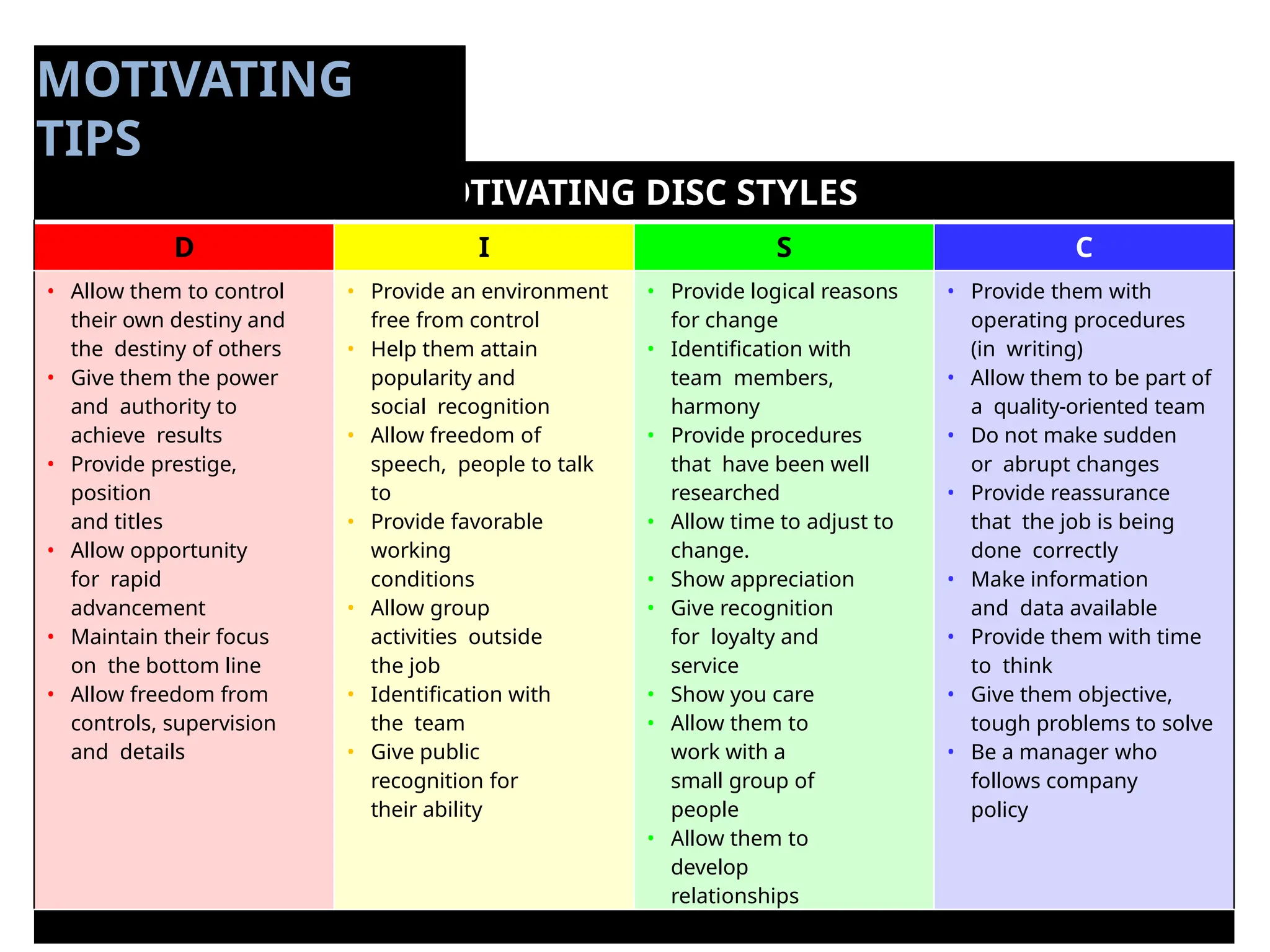
MOTIVATING DISC STYLES
D I S C
• Allow them to control
their own destiny and
the destiny of others
• Give them the power
and authority to
achieve results
• Provide prestige,
position
and titles
• Allow opportunity
for rapid
advancement
• Maintain their focus
on the bottom line
• Allow freedom from
controls, supervision
and details
• Provide an environment
free from control
• Help them attain
popularity and
social recognition
• Allow freedom of
speech, people to talk
to
• Provide favorable
working
conditions
• Allow group
activities outside
the job
• Identification with
the team
• Give public
recognition for
their ability
• Provide logical reasons
for change
• Identification with
team members,
harmony
• Provide procedures
that have been well
researched
• Allow time to adjust to
change.
• Show appreciation
• Give recognition
for loyalty and
service
• Show you care
• Allow them to
work with a
small group of
people
• Allow them to
develop
relationships
• Provide them with
operating procedures
(in writing)
• Allow them to be part of
a quality-oriented team
• Do not make sudden
or abrupt changes
• Provide reassurance
that the job is being
done correctly
• Make information
and data available
• Provide them with time
to think
• Give them objective,
tough problems to solve
• Be a manager who
follows company
policy
MOTIVATING
TIPS
INSIGHTS
CONDUCTOR
(D)
PROMOTER
(I)
SUPPORTER
(S)
ANALYZER
(C)
DESCRIPTORS
Competitive
Confrontation
al Direct
Results- Oriented
Sense of
Urgency
Change Agent
High Trust Level
Not Fearful of
change
Contactability
Rather Talk than
Listen
Verbal Skills
Projects
Self-Confidence
Accommodating
Dislikes
Confrontation
Persistent
Adaptable
Good Listener
Precise
Accurat
e
Concern for
Quality
Critical
Listener
Non-verbal
Communicator
Attention to
Detail
WORDS THAT DON’T WORK
Frequent
Interruptions Follow
Directions
In My Opinion
Theoretical
The Same for
Everyone
Sophisticated
Requires Study
Substantial
Change
Innovative
Play to Win
Clever
Educated
Guess
Experim
ental
VALUE TO THE TEAM
Getting Results Promoting Ideas
Promoting and
Implementing
Ideas
Connecting the Plan
PERSUADER
(DI)
RELATER
(IS)
COORDINATOR
(SC)
IMPLEMENTOR
(CD)
DESCRIPTORS
Process –
Oriented Quick to
Change
Independent
Optimistic
Good
Supporter
Team Player
Persistent Co-
operative
Sensitive to Other’s
Feelings
Products –
Oriented Slow to
Change Self-
Disciplined
Persistent
Creative
Slow-Start/ Fast Finish
Vacillating
Temperamental
WORDS THAT DON’T WORK
Standardize
d
Structured
Uniform
Comple
x
Abstract
Override the
People
New
Revolutionar
y Cutting
Edge
Feelings
Perception
Your
Opinion
VALUE TO THE TEAM
Getting Results
Through
People
Promoting &
Implementing
Ideas
Implementing & Fine
Tuning the Plan
Thinking &
Implementing
Creative Ideas
PERSUADER
(DI)
RELATER
(IS)
COORDINATOR
(SC)
IMPLEMETOR
(CD)
Process –Oriented
Quick to Change
Independent
Optimistic
Good Supporter
Team Player
Persistent
Co-operative
Sensitive to Other’s Feelings
Products –Oriented
Slow to Change
Self-Disciplined
Persistent
Creative
Slow-Start/ Fast Finish
Vacillating
Temperamental
Standardized
Structured
Uniform
Complex
Abstract
Override the People
New
Revolutionary
Cutting Edge
Feelings
Perception
Your Opinion
Getting Results
Through People
Promoting and
Implementing Ideas
Implementing and
Fine tuning the Plan
Thinking and Implementing
Creating Ideas
INSIGHTS

Two Day - EOD 2 - DISC Cue Cards.pptx

  • 1.
    D DOMINANCE VALUE TO THETEAM:  Bottom-line organizer  Forward-looking  Challenge-oriented  Initiates activity  Innovative POSSIBLE LIMITATIONS:  Overuse of position  Sets standards too high  Lacks tact and diplomacy  Takes on too much, too soon, too fast DESCRIPTORS: (Above 50)  Adventuresome  Competitive  Daring  Decisive  Direct  Innovative  Persistent  Problem Solver  Result-oriented  Self-starter OBSERVABLE BEHAVIOR:  Change: Love change  Conflict response: Fight back  Driving: Fast, always somewhere to get to in a hurry  Gesture: Lot of hand movement and big gestures  Goal setting: Sets many goals - usually high risk, not written down  Risk Factor: High risk taker  Rules: May tend to break the rules  Talk to others: Direct  Walk: Fast, always going somewhere POSSIBLE STRENGTHS:  Ego  Problem-solver  Likes challenging assignments  Drive for results  Positive, likes confrontation  Power and authority  Motivated by direct answers NEEDS DRIVEN BEHAVIOUR:  High need for control FEAR OF THE HIGH D:  Being taken advantage of EMOTION OF THE HIGH D:  Anger DESCRIPTORS
  • 2.
    I INFLUENCE VALUE TO THETEAM:  Optimism and enthusiasm  Creative problem solving  Motivates others towards goals  Team player  Negotiates conflicts POSSIBLE LIMITATIONS:  Inattentive to details  Unrealistic in appraising people  Trust people indiscriminately  Situational listener DESCRIPTORS: (Above 50)  Charming  Confident  Convincing  Enthusiastic  Inspiring  Optimistic  Persuasive  Popular  Sociable  Trusting OBSERVABLE BEHAVIOR:  Change: May not notice change  Conflict response: Non confronting, puts things under the carpet  Driving: Visual, looks around, radio on  Gesture: Big gestures & facial expressions  Goal setting: Not good at setting goals.  Risk Factor: Moderate  Rules: Not aware of rules and may break them unintentionally  Walk: Casual, lazy walk, looks in different directions, nodding & acknowledging POSSIBLE STRENGTHS:  Socially and verbally aggressive  Very optimistic  Good at persuading people  Can see the "big dream" and communicate it  People-oriented  Team-oriented  Motivated by praise & strokes NEEDS DRIVEN BEHAVIOUR:  High need to verbalize ideas FEAR OF THE HIGH I:  Social Rejection EMOTION OF THE HIGH I:  Optimism DESCRIPTORS
  • 3.
    S STEADINESS VALUE TO THETEAM:  Dependable team player  Work for a leader and a cause  Patient and empathetic  Logical step-wise thinker  Service-oriented POSSIBLE LIMITATIONS:  Yield to avoid controversy  Difficulty in establishing priorities  Dislike of unwarranted change  Difficulty dealing with diverse situations DESCRIPTORS: (Above 50)  Amiable  Friendly  Good Listener  Patient  Relaxed  Sincere  Stable  Steady  Team Player  Understanding OBSERVABLE BEHAVIOR:  Change: Does not like unwarranted change  Conflict response: Tolerate, put up with it or give in to ensure harmony  Driving: Relaxed pace, no hurry  Gesture: Will gesture with hands, no big gestures  Goal setting: Short term low risk  Risk Factor: Moderate, low risk taker  Rules: Time tested, proven rules  Walk : Steady, easy pace POSSIBLE STRENGTHS:  Loyal to those they identify with  Good listener  Patient and empathetic  Likes a team environment  Long service deemed important  Geared towards family  Motivated by traditional procedures NEEDS DRIVEN BEHAVIOUR:  High need to accommodate FEAR OF THE HIGH S:  Loss of Security EMOTION OF THE HIGH S:  Non-Expressive of Emotions DESCRIPTORS
  • 4.
    C COMPLIANCE VALUE TO THETEAM:  Maintains high standards  Conscientious and steady  Defines, clarifies, gets data and tests  Objective - "the anchor of reality"  Comprehensive problem solver POSSIBLE LIMITATIONS:  Be defensive when criticized  Get bogged down in details  Be overly intense for the situation  Appear somewhat aloof/cool DESCRIPTORS: (Above 50)  Accurate  Analytical  Conscientious  Courteous  Diplomatic  Fact-finder  High Standards  Mature  Patient  Precise OBSERVABLE BEHAVIOR:  Change: Concerned about effects of change  Conflict response: Avoidance, will use SOPs/frameworks  Driving: Careful, follow rules, best drivers  Gesture: Little or no gestures  Goal setting: Good at setting goals  Risk Factor: Very low  Rules: By the book. Knows and follows the rules  Walk : Straight line POSSIBLE STRENGTHS:  Critical thinker  High standards for self and subordinates  Well disciplined  Maintain high standards  Motivated by the right way to proceed  Accurate NEEDS DRIVEN BEHAVIOUR:  High need to follow rules FEAR OF THE HIGH C:  Criticism of their Work EMOTION OF THE HIGH C:  Fear DESCRIPTORS
  • 5.
    HIGH D ISLOOKING FOR : RESULTS COMMUNICATING EFFECTIVELY WITH THE D  High risk taker - will need to slow down and look at data  Low attention to detail - will need to spend time looking at data and facts  Needs to listen before acting HIGH I IS LOOKING FOR : THE EXPERIENCE COMMUNICATING EFFECTIVELY WITH THE I  High D needs to add a little fun to the task and slow down just a bit  High D must allow the High I to verbalize  High D will need to give time to the High I to discuss and then take decisions HIGH C IS LOOKING FOR : INFORMATION COMMUNICATING EFFECTIVELY WITH THE C  High D needs to slow down and get the facts  High D needs to reduce aggression or being pushy with the High C  High D needs to give time to the High C to assimilate and take decisions HIGH S IS LOOKING FOR : SECURITY COMMUNICATING EFFECTIVELY WITH THE S  High D needs to slow down and build a trust relationship  High D should reduce aggression and allow the High S to verbalize  High D needs to listen D COMMUNICATION TIPS
  • 6.
    HIGH D ISLOOKING FOR : RESULTS COMMUNICATING EFFECTIVELY WITH THE D  High I will need to be more direct with the High D  The High I needs to allow the High D to take charge of the conversation  Being aware that the High D will be aggressive, the High I should maintain his position HIGH I IS LOOKING FOR : THE EXPERIENCE COMMUNICATING EFFECTIVELY WITH THE I  Needs to prioritize through logical analysis  Set strict schedules and deadlines - time management HIGH C IS LOOKING FOR : INFORMATION COMMUNICATING EFFECTIVELY WITH THE C  The High I will have to slow down, control emotions  The High I will need to provide data, facts and figures  Personal talk, extra verbalization, over enthusiasm, emotions needs to be reduced HIGH S IS LOOKING FOR : SECURITY COMMUNICATING EFFECTIVELY WITH THE S  High I will need to tone down his approach, talk less and encourage the High S to interact  Non-emotional nature of the High S should not be taken by the High I as an indication of agreement  The High I needs to ask more questions I COMMUNICATION TIPS
  • 7.
    HIGH D ISLOOKING FOR : RESULTS COMMUNICATING EFFECTIVELY WITH THE D  The High S needs to pick up the pace and be direct  The High S should not allow the High D to overpower him and hence go along with the High D  The High S needs to ask more questions, forcing the High D to defend his position HIGH I IS LOOKING FOR : THE EXPERIENCE COMMUNICATING EFFECTIVELY WITH THE I  High S needs to loosen up with the High I for more freedom and fun  Allow the High I to verbalize  Encourage creativity and innovation through verbalization HIGH C IS LOOKING FOR : INFORMATION COMMUNICATING EFFECTIVELY WITH THE C  The High S will need to prioritize and deal with change effectively  Needs to manage/handle multiple tasks  The High S will need to provide data to the High C HIGH S IS LOOKING FOR : SECURITY COMMUNICATING EFFECTIVELY WITH THE S  Needs to pick up the pace to achieve entire potential  Needs to help with prioritization of tasks  Needs to know when to stop thinking and start implementing S COMMUNICATION TIPS
  • 8.
    HIGH D ISLOOKING FOR : RESULTS COMMUNICATING EFFECTIVELY WITH THE D  The High C needs to come up to the expectations of the High D  The High C needs to ask for data against the High D’s need to get into action  The High C should relax and not become over critical HIGH I IS LOOKING FOR : THE EXPERIENCE COMMUNICATING EFFECTIVELY WITH THE I  The High C will need to loosen up and accept the High I’s need to verbalize  The High C needs to pick up the pace  Use questions which will allow the High I to verbalize HIGH C IS LOOKING FOR : INFORMATION COMMUNICATING EFFECTIVELY WITH THE C  The High C needs to reduce perfectionist tendencies HIGH S IS LOOKING FOR : SECURITY COMMUNICATING EFFECTIVELY WITH THE S  The High C will need to give enough information  Use information to make the High S feel comfortable and accept required change  Will need to help the High S prioritize tasks C COMMUNICATION TIPS
  • 9.
    MANAGING TIPS MANAGING DISCSTYLES D I S C • Clearly explain results expected • Define boundaries • Provide challenging assignments • Confront face-to-face in all disagreements • Coach on empathy & people sensitivity • Coach on teamwork and collaboration • Coach on listening skills • Discuss advancement and career path • Make sure their emotional intensity fits the situation • Coach them in learning to pace self and relax • Coach in setting realistic goals • Coach on time management and prioritization • Set clear objectives to be accomplished • Look for opportunities to utilize their verbal skills • Allow them freedom of movement – less control • Develop a friendship and make time for interaction • Open door policy for High I to discuss any issues • Coach on behavioral styles to increase • Prepare them for upcoming changes • Needs tangible rewards, but will not ask for them • Allow them the opportunity to finish tasks started • Do not give them too many tasks at the same time • Encourage their contributions in meetings • Involve them in long- term planning • Make an effort to get to know them and their needs • Coach to stretch them step by step to new heights • They like work with a small group of people • Private place to work – no chaos & crowded places • Do not criticize their work unless you can prove a better way – they are skeptical by nature • Involve them in defining & implementing benchmarks • Coach to set practical goals • Involve them in long term planning • Coach on people skills / skeptical • Respect their personal need for privacy
  • 10.
    MOTIVATING DISC STYLES DI S C • Allow them to control their own destiny and the destiny of others • Give them the power and authority to achieve results • Provide prestige, position and titles • Allow opportunity for rapid advancement • Maintain their focus on the bottom line • Allow freedom from controls, supervision and details • Provide an environment free from control • Help them attain popularity and social recognition • Allow freedom of speech, people to talk to • Provide favorable working conditions • Allow group activities outside the job • Identification with the team • Give public recognition for their ability • Provide logical reasons for change • Identification with team members, harmony • Provide procedures that have been well researched • Allow time to adjust to change. • Show appreciation • Give recognition for loyalty and service • Show you care • Allow them to work with a small group of people • Allow them to develop relationships • Provide them with operating procedures (in writing) • Allow them to be part of a quality-oriented team • Do not make sudden or abrupt changes • Provide reassurance that the job is being done correctly • Make information and data available • Provide them with time to think • Give them objective, tough problems to solve • Be a manager who follows company policy MOTIVATING TIPS
  • 11.
    INSIGHTS CONDUCTOR (D) PROMOTER (I) SUPPORTER (S) ANALYZER (C) DESCRIPTORS Competitive Confrontation al Direct Results- Oriented Senseof Urgency Change Agent High Trust Level Not Fearful of change Contactability Rather Talk than Listen Verbal Skills Projects Self-Confidence Accommodating Dislikes Confrontation Persistent Adaptable Good Listener Precise Accurat e Concern for Quality Critical Listener Non-verbal Communicator Attention to Detail WORDS THAT DON’T WORK Frequent Interruptions Follow Directions In My Opinion Theoretical The Same for Everyone Sophisticated Requires Study Substantial Change Innovative Play to Win Clever Educated Guess Experim ental VALUE TO THE TEAM Getting Results Promoting Ideas Promoting and Implementing Ideas Connecting the Plan
  • 12.
    PERSUADER (DI) RELATER (IS) COORDINATOR (SC) IMPLEMENTOR (CD) DESCRIPTORS Process – Oriented Quickto Change Independent Optimistic Good Supporter Team Player Persistent Co- operative Sensitive to Other’s Feelings Products – Oriented Slow to Change Self- Disciplined Persistent Creative Slow-Start/ Fast Finish Vacillating Temperamental WORDS THAT DON’T WORK Standardize d Structured Uniform Comple x Abstract Override the People New Revolutionar y Cutting Edge Feelings Perception Your Opinion VALUE TO THE TEAM Getting Results Through People Promoting & Implementing Ideas Implementing & Fine Tuning the Plan Thinking & Implementing Creative Ideas PERSUADER (DI) RELATER (IS) COORDINATOR (SC) IMPLEMETOR (CD) Process –Oriented Quick to Change Independent Optimistic Good Supporter Team Player Persistent Co-operative Sensitive to Other’s Feelings Products –Oriented Slow to Change Self-Disciplined Persistent Creative Slow-Start/ Fast Finish Vacillating Temperamental Standardized Structured Uniform Complex Abstract Override the People New Revolutionary Cutting Edge Feelings Perception Your Opinion Getting Results Through People Promoting and Implementing Ideas Implementing and Fine tuning the Plan Thinking and Implementing Creating Ideas INSIGHTS