Emil Velinov
ITC-Prague









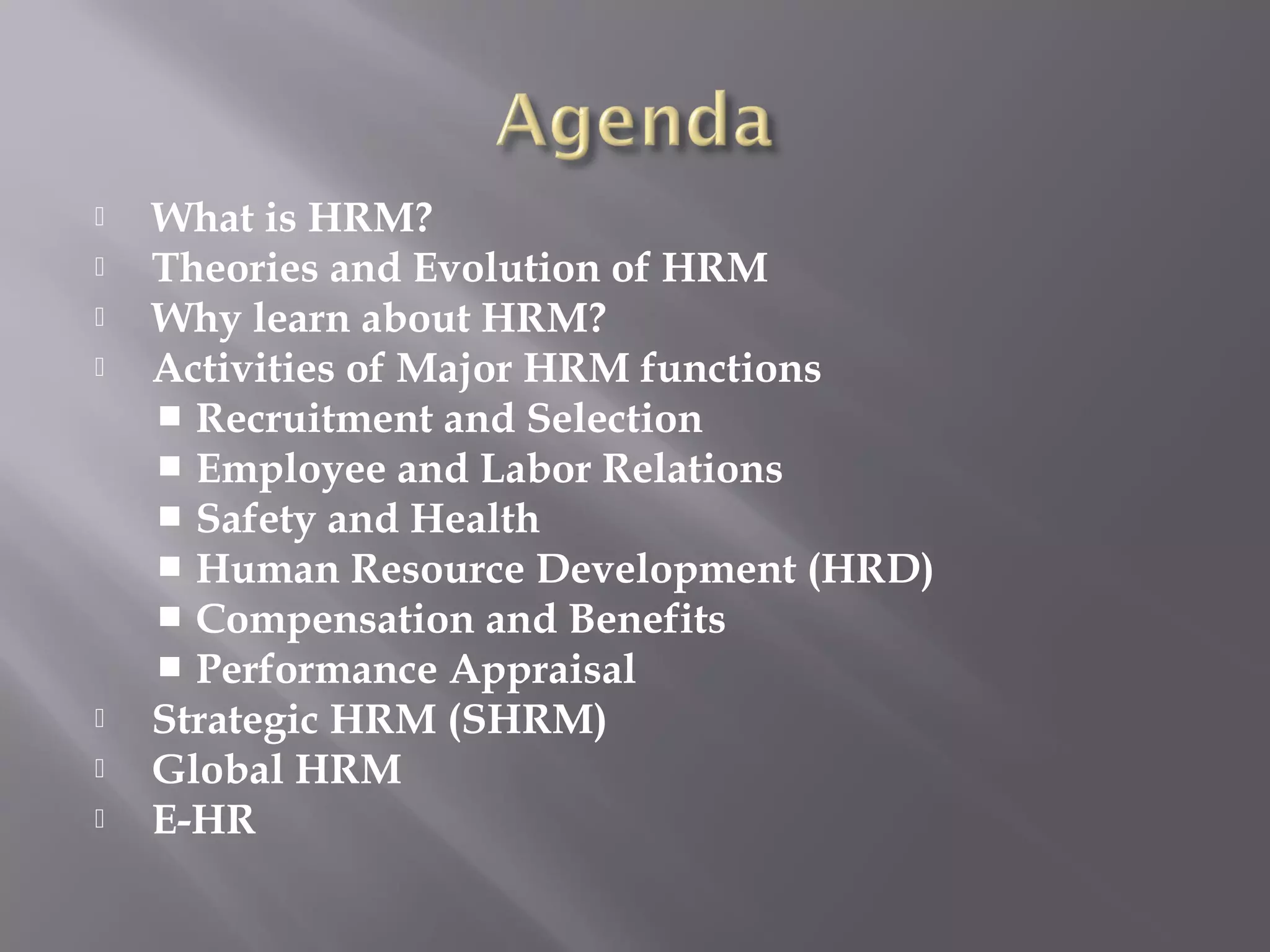
What is HRM?
Theories and Evolution of HRM
Why learn about HRM?
Activities of Major HRM functions
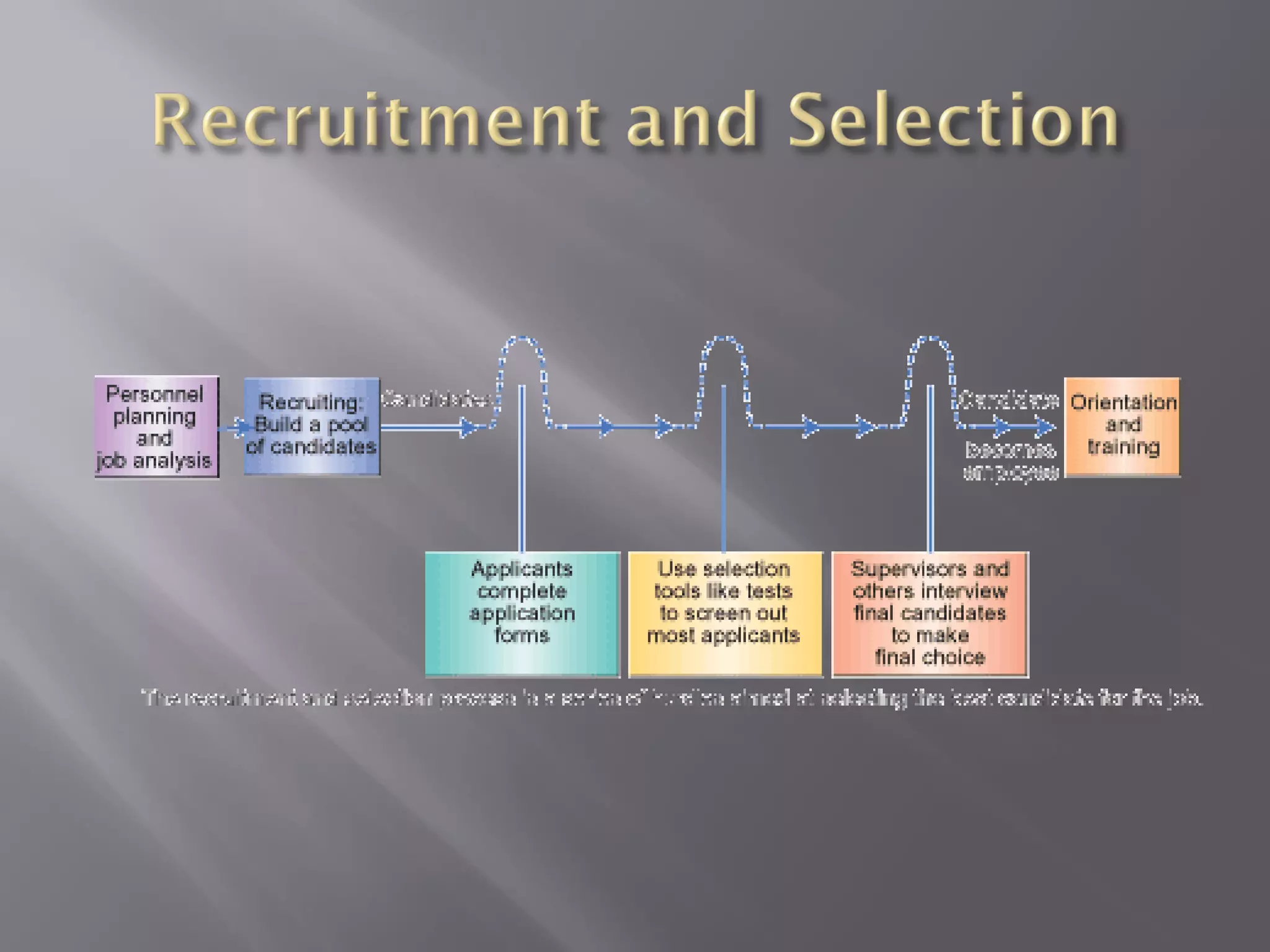
 Recruitment and Selection
 Employee and Labor Relations
 Safety and Health
 Human Resource Development (HRD)
 Compensation and Benefits
 Performance Appraisal
Strategic HRM (SHRM)
Global HRM
E-HR
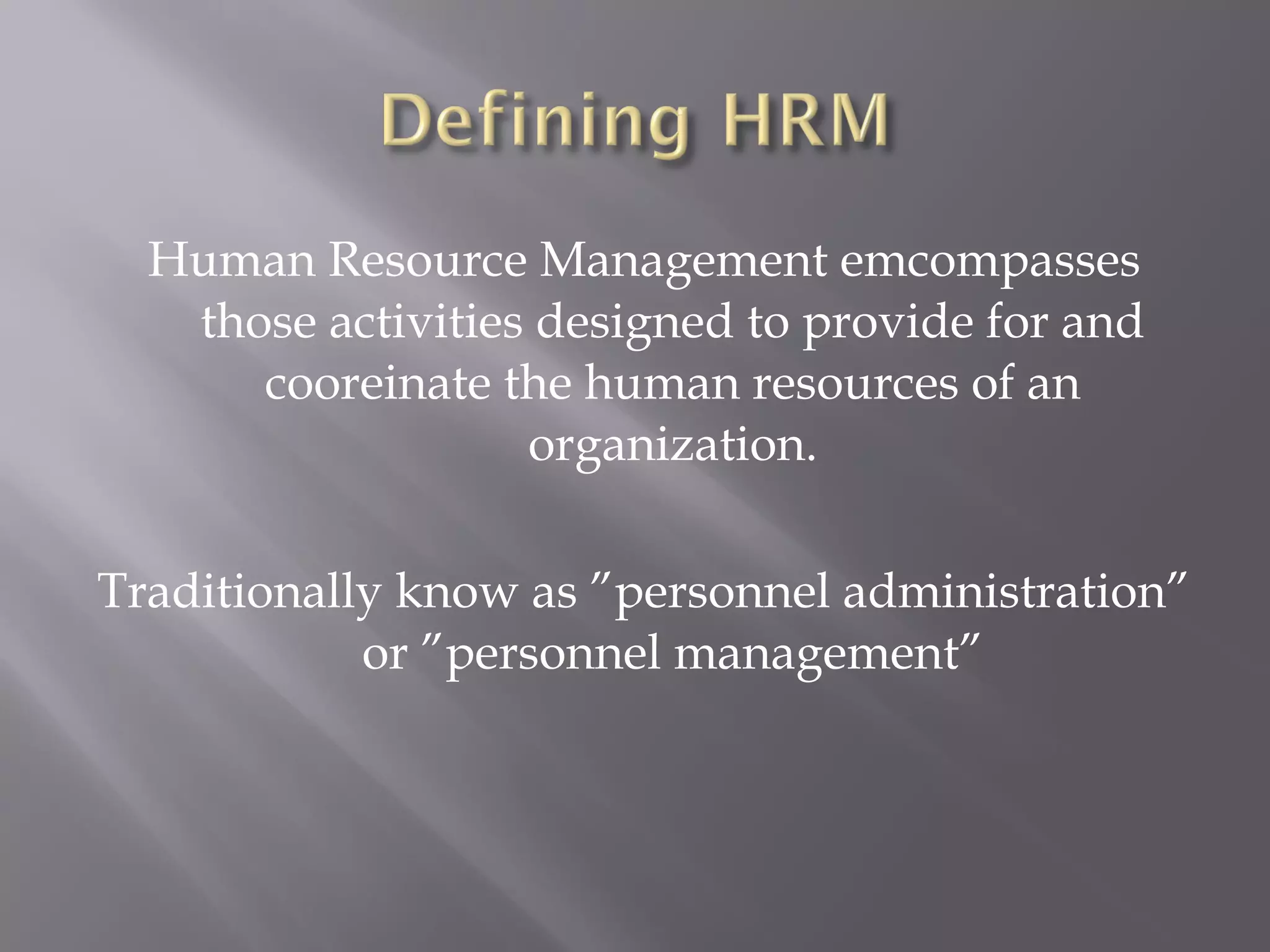
Human Resource Management emcompasses
those activities designed to provide for and
cooreinate the human resources of an
organization.
Traditionally know as ”personnel administration”
or ”personnel management”


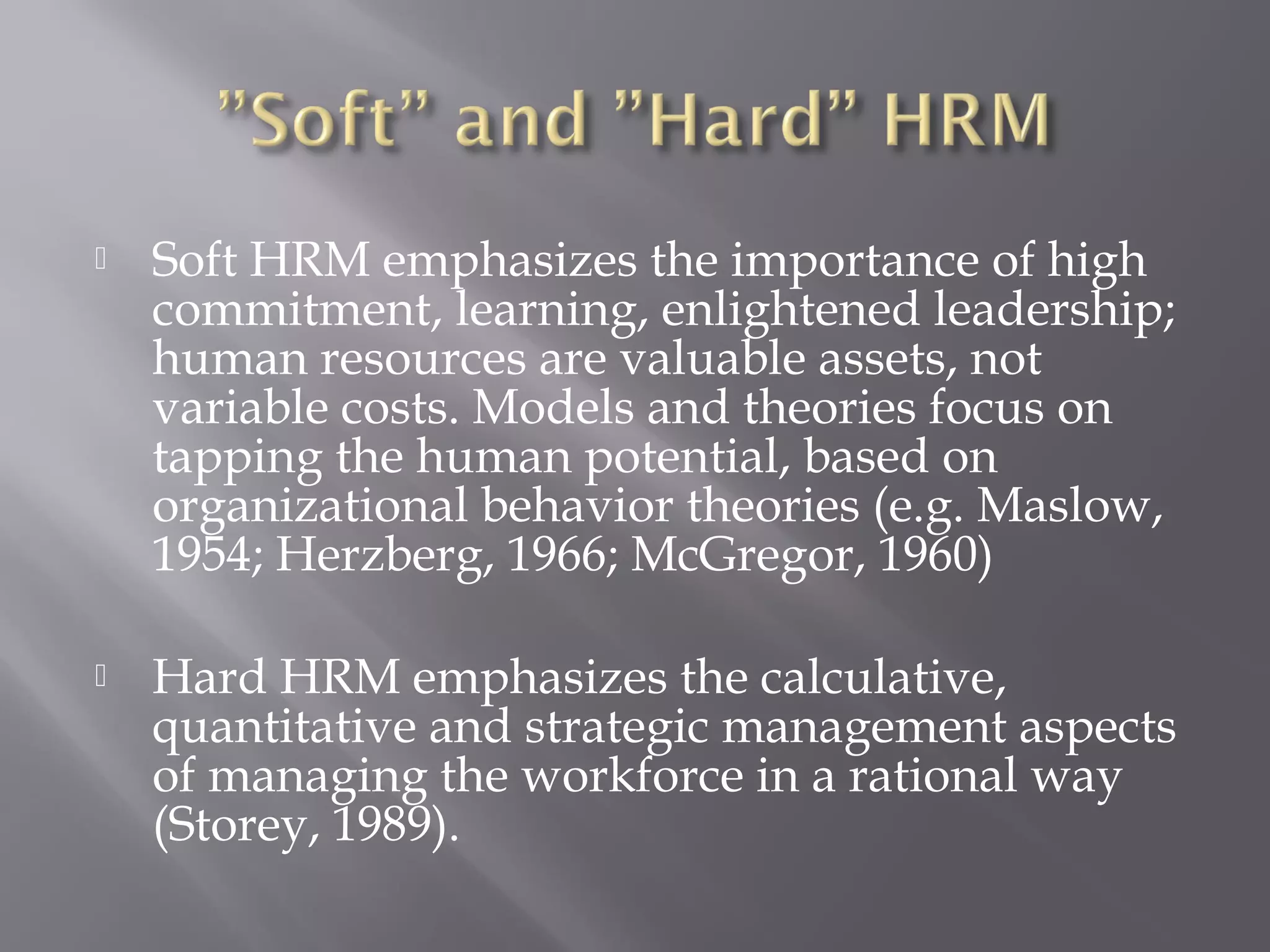
Soft HRM emphasizes the importance of high
commitment, learning, enlightened leadership;
human resources are valuable assets, not
variable costs. Models and theories focus on
tapping the human potential, based on
organizational behavior theories (e.g. Maslow,
1954; Herzberg, 1966; McGregor, 1960)



Hard HRM emphasizes the calculative,
quantitative and strategic management aspects
of managing the workforce in a rational way
(Storey, 1989).
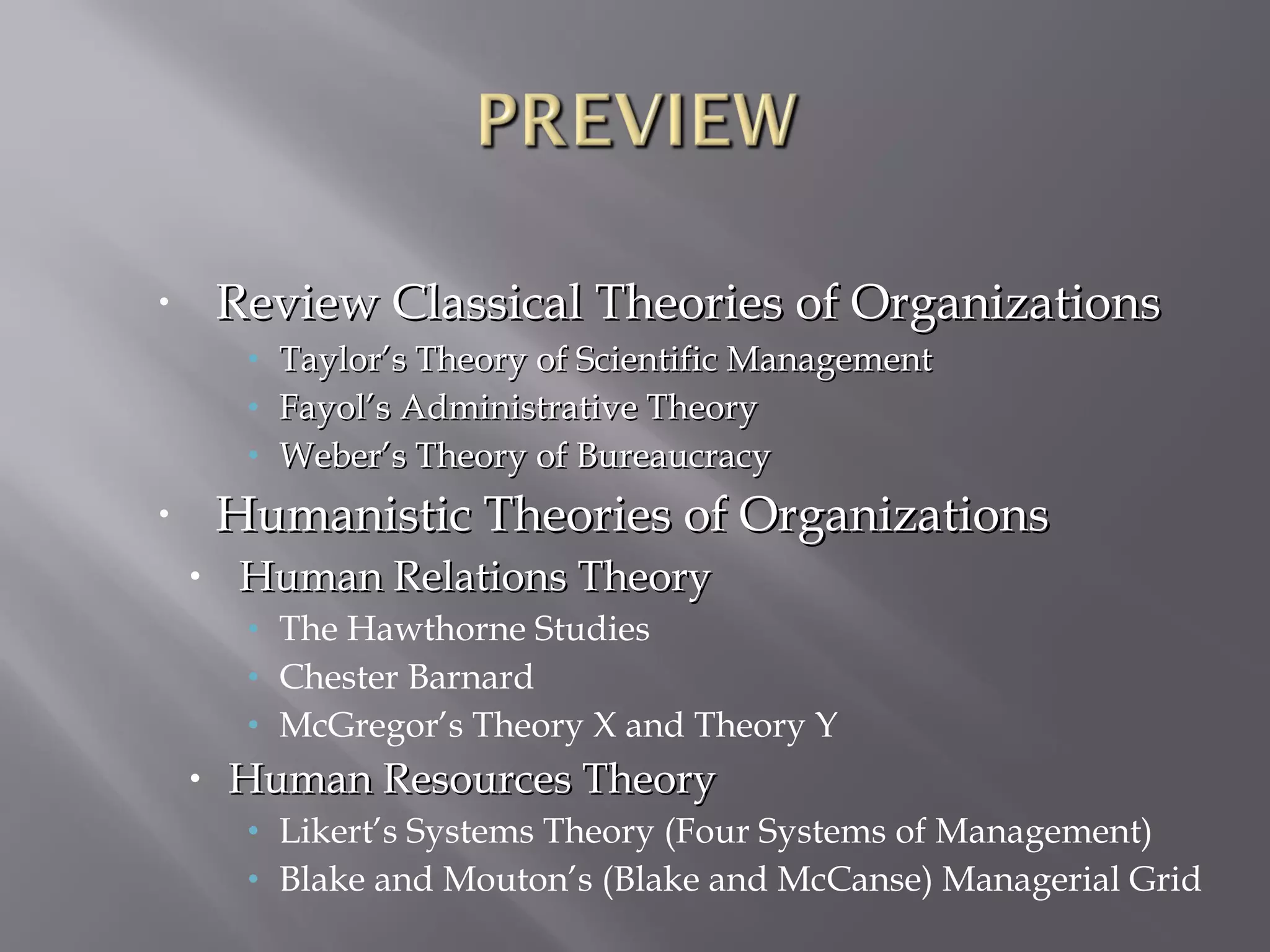
Review Classical Theories of Organizations

•

• Taylor’s Theory of Scientific Management
• Fayol’s Administrative Theory
• Weber’s Theory of Bureaucracy

Humanistic Theories of Organizations

•

•

Human Relations Theory
• The Hawthorne Studies
• Chester Barnard
• McGregor’s Theory X and Theory Y

•

Human Resources Theory
• Likert’s Systems Theory (Four Systems of Management)
• Blake and Mouton’s (Blake and McCanse) Managerial Grid
•

•
•
•
•

•

•

Classical Theories of Organizations
Taylor’s Theory of Scientific Management (tasks)
Fayol’s Administrative Theory (mgmt)
Weber’s Theory of Bureaucracy (org structure)
All 3 theories attempt to enhance management’s ability
to predict and control the behavior of their workers
Considered only the task function of communication
(ignored relational and maintenance functions of
communication)
Designed to predict and control behavior in
organizations
Classical theories emphasized coercion, control, and
punishment (FOCUS ON TASKS /PRODUCTION).

•

•
•
•
•
•
•

Maintain predictability and control
Decision-making power at top of hierarchy
Minimize input from lower-level employees
Rely on science and rules to guide behavior
Regulate communication to increase predictability and decrease
misunderstandings
Result:
• Workers feel they have no control over their work situation
• Management does not care about their ideas
• Feelings and ideas of workers are unimportant

•

Humanistic theories were developed to promote the
CONCERNS of the individual worker in an atmosphere that
was too focused on production (FOCUS ON RELATIONAL &
MAINTENANCE FUNCTIONS)
•

•

•

•

•

•
•

Human relations theory is characterized by a shift in emphasis
from TASK to WORKER
Go beyond physical contributions to include creative, cognitive,
and emotional aspects of workers
Based on a more dyadic (two-way) conceptualization of
communication.
SOCIAL RELATIONSHIPS are at the heart of organizational
behavior--effectiveness is contingent on the social well-being of
workers
Workers communicate opinions, complaints, suggestions, and
feelings to increase satisfaction and production
Origins (Hawthorne Studies & work of Chester Barnard)
Human Relations School of Management - Elton Mayo
(Harvard
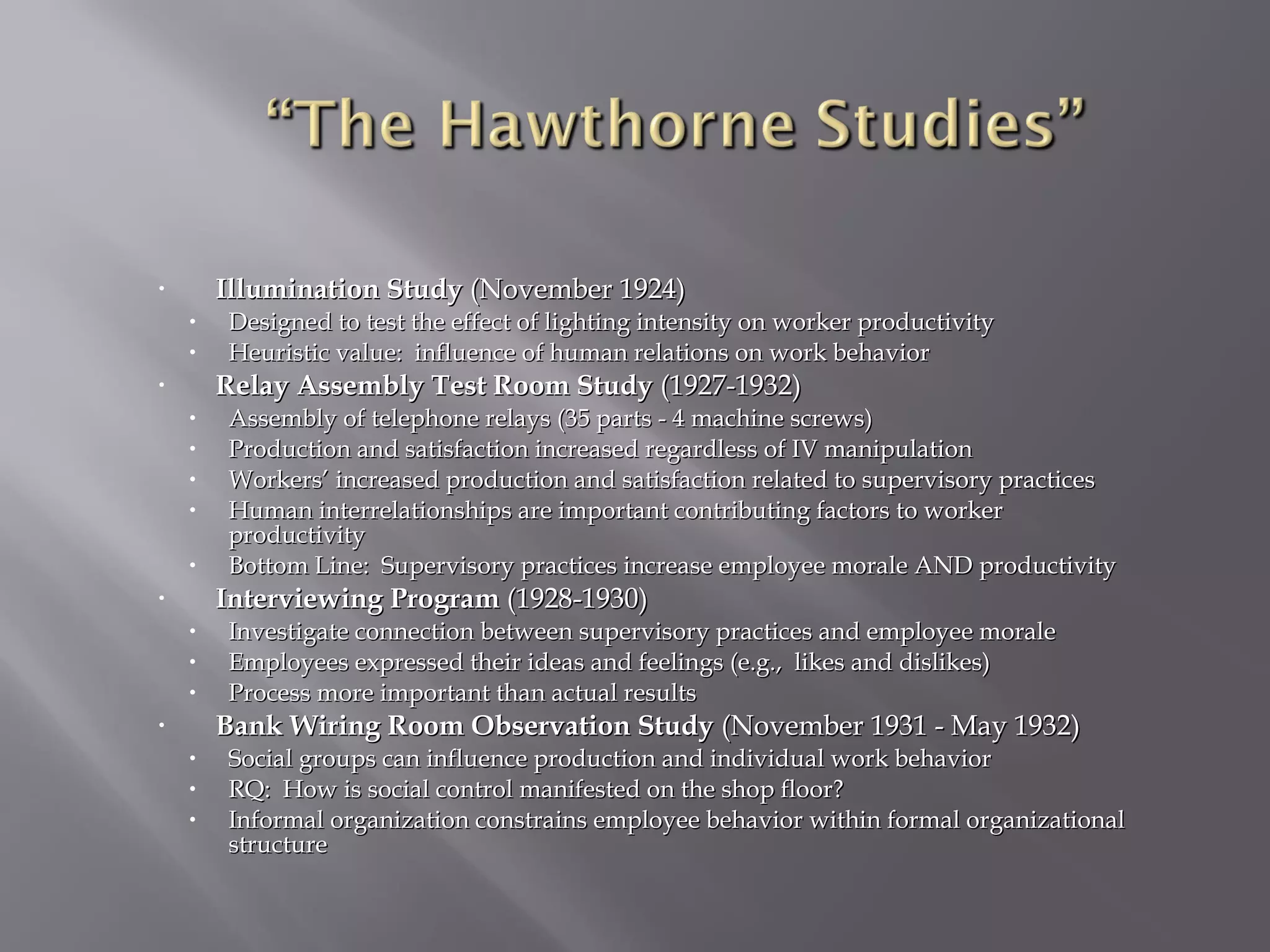
“The Hawthorne Studies

•

Hawthorne Works of Western Electric Company
• 1924 - Chicago
• Research focus: Relation of quality and quantity of illumination
to efficiency in industry
• Four Important Studies
•
Illumination Study (November 1924)

•

•
•

Designed to test the effect of lighting intensity on worker productivity
Heuristic value: influence of human relations on work behavior

Relay Assembly Test Room Study (1927-1932)

•

•
•
•
•
•

Assembly of telephone relays (35 parts - 4 machine screws)
Production and satisfaction increased regardless of IV manipulation
Workers’ increased production and satisfaction related to supervisory practices
Human interrelationships are important contributing factors to worker
productivity
Bottom Line: Supervisory practices increase employee morale AND productivity

Interviewing Program (1928-1930)

•

•
•
•

Investigate connection between supervisory practices and employee morale
Employees expressed their ideas and feelings (e.g., likes and dislikes)
Process more important than actual results

Bank Wiring Room Observation Study (November 1931 - May 1932)

•

•
•
•

Social groups can influence production and individual work behavior
RQ: How is social control manifested on the shop floor?
Informal organization constrains employee behavior within formal organizational
structure
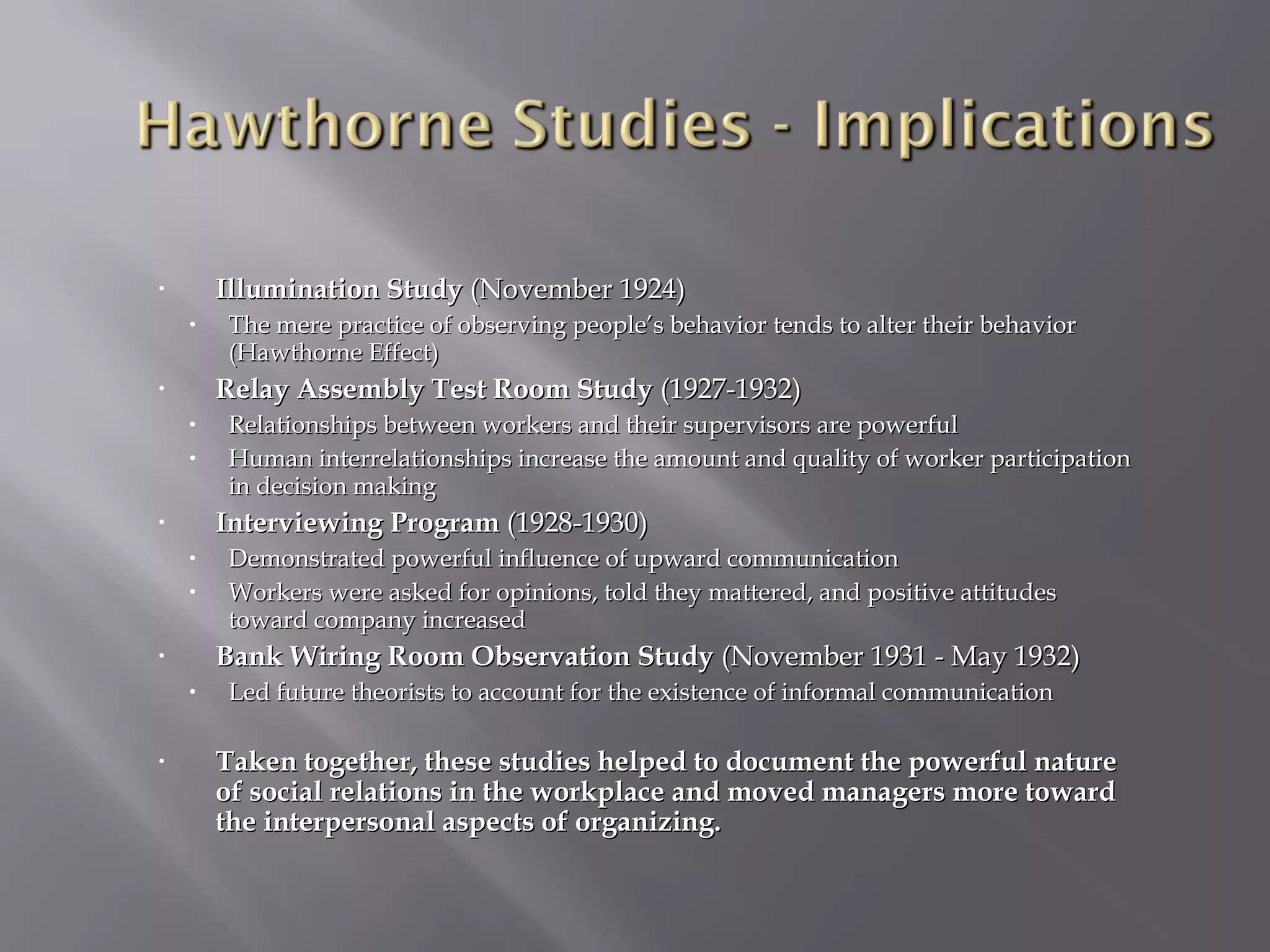
Illumination Study (November 1924)

•

•

Relay Assembly Test Room Study (1927-1932)

•

•
•

Relationships between workers and their supervisors are powerful
Human interrelationships increase the amount and quality of worker participation
in decision making

Interviewing Program (1928-1930)

•

•
•

Demonstrated powerful influence of upward communication
Workers were asked for opinions, told they mattered, and positive attitudes
toward company increased

Bank Wiring Room Observation Study (November 1931 - May 1932)

•

•
•

The mere practice of observing people’s behavior tends to alter their behavior
(Hawthorne Effect)

Led future theorists to account for the existence of informal communication

Taken together, these studies helped to document the powerful nature
of social relations in the workplace and moved managers more toward
the interpersonal aspects of organizing.
•
•
•
•

•
•
•

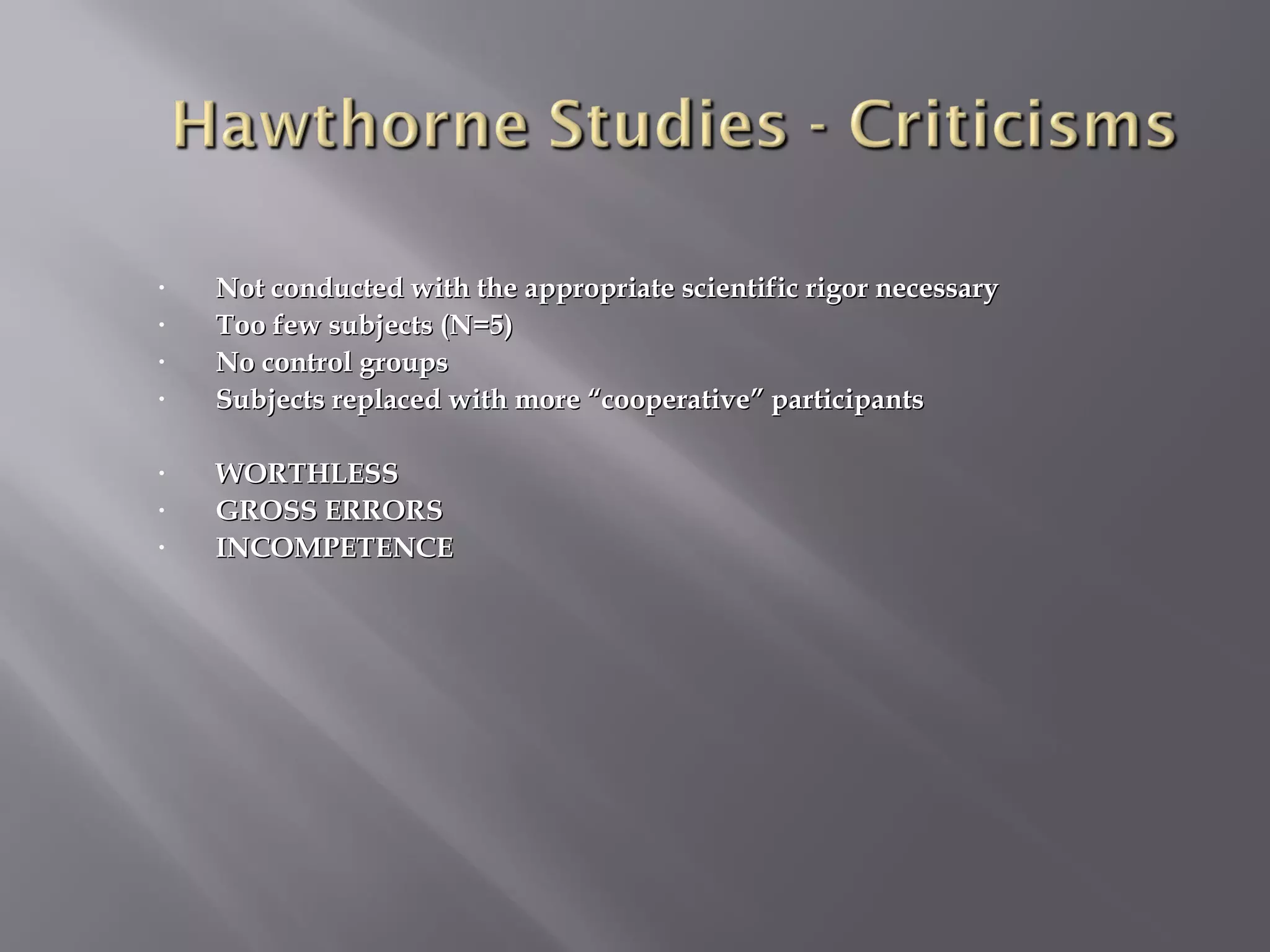
Not conducted with the appropriate scientific rigor necessary
Too few subjects (N=5)
No control groups
Subjects replaced with more “cooperative” participants
WORTHLESS
GROSS ERRORS
INCOMPETENCE
•

•
•
•

•

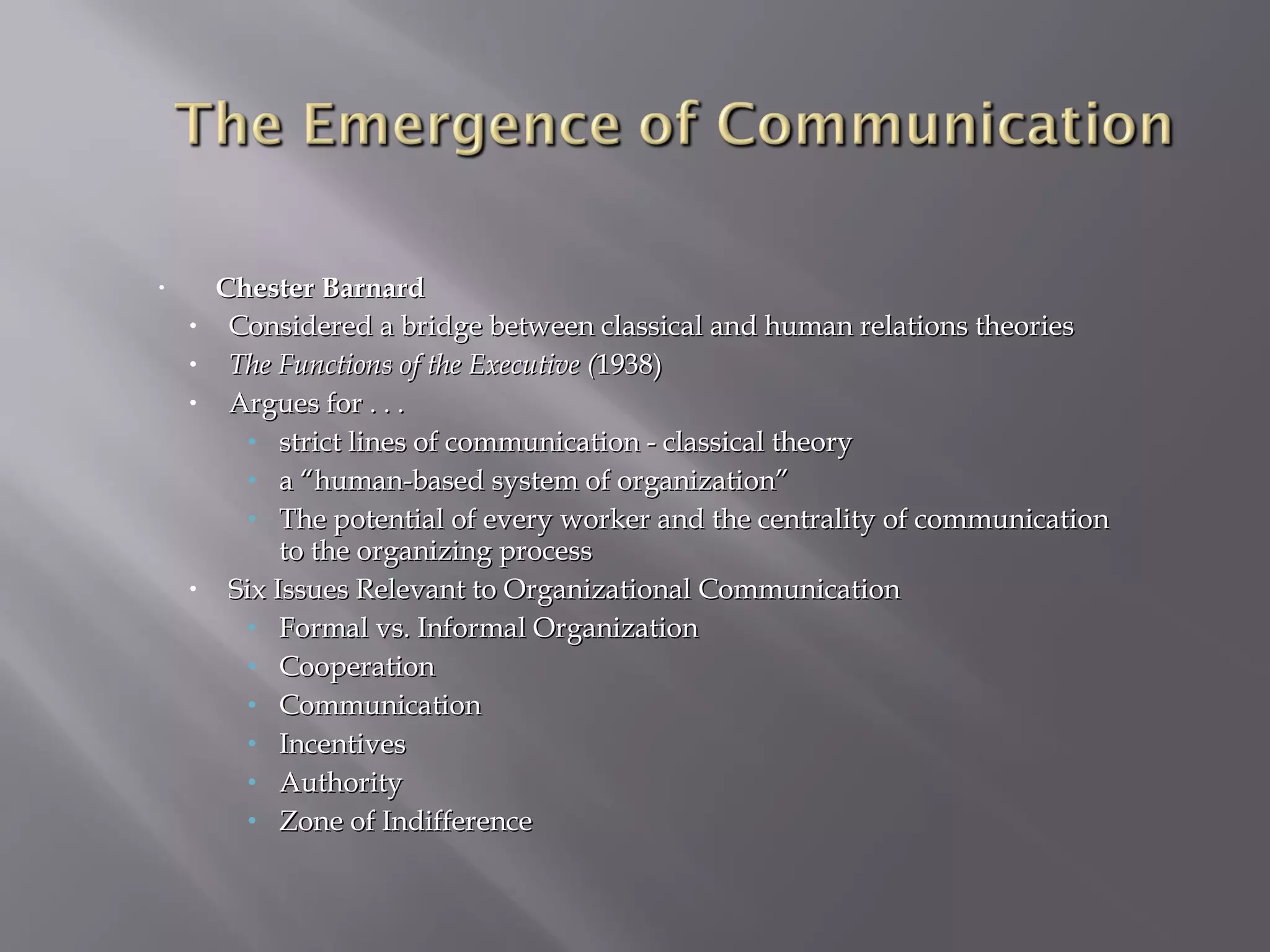
Chester Barnard
Considered a bridge between classical and human relations theories
The Functions of the Executive (1938)
Argues for . . .
• strict lines of communication - classical theory
• a “human-based system of organization”
• The potential of every worker and the centrality of communication
to the organizing process
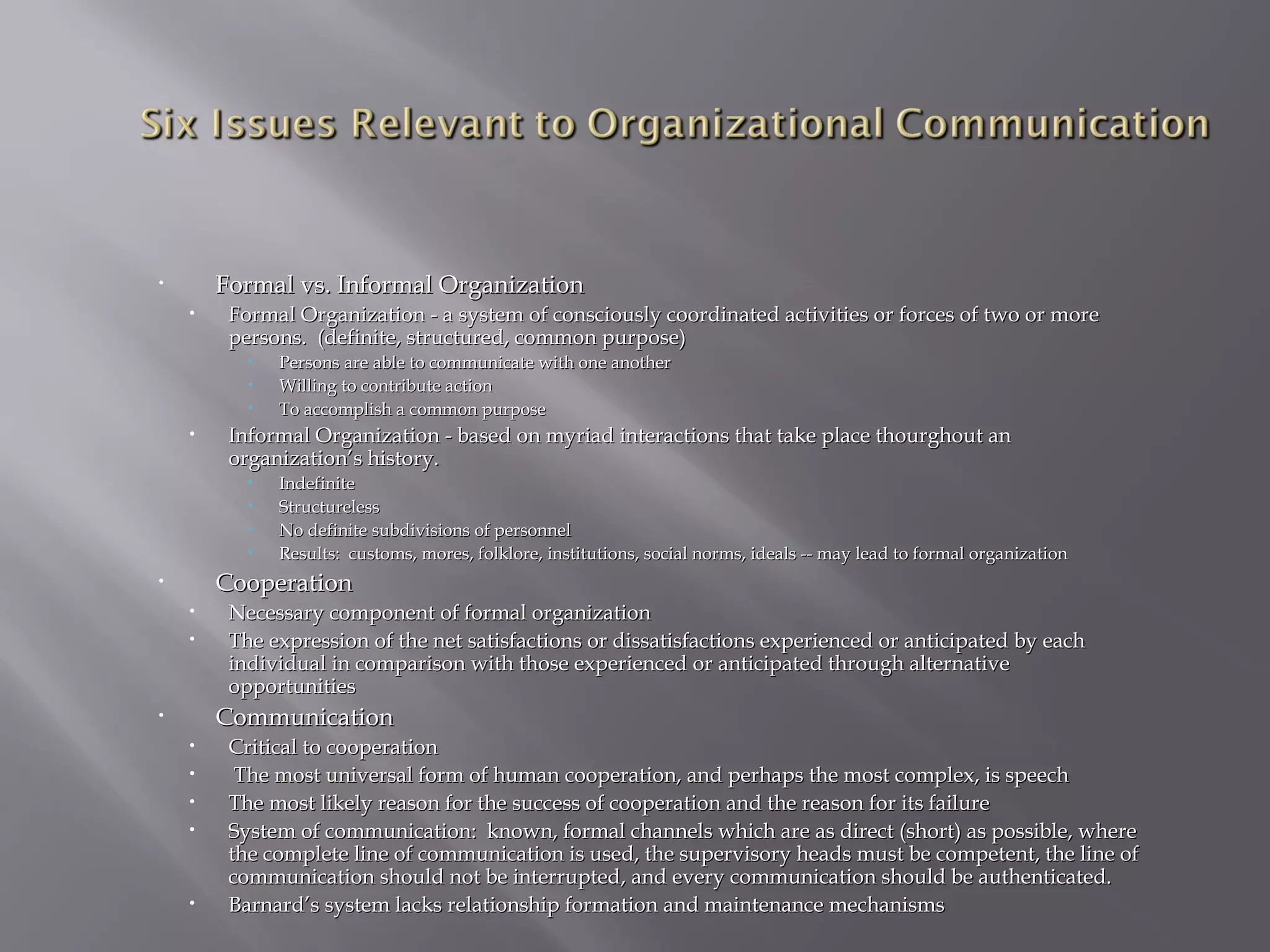
Six Issues Relevant to Organizational Communication
• Formal vs. Informal Organization
• Cooperation
• Communication
• Incentives
• Authority
• Zone of Indifference
Formal vs. Informal Organization

•

•

Formal Organization - a system of consciously coordinated activities or forces of two or more
persons. (definite, structured, common purpose)
•
•
•

•

Persons are able to communicate with one another
Willing to contribute action
To accomplish a common purpose

Informal Organization - based on myriad interactions that take place thourghout an
organization’s history.
•
•
•
•

Indefinite
Structureless
No definite subdivisions of personnel
Results: customs, mores, folklore, institutions, social norms, ideals -- may lead to formal organization

Cooperation

•

•
•

Necessary component of formal organization
The expression of the net satisfactions or dissatisfactions experienced or anticipated by each
individual in comparison with those experienced or anticipated through alternative
opportunities

Communication

•

•
•
•
•

•

Critical to cooperation
The most universal form of human cooperation, and perhaps the most complex, is speech
The most likely reason for the success of cooperation and the reason for its failure
System of communication: known, formal channels which are as direct (short) as possible, where
the complete line of communication is used, the supervisory heads must be competent, the line of
communication should not be interrupted, and every communication should be authenticated.
Barnard’s system lacks relationship formation and maintenance mechanisms
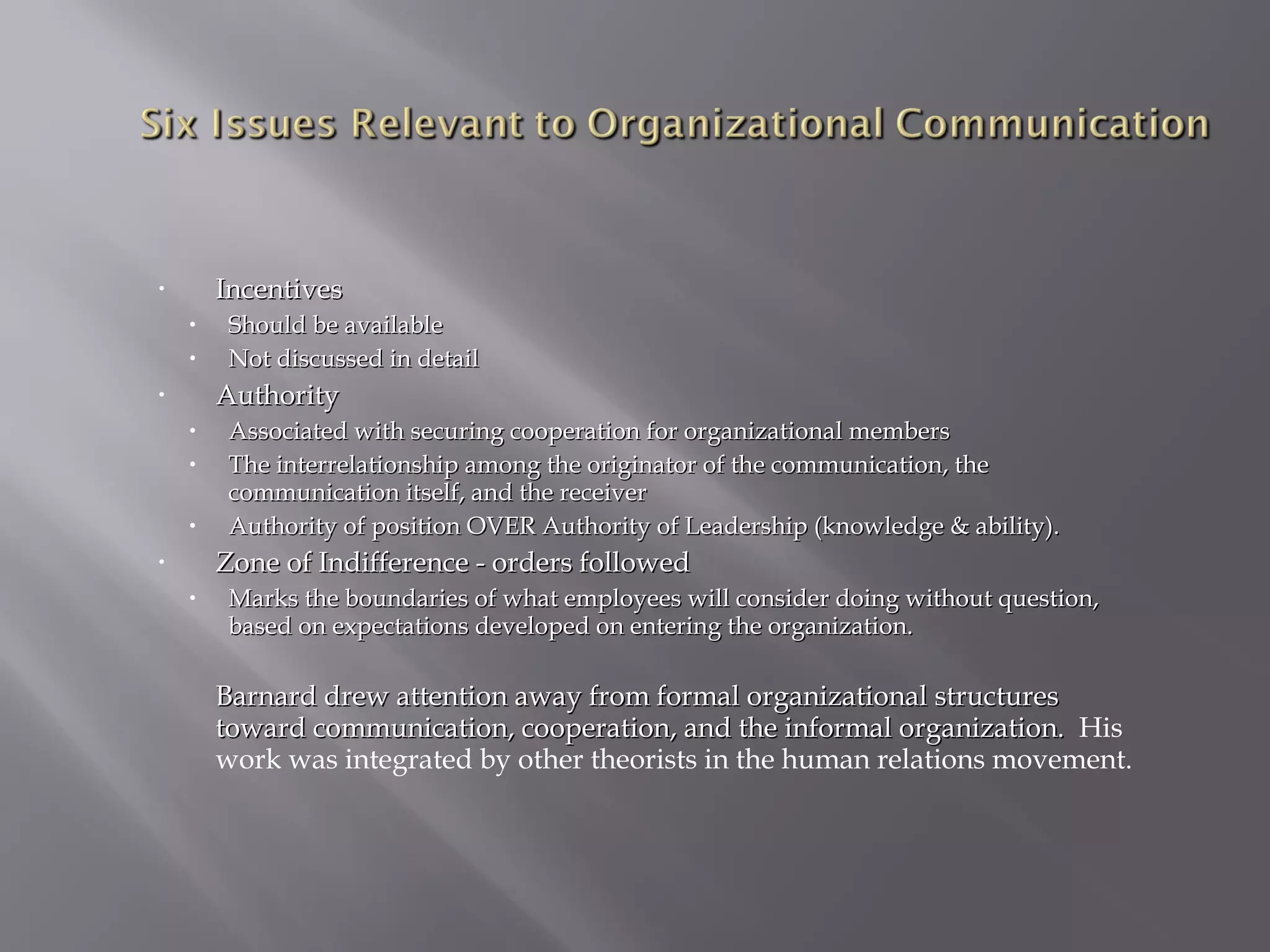
Incentives

•

•
•

Should be available
Not discussed in detail

Authority

•

•
•
•

Associated with securing cooperation for organizational members
The interrelationship among the originator of the communication, the
communication itself, and the receiver
Authority of position OVER Authority of Leadership (knowledge & ability).

Zone of Indifference - orders followed

•

•

Marks the boundaries of what employees will consider doing without question,
based on expectations developed on entering the organization.

Barnard drew attention away from formal organizational structures
toward communication, cooperation, and the informal organization. His
work was integrated by other theorists in the human relations movement.
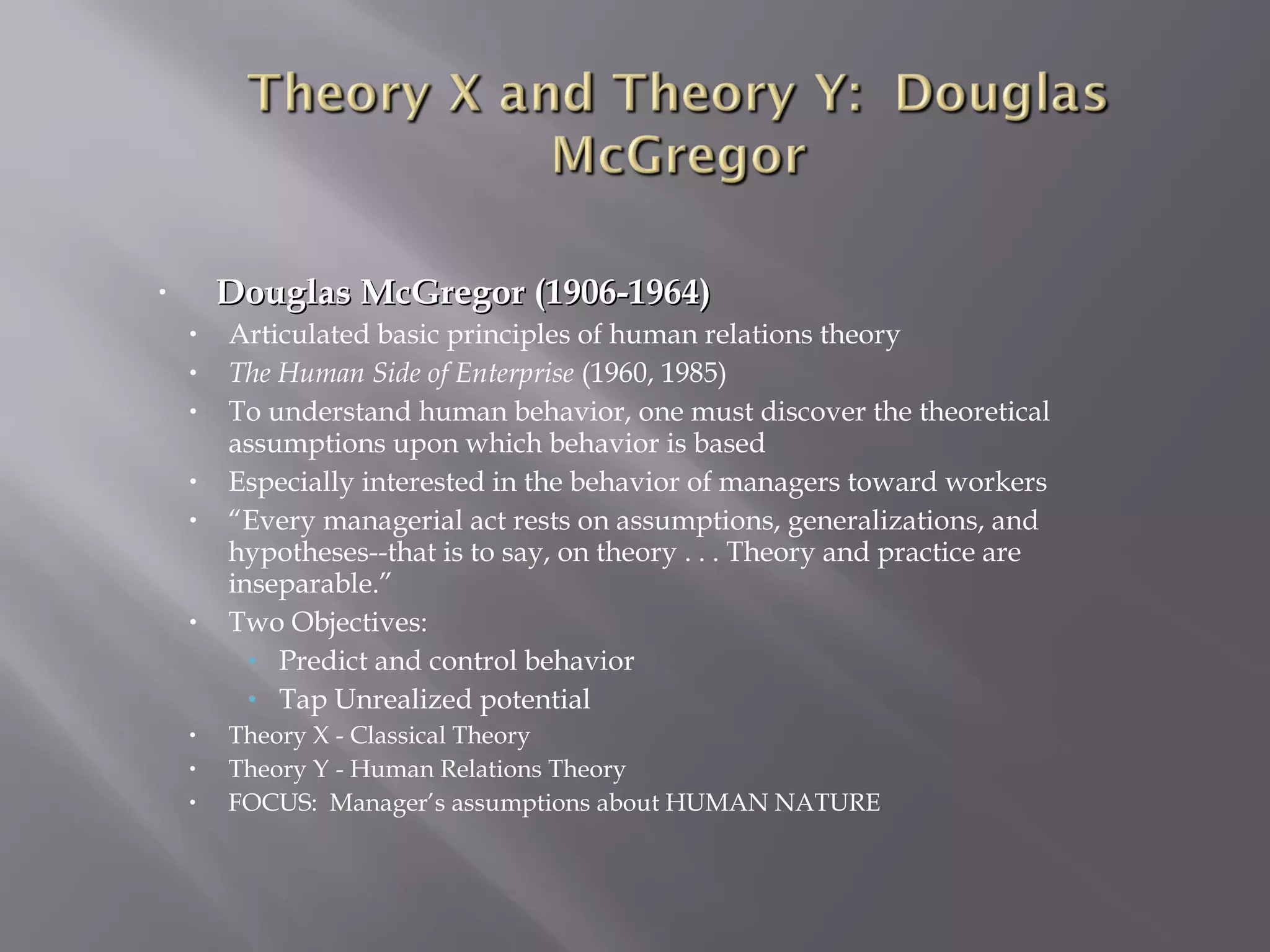
Douglas McGregor (1906-1964)

•
•
•
•
•
•

•

•
•
•

Articulated basic principles of human relations theory
The Human Side of Enterprise (1960, 1985)
To understand human behavior, one must discover the theoretical
assumptions upon which behavior is based
Especially interested in the behavior of managers toward workers
“Every managerial act rests on assumptions, generalizations, and
hypotheses--that is to say, on theory . . . Theory and practice are
inseparable.”
Two Objectives:
• Predict and control behavior
• Tap Unrealized potential
Theory X - Classical Theory
Theory Y - Human Relations Theory
FOCUS: Manager’s assumptions about HUMAN NATURE
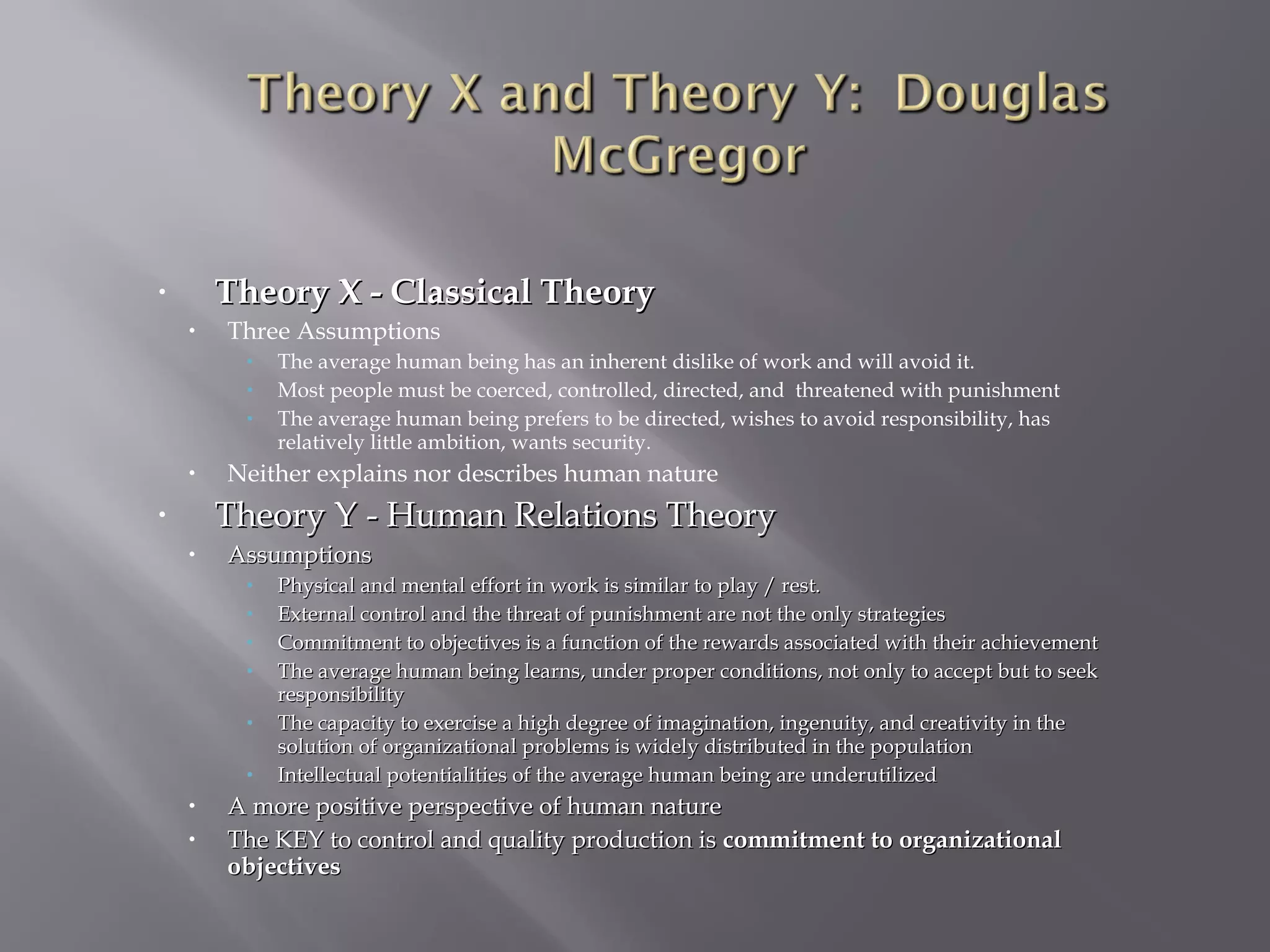
Theory X - Classical Theory

•
•

Three Assumptions
•
•
•

•

The average human being has an inherent dislike of work and will avoid it.
Most people must be coerced, controlled, directed, and threatened with punishment
The average human being prefers to be directed, wishes to avoid responsibility, has
relatively little ambition, wants security.

Neither explains nor describes human nature

Theory Y - Human Relations Theory

•
•

Assumptions
•
•
•
•
•
•

•
•

Physical and mental effort in work is similar to play / rest.
External control and the threat of punishment are not the only strategies
Commitment to objectives is a function of the rewards associated with their achievement
The average human being learns, under proper conditions, not only to accept but to seek
responsibility
The capacity to exercise a high degree of imagination, ingenuity, and creativity in the
solution of organizational problems is widely distributed in the population
Intellectual potentialities of the average human being are underutilized

A more positive perspective of human nature
The KEY to control and quality production is commitment to organizational
objectives
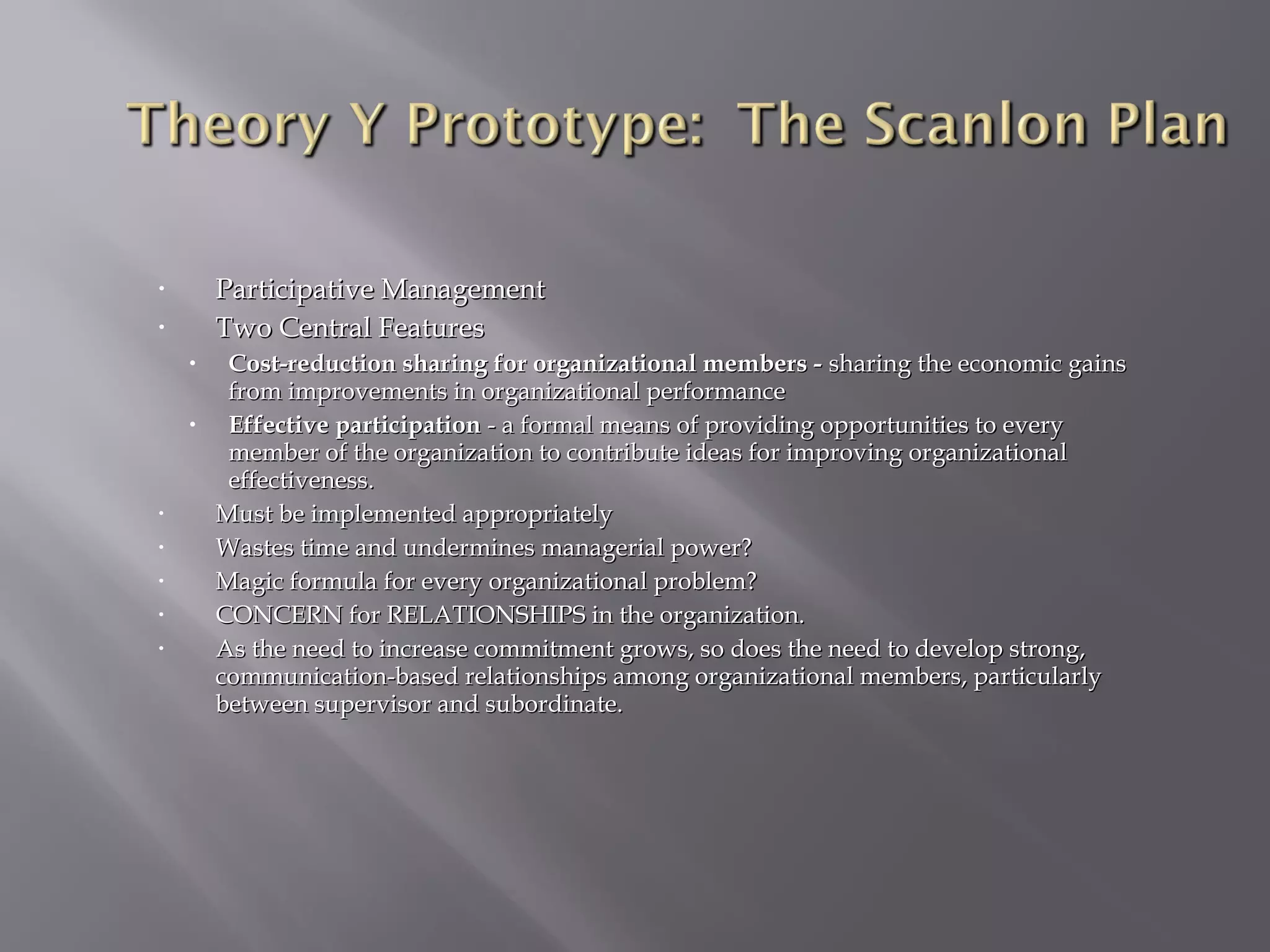
Participative Management
Two Central Features

•
•

•
•

•
•
•
•
•

Cost-reduction sharing for organizational members - sharing the economic gains
from improvements in organizational performance
Effective participation - a formal means of providing opportunities to every
member of the organization to contribute ideas for improving organizational
effectiveness.
Must be implemented appropriately
Wastes time and undermines managerial power?
Magic formula for every organizational problem?
CONCERN for RELATIONSHIPS in the organization.
As the need to increase commitment grows, so does the need to develop strong,
communication-based relationships among organizational members, particularly
between supervisor and subordinate.
•

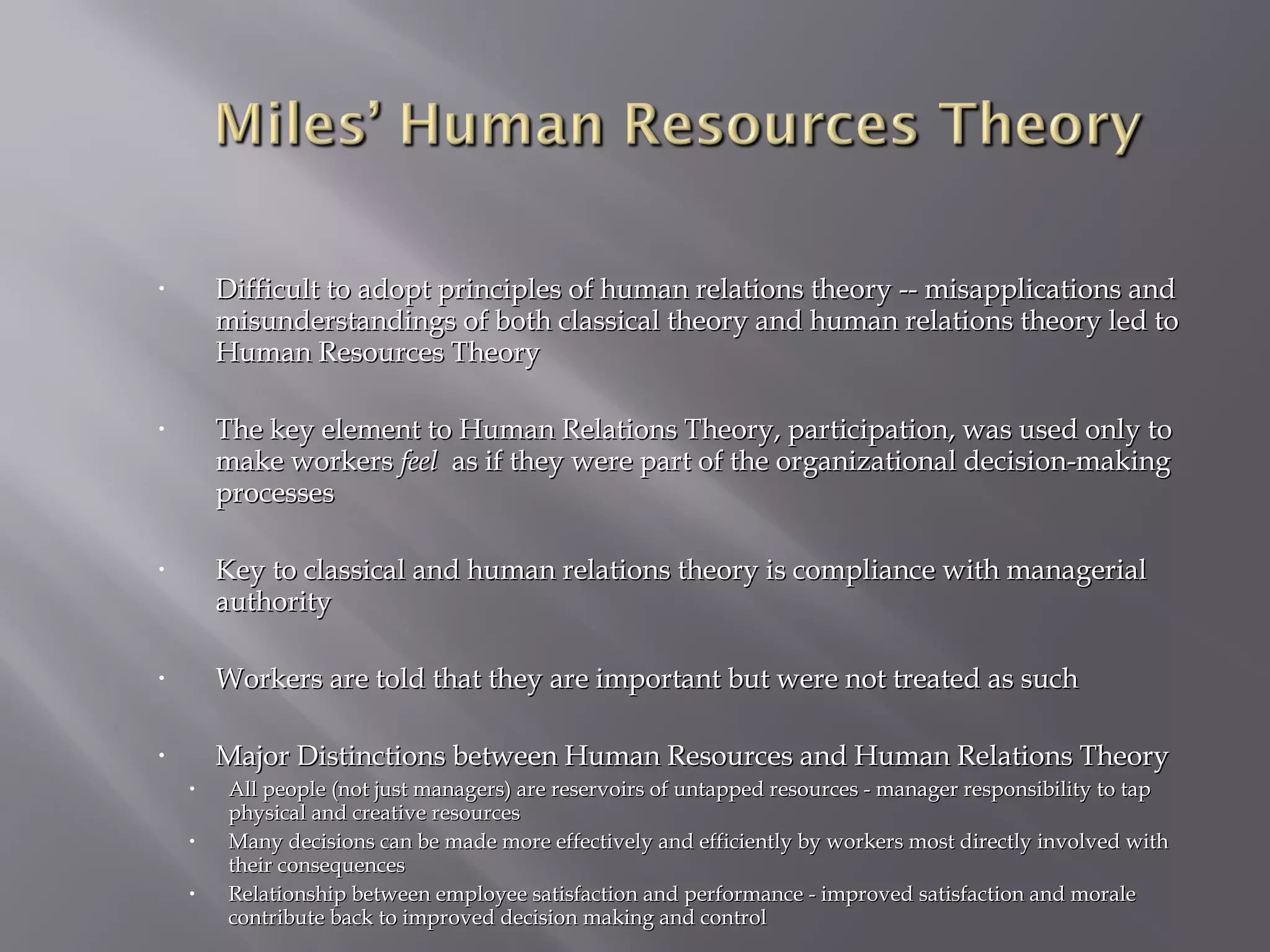
Difficult to adopt principles of human relations theory -- misapplications and
misunderstandings of both classical theory and human relations theory led to
Human Resources Theory

•

The key element to Human Relations Theory, participation, was used only to
make workers feel as if they were part of the organizational decision-making
processes

•

Key to classical and human relations theory is compliance with managerial
authority

•

Workers are told that they are important but were not treated as such

•

Major Distinctions between Human Resources and Human Relations Theory
•
•
•

All people (not just managers) are reservoirs of untapped resources - manager responsibility to tap
physical and creative resources
Many decisions can be made more effectively and efficiently by workers most directly involved with
their consequences
Relationship between employee satisfaction and performance - improved satisfaction and morale
contribute back to improved decision making and control
•

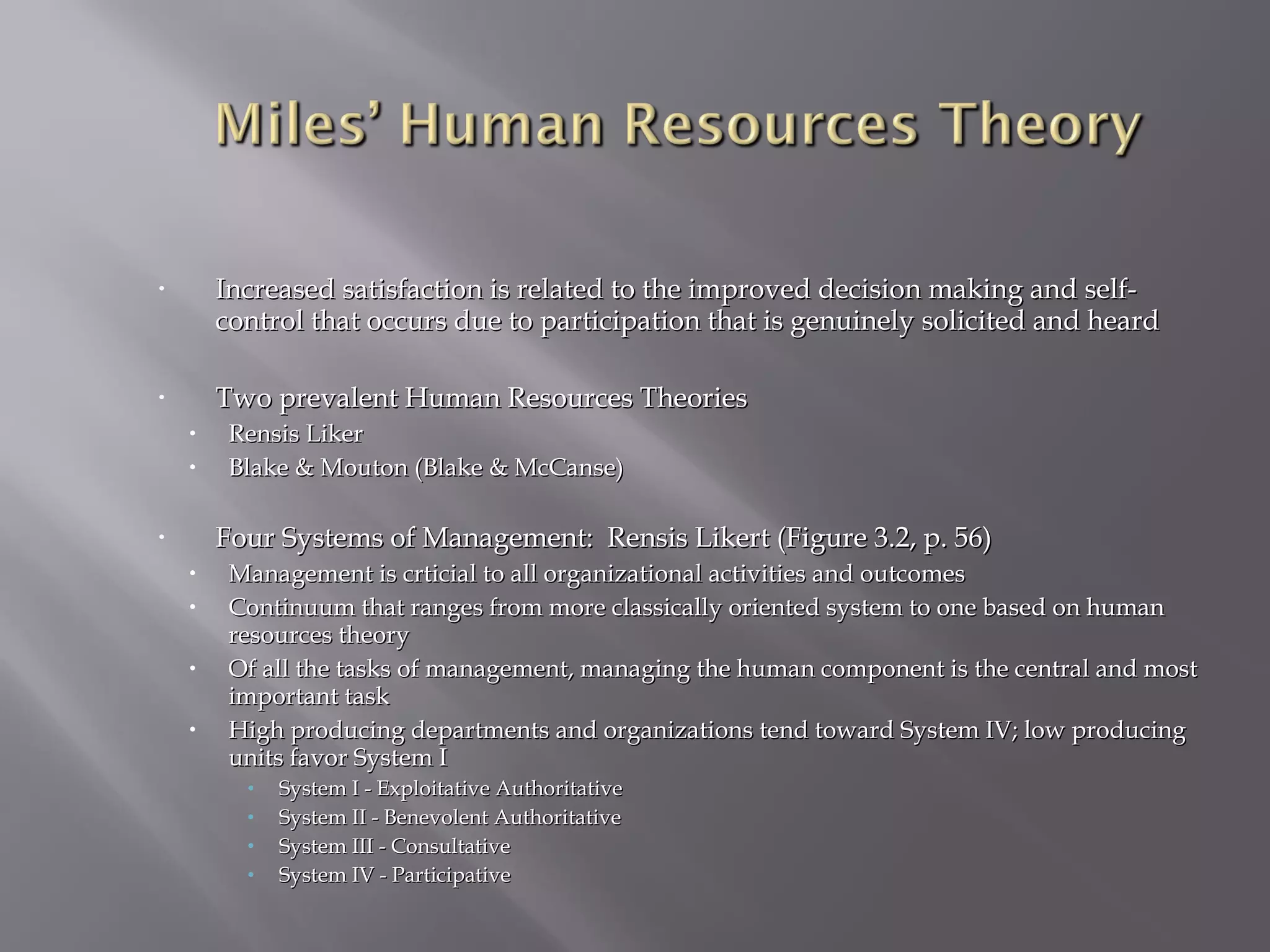
Increased satisfaction is related to the improved decision making and selfcontrol that occurs due to participation that is genuinely solicited and heard

•

Two prevalent Human Resources Theories
•
•

Rensis Liker
Blake & Mouton (Blake & McCanse)

Four Systems of Management: Rensis Likert (Figure 3.2, p. 56)

•

•
•
•
•

Management is crticial to all organizational activities and outcomes
Continuum that ranges from more classically oriented system to one based on human
resources theory
Of all the tasks of management, managing the human component is the central and most
important task
High producing departments and organizations tend toward System IV; low producing
units favor System I
•
•
•
•

System I - Exploitative Authoritative
System II - Benevolent Authoritative
System III - Consultative
System IV - Participative
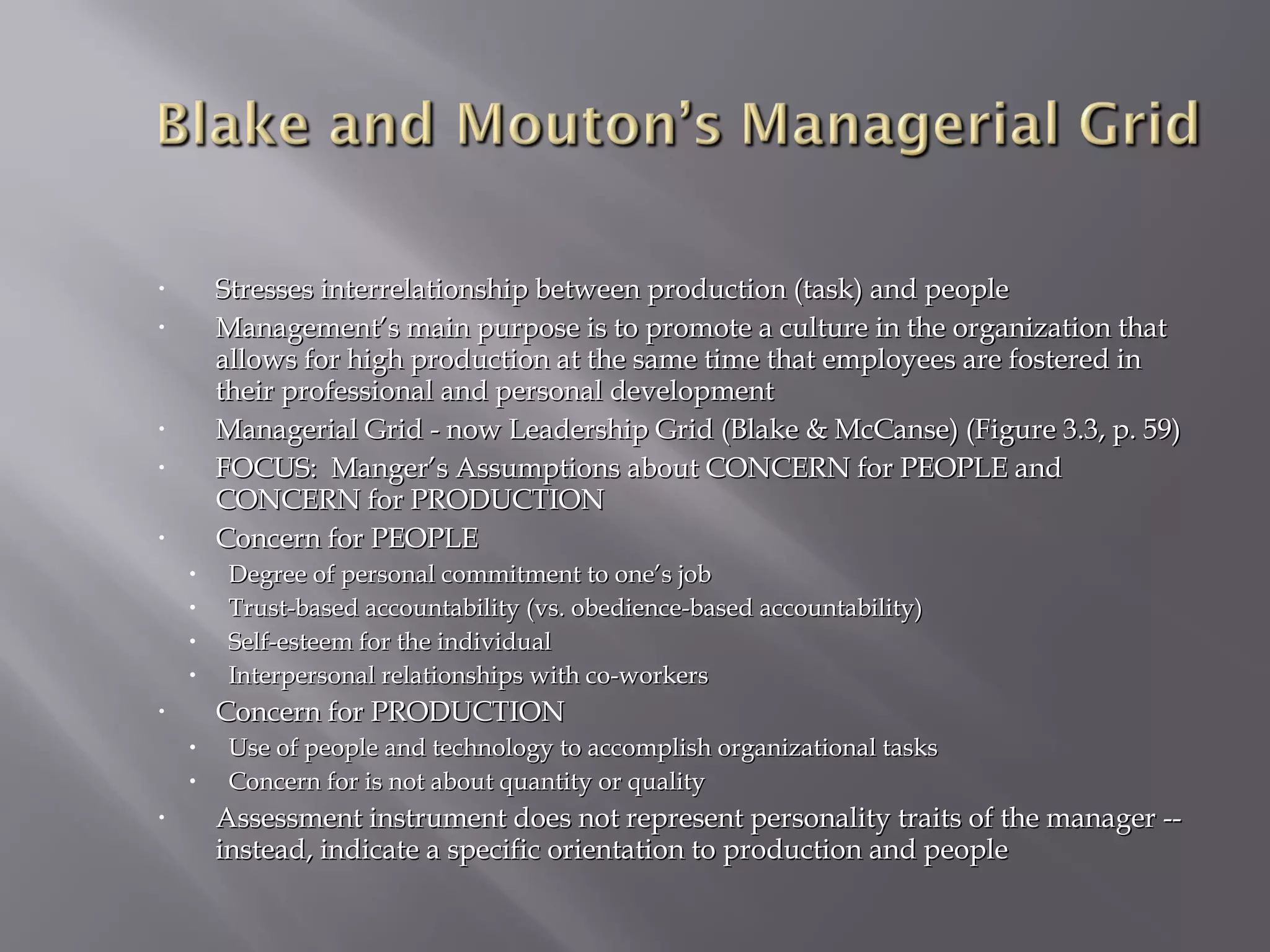
Stresses interrelationship between production (task) and people
Management’s main purpose is to promote a culture in the organization that
allows for high production at the same time that employees are fostered in
their professional and personal development
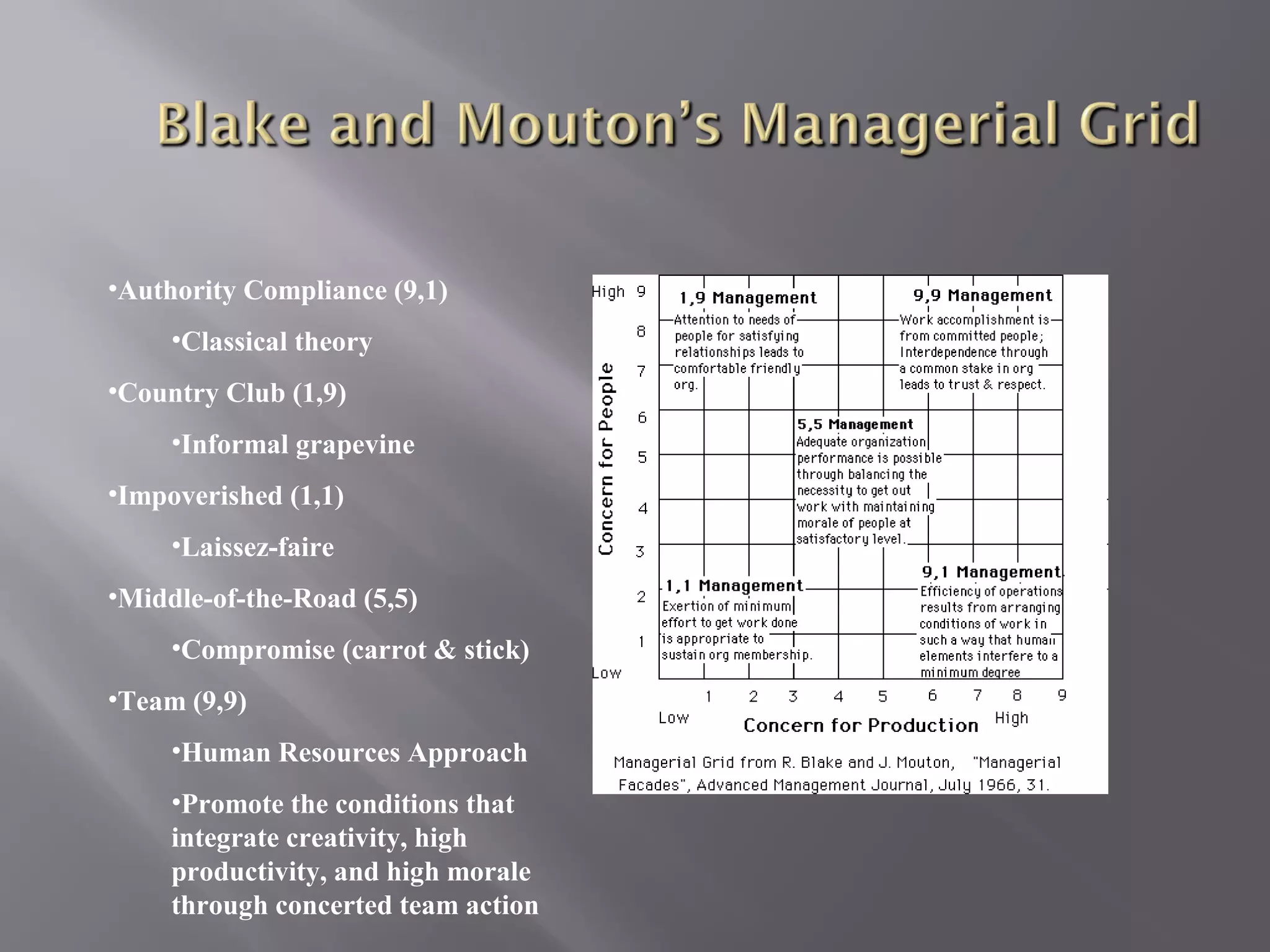
Managerial Grid - now Leadership Grid (Blake & McCanse) (Figure 3.3, p. 59)
FOCUS: Manger’s Assumptions about CONCERN for PEOPLE and
CONCERN for PRODUCTION
Concern for PEOPLE

•
•

•
•

•

•
•
•
•

Concern for PRODUCTION

•

•
•
•

Degree of personal commitment to one’s job
Trust-based accountability (vs. obedience-based accountability)
Self-esteem for the individual
Interpersonal relationships with co-workers
Use of people and technology to accomplish organizational tasks
Concern for is not about quantity or quality

Assessment instrument does not represent personality traits of the manager -instead, indicate a specific orientation to production and people
•Authority Compliance (9,1)
•Classical theory
•Country Club (1,9)
•Informal grapevine
•Impoverished (1,1)
•Laissez-faire
•Middle-of-the-Road (5,5)
•Compromise (carrot & stick)
•Team (9,9)
•Human Resources Approach
•Promote the conditions that
integrate creativity, high
productivity, and high morale
through concerted team action
•

•

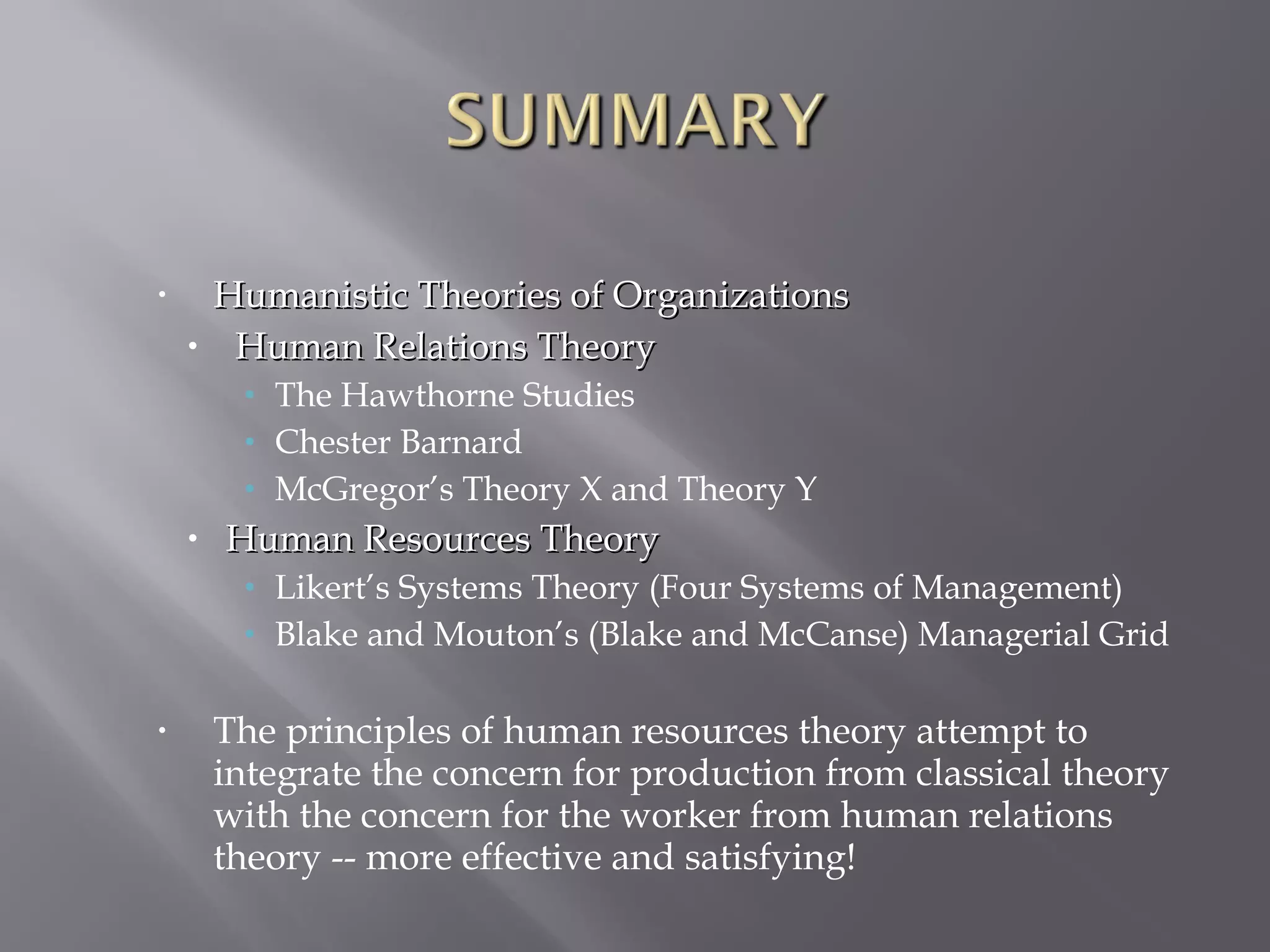
Humanistic Theories of Organizations
Human Relations Theory
• The Hawthorne Studies
• Chester Barnard
• McGregor’s Theory X and Theory Y

•

Human Resources Theory
• Likert’s Systems Theory (Four Systems of Management)
• Blake and Mouton’s (Blake and McCanse) Managerial Grid

•

The principles of human resources theory attempt to
integrate the concern for production from classical theory
with the concern for the worker from human relations
theory -- more effective and satisfying!
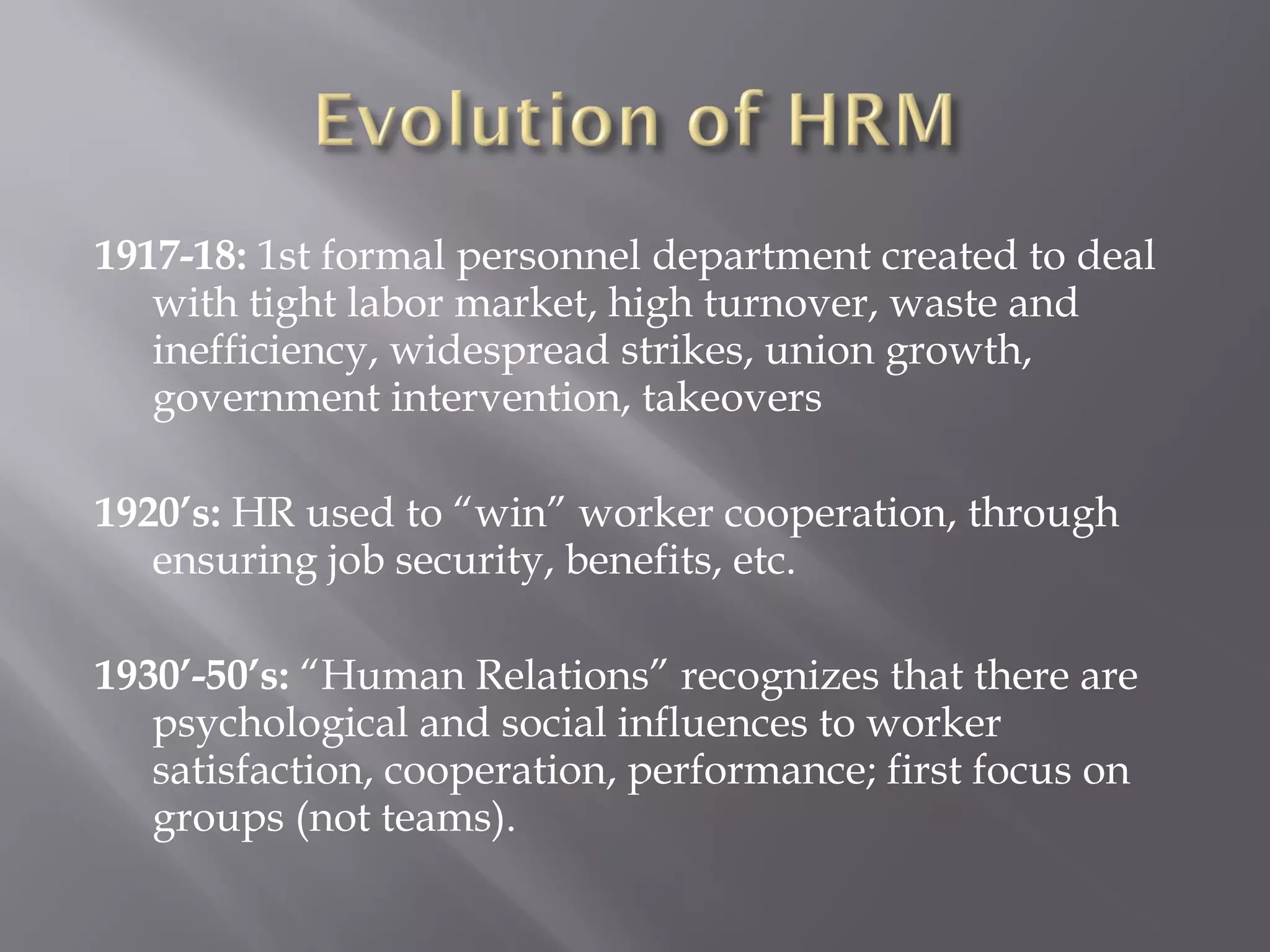
1917-18: 1st formal personnel department created to deal
with tight labor market, high turnover, waste and
inefficiency, widespread strikes, union growth,
government intervention, takeovers
1920’s: HR used to “win” worker cooperation, through
ensuring job security, benefits, etc.
1930’-50’s: “Human Relations” recognizes that there are
psychological and social influences to worker
satisfaction, cooperation, performance; first focus on
groups (not teams).
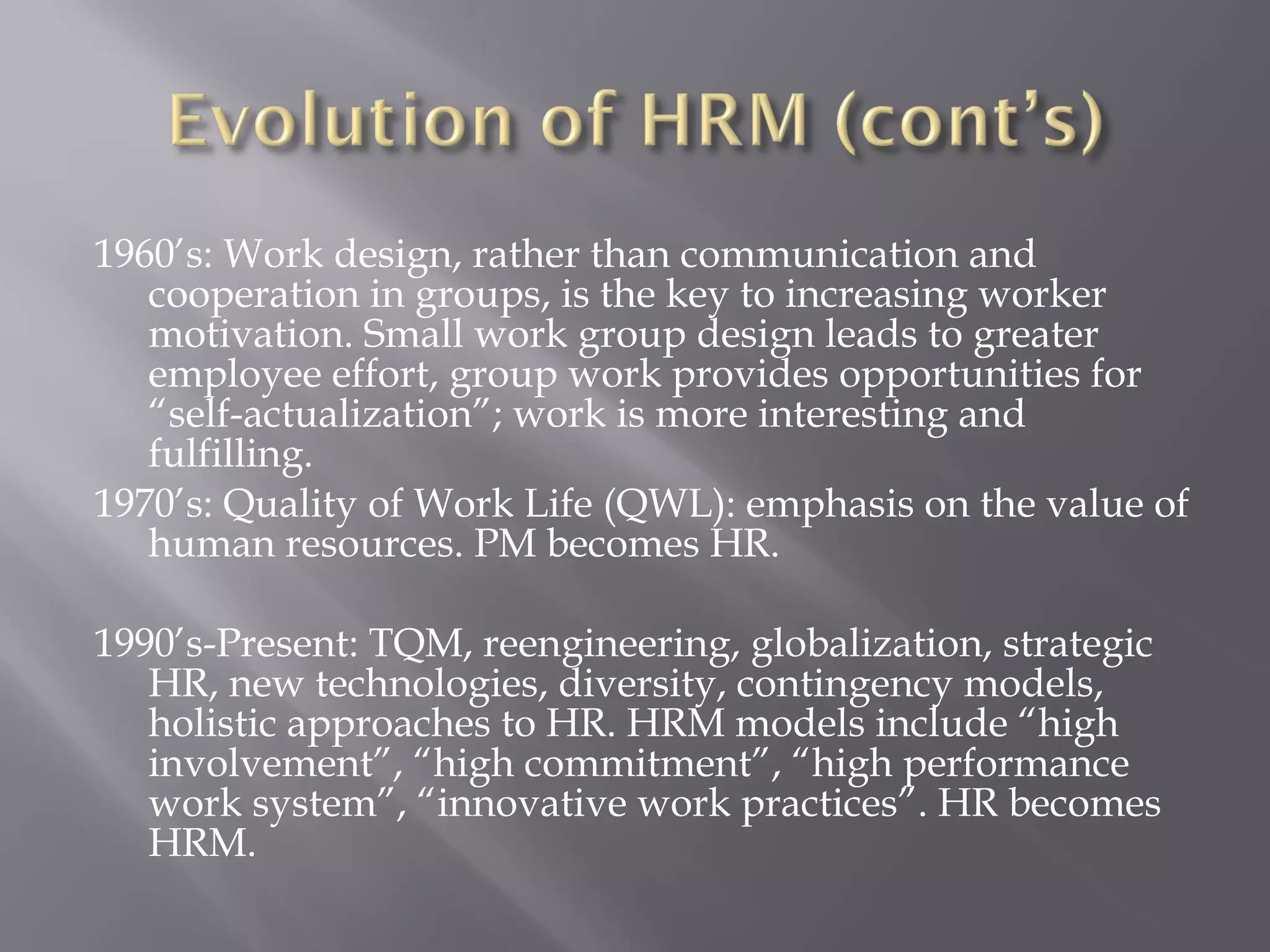
1960’s: Work design, rather than communication and
cooperation in groups, is the key to increasing worker
motivation. Small work group design leads to greater
employee effort, group work provides opportunities for
“self-actualization”; work is more interesting and
fulfilling.
1970’s: Quality of Work Life (QWL): emphasis on the value of
human resources. PM becomes HR.
1990’s-Present: TQM, reengineering, globalization, strategic
HR, new technologies, diversity, contingency models,
holistic approaches to HR. HRM models include “high
involvement”, “high commitment”, “high performance
work system”, “innovative work practices”. HR becomes
HRM.






HR issues are relevant to everyone in all
organizations
Provides understanding of systems and
processes needed to develop and utilize talents
of employees
Staffing is the #1 issue for executives.
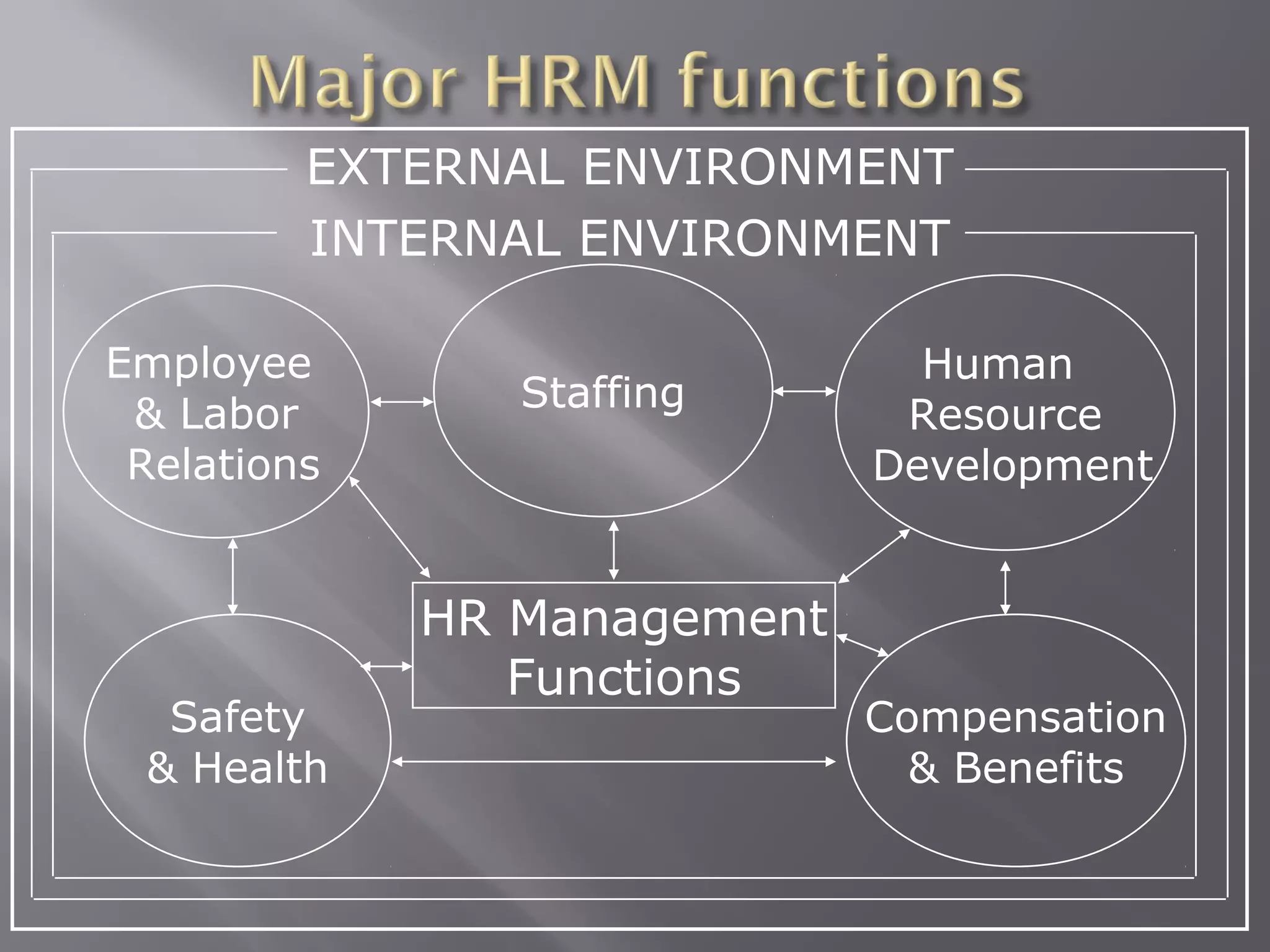
EXTERNAL ENVIRONMENT
INTERNAL ENVIRONMENT
Employee
& Labor
Relations

Safety
& Health

Staffing

HR Management
Functions

Human
Resource
Development

Compensation
& Benefits








Conducting job analyses to establish th specific
requirements of individual jobs within the
organization.
Forecasting the human resource requirements
the organization needs to achieve its objectives.
Developing tand implementing a plan to meet
these requirements.
Recruiting the human resources to fill specific
jobs within the organization.


JA: the process of determining and reporting pertinent
information relating to the nature of a specific job. Involves
the determination of the tasks which comprise the job and of
the “KSA’s” and responsibilities required of the person(s)
holding that job, for successful job performance; defines the
what, how, why of a job.



Methods of conducting JA: observation, motion and time
study, interviews, questionnaires (off-the-shelf; custom)



JA leads to the job description (summary statement + duties
and responsibilities) and job specifications (skills, education,
experience required).



JA is the foundation for all traditional HR functions (as well as
some others!).


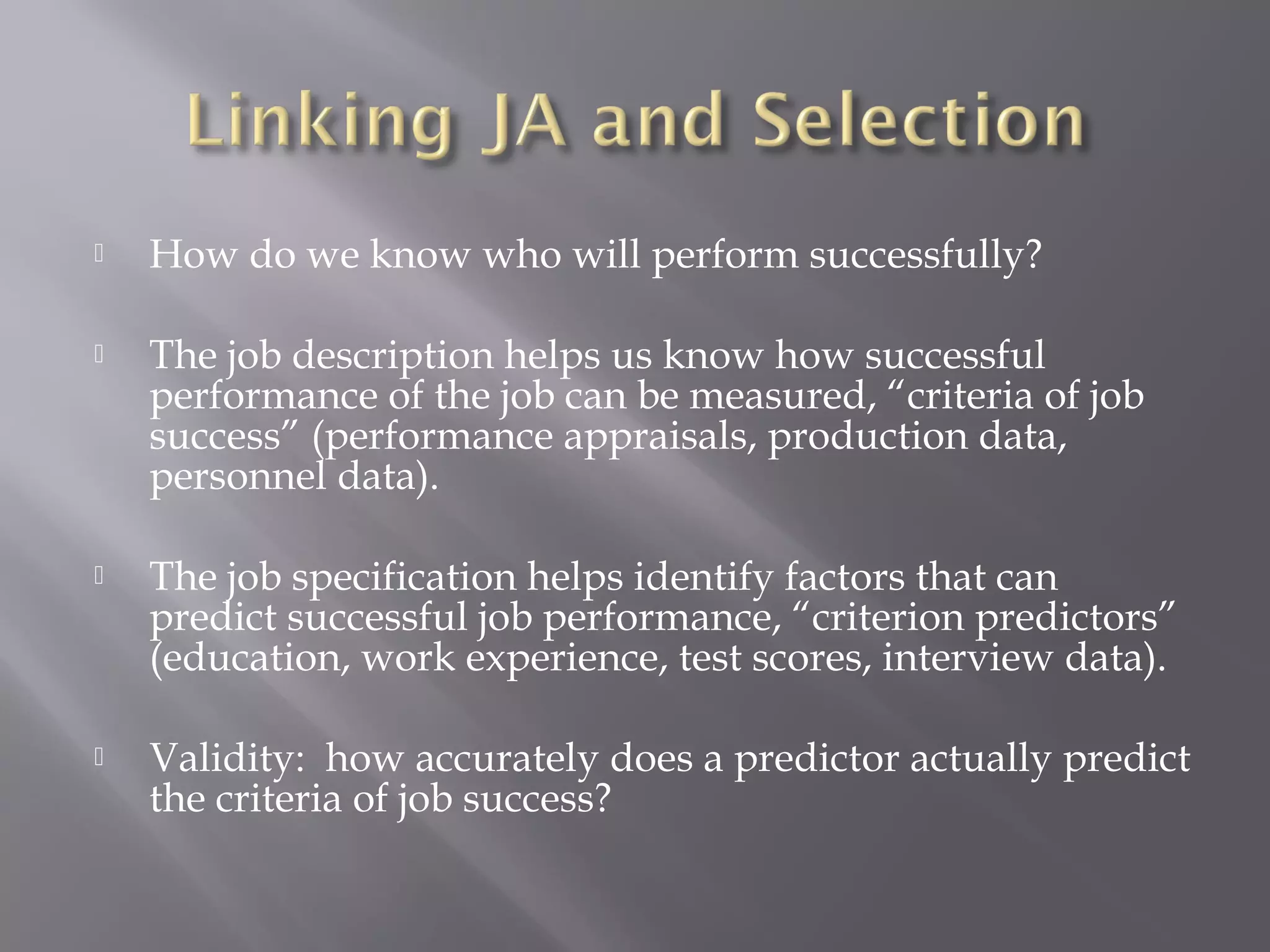
How do we know who will perform successfully?



The job description helps us know how successful
performance of the job can be measured, “criteria of job
success” (performance appraisals, production data,
personnel data).



The job specification helps identify factors that can
predict successful job performance, “criterion predictors”
(education, work experience, test scores, interview data).



Validity: how accurately does a predictor actually predict
the criteria of job success?


Included in the reading packet for this class are
samples of CV’s and job application forms,
including explanations of the various elements
and why they are (often) included.



Remember the content, style, and form of the
CV and letter of application is highly
dependent on geographical customs. If in
doubt, ASK!





Training is a learning process that involves the
acquisition of skills, concepts, rules, or
attitudes; designed to enhance performance
(also through helping employees meet own
objectives of job security, financially and
intellectually rewarding work, recognition,
status, responsibility, achievement).
Orientation
On-the job training; apprenticeships







Intended to develop the experience, attitudes,
and skills necessary to be an effective manager
Should be tied to organizational objectives
Often include team work, project work, and
leadership training
Methods include coaching, job rotation, project
assignments, classroom training (case studies,
role playing, in-basket techniques, business
games.
On going formal effort to develop and enrich the
organization’s human resources so as to meet both
the organization’s and employees objectives;
concrete action plan for the individual to meet these
goals.
 Increases attractiveness of company to job seekers
 Supports retention
 Addresses needs of minorities, women, >50
professionals
 Mechanism for dealing with downsizing,
reengineering, restructuring







PA is a feedback system that involves the direct
evaluation of individual or group performance
by a supervisor, manager, or peers.
Used for performance feedback, pay
administration, counseling and developing
employees.
Represents an importan link between goalsetting processes and reward systems.







Goal setting (MBO)
360-degree feedback
Work standards approach
Critical-incident appraisal
Graphic rating scales
Behaviorally Anchored Rating Scale (BARS)




Both intrinsic and extrinsic rewards received as
a result of employment by the organization.
Ideally, rewards are linked to performance.
Rewards “cause” satisfaction
 Rewards based on performance “cause” improved
performance
 Satisfaction does not (necessarily) “cause” better
performance; performance “causes” satisfaction







Workplace support (flexible schedules, child
care, etc), autonomy; meaningfulness;
opportunities for leaning and advancement
and job security are highly related to job
satisfaction; pay and benefits have little effect
on job satisfaction.
Job satisfaction leads to organizational
commitment; job dissatisfaction may lead to
turnover, absenteeism, tardiness, accidents,
strikes, grievances.
Job satisfaction is NOT the same as motivation!


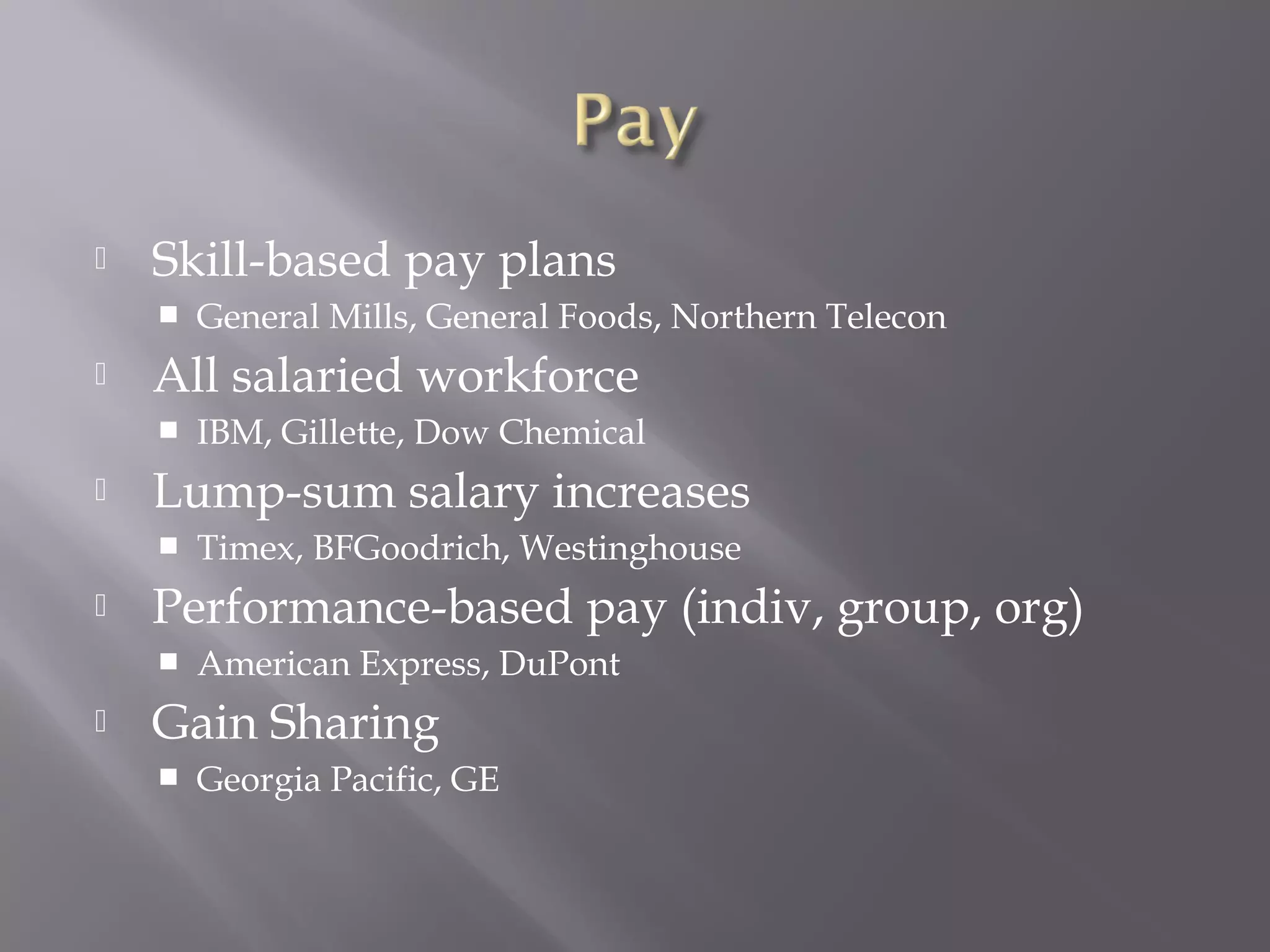
Skill-based pay plans




All salaried workforce




Timex, BFGoodrich, Westinghouse

Performance-based pay (indiv, group, org)




IBM, Gillette, Dow Chemical

Lump-sum salary increases




General Mills, General Foods, Northern Telecon

American Express, DuPont

Gain Sharing


Georgia Pacific, GE


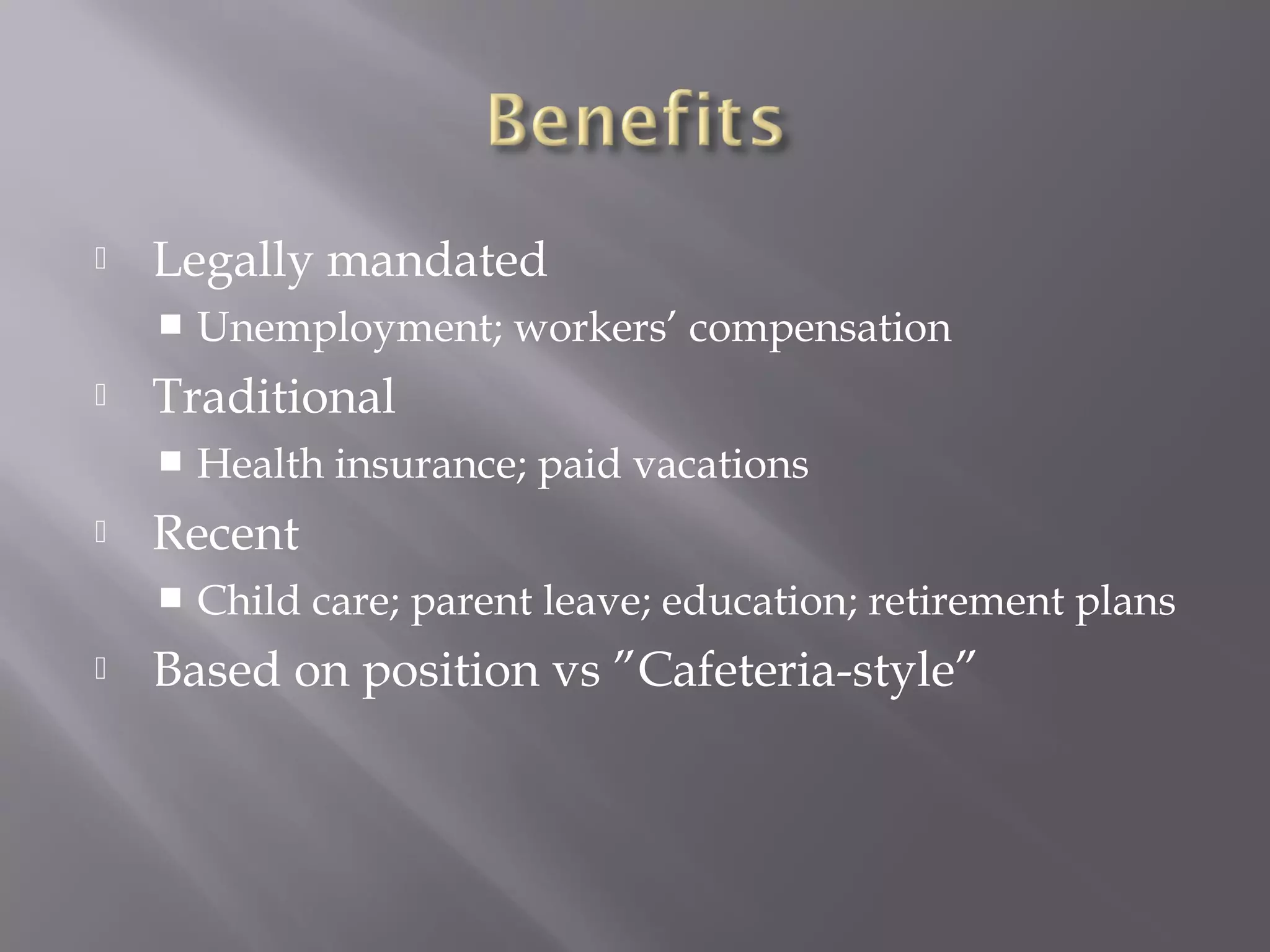
Legally mandated




Traditional




Health insurance; paid vacations

Recent




Unemployment; workers’ compensation

Child care; parent leave; education; retirement plans

Based on position vs ”Cafeteria-style”


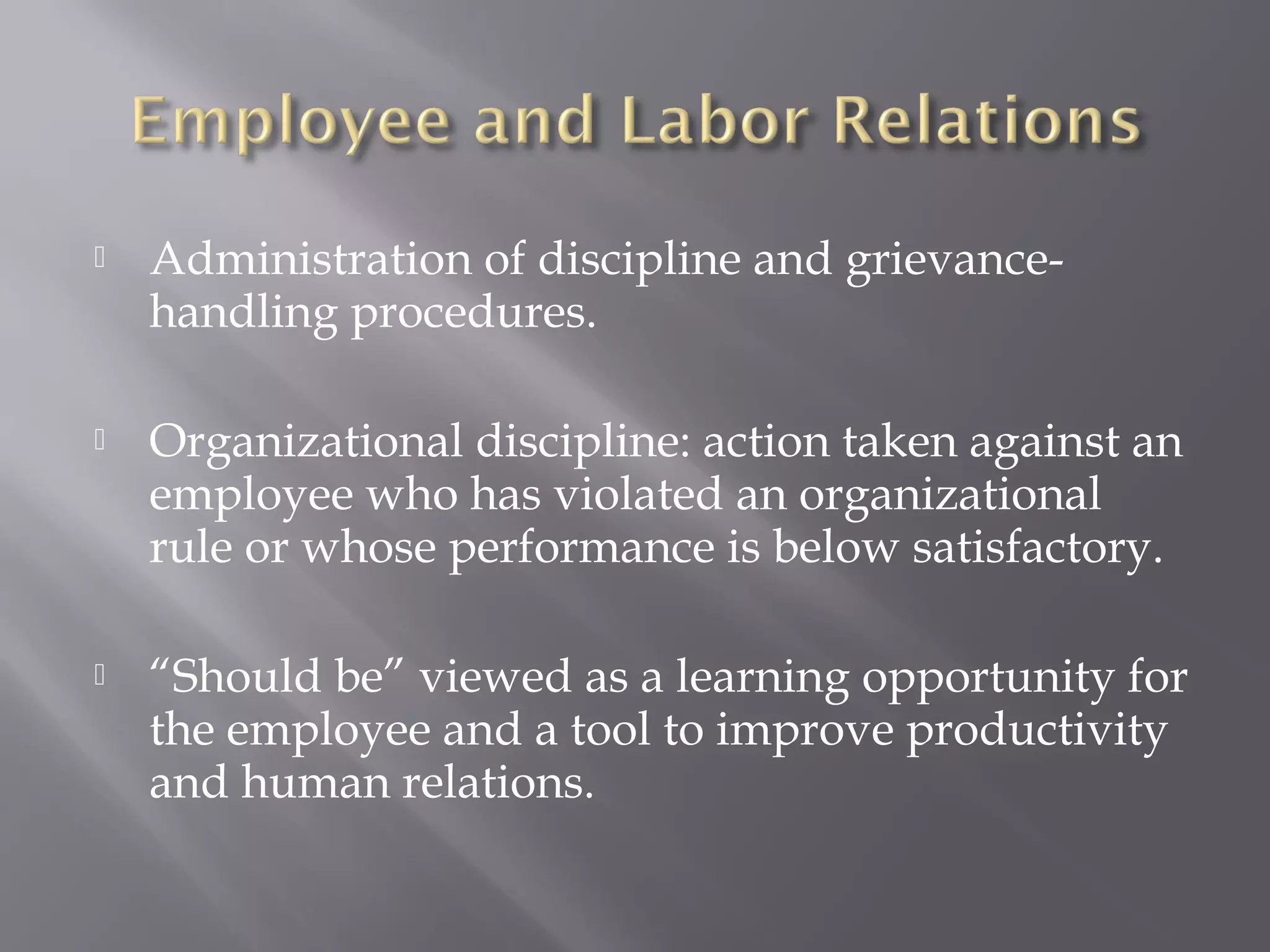
Administration of discipline and grievancehandling procedures.



Organizational discipline: action taken against an
employee who has violated an organizational
rule or whose performance is below satisfactory.



“Should be” viewed as a learning opportunity for
the employee and a tool to improve productivity
and human relations.


Most industrial countries have formal agencies for the
purpose of planning, monitoring, evaluating, and
ensuring employee safety.



Safety most often measured by accident frequency and
severity.



Organizational safety programs emphasize accident
prevention, from standardizing operating procedures
to redesigning work to establishing “contests”, holding
periodic safety workshops, seminars, etc., clearly
posting safety rules and regulations.


Occupational diseases may cost industry as much or
more than occupational accidents.



Number of job-related accidents has decreased;
number of job-related illnesses has risen.



Many diseases and health-related problems that are not
necessarily job-related may affect job performance
(alcohol & drug abuse, AIDS).



Many companies now offer wellness programs,
including fitness centers, EAP programs.


Stress is the mental and physical condition that results
from a perceived threat of danger (physical or emotional)
and the pressure to remove it. Sources include: Threat of
job loss; job mismatch; conflicting expectations; role
ambiguity; role overload; fear/responsibility; working
conditions; working relationships, alienation.



Signs of stress in the workplace include absenteeism, job
turnover, lower productivity, and increased mistakes.
Stress-related disorders include tension and migraine
headaches, coronary heart disease, high blood pressure,
sleep disorders, problems with concentration, appetite,
etc.



Burnout: work is no longer meaningful


Fewer and fewer HR departments have
retained or are limited to traditional, standard
HR functions.



Corporate universities are becoming common
place; HRM supporting the “Learning
Factory”; outsourcing often used for benefit
and training functions; staffing being delegated
to line managers and autonomous teams.


“The process of linking HR practices to
business strategy” (Ulrich, 1997, p. 89); “the
process by which organizations seek to link the
human, social, and intellectual capital of their
members to the strategic needs of the firm”
(Bamberger & Meshoulam (2000, p. 6).



Affirms the importance of the effective
management of people as a source of
competitive advantage.


GHRM: utilization of global human resources to achieve
organizational objectives without regard to geographic
boundaries.



“Going Global” has a major impact on all HRM functions,
from planning, recruitment, and selection to
compensation and benefits, to human resource
development, to safety and health issues, to employee
and labor relations. Each of the various functions has an
even greater impact on organizational performance than
in domestic companies.



Additional challenges include: political and legal factors,
cultural/language issues and maintaining corporate
identity/culture, economic factors, and labormanagement relations.


E.HR: the application of conventional, web, voice and mtechnologies to improve HR administration, transactions
and process performance. “Speed” and “agility” have
become key words for HRM.



E-HR survey in 91 international organizations: 76% have
redesigned or introduced new HR technologies/systems
in the past year and 90% of the remaining expect to do so
within the coming year.



While very cutting edge, total e-HR is expensive and
time consuming. Many companies focus on recruitment,
web training and web approaches to reporting,
appraisal, and reporting.




1998: 17% of Fortune Global 500 companies recruited on the net;
1999, 45%
$1.7 billion on recruitment in 2003
Estimated 2.5 million resumes on the internet

Human resource management course

  • 1.
  • 2.
           What is HRM? Theoriesand Evolution of HRM Why learn about HRM? Activities of Major HRM functions  Recruitment and Selection  Employee and Labor Relations  Safety and Health  Human Resource Development (HRD)  Compensation and Benefits  Performance Appraisal Strategic HRM (SHRM) Global HRM E-HR
  • 3.
    Human Resource Managementemcompasses those activities designed to provide for and cooreinate the human resources of an organization. Traditionally know as ”personnel administration” or ”personnel management”
  • 4.
     Soft HRM emphasizesthe importance of high commitment, learning, enlightened leadership; human resources are valuable assets, not variable costs. Models and theories focus on tapping the human potential, based on organizational behavior theories (e.g. Maslow, 1954; Herzberg, 1966; McGregor, 1960)  Hard HRM emphasizes the calculative, quantitative and strategic management aspects of managing the workforce in a rational way (Storey, 1989).
  • 5.
    Review Classical Theoriesof Organizations • • Taylor’s Theory of Scientific Management • Fayol’s Administrative Theory • Weber’s Theory of Bureaucracy Humanistic Theories of Organizations • • Human Relations Theory • The Hawthorne Studies • Chester Barnard • McGregor’s Theory X and Theory Y • Human Resources Theory • Likert’s Systems Theory (Four Systems of Management) • Blake and Mouton’s (Blake and McCanse) Managerial Grid
  • 6.
    • • • • • • • Classical Theories ofOrganizations Taylor’s Theory of Scientific Management (tasks) Fayol’s Administrative Theory (mgmt) Weber’s Theory of Bureaucracy (org structure) All 3 theories attempt to enhance management’s ability to predict and control the behavior of their workers Considered only the task function of communication (ignored relational and maintenance functions of communication) Designed to predict and control behavior in organizations
  • 7.
    Classical theories emphasizedcoercion, control, and punishment (FOCUS ON TASKS /PRODUCTION). • • • • • • • Maintain predictability and control Decision-making power at top of hierarchy Minimize input from lower-level employees Rely on science and rules to guide behavior Regulate communication to increase predictability and decrease misunderstandings Result: • Workers feel they have no control over their work situation • Management does not care about their ideas • Feelings and ideas of workers are unimportant • Humanistic theories were developed to promote the CONCERNS of the individual worker in an atmosphere that was too focused on production (FOCUS ON RELATIONAL & MAINTENANCE FUNCTIONS)
  • 8.
    • • • • • • • Human relations theoryis characterized by a shift in emphasis from TASK to WORKER Go beyond physical contributions to include creative, cognitive, and emotional aspects of workers Based on a more dyadic (two-way) conceptualization of communication. SOCIAL RELATIONSHIPS are at the heart of organizational behavior--effectiveness is contingent on the social well-being of workers Workers communicate opinions, complaints, suggestions, and feelings to increase satisfaction and production Origins (Hawthorne Studies & work of Chester Barnard) Human Relations School of Management - Elton Mayo (Harvard
  • 9.
    “The Hawthorne Studies • HawthorneWorks of Western Electric Company • 1924 - Chicago • Research focus: Relation of quality and quantity of illumination to efficiency in industry • Four Important Studies •
  • 10.
    Illumination Study (November1924) • • • Designed to test the effect of lighting intensity on worker productivity Heuristic value: influence of human relations on work behavior Relay Assembly Test Room Study (1927-1932) • • • • • • Assembly of telephone relays (35 parts - 4 machine screws) Production and satisfaction increased regardless of IV manipulation Workers’ increased production and satisfaction related to supervisory practices Human interrelationships are important contributing factors to worker productivity Bottom Line: Supervisory practices increase employee morale AND productivity Interviewing Program (1928-1930) • • • • Investigate connection between supervisory practices and employee morale Employees expressed their ideas and feelings (e.g., likes and dislikes) Process more important than actual results Bank Wiring Room Observation Study (November 1931 - May 1932) • • • • Social groups can influence production and individual work behavior RQ: How is social control manifested on the shop floor? Informal organization constrains employee behavior within formal organizational structure
  • 11.
    Illumination Study (November1924) • • Relay Assembly Test Room Study (1927-1932) • • • Relationships between workers and their supervisors are powerful Human interrelationships increase the amount and quality of worker participation in decision making Interviewing Program (1928-1930) • • • Demonstrated powerful influence of upward communication Workers were asked for opinions, told they mattered, and positive attitudes toward company increased Bank Wiring Room Observation Study (November 1931 - May 1932) • • • The mere practice of observing people’s behavior tends to alter their behavior (Hawthorne Effect) Led future theorists to account for the existence of informal communication Taken together, these studies helped to document the powerful nature of social relations in the workplace and moved managers more toward the interpersonal aspects of organizing.
  • 12.
    • • • • • • • Not conducted withthe appropriate scientific rigor necessary Too few subjects (N=5) No control groups Subjects replaced with more “cooperative” participants WORTHLESS GROSS ERRORS INCOMPETENCE
  • 13.
    • • • • • Chester Barnard Considered abridge between classical and human relations theories The Functions of the Executive (1938) Argues for . . . • strict lines of communication - classical theory • a “human-based system of organization” • The potential of every worker and the centrality of communication to the organizing process Six Issues Relevant to Organizational Communication • Formal vs. Informal Organization • Cooperation • Communication • Incentives • Authority • Zone of Indifference
  • 14.
    Formal vs. InformalOrganization • • Formal Organization - a system of consciously coordinated activities or forces of two or more persons. (definite, structured, common purpose) • • • • Persons are able to communicate with one another Willing to contribute action To accomplish a common purpose Informal Organization - based on myriad interactions that take place thourghout an organization’s history. • • • • Indefinite Structureless No definite subdivisions of personnel Results: customs, mores, folklore, institutions, social norms, ideals -- may lead to formal organization Cooperation • • • Necessary component of formal organization The expression of the net satisfactions or dissatisfactions experienced or anticipated by each individual in comparison with those experienced or anticipated through alternative opportunities Communication • • • • • • Critical to cooperation The most universal form of human cooperation, and perhaps the most complex, is speech The most likely reason for the success of cooperation and the reason for its failure System of communication: known, formal channels which are as direct (short) as possible, where the complete line of communication is used, the supervisory heads must be competent, the line of communication should not be interrupted, and every communication should be authenticated. Barnard’s system lacks relationship formation and maintenance mechanisms
  • 15.
    Incentives • • • Should be available Notdiscussed in detail Authority • • • • Associated with securing cooperation for organizational members The interrelationship among the originator of the communication, the communication itself, and the receiver Authority of position OVER Authority of Leadership (knowledge & ability). Zone of Indifference - orders followed • • Marks the boundaries of what employees will consider doing without question, based on expectations developed on entering the organization. Barnard drew attention away from formal organizational structures toward communication, cooperation, and the informal organization. His work was integrated by other theorists in the human relations movement.
  • 16.
    Douglas McGregor (1906-1964) • • • • • • • • • • Articulatedbasic principles of human relations theory The Human Side of Enterprise (1960, 1985) To understand human behavior, one must discover the theoretical assumptions upon which behavior is based Especially interested in the behavior of managers toward workers “Every managerial act rests on assumptions, generalizations, and hypotheses--that is to say, on theory . . . Theory and practice are inseparable.” Two Objectives: • Predict and control behavior • Tap Unrealized potential Theory X - Classical Theory Theory Y - Human Relations Theory FOCUS: Manager’s assumptions about HUMAN NATURE
  • 17.
    Theory X -Classical Theory • • Three Assumptions • • • • The average human being has an inherent dislike of work and will avoid it. Most people must be coerced, controlled, directed, and threatened with punishment The average human being prefers to be directed, wishes to avoid responsibility, has relatively little ambition, wants security. Neither explains nor describes human nature Theory Y - Human Relations Theory • • Assumptions • • • • • • • • Physical and mental effort in work is similar to play / rest. External control and the threat of punishment are not the only strategies Commitment to objectives is a function of the rewards associated with their achievement The average human being learns, under proper conditions, not only to accept but to seek responsibility The capacity to exercise a high degree of imagination, ingenuity, and creativity in the solution of organizational problems is widely distributed in the population Intellectual potentialities of the average human being are underutilized A more positive perspective of human nature The KEY to control and quality production is commitment to organizational objectives
  • 18.
    Participative Management Two CentralFeatures • • • • • • • • • Cost-reduction sharing for organizational members - sharing the economic gains from improvements in organizational performance Effective participation - a formal means of providing opportunities to every member of the organization to contribute ideas for improving organizational effectiveness. Must be implemented appropriately Wastes time and undermines managerial power? Magic formula for every organizational problem? CONCERN for RELATIONSHIPS in the organization. As the need to increase commitment grows, so does the need to develop strong, communication-based relationships among organizational members, particularly between supervisor and subordinate.
  • 19.
    • Difficult to adoptprinciples of human relations theory -- misapplications and misunderstandings of both classical theory and human relations theory led to Human Resources Theory • The key element to Human Relations Theory, participation, was used only to make workers feel as if they were part of the organizational decision-making processes • Key to classical and human relations theory is compliance with managerial authority • Workers are told that they are important but were not treated as such • Major Distinctions between Human Resources and Human Relations Theory • • • All people (not just managers) are reservoirs of untapped resources - manager responsibility to tap physical and creative resources Many decisions can be made more effectively and efficiently by workers most directly involved with their consequences Relationship between employee satisfaction and performance - improved satisfaction and morale contribute back to improved decision making and control
  • 20.
    • Increased satisfaction isrelated to the improved decision making and selfcontrol that occurs due to participation that is genuinely solicited and heard • Two prevalent Human Resources Theories • • Rensis Liker Blake & Mouton (Blake & McCanse) Four Systems of Management: Rensis Likert (Figure 3.2, p. 56) • • • • • Management is crticial to all organizational activities and outcomes Continuum that ranges from more classically oriented system to one based on human resources theory Of all the tasks of management, managing the human component is the central and most important task High producing departments and organizations tend toward System IV; low producing units favor System I • • • • System I - Exploitative Authoritative System II - Benevolent Authoritative System III - Consultative System IV - Participative
  • 21.
    Stresses interrelationship betweenproduction (task) and people Management’s main purpose is to promote a culture in the organization that allows for high production at the same time that employees are fostered in their professional and personal development Managerial Grid - now Leadership Grid (Blake & McCanse) (Figure 3.3, p. 59) FOCUS: Manger’s Assumptions about CONCERN for PEOPLE and CONCERN for PRODUCTION Concern for PEOPLE • • • • • • • • • Concern for PRODUCTION • • • • Degree of personal commitment to one’s job Trust-based accountability (vs. obedience-based accountability) Self-esteem for the individual Interpersonal relationships with co-workers Use of people and technology to accomplish organizational tasks Concern for is not about quantity or quality Assessment instrument does not represent personality traits of the manager -instead, indicate a specific orientation to production and people
  • 22.
    •Authority Compliance (9,1) •Classicaltheory •Country Club (1,9) •Informal grapevine •Impoverished (1,1) •Laissez-faire •Middle-of-the-Road (5,5) •Compromise (carrot & stick) •Team (9,9) •Human Resources Approach •Promote the conditions that integrate creativity, high productivity, and high morale through concerted team action
  • 23.
    • • Humanistic Theories ofOrganizations Human Relations Theory • The Hawthorne Studies • Chester Barnard • McGregor’s Theory X and Theory Y • Human Resources Theory • Likert’s Systems Theory (Four Systems of Management) • Blake and Mouton’s (Blake and McCanse) Managerial Grid • The principles of human resources theory attempt to integrate the concern for production from classical theory with the concern for the worker from human relations theory -- more effective and satisfying!
  • 24.
    1917-18: 1st formalpersonnel department created to deal with tight labor market, high turnover, waste and inefficiency, widespread strikes, union growth, government intervention, takeovers 1920’s: HR used to “win” worker cooperation, through ensuring job security, benefits, etc. 1930’-50’s: “Human Relations” recognizes that there are psychological and social influences to worker satisfaction, cooperation, performance; first focus on groups (not teams).
  • 25.
    1960’s: Work design,rather than communication and cooperation in groups, is the key to increasing worker motivation. Small work group design leads to greater employee effort, group work provides opportunities for “self-actualization”; work is more interesting and fulfilling. 1970’s: Quality of Work Life (QWL): emphasis on the value of human resources. PM becomes HR. 1990’s-Present: TQM, reengineering, globalization, strategic HR, new technologies, diversity, contingency models, holistic approaches to HR. HRM models include “high involvement”, “high commitment”, “high performance work system”, “innovative work practices”. HR becomes HRM.
  • 26.
       HR issues arerelevant to everyone in all organizations Provides understanding of systems and processes needed to develop and utilize talents of employees Staffing is the #1 issue for executives.
  • 27.
    EXTERNAL ENVIRONMENT INTERNAL ENVIRONMENT Employee &Labor Relations Safety & Health Staffing HR Management Functions Human Resource Development Compensation & Benefits
  • 28.
        Conducting job analysesto establish th specific requirements of individual jobs within the organization. Forecasting the human resource requirements the organization needs to achieve its objectives. Developing tand implementing a plan to meet these requirements. Recruiting the human resources to fill specific jobs within the organization.
  • 29.
     JA: the processof determining and reporting pertinent information relating to the nature of a specific job. Involves the determination of the tasks which comprise the job and of the “KSA’s” and responsibilities required of the person(s) holding that job, for successful job performance; defines the what, how, why of a job.  Methods of conducting JA: observation, motion and time study, interviews, questionnaires (off-the-shelf; custom)  JA leads to the job description (summary statement + duties and responsibilities) and job specifications (skills, education, experience required).  JA is the foundation for all traditional HR functions (as well as some others!).
  • 31.
     How do weknow who will perform successfully?  The job description helps us know how successful performance of the job can be measured, “criteria of job success” (performance appraisals, production data, personnel data).  The job specification helps identify factors that can predict successful job performance, “criterion predictors” (education, work experience, test scores, interview data).  Validity: how accurately does a predictor actually predict the criteria of job success?
  • 32.
     Included in thereading packet for this class are samples of CV’s and job application forms, including explanations of the various elements and why they are (often) included.  Remember the content, style, and form of the CV and letter of application is highly dependent on geographical customs. If in doubt, ASK!
  • 33.
       Training is alearning process that involves the acquisition of skills, concepts, rules, or attitudes; designed to enhance performance (also through helping employees meet own objectives of job security, financially and intellectually rewarding work, recognition, status, responsibility, achievement). Orientation On-the job training; apprenticeships
  • 34.
        Intended to developthe experience, attitudes, and skills necessary to be an effective manager Should be tied to organizational objectives Often include team work, project work, and leadership training Methods include coaching, job rotation, project assignments, classroom training (case studies, role playing, in-basket techniques, business games.
  • 35.
    On going formaleffort to develop and enrich the organization’s human resources so as to meet both the organization’s and employees objectives; concrete action plan for the individual to meet these goals.  Increases attractiveness of company to job seekers  Supports retention  Addresses needs of minorities, women, >50 professionals  Mechanism for dealing with downsizing, reengineering, restructuring 
  • 36.
       PA is afeedback system that involves the direct evaluation of individual or group performance by a supervisor, manager, or peers. Used for performance feedback, pay administration, counseling and developing employees. Represents an importan link between goalsetting processes and reward systems.
  • 37.
          Goal setting (MBO) 360-degreefeedback Work standards approach Critical-incident appraisal Graphic rating scales Behaviorally Anchored Rating Scale (BARS)
  • 38.
      Both intrinsic andextrinsic rewards received as a result of employment by the organization. Ideally, rewards are linked to performance. Rewards “cause” satisfaction  Rewards based on performance “cause” improved performance  Satisfaction does not (necessarily) “cause” better performance; performance “causes” satisfaction 
  • 39.
       Workplace support (flexibleschedules, child care, etc), autonomy; meaningfulness; opportunities for leaning and advancement and job security are highly related to job satisfaction; pay and benefits have little effect on job satisfaction. Job satisfaction leads to organizational commitment; job dissatisfaction may lead to turnover, absenteeism, tardiness, accidents, strikes, grievances. Job satisfaction is NOT the same as motivation!
  • 40.
     Skill-based pay plans   Allsalaried workforce   Timex, BFGoodrich, Westinghouse Performance-based pay (indiv, group, org)   IBM, Gillette, Dow Chemical Lump-sum salary increases   General Mills, General Foods, Northern Telecon American Express, DuPont Gain Sharing  Georgia Pacific, GE
  • 41.
     Legally mandated   Traditional   Health insurance;paid vacations Recent   Unemployment; workers’ compensation Child care; parent leave; education; retirement plans Based on position vs ”Cafeteria-style”
  • 42.
     Administration of disciplineand grievancehandling procedures.  Organizational discipline: action taken against an employee who has violated an organizational rule or whose performance is below satisfactory.  “Should be” viewed as a learning opportunity for the employee and a tool to improve productivity and human relations.
  • 44.
     Most industrial countrieshave formal agencies for the purpose of planning, monitoring, evaluating, and ensuring employee safety.  Safety most often measured by accident frequency and severity.  Organizational safety programs emphasize accident prevention, from standardizing operating procedures to redesigning work to establishing “contests”, holding periodic safety workshops, seminars, etc., clearly posting safety rules and regulations.
  • 45.
     Occupational diseases maycost industry as much or more than occupational accidents.  Number of job-related accidents has decreased; number of job-related illnesses has risen.  Many diseases and health-related problems that are not necessarily job-related may affect job performance (alcohol & drug abuse, AIDS).  Many companies now offer wellness programs, including fitness centers, EAP programs.
  • 46.
     Stress is themental and physical condition that results from a perceived threat of danger (physical or emotional) and the pressure to remove it. Sources include: Threat of job loss; job mismatch; conflicting expectations; role ambiguity; role overload; fear/responsibility; working conditions; working relationships, alienation.  Signs of stress in the workplace include absenteeism, job turnover, lower productivity, and increased mistakes. Stress-related disorders include tension and migraine headaches, coronary heart disease, high blood pressure, sleep disorders, problems with concentration, appetite, etc.  Burnout: work is no longer meaningful
  • 47.
     Fewer and fewerHR departments have retained or are limited to traditional, standard HR functions.  Corporate universities are becoming common place; HRM supporting the “Learning Factory”; outsourcing often used for benefit and training functions; staffing being delegated to line managers and autonomous teams.
  • 48.
     “The process oflinking HR practices to business strategy” (Ulrich, 1997, p. 89); “the process by which organizations seek to link the human, social, and intellectual capital of their members to the strategic needs of the firm” (Bamberger & Meshoulam (2000, p. 6).  Affirms the importance of the effective management of people as a source of competitive advantage.
  • 49.
     GHRM: utilization ofglobal human resources to achieve organizational objectives without regard to geographic boundaries.  “Going Global” has a major impact on all HRM functions, from planning, recruitment, and selection to compensation and benefits, to human resource development, to safety and health issues, to employee and labor relations. Each of the various functions has an even greater impact on organizational performance than in domestic companies.  Additional challenges include: political and legal factors, cultural/language issues and maintaining corporate identity/culture, economic factors, and labormanagement relations.
  • 50.
     E.HR: the applicationof conventional, web, voice and mtechnologies to improve HR administration, transactions and process performance. “Speed” and “agility” have become key words for HRM.  E-HR survey in 91 international organizations: 76% have redesigned or introduced new HR technologies/systems in the past year and 90% of the remaining expect to do so within the coming year.  While very cutting edge, total e-HR is expensive and time consuming. Many companies focus on recruitment, web training and web approaches to reporting, appraisal, and reporting.    1998: 17% of Fortune Global 500 companies recruited on the net; 1999, 45% $1.7 billion on recruitment in 2003 Estimated 2.5 million resumes on the internet