ANJALI DAS V.M
MBA
RAJADHANI BUSINESS SCHOOL
CONTENTS
 Introduction.
 Meaning
 Evolution
 Significance
 Personnel management
 Functions
 Human capital management
 Characteristics and qualities of HR manager.
 Recent trends in HRM
INTRODUCTION
 Management of human resources.
 Helps to maximize employee productivity.
 Mainly focused on employee recruitment,
training & development, performance
appraisal, rewarding and employee benefits
design.
MEANING
Process of
 hiring employees
 developing them to become more valuable to
the organization
 making the efficient and effective use of human
resources for achieving the defined goals
The management of people in organizations
from a macro perspective
EVOLUTION
Classified into 3 stages
Period before industrial revolution
Period of industrial revolution
Post industrial revolution
PERIOD BEFORE INDUSTRIAL
REVOLUTION
 Primary source was agriculture.
 Limited production.
 Number of specialized crafts was limited.
 Communication channel were limited.
PERIOD OF INDUSTRIAL
REVOLUTION
 Period between 1750 to 1850.
 Conversion of economy from agriculture to
industry.
 Growth of labor union.
 Industrial relation department emerged.
 A department was set up to look into workers
wages, welfare and other related issues.
 Emergence of personnel management.
POST INDUSTRIAL
REVOLUTION
 F.W.Taylor introduced principles of scientific
management.
 Observations and findings of Hawthrone
experiment shifted the focus of Human
resource from increasing worker’s productivity
to increasing worker’s efficiency through
greater work satisfaction.
 Introduction of Douglas McGregor Theory X
and Theory Y (1960) and Abraham Maslow’s
Hierarchy of needs
EVOLUTION OF HRM
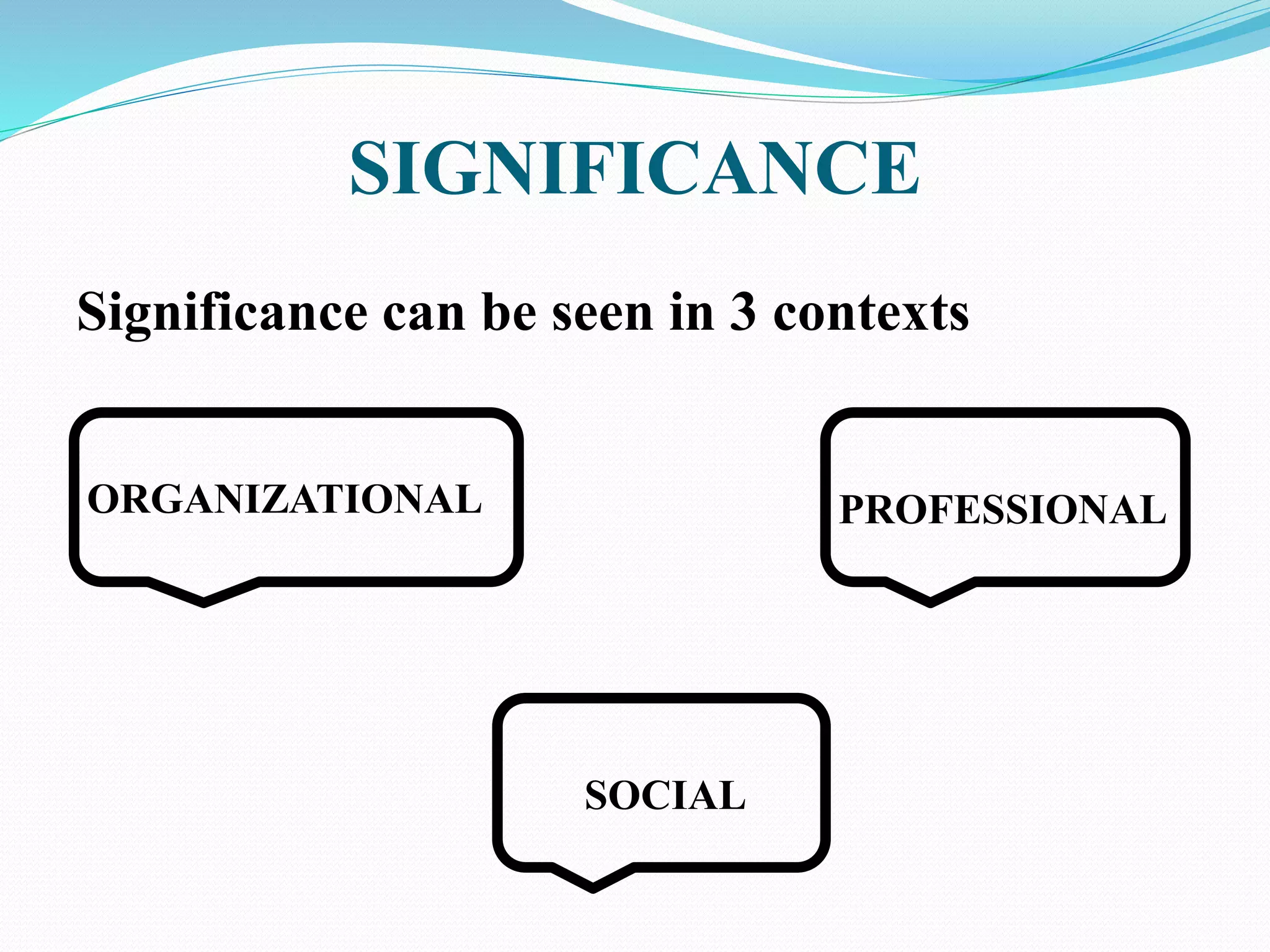
SIGNIFICANCE
Significance can be seen in 3 contexts
ORGANIZATIONAL PROFESSIONAL
SOCIAL
ORGANIZATIONAL
SIGNIFICANCE
Help to achieve organizational goals in
 Attract and retain best people.
 Provide training, development and performance
appraisal so that helps to develop the right skills
and attitudes.
 Effective utilization of human resources.
 Ensure the organization have a dedicated and
competent workers in future.
 Provide motivation and participation.
SOCIAL SIGNIFICANCE
Social significance implies the need satisfaction
of individuals, who are the part of society.
 Increase employee opportunities
 Eliminate the wastage of human resources
 Effective utilization of hidden talents.
PROFESSIONAL
SIGNIFICANCE
It implies the development of people and providing
a healthy environment for their effective
utilization.
 Offering excellent growth opportunities.
 Providing motivation by giving incentives.
 Developing people on continuous basis.
 Provide better working environment.
 Encourage creativity.
 Promote team work and team spirit.
PERSONNEL MANAGEMENT
 Deals with recruitment, hiring, staffing,
development of the workforce.
 Also deals with procurement, development,
compensation, job evaluation, employee
welfare, utilization, maintenance and collective
bargaining.
 Basic managerial functions include Planning,
Organizing, Directing, Motivation, Control and
Coordination.
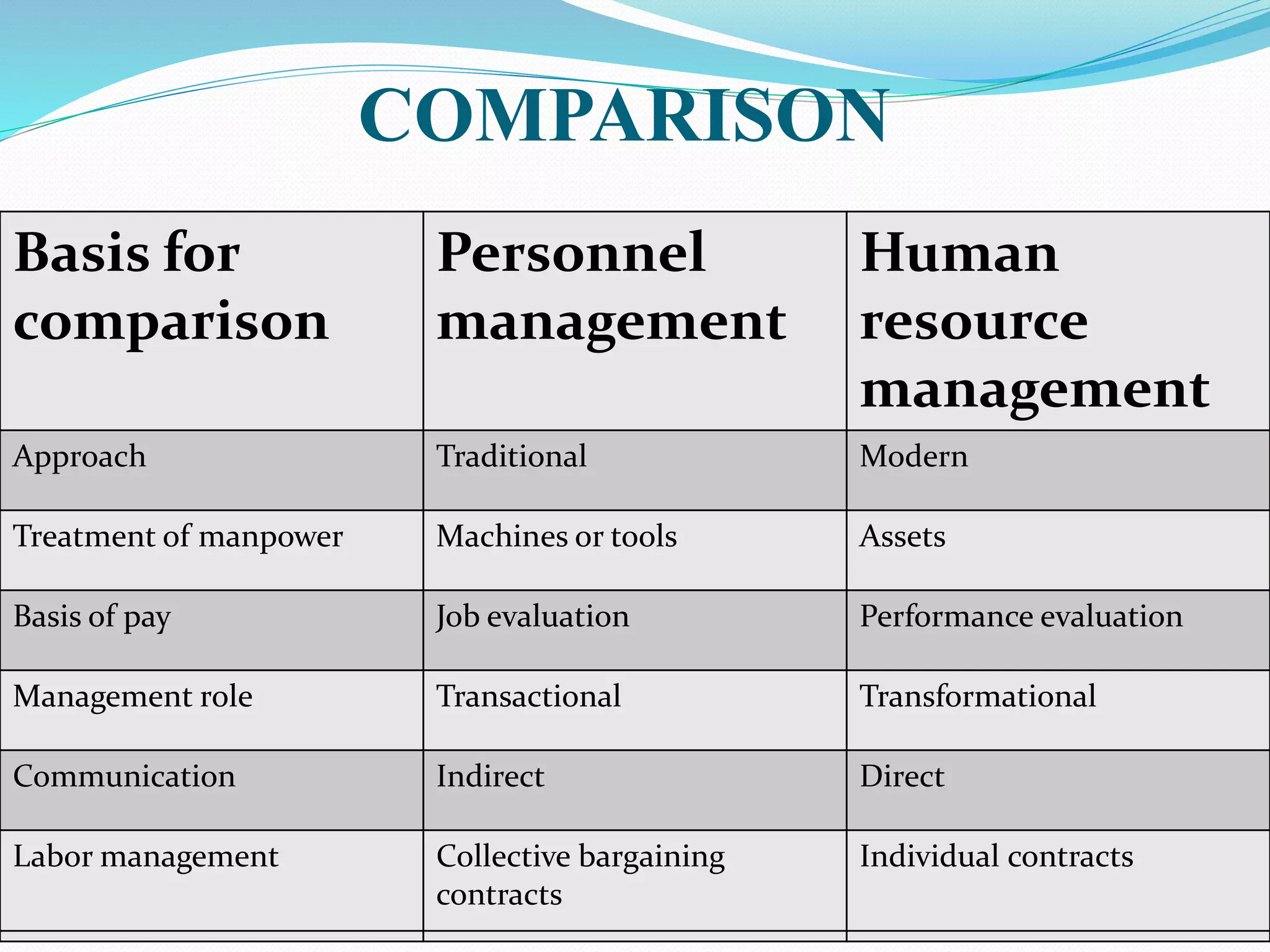
COMPARISON
Basis for
comparison
Personnel
management
Human
resource
management
Approach Traditional Modern
Treatment of manpower Machines or tools Assets
Basis of pay Job evaluation Performance evaluation
Management role Transactional Transformational
Communication Indirect Direct
Labor management Collective bargaining
contracts
Individual contracts
Basis for
comparison
Personnel
management
Human
resource
management
Approach Traditional Modern
Treatment of manpower Machines or tools Assets
Basis of pay Job evaluation Performance evaluation
Management role Transactional Transformational
Communication Indirect Direct
Labor management Collective bargaining
contracts
Individual contracts
COMPARISON (cntd..)
Basis for
comparison
Personnel
management
Human
resource
management
Type of function Routine function Strategic function
Initiatives Piecemeal Integrated
Management actions Procedure Business needs
Decision making Slow Fast
Job design Division of labor Groups/Teams
Focus Primarily on mundane
activities like employee
hiring, remunerating,
training, and harmony.
Treat manpower of the
organization as valued
assets, to be valued, used
and preserved.
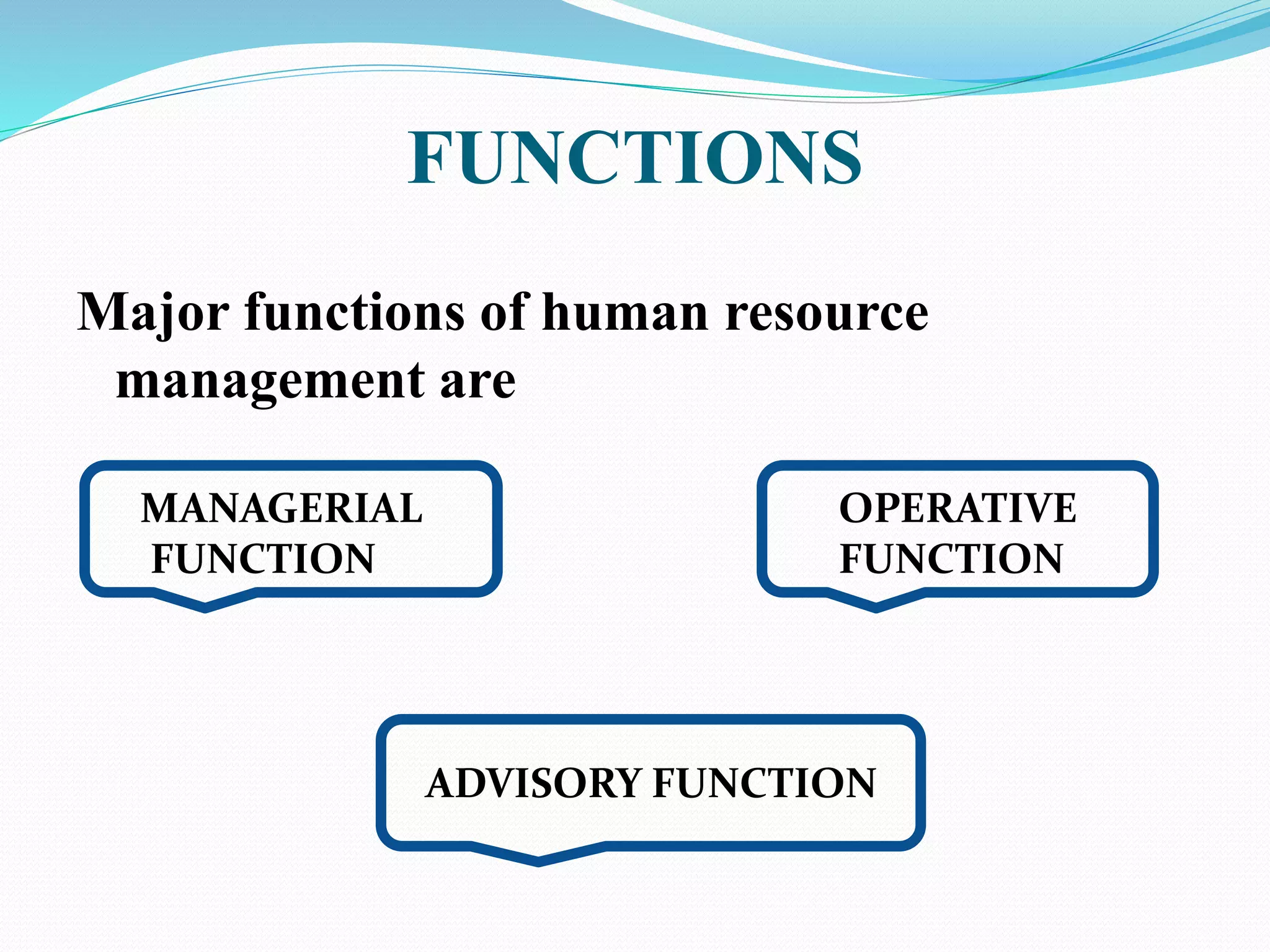
FUNCTIONS
Major functions of human resource
management are
MANAGERIAL
FUNCTION
OPERATIVE
FUNCTION
ADVISORY FUNCTION
MANAGERIAL FUNCTION
 Planning
 Organizing
 Directing
 Controlling
PLANNING
Necessary to determine the goals of the
organization
Determination of personnel programs
Personnel planning involves 3 steps
 Supply & demand forecast
 Net shortage and excess of personnel by job
category are projected for a specific time horizon.
 Plans are developed to eliminate the forecast
shortages and excess of particular categories of
human resources.
ORGANIZING
Design and develop organization structure
 Grouping of personnel activity logically into
functions or positions;
 Assignment of different functions to different
individuals;
 Delegation of authority according to the tasks
assigned and responsibilities involved;
 Co-ordination of activities of different individuals.
DIRECTING
 Guide and motivate the people to accomplish the
personnel programs.
 Motivation is a continuous process as new needs
and expectations emerge among employees when
old ones are satisfied.
 Motivate through career planning, salary
administration, ensuring employee morale,
developing cordial relationships and provision of
safety requirements and welfare of employees.
CONTROLLING
 Regulation of activities in accordance with the
plans, formulated on the basis of the objectives of
the organization.
 Observation and comparison of results with the
standards and correction of deviations that may
occur.
 It involves performance appraisal, critical
examination of personnel records and statistics
and personnel audit.
OPERATIVE FUNCTION
 Employment
 Development
 Compensation
 Maintenance(working conditions & welfare)
 Motivation
 Personnel records
 Industrial relations
 Separation
ADVISORY FUNCTION
 HR manager has education and training related to
human resources.
 Can give advices related to HR.
Offers advice to
Advised to top management
Advised to departmental heads
HUMAN CAPITAL
MANAGEMENT
 Also called as talent management.
 It recognizes that people are investors of their
personal human capital.
 Approach to employee staffing that perceives
people as assets (human capital) whose current
value can be measured and whose future value can
be enhanced through investment.
HCM (cntd…)
HCM will works best where the organization is:
 Organization is people-oriented business.
 Organization is relatively large
 Environment is simple & stable.
 Organization has investors/stakeholders who are
interested in the medium to longer term.
 Focused on growth through differentiation rather
than cost leadership.
HCM (cntd…)
 Managed with a clear & high business strategy.
 Planning is bottom-up as well as top-down.
 Managers take responsibility for people
management.
 Organization acknowledges complexity and is
based on networks and relationships.
 Culture is relatively sophisticated.
 Uses technology effectively.
CHARACTERISTICS OF HR
MANAGER
 Communicator.
 Technologically savvy.
 Purpose focused.
 Presenter.
 Knowledge and expertise in HR.
 Trustworthy.
 Solutions oriented.
 Time management.
CHARACTERISTICS OF HR
MANAGER(cntd..)
 Decision maker.
 Motivator.
 Leader.
 Excellent listener.
 Want to be managers.
RECENT TRENDS IN HRM
 Globalization and its implications.
 Work-force Diversity.
 Changing skill requirements.
 Corporate downsizing.
 Continuous improvement programs.
 Re-engineering work processes for improved
productivity.
 Contingent workforce.
RECENT TRENDS IN
HRM(cntd..)
 Mass Customization.
 Decentralized work sites.
 Employee involvement.
 Technology.
 Health.
 Family work life balance.
 Confidentiality.
REFERENCES
 www.hrdictionaryblog.com
 www.linkedin.com
 www.yourarticlelibrary.com
 www.wikipedia.org
Human resource management

Human resource management

  • 1.
  • 2.
    CONTENTS  Introduction.  Meaning Evolution  Significance  Personnel management  Functions  Human capital management  Characteristics and qualities of HR manager.  Recent trends in HRM
  • 3.
    INTRODUCTION  Management ofhuman resources.  Helps to maximize employee productivity.  Mainly focused on employee recruitment, training & development, performance appraisal, rewarding and employee benefits design.
  • 4.
    MEANING Process of  hiringemployees  developing them to become more valuable to the organization  making the efficient and effective use of human resources for achieving the defined goals The management of people in organizations from a macro perspective
  • 5.
    EVOLUTION Classified into 3stages Period before industrial revolution Period of industrial revolution Post industrial revolution
  • 6.
    PERIOD BEFORE INDUSTRIAL REVOLUTION Primary source was agriculture.  Limited production.  Number of specialized crafts was limited.  Communication channel were limited.
  • 7.
    PERIOD OF INDUSTRIAL REVOLUTION Period between 1750 to 1850.  Conversion of economy from agriculture to industry.  Growth of labor union.  Industrial relation department emerged.  A department was set up to look into workers wages, welfare and other related issues.  Emergence of personnel management.
  • 8.
    POST INDUSTRIAL REVOLUTION  F.W.Taylorintroduced principles of scientific management.  Observations and findings of Hawthrone experiment shifted the focus of Human resource from increasing worker’s productivity to increasing worker’s efficiency through greater work satisfaction.  Introduction of Douglas McGregor Theory X and Theory Y (1960) and Abraham Maslow’s Hierarchy of needs
  • 9.
  • 10.
    SIGNIFICANCE Significance can beseen in 3 contexts ORGANIZATIONAL PROFESSIONAL SOCIAL
  • 11.
    ORGANIZATIONAL SIGNIFICANCE Help to achieveorganizational goals in  Attract and retain best people.  Provide training, development and performance appraisal so that helps to develop the right skills and attitudes.  Effective utilization of human resources.  Ensure the organization have a dedicated and competent workers in future.  Provide motivation and participation.
  • 12.
    SOCIAL SIGNIFICANCE Social significanceimplies the need satisfaction of individuals, who are the part of society.  Increase employee opportunities  Eliminate the wastage of human resources  Effective utilization of hidden talents.
  • 13.
    PROFESSIONAL SIGNIFICANCE It implies thedevelopment of people and providing a healthy environment for their effective utilization.  Offering excellent growth opportunities.  Providing motivation by giving incentives.  Developing people on continuous basis.  Provide better working environment.  Encourage creativity.  Promote team work and team spirit.
  • 14.
    PERSONNEL MANAGEMENT  Dealswith recruitment, hiring, staffing, development of the workforce.  Also deals with procurement, development, compensation, job evaluation, employee welfare, utilization, maintenance and collective bargaining.  Basic managerial functions include Planning, Organizing, Directing, Motivation, Control and Coordination.
  • 15.
    COMPARISON Basis for comparison Personnel management Human resource management Approach TraditionalModern Treatment of manpower Machines or tools Assets Basis of pay Job evaluation Performance evaluation Management role Transactional Transformational Communication Indirect Direct Labor management Collective bargaining contracts Individual contracts Basis for comparison Personnel management Human resource management Approach Traditional Modern Treatment of manpower Machines or tools Assets Basis of pay Job evaluation Performance evaluation Management role Transactional Transformational Communication Indirect Direct Labor management Collective bargaining contracts Individual contracts
  • 16.
    COMPARISON (cntd..) Basis for comparison Personnel management Human resource management Typeof function Routine function Strategic function Initiatives Piecemeal Integrated Management actions Procedure Business needs Decision making Slow Fast Job design Division of labor Groups/Teams Focus Primarily on mundane activities like employee hiring, remunerating, training, and harmony. Treat manpower of the organization as valued assets, to be valued, used and preserved.
  • 17.
    FUNCTIONS Major functions ofhuman resource management are MANAGERIAL FUNCTION OPERATIVE FUNCTION ADVISORY FUNCTION
  • 18.
    MANAGERIAL FUNCTION  Planning Organizing  Directing  Controlling
  • 19.
    PLANNING Necessary to determinethe goals of the organization Determination of personnel programs Personnel planning involves 3 steps  Supply & demand forecast  Net shortage and excess of personnel by job category are projected for a specific time horizon.  Plans are developed to eliminate the forecast shortages and excess of particular categories of human resources.
  • 20.
    ORGANIZING Design and developorganization structure  Grouping of personnel activity logically into functions or positions;  Assignment of different functions to different individuals;  Delegation of authority according to the tasks assigned and responsibilities involved;  Co-ordination of activities of different individuals.
  • 21.
    DIRECTING  Guide andmotivate the people to accomplish the personnel programs.  Motivation is a continuous process as new needs and expectations emerge among employees when old ones are satisfied.  Motivate through career planning, salary administration, ensuring employee morale, developing cordial relationships and provision of safety requirements and welfare of employees.
  • 22.
    CONTROLLING  Regulation ofactivities in accordance with the plans, formulated on the basis of the objectives of the organization.  Observation and comparison of results with the standards and correction of deviations that may occur.  It involves performance appraisal, critical examination of personnel records and statistics and personnel audit.
  • 23.
    OPERATIVE FUNCTION  Employment Development  Compensation  Maintenance(working conditions & welfare)  Motivation  Personnel records  Industrial relations  Separation
  • 24.
    ADVISORY FUNCTION  HRmanager has education and training related to human resources.  Can give advices related to HR. Offers advice to Advised to top management Advised to departmental heads
  • 25.
    HUMAN CAPITAL MANAGEMENT  Alsocalled as talent management.  It recognizes that people are investors of their personal human capital.  Approach to employee staffing that perceives people as assets (human capital) whose current value can be measured and whose future value can be enhanced through investment.
  • 26.
    HCM (cntd…) HCM willworks best where the organization is:  Organization is people-oriented business.  Organization is relatively large  Environment is simple & stable.  Organization has investors/stakeholders who are interested in the medium to longer term.  Focused on growth through differentiation rather than cost leadership.
  • 27.
    HCM (cntd…)  Managedwith a clear & high business strategy.  Planning is bottom-up as well as top-down.  Managers take responsibility for people management.  Organization acknowledges complexity and is based on networks and relationships.  Culture is relatively sophisticated.  Uses technology effectively.
  • 28.
    CHARACTERISTICS OF HR MANAGER Communicator.  Technologically savvy.  Purpose focused.  Presenter.  Knowledge and expertise in HR.  Trustworthy.  Solutions oriented.  Time management.
  • 29.
    CHARACTERISTICS OF HR MANAGER(cntd..) Decision maker.  Motivator.  Leader.  Excellent listener.  Want to be managers.
  • 30.
    RECENT TRENDS INHRM  Globalization and its implications.  Work-force Diversity.  Changing skill requirements.  Corporate downsizing.  Continuous improvement programs.  Re-engineering work processes for improved productivity.  Contingent workforce.
  • 31.
    RECENT TRENDS IN HRM(cntd..) Mass Customization.  Decentralized work sites.  Employee involvement.  Technology.  Health.  Family work life balance.  Confidentiality.
  • 32.
    REFERENCES  www.hrdictionaryblog.com  www.linkedin.com www.yourarticlelibrary.com  www.wikipedia.org