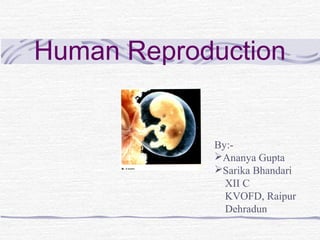
Human Reproduction
By:-
Ananya Gupta
Sarika Bhandari
XII C
KVOFD, Raipur
Dehradun
Battle of the sexes!!!
Are males and
females all that
different?
Well…..
Yes
And
No!
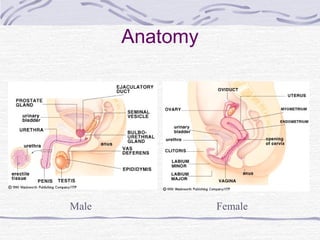
Anatomy
Male Female
Similarities
2 pouches
Testicles
Ovaries
Start out inside body
Testicles “descend” before birth
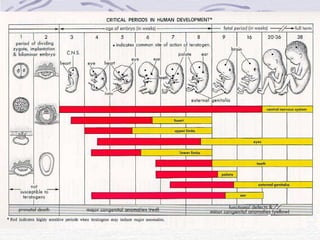
Foetus begins with “starter parts” that
could develop into either gender.
Around 7th
Week…
Baby’s body is “told” by DNA to become
either male or female.
“Unused” parts disintegrate
“Used” parts continue development
(see overhead)
Male or Female???
DNA determines baby’s gender
XX = Female
XY = Male
Depends on which egg & sperm get
together.
Father determines baby’s gender.
Anatomy – similarities
Function – VERY different!
Male
Uncomplicated
Produce sperm
2-4 MILLION
every day
Female
Very Complicated!
One egg
Once a month
Careful coordination
of hormones & body
Timing - perfect!
Females
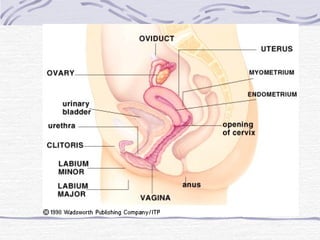
Ovaries
2 pouches
Contain ova
Born with all of her eggs (~ 400,000)
Use up ~500
Won’t run out!
Ovulation
One egg released from ovary to oviduct
(fallopian tube)
After Ovulation
Egg pushed along by cilia
Few days travel time to arrive in uterus
Cervix – Opening between uterus & vagina
Normally tiny
At birth – muscles pull open (dilation) cervix to
allow baby to pass through = Labor
Menstrual Cycle
Complex combination of 10-12
chemicals (hormones)
Usually one egg once a month
All about timing!!!
Uterus must be ready when egg gets there
in case it was fertilized
If no fertilization, tear down lining of uterus
and rebuild for next month
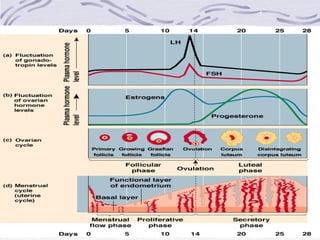
28-Day Cycle (average)
Three Stages
1. Tear Down
2. Rebuild
3. Extra nutrients/blood for potential baby
No Baby?
Back to #1
Chemicals (hormones)
Regulate events in the body
Estrogen
Progesterone
LH (leuteinizing hormone)
FSH (follicle stimulating hormone)
Many others
Day 1
First menstrual blood & tissue
No baby = breaks down lining of uterus
5-7 days of blood/tissue exits body
Pre-Ovulation
~Day 14
Ovulation = Egg released
Temp spikes slightly
Most fertile in next few days!
Able to get pregnant
Egg gets fertilized while traveling through
oviduct.
Post-Ovulation
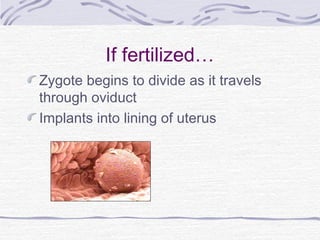
If fertilized…
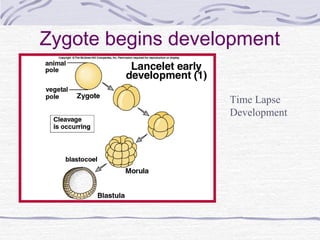
Zygote begins to divide as it travels
through oviduct
Implants into lining of uterus
If not fertilized…
Egg travels through oviduct to uterus
Exits body with blood and tissues
during menstruation
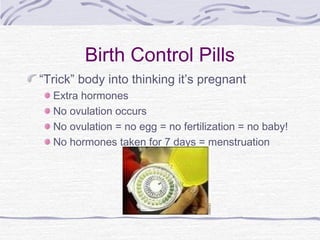
Birth Control Pills
“Trick” body into thinking it’s pregnant
Extra hormones
No ovulation occurs
No ovulation = no egg = no fertilization = no baby!
No hormones taken for 7 days = menstruation
Male
Testes
Produce 2-4 million sperm every day
Outside body – why?
Sperm like temps 1-2° cooler than body temp
Vas Deferens
Tube sperm travel through
Vasectomy
Cut/tie off tube – sperm can’t get out!
Semen
Contains
300-500 million sperm
Sperm food
pH buffers
Allows sperm to survive for a couple of
days inside female’s body (hostile
environment)
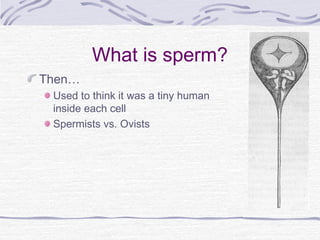
What is sperm?
Then…
Used to think it was a tiny human
inside each cell
Spermists vs. Ovists
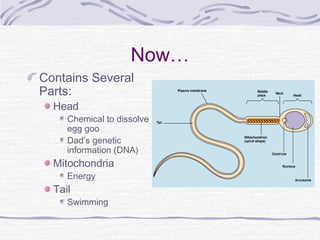
Now…
Contains Several
Parts:
Head
Chemical to dissolve
egg goo
Dad’s genetic
information (DNA)
Mitochondria
Energy
Tail
Swimming
Prostate Gland
Adds non-sperm stuff to semen
pH buffers
Nourishment
Cancer very common
Slower-growing (usually)
Surgery for removal
Bulbourethral gland
Adds lubricant to aid travel of semen
through the urethra
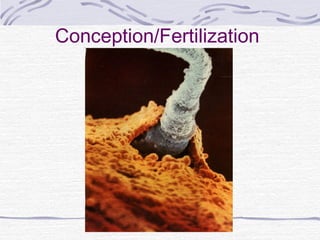
Conception/Fertilization
Ejaculation
Release of 300-500 million sperm
Egg needs to be in oviduct
Sperm to egg, not an easy task
Go wrong direction : 2 paths – only 1 leads to an
egg
Get attacked by female’s white blood cells
Acidic environment
Current
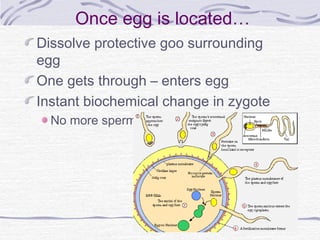
Once egg is located…
Dissolve protective goo surrounding
egg
One gets through – enters egg
Instant biochemical change in zygote
No more sperm allowed in
Zygote begins development
Time Lapse
Development
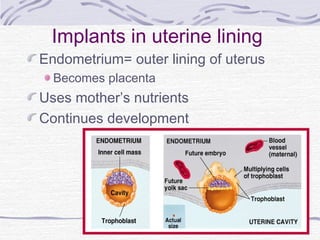
Implants in uterine lining
Endometrium= outer lining of uterus
Becomes placenta
Uses mother’s nutrients
Continues development
Foetal Development
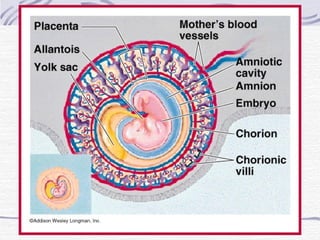
Anmion
Membrane surrounding baby
Contains amniotic fluid
Breaks just before birth = “water broke”
Amniotic Fluid
The “water” – surrounding baby
Buoyant cradle for baby
Protection
Free movement
Foetal Dev (cont’d)
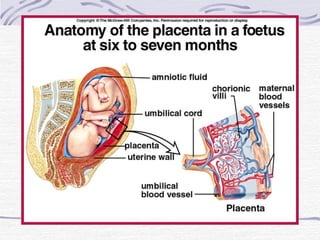
Umbilical Cord
Blood vessels from placenta to baby
Mom’s & baby’s blood do not circulate
together!
Can have 2 different blood types
Diffusion
Ancient beliefs
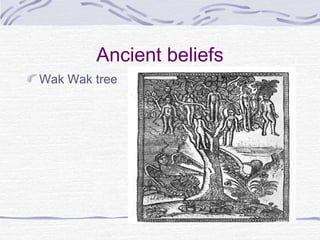
Wak Wak tree
Birth
Labor – muscles used to open cervix
Baby flips upside down
Head first!
Feet first = Breech (bad)
Cesarian Section (“C-section”) surgical removal
of baby
After baby is born mom delivers
placenta (“afterbirth”) that detaches
from uterus
Breastfeeding
Most nutritious option for baby
Milk changes as baby grows
Antibodies from mom create immunity
for baby
Studies have shown correlation
between breastfeeding and higher
intelligence in baby.
Bond w/baby is stronger
Twins/Multiple Births
Two types
Monozygotic
From one egg
Identical
Dizygotic
From two eggs
Fraternal
Not identical
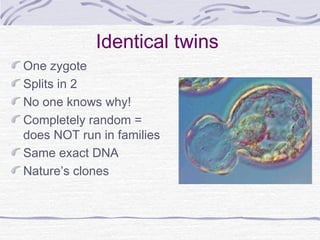
Identical twins
One zygote
Splits in 2
No one knows why!
Completely random =
does NOT run in families
Same exact DNA
Nature’s clones
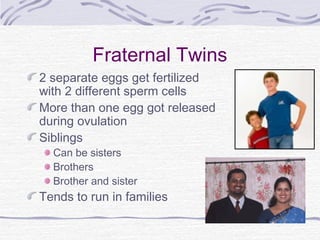
Fraternal Twins
2 separate eggs get fertilized
with 2 different sperm cells
More than one egg got released
during ovulation
Siblings
Can be sisters
Brothers
Brother and sister
Tends to run in families
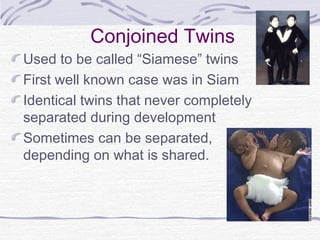
Conjoined Twins
Used to be called “Siamese” twins
First well known case was in Siam
Identical twins that never completely
separated during development
Sometimes can be separated,
depending on what is shared.
We are thankful to :
Our Biology teacher Mr. G.R. Thapliyal
Tata McGraw Hill Publications
Wadsworth Publishing Company/ITC
Addison Wesely Incorporation
Wikipedia
Microsoft
Our Parents

Human reproduction

  • 1.
    Human Reproduction By:- Ananya Gupta SarikaBhandari XII C KVOFD, Raipur Dehradun
  • 2.
    Battle of thesexes!!! Are males and females all that different? Well….. Yes And No!
  • 3.
  • 4.
    Similarities 2 pouches Testicles Ovaries Start outinside body Testicles “descend” before birth Foetus begins with “starter parts” that could develop into either gender.
  • 5.
    Around 7th Week… Baby’s bodyis “told” by DNA to become either male or female. “Unused” parts disintegrate “Used” parts continue development (see overhead)
  • 6.
    Male or Female??? DNAdetermines baby’s gender XX = Female XY = Male Depends on which egg & sperm get together. Father determines baby’s gender.
  • 7.
    Anatomy – similarities Function– VERY different! Male Uncomplicated Produce sperm 2-4 MILLION every day Female Very Complicated! One egg Once a month Careful coordination of hormones & body Timing - perfect!
  • 8.
    Females Ovaries 2 pouches Contain ova Bornwith all of her eggs (~ 400,000) Use up ~500 Won’t run out! Ovulation One egg released from ovary to oviduct (fallopian tube)
  • 10.
    After Ovulation Egg pushedalong by cilia Few days travel time to arrive in uterus Cervix – Opening between uterus & vagina Normally tiny At birth – muscles pull open (dilation) cervix to allow baby to pass through = Labor
  • 11.
    Menstrual Cycle Complex combinationof 10-12 chemicals (hormones) Usually one egg once a month All about timing!!! Uterus must be ready when egg gets there in case it was fertilized If no fertilization, tear down lining of uterus and rebuild for next month
  • 12.
    28-Day Cycle (average) ThreeStages 1. Tear Down 2. Rebuild 3. Extra nutrients/blood for potential baby No Baby? Back to #1
  • 13.
    Chemicals (hormones) Regulate eventsin the body Estrogen Progesterone LH (leuteinizing hormone) FSH (follicle stimulating hormone) Many others
  • 14.
    Day 1 First menstrualblood & tissue No baby = breaks down lining of uterus 5-7 days of blood/tissue exits body Pre-Ovulation
  • 15.
    ~Day 14 Ovulation =Egg released Temp spikes slightly Most fertile in next few days! Able to get pregnant Egg gets fertilized while traveling through oviduct. Post-Ovulation
  • 17.
    If fertilized… Zygote beginsto divide as it travels through oviduct Implants into lining of uterus
  • 18.
    If not fertilized… Eggtravels through oviduct to uterus Exits body with blood and tissues during menstruation
  • 19.
    Birth Control Pills “Trick”body into thinking it’s pregnant Extra hormones No ovulation occurs No ovulation = no egg = no fertilization = no baby! No hormones taken for 7 days = menstruation
  • 20.
    Male Testes Produce 2-4 millionsperm every day Outside body – why? Sperm like temps 1-2° cooler than body temp Vas Deferens Tube sperm travel through Vasectomy Cut/tie off tube – sperm can’t get out!
  • 21.
    Semen Contains 300-500 million sperm Spermfood pH buffers Allows sperm to survive for a couple of days inside female’s body (hostile environment)
  • 22.
    What is sperm? Then… Usedto think it was a tiny human inside each cell Spermists vs. Ovists
  • 23.
    Now… Contains Several Parts: Head Chemical todissolve egg goo Dad’s genetic information (DNA) Mitochondria Energy Tail Swimming
  • 24.
    Prostate Gland Adds non-spermstuff to semen pH buffers Nourishment Cancer very common Slower-growing (usually) Surgery for removal
  • 25.
    Bulbourethral gland Adds lubricantto aid travel of semen through the urethra
  • 26.
  • 27.
    Conception/Fertilization Ejaculation Release of 300-500million sperm Egg needs to be in oviduct Sperm to egg, not an easy task Go wrong direction : 2 paths – only 1 leads to an egg Get attacked by female’s white blood cells Acidic environment Current
  • 28.
    Once egg islocated… Dissolve protective goo surrounding egg One gets through – enters egg Instant biochemical change in zygote No more sperm allowed in
  • 29.
  • 30.
    Implants in uterinelining Endometrium= outer lining of uterus Becomes placenta Uses mother’s nutrients Continues development
  • 31.
    Foetal Development Anmion Membrane surroundingbaby Contains amniotic fluid Breaks just before birth = “water broke” Amniotic Fluid The “water” – surrounding baby Buoyant cradle for baby Protection Free movement
  • 33.
    Foetal Dev (cont’d) UmbilicalCord Blood vessels from placenta to baby Mom’s & baby’s blood do not circulate together! Can have 2 different blood types Diffusion
  • 35.
  • 36.
    Birth Labor – musclesused to open cervix Baby flips upside down Head first! Feet first = Breech (bad) Cesarian Section (“C-section”) surgical removal of baby After baby is born mom delivers placenta (“afterbirth”) that detaches from uterus
  • 37.
    Breastfeeding Most nutritious optionfor baby Milk changes as baby grows Antibodies from mom create immunity for baby Studies have shown correlation between breastfeeding and higher intelligence in baby. Bond w/baby is stronger
  • 38.
    Twins/Multiple Births Two types Monozygotic Fromone egg Identical Dizygotic From two eggs Fraternal Not identical
  • 39.
    Identical twins One zygote Splitsin 2 No one knows why! Completely random = does NOT run in families Same exact DNA Nature’s clones
  • 40.
    Fraternal Twins 2 separateeggs get fertilized with 2 different sperm cells More than one egg got released during ovulation Siblings Can be sisters Brothers Brother and sister Tends to run in families
  • 41.
    Conjoined Twins Used tobe called “Siamese” twins First well known case was in Siam Identical twins that never completely separated during development Sometimes can be separated, depending on what is shared.
  • 43.
    We are thankfulto : Our Biology teacher Mr. G.R. Thapliyal Tata McGraw Hill Publications Wadsworth Publishing Company/ITC Addison Wesely Incorporation Wikipedia Microsoft Our Parents