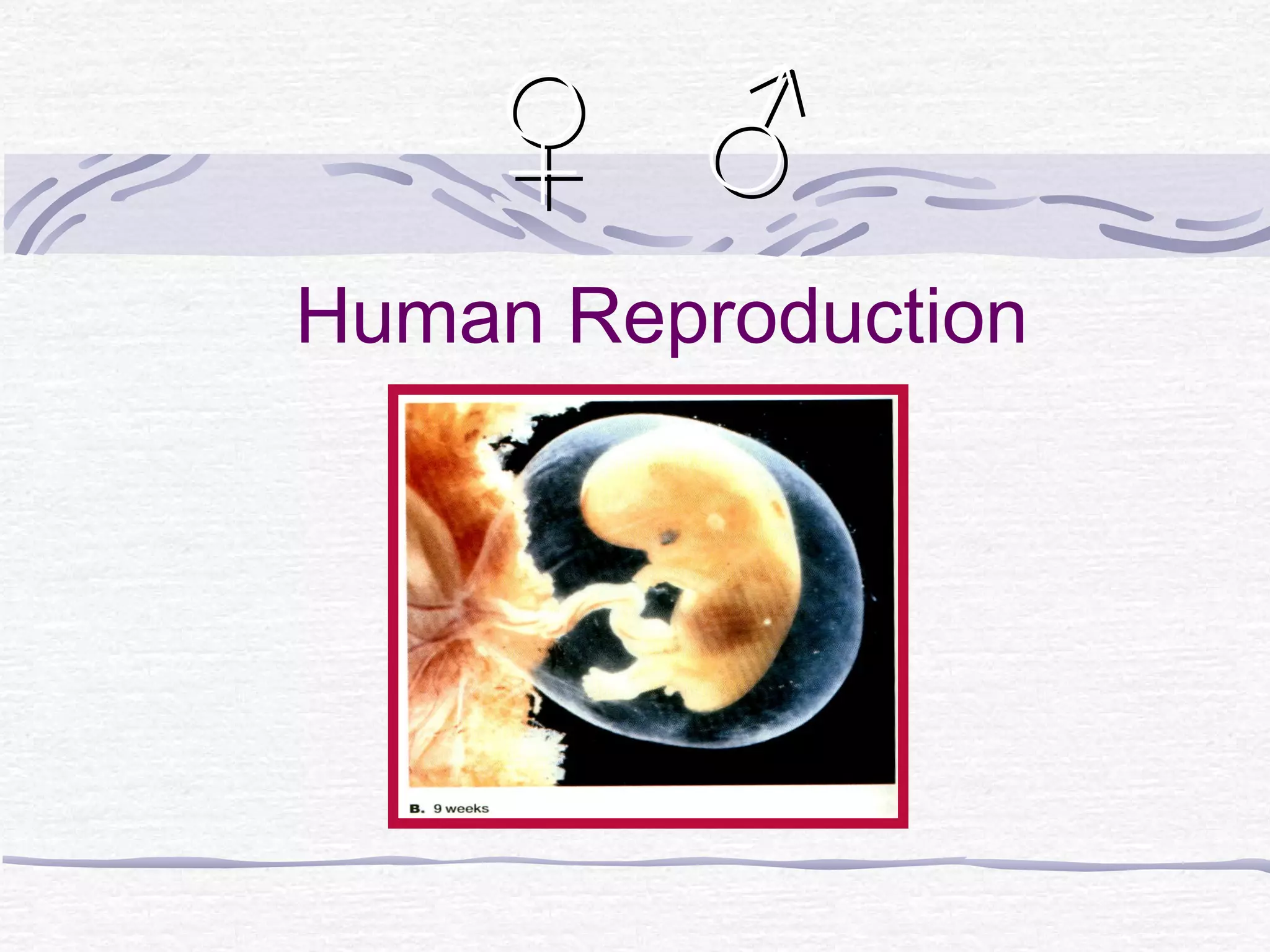
Human Reproduction
♀ ♂♀ ♂
Battle of the sexes!!!
Are males and
females all that
different?
Well…..
Yes
And
No!
Anatomy
Male Female
Similarities
2 pouches
Testicles
Ovaries
Start out inside body
Testicles “descend” before birth
Fetus begins with “starter parts” that
could develop into either gender.
Around 7th
Week…
Baby’s body is “told” by DNA to become
either male or female.
“Unused” parts disintegrate
“Used” parts continue development
Male or Female???
DNA determines baby’s gender
XX = Female
XY = Male
Depends on which egg & sperm get
together.
Father determines baby’s gender.
Anatomy – similarities
Function – VERY different!
Male
Uncomplicated
Produce sperm
2-4 MILLION
every day
Female
Very Complicated!
One egg
Once a month
Careful coordination
of hormones & body
Timing perfect!
Females
Ovaries
2 pouches
Contain ova
Born with all of her eggs (~ 400,000)
Use up ~500
Won’t run out!
Ovulation
One egg released from ovary to oviduct
(fallopian tube)
10
After Ovulation
Egg pushed along by cilia
Few days travel time to arrive in uterus
Cervix – Opening between uterus & vagina
Normally tiny
At birth – muscles pull open (dilation) cervix to
allow baby to pass through = Labor
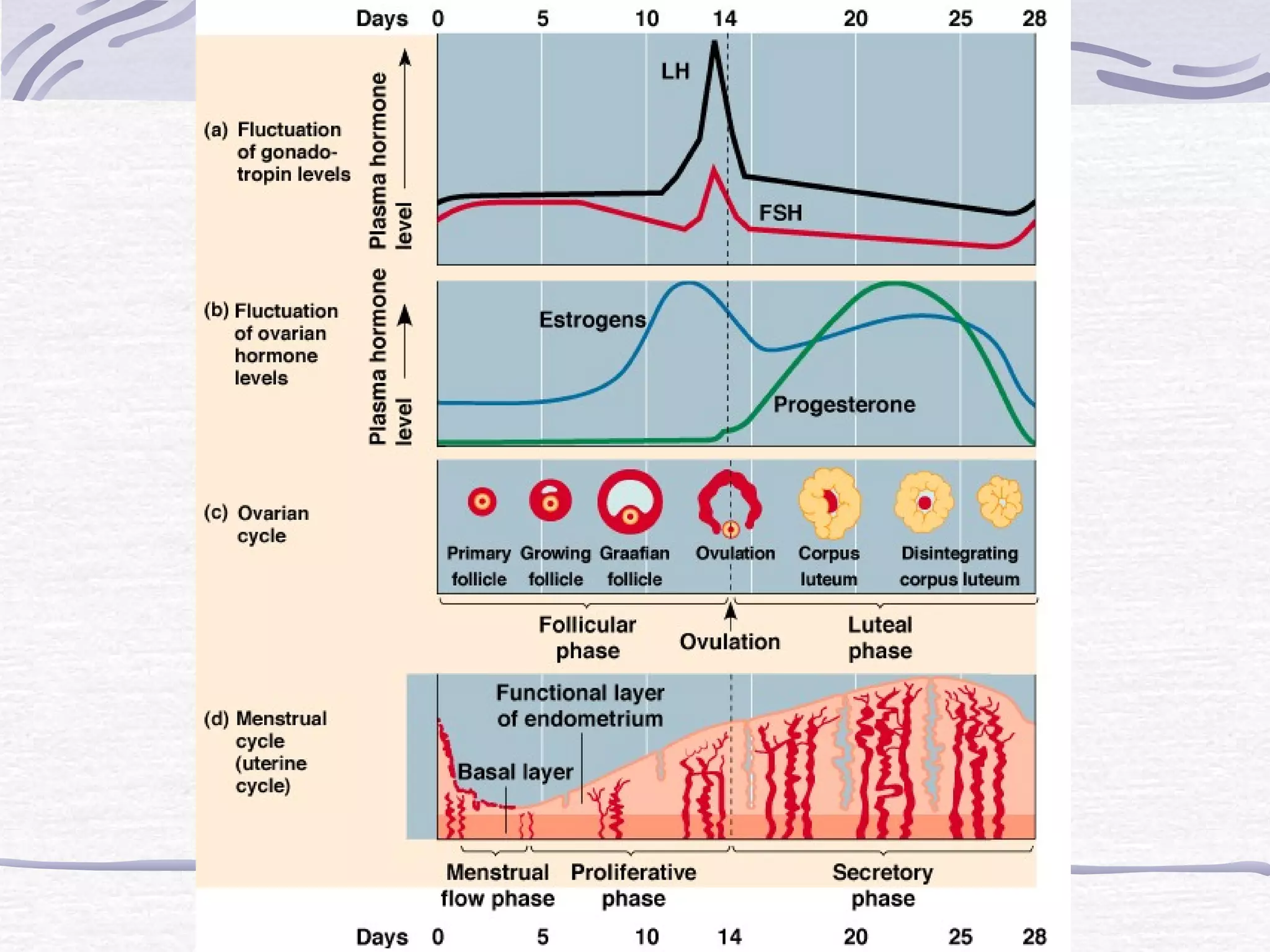
Menstrual Cycle
Complex combination of 10-12
chemicals (hormones)
Usually one egg once a month
All about timing!!!
Uterus must be ready when egg gets there
in case it was fertilized
If no fertilization, tear down lining of uterus
and rebuild for next month
28-Day Cycle (average)
Three Stages
1. Tear Down
2. Rebuild
3. Extra nutrients/blood for potential baby
No Baby?
Back to #1
Chemicals (hormones)
Regulate events in the
body
Estrogen
Progesterone
Many others
15
Estrogen
Estrogen is responsible for
the secondary sex
characteristics and the sex
drive in females. It spurs
the onset of puberty and is
responsible for
OVULATION.
16
Progesterone
Progesterone builds up the
lining of the uterus called
the endometrium in
preparation for the fertilized
ovum
Day 1
First menstrual blood & tissue
No baby = breaks down lining of uterus
5-7 days of blood/tissue exits body
Pre-Ovulation
~Day 14
Ovulation = Egg released
Temp spikes slightly
Most fertile in next few days!
Able to get pregnant
Egg gets fertilized while traveling through
oviduct.
Post-Ovulation
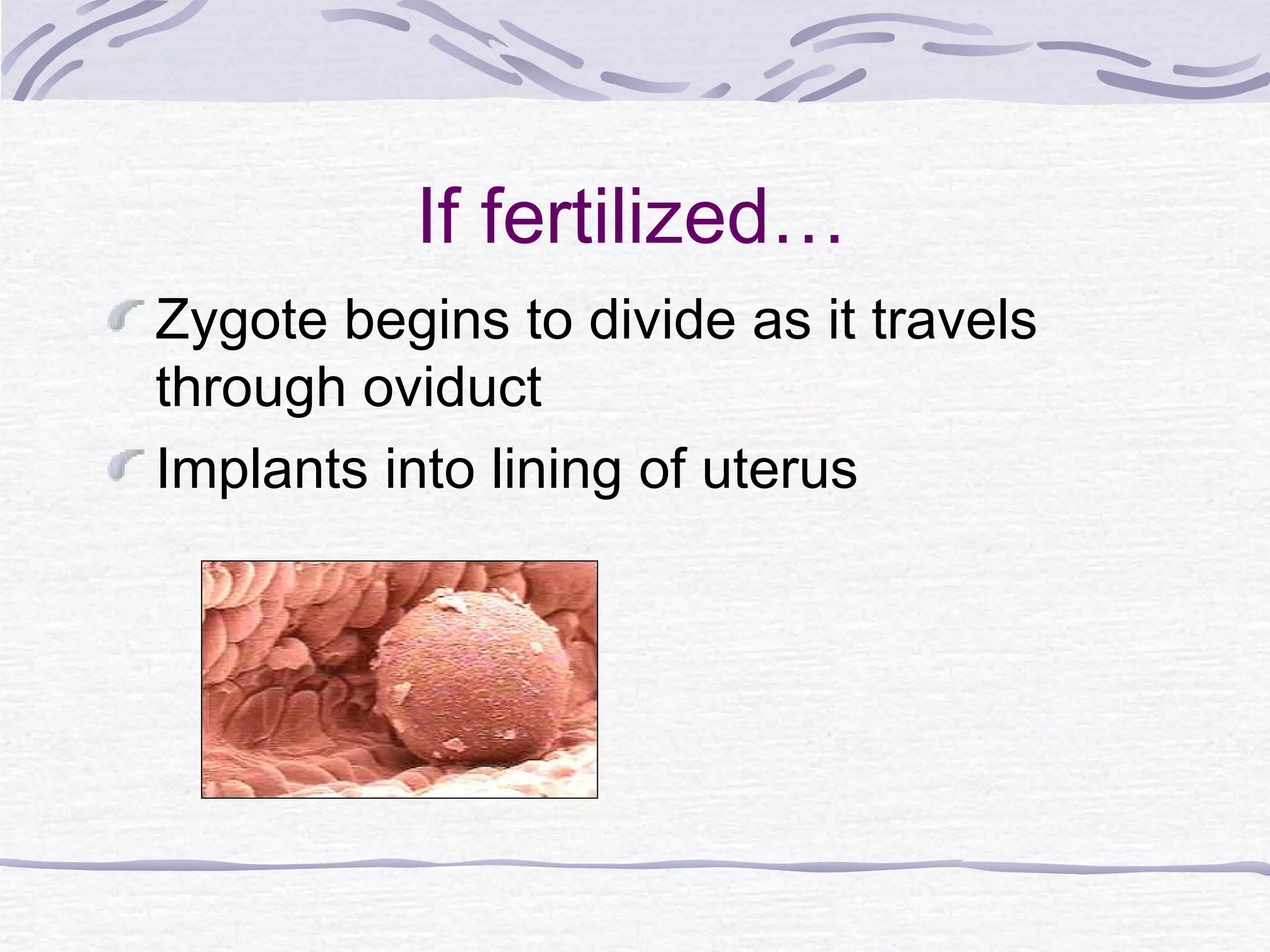
If fertilized…
Zygote begins to divide as it travels
through oviduct
Implants into lining of uterus
If not fertilized…
Egg travels through oviduct to uterus
Exits body with blood and tissues
during menstruation
Birth Control Pills
“Trick” body into thinking it’s pregnant
Extra hormones
No ovulation occurs
No ovulation = no egg = no fertilization = no baby!
No hormones taken for 7 days = menstruation
Male
Testes
Produce 2-4 million sperm every day
Outside body – why?
Sperm like temps 1-2° cooler than body temp
Vas Deferens
Tube sperm travel through
Vasectomy
Cut/tie off tube – sperm can’t get out!
Semen
Contains
300-500 million sperm
Sperm food
pH buffers
Allows sperm to survive for a couple of
days inside female’s body (hostile
environment)
What is sperm?
Then…
Used to think it was a tiny human
inside each cell
Spermists vs. Ovists
Do you remember this?
Now…
Contains Several
Parts:
Head
Chemical to
dissolve egg
goo
Dad’s genetic
information
(DNA)
Mitochondria
Energy
Tail
Swimming
27
Sperm
The microscopic cells produced by the male's
testicles which can fertilize the female's ovum.
They are tiny, living cells 100 times smaller than a
pencil dot. (the smallest cell in a mans body
Enough sperm would fit on the head of a pin to re-
populate the earth if each sperm fertilized an egg.
It is destroyed by warm body temperature, acidic
environment.
It can survive in a women’s body for 5-8 days.
Any sperm not ejaculated are passed in the urine.
Prostate Gland
Adds non-sperm stuff to semen
pH buffers
Nourishment
Cancer very common
Slower-growing (usually)
Surgery for removal
Bulbourethral gland
Adds lubricant to aid travel of semen
through the urethra
Conception/Fertilization
Ejaculation
Release of 300-500 million sperm
Egg needs to be in oviduct
Sperm to egg, not an easy task
Go wrong direction : 2 paths – only 1 leads to an
egg
Get attacked by female’s white blood cells
Acidic environment
Current
Once egg is located…
Dissolve protective goo surrounding
egg
One gets through – enters egg
Instant biochemical change in zygote
No more sperm allowed in
Zygote begins development
Time Lapse
Development
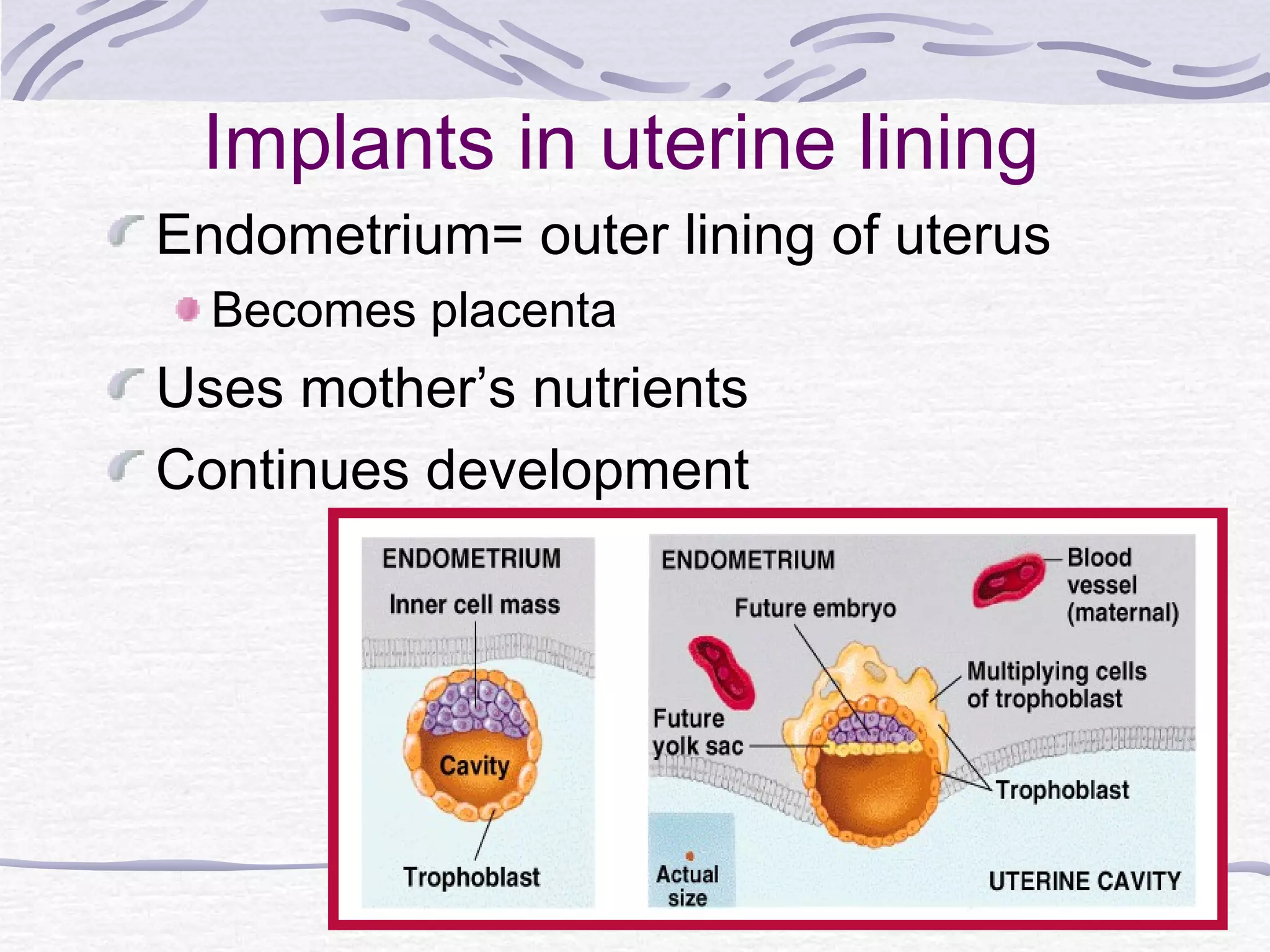
Implants in uterine lining
Endometrium= outer lining of uterus
Becomes placenta
Uses mother’s nutrients
Continues development
Fetal Development
Anmion
Membrane surrounding baby
Contains amniotic fluid
Breaks just before birth = “water broke”
Amniotic Fluid
The “water” – surrounding baby
Buoyant cradle for baby
Protection
Free movement
Fetal Dev (cont’d)
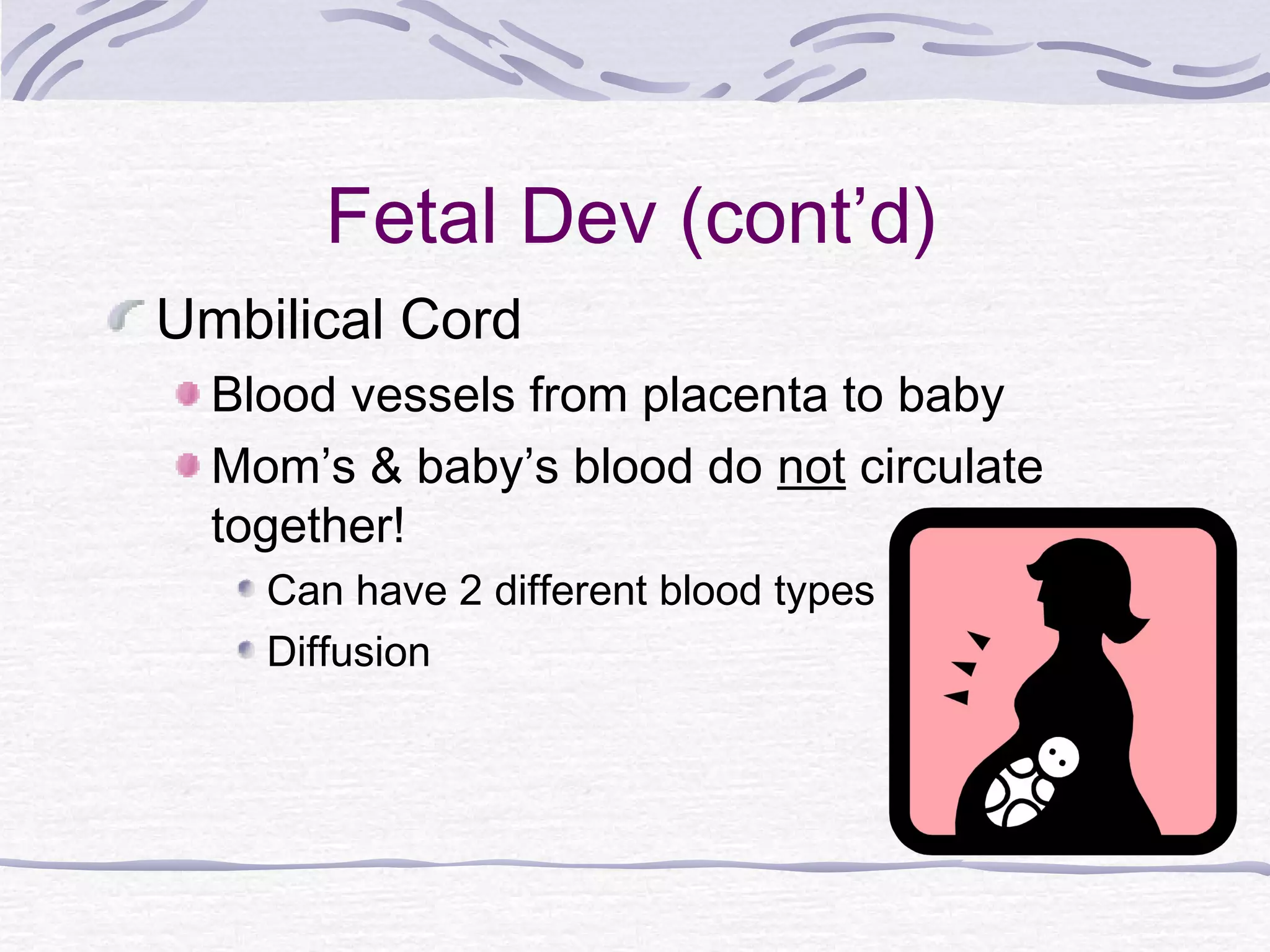
Umbilical Cord
Blood vessels from placenta to baby
Mom’s & baby’s blood do not circulate
together!
Can have 2 different blood types
Diffusion
Birth
Labor – muscles used to open cervix
Baby flips upside down
Head first!
Feet first = Breech (bad)
Cesarian Section (“C-section”) surgical removal
of baby
After baby is born mom delivers
placenta (“afterbirth”) that detaches
from uterus
Breastfeeding
Most nutritious option for baby
Milk changes as baby grows
Antibodies from mom create immunity
for baby
Studies have shown correlation
between breastfeeding and higher
intelligence in baby.
Bond w/baby is stronger
Twins/Multiple Births
Two types
Monozygotic
From one egg
Identical
Dizygotic
From two eggs
Fraternal
Not identical
Identical twins
One zygote
Splits in 2
Same exact DNA
Nature’s clones
Fraternal Twins
2 separate eggs get fertilized
with 2 different sperm cells
More than one egg got released
during ovulation
Siblings
Can be sisters
Brothers
Brother and sister
Tends to run in families
Conjoined Twins
Used to be called “Siamese” twins
First well known case was in Siam
Identical twins that never completely
separated during development
Sometimes can be separated,
depending on what is shared.
46
Sexually Transmitted Diseases
Sexually
Transmitted
Infections
47
STDs
STDs are diseases and infections which
are capable of being spread from person
to person through:
sexual intercourse
oral-genital contact or in non-sexual ways.
IV drug
48
Symptoms
What are the symptoms? How would I
know if I have been infected?
Sores (either painful or painless)
Blood in urine
Burning sensation when urinating
Rashes
Itching
Bumps
Warts
Unusual discharge
49
What is a Sexually
Transmitted Infection or STI?
STI’s are infections that are spread
from person to person through intimate
sexual contact.
STI’s are dangerous because they are
easily spread and it is hard to tell just
by looking who has an STI.
1 in 4 sexually active teens has an STI.
50
Common STI’s
Chlamydia
Gonorrhea
Genital Herpes
(HSV-2)
Genital Warts
(HPV)
Hepatitis B
HIV and AIDS
Pubic Lice
Syphilis
Trichomoniasis
51
What’s the difference between STDs and
STIs?
STDs are Sexually Transmitted Diseases
while STIs are Sexually Transmitted
Infections.  STIs are transmitted through
sexual activity and as a result of the infection,
these STIs can become STDs overtime.  This
process is dependent on numerous factors: 
genetics, immunity, environment, individual
make-up, continual exposure, treatment, the
possibility of multiple STIs, continual sexual
activity without protection.
51
52
Chlamydia
Caused by bacteria called Chlamydia
Trachoma.
Chlamydia is one of the most common
sexually transmitted infections.
Chlamydia is curable.
Your healthcare provider will give you
antibiotics for treatment.
Anyone with whom you’ve had sex will
also need to be treated
53
Gonorrhea
Caused by a bacteria known as
Neisseria gonorrhoeae.
Gonorrhea is treatable.
Your healthcare provider will give you
antibiotics for treatment.
Anyone with whom you’ve had sex will
also need to be treated
54
Genital Herpes (HSV-2)
HSV-2 is caused by the herpes virus.
You can still get HSV-2 even when you
use a condom.
After contracting the herpes virus you
will have it FOREVER. There is NO
cure.
A doctor can prescribe antiviral
medication to help control recurring
outbreaks and clear up painful sores.
55
Genital Warts (HPV)
Genital warts are caused by human
papillomavirus (HPV).
There is NO cure for the virus. You may
have more outbreaks and you can spread
the virus to anyone you have sex with.
You can still get HPV even when you use
a condom.
Some warts can be dissolved with special
medication or the doctor can “freeze”
them off with a special chemical.
56
Hepatitis B
Hepatitis is a disease of the liver.
Hepatitis B is transmitted person to person
through blood and body fluids.
There is no treatment for the virus after it
has been contracted.
The only treatment is prevention:
Abstain from sex
Always use latex condoms
Avoid contact with other people’s blood
Get immunized
57
HIV and AIDS
AIDS is one of the most deadly
diseases in history.
AIDS is caused by HIV (Human
immunodeficiency virus).
HIV destroys the body’s defense
system (the immune system).
Thousands of teens in the U.S. become
infected each year.
58
How do you get HIV?
HIV can be transmitted from an infected
person to another person through
blood, semen, vaginal fluids, and breast
milk.
People who have another STD are at
higher risk for contracting HIV during
sex with infected partners.
59
How do people know they
have HIV?
Many people do not know they have it.
Symptoms may not appear for up to 10
years.
Some people may feel and look healthy
for years while they are infected with
HIV.
It is possible to infect others with HIV,
even if the person has absolutely no
symptoms.
60
Symptoms of AIDS
Extreme weakness
and fatigue
Rapid weight loss
Frequent fevers with
not explanation
Heavy sweating at
night
Swollen lymph glands
Minor infections that
cause skin rashes
and mouth, genital,
and anal sores.
White spots in the
mouth or throat
Chronic diarrhea
A cough that won’t go
away
Short-term memory
loss
61
How is HIV treated?
There is NO cure.
If you think you or your partner may
have HIV or AIDS you need to see a
healthcare provider who can do blood
tests.
Prevention is the only way to protect
yourself from contracting the virus.
Pubic Lice (Crabs)
Pubic lice are tiny insects that can crawl from
the pubic hair of one person to the pubic hair of
another person during sex.
You will be prescribed or told to buy medication
that kills the lice and their eggs.
You will also need to dry clean or use very hot
water to wash all of your bedding, towels, or
recently worn clothing to kill the lice.
Tell your partner.
Pubic lice can be spread even when you use a
condom
63
Syphilis
Caused by bacteria called Trepenoma
pallidum.
If not treated Syphilis can be very dangerous
and can cause brain damage and other
serious health problems.
If you are diagnosed as having the disease
you can be treated with antibiotics.
Anyone with whom you’ve had sex will also
need to be treated
64
Trichomoniasis
Sometimes called “trich” it is a parasite that
can be passed from person to person during
sexual intercourse.
One of the most common STD’s
Can be passed on via damp towels,
washcloths, and bathing suits if someone
has the parasite.
If you have the disease your healthcare
provider will give you antibiotics.
Anyone with whom you’ve had sex will also
need to be treated.
65
What Happens if I don’t get
treated?
If you have an STD and don’t get
treatment you can have some long-term
effects such as:
Infertility (Unable to have babies)
Cancer
Long-term pain
Can pass disease from mother to baby
Death
66
What do I do if I have
symptoms?
If you think you have an STI you need to see
a healthcare provider for treatment.
If you feel nervous about getting checked for
STDs, take a few deep breaths and try to
relax. You may be shy about having doctors
and nurses look at your genitals. The tests
are usually quick, and it may help to
remember that the nurses and doctors are
there to help you, and do this kind of test all
the time.
67
Prevention is the Key
Abstinence, not having sex, is the best
way to protect yourself.
It is possible to get an STD even
without having intercourse through skin-
to-skin contact.
68
Conclusion
It is much easier to prevent an STI than to
cure one.
The ONLY way to prevent STI’s is to abstain
from ALL types of sexual intercourse.
Condoms do not always protect you from
STI’s such as HSV-2, HPV, and Pubic Lice.
Remember, just because you and your
partner may be monogamous with each other,
the risk of getting an STI is increased by the
number of previous sexual partners either
partner has had.
69
How well do you know the 63 people you
had sex with last night?
70
References
www.iwannaknow.org
www.kidshealth.org
www.lib.uiowa.edu
www.healthac.org
www.afraidtoask.com
www.herpes-coldsores.com/std/pictures
www.nehc.med.navy.mil/hp/images/std
_pictures
SOME OF THE STI information was Developed by Bridget Robinson, RN, BSN,SNM
University of Kansas School of Nursing HETC Project-This powerpoint has additions

Human reproduction

  • 1.
  • 2.
    Battle of thesexes!!! Are males and females all that different? Well….. Yes And No!
  • 3.
  • 4.
    Similarities 2 pouches Testicles Ovaries Start outinside body Testicles “descend” before birth Fetus begins with “starter parts” that could develop into either gender.
  • 5.
    Around 7th Week… Baby’s bodyis “told” by DNA to become either male or female. “Unused” parts disintegrate “Used” parts continue development
  • 6.
    Male or Female??? DNAdetermines baby’s gender XX = Female XY = Male Depends on which egg & sperm get together. Father determines baby’s gender.
  • 7.
    Anatomy – similarities Function– VERY different! Male Uncomplicated Produce sperm 2-4 MILLION every day Female Very Complicated! One egg Once a month Careful coordination of hormones & body Timing perfect!
  • 8.
    Females Ovaries 2 pouches Contain ova Bornwith all of her eggs (~ 400,000) Use up ~500 Won’t run out! Ovulation One egg released from ovary to oviduct (fallopian tube)
  • 10.
  • 11.
    After Ovulation Egg pushedalong by cilia Few days travel time to arrive in uterus Cervix – Opening between uterus & vagina Normally tiny At birth – muscles pull open (dilation) cervix to allow baby to pass through = Labor
  • 12.
    Menstrual Cycle Complex combinationof 10-12 chemicals (hormones) Usually one egg once a month All about timing!!! Uterus must be ready when egg gets there in case it was fertilized If no fertilization, tear down lining of uterus and rebuild for next month
  • 13.
    28-Day Cycle (average) ThreeStages 1. Tear Down 2. Rebuild 3. Extra nutrients/blood for potential baby No Baby? Back to #1
  • 14.
    Chemicals (hormones) Regulate eventsin the body Estrogen Progesterone Many others
  • 15.
    15 Estrogen Estrogen is responsiblefor the secondary sex characteristics and the sex drive in females. It spurs the onset of puberty and is responsible for OVULATION.
  • 16.
    16 Progesterone Progesterone builds upthe lining of the uterus called the endometrium in preparation for the fertilized ovum
  • 17.
    Day 1 First menstrualblood & tissue No baby = breaks down lining of uterus 5-7 days of blood/tissue exits body Pre-Ovulation
  • 18.
    ~Day 14 Ovulation =Egg released Temp spikes slightly Most fertile in next few days! Able to get pregnant Egg gets fertilized while traveling through oviduct. Post-Ovulation
  • 20.
    If fertilized… Zygote beginsto divide as it travels through oviduct Implants into lining of uterus
  • 21.
    If not fertilized… Eggtravels through oviduct to uterus Exits body with blood and tissues during menstruation
  • 22.
    Birth Control Pills “Trick”body into thinking it’s pregnant Extra hormones No ovulation occurs No ovulation = no egg = no fertilization = no baby! No hormones taken for 7 days = menstruation
  • 23.
    Male Testes Produce 2-4 millionsperm every day Outside body – why? Sperm like temps 1-2° cooler than body temp Vas Deferens Tube sperm travel through Vasectomy Cut/tie off tube – sperm can’t get out!
  • 24.
    Semen Contains 300-500 million sperm Spermfood pH buffers Allows sperm to survive for a couple of days inside female’s body (hostile environment)
  • 25.
    What is sperm? Then… Usedto think it was a tiny human inside each cell Spermists vs. Ovists Do you remember this?
  • 26.
    Now… Contains Several Parts: Head Chemical to dissolveegg goo Dad’s genetic information (DNA) Mitochondria Energy Tail Swimming
  • 27.
    27 Sperm The microscopic cellsproduced by the male's testicles which can fertilize the female's ovum. They are tiny, living cells 100 times smaller than a pencil dot. (the smallest cell in a mans body Enough sperm would fit on the head of a pin to re- populate the earth if each sperm fertilized an egg. It is destroyed by warm body temperature, acidic environment. It can survive in a women’s body for 5-8 days. Any sperm not ejaculated are passed in the urine.
  • 28.
    Prostate Gland Adds non-spermstuff to semen pH buffers Nourishment Cancer very common Slower-growing (usually) Surgery for removal
  • 29.
    Bulbourethral gland Adds lubricantto aid travel of semen through the urethra
  • 30.
  • 31.
    Conception/Fertilization Ejaculation Release of 300-500million sperm Egg needs to be in oviduct Sperm to egg, not an easy task Go wrong direction : 2 paths – only 1 leads to an egg Get attacked by female’s white blood cells Acidic environment Current
  • 32.
    Once egg islocated… Dissolve protective goo surrounding egg One gets through – enters egg Instant biochemical change in zygote No more sperm allowed in
  • 33.
  • 34.
    Implants in uterinelining Endometrium= outer lining of uterus Becomes placenta Uses mother’s nutrients Continues development
  • 35.
    Fetal Development Anmion Membrane surroundingbaby Contains amniotic fluid Breaks just before birth = “water broke” Amniotic Fluid The “water” – surrounding baby Buoyant cradle for baby Protection Free movement
  • 37.
    Fetal Dev (cont’d) UmbilicalCord Blood vessels from placenta to baby Mom’s & baby’s blood do not circulate together! Can have 2 different blood types Diffusion
  • 39.
    Birth Labor – musclesused to open cervix Baby flips upside down Head first! Feet first = Breech (bad) Cesarian Section (“C-section”) surgical removal of baby After baby is born mom delivers placenta (“afterbirth”) that detaches from uterus
  • 40.
    Breastfeeding Most nutritious optionfor baby Milk changes as baby grows Antibodies from mom create immunity for baby Studies have shown correlation between breastfeeding and higher intelligence in baby. Bond w/baby is stronger
  • 41.
    Twins/Multiple Births Two types Monozygotic Fromone egg Identical Dizygotic From two eggs Fraternal Not identical
  • 42.
    Identical twins One zygote Splitsin 2 Same exact DNA Nature’s clones
  • 43.
    Fraternal Twins 2 separateeggs get fertilized with 2 different sperm cells More than one egg got released during ovulation Siblings Can be sisters Brothers Brother and sister Tends to run in families
  • 44.
    Conjoined Twins Used tobe called “Siamese” twins First well known case was in Siam Identical twins that never completely separated during development Sometimes can be separated, depending on what is shared.
  • 46.
  • 47.
    47 STDs STDs are diseasesand infections which are capable of being spread from person to person through: sexual intercourse oral-genital contact or in non-sexual ways. IV drug
  • 48.
    48 Symptoms What are thesymptoms? How would I know if I have been infected? Sores (either painful or painless) Blood in urine Burning sensation when urinating Rashes Itching Bumps Warts Unusual discharge
  • 49.
    49 What is aSexually Transmitted Infection or STI? STI’s are infections that are spread from person to person through intimate sexual contact. STI’s are dangerous because they are easily spread and it is hard to tell just by looking who has an STI. 1 in 4 sexually active teens has an STI.
  • 50.
    50 Common STI’s Chlamydia Gonorrhea Genital Herpes (HSV-2) GenitalWarts (HPV) Hepatitis B HIV and AIDS Pubic Lice Syphilis Trichomoniasis
  • 51.
    51 What’s the differencebetween STDs and STIs? STDs are Sexually Transmitted Diseases while STIs are Sexually Transmitted Infections.  STIs are transmitted through sexual activity and as a result of the infection, these STIs can become STDs overtime.  This process is dependent on numerous factors:  genetics, immunity, environment, individual make-up, continual exposure, treatment, the possibility of multiple STIs, continual sexual activity without protection. 51
  • 52.
    52 Chlamydia Caused by bacteriacalled Chlamydia Trachoma. Chlamydia is one of the most common sexually transmitted infections. Chlamydia is curable. Your healthcare provider will give you antibiotics for treatment. Anyone with whom you’ve had sex will also need to be treated
  • 53.
    53 Gonorrhea Caused by abacteria known as Neisseria gonorrhoeae. Gonorrhea is treatable. Your healthcare provider will give you antibiotics for treatment. Anyone with whom you’ve had sex will also need to be treated
  • 54.
    54 Genital Herpes (HSV-2) HSV-2is caused by the herpes virus. You can still get HSV-2 even when you use a condom. After contracting the herpes virus you will have it FOREVER. There is NO cure. A doctor can prescribe antiviral medication to help control recurring outbreaks and clear up painful sores.
  • 55.
    55 Genital Warts (HPV) Genitalwarts are caused by human papillomavirus (HPV). There is NO cure for the virus. You may have more outbreaks and you can spread the virus to anyone you have sex with. You can still get HPV even when you use a condom. Some warts can be dissolved with special medication or the doctor can “freeze” them off with a special chemical.
  • 56.
    56 Hepatitis B Hepatitis isa disease of the liver. Hepatitis B is transmitted person to person through blood and body fluids. There is no treatment for the virus after it has been contracted. The only treatment is prevention: Abstain from sex Always use latex condoms Avoid contact with other people’s blood Get immunized
  • 57.
    57 HIV and AIDS AIDSis one of the most deadly diseases in history. AIDS is caused by HIV (Human immunodeficiency virus). HIV destroys the body’s defense system (the immune system). Thousands of teens in the U.S. become infected each year.
  • 58.
    58 How do youget HIV? HIV can be transmitted from an infected person to another person through blood, semen, vaginal fluids, and breast milk. People who have another STD are at higher risk for contracting HIV during sex with infected partners.
  • 59.
    59 How do peopleknow they have HIV? Many people do not know they have it. Symptoms may not appear for up to 10 years. Some people may feel and look healthy for years while they are infected with HIV. It is possible to infect others with HIV, even if the person has absolutely no symptoms.
  • 60.
    60 Symptoms of AIDS Extremeweakness and fatigue Rapid weight loss Frequent fevers with not explanation Heavy sweating at night Swollen lymph glands Minor infections that cause skin rashes and mouth, genital, and anal sores. White spots in the mouth or throat Chronic diarrhea A cough that won’t go away Short-term memory loss
  • 61.
    61 How is HIVtreated? There is NO cure. If you think you or your partner may have HIV or AIDS you need to see a healthcare provider who can do blood tests. Prevention is the only way to protect yourself from contracting the virus.
  • 62.
    Pubic Lice (Crabs) Pubiclice are tiny insects that can crawl from the pubic hair of one person to the pubic hair of another person during sex. You will be prescribed or told to buy medication that kills the lice and their eggs. You will also need to dry clean or use very hot water to wash all of your bedding, towels, or recently worn clothing to kill the lice. Tell your partner. Pubic lice can be spread even when you use a condom
  • 63.
    63 Syphilis Caused by bacteriacalled Trepenoma pallidum. If not treated Syphilis can be very dangerous and can cause brain damage and other serious health problems. If you are diagnosed as having the disease you can be treated with antibiotics. Anyone with whom you’ve had sex will also need to be treated
  • 64.
    64 Trichomoniasis Sometimes called “trich”it is a parasite that can be passed from person to person during sexual intercourse. One of the most common STD’s Can be passed on via damp towels, washcloths, and bathing suits if someone has the parasite. If you have the disease your healthcare provider will give you antibiotics. Anyone with whom you’ve had sex will also need to be treated.
  • 65.
    65 What Happens ifI don’t get treated? If you have an STD and don’t get treatment you can have some long-term effects such as: Infertility (Unable to have babies) Cancer Long-term pain Can pass disease from mother to baby Death
  • 66.
    66 What do Ido if I have symptoms? If you think you have an STI you need to see a healthcare provider for treatment. If you feel nervous about getting checked for STDs, take a few deep breaths and try to relax. You may be shy about having doctors and nurses look at your genitals. The tests are usually quick, and it may help to remember that the nurses and doctors are there to help you, and do this kind of test all the time.
  • 67.
    67 Prevention is theKey Abstinence, not having sex, is the best way to protect yourself. It is possible to get an STD even without having intercourse through skin- to-skin contact.
  • 68.
    68 Conclusion It is mucheasier to prevent an STI than to cure one. The ONLY way to prevent STI’s is to abstain from ALL types of sexual intercourse. Condoms do not always protect you from STI’s such as HSV-2, HPV, and Pubic Lice. Remember, just because you and your partner may be monogamous with each other, the risk of getting an STI is increased by the number of previous sexual partners either partner has had.
  • 69.
    69 How well doyou know the 63 people you had sex with last night?
  • 70.
    70 References www.iwannaknow.org www.kidshealth.org www.lib.uiowa.edu www.healthac.org www.afraidtoask.com www.herpes-coldsores.com/std/pictures www.nehc.med.navy.mil/hp/images/std _pictures SOME OF THESTI information was Developed by Bridget Robinson, RN, BSN,SNM University of Kansas School of Nursing HETC Project-This powerpoint has additions