SC.912.L.16.13
Reproduction
Vocabulary
• Blastocyst
• Bulbourethral Glands
• Cleavage
• Corpus Luteum
• Embryo
• Epididymis
• Semen
• Fallopian Tube
• Fetus
• Follicle
• Gestation
• Implantation
• Menstrual Cycle
• Ovarian cycle
• Ovary
• Ovulation
• Ovum
• Penis
• Placenta
• Pregnancy
• Prostate Gland
• Seminal Vesicles
• Seminiferous Tubules
• Testes
• Uterus
• Vagina
• Vas Deferens
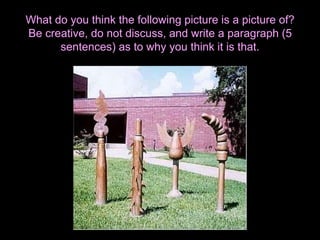
What do you think the following picture is a picture of?
Be creative, do not discuss, and write a paragraph (5
sentences) as to why you think it is that.
Grease 2
• https://www.youtube.com/watch?v=oJGQgAniyho
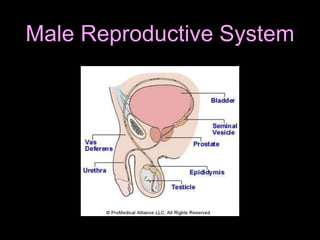
Male Reproductive System
Role
• Produce sperm cells
• Deliver sperm cells to the female reproductive
system to fertilize an egg cell
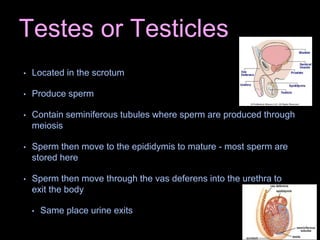
Testes or Testicles
• Located in the scrotum
• Produce sperm
• Contain seminiferous tubules where sperm are produced through
meiosis
• Sperm then move to the epididymis to mature - most sperm are
stored here
• Sperm then move through the vas deferens into the urethra to
exit the body
• Same place urine exits
Vasectomy
• A minor operation performed on adult males as a
method of birth control.
• In a vasectomy, both vas deferens are cut to stop
sperm from exiting the body
• Does this affect any secondary sex
characteristics?
Semen
• Mixture of fluid and sperm
• When sperm cells move into the urethra, they mix with fluid from
glands
• These fluids nourish the sperm and help them through the female
reproductive system
• Seminal vesicles: fluid for energy for sperm
• Prostate gland: fluid to neutralize acids in female RS
• Bulbourethral glands: neutralized traces of acidic urine in the
urethra
Penis
• Deposits sperm in the female RS
• Contains 3 cylinders of spongy tissue where
blood collects
• Sperm exit through ejaculation
• 300-400 million sperm, 3.5 mL of semen are
expelled
Random
• Pigs ejaculate 50-400 mL of semen and 5-20 minutes to
complete ejaculation
• Honey Bee’s have exploding testicles
• Female hyenas have pseudopenis’
• It takes 40 years for Galapagos giant tortoises to reach
sexual maturity
• Argonaut’s have a detachable penis
• https://www.youtube.com/watch?v=eI_quJRRGxk
What age?
• Can a women no longer become pregnant and give
birth?
• Can men no longer father children?
• The possibility of birth defects increases with maternal
age, beginning about age 35, but not with paternal age.
Why?
• Random: Oldest mother to give birth was 74, died 18
months after. Youngest was 5 years old. Oldest man
(in 2012) to father child was 96.
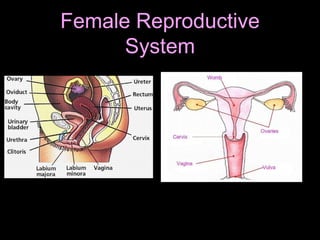
Female Reproductive
System
Female Reproductive
System
• Prepares for a possible pregnancy each month by
releasing a mature egg cell
• If fertilization happen, the female RS will nourish
and protect it through 9 months of pregnancy
Ovaries
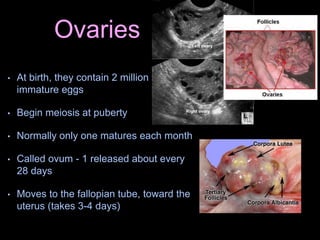
• At birth, they contain 2 million
immature eggs
• Begin meiosis at puberty
• Normally only one matures each month
• Called ovum - 1 released about every
28 days
• Moves to the fallopian tube, toward the
uterus (takes 3-4 days)
Fertilization
• For fertilization to happen, sperm are deposited in
the vagina, they must pass through the cervix into
the uterus then to the egg in the fallopian tube.
• If the egg is not fertilized it will die within 24-48
hours
Cervix
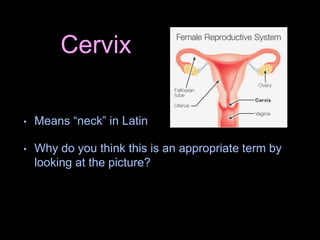
• Means “neck” in Latin
• Why do you think this is an appropriate term by
looking at the picture?
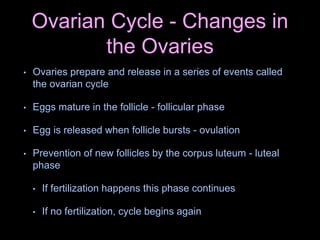
Ovarian Cycle - Changes in
the Ovaries
• Ovaries prepare and release in a series of events called
the ovarian cycle
• Eggs mature in the follicle - follicular phase
• Egg is released when follicle bursts - ovulation
• Prevention of new follicles by the corpus luteum - luteal
phase
• If fertilization happens this phase continues
• If no fertilization, cycle begins again
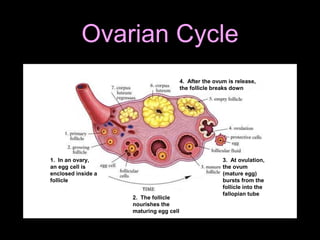
Ovarian Cycle
1. In an ovary,
an egg cell is
enclosed inside a
follicle
2. The follicle
nourishes the
maturing egg cell
3. At ovulation,
the ovum
(mature egg)
bursts from the
follicle into the
fallopian tube
4. After the ovum is release,
the follicle breaks down
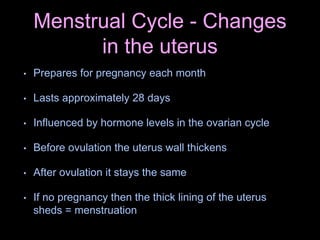
Menstrual Cycle - Changes
in the uterus
• Prepares for pregnancy each month
• Lasts approximately 28 days
• Influenced by hormone levels in the ovarian cycle
• Before ovulation the uterus wall thickens
• After ovulation it stays the same
• If no pregnancy then the thick lining of the uterus
sheds = menstruation
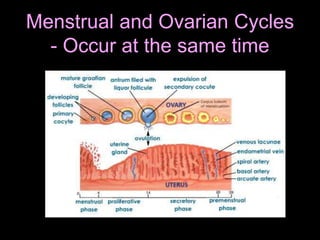
Menstrual and Ovarian Cycles
- Occur at the same time
Menstruation
• Lining breaking causes blood vessels to break
• This is why there is bleeding
• Happens approximately 14 days after ovulation
• Happens at the same time as the Luteal phase
• All the cycles then start again
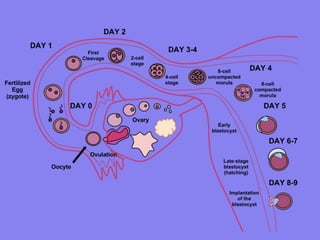
Fertilization
• For fertilization to occur, a sperm cell must swim to a
fallopian tube
• When it reaches the egg, the sperm penetrates the
outer layer
• The sperm and ovum (haploid sex cells) fuse together
• This produces a diploid cell called a zygote
• Zygote then moves through the fallopian tube toward
the uterus
Cleavage
• A series of internal divisions
• Happens in the first week after fertilization
• Produces many new cells in the zygote
• All this happens as the zygote is moving through
the fallopian tube toward the uterus
• When it reaches the uterus, it is a hollow ball of
cells called a blastocyst
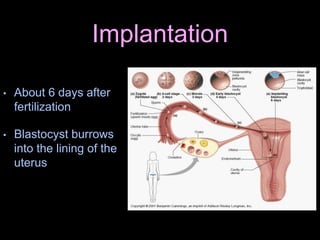
Implantation
• About 6 days after
fertilization
• Blastocyst burrows
into the lining of the
uterus
Pregnancy
• Known as gestation
• Lasts 9 months
• Divided into 3 Trimesters
Random
• Pigs are pregnant for 3 months 3 weeks and 3
days
• Hamster - 16 days
• Cow - 280 days
• Elephant - 2 years
• Opposum - 13 days
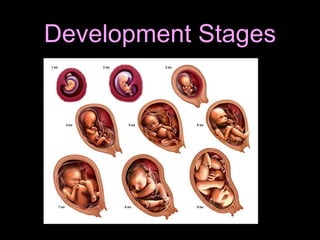
First Trimester
• Embryo grows rapidly
• Membranes for protection and nourishment develop
• Amnion: Encloses and protects the embryo
• Chorion: Forms the placenta
• Placenta develops: nourishes the embryo
• Mother and baby usually never mix blood
• Nutrients from mother’s blood diffuse into the placenta and are carried to the embryo
through blood vessels in the umbilical cord
• Waste products along with nutrients get passed (drugs and alcohol) - this is why you
should not drink or do drugs while pregnant!!!
• FYI - Doctors say there is no benefit to eating placenta (placentophagy) - in animals it is
used to cover the birth and for nutrition (we are already well-nourished)
First Trimester Cont.
• Embryo: First 8 weeks
• End of 3rd week: blood vessels and gut develop, embryo is about
2mm (.08 in) long
• 4th week: arms and legs begin to develop, embryo doubles in
length, all major organs begin to form, heart begins to beat
• 2nd month: arms and legs take shape, internal organs can be
seen, embryo is 22mm (.9 in) and weighs 1 g
• Fetus: from 8th week until birth
• By the end of the 1st trimester: sex can be distinguished, has
recognizable body features, organ systems have begun to form
Second Trimester
• Uterus enlarges
• Fetus’s heartbeat can be heard
• Skeleton begins to form
• Layer of soft hair (lanugo) grows over the skin
• Fetus begins to wake and sleep
• Begins to move, swallows, sucks its thumb
• Can make a fist, hiccup, kick and curl its toes
• By the end: approximately 13.4 in long and 2 lbs
Third Trimester
• Fetus grows quickly
• Organs become functional
• Can see light and dark
• Can react to music and loud sounds
• Fat deposits develop to insulate the body
Birth
• About 38 weeks after fertilization
• Uterus begins to contract
• Amniotic sac breaks
• Muscular contractions and other events = labor
• Walls of uterus contract, pushes the fetus out through the vagina
• Placenta and umbilical cord exit after the baby (collectively called
afterbirth)
• After birth - lungs expand for the first time
Development Stages
Random
Random

Human Reproduction

  • 1.
  • 2.
    Vocabulary • Blastocyst • BulbourethralGlands • Cleavage • Corpus Luteum • Embryo • Epididymis • Semen • Fallopian Tube • Fetus • Follicle • Gestation • Implantation • Menstrual Cycle • Ovarian cycle • Ovary • Ovulation • Ovum • Penis • Placenta • Pregnancy • Prostate Gland • Seminal Vesicles • Seminiferous Tubules • Testes • Uterus • Vagina • Vas Deferens
  • 3.
    What do youthink the following picture is a picture of? Be creative, do not discuss, and write a paragraph (5 sentences) as to why you think it is that.
  • 4.
  • 5.
  • 6.
    Role • Produce spermcells • Deliver sperm cells to the female reproductive system to fertilize an egg cell
  • 7.
    Testes or Testicles •Located in the scrotum • Produce sperm • Contain seminiferous tubules where sperm are produced through meiosis • Sperm then move to the epididymis to mature - most sperm are stored here • Sperm then move through the vas deferens into the urethra to exit the body • Same place urine exits
  • 8.
    Vasectomy • A minoroperation performed on adult males as a method of birth control. • In a vasectomy, both vas deferens are cut to stop sperm from exiting the body • Does this affect any secondary sex characteristics?
  • 9.
    Semen • Mixture offluid and sperm • When sperm cells move into the urethra, they mix with fluid from glands • These fluids nourish the sperm and help them through the female reproductive system • Seminal vesicles: fluid for energy for sperm • Prostate gland: fluid to neutralize acids in female RS • Bulbourethral glands: neutralized traces of acidic urine in the urethra
  • 10.
    Penis • Deposits spermin the female RS • Contains 3 cylinders of spongy tissue where blood collects • Sperm exit through ejaculation • 300-400 million sperm, 3.5 mL of semen are expelled
  • 11.
    Random • Pigs ejaculate50-400 mL of semen and 5-20 minutes to complete ejaculation • Honey Bee’s have exploding testicles • Female hyenas have pseudopenis’ • It takes 40 years for Galapagos giant tortoises to reach sexual maturity • Argonaut’s have a detachable penis • https://www.youtube.com/watch?v=eI_quJRRGxk
  • 12.
    What age? • Cana women no longer become pregnant and give birth? • Can men no longer father children? • The possibility of birth defects increases with maternal age, beginning about age 35, but not with paternal age. Why? • Random: Oldest mother to give birth was 74, died 18 months after. Youngest was 5 years old. Oldest man (in 2012) to father child was 96.
  • 13.
  • 14.
    Female Reproductive System • Preparesfor a possible pregnancy each month by releasing a mature egg cell • If fertilization happen, the female RS will nourish and protect it through 9 months of pregnancy
  • 15.
    Ovaries • At birth,they contain 2 million immature eggs • Begin meiosis at puberty • Normally only one matures each month • Called ovum - 1 released about every 28 days • Moves to the fallopian tube, toward the uterus (takes 3-4 days)
  • 16.
    Fertilization • For fertilizationto happen, sperm are deposited in the vagina, they must pass through the cervix into the uterus then to the egg in the fallopian tube. • If the egg is not fertilized it will die within 24-48 hours
  • 17.
    Cervix • Means “neck”in Latin • Why do you think this is an appropriate term by looking at the picture?
  • 18.
    Ovarian Cycle -Changes in the Ovaries • Ovaries prepare and release in a series of events called the ovarian cycle • Eggs mature in the follicle - follicular phase • Egg is released when follicle bursts - ovulation • Prevention of new follicles by the corpus luteum - luteal phase • If fertilization happens this phase continues • If no fertilization, cycle begins again
  • 19.
    Ovarian Cycle 1. Inan ovary, an egg cell is enclosed inside a follicle 2. The follicle nourishes the maturing egg cell 3. At ovulation, the ovum (mature egg) bursts from the follicle into the fallopian tube 4. After the ovum is release, the follicle breaks down
  • 20.
    Menstrual Cycle -Changes in the uterus • Prepares for pregnancy each month • Lasts approximately 28 days • Influenced by hormone levels in the ovarian cycle • Before ovulation the uterus wall thickens • After ovulation it stays the same • If no pregnancy then the thick lining of the uterus sheds = menstruation
  • 21.
    Menstrual and OvarianCycles - Occur at the same time
  • 22.
    Menstruation • Lining breakingcauses blood vessels to break • This is why there is bleeding • Happens approximately 14 days after ovulation • Happens at the same time as the Luteal phase • All the cycles then start again
  • 23.
    Fertilization • For fertilizationto occur, a sperm cell must swim to a fallopian tube • When it reaches the egg, the sperm penetrates the outer layer • The sperm and ovum (haploid sex cells) fuse together • This produces a diploid cell called a zygote • Zygote then moves through the fallopian tube toward the uterus
  • 25.
    Cleavage • A seriesof internal divisions • Happens in the first week after fertilization • Produces many new cells in the zygote • All this happens as the zygote is moving through the fallopian tube toward the uterus • When it reaches the uterus, it is a hollow ball of cells called a blastocyst
  • 26.
    Implantation • About 6days after fertilization • Blastocyst burrows into the lining of the uterus
  • 27.
    Pregnancy • Known asgestation • Lasts 9 months • Divided into 3 Trimesters
  • 28.
    Random • Pigs arepregnant for 3 months 3 weeks and 3 days • Hamster - 16 days • Cow - 280 days • Elephant - 2 years • Opposum - 13 days
  • 29.
    First Trimester • Embryogrows rapidly • Membranes for protection and nourishment develop • Amnion: Encloses and protects the embryo • Chorion: Forms the placenta • Placenta develops: nourishes the embryo • Mother and baby usually never mix blood • Nutrients from mother’s blood diffuse into the placenta and are carried to the embryo through blood vessels in the umbilical cord • Waste products along with nutrients get passed (drugs and alcohol) - this is why you should not drink or do drugs while pregnant!!! • FYI - Doctors say there is no benefit to eating placenta (placentophagy) - in animals it is used to cover the birth and for nutrition (we are already well-nourished)
  • 30.
    First Trimester Cont. •Embryo: First 8 weeks • End of 3rd week: blood vessels and gut develop, embryo is about 2mm (.08 in) long • 4th week: arms and legs begin to develop, embryo doubles in length, all major organs begin to form, heart begins to beat • 2nd month: arms and legs take shape, internal organs can be seen, embryo is 22mm (.9 in) and weighs 1 g • Fetus: from 8th week until birth • By the end of the 1st trimester: sex can be distinguished, has recognizable body features, organ systems have begun to form
  • 31.
    Second Trimester • Uterusenlarges • Fetus’s heartbeat can be heard • Skeleton begins to form • Layer of soft hair (lanugo) grows over the skin • Fetus begins to wake and sleep • Begins to move, swallows, sucks its thumb • Can make a fist, hiccup, kick and curl its toes • By the end: approximately 13.4 in long and 2 lbs
  • 32.
    Third Trimester • Fetusgrows quickly • Organs become functional • Can see light and dark • Can react to music and loud sounds • Fat deposits develop to insulate the body
  • 33.
    Birth • About 38weeks after fertilization • Uterus begins to contract • Amniotic sac breaks • Muscular contractions and other events = labor • Walls of uterus contract, pushes the fetus out through the vagina • Placenta and umbilical cord exit after the baby (collectively called afterbirth) • After birth - lungs expand for the first time
  • 34.
  • 35.
  • 36.