Today's Session learningobjectives
• Water, importance of water & its uses
• What is safe water
• What is community water requirements
• Type & sources of water
• Hydrologic Cycle
4.
Water
• Water, asubstance composed of the chemical
elements hydrogen and oxygen (H2O)and existing in
gaseous, liquid, and solid states
5.
Water-Characteristics
• Plentiful andessential of compounds
• A tasteless and
• Odourless liquid at room temperature
• Should be easily accessible, adequate in quantity ,
• Free from contamination ,safe and readily available
throughout the year
6.
Role of Water
•Great role to play in socio-economic development of
human population
• Essential factor in the economic, social and cultural
developing of a community
• Also integrated with other PHC Components
7.
Safe and wholesomewater
Free from
• Pathogenic agents
• Harmful chemical substances
• Pleasant to the taste i.e. free from colour and
odour and
• Usable for domestic purposes
8.
Water requirement
• Thebasic physiological requirements for
drinking about 2 liters per head per day
• 150-200 liters per capita / day is considered to
meet the needs for all domestic purpose
• The consumption of water, however, depends
upon climate conditions, standard of living
and habits of the people
9.
Uses of water
Theuses of water in a community are:
• Domestic use, drinking, cooking, washing
and bathing, flushing of toilets, gardening
• Public purpose; cleaning streets, recreational
purpose like swimming pools, public
fountains and ornaments ponds, fire
protection and public parks
10.
Uses of water….cont
•Industrial purposes: for processing and cooling
• Agricultural purpose: irrigation
• Power production from hydropower and stream
power
• Carrying away waste from all manner of
establishments and institutions
• Eliminate diseases, promote rural development
and improve quality of life
Classification of water
•Portable water: used for drinking purposes
• Clean water: all times free from contamination and
safe for human consumption,
• Polluted water: which has suffered impairment of
physical quality through addition of substances
causing turbidity, odor or taste
• Contaminated water: which carries infection due to
the addition of human or animal waste
13.
Sources of watersupply
In general, water sources must conform to two
criteria:
1. The quantity must be sufficient to meet
present and future requirement
2. The quality of water must be acceptable
• There are three main sources of water
14.
Sources of watersupply…cont.
1. RAIN
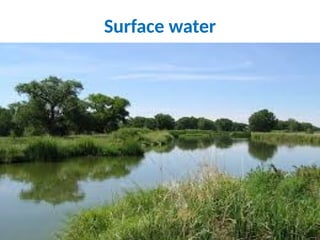
2. SURFACE WATER
• Impounding Reservoirs
• Rivers and streams
• Tanks, Ponds and Lakes
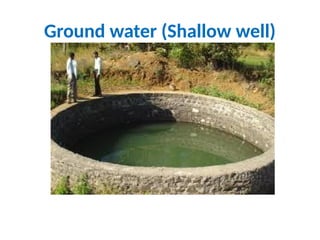
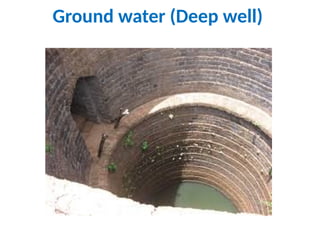
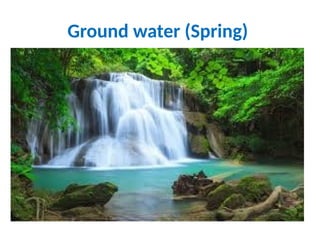
3. GROUND WATER
• Shallow Wells
• Deep Wells
• Springs
15.
RAIN WATER
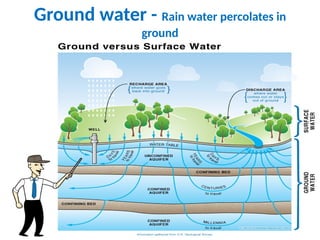
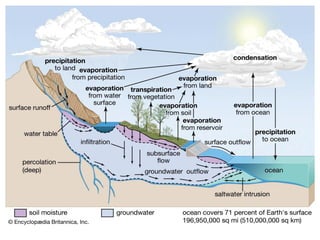
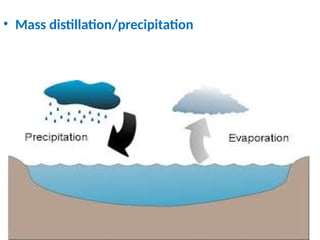
• Itis the prime source of all water
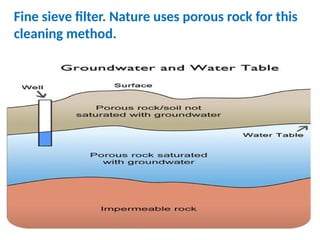
• A part of the rain water sinks into the grounds to form
ground water,
• Part of its evaporates back into the atmosphere, and
some runs off to form streams and rivers which flow
ultimately into the sea
• Some of the water in the soil is taken up by the plants
and is evaporated in the turn by leaves (Events spoken
“water cycle”).
16.
Characteristics of rainwater
• Purest water in nature
• Physically it is clear, bright and sparking
• Chemically it is very soft water contain only
traces of dissolved solids (0.0005 %)
• Free from pathogenic agents
17.
Impurities: of rainwater
• Rain water tends to become impure as it
passes through the atmosphere
• It picks up suspended impurities from the
atmosphere such as dust, soot and
microorganisms and gases such as carbon
dioxide, nitrogen, oxygen and ammonia.
18.
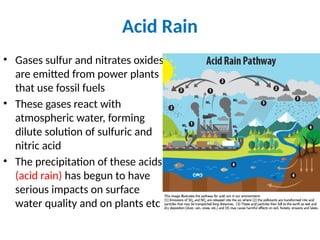
Acid Rain
• Gasessulfur and nitrates oxides
are emitted from power plants
that use fossil fuels
• These gases react with
atmospheric water, forming
dilute solution of sulfuric and
nitric acid
• The precipitation of these acids
(acid rain) has begun to have
serious impacts on surface
water quality and on plants etc
19.
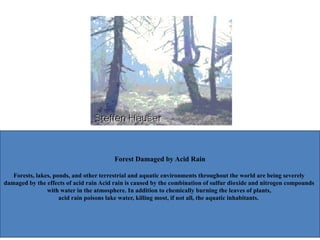
Forest Damaged byAcid Rain
Forests, lakes, ponds, and other terrestrial and aquatic environments throughout the world are being severely
damaged by the effects of acid rain Acid rain is caused by the combination of sulfur dioxide and nitrogen compounds
with water in the atmosphere. In addition to chemically burning the leaves of plants,
acid rain poisons lake water, killing most, if not all, the aquatic inhabitants.
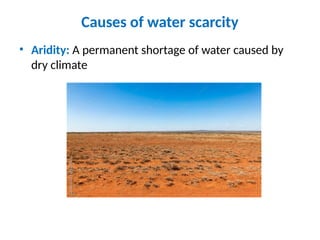
Causes of waterscarcity
• Aridity: A permanent shortage of water caused by
dry climate
26.
Causes of waterscarcity
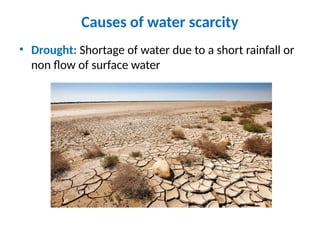
• Drought: Shortage of water due to a short rainfall or
non flow of surface water
27.
Causes of waterscarcity
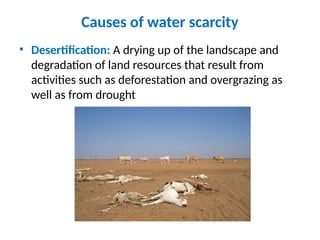
• Desertification: A drying up of the landscape and
degradation of land resources that result from
activities such as deforestation and overgrazing as
well as from drought
28.
Causes of waterscarcity
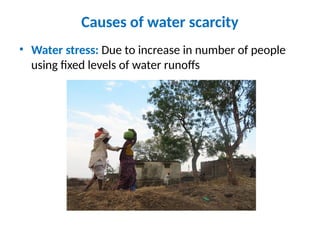
• Water stress: Due to increase in number of people
using fixed levels of water runoffs
Hydrologic cycle
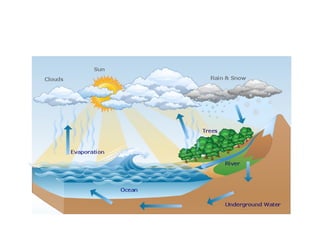
• Thehydrologic or hydrological cycle involves
the continuous circulation of water in the
Earth-Atmosphere system
• Its motion of the water from the ground to the
atmosphere and back again
31.
Stages of thehydrologic cycle
5 major stages involved, the most important are:
• Evaporation
• Transpiration
• Condensation
• Precipitation and
• Runoff
Water Pollution
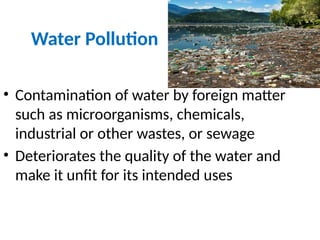
• Contaminationof water by foreign matter
such as microorganisms, chemicals,
industrial or other wastes, or sewage
• Deteriorates the quality of the water and
make it unfit for its intended uses
35.
Major Pollutants
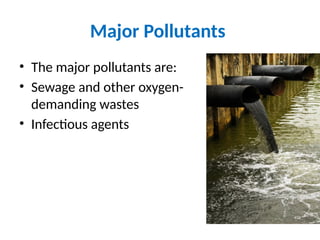
• Themajor pollutants are:
• Sewage and other oxygen-
demanding wastes
• Infectious agents
36.
Major Pollutants…cont.
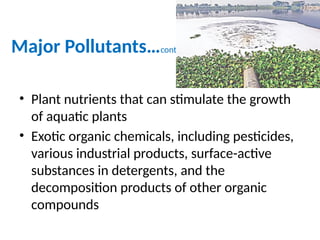
• Plantnutrients that can stimulate the growth
of aquatic plants
• Exotic organic chemicals, including pesticides,
various industrial products, surface-active
substances in detergents, and the
decomposition products of other organic
compounds
37.
Major Pollutants…cont.
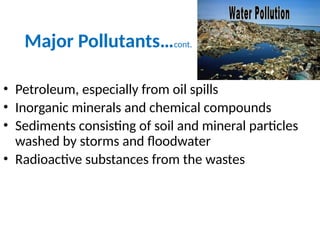
• Petroleum,especially from oil spills
• Inorganic minerals and chemical compounds
• Sediments consisting of soil and mineral particles
washed by storms and floodwater
• Radioactive substances from the wastes
Purification of waterat large scale
Done by filtration which may be:
• Slow sand filtration
• Rapid sand filtration
• Desalination
46.
Purification of waterat large scale…cont.
• The purpose is to produce water is safe and
wholesome depends upon the nature of raw
and desired standards of water quality
47.
Purification of waterat large scale…cont.
• Ground water i.e. well & springs may need no
treatment other than disinfection
48.
Purification of waterat large scale…cont.
• Surface water i.e. River water which tends to
be turbid & polluted require purification
49.
Purification of waterat large scale…cont.
Water supply caries following steps:
• Storage
• Filtration
• Disinfection
50.
Storage-Physical
• Water isdrawn out from the source and
impounded in natural or artificial reservoirs
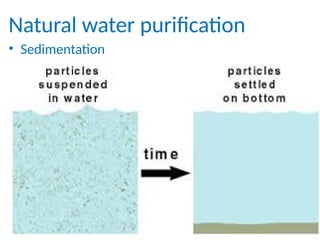
• By mere storage considerable quality of water
improves
• About 90% of suspended impurities and
turbidity of water settle down in 24 hours
51.
Storage-Chemical
• Certain chemicalchanges take place during
storage
• The aerobic bacteria oxidize the organic
matter present in water with the aid of oxygen
• As a result the content of free ammonia is
reduced
52.
Storage-Biological
• Due toantibiosis and oxidation 90%
pathogenic organism in the first 6-7 days
gradually die out
53.
Purification of waterat small scale or
domestic level
It is carried out by:
• Boiling
• Chemical disinfection
• Filtration
• Solar radiation
Measuring Water Quality:Chemical
Conductivity; A measure of how much electrical
current water can conduct. It gives a good idea of the
amount of dissolved solids (such as salt, dust)
• Distilled water; low conductance
• Rainwater; higher
• Sea water; extremely high ability of
water to conduct an electrical current