Human Development
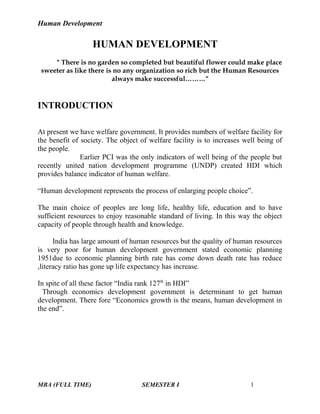
HUMAN DEVELOPMENT
" There is no garden so completed but beautiful flower could make place
sweeter as like there is no any organization so rich but the Human Resources
always make successful………"
INTRODUCTION
At present we have welfare government. It provides numbers of welfare facility for
the benefit of society. The object of welfare facility is to increases well being of
the people.
Earlier PCI was the only indicators of well being of the people but
recently united nation development programme (UNDP) created HDI which
provides balance indicator of human welfare.
“Human development represents the process of enlarging people choice”.
The main choice of peoples are long life, healthy life, education and to have
sufficient resources to enjoy reasonable standard of living. In this way the object
capacity of people through health and knowledge.
India has large amount of human resources but the quality of human resources
is very poor for human development government stated economic planning
1951due to economic planning birth rate has come down death rate has reduce
,literacy ratio has gone up life expectancy has increase.
In spite of all these factor “India rank 127th
in HDI”
Through economics development government is determinant to get human
development. There fore “Economics growth is the means, human development in
the end”.
MBA (FULL TIME) 1SEMESTER I
Human Development
THE INPORTANT AND ADVANTES OF HDI
1) It helps to control population
2) It create better quality of life (People).
3) It permits full utilization of recourses.
4) It creates intellectual climate in the country as continious research and
development is made in science and technology.
5) It permits fast economics growth.
6) It brings rational thinking among people.
7) It brings rational thinking among people.
8) It motivates people to work hard and take risk.
9) It brings complete change in the economic structure.
10) By investing money in human development government get higher return
because human factor is not subject to depreciation like plant and machinery.
11)By investing money in plant and machinery and other equipment but
investing money in human development means long lasting investment.
Therefore for human development government makes investing in education,
health and family welfare.
MBA (FULL TIME) 2SEMESTER I
Human Development
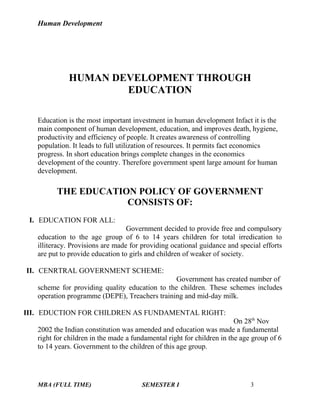
HUMAN DEVELOPMENT THROUGH
EDUCATION
Education is the most important investment in human development Infact it is the
main component of human development, education, and improves death, hygiene,
productivity and efficiency of people. It creates awareness of controlling
population. It leads to full utilization of resources. It permits fact economics
progress. In short education brings complete changes in the economics
development of the country. Therefore government spent large amount for human
development.
THE EDUCATION POLICY OF GOVERNMENT
CONSISTS OF:
I. EDUCATION FOR ALL:
Government decided to provide free and compulsory
education to the age group of 6 to 14 years children for total irredication to
illiteracy. Provisions are made for providing ocational guidance and special efforts
are put to provide education to girls and children of weaker of society.
II. CENRTRAL GOVERNMENT SCHEME:
Government has created number of
scheme for providing quality education to the children. These schemes includes
operation programme (DEPE), Treachers training and mid-day milk.
III. EDUCTION FOR CHILDREN AS FUNDAMENTAL RIGHT:
On 28th
Nov
2002 the Indian constitution was amended and education was made a fundamental
right for children in the made a fundamental right for children in the age group of 6
to 14 years. Government to the children of this age group.
MBA (FULL TIME) 3SEMESTER I
Human Development
IV. SARVA SHIKSHA ABHIYAN (SSA):
Started in Nov 2000 and its object is to
provide education to every one in this country, so that illiteracy can be irradicated.
V. NATIONAL PROGRAMME OF EDUCATION GIRLS AT ELIMENTARY
LEVEL (NPEGEL):
Started in July 2003 and it object is to provide education to girls who belong to
under privileged and disadvantages group in the backward areas.
VI. KASTURBA GANDHI BALIKA VIDYALYA (KGBU):
Started in 20004-
20005 under which 750 residential schools were getting up. Which provides
logging and boarding besides education to those girls who belong to SC, ST, and
OBC.
VII. ADULT EDUCATION:
In 1998 government started “National literacy mission “
for providing education to adult illiterate so that literacy ratio can be raised to
75%.
VIII. RISE IN PLAN EXPENDITURE:
Plan after plan government allocate
more money for education. In the 9th
plan government allocate Rs 24,908Cr which
means 76% rise out of Rs 43825 Cr Rs28750Cr is spent for elementary education.
Because of this government policies no. of achievements are made in the field of
education.
MBA (FULL TIME) 4SEMESTER I
Human Development
1-RISE IN ENROLLMENT:
These are rise in enrollment in primary and upper
primary school. Infact gross Enrollment rate has increased (GER) for last 50 years
as shown in the table.
2-LITERACY RAIO INCREASED:
There is rise in literacy ratio as
shown in the following
table.
MBA (FULL TIME) 5
YEAR MALE(L.R) FEMALE(L.R)
1951 18.33%
1991 52.21%
2001 64.84% 75.85% 64.84%
SEMESTER I
Human Development
3-INCREASE IN EDUCATION INSTITUTIONS:
The table shows there is rise in
number of education institutions for last 50years.
4-PROGRESS IN SECONDARY EDUCATION:
There is progress even in
higher secondary education as more students are enrolled in this school . in the
year 2000-01 33.2m students were enrolled in the higher secondary school.
5-GROWTH IN HIGHER AND UVIVERSITY EDUCATION:
There is
growth in university &higher education. The number of university has increased
from 27 to 351 and there is sepret university for providing education in university
for providing education in agriculture, health etc, similarly the concept of open
MBA (FULL TIME) 6
i. EDUCATION INSTITUTION ii. 50-51 iii. 01-02
iv. PRIMARY SCHOOL v. 210 vi. 664
vii. HIGHER SEC SCHOOL viii. 17 ix. 133
x. UNICERSITY xi. 27 xii. 351
xiii. PROFESSIONAL INSTITUTES xiv. 208 xv. 2409
SEMESTER I
Human Development
university is becoming popular among employed students
accredidiam is mandatory (compulsory) for all college and university.
6-TECHNICAL AND PROFESSIONAL EDUCATION:
There are abnormal
increases in technical and professional educational institutions. There are 1349
engineering colleges 1030 colleges provides master degrees in computer
application. 930 colleges provide MBA education. There linkage between industry
and university so that education can be provided according to the needs of the co.
FAILURES OF EDUCATION POLICY
1) LOWER ENROLLMENT OF GIRLS:
There is lower enrollment of girls in
primary and upper primary schools. In absolute term enrollment has increased but
MBA (FULL TIME) 7
YEARS PRIMARY(1TO4) UPERPRIMARY(4TO8)
1950-51 19.1M 3.1M
1990-91 17.4M 34.0M
2000-01 113.8M 42.8M
SEMESTER I
Human Development
proportionately it has come down. Many parents didn’t sent there daughter school
due to economic, social and religious reasons.
2) TEACHER STUDENT RATIO:
The teacher student ratio even in the
primary and upper primary school is raising in 50.51 it was 1:24 but in 2001-02 it
increase to 1:43.
3) HIGH DROP OUT RATIO:
The drop out ratio is very high even at primary level.
Many children leave school without completing even primary education on 60-61
the drop out ratio was 64.9% but in 2001-02 it reduce to 54.6%.
4) INADEQUATE FACILITY:
Adequate facilities are not available in many schools
35% school have no building, 56% school have no drinking water facility , 70%
school have no toilet facilities, larges numbers of school do not have even black
board and library facility.
5) LACK OR SOCIAL RELEVENT:
There is lack of social relevant in the
education system the quality of education is poor and it does not satisfy the needs
of the society.
6) NARROW COVERAGE OF HIGHER EDUCATION:
There is very narrow
coverage of higher education large number of students join arts, science and
commerce even reasonable no of students.
7) EDUCATED UNEMPLOYED PEOPLE:
India has large number of educated
unemployment people because out education is examination oriented and not job-
oriented we give theoretical training but there is no practical training.
HUMAN DEVELOPMENT THROUGH HEALTH
Healthy population is essential for economic progress. Similarly human
development has realized this concept. Therefore government spends infact 5.2%
of GDP government spends only on health care.
MBA (FULL TIME) 8SEMESTER I
Human Development
THE MAIN POLICIES OF GOVERNMENT TOWARDS
HEALTH CARE ARE:
1-IMPROVING HEALTH OF POPULATION:
Improving health of population
particularly in under pre village and weaker section of the society.
2-ACCESS OF HEALTH CARE:
People should have access to health care, there
fore for last 50 year government has constructed infrastructure so that people
should get health facility.
3-AIDS CONTROLS:
HIV positive creates AIDS, It is a killing desesses,5.1 million
men and women in India are suffering from aids there is sure of AIDS. There of
prevention is necessary government has constituted national council for AIDS
under the chairmanship of prime minister.
4-CONTROL OF NON-COMMUNICABLE OF DESEASES:
Similarly many non-
communicable diseases such as cancer, mental disorder, and blindness have to be
controlled.
5-PLAN-OUTLAY:
There fore government spends more and more money on health
care facility, for e.g.: in 2003-2004 government spends Rs: 1550cr but 2004-2005
It increase to Rs: 2208cr which was 55% higher than last year.
Due to this positive police of government number of achievements is made.
1) EXPANSION OF HEALTH INFRASTRUCTURE:
MBA (FULL TIME) 9SEMESTER I
Human Development
There is expansion of health
infrastructure as more hospitals, dispensary and primary health centers are set up ,
as shown in the following table.
2) DECLINE IN MORTALITY RATE:
There is decline in mortality rate is as
shown in the following table.
Particular 1981 2004-05
Death Rate 12.5 8.1
Infant Mortality Rate
(0 to 1 year)
110 63
Child Mortality rate
(1 to 4 Year)
41.2 19.2
3) RISE IN LIFE EXPECTANCY:
MBA (FULL TIME) 10
PARTICULAR 1981 2003
Primary health center 57,363 163,195
Dispensary -hospitals 23,555 38,031
Hospital Bed 5,69,495 9,14,543
SEMESTER I
Human Development
The average life of people in India is rising due
to health care facilities made available by government. The average life is more
than 64 year for both man and woman.
4) CONTROL OF DISEASES:
Number of diseases is controlled by providing
health care facilities, there diseases include malaria T.B, leprosy, chicken pox,
small pox, etc,
HOW EVER THE FAILURE OF HEALTH POLICIES ARE:
1) POOR HEALTH CARE SYSTEM:
There is very poor health care system. Many
hospital do not have adequate, man, power, lack of doctors, nurses, medicine,
equipments facilities are poor. Hospitals are over crowded and those medicines are
given which have crossed expiry date.
2) HIGH RATE OF ILLNESS:
The rate of illness is very high particularly among
woman due to this people do not go to work working days are lost efficiency falls.
3) LOW CONCIOUS OF HEALTH CARE:
Poor people are uneducated they do not
realize the importance of health. Infact there is lack of health consciousness among
large no of people.
4) POOR NUTRITIONAL SCENCE:
The nutritional scene is very poor as 50%
children below 5 years are under weight 30% newly born children are under weight
and woman are anemic
(Shortage of blood).
5) INADEQUATE WATER SUPPLY AND SANITATION FACILITY:
There is
inadequate water supply and sanitation facility only 78% populations have excess
to drinking water, only 25% populations have toilet facility within premises.
MBA (FULL TIME) 11SEMESTER I
Human Development
6) HEALTH PROBLEM RELATED TO URBANISATION:
The rapid
urbanization created number of health problem due to growth of stems. These
problems include pollution, as asthmas, stress, tension, heart problem, mental
discarded.
HUMAN DEVELOPMENT THROUGH FAMILY
WELFARE
MBA (FULL TIME) 12SEMESTER I
Human Development
Besides education and health one of the important element of human development
is family welfare after achieve. Independence goes started family planning
programmer. The concept of this programmed is not restricted only small family
but also to look after well being on the family members.
THUS THE AREA OF FAMILY WELFARE
PROGRAMME ARE:
1) CHILD HEALTH CARE:
Child health care looking after the health of child so
that IMR and CMR can be reduced.
2) VOLUNTARY ACCEPTANCE OF FAMILY WELFARE:
Voluntary acceptance
of family welfare no forces no compression on any person to accept the principles
of family welfare.
3) GOVERNMENT WILL CREATE SUITABLE:
Government will create suitable
environment in the country so that people can accept family welfare principles.
THE OBJECTIVE OF FAMILY WELFARE PROGRAMMES ARE:
1) STABLE POPULATION:
To get stable population so that population explosion
can be avoided.
2) QUALITY OF LIFE:
Improving the quality of population by providing
education and health.
3) U.I.P;
MBA (FULL TIME) 13SEMESTER I
Human Development
Universal immunization program. I.e. providing vacant facility to protect
diseases particularly polio, etc.
4) SAFE MOTHER HOOD:
Safe mother hood to reduce MMR.
5) CONROL OF DISEASES:
Controlling all kinds of diseases pertaining through
birth of child. To achieve this objective government announced N.P.P 2000 its
human development.
i. IMMEDIATE OBJECTIVE:
Immediate objective to provide health infrastructure.
ii. MEDIUM HEALTH OBJECTIVE;
Medium term objective to reduce total
fertility rate to 2.1% by the year 2010.
iii. LONG TERM OBJECTIOVE:
The long term objective is to have stability
in population welfare programme are:-
a. Birth rate has reduced from 40.8 to 20.8.
b. Death rate has reduced from 25.1 to 8.1
.
c. IMR is reducing from 146 to 63.
d. MMR has also reduced.
e. Average life is increased.
f. Std of living is rising.
MBA (FULL TIME) 14SEMESTER I
Human Development
g. People have realized the importance of family welfare programmed.
MBA (FULL TIME) 15SEMESTER I
Human Development
HOWEVER THE FAILURES OF FAMILY
WELFARE PROGRMMES
1) Birth rate is still very high compare to other countries.
2) .MMR is also very high.
3) Target of 100% UIP is not achieved only 80% target is archived in Bihar it
is only 40%.
4) There is reasonal disparity for e.g. In kerla, birth rate has reduce and literacy
5) Ratio has increased but in BIMARU Stated the progress is not satisfactory.
6) Women’s education and health has been neglected.
7) There is lack of health infrastructure –lack of primary health centers in the
rural areas.
8) There is lack of political as government is not made answerable for failure of
family welfare progrmmes.
9) Voluntary workers are neglected due to high degree of corruption at
panchaytat level the untrained nurse get only Rs: 2/- per delivery instead of
Rs: 10/- prescribed by government.
10) Indifference of citizen it means the family welfare programme has not
become a mass movement the people participation is limited.
11) In spite of this government is investing large amount of money in
education, health and family welfare programme for human development.
MBA (FULL TIME) 16SEMESTER I

Human development

  • 1.
    Human Development HUMAN DEVELOPMENT "There is no garden so completed but beautiful flower could make place sweeter as like there is no any organization so rich but the Human Resources always make successful………" INTRODUCTION At present we have welfare government. It provides numbers of welfare facility for the benefit of society. The object of welfare facility is to increases well being of the people. Earlier PCI was the only indicators of well being of the people but recently united nation development programme (UNDP) created HDI which provides balance indicator of human welfare. “Human development represents the process of enlarging people choice”. The main choice of peoples are long life, healthy life, education and to have sufficient resources to enjoy reasonable standard of living. In this way the object capacity of people through health and knowledge. India has large amount of human resources but the quality of human resources is very poor for human development government stated economic planning 1951due to economic planning birth rate has come down death rate has reduce ,literacy ratio has gone up life expectancy has increase. In spite of all these factor “India rank 127th in HDI” Through economics development government is determinant to get human development. There fore “Economics growth is the means, human development in the end”. MBA (FULL TIME) 1SEMESTER I
  • 2.
    Human Development THE INPORTANTAND ADVANTES OF HDI 1) It helps to control population 2) It create better quality of life (People). 3) It permits full utilization of recourses. 4) It creates intellectual climate in the country as continious research and development is made in science and technology. 5) It permits fast economics growth. 6) It brings rational thinking among people. 7) It brings rational thinking among people. 8) It motivates people to work hard and take risk. 9) It brings complete change in the economic structure. 10) By investing money in human development government get higher return because human factor is not subject to depreciation like plant and machinery. 11)By investing money in plant and machinery and other equipment but investing money in human development means long lasting investment. Therefore for human development government makes investing in education, health and family welfare. MBA (FULL TIME) 2SEMESTER I
  • 3.
    Human Development HUMAN DEVELOPMENTTHROUGH EDUCATION Education is the most important investment in human development Infact it is the main component of human development, education, and improves death, hygiene, productivity and efficiency of people. It creates awareness of controlling population. It leads to full utilization of resources. It permits fact economics progress. In short education brings complete changes in the economics development of the country. Therefore government spent large amount for human development. THE EDUCATION POLICY OF GOVERNMENT CONSISTS OF: I. EDUCATION FOR ALL: Government decided to provide free and compulsory education to the age group of 6 to 14 years children for total irredication to illiteracy. Provisions are made for providing ocational guidance and special efforts are put to provide education to girls and children of weaker of society. II. CENRTRAL GOVERNMENT SCHEME: Government has created number of scheme for providing quality education to the children. These schemes includes operation programme (DEPE), Treachers training and mid-day milk. III. EDUCTION FOR CHILDREN AS FUNDAMENTAL RIGHT: On 28th Nov 2002 the Indian constitution was amended and education was made a fundamental right for children in the made a fundamental right for children in the age group of 6 to 14 years. Government to the children of this age group. MBA (FULL TIME) 3SEMESTER I
  • 4.
    Human Development IV. SARVASHIKSHA ABHIYAN (SSA): Started in Nov 2000 and its object is to provide education to every one in this country, so that illiteracy can be irradicated. V. NATIONAL PROGRAMME OF EDUCATION GIRLS AT ELIMENTARY LEVEL (NPEGEL): Started in July 2003 and it object is to provide education to girls who belong to under privileged and disadvantages group in the backward areas. VI. KASTURBA GANDHI BALIKA VIDYALYA (KGBU): Started in 20004- 20005 under which 750 residential schools were getting up. Which provides logging and boarding besides education to those girls who belong to SC, ST, and OBC. VII. ADULT EDUCATION: In 1998 government started “National literacy mission “ for providing education to adult illiterate so that literacy ratio can be raised to 75%. VIII. RISE IN PLAN EXPENDITURE: Plan after plan government allocate more money for education. In the 9th plan government allocate Rs 24,908Cr which means 76% rise out of Rs 43825 Cr Rs28750Cr is spent for elementary education. Because of this government policies no. of achievements are made in the field of education. MBA (FULL TIME) 4SEMESTER I
  • 5.
    Human Development 1-RISE INENROLLMENT: These are rise in enrollment in primary and upper primary school. Infact gross Enrollment rate has increased (GER) for last 50 years as shown in the table. 2-LITERACY RAIO INCREASED: There is rise in literacy ratio as shown in the following table. MBA (FULL TIME) 5 YEAR MALE(L.R) FEMALE(L.R) 1951 18.33% 1991 52.21% 2001 64.84% 75.85% 64.84% SEMESTER I
  • 6.
    Human Development 3-INCREASE INEDUCATION INSTITUTIONS: The table shows there is rise in number of education institutions for last 50years. 4-PROGRESS IN SECONDARY EDUCATION: There is progress even in higher secondary education as more students are enrolled in this school . in the year 2000-01 33.2m students were enrolled in the higher secondary school. 5-GROWTH IN HIGHER AND UVIVERSITY EDUCATION: There is growth in university &higher education. The number of university has increased from 27 to 351 and there is sepret university for providing education in university for providing education in agriculture, health etc, similarly the concept of open MBA (FULL TIME) 6 i. EDUCATION INSTITUTION ii. 50-51 iii. 01-02 iv. PRIMARY SCHOOL v. 210 vi. 664 vii. HIGHER SEC SCHOOL viii. 17 ix. 133 x. UNICERSITY xi. 27 xii. 351 xiii. PROFESSIONAL INSTITUTES xiv. 208 xv. 2409 SEMESTER I
  • 7.
    Human Development university isbecoming popular among employed students accredidiam is mandatory (compulsory) for all college and university. 6-TECHNICAL AND PROFESSIONAL EDUCATION: There are abnormal increases in technical and professional educational institutions. There are 1349 engineering colleges 1030 colleges provides master degrees in computer application. 930 colleges provide MBA education. There linkage between industry and university so that education can be provided according to the needs of the co. FAILURES OF EDUCATION POLICY 1) LOWER ENROLLMENT OF GIRLS: There is lower enrollment of girls in primary and upper primary schools. In absolute term enrollment has increased but MBA (FULL TIME) 7 YEARS PRIMARY(1TO4) UPERPRIMARY(4TO8) 1950-51 19.1M 3.1M 1990-91 17.4M 34.0M 2000-01 113.8M 42.8M SEMESTER I
  • 8.
    Human Development proportionately ithas come down. Many parents didn’t sent there daughter school due to economic, social and religious reasons. 2) TEACHER STUDENT RATIO: The teacher student ratio even in the primary and upper primary school is raising in 50.51 it was 1:24 but in 2001-02 it increase to 1:43. 3) HIGH DROP OUT RATIO: The drop out ratio is very high even at primary level. Many children leave school without completing even primary education on 60-61 the drop out ratio was 64.9% but in 2001-02 it reduce to 54.6%. 4) INADEQUATE FACILITY: Adequate facilities are not available in many schools 35% school have no building, 56% school have no drinking water facility , 70% school have no toilet facilities, larges numbers of school do not have even black board and library facility. 5) LACK OR SOCIAL RELEVENT: There is lack of social relevant in the education system the quality of education is poor and it does not satisfy the needs of the society. 6) NARROW COVERAGE OF HIGHER EDUCATION: There is very narrow coverage of higher education large number of students join arts, science and commerce even reasonable no of students. 7) EDUCATED UNEMPLOYED PEOPLE: India has large number of educated unemployment people because out education is examination oriented and not job- oriented we give theoretical training but there is no practical training. HUMAN DEVELOPMENT THROUGH HEALTH Healthy population is essential for economic progress. Similarly human development has realized this concept. Therefore government spends infact 5.2% of GDP government spends only on health care. MBA (FULL TIME) 8SEMESTER I
  • 9.
    Human Development THE MAINPOLICIES OF GOVERNMENT TOWARDS HEALTH CARE ARE: 1-IMPROVING HEALTH OF POPULATION: Improving health of population particularly in under pre village and weaker section of the society. 2-ACCESS OF HEALTH CARE: People should have access to health care, there fore for last 50 year government has constructed infrastructure so that people should get health facility. 3-AIDS CONTROLS: HIV positive creates AIDS, It is a killing desesses,5.1 million men and women in India are suffering from aids there is sure of AIDS. There of prevention is necessary government has constituted national council for AIDS under the chairmanship of prime minister. 4-CONTROL OF NON-COMMUNICABLE OF DESEASES: Similarly many non- communicable diseases such as cancer, mental disorder, and blindness have to be controlled. 5-PLAN-OUTLAY: There fore government spends more and more money on health care facility, for e.g.: in 2003-2004 government spends Rs: 1550cr but 2004-2005 It increase to Rs: 2208cr which was 55% higher than last year. Due to this positive police of government number of achievements is made. 1) EXPANSION OF HEALTH INFRASTRUCTURE: MBA (FULL TIME) 9SEMESTER I
  • 10.
    Human Development There isexpansion of health infrastructure as more hospitals, dispensary and primary health centers are set up , as shown in the following table. 2) DECLINE IN MORTALITY RATE: There is decline in mortality rate is as shown in the following table. Particular 1981 2004-05 Death Rate 12.5 8.1 Infant Mortality Rate (0 to 1 year) 110 63 Child Mortality rate (1 to 4 Year) 41.2 19.2 3) RISE IN LIFE EXPECTANCY: MBA (FULL TIME) 10 PARTICULAR 1981 2003 Primary health center 57,363 163,195 Dispensary -hospitals 23,555 38,031 Hospital Bed 5,69,495 9,14,543 SEMESTER I
  • 11.
    Human Development The averagelife of people in India is rising due to health care facilities made available by government. The average life is more than 64 year for both man and woman. 4) CONTROL OF DISEASES: Number of diseases is controlled by providing health care facilities, there diseases include malaria T.B, leprosy, chicken pox, small pox, etc, HOW EVER THE FAILURE OF HEALTH POLICIES ARE: 1) POOR HEALTH CARE SYSTEM: There is very poor health care system. Many hospital do not have adequate, man, power, lack of doctors, nurses, medicine, equipments facilities are poor. Hospitals are over crowded and those medicines are given which have crossed expiry date. 2) HIGH RATE OF ILLNESS: The rate of illness is very high particularly among woman due to this people do not go to work working days are lost efficiency falls. 3) LOW CONCIOUS OF HEALTH CARE: Poor people are uneducated they do not realize the importance of health. Infact there is lack of health consciousness among large no of people. 4) POOR NUTRITIONAL SCENCE: The nutritional scene is very poor as 50% children below 5 years are under weight 30% newly born children are under weight and woman are anemic (Shortage of blood). 5) INADEQUATE WATER SUPPLY AND SANITATION FACILITY: There is inadequate water supply and sanitation facility only 78% populations have excess to drinking water, only 25% populations have toilet facility within premises. MBA (FULL TIME) 11SEMESTER I
  • 12.
    Human Development 6) HEALTHPROBLEM RELATED TO URBANISATION: The rapid urbanization created number of health problem due to growth of stems. These problems include pollution, as asthmas, stress, tension, heart problem, mental discarded. HUMAN DEVELOPMENT THROUGH FAMILY WELFARE MBA (FULL TIME) 12SEMESTER I
  • 13.
    Human Development Besides educationand health one of the important element of human development is family welfare after achieve. Independence goes started family planning programmer. The concept of this programmed is not restricted only small family but also to look after well being on the family members. THUS THE AREA OF FAMILY WELFARE PROGRAMME ARE: 1) CHILD HEALTH CARE: Child health care looking after the health of child so that IMR and CMR can be reduced. 2) VOLUNTARY ACCEPTANCE OF FAMILY WELFARE: Voluntary acceptance of family welfare no forces no compression on any person to accept the principles of family welfare. 3) GOVERNMENT WILL CREATE SUITABLE: Government will create suitable environment in the country so that people can accept family welfare principles. THE OBJECTIVE OF FAMILY WELFARE PROGRAMMES ARE: 1) STABLE POPULATION: To get stable population so that population explosion can be avoided. 2) QUALITY OF LIFE: Improving the quality of population by providing education and health. 3) U.I.P; MBA (FULL TIME) 13SEMESTER I
  • 14.
    Human Development Universal immunizationprogram. I.e. providing vacant facility to protect diseases particularly polio, etc. 4) SAFE MOTHER HOOD: Safe mother hood to reduce MMR. 5) CONROL OF DISEASES: Controlling all kinds of diseases pertaining through birth of child. To achieve this objective government announced N.P.P 2000 its human development. i. IMMEDIATE OBJECTIVE: Immediate objective to provide health infrastructure. ii. MEDIUM HEALTH OBJECTIVE; Medium term objective to reduce total fertility rate to 2.1% by the year 2010. iii. LONG TERM OBJECTIOVE: The long term objective is to have stability in population welfare programme are:- a. Birth rate has reduced from 40.8 to 20.8. b. Death rate has reduced from 25.1 to 8.1 . c. IMR is reducing from 146 to 63. d. MMR has also reduced. e. Average life is increased. f. Std of living is rising. MBA (FULL TIME) 14SEMESTER I
  • 15.
    Human Development g. Peoplehave realized the importance of family welfare programmed. MBA (FULL TIME) 15SEMESTER I
  • 16.
    Human Development HOWEVER THEFAILURES OF FAMILY WELFARE PROGRMMES 1) Birth rate is still very high compare to other countries. 2) .MMR is also very high. 3) Target of 100% UIP is not achieved only 80% target is archived in Bihar it is only 40%. 4) There is reasonal disparity for e.g. In kerla, birth rate has reduce and literacy 5) Ratio has increased but in BIMARU Stated the progress is not satisfactory. 6) Women’s education and health has been neglected. 7) There is lack of health infrastructure –lack of primary health centers in the rural areas. 8) There is lack of political as government is not made answerable for failure of family welfare progrmmes. 9) Voluntary workers are neglected due to high degree of corruption at panchaytat level the untrained nurse get only Rs: 2/- per delivery instead of Rs: 10/- prescribed by government. 10) Indifference of citizen it means the family welfare programme has not become a mass movement the people participation is limited. 11) In spite of this government is investing large amount of money in education, health and family welfare programme for human development. MBA (FULL TIME) 16SEMESTER I