Class XII
Indian Economic Development
 HUMAN
CAPITAL
FORMATION IN
INDIA
Madan Kumar M.A.,M.A.,B.Ed.,M.Phil.,M.B.A.,
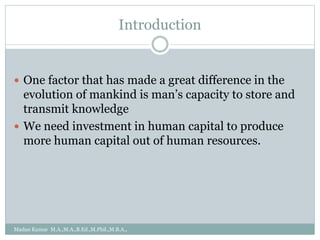
Introduction
 One factor that has made a great difference in the
evolution of mankind is man’s capacity to store and
transmit knowledge
 We need investment in human capital to produce
more human capital out of human resources.
Madan Kumar M.A.,M.A.,B.Ed.,M.Phil.,M.B.A.,
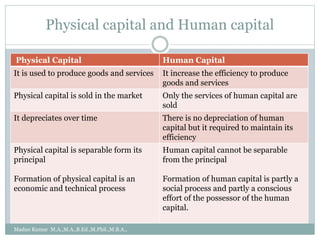
Physical capital and Human capital
Physical Capital Human Capital
It is used to produce goods and services It increase the efficiency to produce
goods and services
Physical capital is sold in the market Only the services of human capital are
sold
It depreciates over time There is no depreciation of human
capital but it required to maintain its
efficiency
Physical capital is separable form its
principal
Formation of physical capital is an
economic and technical process
Human capital cannot be separable
from the principal
Formation of human capital is partly a
social process and partly a conscious
effort of the possessor of the human
capital.
Madan Kumar M.A.,M.A.,B.Ed.,M.Phil.,M.B.A.,
Human Capital formation
“ Human capital formation is the process of acquiring
and increasing the number of persons, who have sills,
education and experience, which are critical for
economic and political development of a country”
Prof. G.M.Meier
Madan Kumar M.A.,M.A.,B.Ed.,M.Phil.,M.B.A.,
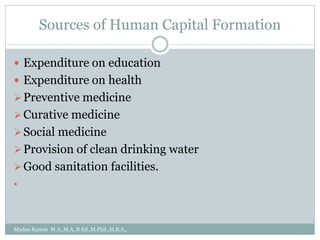
Sources of Human Capital Formation
 Expenditure on education
 Expenditure on health
Preventive medicine
Curative medicine
Social medicine
Provision of clean drinking water
Good sanitation facilities.
•
Madan Kumar M.A.,M.A.,B.Ed.,M.Phil.,M.B.A.,
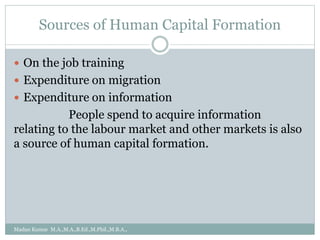
Sources of Human Capital Formation
 On the job training
 Expenditure on migration
 Expenditure on information
People spend to acquire information
relating to the labour market and other markets is also
a source of human capital formation.
Madan Kumar M.A.,M.A.,B.Ed.,M.Phil.,M.B.A.,
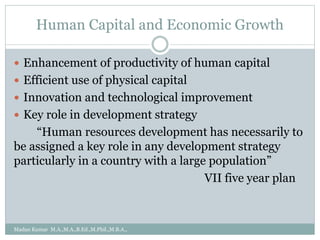
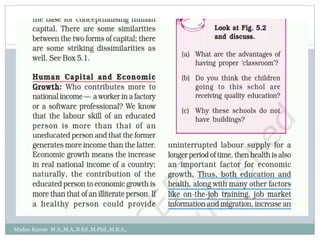
Human Capital and Economic Growth
 Enhancement of productivity of human capital
 Efficient use of physical capital
 Innovation and technological improvement
 Key role in development strategy
“Human resources development has necessarily to
be assigned a key role in any development strategy
particularly in a country with a large population”
VII five year plan
Madan Kumar M.A.,M.A.,B.Ed.,M.Phil.,M.B.A.,
Human Capital and Economic Growth
 Improvement in quality of life
 Positive change in attitude
Madan Kumar M.A.,M.A.,B.Ed.,M.Phil.,M.B.A.,
Relation between Human Capital and Economic
Welfare
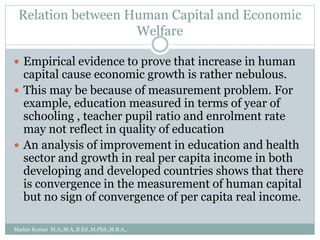
 Empirical evidence to prove that increase in human
capital cause economic growth is rather nebulous.
 This may be because of measurement problem. For
example, education measured in terms of year of
schooling , teacher pupil ratio and enrolment rate
may not reflect in quality of education
 An analysis of improvement in education and health
sector and growth in real per capita income in both
developing and developed countries shows that there
is convergence in the measurement of human capital
but no sign of convergence of per capita real income.
Madan Kumar M.A.,M.A.,B.Ed.,M.Phil.,M.B.A.,
Relation between Human Capital and Economic
Welfare
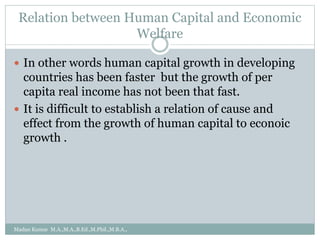
 In other words human capital growth in developing
countries has been faster but the growth of per
capita real income has not been that fast.
 It is difficult to establish a relation of cause and
effect from the growth of human capital to econoic
growth .
Madan Kumar M.A.,M.A.,B.Ed.,M.Phil.,M.B.A.,
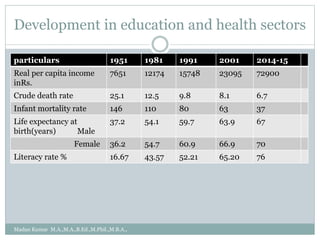
Development in education and health sectors
particulars 1951 1981 1991 2001 2014-15
Real per capita income
inRs.
7651 12174 15748 23095 72900
Crude death rate 25.1 12.5 9.8 8.1 6.7
Infant mortality rate 146 110 80 63 37
Life expectancy at
birth(years) Male
37.2 54.1 59.7 63.9 67
Female 36.2 54.7 60.9 66.9 70
Literacy rate % 16.67 43.57 52.21 65.20 76
Madan Kumar M.A.,M.A.,B.Ed.,M.Phil.,M.B.A.,
Transformation of India into a knowledge
economy
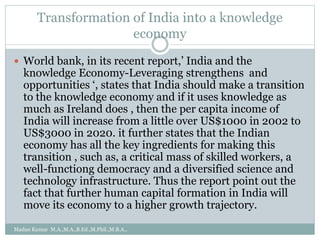
 World bank, in its recent report,’ India and the
knowledge Economy-Leveraging strengthens and
opportunities ‘, states that India should make a transition
to the knowledge economy and if it uses knowledge as
much as Ireland does , then the per capita income of
India will increase from a little over US$1000 in 2002 to
US$3000 in 2020. it further states that the Indian
economy has all the key ingredients for making this
transition , such as, a critical mass of skilled workers, a
well-functiong democracy and a diversified science and
technology infrastructure. Thus the report point out the
fact that further human capital formation in India will
move its economy to a higher growth trajectory.
Madan Kumar M.A.,M.A.,B.Ed.,M.Phil.,M.B.A.,
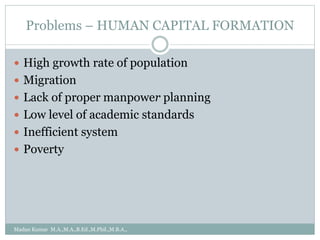
Problems – HUMAN CAPITAL FORMATION
 High growth rate of population
 Migration
 Lack of proper manpower planning
 Low level of academic standards
 Inefficient system
 Poverty
Madan Kumar M.A.,M.A.,B.Ed.,M.Phil.,M.B.A.,
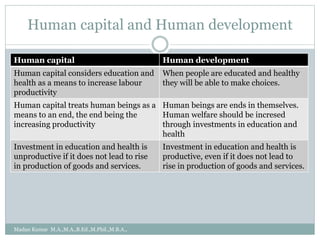
Human capital and Human development
Human capital Human development
Human capital considers education and
health as a means to increase labour
productivity
When people are educated and healthy
they will be able to make choices.
Human capital treats human beings as a
means to an end, the end being the
increasing productivity
Human beings are ends in themselves.
Human welfare should be incresed
through investments in education and
health
Investment in education and health is
unproductive if it does not lead to rise
in production of goods and services.
Investment in education and health is
productive, even if it does not lead to
rise in production of goods and services.
Madan Kumar M.A.,M.A.,B.Ed.,M.Phil.,M.B.A.,
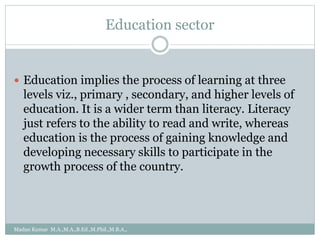
Education sector
 Education implies the process of learning at three
levels viz., primary , secondary, and higher levels of
education. It is a wider term than literacy. Literacy
just refers to the ability to read and write, whereas
education is the process of gaining knowledge and
developing necessary skills to participate in the
growth process of the country.
Madan Kumar M.A.,M.A.,B.Ed.,M.Phil.,M.B.A.,
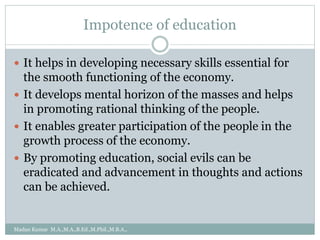
Impotence of education
 It helps in developing necessary skills essential for
the smooth functioning of the economy.
 It develops mental horizon of the masses and helps
in promoting rational thinking of the people.
 It enables greater participation of the people in the
growth process of the economy.
 By promoting education, social evils can be
eradicated and advancement in thoughts and actions
can be achieved.
Madan Kumar M.A.,M.A.,B.Ed.,M.Phil.,M.B.A.,
Growth in government expenditure on education
 The expenditure by the government on education is
expressed in two ways:
 1) as a percentage of total government expenditure
 2) as a percentage of Gross Domestic Product
Madan Kumar M.A.,M.A.,B.Ed.,M.Phil.,M.B.A.,
Growth in government expenditure on education
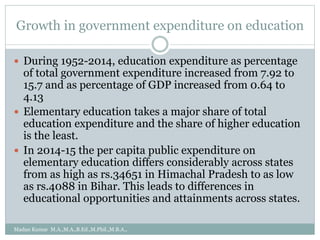
 During 1952-2014, education expenditure as percentage
of total government expenditure increased from 7.92 to
15.7 and as percentage of GDP increased from 0.64 to
4.13
 Elementary education takes a major share of total
education expenditure and the share of higher education
is the least.
 In 2014-15 the per capita public expenditure on
elementary education differs considerably across states
from as high as rs.34651 in Himachal Pradesh to as low
as rs.4088 in Bihar. This leads to differences in
educational opportunities and attainments across states.
Madan Kumar M.A.,M.A.,B.Ed.,M.Phil.,M.B.A.,
Growth in government expenditure on education
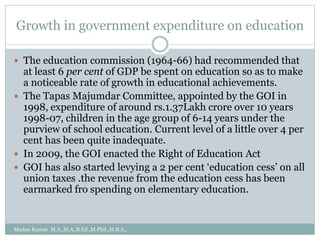
 The education commission (1964-66) had recommended that
at least 6 per cent of GDP be spent on education so as to make
a noticeable rate of growth in educational achievements.
 The Tapas Majumdar Committee, appointed by the GOI in
1998, expenditure of around rs.1.37Lakh crore over 10 years
1998-07, children in the age group of 6-14 years under the
purview of school education. Current level of a little over 4 per
cent has been quite inadequate.
 In 2009, the GOI enacted the Right of Education Act
 GOI has also started levying a 2 per cent ‘education cess’ on all
union taxes .the revenue from the education cess has been
earmarked fro spending on elementary education.
Madan Kumar M.A.,M.A.,B.Ed.,M.Phil.,M.B.A.,
Right to Education Act
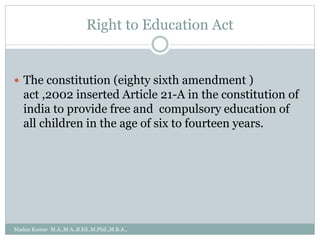
 The constitution (eighty sixth amendment )
act ,2002 inserted Article 21-A in the constitution of
india to provide free and compulsory education of
all children in the age of six to fourteen years.
Madan Kumar M.A.,M.A.,B.Ed.,M.Phil.,M.B.A.,
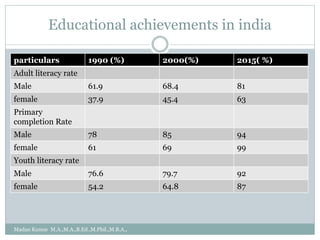
Educational achievements in india
particulars 1990 (%) 2000(%) 2015( %)
Adult literacy rate
Male 61.9 68.4 81
female 37.9 45.4 63
Primary
completion Rate
Male 78 85 94
female 61 69 99
Youth literacy rate
Male 76.6 79.7 92
female 54.2 64.8 87
Madan Kumar M.A.,M.A.,B.Ed.,M.Phil.,M.B.A.,
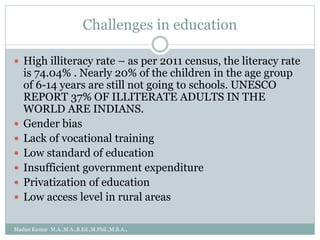
Challenges in education
 High illiteracy rate – as per 2011 census, the literacy rate
is 74.04% . Nearly 20% of the children in the age group
of 6-14 years are still not going to schools. UNESCO
REPORT 37% OF ILLITERATE ADULTS IN THE
WORLD ARE INDIANS.
 Gender bias
 Lack of vocational training
 Low standard of education
 Insufficient government expenditure
 Privatization of education
 Low access level in rural areas
Madan Kumar M.A.,M.A.,B.Ed.,M.Phil.,M.B.A.,
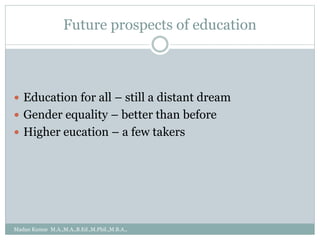
Future prospects of education
 Education for all – still a distant dream
 Gender equality – better than before
 Higher eucation – a few takers
Madan Kumar M.A.,M.A.,B.Ed.,M.Phil.,M.B.A.,
Best wishes
Thank you
Madan Kumar M.A.,M.A.,B.Ed.,M.Phil.,M.B.A.,

human Capital formation

  • 1.
    Class XII Indian EconomicDevelopment  HUMAN CAPITAL FORMATION IN INDIA Madan Kumar M.A.,M.A.,B.Ed.,M.Phil.,M.B.A.,
  • 2.
    Introduction  One factorthat has made a great difference in the evolution of mankind is man’s capacity to store and transmit knowledge  We need investment in human capital to produce more human capital out of human resources. Madan Kumar M.A.,M.A.,B.Ed.,M.Phil.,M.B.A.,
  • 3.
    Physical capital andHuman capital Physical Capital Human Capital It is used to produce goods and services It increase the efficiency to produce goods and services Physical capital is sold in the market Only the services of human capital are sold It depreciates over time There is no depreciation of human capital but it required to maintain its efficiency Physical capital is separable form its principal Formation of physical capital is an economic and technical process Human capital cannot be separable from the principal Formation of human capital is partly a social process and partly a conscious effort of the possessor of the human capital. Madan Kumar M.A.,M.A.,B.Ed.,M.Phil.,M.B.A.,
  • 4.
    Human Capital formation “Human capital formation is the process of acquiring and increasing the number of persons, who have sills, education and experience, which are critical for economic and political development of a country” Prof. G.M.Meier Madan Kumar M.A.,M.A.,B.Ed.,M.Phil.,M.B.A.,
  • 5.
    Sources of HumanCapital Formation  Expenditure on education  Expenditure on health Preventive medicine Curative medicine Social medicine Provision of clean drinking water Good sanitation facilities. • Madan Kumar M.A.,M.A.,B.Ed.,M.Phil.,M.B.A.,
  • 6.
    Sources of HumanCapital Formation  On the job training  Expenditure on migration  Expenditure on information People spend to acquire information relating to the labour market and other markets is also a source of human capital formation. Madan Kumar M.A.,M.A.,B.Ed.,M.Phil.,M.B.A.,
  • 7.
    Human Capital andEconomic Growth  Enhancement of productivity of human capital  Efficient use of physical capital  Innovation and technological improvement  Key role in development strategy “Human resources development has necessarily to be assigned a key role in any development strategy particularly in a country with a large population” VII five year plan Madan Kumar M.A.,M.A.,B.Ed.,M.Phil.,M.B.A.,
  • 8.
    Human Capital andEconomic Growth  Improvement in quality of life  Positive change in attitude Madan Kumar M.A.,M.A.,B.Ed.,M.Phil.,M.B.A.,
  • 9.
    Relation between HumanCapital and Economic Welfare  Empirical evidence to prove that increase in human capital cause economic growth is rather nebulous.  This may be because of measurement problem. For example, education measured in terms of year of schooling , teacher pupil ratio and enrolment rate may not reflect in quality of education  An analysis of improvement in education and health sector and growth in real per capita income in both developing and developed countries shows that there is convergence in the measurement of human capital but no sign of convergence of per capita real income. Madan Kumar M.A.,M.A.,B.Ed.,M.Phil.,M.B.A.,
  • 10.
    Relation between HumanCapital and Economic Welfare  In other words human capital growth in developing countries has been faster but the growth of per capita real income has not been that fast.  It is difficult to establish a relation of cause and effect from the growth of human capital to econoic growth . Madan Kumar M.A.,M.A.,B.Ed.,M.Phil.,M.B.A.,
  • 11.
    Development in educationand health sectors particulars 1951 1981 1991 2001 2014-15 Real per capita income inRs. 7651 12174 15748 23095 72900 Crude death rate 25.1 12.5 9.8 8.1 6.7 Infant mortality rate 146 110 80 63 37 Life expectancy at birth(years) Male 37.2 54.1 59.7 63.9 67 Female 36.2 54.7 60.9 66.9 70 Literacy rate % 16.67 43.57 52.21 65.20 76 Madan Kumar M.A.,M.A.,B.Ed.,M.Phil.,M.B.A.,
  • 12.
    Transformation of Indiainto a knowledge economy  World bank, in its recent report,’ India and the knowledge Economy-Leveraging strengthens and opportunities ‘, states that India should make a transition to the knowledge economy and if it uses knowledge as much as Ireland does , then the per capita income of India will increase from a little over US$1000 in 2002 to US$3000 in 2020. it further states that the Indian economy has all the key ingredients for making this transition , such as, a critical mass of skilled workers, a well-functiong democracy and a diversified science and technology infrastructure. Thus the report point out the fact that further human capital formation in India will move its economy to a higher growth trajectory. Madan Kumar M.A.,M.A.,B.Ed.,M.Phil.,M.B.A.,
  • 13.
    Problems – HUMANCAPITAL FORMATION  High growth rate of population  Migration  Lack of proper manpower planning  Low level of academic standards  Inefficient system  Poverty Madan Kumar M.A.,M.A.,B.Ed.,M.Phil.,M.B.A.,
  • 14.
    Human capital andHuman development Human capital Human development Human capital considers education and health as a means to increase labour productivity When people are educated and healthy they will be able to make choices. Human capital treats human beings as a means to an end, the end being the increasing productivity Human beings are ends in themselves. Human welfare should be incresed through investments in education and health Investment in education and health is unproductive if it does not lead to rise in production of goods and services. Investment in education and health is productive, even if it does not lead to rise in production of goods and services. Madan Kumar M.A.,M.A.,B.Ed.,M.Phil.,M.B.A.,
  • 15.
    Education sector  Educationimplies the process of learning at three levels viz., primary , secondary, and higher levels of education. It is a wider term than literacy. Literacy just refers to the ability to read and write, whereas education is the process of gaining knowledge and developing necessary skills to participate in the growth process of the country. Madan Kumar M.A.,M.A.,B.Ed.,M.Phil.,M.B.A.,
  • 16.
    Impotence of education It helps in developing necessary skills essential for the smooth functioning of the economy.  It develops mental horizon of the masses and helps in promoting rational thinking of the people.  It enables greater participation of the people in the growth process of the economy.  By promoting education, social evils can be eradicated and advancement in thoughts and actions can be achieved. Madan Kumar M.A.,M.A.,B.Ed.,M.Phil.,M.B.A.,
  • 17.
    Growth in governmentexpenditure on education  The expenditure by the government on education is expressed in two ways:  1) as a percentage of total government expenditure  2) as a percentage of Gross Domestic Product Madan Kumar M.A.,M.A.,B.Ed.,M.Phil.,M.B.A.,
  • 18.
    Growth in governmentexpenditure on education  During 1952-2014, education expenditure as percentage of total government expenditure increased from 7.92 to 15.7 and as percentage of GDP increased from 0.64 to 4.13  Elementary education takes a major share of total education expenditure and the share of higher education is the least.  In 2014-15 the per capita public expenditure on elementary education differs considerably across states from as high as rs.34651 in Himachal Pradesh to as low as rs.4088 in Bihar. This leads to differences in educational opportunities and attainments across states. Madan Kumar M.A.,M.A.,B.Ed.,M.Phil.,M.B.A.,
  • 19.
    Growth in governmentexpenditure on education  The education commission (1964-66) had recommended that at least 6 per cent of GDP be spent on education so as to make a noticeable rate of growth in educational achievements.  The Tapas Majumdar Committee, appointed by the GOI in 1998, expenditure of around rs.1.37Lakh crore over 10 years 1998-07, children in the age group of 6-14 years under the purview of school education. Current level of a little over 4 per cent has been quite inadequate.  In 2009, the GOI enacted the Right of Education Act  GOI has also started levying a 2 per cent ‘education cess’ on all union taxes .the revenue from the education cess has been earmarked fro spending on elementary education. Madan Kumar M.A.,M.A.,B.Ed.,M.Phil.,M.B.A.,
  • 20.
    Right to EducationAct  The constitution (eighty sixth amendment ) act ,2002 inserted Article 21-A in the constitution of india to provide free and compulsory education of all children in the age of six to fourteen years. Madan Kumar M.A.,M.A.,B.Ed.,M.Phil.,M.B.A.,
  • 21.
    Educational achievements inindia particulars 1990 (%) 2000(%) 2015( %) Adult literacy rate Male 61.9 68.4 81 female 37.9 45.4 63 Primary completion Rate Male 78 85 94 female 61 69 99 Youth literacy rate Male 76.6 79.7 92 female 54.2 64.8 87 Madan Kumar M.A.,M.A.,B.Ed.,M.Phil.,M.B.A.,
  • 22.
    Challenges in education High illiteracy rate – as per 2011 census, the literacy rate is 74.04% . Nearly 20% of the children in the age group of 6-14 years are still not going to schools. UNESCO REPORT 37% OF ILLITERATE ADULTS IN THE WORLD ARE INDIANS.  Gender bias  Lack of vocational training  Low standard of education  Insufficient government expenditure  Privatization of education  Low access level in rural areas Madan Kumar M.A.,M.A.,B.Ed.,M.Phil.,M.B.A.,
  • 23.
    Future prospects ofeducation  Education for all – still a distant dream  Gender equality – better than before  Higher eucation – a few takers Madan Kumar M.A.,M.A.,B.Ed.,M.Phil.,M.B.A.,
  • 24.
    Best wishes Thank you MadanKumar M.A.,M.A.,B.Ed.,M.Phil.,M.B.A.,
  • 25.