INDIA
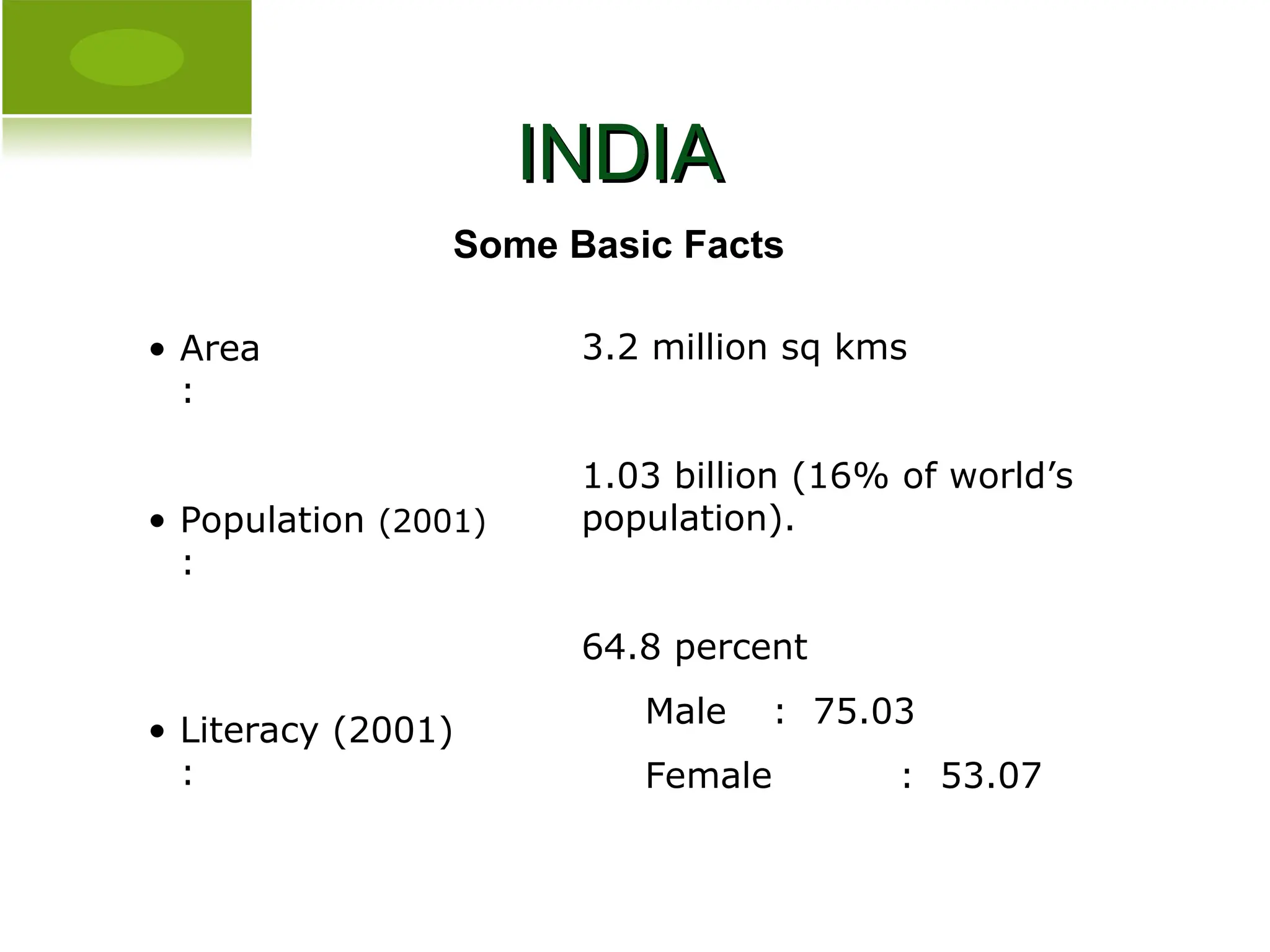
INDIA
Some Basic Facts
•Area
:
• Population (2001)
:
• Literacy (2001)
:
3.2 million sq kms
1.03 billion (16% of world’s
population).
64.8 percent
Male : 75.03
Female : 53.07
4.
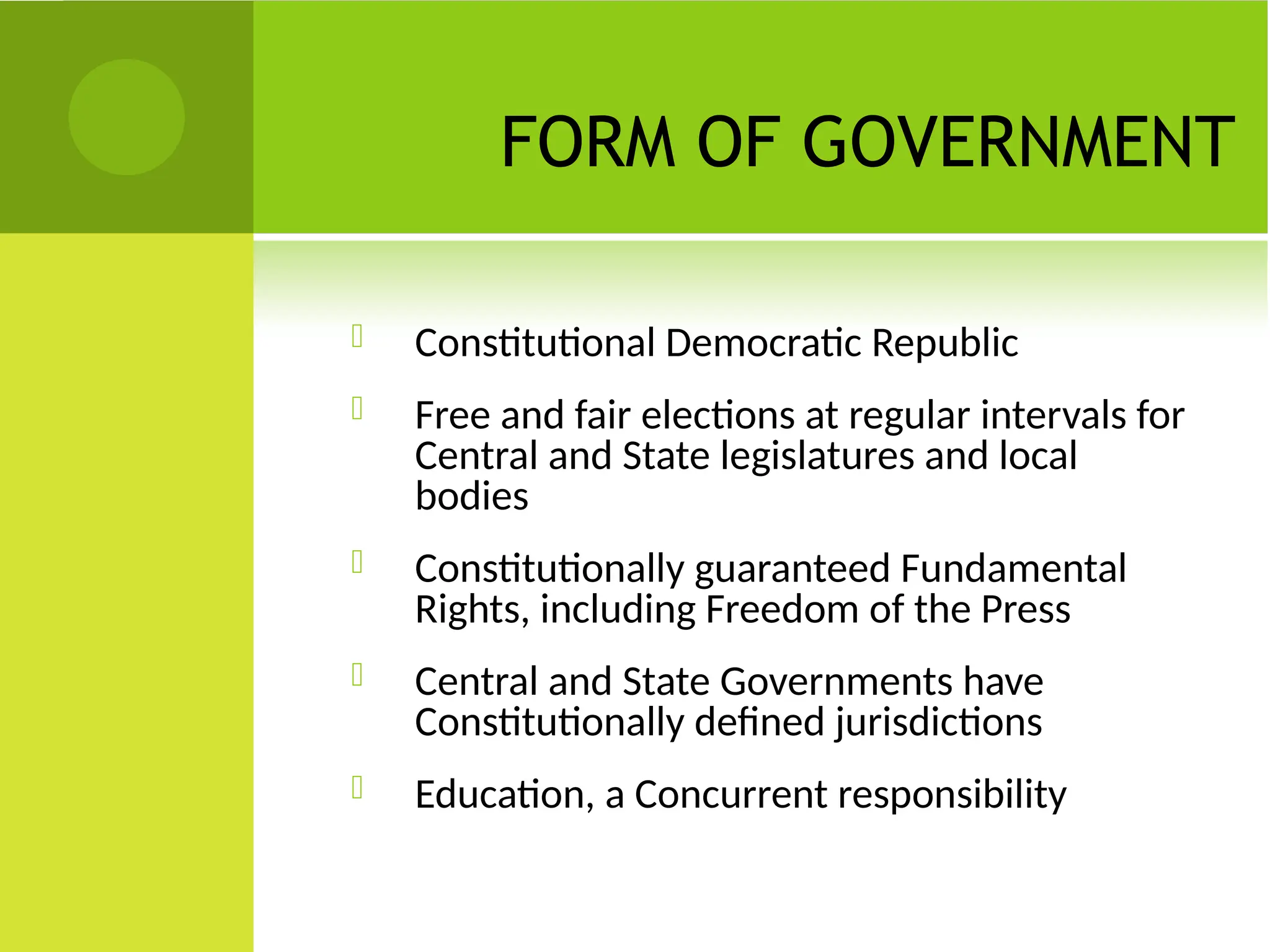
FORM OF GOVERNMENT
Constitutional Democratic Republic
Free and fair elections at regular intervals for
Central and State legislatures and local
bodies
Constitutionally guaranteed Fundamental
Rights, including Freedom of the Press
Central and State Governments have
Constitutionally defined jurisdictions
Education, a Concurrent responsibility
5.
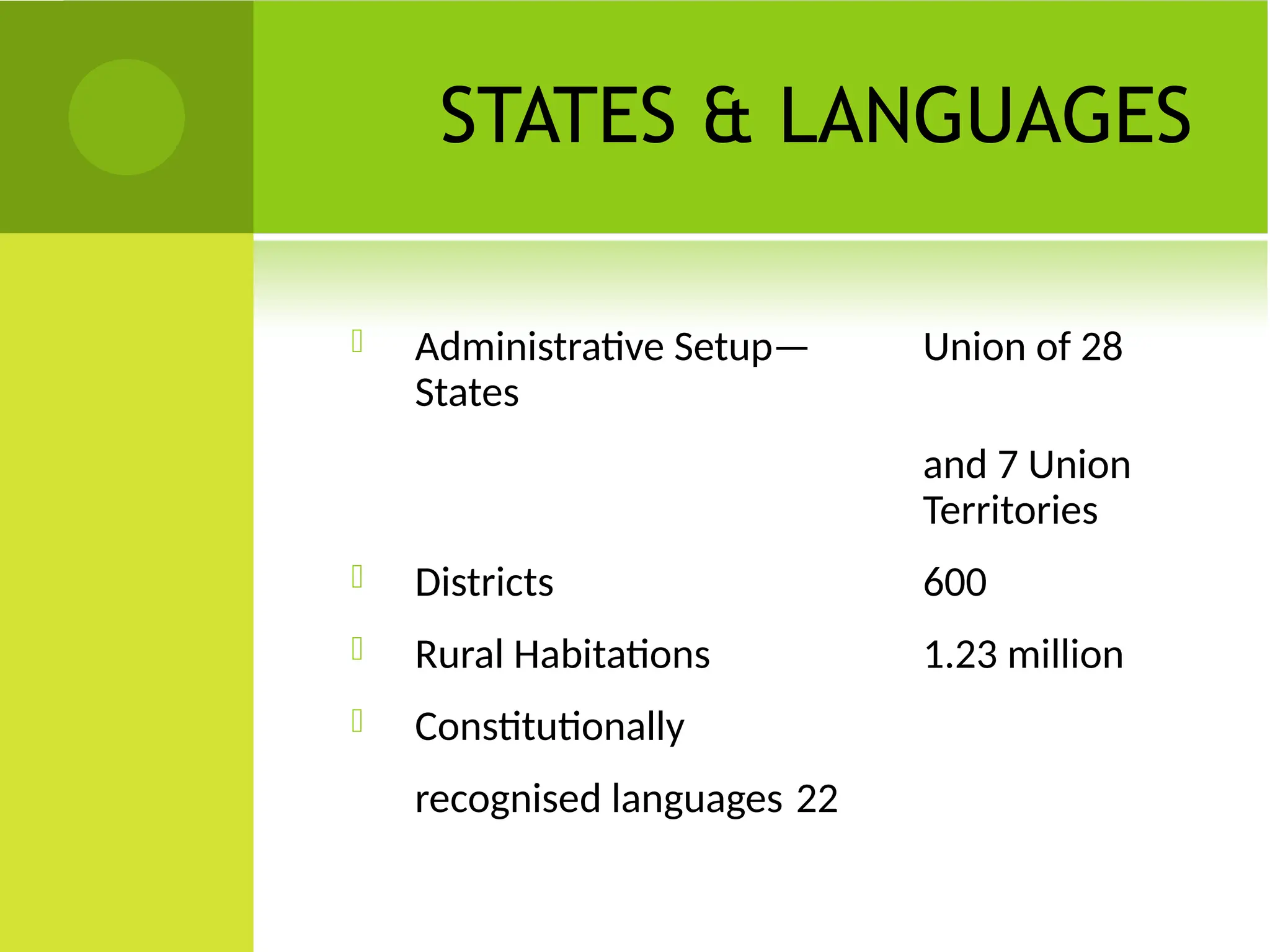
STATES & LANGUAGES
Administrative Setup— Union of 28
States
and 7 Union
Territories
Districts 600
Rural Habitations 1.23 million
Constitutionally
recognised languages 22
6.
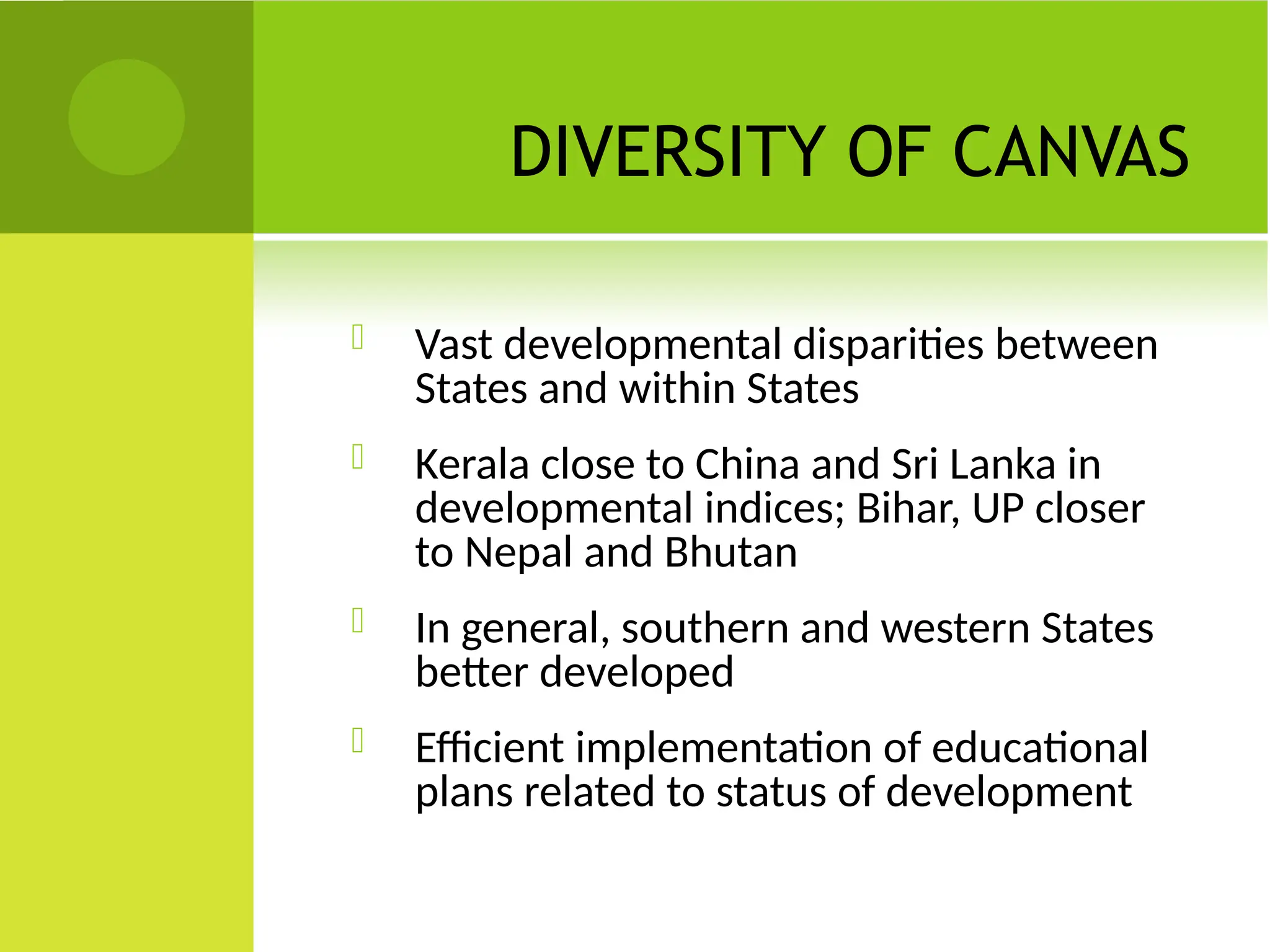
DIVERSITY OF CANVAS
Vast developmental disparities between
States and within States
Kerala close to China and Sri Lanka in
developmental indices; Bihar, UP closer
to Nepal and Bhutan
In general, southern and western States
better developed
Efficient implementation of educational
plans related to status of development
7.
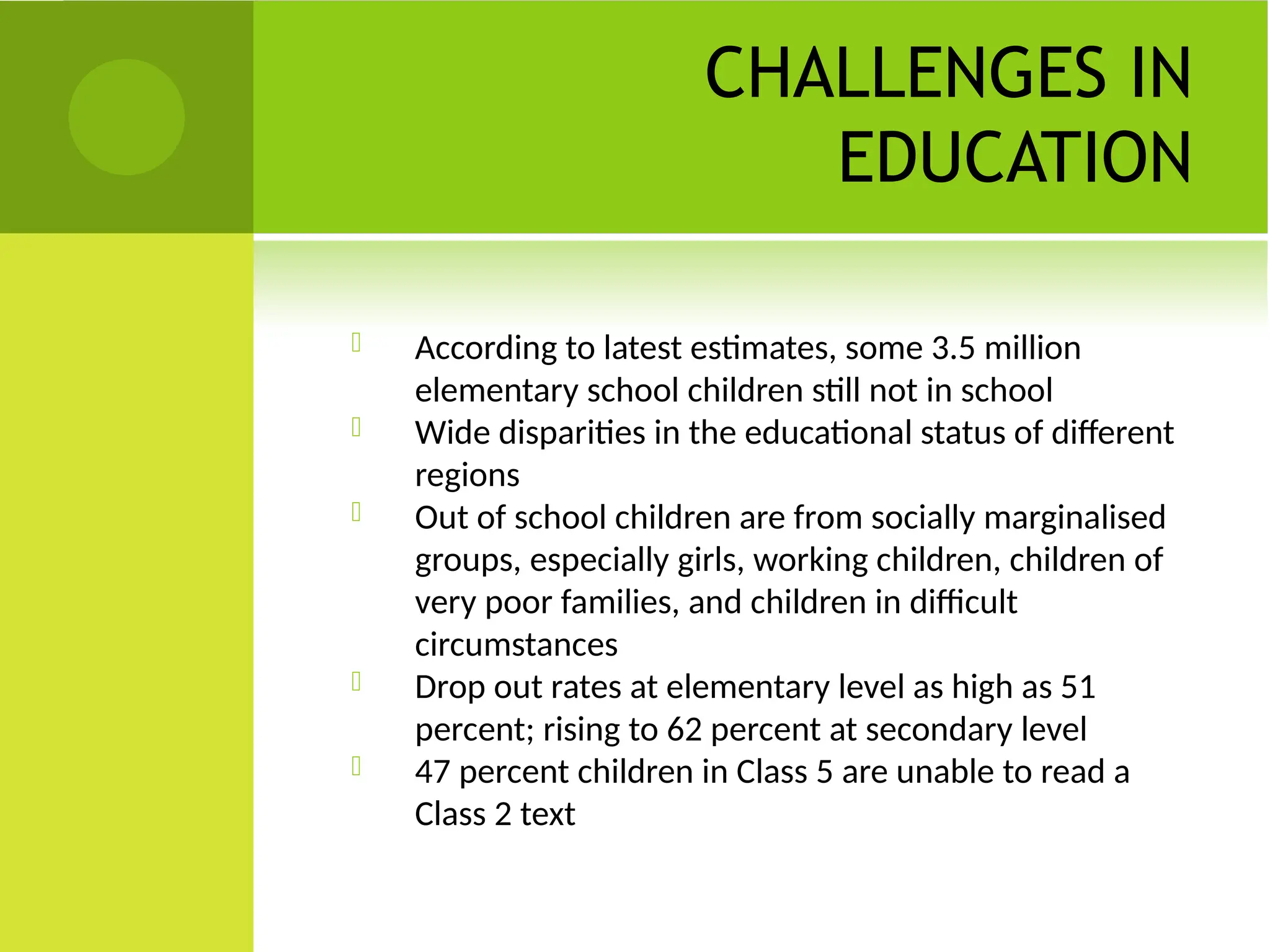
CHALLENGES IN
EDUCATION
Accordingto latest estimates, some 3.5 million
elementary school children still not in school
Wide disparities in the educational status of different
regions
Out of school children are from socially marginalised
groups, especially girls, working children, children of
very poor families, and children in difficult
circumstances
Drop out rates at elementary level as high as 51
percent; rising to 62 percent at secondary level
47 percent children in Class 5 are unable to read a
Class 2 text
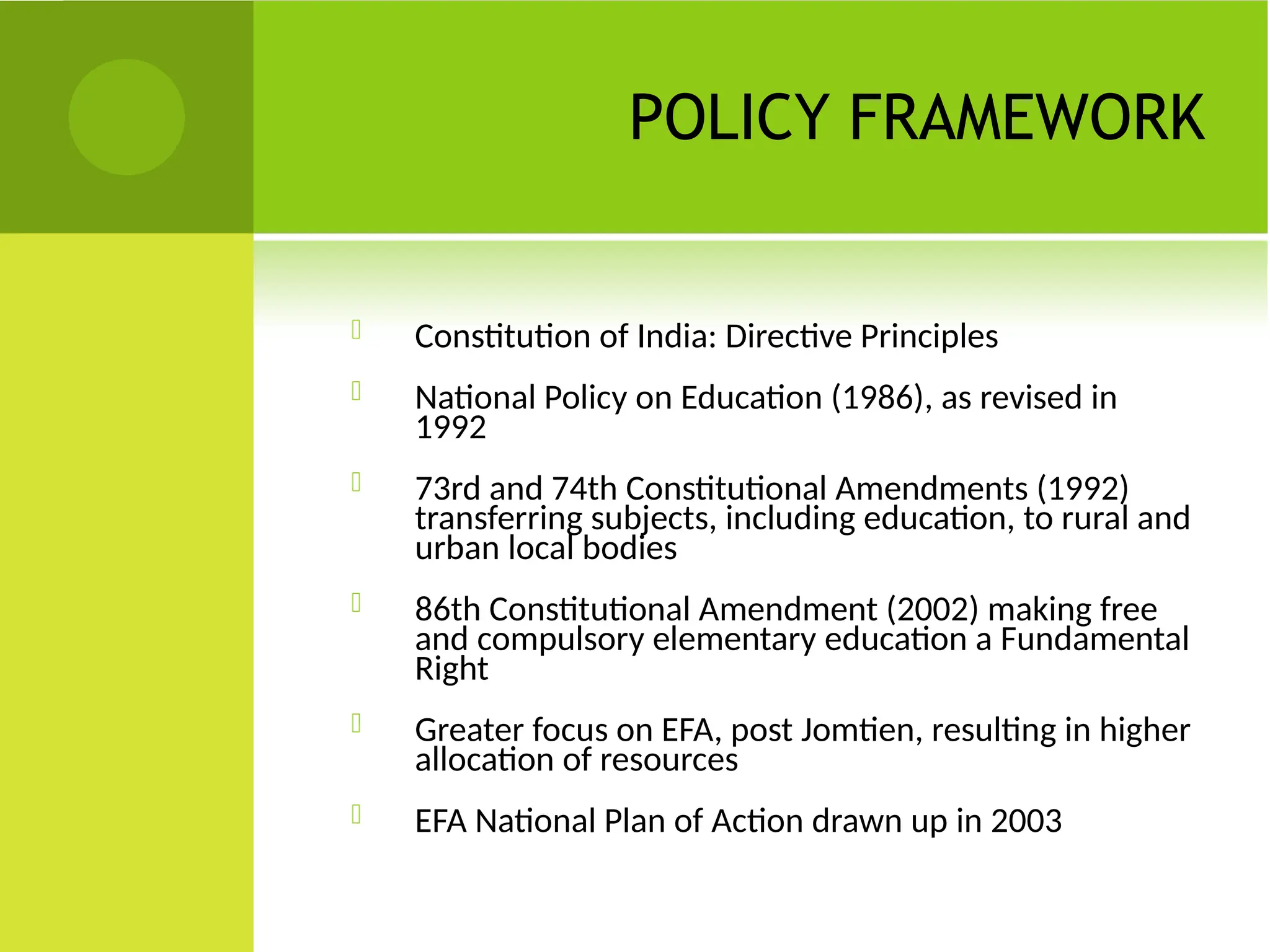
POLICY FRAMEWORK
Constitutionof India: Directive Principles
National Policy on Education (1986), as revised in
1992
73rd and 74th Constitutional Amendments (1992)
transferring subjects, including education, to rural and
urban local bodies
86th Constitutional Amendment (2002) making free
and compulsory elementary education a Fundamental
Right
Greater focus on EFA, post Jomtien, resulting in higher
allocation of resources
EFA National Plan of Action drawn up in 2003
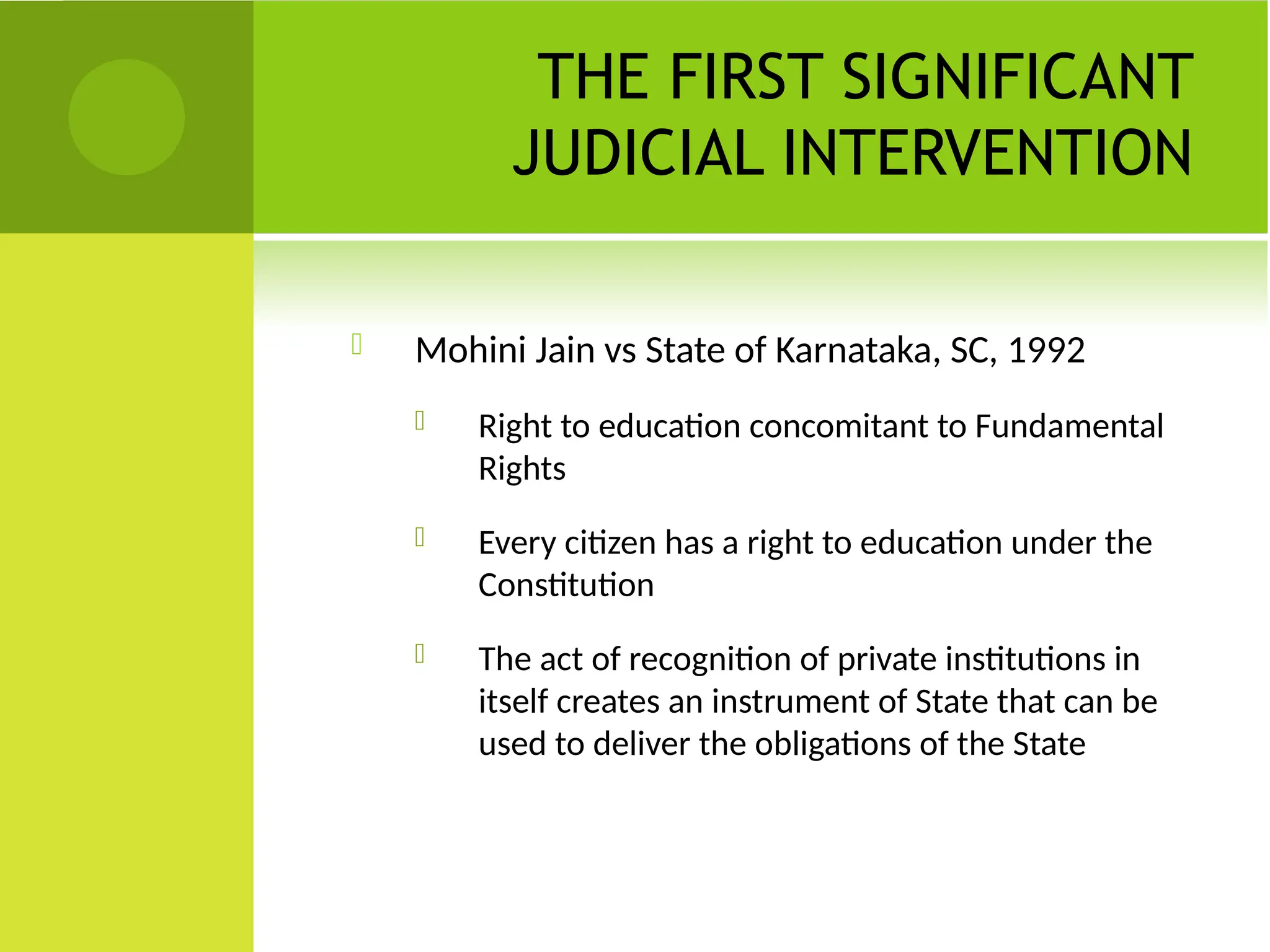
THE FIRST SIGNIFICANT
JUDICIALINTERVENTION
Mohini Jain vs State of Karnataka, SC, 1992
Right to education concomitant to Fundamental
Rights
Every citizen has a right to education under the
Constitution
The act of recognition of private institutions in
itself creates an instrument of State that can be
used to deliver the obligations of the State
12.
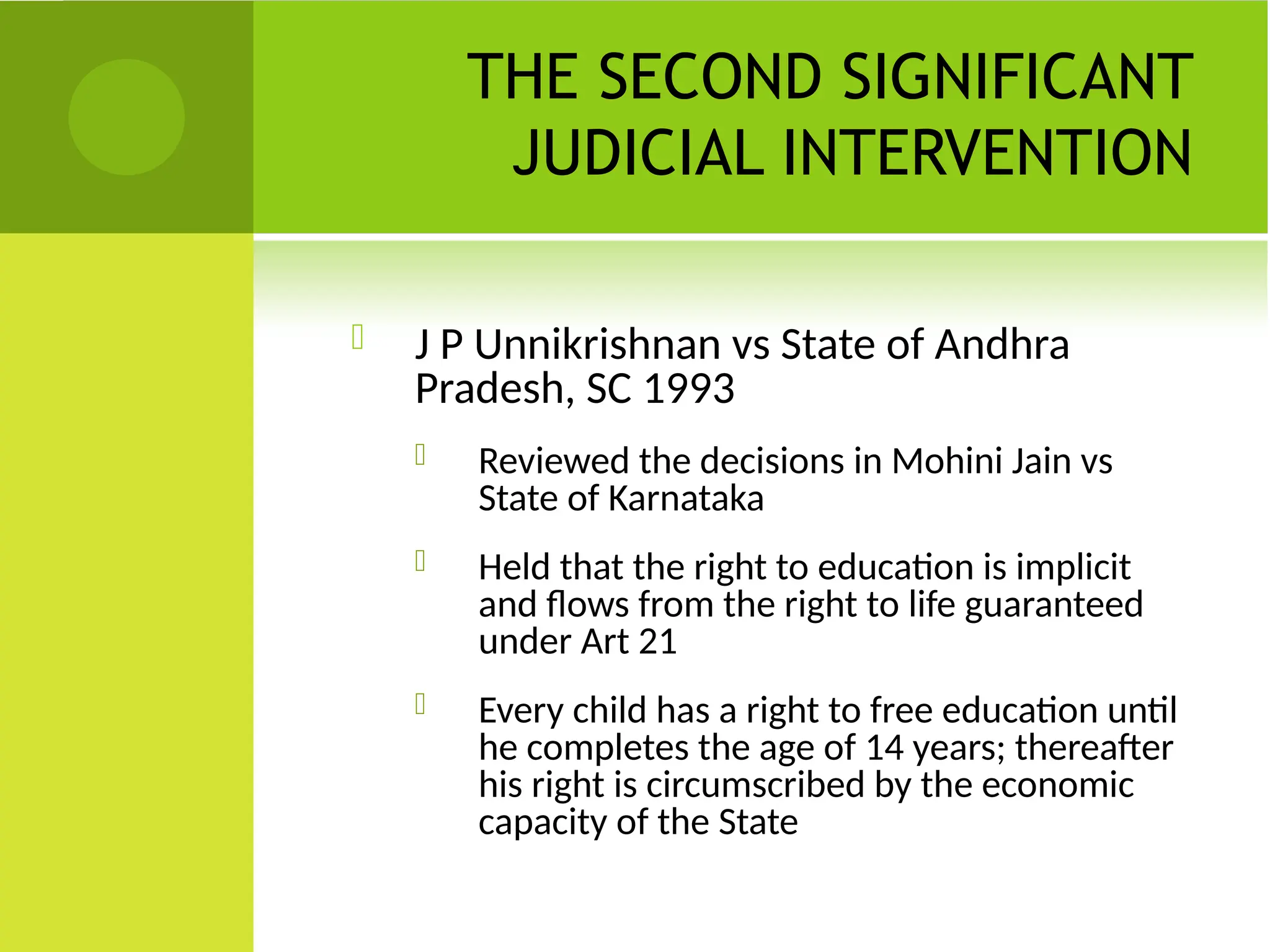
THE SECOND SIGNIFICANT
JUDICIALINTERVENTION
J P Unnikrishnan vs State of Andhra
Pradesh, SC 1993
Reviewed the decisions in Mohini Jain vs
State of Karnataka
Held that the right to education is implicit
and flows from the right to life guaranteed
under Art 21
Every child has a right to free education until
he completes the age of 14 years; thereafter
his right is circumscribed by the economic
capacity of the State
13.
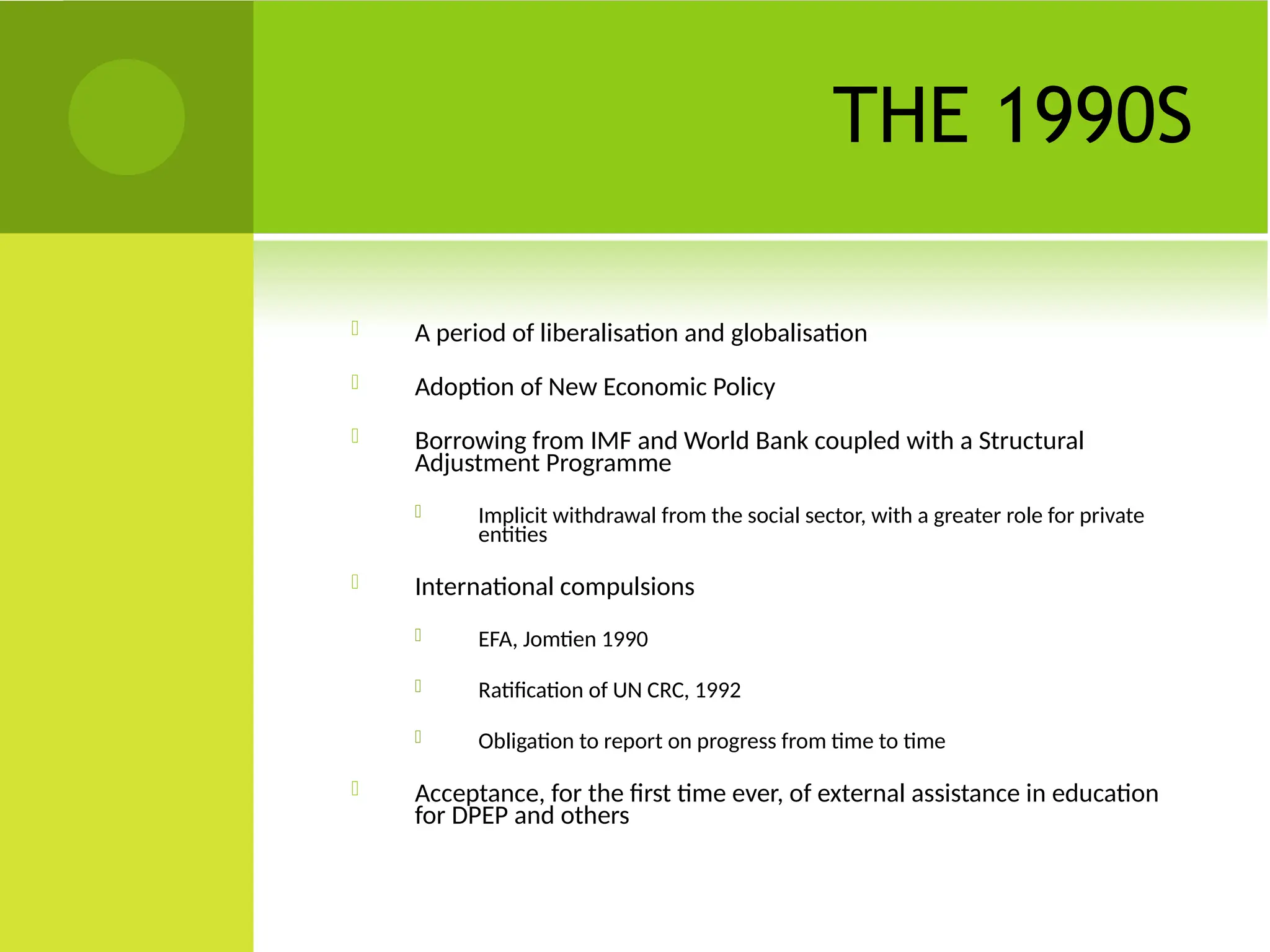
THE 1990S
Aperiod of liberalisation and globalisation
Adoption of New Economic Policy
Borrowing from IMF and World Bank coupled with a Structural
Adjustment Programme
Implicit withdrawal from the social sector, with a greater role for private
entities
International compulsions
EFA, Jomtien 1990
Ratification of UN CRC, 1992
Obligation to report on progress from time to time
Acceptance, for the first time ever, of external assistance in education
for DPEP and others
14.
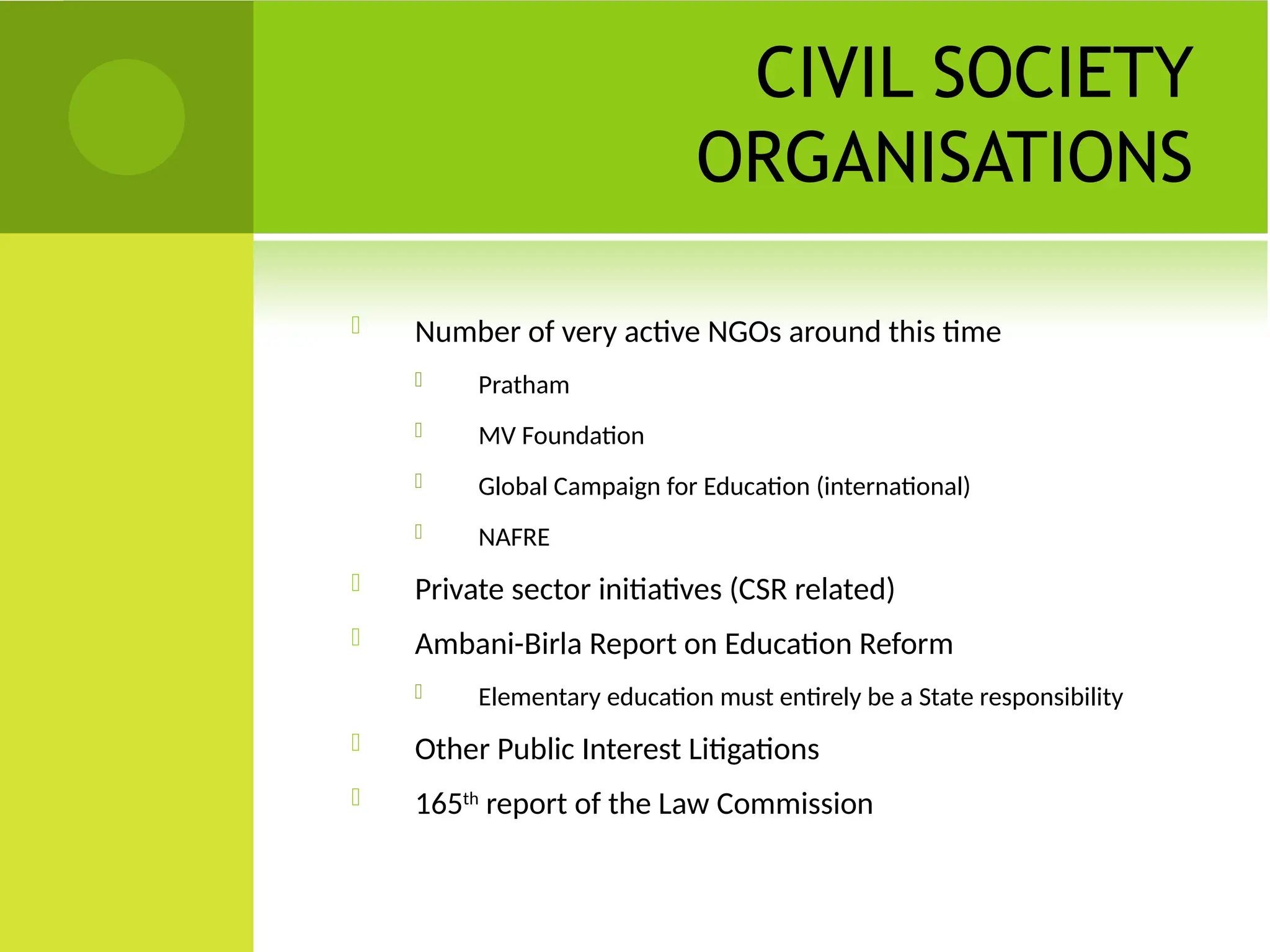
CIVIL SOCIETY
ORGANISATIONS
Numberof very active NGOs around this time
Pratham
MV Foundation
Global Campaign for Education (international)
NAFRE
Private sector initiatives (CSR related)
Ambani-Birla Report on Education Reform
Elementary education must entirely be a State responsibility
Other Public Interest Litigations
165th
report of the Law Commission
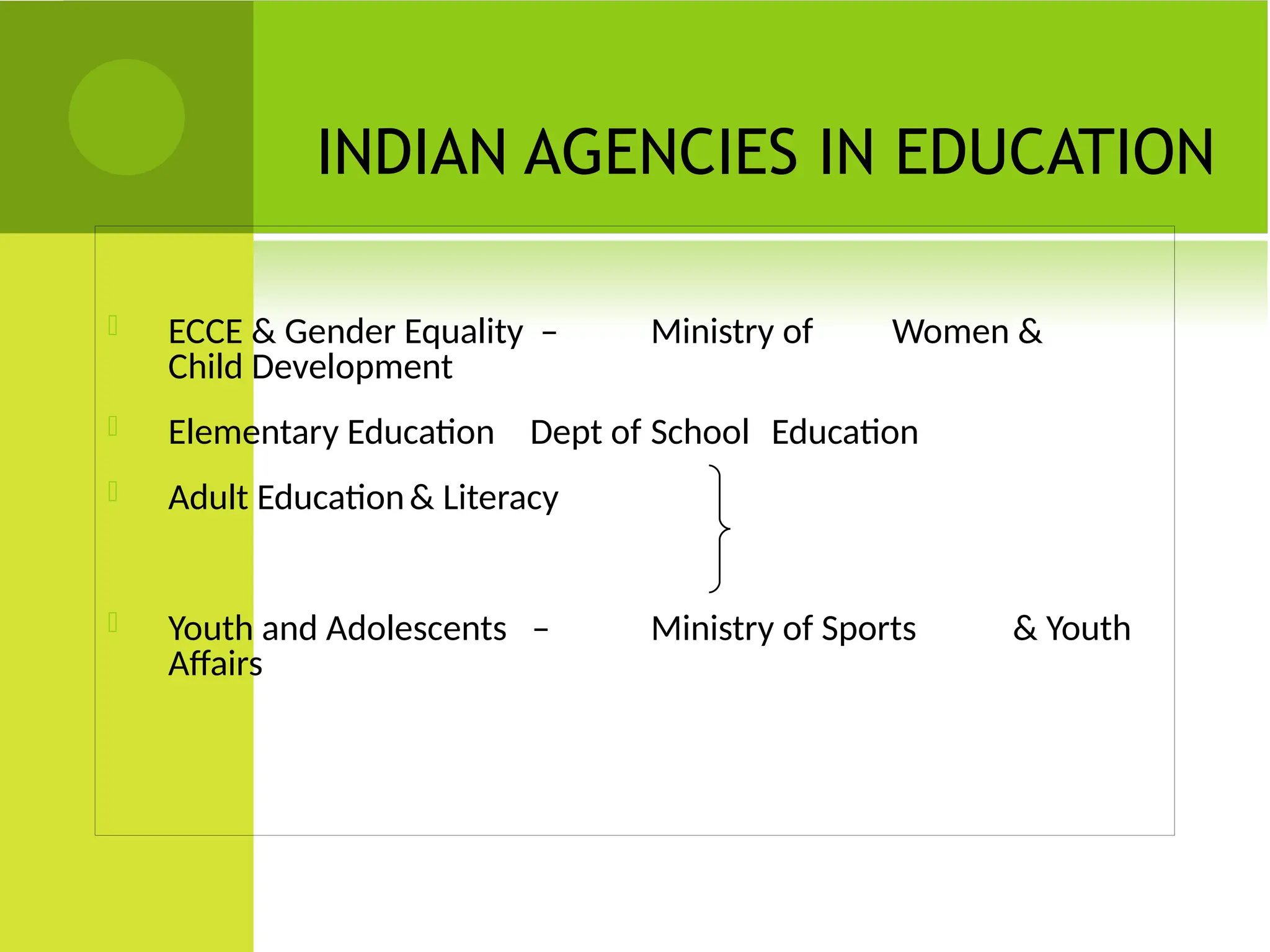
INDIAN AGENCIES INEDUCATION
ECCE & Gender Equality – Ministry of Women &
Child Development
Elementary Education Dept of School Education
Adult Education& Literacy
Youth and Adolescents – Ministry of Sports & Youth
Affairs
17.
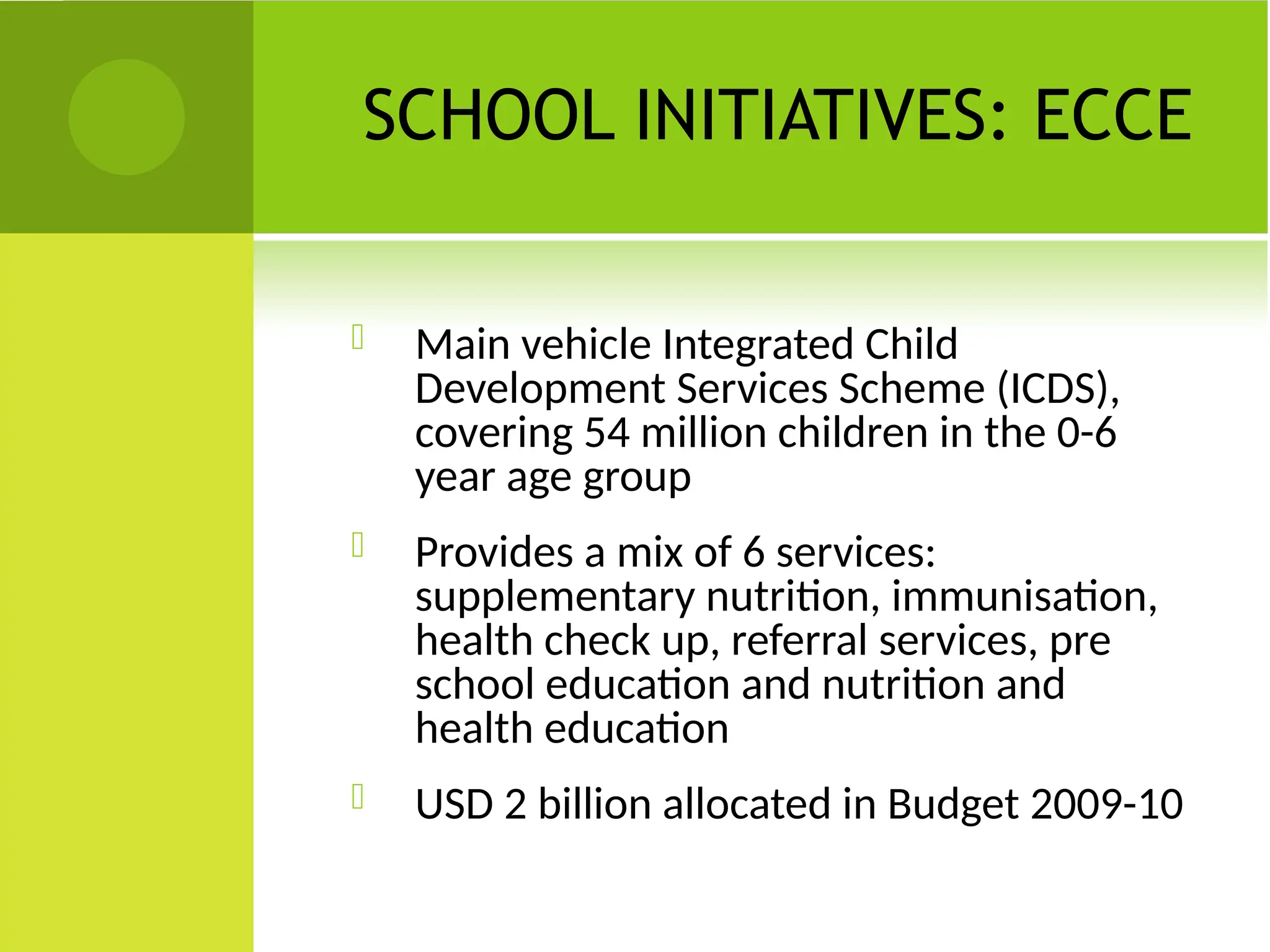
SCHOOL INITIATIVES: ECCE
Main vehicle Integrated Child
Development Services Scheme (ICDS),
covering 54 million children in the 0-6
year age group
Provides a mix of 6 services:
supplementary nutrition, immunisation,
health check up, referral services, pre
school education and nutrition and
health education
USD 2 billion allocated in Budget 2009-10
18.
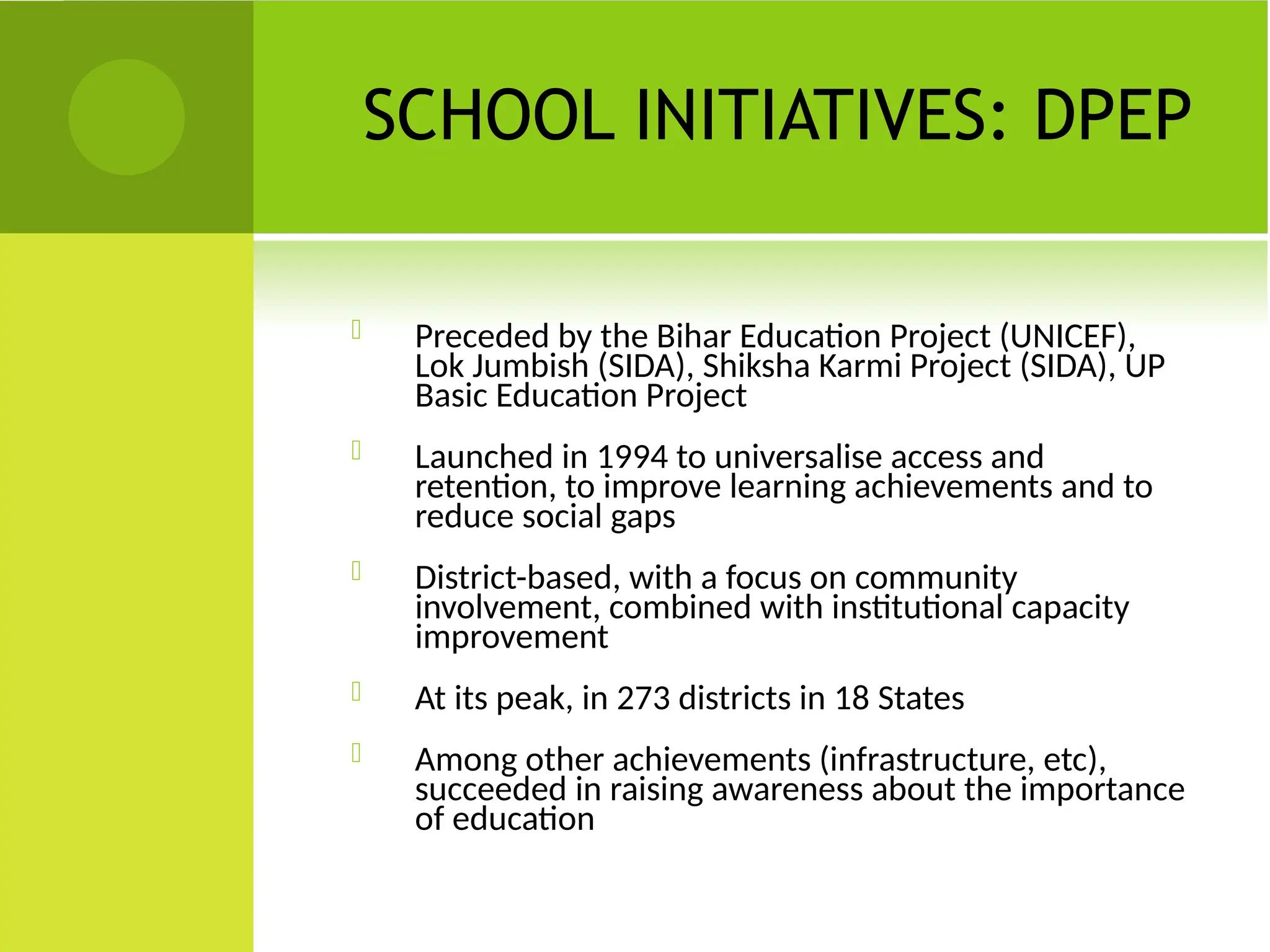
SCHOOL INITIATIVES: DPEP
Preceded by the Bihar Education Project (UNICEF),
Lok Jumbish (SIDA), Shiksha Karmi Project (SIDA), UP
Basic Education Project
Launched in 1994 to universalise access and
retention, to improve learning achievements and to
reduce social gaps
District-based, with a focus on community
involvement, combined with institutional capacity
improvement
At its peak, in 273 districts in 18 States
Among other achievements (infrastructure, etc),
succeeded in raising awareness about the importance
of education
19.
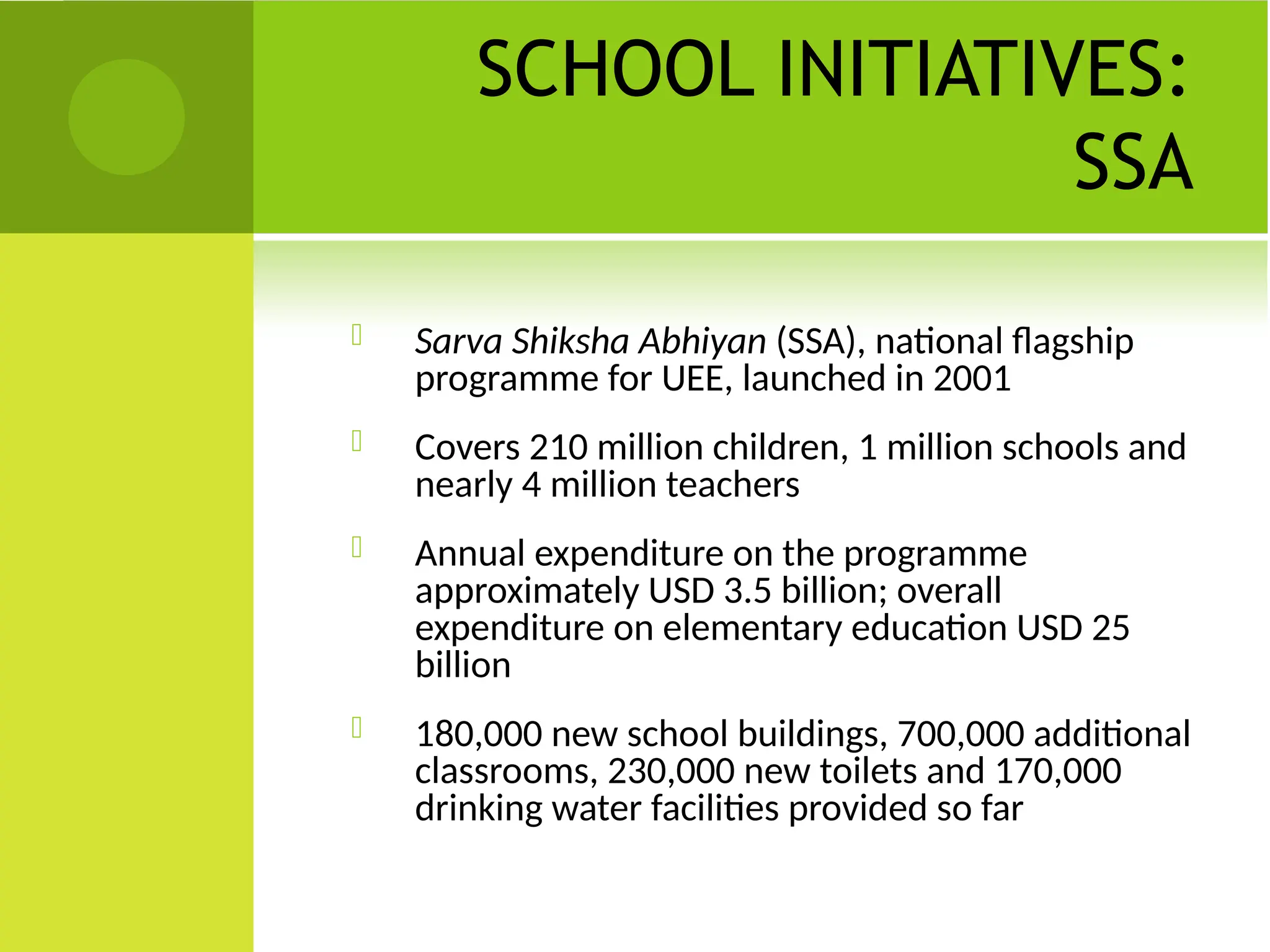
SCHOOL INITIATIVES:
SSA
SarvaShiksha Abhiyan (SSA), national flagship
programme for UEE, launched in 2001
Covers 210 million children, 1 million schools and
nearly 4 million teachers
Annual expenditure on the programme
approximately USD 3.5 billion; overall
expenditure on elementary education USD 25
billion
180,000 new school buildings, 700,000 additional
classrooms, 230,000 new toilets and 170,000
drinking water facilities provided so far
20.
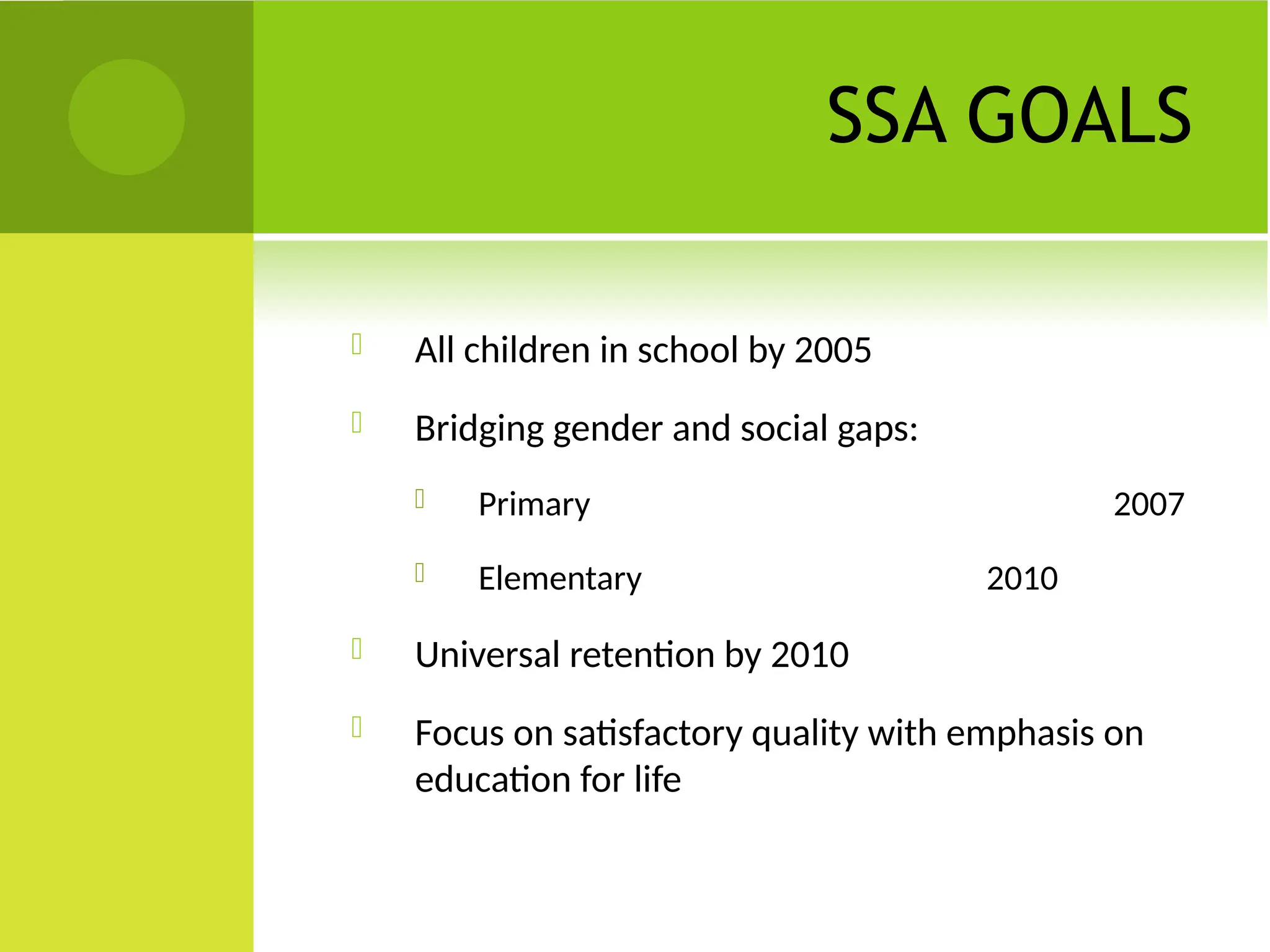
SSA GOALS
Allchildren in school by 2005
Bridging gender and social gaps:
Primary 2007
Elementary 2010
Universal retention by 2010
Focus on satisfactory quality with emphasis on
education for life
21.
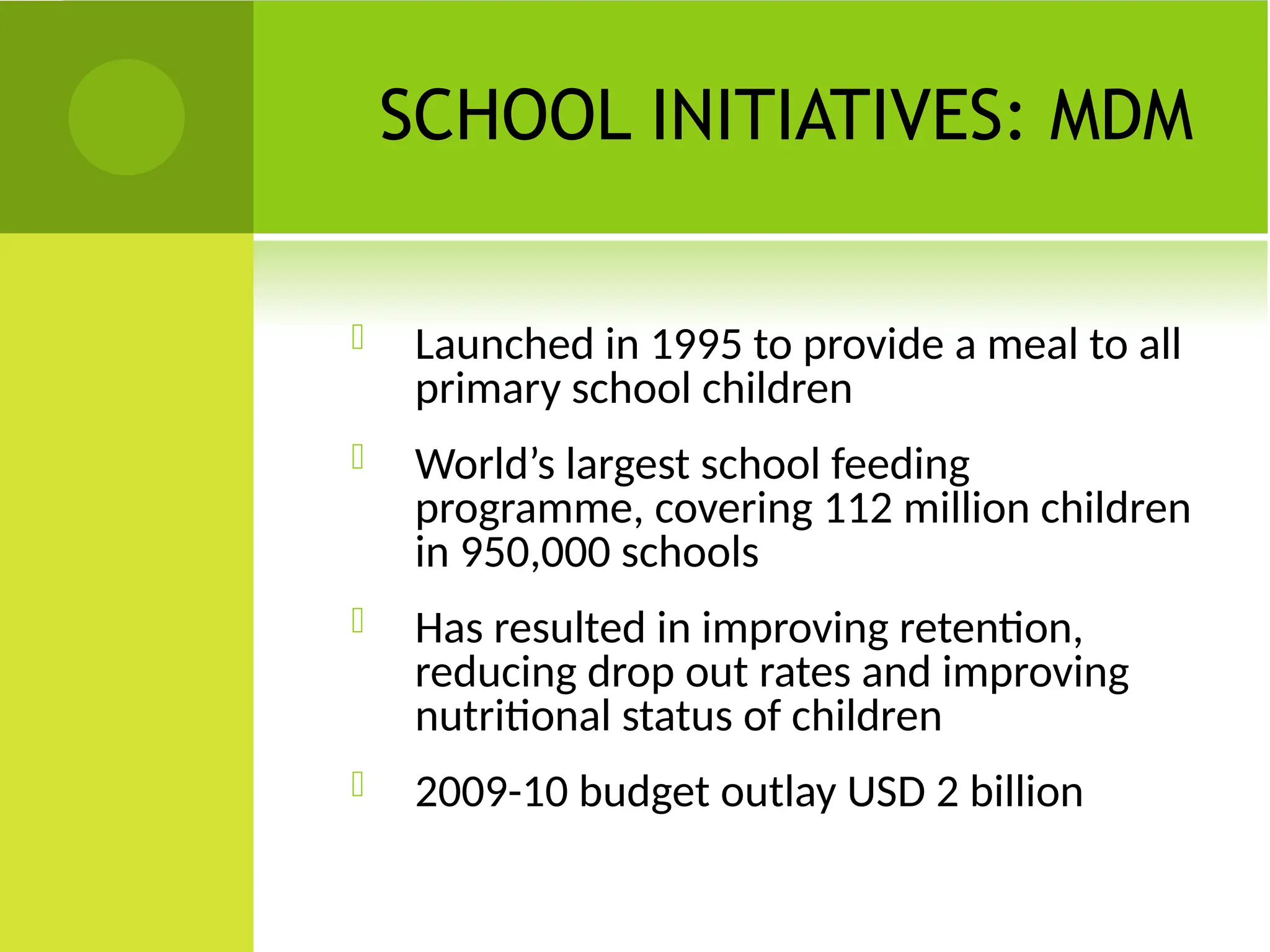
SCHOOL INITIATIVES: MDM
Launched in 1995 to provide a meal to all
primary school children
World’s largest school feeding
programme, covering 112 million children
in 950,000 schools
Has resulted in improving retention,
reducing drop out rates and improving
nutritional status of children
2009-10 budget outlay USD 2 billion
22.
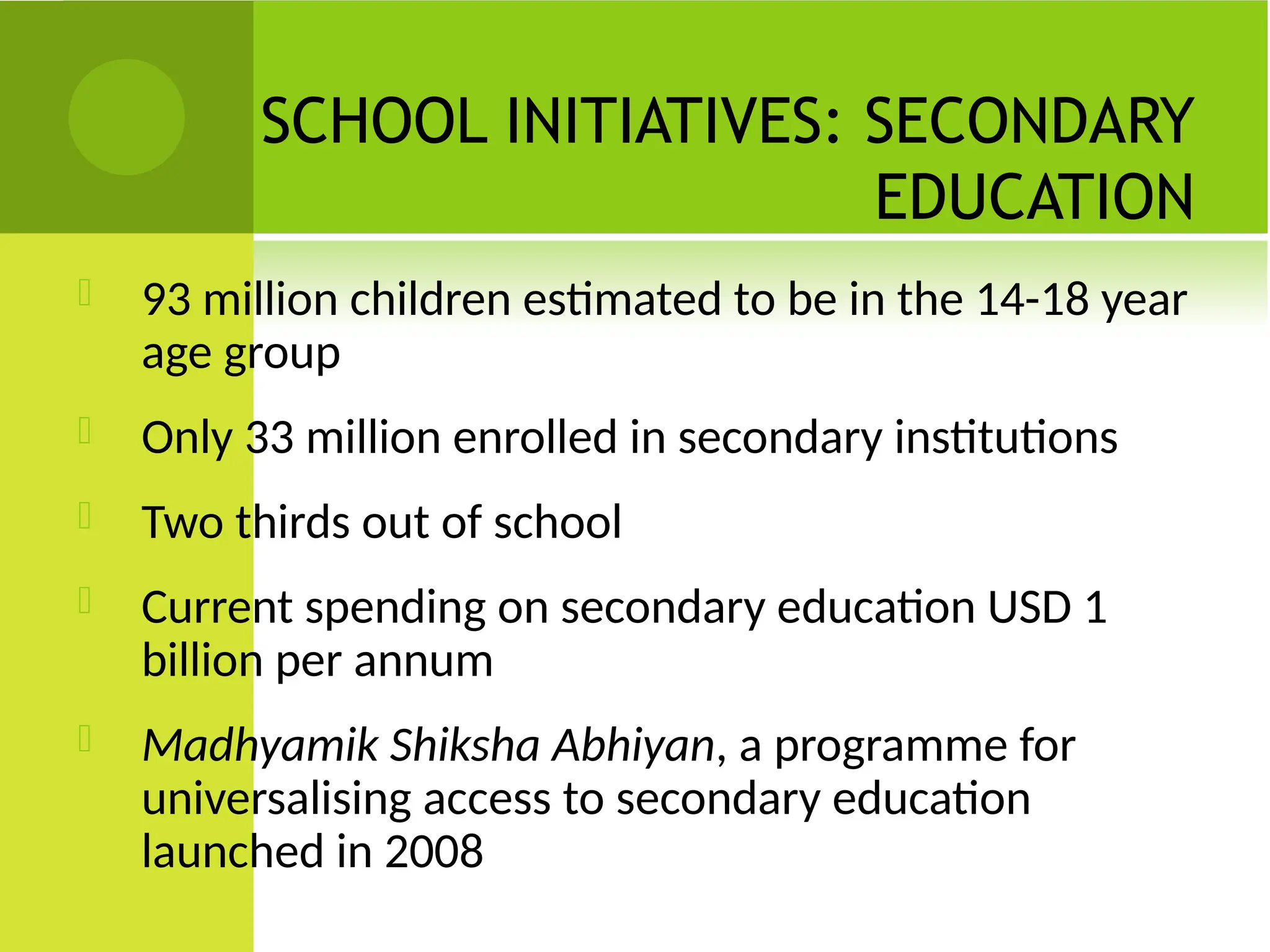
SCHOOL INITIATIVES: SECONDARY
EDUCATION
93 million children estimated to be in the 14-18 year
age group
Only 33 million enrolled in secondary institutions
Two thirds out of school
Current spending on secondary education USD 1
billion per annum
Madhyamik Shiksha Abhiyan, a programme for
universalising access to secondary education
launched in 2008
23.
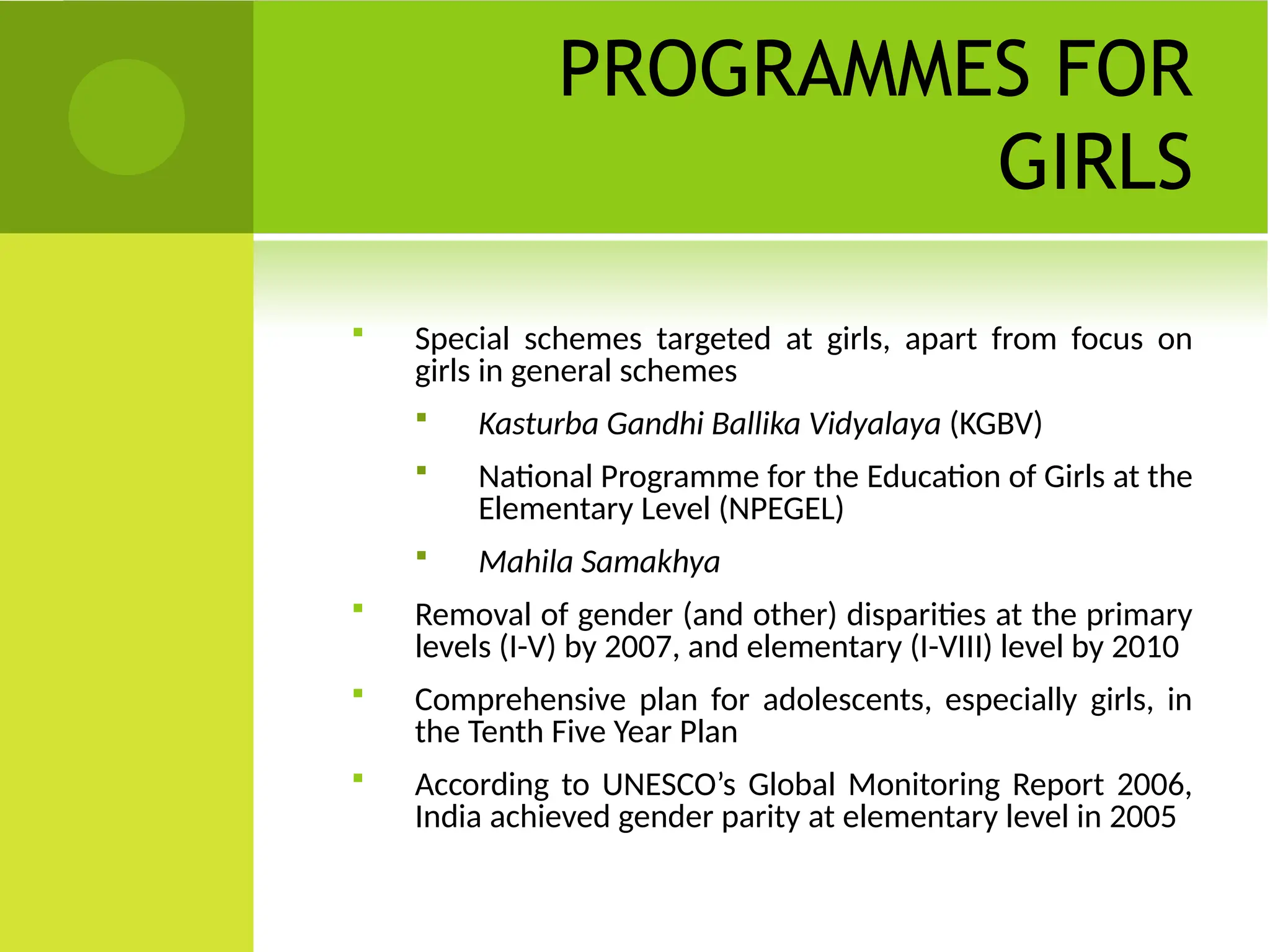
PROGRAMMES FOR
GIRLS
Specialschemes targeted at girls, apart from focus on
girls in general schemes
Kasturba Gandhi Ballika Vidyalaya (KGBV)
National Programme for the Education of Girls at the
Elementary Level (NPEGEL)
Mahila Samakhya
Removal of gender (and other) disparities at the primary
levels (I-V) by 2007, and elementary (I-VIII) level by 2010
Comprehensive plan for adolescents, especially girls, in
the Tenth Five Year Plan
According to UNESCO’s Global Monitoring Report 2006,
India achieved gender parity at elementary level in 2005
24.
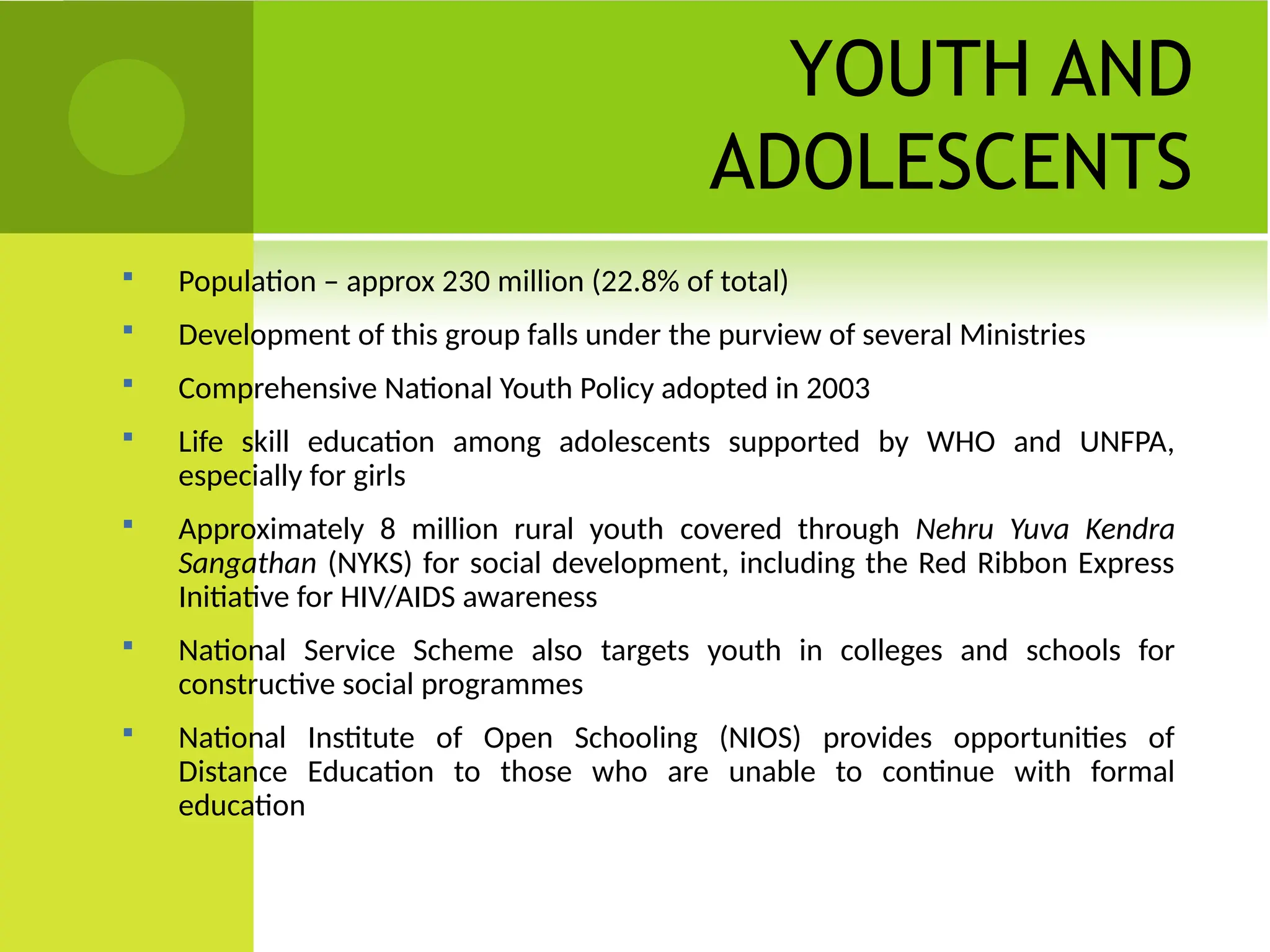
YOUTH AND
ADOLESCENTS
Population– approx 230 million (22.8% of total)
Development of this group falls under the purview of several Ministries
Comprehensive National Youth Policy adopted in 2003
Life skill education among adolescents supported by WHO and UNFPA,
especially for girls
Approximately 8 million rural youth covered through Nehru Yuva Kendra
Sangathan (NYKS) for social development, including the Red Ribbon Express
Initiative for HIV/AIDS awareness
National Service Scheme also targets youth in colleges and schools for
constructive social programmes
National Institute of Open Schooling (NIOS) provides opportunities of
Distance Education to those who are unable to continue with formal
education
25.
ADULT EDUCATION
NationalLiteracy Mission to provide functional literacy to all
adults
To achieve sustainable threshold literacy (75%) by 2007
597 districts covered under AE programmes; 485 under PLP and 328
under CE
Recently recast as Saakshar Bharat to focus on adults above 15
years, with a special focus on female literacy
Vocational education and skill development through 157 Jan
Shikshan Sansthans
Absolute number of illiterates declined by 25 million between 1991-
2001
Gender gap reduced from 24.9% in 1991 to 21.6% in 2001
26.
NEW INITIATIVES
EducationCess @ 2% imposed on all Central taxes to
augment resources for EFA
Estimated yield in 2009-10: US $ 4 billion
Increased to 3% with effect from 2006 to provide for
secondary education
Legislation detailing elementary education as a
Fundamental Right recently notified
ICDS universalised to cover all habitations
Mid-day Meal scheme expanded to cover upper primary
classes
Scheme for universal access to secondary education being
launched
THE INDIAN
CONSTITUTION
Superioror supreme law of the land, reflecting
the relationship of the State with its citizens
Includes Fundamental Rights and Directive
Principles of State Policy
Fundamental Rights are enforceable, justiciable
Directive Principles non-binding, but meant to
guide the State
Together known as the “conscience of the
Constitution” (K C Wheare, Modern
Constitutions)
29.
WHY A RIGHTTO
EDUCATION?
Right to Education linked to a fundamental debate at the
time of writing the Constitution
Related to governance itself, whether to include
universal adult franchise or not
Opponents argued that providing a right to vote to all, when
most were illiterate, would negate democracy
Art 45 introduced as a compromise
“The State shall endeavour to provide, within a period of ten
years from the commencement of this Constitution, for free
and compulsory education for all children until they complete
the age of fourteen years” (emphasis added)
Only Directive Principle with a time frame, indicating that our
leaders were not prepared to give more than ten years to
establish democracy on the bedrock of universal education
30.
HOWEVER…
The timeframe of ten years was never respected
Government and the bureaucracy concluded that
adequate financial resources were not available
Number of illiterates in the country rose from
294.2 million in 1951, to 325.5 million in 1961
31.
THE CONSTITUTION (86TH
AMENDMENT)ACT, 2002
Adds a new Fundamental Right (“Right to Education”) by inserting
Article 21A:
“The State shall provide free and compulsory education to all
children of the age of six to fourteen years in such manner as the
State may, by law, determine.”
Changes Article 45 (in the Directive Principles) to:
“The State shall endeavour to provide early childhood care and
education for all children until they complete the age of six years.”
Adds the following (eleventh) Fundamental Duty in Article 51A:
(It shall be the duty of every citizen of India…)
“(k) who is a parent or guardian to provide opportunities for
education to his child or as the case may be, ward between the age
of six and fourteen years.”
32.
BASIC CONCEPTS
“CompulsoryEducation” defined as the
obligation of the State to take all necessary
steps to ensure that every child participates in,
and completes Elementary Education
“Free Education” defined as freedom from
liability to (i) pay any fee to the school, and (ii)
incur such other prescribed expenses as may
be likely to prevent the child from participating
in and completing Elementary Education
33.
CHILD’S RIGHT TO
EDUCATION
Spelt out as “right to free and compulsory
education of equitable quality” – in turn,
elaborated as the right to participate in
full-time free and compulsory elementary
education in a neighbourhood school,
which fulfils prescribed norms regarding
infrastructure, staffing,curriculum, etc
Suitable provisions for non-enrolled
children to enable them to join age
appropriate grades
34.
RESPONSIBILITIES OF THE
STATE
Responsibilities at various levels (Centre,
State, local authority) spelt out
State to make available a neighbourhood
school, which fulfils prescribed norms, for
every child within three years
Regular monitoring and taking all
necessary steps including removal of all
barriers (social, economic, academic,
physical, etc), so that every child
completes Elementary Education