People as Resource
Class: 9
Economics
Chapter: 2
Date: 07/07/2020
By: Mahendra Kumar Yadav
Subscribe my channel to
see educational videos
and press bell icon to get notification of new
videos.
Quality of Population
The quality of population depends
upon the literacy rate, health of a
person indicated by life expectancy
and skill formation acquired by the
people of the country. The quality
of the population ultimately decides
the growth rate of the country.
Literate and healthy population are
an asset.
Asset is anything
that can be owned
or controlled to
produce value and
that is held by an
economic entity
and that could
produce positive
economic value.
Education
Usually education in the initial years of life of a child
bore him the fruits in the later years in terms of a
good job and salary. We see education is an
important input for the growth of a person. It
opens new horizon for him, provided new
aspiration and developed values of life. Not only
for him, education contributes towards the growth
of society also. It enhances the national income,
cultural richness and increases the efficiency of
governance. There is a provision made for
providing universal access, retention and quality in
national income, cultural richness and increases
the efficiency of governance.
Educational Facilities:
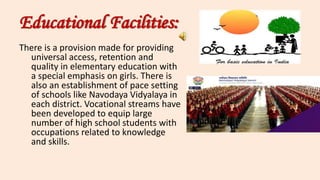
There is a provision made for providing
universal access, retention and
quality in elementary education with
a special emphasis on girls. There is
also an establishment of pace setting
of schools like Navodaya Vidyalaya in
each district. Vocational streams have
been developed to equip large
number of high school students with
occupations related to knowledge
and skills.
Government investment on Education
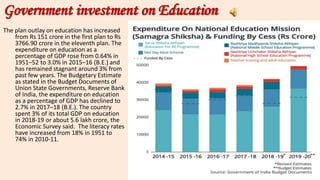
The plan outlay on education has increased
from Rs 151 crore in the first plan to Rs
3766.90 crore in the eleventh plan. The
expenditure on education as a
percentage of GDP rose from 0.64% in
1951–52 to 3.0% in 2015–16 (B.E.) and
has remained stagnant around 3% from
past few years. The Budgetary Estimate
as stated in the Budget Documents of
Union State Governments, Reserve Bank
of India, the expenditure on education
as a percentage of GDP has declined to
2.7% in 2017–18 (B.E.). The country
spent 3% of its total GDP on education
in 2018-19 or about 5.6 lakh crore, the
Economic Survey said. The literacy rates
have increased from 18% in 1951 to
74% in 2010-11.
Status of Education
Literacy is not only a right, it is also needed if the
citizens are to perform their duties and enjoy their
rights properly. However, a vast difference is
noticed across different sections of the
population. Literacy among males is nearly 16.6%
higher than females and it is about 16.1% higher in
urban areas as compared to rural areas. In 2011,
literacy rates varied from 94% in Kerala to 62% in
Bihar. The primary school system has expanded to
over 8.58 lakh in 2013–14. Unfortunately, this
huge expansion of schools has been diluted by the
poor quality of schooling and high dropout rates.
“Sarva Siksha Abhiyan” is a significant step
towards providing elementary education to all
children in the age group of 6–14 years by 2010...
Salient features of NEP 2019
• The policy aims to universalize the pre-primary education by 2025 and provide foundational literacy/numeracy for all by 2025
• It aims at equitable & inclusive education for every child in the country, with a special focus on under-represented groups
(URGs).
• Universal Access & Retention with 100% Gross Enrolment Ratio for all school education by 2030.
• Children learn languages, most quickly between 2-8 years, and multilingualism has great cognitive benefits for students.
Therefore a three-language formula has been proposed
• A new independent State School Regulatory Authority (SSRA) to be created
• It aims to consolidate 800 universities & 40,000 colleges into around 15,000 large, multidisciplinary institutions
• The policy proposes three types of Higher Educational Institutions (HEIs): Research Universities, Teaching Universities and
Autonomous degree-granting colleges
• It aims to provide autonomy to all higher education institutions. Higher education institutions to be governed by Independent
Boards with complete academic and administrative autonomy
• An autonomous body called the National Research Foundation (NRF) to be set up through an Act of Parliament
• Rashtriya Shiksha Aayog or the National Education Commission - apex body - to be constituted. It will be chaired by the Prime
Minister and will comprise eminent educationists, researchers, Union Ministers, representation of Chief Ministers of States,
eminent professionals from various fields
• MHRD to be re-designated as the Ministry of Education (MoE)
• Increase in public investment by the Central and State Governments to 20% of overall public expenditure over a 10 year period
Thank
You

People as resource class 9 part 2

  • 1.
    People as Resource Class:9 Economics Chapter: 2 Date: 07/07/2020 By: Mahendra Kumar Yadav Subscribe my channel to see educational videos and press bell icon to get notification of new videos.
  • 2.
    Quality of Population Thequality of population depends upon the literacy rate, health of a person indicated by life expectancy and skill formation acquired by the people of the country. The quality of the population ultimately decides the growth rate of the country. Literate and healthy population are an asset. Asset is anything that can be owned or controlled to produce value and that is held by an economic entity and that could produce positive economic value.
  • 3.
    Education Usually education inthe initial years of life of a child bore him the fruits in the later years in terms of a good job and salary. We see education is an important input for the growth of a person. It opens new horizon for him, provided new aspiration and developed values of life. Not only for him, education contributes towards the growth of society also. It enhances the national income, cultural richness and increases the efficiency of governance. There is a provision made for providing universal access, retention and quality in national income, cultural richness and increases the efficiency of governance.
  • 4.
    Educational Facilities: There isa provision made for providing universal access, retention and quality in elementary education with a special emphasis on girls. There is also an establishment of pace setting of schools like Navodaya Vidyalaya in each district. Vocational streams have been developed to equip large number of high school students with occupations related to knowledge and skills.
  • 5.
    Government investment onEducation The plan outlay on education has increased from Rs 151 crore in the first plan to Rs 3766.90 crore in the eleventh plan. The expenditure on education as a percentage of GDP rose from 0.64% in 1951–52 to 3.0% in 2015–16 (B.E.) and has remained stagnant around 3% from past few years. The Budgetary Estimate as stated in the Budget Documents of Union State Governments, Reserve Bank of India, the expenditure on education as a percentage of GDP has declined to 2.7% in 2017–18 (B.E.). The country spent 3% of its total GDP on education in 2018-19 or about 5.6 lakh crore, the Economic Survey said. The literacy rates have increased from 18% in 1951 to 74% in 2010-11.
  • 6.
    Status of Education Literacyis not only a right, it is also needed if the citizens are to perform their duties and enjoy their rights properly. However, a vast difference is noticed across different sections of the population. Literacy among males is nearly 16.6% higher than females and it is about 16.1% higher in urban areas as compared to rural areas. In 2011, literacy rates varied from 94% in Kerala to 62% in Bihar. The primary school system has expanded to over 8.58 lakh in 2013–14. Unfortunately, this huge expansion of schools has been diluted by the poor quality of schooling and high dropout rates. “Sarva Siksha Abhiyan” is a significant step towards providing elementary education to all children in the age group of 6–14 years by 2010...
  • 7.
    Salient features ofNEP 2019 • The policy aims to universalize the pre-primary education by 2025 and provide foundational literacy/numeracy for all by 2025 • It aims at equitable & inclusive education for every child in the country, with a special focus on under-represented groups (URGs). • Universal Access & Retention with 100% Gross Enrolment Ratio for all school education by 2030. • Children learn languages, most quickly between 2-8 years, and multilingualism has great cognitive benefits for students. Therefore a three-language formula has been proposed • A new independent State School Regulatory Authority (SSRA) to be created • It aims to consolidate 800 universities & 40,000 colleges into around 15,000 large, multidisciplinary institutions • The policy proposes three types of Higher Educational Institutions (HEIs): Research Universities, Teaching Universities and Autonomous degree-granting colleges • It aims to provide autonomy to all higher education institutions. Higher education institutions to be governed by Independent Boards with complete academic and administrative autonomy • An autonomous body called the National Research Foundation (NRF) to be set up through an Act of Parliament • Rashtriya Shiksha Aayog or the National Education Commission - apex body - to be constituted. It will be chaired by the Prime Minister and will comprise eminent educationists, researchers, Union Ministers, representation of Chief Ministers of States, eminent professionals from various fields • MHRD to be re-designated as the Ministry of Education (MoE) • Increase in public investment by the Central and State Governments to 20% of overall public expenditure over a 10 year period
  • 8.