HRNC / NIA
November 21, 2013
Niagara Falls
Presented by
Stuart E. Rudner
Employment Law 101:
From Hiring to Firing
Common Myths
 Every employee has a probation period during
which they can be dismissed without notice or
cause.
 Unless a contract states otherwise, employees are
only entitled to the Employment Standards Act
minimum amounts of notice / severance
 Termination clauses are not enforceable
 Only the most recent period of employment
counts when calculating entitlement to severance
pay
2
How Much Notice / Severance?
 You have to give a dismissed worker a “package”
 The common law requires one month of notice for
every year of service (or two weeks for every
year, or some other absolute amount).
 Pay in lieu of notice of dismissal includes base
salary only.
 An employer can discount the amount of notice of
dismissal required if the employee’s conduct or
performance was not up to par
3
 You can’t fire someone in Canada
 Providing positive or negative references to
dismissed employees can result in liability.
 Non-competition covenants are enforceable
against former employees.
 If you are concerned about a human rights
complaint, dismissing the individual on a without
cause basis will preclude a claim being brought.
4
From Hiring to Dismissal
1. Hiring Process
2. During the relationship
3. Dismissal
5
The Hiring Process
 Dealing with publicly available information
online
 Courts recognizing Facebook and similar
postings not necessarily “private”
 Don’t demand access or password
Caution
 Risk of inaccurate information
 Take everything with a grain of salt
 Risk of stumbling
on inappropriate information
– Race
– Age
– Disability
Human Rights Code
 Every person who is an employee has a
right to freedom from harassment in the
workplace by the employer or agent of
the employer or by another employee
because of…
 You don’t want to know more than you
need to
Mitigating Risks
 Have protocol for every applicant
 Screen candidates in consistent manner
 Have non-decision maker filter out
inappropriate info
 Log reasons for not hiring
AODA & Accommodation
 Positive duty to accommodate in hiring
process
 Must advise applicants will accommodate
 Must proactively inquire
 Must accommodate if requested
 Applies to posting, websites, access to
interview space, etc.
10
11
Accommodation
 Duty to accommodate to point of “undue
hardship”
 Employees do not have to reveal need for
accommodation in application process
– Not “dishonest” or cause for dismissal
 Separate accommodation from hiring
decision if possible
Accommodation
 Process is to be 2 (or 3) way dialogue
 Employee must produce appropriate
medical documentation
 Not entitled to preferred form of
accommodation
 Must show appropriate efforts to consider
potential accommodations
12
Employment Agreements
 Use them!
 Do it properly
– Before there’s already an agreement
– With consideration
– Explained and understood
– Independent legal advice
Employment Agreements
 Basic Checklist:
– Duties (maintain flexibility)
– Remuneration and benefits (maintain
flexibility)
– Restrictive Covenants
– Vacation
– Termination
– No conflicting obligations
Employment Agreements
 Basic Checklist (cont’d):
– Hours of work
– Vacation / holidays
– Dress code
– Conflict of interest
– Expenses
– Social Media
Termination Clauses
 Enforceable if done properly
 Avoid uncertainty of “reasonable
notice” & reduce dismissal costs
 Use clear language
 Don’t go below employment
standards
16
Termination Clauses
 Address benefits
 Address mitigation
17
Policies to Protect the
Employer
Implementing Policies
A. Have a policy
B. Use clear and unambiguous language
C. Keep the policy up to date
D. Publicize the policy
E. Make employees aware of concerns
F. Ensure supervisors and managers are aware
of the policy and how to monitor
G. Monitor behaviour
H. Discipline violators
20
Dismissals
 2 types: With cause or without
cause
 If with cause, no further
obligation to employee
 Otherwise, need to assess
employee’s entitlements to
notice/pay in lieu/severance
 No “near cause”
21
Without Just Cause
 Notice of Dismissal or Pay in Lieu
 Two sources of entitlement
– Employment Standards Act /
Canada Labour Code
– Common Law
 Can contract out of common law
22
Common Law: The Length of
Notice
 Requirement: “reasonable” notice
of dismissal
 The Bardal Factors
1) Length of service
2) Age
3) Position / Character of Employment
4) Availability of Similar Employment
What is “reasonable”?
 No “rule of thumb” or direct 1:1
relationship between years of service and
months of reasonable notice
 Beware the short-term employee
 Inducement
23
The Changing Times
 End of mandatory retirement, people
working longer --> Wrongful dismissal
claims by workers in 70s and 80s!
 Recent decision:
I do not think there is a place in this social reality
for an automatic presumption that persons should
or would naturally retire on reaching senior age.
24
The Changing Times
Di Tomaso v. Crown Metal Packaging Canada
LP:
there is recent jurisprudence suggesting
that, if anything, (position/character of
employment) is today a factor of declining
relative importance.
25
26
Without Cause: Options
 Working notice
– must allow opportunity to
look for new employment
 Salary & benefit continuance
 Lump-sum
 Combination
 Dangers of failing to continue benefits
27
For Just Cause
 Capital Punishment of Employment Law
 Employer must prove:
1. that the alleged misconduct took place,
and
2. that the nature or degree of misconduct warranted
dismissal, bearing in mind all relevant
circumstances
 Proportionality is guiding principle – “punishment
must fit the crime”
The Contextual Approach
 Employer must consider all circumstances,
not just alleged misconduct
– Length of service
– Disciplinary history
– Nature of position
 Same set of facts can yield different
results
28
29
Performance Issues
Employer must:
 Set a clear, reasonable standard
 Communicate expectations
 Measure the performance
 Take appropriate action
– Warnings (verbal and written) – document everything!
– Counseling
– Training
 Allow reasonable time for improvement
Off-Duty Conduct
 Generally, what you do on your time is your business
 Unless
– The conduct renders the employee unable to perform his
duties satisfactorily.
– The conduct interferes with the efficient management of
the operation or workforce.
– The conduct leads to a refusal or reluctance of other
employees to work with him.
– The conduct harms the general reputation of the Employer,
its product or its employees.

31
The Importance of the
Investigation
 Investigate first
 Ensure fairness, objectivity, thoroughness
 Give opportunity to respond
 Often, employee response is critical factor
in determining appropriate discipline
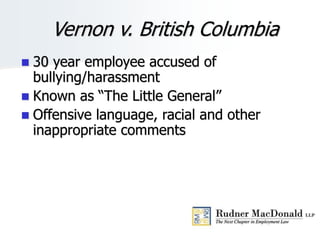
Vernon v. British Columbia
 30 year employee accused of
bullying/harassment
 Known as “The Little General”
 Offensive language, racial and other
inappropriate comments
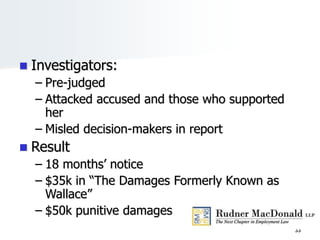
 Investigators:
– Pre-judged
– Attacked accused and those who supported
her
– Misled decision-makers in report
 Result
– 18 months’ notice
– $35k in “The Damages Formerly Known as
Wallace”
– $50k punitive damages
33
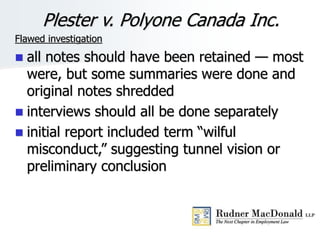
Plester v. Polyone Canada Inc.
Flawed investigation
 all notes should have been retained — most
were, but some summaries were done and
original notes shredded
 interviews should all be done separately
 initial report included term “wilful
misconduct,” suggesting tunnel vision or
preliminary conclusion
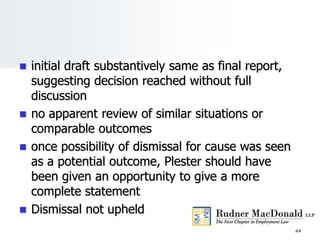
 initial draft substantively same as final report,
suggesting decision reached without full
discussion
 no apparent review of similar situations or
comparable outcomes
 once possibility of dismissal for cause was seen
as a potential outcome, Plester should have
been given an opportunity to give a more
complete statement
 Dismissal not upheld
35
36
Human Rights Claims
 Cannot dismiss based upon protected
ground
 Caution when applying performance
requirements
 Even if tiny part of reason was
protected ground despite other
legitimate reasons
 Potential for “general damages” plus
damages for loss of income from date
of dismissal to date of hearing
37
Stuart E. Rudner
srudner@rudnermacdonald.com
647.255.3100
www.rudnermacdonald.com
Twitter: @CanadianHRLaw
LinkedIn: Connect with me, join the
Canadian HR Law Group and visit the Rudner
MacDonald Page
Blog: Canadian HR Law
http://www.hrreporter.com/blog/canadian-hr-law
FaceBook: Rudner MacDonald Page
Google+: Canadian HR Law, Rudner MacDonald
Page
YouTube: Rudner MacDonald channel

Employment Law 101: From Hiring to Firing

  • 1.
    HRNC / NIA November21, 2013 Niagara Falls Presented by Stuart E. Rudner Employment Law 101: From Hiring to Firing
  • 2.
    Common Myths  Everyemployee has a probation period during which they can be dismissed without notice or cause.  Unless a contract states otherwise, employees are only entitled to the Employment Standards Act minimum amounts of notice / severance  Termination clauses are not enforceable  Only the most recent period of employment counts when calculating entitlement to severance pay 2
  • 3.
    How Much Notice/ Severance?  You have to give a dismissed worker a “package”  The common law requires one month of notice for every year of service (or two weeks for every year, or some other absolute amount).  Pay in lieu of notice of dismissal includes base salary only.  An employer can discount the amount of notice of dismissal required if the employee’s conduct or performance was not up to par 3
  • 4.
     You can’tfire someone in Canada  Providing positive or negative references to dismissed employees can result in liability.  Non-competition covenants are enforceable against former employees.  If you are concerned about a human rights complaint, dismissing the individual on a without cause basis will preclude a claim being brought. 4
  • 5.
    From Hiring toDismissal 1. Hiring Process 2. During the relationship 3. Dismissal 5
  • 6.
    The Hiring Process Dealing with publicly available information online  Courts recognizing Facebook and similar postings not necessarily “private”  Don’t demand access or password
  • 7.
    Caution  Risk ofinaccurate information  Take everything with a grain of salt  Risk of stumbling on inappropriate information – Race – Age – Disability
  • 8.
    Human Rights Code Every person who is an employee has a right to freedom from harassment in the workplace by the employer or agent of the employer or by another employee because of…  You don’t want to know more than you need to
  • 9.
    Mitigating Risks  Haveprotocol for every applicant  Screen candidates in consistent manner  Have non-decision maker filter out inappropriate info  Log reasons for not hiring
  • 10.
    AODA & Accommodation Positive duty to accommodate in hiring process  Must advise applicants will accommodate  Must proactively inquire  Must accommodate if requested  Applies to posting, websites, access to interview space, etc. 10
  • 11.
    11 Accommodation  Duty toaccommodate to point of “undue hardship”  Employees do not have to reveal need for accommodation in application process – Not “dishonest” or cause for dismissal  Separate accommodation from hiring decision if possible
  • 12.
    Accommodation  Process isto be 2 (or 3) way dialogue  Employee must produce appropriate medical documentation  Not entitled to preferred form of accommodation  Must show appropriate efforts to consider potential accommodations 12
  • 13.
    Employment Agreements  Usethem!  Do it properly – Before there’s already an agreement – With consideration – Explained and understood – Independent legal advice
  • 14.
    Employment Agreements  BasicChecklist: – Duties (maintain flexibility) – Remuneration and benefits (maintain flexibility) – Restrictive Covenants – Vacation – Termination – No conflicting obligations
  • 15.
    Employment Agreements  BasicChecklist (cont’d): – Hours of work – Vacation / holidays – Dress code – Conflict of interest – Expenses – Social Media
  • 16.
    Termination Clauses  Enforceableif done properly  Avoid uncertainty of “reasonable notice” & reduce dismissal costs  Use clear language  Don’t go below employment standards 16
  • 17.
    Termination Clauses  Addressbenefits  Address mitigation 17
  • 18.
    Policies to Protectthe Employer
  • 19.
    Implementing Policies A. Havea policy B. Use clear and unambiguous language C. Keep the policy up to date D. Publicize the policy E. Make employees aware of concerns F. Ensure supervisors and managers are aware of the policy and how to monitor G. Monitor behaviour H. Discipline violators
  • 20.
    20 Dismissals  2 types:With cause or without cause  If with cause, no further obligation to employee  Otherwise, need to assess employee’s entitlements to notice/pay in lieu/severance  No “near cause”
  • 21.
    21 Without Just Cause Notice of Dismissal or Pay in Lieu  Two sources of entitlement – Employment Standards Act / Canada Labour Code – Common Law  Can contract out of common law
  • 22.
    22 Common Law: TheLength of Notice  Requirement: “reasonable” notice of dismissal  The Bardal Factors 1) Length of service 2) Age 3) Position / Character of Employment 4) Availability of Similar Employment
  • 23.
    What is “reasonable”? No “rule of thumb” or direct 1:1 relationship between years of service and months of reasonable notice  Beware the short-term employee  Inducement 23
  • 24.
    The Changing Times End of mandatory retirement, people working longer --> Wrongful dismissal claims by workers in 70s and 80s!  Recent decision: I do not think there is a place in this social reality for an automatic presumption that persons should or would naturally retire on reaching senior age. 24
  • 25.
    The Changing Times DiTomaso v. Crown Metal Packaging Canada LP: there is recent jurisprudence suggesting that, if anything, (position/character of employment) is today a factor of declining relative importance. 25
  • 26.
    26 Without Cause: Options Working notice – must allow opportunity to look for new employment  Salary & benefit continuance  Lump-sum  Combination  Dangers of failing to continue benefits
  • 27.
    27 For Just Cause Capital Punishment of Employment Law  Employer must prove: 1. that the alleged misconduct took place, and 2. that the nature or degree of misconduct warranted dismissal, bearing in mind all relevant circumstances  Proportionality is guiding principle – “punishment must fit the crime”
  • 28.
    The Contextual Approach Employer must consider all circumstances, not just alleged misconduct – Length of service – Disciplinary history – Nature of position  Same set of facts can yield different results 28
  • 29.
    29 Performance Issues Employer must: Set a clear, reasonable standard  Communicate expectations  Measure the performance  Take appropriate action – Warnings (verbal and written) – document everything! – Counseling – Training  Allow reasonable time for improvement
  • 30.
    Off-Duty Conduct  Generally,what you do on your time is your business  Unless – The conduct renders the employee unable to perform his duties satisfactorily. – The conduct interferes with the efficient management of the operation or workforce. – The conduct leads to a refusal or reluctance of other employees to work with him. – The conduct harms the general reputation of the Employer, its product or its employees. 
  • 31.
    31 The Importance ofthe Investigation  Investigate first  Ensure fairness, objectivity, thoroughness  Give opportunity to respond  Often, employee response is critical factor in determining appropriate discipline
  • 32.
    Vernon v. BritishColumbia  30 year employee accused of bullying/harassment  Known as “The Little General”  Offensive language, racial and other inappropriate comments
  • 33.
     Investigators: – Pre-judged –Attacked accused and those who supported her – Misled decision-makers in report  Result – 18 months’ notice – $35k in “The Damages Formerly Known as Wallace” – $50k punitive damages 33
  • 34.
    Plester v. PolyoneCanada Inc. Flawed investigation  all notes should have been retained — most were, but some summaries were done and original notes shredded  interviews should all be done separately  initial report included term “wilful misconduct,” suggesting tunnel vision or preliminary conclusion
  • 35.
     initial draftsubstantively same as final report, suggesting decision reached without full discussion  no apparent review of similar situations or comparable outcomes  once possibility of dismissal for cause was seen as a potential outcome, Plester should have been given an opportunity to give a more complete statement  Dismissal not upheld 35
  • 36.
    36 Human Rights Claims Cannot dismiss based upon protected ground  Caution when applying performance requirements  Even if tiny part of reason was protected ground despite other legitimate reasons  Potential for “general damages” plus damages for loss of income from date of dismissal to date of hearing
  • 37.
    37 Stuart E. Rudner srudner@rudnermacdonald.com 647.255.3100 www.rudnermacdonald.com Twitter:@CanadianHRLaw LinkedIn: Connect with me, join the Canadian HR Law Group and visit the Rudner MacDonald Page Blog: Canadian HR Law http://www.hrreporter.com/blog/canadian-hr-law FaceBook: Rudner MacDonald Page Google+: Canadian HR Law, Rudner MacDonald Page YouTube: Rudner MacDonald channel