The Strategic Role of  Human Resource Management
The Manager’s Human Resource Management Jobs Management process The five basic functions  planning organizing staffing leading controlling.
The Manager’s Human Resource Management Jobs Human resource management (HRM) The policies and practices involved in carrying out the “people” or human resource aspects of a management position, including  Recruiting Screening Training Rewarding appraising.
Personnel Aspects Of A Manager’s Job Conducting job analyses (determining the nature of each employee’s job) Planning labor needs and recruiting job candidates Selecting job candidates Orienting and training new employees Managing wages and salaries (compensating employees) Providing incentives and benefits Appraising performance Communicating (interviewing, counseling, disciplining) Training and developing managers Building employee commitment
Personnel Mistakes Hire the wrong person for the job Experience high turnover Have your people not doing their best Waste time with useless interviews Have your company in court because of discriminatory actions Have your company cited by OSHA for unsafe practices Have some employees think their salaries are unfair and inequitable relative to others in the organization Allow a lack of training to undermine your department’s effectiveness Commit any unfair labor practices
Line and Staff Aspects of HRM Line manager A manager who is  1-authorized to  direct the work of subordinates 2- responsible for accomplishing the organization’s tasks. Staff manager A manager who  1-assists 2-advises line managers.
Line Managers’ HRM Responsibilities Placing the right person on the right job Starting new employees in the organization (orientation) Training employees for jobs new to them Improving the job performance of each person Gaining creative cooperation and developing smooth working relationships Interpreting the firm’s policies and procedures Controlling labor costs Developing the abilities of each person Creating and maintaining department morale Protecting employees’ health and physical condition
Functions of the HR Manager A line function The HR manager directs the activities of the people in his or her own department and in related service areas (like the plant cafeteria). A coordinative function HR managers also coordinate personnel activities, a duty often referred to as  functional control . Staff (assist and advise) functions Assisting and advising line managers is the heart of the HR manager’s job.
Employee Advocacy HR must take responsibility for: Clearly defining how management should be treating employees. Making sure employees have the mechanisms required to contest unfair practices. Represent the interests of employees within the framework of its primary obligation to senior management.
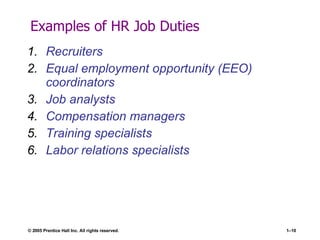
Examples of HR Job Duties Recruiters Equal employment opportunity (EEO) coordinators Job analysts Compensation managers  Training specialists Labor relations specialists
Examples of HR Job Duties Recruiters Search for qualified job applicants. Equal employment opportunity (EEO) coordinators Investigate and resolve EEO grievances, examine organizational practices for potential violations, and compile and submit EEO reports. Job analysts Collect and examine information about jobs to prepare job descriptions.
Examples of HR Job Duties (cont’d) Compensation managers Develop compensation plans and handle the employee benefits program. Training specialists Plan, organize, and direct training activities. Labor relations specialists Advise management on all aspects of union–management relations.
Cooperative Line and Staff HR Management The line manager’s responsibility is to specify the qualifications employees need to fill specific positions. HR staff then develops sources of qualified applicants and conduct initial screening interviews HR administers the appropriate tests and refers the best applicants to the supervisor (line manager), who interviews and selects the ones he or she wants.
A Changing HR Environment Globalization Technological Advances Exporting Jobs The Nature of Work Workforce Demographics
Measuring HR’s Contribution Strategy The company’s long-term plan for how it will balance its internal strengths and weaknesses with its external opportunities and threats to maintain a competitive advantage. HR managers today are more involved in partnering with their top managers in both designing and implementing their companies’ strategies. Top management wants to see, precisely, how the HR manager’s plans will make the company more valuable.
HR Metrics Absence Rate= (Number of days absent in month) --------------------------------------------------------------------------------------X100 (Average number of employees during mo.) × (number of workdays) Cost per Hire= Advertising + Agency Fees + Employee Referrals + Travel cost of applicants and staff + Relocation costs + Recruiter pay and benefits ---------------------------------------------------------------------------------------Number of Hires Figure 1 –5
HR Metrics Health Care Costs per Employee= Total cost of health care  ------------------------------- Total Employees HR Expense Factor= HR expense  ------------ Total operating expense Figure 1 –5
HR Metrics (cont’d) Human Capital ROI  Revenue − (Operating Expense − [Compensation cost + Benefit cost]) --------------------------------------------------------------------------------(Compensation cost + Benefit cost) Human Capital Value Added  Revenue − (Operating Expense − ([Compensation cost + Benefit Cost])  -------------------------------------------------------------------------------- Total Number of FTE  Figure 1 –5  (cont’d)
HR Metrics (cont’d) Revenue Factor Revenue --------------------------- Total Number of FTE Time to fill Total days elapsed to fill requisitions -------------------------------------------- Number hired Figure 1 –5  (cont’d)
HR Metrics (cont’d) Training Investment Factor Total training cost ----------------------- Headcount Turnover Costs Cost to terminate + Cost per hire + Vacancy Cost + Learning curve loss Figure 1 –5  (cont’d)
HR Metrics (cont’d) Turnover Rate%= Number of separations during month -------------------------------------------------------X100 Average number of employees during month Workers’ Compensation Cost per Employee= Total WC cost for Year -------------------------- Average number of employees Figure 1 –5  (cont’d)
Measuring HR’s Contribution The HR Scorecard Shows the quantitative standards, or “metrics” the firm uses to measure HR activities. Measures the employee behaviors resulting from these activities. Measures the strategically relevant organizational outcomes of those employee behaviors.
Benefits of a  High Performance Work System (HPWS) Generate more job applicants Screen candidates more effectively Provide more and better training Link pay more explicitly to performance Provide a safer work environment Produce more qualified applicants per position More employees are hired based on validated selection tests Provide more hours of training for new employees Higher percentages of employees receiving regular performance appraisals.
The New HR Manager New Proficiencies The Need to “Know Your Employment Law” HR is becoming more professionalized. Society for Human Resource Management (SHRM)
The New HR Manager New Proficiencies HR proficiencies Business proficiencies Leadership proficiencies Learning proficiencies
The New HR Manager (cont’d) The Need to “Know Your Employment Law” Equal employment laws Occupational safety and health laws Labor laws
The New HR Manager Ethics and HR Ethical lapses (e.g., Enron, Martha Stewart) Sarbanes-Oxley Act in 2003 Intended to curb erroneous corporate financial reporting:  Requires CEOs and CFOs to certify their companies’ periodic financial reports. Prohibits personal loans to executive officers and directors. Requires CEOs and CFOs to reimburse their firms for bonuses and stock option profits if corporate financial statements subsequently require restating.
HR Professional Certification HR is becoming more professionalized. Society for Human Resource Management (SHRM) SHRM’s Human Resource Certification Institute (HRCI) SPHR (senior professional in HR) PHR (professional in HR)  certificate
HR and Technology Benefits of technological applications for HR Intranet-based employee portals through which employees can self-service HR transactions. The availability of centralized call centers staffed with HR specialists. Increased efficiency of HR operations. The development of data warehouses of HR-related information. The ability to outsource HR activities to specialist service providers.
Strategy and the Basic HR Process Figure 1 –8

Hr34 1

  • 1.
    The Strategic Roleof Human Resource Management
  • 2.
    The Manager’s HumanResource Management Jobs Management process The five basic functions planning organizing staffing leading controlling.
  • 3.
    The Manager’s HumanResource Management Jobs Human resource management (HRM) The policies and practices involved in carrying out the “people” or human resource aspects of a management position, including Recruiting Screening Training Rewarding appraising.
  • 4.
    Personnel Aspects OfA Manager’s Job Conducting job analyses (determining the nature of each employee’s job) Planning labor needs and recruiting job candidates Selecting job candidates Orienting and training new employees Managing wages and salaries (compensating employees) Providing incentives and benefits Appraising performance Communicating (interviewing, counseling, disciplining) Training and developing managers Building employee commitment
  • 5.
    Personnel Mistakes Hirethe wrong person for the job Experience high turnover Have your people not doing their best Waste time with useless interviews Have your company in court because of discriminatory actions Have your company cited by OSHA for unsafe practices Have some employees think their salaries are unfair and inequitable relative to others in the organization Allow a lack of training to undermine your department’s effectiveness Commit any unfair labor practices
  • 6.
    Line and StaffAspects of HRM Line manager A manager who is 1-authorized to direct the work of subordinates 2- responsible for accomplishing the organization’s tasks. Staff manager A manager who 1-assists 2-advises line managers.
  • 7.
    Line Managers’ HRMResponsibilities Placing the right person on the right job Starting new employees in the organization (orientation) Training employees for jobs new to them Improving the job performance of each person Gaining creative cooperation and developing smooth working relationships Interpreting the firm’s policies and procedures Controlling labor costs Developing the abilities of each person Creating and maintaining department morale Protecting employees’ health and physical condition
  • 8.
    Functions of theHR Manager A line function The HR manager directs the activities of the people in his or her own department and in related service areas (like the plant cafeteria). A coordinative function HR managers also coordinate personnel activities, a duty often referred to as functional control . Staff (assist and advise) functions Assisting and advising line managers is the heart of the HR manager’s job.
  • 9.
    Employee Advocacy HRmust take responsibility for: Clearly defining how management should be treating employees. Making sure employees have the mechanisms required to contest unfair practices. Represent the interests of employees within the framework of its primary obligation to senior management.
  • 10.
    Examples of HRJob Duties Recruiters Equal employment opportunity (EEO) coordinators Job analysts Compensation managers Training specialists Labor relations specialists
  • 11.
    Examples of HRJob Duties Recruiters Search for qualified job applicants. Equal employment opportunity (EEO) coordinators Investigate and resolve EEO grievances, examine organizational practices for potential violations, and compile and submit EEO reports. Job analysts Collect and examine information about jobs to prepare job descriptions.
  • 12.
    Examples of HRJob Duties (cont’d) Compensation managers Develop compensation plans and handle the employee benefits program. Training specialists Plan, organize, and direct training activities. Labor relations specialists Advise management on all aspects of union–management relations.
  • 13.
    Cooperative Line andStaff HR Management The line manager’s responsibility is to specify the qualifications employees need to fill specific positions. HR staff then develops sources of qualified applicants and conduct initial screening interviews HR administers the appropriate tests and refers the best applicants to the supervisor (line manager), who interviews and selects the ones he or she wants.
  • 14.
    A Changing HREnvironment Globalization Technological Advances Exporting Jobs The Nature of Work Workforce Demographics
  • 15.
    Measuring HR’s ContributionStrategy The company’s long-term plan for how it will balance its internal strengths and weaknesses with its external opportunities and threats to maintain a competitive advantage. HR managers today are more involved in partnering with their top managers in both designing and implementing their companies’ strategies. Top management wants to see, precisely, how the HR manager’s plans will make the company more valuable.
  • 16.
    HR Metrics AbsenceRate= (Number of days absent in month) --------------------------------------------------------------------------------------X100 (Average number of employees during mo.) × (number of workdays) Cost per Hire= Advertising + Agency Fees + Employee Referrals + Travel cost of applicants and staff + Relocation costs + Recruiter pay and benefits ---------------------------------------------------------------------------------------Number of Hires Figure 1 –5
  • 17.
    HR Metrics HealthCare Costs per Employee= Total cost of health care ------------------------------- Total Employees HR Expense Factor= HR expense ------------ Total operating expense Figure 1 –5
  • 18.
    HR Metrics (cont’d)Human Capital ROI Revenue − (Operating Expense − [Compensation cost + Benefit cost]) --------------------------------------------------------------------------------(Compensation cost + Benefit cost) Human Capital Value Added Revenue − (Operating Expense − ([Compensation cost + Benefit Cost]) -------------------------------------------------------------------------------- Total Number of FTE Figure 1 –5 (cont’d)
  • 19.
    HR Metrics (cont’d)Revenue Factor Revenue --------------------------- Total Number of FTE Time to fill Total days elapsed to fill requisitions -------------------------------------------- Number hired Figure 1 –5 (cont’d)
  • 20.
    HR Metrics (cont’d)Training Investment Factor Total training cost ----------------------- Headcount Turnover Costs Cost to terminate + Cost per hire + Vacancy Cost + Learning curve loss Figure 1 –5 (cont’d)
  • 21.
    HR Metrics (cont’d)Turnover Rate%= Number of separations during month -------------------------------------------------------X100 Average number of employees during month Workers’ Compensation Cost per Employee= Total WC cost for Year -------------------------- Average number of employees Figure 1 –5 (cont’d)
  • 22.
    Measuring HR’s ContributionThe HR Scorecard Shows the quantitative standards, or “metrics” the firm uses to measure HR activities. Measures the employee behaviors resulting from these activities. Measures the strategically relevant organizational outcomes of those employee behaviors.
  • 23.
    Benefits of a High Performance Work System (HPWS) Generate more job applicants Screen candidates more effectively Provide more and better training Link pay more explicitly to performance Provide a safer work environment Produce more qualified applicants per position More employees are hired based on validated selection tests Provide more hours of training for new employees Higher percentages of employees receiving regular performance appraisals.
  • 24.
    The New HRManager New Proficiencies The Need to “Know Your Employment Law” HR is becoming more professionalized. Society for Human Resource Management (SHRM)
  • 25.
    The New HRManager New Proficiencies HR proficiencies Business proficiencies Leadership proficiencies Learning proficiencies
  • 26.
    The New HRManager (cont’d) The Need to “Know Your Employment Law” Equal employment laws Occupational safety and health laws Labor laws
  • 27.
    The New HRManager Ethics and HR Ethical lapses (e.g., Enron, Martha Stewart) Sarbanes-Oxley Act in 2003 Intended to curb erroneous corporate financial reporting: Requires CEOs and CFOs to certify their companies’ periodic financial reports. Prohibits personal loans to executive officers and directors. Requires CEOs and CFOs to reimburse their firms for bonuses and stock option profits if corporate financial statements subsequently require restating.
  • 28.
    HR Professional CertificationHR is becoming more professionalized. Society for Human Resource Management (SHRM) SHRM’s Human Resource Certification Institute (HRCI) SPHR (senior professional in HR) PHR (professional in HR) certificate
  • 29.
    HR and TechnologyBenefits of technological applications for HR Intranet-based employee portals through which employees can self-service HR transactions. The availability of centralized call centers staffed with HR specialists. Increased efficiency of HR operations. The development of data warehouses of HR-related information. The ability to outsource HR activities to specialist service providers.
  • 30.
    Strategy and theBasic HR Process Figure 1 –8