Management                                                            tenth edition


   Stephen P. Robbins                                                  Mary Coulter


                        Chapter
                                                Managing
                        10                      Human
                                                Resources
Copyright © 2010 Pearson Education, Inc. Publishing as Prentice Hall                    10–1
Learning Outcomes
 Follow this Learning Outline as you read and study
 this chapter.
10.1 The Human Resource Management Process
   • Explain why the HRM process is important.
   • Discuss the environmental factors that most directly affect the HRM
     process.
10.2 Identifying and Selecting Competent Employees
   • Define job analysis, job description, and job specification.
   • Discuss the major sources of potential job candidates.
   • Describe the different selection devices and which works best for
     different jobs.
   • Explain why a realistic job preview is important.

Copyright © 2010 Pearson Education, Inc. Publishing as Prentice Hall     10–2
Learning Outcomes
 10.3 Providing Employees with Needed Skills
      and Knowledge
       • Explain why orientation is so important.
       • Describe the different types of training and how that training can
         be provided.
 10.4 Retaining Competent, High Performing
      Employees
       • Describe the different performance appraisal methods.
       • Discuss the factors that influence employee compensation and
         benefits.
       • Describe skill-based and variable pay systems.


Copyright © 2010 Pearson Education, Inc. Publishing as Prentice Hall     10–3
Learning Outcomes
 10.5 Contemporary Issues in Managing Human
      Resources
       • Explain how managers can manage downsizing.
       • Discuss how managers can manage workforce
         diversity.
       • Explain what sexual harassment is and what
         managers need to know about it.
       • Describe how organizations are dealing with work-life
         balance issues.
       • Discuss how organizations are controlling HR costs.

Copyright © 2010 Pearson Education, Inc. Publishing as Prentice Hall   10–4
The Importance of Human
 Resource Management (HRM)
 • As a significant source of competitive advantage
        People-oriented HR creates superior shareholder
         value
 • As an important strategic tool
        Achieve competitive success through people by
         treating employees as partners
 • To improve organizational performance
        High performance work practices lead to both high
         individual and high organizational performance.


Copyright © 2010 Pearson Education, Inc. Publishing as Prentice Hall   10–5
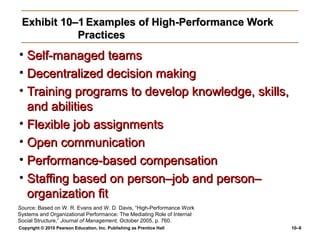
Exhibit 10–1 Examples of High-Performance Work
            Practices
• Self-managed teams
• Decentralized decision making
• Training programs to develop knowledge, skills,
  and abilities
• Flexible job assignments
• Open communication
• Performance-based compensation
• Staffing based on person–job and person–
  organization fit
Source: Based on W. R. Evans and W. D. Davis, “High-Performance Work
Systems and Organizational Performance: The Mediating Role of Internal
Social Structure,” Journal of Management, October 2005, p. 760.
Copyright © 2010 Pearson Education, Inc. Publishing as Prentice Hall     10–6
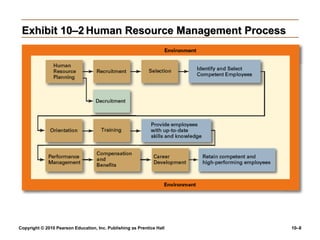
The HRM Process
 • Functions of the HRM Process
        Ensuring that competent employees are identified and
         selected.
        Providing employees with up-to-date knowledge and
         skills to do their jobs.
        Ensuring that the organization retains competent and
         high-performing employees.


Copyright © 2010 Pearson Education, Inc. Publishing as Prentice Hall   10–7
Exhibit 10–2 Human Resource Management Process


Copyright © 2010 Pearson Education, Inc. Publishing as Prentice Hall   10–8
Environmental Factors Affecting
 HRM
• Employee Labor Unions
      Organizations that represent workers and seek to
       protect their interests through collective bargaining.
               Collective bargaining agreement
                 – A contractual agreement between a firm and a union
                   elected to represent a bargaining unit of employees of the
                   firm in bargaining for wage, hours, and working conditions.
• Governmental Laws and Regulations
      Limit managerial discretion in hiring, promoting, and
       discharging employees.
               Affirmative Action: Organizational programs that enhance the
                status of members of protected groups.
Copyright © 2010 Pearson Education, Inc. Publishing as Prentice Hall         10–9
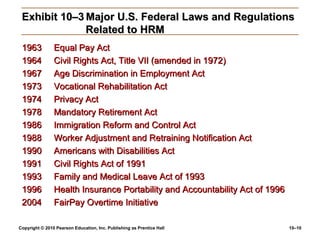
Exhibit 10–3 Major U.S. Federal Laws and Regulations
              Related to HRM
 1963           Equal Pay Act
 1964           Civil Rights Act, Title VII (amended in 1972)
 1967           Age Discrimination in Employment Act
 1973           Vocational Rehabilitation Act
 1974           Privacy Act
 1978           Mandatory Retirement Act
 1986           Immigration Reform and Control Act
 1988           Worker Adjustment and Retraining Notification Act
 1990           Americans with Disabilities Act
 1991           Civil Rights Act of 1991
 1993           Family and Medical Leave Act of 1993
 1996           Health Insurance Portability and Accountability Act of 1996
 2004           FairPay Overtime Initiative

Copyright © 2010 Pearson Education, Inc. Publishing as Prentice Hall          10–10
Managing Human Resources
 • Human Resource (HR) Planning
        The process by which managers ensure that they
         have the right number and kinds of people in the right
         places, and at the right times, who are capable of
         effectively and efficiently performing their tasks.
        Helps avoid sudden talent shortages and surpluses.
        Steps in HR planning:
                Assessing current human resources
                Assessing future needs for human resources


Copyright © 2010 Pearson Education, Inc. Publishing as Prentice Hall   10–11
Current Assessment
 • Human Resource Inventory
        A review of the current make-up of the organization’s
         current resource status.
        Job Analysis
                An assessment that defines a job and the behaviors
                 necessary to perform the job.
                Requires conducting interviews, engaging in direct
                 observation, and collecting the self-reports of employees and
                 their managers.


Copyright © 2010 Pearson Education, Inc. Publishing as Prentice Hall        10–12
Current Assessment (cont’d)
 • Job Description
        A written statement that describes a job.
 • Job Specification
        A written statement of the minimum qualifications that
         a person must possess to perform a given job
         successfully.


Copyright © 2010 Pearson Education, Inc. Publishing as Prentice Hall   10–13
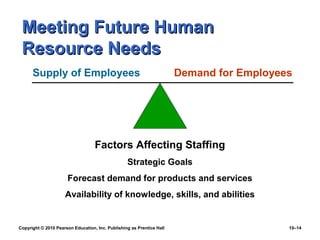
Meeting Future Human
 Resource Needs
      Supply of Employees                                              Demand for Employees


                                   Factors Affecting Staffing
                                                  Strategic Goals
                      Forecast demand for products and services
                     Availability of knowledge, skills, and abilities


Copyright © 2010 Pearson Education, Inc. Publishing as Prentice Hall                      10–14
Recruitment and Decruitment
 • Recruitment
        The process of locating, identifying, and attracting
         capable applicants to an organization
 • Decruitment
        The process of reducing a surplus of employees in
         the workforce of an organization
 • Online Recruiting
        Recruitment of employees through the Internet
              Organizational Web sites
              Online recruiters


Copyright © 2010 Pearson Education, Inc. Publishing as Prentice Hall   10–15
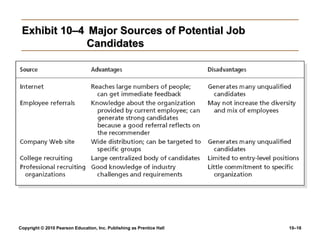
Exhibit 10–4 Major Sources of Potential Job
              Candidates


Copyright © 2010 Pearson Education, Inc. Publishing as Prentice Hall   10–16
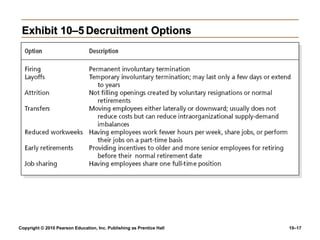
Exhibit 10–5 Decruitment Options


Copyright © 2010 Pearson Education, Inc. Publishing as Prentice Hall   10–17
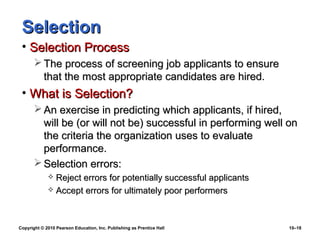
Selection
 • Selection Process
        The process of screening job applicants to ensure
         that the most appropriate candidates are hired.
 • What is Selection?
        An exercise in predicting which applicants, if hired,
         will be (or will not be) successful in performing well on
         the criteria the organization uses to evaluate
         performance.
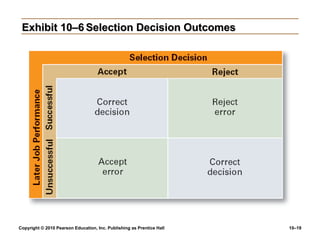
        Selection errors:
              Reject errors for potentially successful applicants
              Accept errors for ultimately poor performers


Copyright © 2010 Pearson Education, Inc. Publishing as Prentice Hall   10–18
Exhibit 10–6 Selection Decision Outcomes


Copyright © 2010 Pearson Education, Inc. Publishing as Prentice Hall   10–19
Validity and Reliability
 • Validity (of Prediction)
        A proven relationship between the selection device
         used and some relevant criterion for successful
         performance in an organization.

 • Reliability (of Prediction)
        The degree of consistency with which a selection
         device measures the same thing.
                Individual test scores obtained with a selection device are
                 consistent over multiple testing instances.


Copyright © 2010 Pearson Education, Inc. Publishing as Prentice Hall           10–20
Exhibit 10–7 Selection Tools

 • Application Forms
 • Written Tests
 • Performance Simulations Tests
 • Interviews
 • Background Investigations
 • Physical Examinations


Copyright © 2010 Pearson Education, Inc. Publishing as Prentice Hall   10–21
Application Forms

 • Strengths and weaknesses:
        Almost universally used
        Relevant biographical data and facts that can be
         verified
        Can predict job performance
        Weighted-item applications are difficult and expensive
         to create and maintain


Copyright © 2010 Pearson Education, Inc. Publishing as Prentice Hall   10–22
Written Tests
 • Types of Tests
        Intelligence: how smart are you?
        Aptitude: can you learn to do it?
        Attitude: how do you feel about it?
        Ability: can you do it now?
        Interest: do you want to do it?
 • Legal Challenges to Tests
        Lack of job-relatedness of test items or interview
         questions to job requirements
        Discrimination in equal employment opportunity
         against members of protected classes

Copyright © 2010 Pearson Education, Inc. Publishing as Prentice Hall   10–23
Performance Simulation Tests
 • Testing an applicant’s ability to perform actual
   job behaviors, use required skills, and
   demonstrate specific knowledge of the job.
        Work sampling
                Requiring applicants to actually perform a task or set of tasks
                 that are central to successful job performance.
        Assessment centers
                Dedicated facilities in which job candidates undergo a series
                 of performance simulation tests to evaluate their managerial
                 potential.


Copyright © 2010 Pearson Education, Inc. Publishing as Prentice Hall          10–24
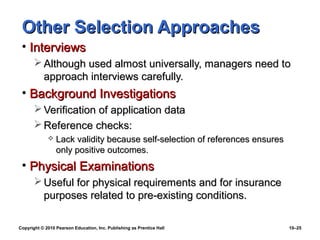
Other Selection Approaches
 • Interviews
        Although used almost universally, managers need to
         approach interviews carefully.
 • Background Investigations
        Verification of application data
        Reference checks:
                Lack validity because self-selection of references ensures
                 only positive outcomes.
 • Physical Examinations
        Useful for physical requirements and for insurance
         purposes related to pre-existing conditions.

Copyright © 2010 Pearson Education, Inc. Publishing as Prentice Hall          10–25
Other Selection Approaches
 (cont’d)
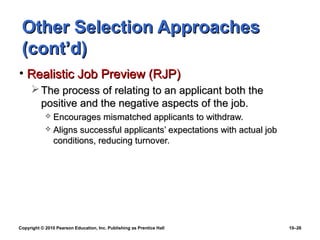
• Realistic Job Preview (RJP)
      The process of relating to an applicant both the
       positive and the negative aspects of the job.
             Encourages mismatched applicants to withdraw.
             Aligns successful applicants’ expectations with actual job
              conditions, reducing turnover.


Copyright © 2010 Pearson Education, Inc. Publishing as Prentice Hall       10–26
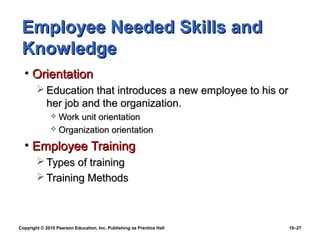
Employee Needed Skills and
 Knowledge
  • Orientation
         Education that introduces a new employee to his or
          her job and the organization.
               Work unit orientation
               Organization orientation

  • Employee Training
         Types of training
         Training Methods


Copyright © 2010 Pearson Education, Inc. Publishing as Prentice Hall   10–27
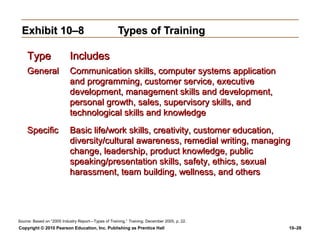
Exhibit 10–8                                       Types of Training

    Type                   Includes
    General                Communication skills, computer systems application
                           and programming, customer service, executive
                           development, management skills and development,
                           personal growth, sales, supervisory skills, and
                           technological skills and knowledge
    Specific               Basic life/work skills, creativity, customer education,
                           diversity/cultural awareness, remedial writing, managing
                           change, leadership, product knowledge, public
                           speaking/presentation skills, safety, ethics, sexual
                           harassment, team building, wellness, and others


Source: Based on “2005 Industry Report—Types of Training,” Training, December 2005, p. 22.
Copyright © 2010 Pearson Education, Inc. Publishing as Prentice Hall                         10–28
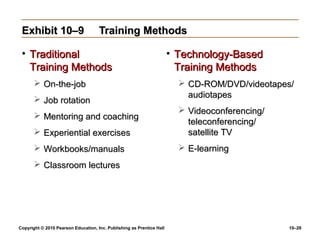
Exhibit 10–9                        Training Methods

 • Traditional                                                         • Technology-Based
   Training Methods                                                      Training Methods
        On-the-job                                                       CD-ROM/DVD/videotapes/
                                                                           audiotapes
        Job rotation
                                                                          Videoconferencing/
        Mentoring and coaching
                                                                           teleconferencing/
        Experiential exercises                                            satellite TV
        Workbooks/manuals                                                E-learning
        Classroom lectures


Copyright © 2010 Pearson Education, Inc. Publishing as Prentice Hall                            10–29
Employee Performance
 Management
 • Performance Management System
        A process of establishing performance standards and
         appraising employee performance.


Copyright © 2010 Pearson Education, Inc. Publishing as Prentice Hall   10–30
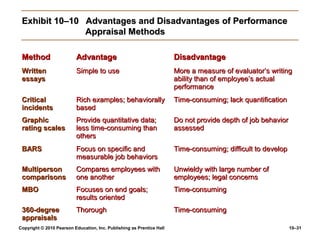
Exhibit 10–10 Advantages and Disadvantages of Performance
               Appraisal Methods

 Method                   Advantage                                    Disadvantage
 Written                  Simple to use                                More a measure of evaluator’s writing
 essays                                                                ability than of employee’s actual
                                                                       performance
 Critical                 Rich examples; behaviorally                  Time-consuming; lack quantification
 incidents                based
 Graphic                  Provide quantitative data;                   Do not provide depth of job behavior
 rating scales            less time-consuming than                     assessed
                          others
 BARS                     Focus on specific and                        Time-consuming; difficult to develop
                          measurable job behaviors
 Multiperson              Compares employees with                      Unwieldy with large number of
 comparisons              one another                                  employees; legal concerns
 MBO                      Focuses on end goals;                        Time-consuming
                          results oriented
 360-degree               Thorough                                     Time-consuming
 appraisals
Copyright © 2010 Pearson Education, Inc. Publishing as Prentice Hall                                          10–31
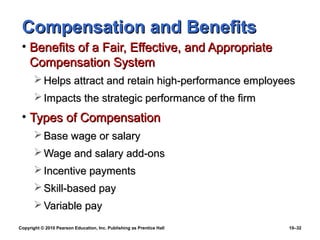
Compensation and Benefits
 • Benefits of a Fair, Effective, and Appropriate
   Compensation System
        Helps attract and retain high-performance employees
        Impacts the strategic performance of the firm
 • Types of Compensation
        Base wage or salary
        Wage and salary add-ons
        Incentive payments
        Skill-based pay
        Variable pay
Copyright © 2010 Pearson Education, Inc. Publishing as Prentice Hall   10–32
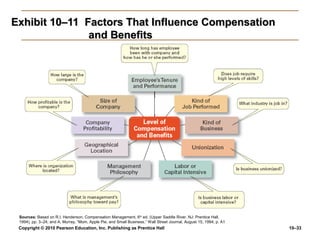
Exhibit 10–11 Factors That Influence Compensation
               and Benefits


 Sources: Based on R.I. Henderson, Compensation Management, 6th ed. (Upper Saddle River, NJ: Prentice Hall,
 1994), pp. 3–24; and A. Murray, “Mom, Apple Pie, and Small Business,” Wall Street Journal, August 15, 1994, p. A1
 Copyright © 2010 Pearson Education, Inc. Publishing as Prentice Hall                                                10–33
Contemporary Issues in
 Managing Human Resources
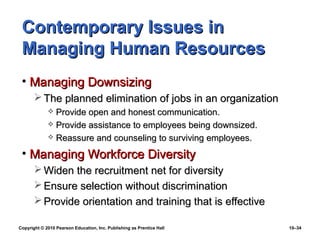
 • Managing Downsizing
        The planned elimination of jobs in an organization
              Provide open and honest communication.
              Provide assistance to employees being downsized.
              Reassure and counseling to surviving employees.

 • Managing Workforce Diversity
        Widen the recruitment net for diversity
        Ensure selection without discrimination
        Provide orientation and training that is effective

Copyright © 2010 Pearson Education, Inc. Publishing as Prentice Hall   10–34
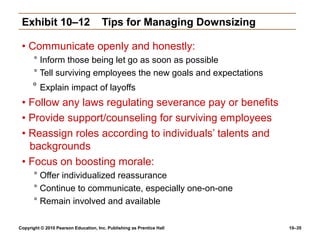
Exhibit 10–12                        Tips for Managing Downsizing

 • Communicate openly and honestly:
       ° Inform those being let go as soon as possible
       ° Tell surviving employees the new goals and expectations
    ° Explain impact of layoffs
 • Follow any laws regulating severance pay or benefits
 • Provide support/counseling for surviving employees
 • Reassign roles according to individuals’ talents and
   backgrounds
 • Focus on boosting morale:
       ° Offer individualized reassurance
       ° Continue to communicate, especially one-on-one
       ° Remain involved and available

Copyright © 2010 Pearson Education, Inc. Publishing as Prentice Hall   10–35
Current Issues in HRM (cont’d)
 • Sexual Harassment
        An unwanted activity of a sexual nature that affects
         an individual’s employment.
                Unwanted sexual advances, requests for sexual favors, and
                 other verbal or physical conduct of a sexual nature when
                 submission or rejection of this conduct explicitly or implicitly
                 affects an individual’s employment.
        An offensive or hostile environment
                An environment in which a person is affected by elements of
                 a sexual nature.
 • Workplace Romances
        Potential liability for harassment


Copyright © 2010 Pearson Education, Inc. Publishing as Prentice Hall            10–36
Current Issues in HRM (cont’d)
 • Work-Life Balance
        Employees have personal lives that they don’t leave
         behind when they come to work.
        Organizations have become more attuned to their
         employees by offering family-friendly benefits:
              On-site child care
              Summer day camps
              Flextime
              Job sharing
              Leave for personal matters
              Flexible job hours


Copyright © 2010 Pearson Education, Inc. Publishing as Prentice Hall   10–37
Current Issues in HRM (cont’d)
 • Controlling HR Costs
        Employee health care
                Encouraging healthy lifestyles
                  – Financial incentives
                  – Wellness programs
                  – Charging employees with poor health habits more for
                    benefits
        Employee pension plans
              Reducing pension benefits
              No longer providing pension plans


Copyright © 2010 Pearson Education, Inc. Publishing as Prentice Hall      10–38

Ch 10 managing human resources

  • 1.
    Management tenth edition Stephen P. Robbins Mary Coulter Chapter Managing 10 Human Resources Copyright © 2010 Pearson Education, Inc. Publishing as Prentice Hall 10–1
  • 2.
    Learning Outcomes Followthis Learning Outline as you read and study this chapter. 10.1 The Human Resource Management Process • Explain why the HRM process is important. • Discuss the environmental factors that most directly affect the HRM process. 10.2 Identifying and Selecting Competent Employees • Define job analysis, job description, and job specification. • Discuss the major sources of potential job candidates. • Describe the different selection devices and which works best for different jobs. • Explain why a realistic job preview is important. Copyright © 2010 Pearson Education, Inc. Publishing as Prentice Hall 10–2
  • 3.
    Learning Outcomes 10.3Providing Employees with Needed Skills and Knowledge • Explain why orientation is so important. • Describe the different types of training and how that training can be provided. 10.4 Retaining Competent, High Performing Employees • Describe the different performance appraisal methods. • Discuss the factors that influence employee compensation and benefits. • Describe skill-based and variable pay systems. Copyright © 2010 Pearson Education, Inc. Publishing as Prentice Hall 10–3
  • 4.
    Learning Outcomes 10.5Contemporary Issues in Managing Human Resources • Explain how managers can manage downsizing. • Discuss how managers can manage workforce diversity. • Explain what sexual harassment is and what managers need to know about it. • Describe how organizations are dealing with work-life balance issues. • Discuss how organizations are controlling HR costs. Copyright © 2010 Pearson Education, Inc. Publishing as Prentice Hall 10–4
  • 5.
    The Importance ofHuman Resource Management (HRM) • As a significant source of competitive advantage  People-oriented HR creates superior shareholder value • As an important strategic tool  Achieve competitive success through people by treating employees as partners • To improve organizational performance  High performance work practices lead to both high individual and high organizational performance. Copyright © 2010 Pearson Education, Inc. Publishing as Prentice Hall 10–5
  • 6.
    Exhibit 10–1 Examplesof High-Performance Work Practices • Self-managed teams • Decentralized decision making • Training programs to develop knowledge, skills, and abilities • Flexible job assignments • Open communication • Performance-based compensation • Staffing based on person–job and person– organization fit Source: Based on W. R. Evans and W. D. Davis, “High-Performance Work Systems and Organizational Performance: The Mediating Role of Internal Social Structure,” Journal of Management, October 2005, p. 760. Copyright © 2010 Pearson Education, Inc. Publishing as Prentice Hall 10–6
  • 7.
    The HRM Process • Functions of the HRM Process  Ensuring that competent employees are identified and selected.  Providing employees with up-to-date knowledge and skills to do their jobs.  Ensuring that the organization retains competent and high-performing employees. Copyright © 2010 Pearson Education, Inc. Publishing as Prentice Hall 10–7
  • 8.
    Exhibit 10–2 HumanResource Management Process Copyright © 2010 Pearson Education, Inc. Publishing as Prentice Hall 10–8
  • 9.
    Environmental Factors Affecting HRM • Employee Labor Unions  Organizations that represent workers and seek to protect their interests through collective bargaining.  Collective bargaining agreement – A contractual agreement between a firm and a union elected to represent a bargaining unit of employees of the firm in bargaining for wage, hours, and working conditions. • Governmental Laws and Regulations  Limit managerial discretion in hiring, promoting, and discharging employees.  Affirmative Action: Organizational programs that enhance the status of members of protected groups. Copyright © 2010 Pearson Education, Inc. Publishing as Prentice Hall 10–9
  • 10.
    Exhibit 10–3 MajorU.S. Federal Laws and Regulations Related to HRM 1963 Equal Pay Act 1964 Civil Rights Act, Title VII (amended in 1972) 1967 Age Discrimination in Employment Act 1973 Vocational Rehabilitation Act 1974 Privacy Act 1978 Mandatory Retirement Act 1986 Immigration Reform and Control Act 1988 Worker Adjustment and Retraining Notification Act 1990 Americans with Disabilities Act 1991 Civil Rights Act of 1991 1993 Family and Medical Leave Act of 1993 1996 Health Insurance Portability and Accountability Act of 1996 2004 FairPay Overtime Initiative Copyright © 2010 Pearson Education, Inc. Publishing as Prentice Hall 10–10
  • 11.
    Managing Human Resources • Human Resource (HR) Planning  The process by which managers ensure that they have the right number and kinds of people in the right places, and at the right times, who are capable of effectively and efficiently performing their tasks.  Helps avoid sudden talent shortages and surpluses.  Steps in HR planning:  Assessing current human resources  Assessing future needs for human resources Copyright © 2010 Pearson Education, Inc. Publishing as Prentice Hall 10–11
  • 12.
    Current Assessment •Human Resource Inventory  A review of the current make-up of the organization’s current resource status.  Job Analysis  An assessment that defines a job and the behaviors necessary to perform the job.  Requires conducting interviews, engaging in direct observation, and collecting the self-reports of employees and their managers. Copyright © 2010 Pearson Education, Inc. Publishing as Prentice Hall 10–12
  • 13.
    Current Assessment (cont’d) • Job Description  A written statement that describes a job. • Job Specification  A written statement of the minimum qualifications that a person must possess to perform a given job successfully. Copyright © 2010 Pearson Education, Inc. Publishing as Prentice Hall 10–13
  • 14.
    Meeting Future Human Resource Needs Supply of Employees Demand for Employees Factors Affecting Staffing Strategic Goals Forecast demand for products and services Availability of knowledge, skills, and abilities Copyright © 2010 Pearson Education, Inc. Publishing as Prentice Hall 10–14
  • 15.
    Recruitment and Decruitment • Recruitment  The process of locating, identifying, and attracting capable applicants to an organization • Decruitment  The process of reducing a surplus of employees in the workforce of an organization • Online Recruiting  Recruitment of employees through the Internet  Organizational Web sites  Online recruiters Copyright © 2010 Pearson Education, Inc. Publishing as Prentice Hall 10–15
  • 16.
    Exhibit 10–4 MajorSources of Potential Job Candidates Copyright © 2010 Pearson Education, Inc. Publishing as Prentice Hall 10–16
  • 17.
    Exhibit 10–5 DecruitmentOptions Copyright © 2010 Pearson Education, Inc. Publishing as Prentice Hall 10–17
  • 18.
    Selection • SelectionProcess  The process of screening job applicants to ensure that the most appropriate candidates are hired. • What is Selection?  An exercise in predicting which applicants, if hired, will be (or will not be) successful in performing well on the criteria the organization uses to evaluate performance.  Selection errors:  Reject errors for potentially successful applicants  Accept errors for ultimately poor performers Copyright © 2010 Pearson Education, Inc. Publishing as Prentice Hall 10–18
  • 19.
    Exhibit 10–6 SelectionDecision Outcomes Copyright © 2010 Pearson Education, Inc. Publishing as Prentice Hall 10–19
  • 20.
    Validity and Reliability • Validity (of Prediction)  A proven relationship between the selection device used and some relevant criterion for successful performance in an organization. • Reliability (of Prediction)  The degree of consistency with which a selection device measures the same thing.  Individual test scores obtained with a selection device are consistent over multiple testing instances. Copyright © 2010 Pearson Education, Inc. Publishing as Prentice Hall 10–20
  • 21.
    Exhibit 10–7 SelectionTools • Application Forms • Written Tests • Performance Simulations Tests • Interviews • Background Investigations • Physical Examinations Copyright © 2010 Pearson Education, Inc. Publishing as Prentice Hall 10–21
  • 22.
    Application Forms •Strengths and weaknesses:  Almost universally used  Relevant biographical data and facts that can be verified  Can predict job performance  Weighted-item applications are difficult and expensive to create and maintain Copyright © 2010 Pearson Education, Inc. Publishing as Prentice Hall 10–22
  • 23.
    Written Tests •Types of Tests  Intelligence: how smart are you?  Aptitude: can you learn to do it?  Attitude: how do you feel about it?  Ability: can you do it now?  Interest: do you want to do it? • Legal Challenges to Tests  Lack of job-relatedness of test items or interview questions to job requirements  Discrimination in equal employment opportunity against members of protected classes Copyright © 2010 Pearson Education, Inc. Publishing as Prentice Hall 10–23
  • 24.
    Performance Simulation Tests • Testing an applicant’s ability to perform actual job behaviors, use required skills, and demonstrate specific knowledge of the job.  Work sampling  Requiring applicants to actually perform a task or set of tasks that are central to successful job performance.  Assessment centers  Dedicated facilities in which job candidates undergo a series of performance simulation tests to evaluate their managerial potential. Copyright © 2010 Pearson Education, Inc. Publishing as Prentice Hall 10–24
  • 25.
    Other Selection Approaches • Interviews  Although used almost universally, managers need to approach interviews carefully. • Background Investigations  Verification of application data  Reference checks:  Lack validity because self-selection of references ensures only positive outcomes. • Physical Examinations  Useful for physical requirements and for insurance purposes related to pre-existing conditions. Copyright © 2010 Pearson Education, Inc. Publishing as Prentice Hall 10–25
  • 26.
    Other Selection Approaches (cont’d) • Realistic Job Preview (RJP)  The process of relating to an applicant both the positive and the negative aspects of the job.  Encourages mismatched applicants to withdraw.  Aligns successful applicants’ expectations with actual job conditions, reducing turnover. Copyright © 2010 Pearson Education, Inc. Publishing as Prentice Hall 10–26
  • 27.
    Employee Needed Skillsand Knowledge • Orientation  Education that introduces a new employee to his or her job and the organization.  Work unit orientation  Organization orientation • Employee Training  Types of training  Training Methods Copyright © 2010 Pearson Education, Inc. Publishing as Prentice Hall 10–27
  • 28.
    Exhibit 10–8 Types of Training Type Includes General Communication skills, computer systems application and programming, customer service, executive development, management skills and development, personal growth, sales, supervisory skills, and technological skills and knowledge Specific Basic life/work skills, creativity, customer education, diversity/cultural awareness, remedial writing, managing change, leadership, product knowledge, public speaking/presentation skills, safety, ethics, sexual harassment, team building, wellness, and others Source: Based on “2005 Industry Report—Types of Training,” Training, December 2005, p. 22. Copyright © 2010 Pearson Education, Inc. Publishing as Prentice Hall 10–28
  • 29.
    Exhibit 10–9 Training Methods • Traditional • Technology-Based Training Methods Training Methods  On-the-job  CD-ROM/DVD/videotapes/ audiotapes  Job rotation  Videoconferencing/  Mentoring and coaching teleconferencing/  Experiential exercises satellite TV  Workbooks/manuals  E-learning  Classroom lectures Copyright © 2010 Pearson Education, Inc. Publishing as Prentice Hall 10–29
  • 30.
    Employee Performance Management • Performance Management System  A process of establishing performance standards and appraising employee performance. Copyright © 2010 Pearson Education, Inc. Publishing as Prentice Hall 10–30
  • 31.
    Exhibit 10–10 Advantagesand Disadvantages of Performance Appraisal Methods Method Advantage Disadvantage Written Simple to use More a measure of evaluator’s writing essays ability than of employee’s actual performance Critical Rich examples; behaviorally Time-consuming; lack quantification incidents based Graphic Provide quantitative data; Do not provide depth of job behavior rating scales less time-consuming than assessed others BARS Focus on specific and Time-consuming; difficult to develop measurable job behaviors Multiperson Compares employees with Unwieldy with large number of comparisons one another employees; legal concerns MBO Focuses on end goals; Time-consuming results oriented 360-degree Thorough Time-consuming appraisals Copyright © 2010 Pearson Education, Inc. Publishing as Prentice Hall 10–31
  • 32.
    Compensation and Benefits • Benefits of a Fair, Effective, and Appropriate Compensation System  Helps attract and retain high-performance employees  Impacts the strategic performance of the firm • Types of Compensation  Base wage or salary  Wage and salary add-ons  Incentive payments  Skill-based pay  Variable pay Copyright © 2010 Pearson Education, Inc. Publishing as Prentice Hall 10–32
  • 33.
    Exhibit 10–11 FactorsThat Influence Compensation and Benefits Sources: Based on R.I. Henderson, Compensation Management, 6th ed. (Upper Saddle River, NJ: Prentice Hall, 1994), pp. 3–24; and A. Murray, “Mom, Apple Pie, and Small Business,” Wall Street Journal, August 15, 1994, p. A1 Copyright © 2010 Pearson Education, Inc. Publishing as Prentice Hall 10–33
  • 34.
    Contemporary Issues in Managing Human Resources • Managing Downsizing  The planned elimination of jobs in an organization  Provide open and honest communication.  Provide assistance to employees being downsized.  Reassure and counseling to surviving employees. • Managing Workforce Diversity  Widen the recruitment net for diversity  Ensure selection without discrimination  Provide orientation and training that is effective Copyright © 2010 Pearson Education, Inc. Publishing as Prentice Hall 10–34
  • 35.
    Exhibit 10–12 Tips for Managing Downsizing • Communicate openly and honestly: ° Inform those being let go as soon as possible ° Tell surviving employees the new goals and expectations ° Explain impact of layoffs • Follow any laws regulating severance pay or benefits • Provide support/counseling for surviving employees • Reassign roles according to individuals’ talents and backgrounds • Focus on boosting morale: ° Offer individualized reassurance ° Continue to communicate, especially one-on-one ° Remain involved and available Copyright © 2010 Pearson Education, Inc. Publishing as Prentice Hall 10–35
  • 36.
    Current Issues inHRM (cont’d) • Sexual Harassment  An unwanted activity of a sexual nature that affects an individual’s employment.  Unwanted sexual advances, requests for sexual favors, and other verbal or physical conduct of a sexual nature when submission or rejection of this conduct explicitly or implicitly affects an individual’s employment.  An offensive or hostile environment  An environment in which a person is affected by elements of a sexual nature. • Workplace Romances  Potential liability for harassment Copyright © 2010 Pearson Education, Inc. Publishing as Prentice Hall 10–36
  • 37.
    Current Issues inHRM (cont’d) • Work-Life Balance  Employees have personal lives that they don’t leave behind when they come to work.  Organizations have become more attuned to their employees by offering family-friendly benefits:  On-site child care  Summer day camps  Flextime  Job sharing  Leave for personal matters  Flexible job hours Copyright © 2010 Pearson Education, Inc. Publishing as Prentice Hall 10–37
  • 38.
    Current Issues inHRM (cont’d) • Controlling HR Costs  Employee health care  Encouraging healthy lifestyles – Financial incentives – Wellness programs – Charging employees with poor health habits more for benefits  Employee pension plans  Reducing pension benefits  No longer providing pension plans Copyright © 2010 Pearson Education, Inc. Publishing as Prentice Hall 10–38