Nature of Human Resource
Management
Management
 Human Resource (HR) Management
 The design of formal systems in an organization
to ensure effective and efficient use of human
talent to accomplish organizational goals.
 Who Is an HR Manager?
 In the course carrying out their duties, every
operating manager is, in essence, an HR
manager.
 HR specialists design processes and systems
that operating managers help implement.
1–1
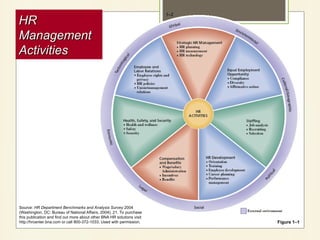
HR
HR
Management
Management
Activities
Activities
1–2
Source: HR Department Benchmarks and Analysis Survey 2004
(Washington, DC: Bureau of National Affairs, 2004), 21. To purchase
this publication and find out more about other BNA HR solutions visit
http://hrcenter.bna.com or call 800-372-1033. Used with permission. Figure 1–1
HR Activities
HR Activities
 Strategic HR Management
 Equal Employment Opportunity
 Staffing
 HR Development
 Compensation and Benefits
 Health, Safety, and Security
 Employee and Labor Relations
1–3
Management of Human Capital
In Organizations
In Organizations
 Human Capital
 The collective value of the capabilities, knowledge, skills,
life experiences, and motivation of an organizational
workforce.
 Also known as intellectual capital.
 How to measure the strategic value of human assets?
 Core Competency
 A unique capability that creates high value and
differentiates an organization from its competition.
 HR competencies: a source of competitive advantage.
1–4
HR Management Challenges
 Globalization of Business
 Outsourcing and increased competition
 The threat of terrorism
 Economic and Technological Changes
 Occupational shifts from manufacturing and
agriculture to service industries and
telecommunications.
 Pressures of global competition causing firms to
adapt by lowering costs and increasing productivity.
 Technological Shifts and the Internet
 Growth of information technology.
1–5
HR Management Challenges
 Workforce Availability and Quality Concerns
 Inadequate supply of workers with needed skills for
“knowledge jobs”
 Education of workers in basic skills
 Growth in Contingent Workforce
 Increases in temporary workers, independent
contractors, leased employees, and part-timers
caused by:
 Need for flexibility in staffing levels
 Increased difficulty in firing regular employees.
 Reduced legal liability from contract employees
1–6
HR Management Challenges
 Workforce Demographics and Diversity
 Increasing Racial/Ethnic Diversity
 More Women in the Workforce
 Single-parent households
 Dual-career couples
 Domestic partners
 Working mothers and family/childcare
 Significantly Aging Workforce
 Age discrimination
1–7
HR Management Challenges
 Organizational Cost Pressures and Restructuring
 Mergers and Acquisitions
 “Right-sizing”—eliminating of layers of management,
closing facilities, merging with other organizations,
and outplacing workers
 Intended results are flatter organizations, increases
in productivity, quality, service and lower costs.
 Costs are “survivor mentality”, loss of employee
loyalty, and turnover of valuable employees.
 HR managers must work toward ensuring cultural
compatibility in mergers.
1–8
HR Management Roles
 Administrative Role
 Clerical and administrative support operations (e.g.,
payroll and benefits work)
 Technology is transforming how HR services are
delivered.
 Outsourcing HR services to reduce HR staffing costs
 Operational and Employee Advocate Role
 “Champion” for employee concerns
 Employee crisis management
 Responding to employee complaints
1–9
Changing Roles of HR Management
1–10
Figure 1–5
Note: Example percentages are based on various surveys.
Strategic Role for HR
 Strategic Role
 “Contributing at the Table” to organizational results
 HR becomes a strategic business partner by:
 Focusing on developing HR programs that enhance
organizational performance.
 Involving HR in strategic planning at the onset.
 Participating in decision making on mergers,
acquisitions, and downsizing.
 Redesigning organizations and work processes
 Accounting and documenting the financial results of
HR activities.
1–11
Operational to Strategic Transformation of HR
1–12
Figure 1–6
New Approaches to HR
Management
Management
 Collaborative HR
 The process of HR professionals from several
different organizations working jointly to
address shared business problems.
 Firms benefit from the expertise of other firms,
without having the time and expense of
developing some of their own HR practices.
1–13
HR Technology
HR Technology
 Human Resource Management System (HRMS)
 An integrated system providing information used by
HR management in decision making.
 Purposes (Benefits) of HRMS
 Administrative and operational efficiency in compiling
HR data
 Availability of data for effective HR strategic planning
 Uses of HRMS
 Automation of payroll and benefit activities
 EEO/affirmative action tracking
 HR Workflow: increased access to HR information
 Employee self-service reduces HR costs.
1–14
Uses of an HRMS
Uses of an HRMS
 HRMS
 Bulletin boards
 What information will be available and what is
information needed?
 Data access
 To what uses will the information be put?
 Employee self-service
 Who will be allowed to access to what information?
 Web-based services and access
 Extended linkage
 When, where, and how often will the information be
needed?
1–15
Ethics and HR Management
 Firms with High Ethical Standards
 Are more likely to reach strategic goals.
 Are viewed more positively by stakeholders
 Are better able to attract and retain human
resources.
 Ethics and Global Differences
 Different legal, political, and cultural factors in other
countries can lead to ethical conflicts for global
managers.
 Foreign Corrupt Practices Act (FCPA)
 Prohibits U.S. firms from engaging in bribery and
other practices in other countries.
1–16
HR’s Role in Organizational
Ethics
Ethics
 HR management plays a key role as the “keeper
and voice” of organizational ethics.
 What is Ethical Behavior?
 What “ought” to be done.
 Dimensions of decisions about ethical issues in
management:
 Extended consequences
 Multiple alternatives
 Mixed outcomes
 Uncertain consequences
 Personal effects
1–17
Examples of Ethical Misconduct in HR Activities
1–18
Figure 1–7
HR’s Role in Organizational
Ethics (cont’d)
Ethics (cont’d)
Responses to Ethical Situations
 Are guided by values and personal behavior
“codes” that include:
Does response meet all applicable laws,
regulations, and government codes?
Does response comply with all organizational
standards of ethical behavior?
Does response pass the test of professional
standards for ethical behavior?
1–19
Ethical Behavior and
Organizational Culture
 Organizational Culture
 The shared values and beliefs in an organization
 Common forms of unethical conduct:
 Lying to supervisors
 Employee drug use or alcohol abuse
 Falsification of records
 Fostering Ethical Behavior
 A written code of ethics and standards of conduct
 Training on ethical behavior for all employees
 A means for employees to obtain ethical advice
 Confidential reporting systems for ethical misconduct
1–20

human resource chapter one notes detailed explanation

  • 1.
    Nature of HumanResource Nature of Human Resource Management Management  Human Resource (HR) Management  The design of formal systems in an organization to ensure effective and efficient use of human talent to accomplish organizational goals.  Who Is an HR Manager?  In the course carrying out their duties, every operating manager is, in essence, an HR manager.  HR specialists design processes and systems that operating managers help implement. 1–1
  • 2.
    HR HR Management Management Activities Activities 1–2 Source: HR DepartmentBenchmarks and Analysis Survey 2004 (Washington, DC: Bureau of National Affairs, 2004), 21. To purchase this publication and find out more about other BNA HR solutions visit http://hrcenter.bna.com or call 800-372-1033. Used with permission. Figure 1–1
  • 3.
    HR Activities HR Activities Strategic HR Management  Equal Employment Opportunity  Staffing  HR Development  Compensation and Benefits  Health, Safety, and Security  Employee and Labor Relations 1–3
  • 4.
    Management of HumanCapital Management of Human Capital In Organizations In Organizations  Human Capital  The collective value of the capabilities, knowledge, skills, life experiences, and motivation of an organizational workforce.  Also known as intellectual capital.  How to measure the strategic value of human assets?  Core Competency  A unique capability that creates high value and differentiates an organization from its competition.  HR competencies: a source of competitive advantage. 1–4
  • 5.
    HR Management Challenges Globalization of Business  Outsourcing and increased competition  The threat of terrorism  Economic and Technological Changes  Occupational shifts from manufacturing and agriculture to service industries and telecommunications.  Pressures of global competition causing firms to adapt by lowering costs and increasing productivity.  Technological Shifts and the Internet  Growth of information technology. 1–5
  • 6.
    HR Management Challenges Workforce Availability and Quality Concerns  Inadequate supply of workers with needed skills for “knowledge jobs”  Education of workers in basic skills  Growth in Contingent Workforce  Increases in temporary workers, independent contractors, leased employees, and part-timers caused by:  Need for flexibility in staffing levels  Increased difficulty in firing regular employees.  Reduced legal liability from contract employees 1–6
  • 7.
    HR Management Challenges Workforce Demographics and Diversity  Increasing Racial/Ethnic Diversity  More Women in the Workforce  Single-parent households  Dual-career couples  Domestic partners  Working mothers and family/childcare  Significantly Aging Workforce  Age discrimination 1–7
  • 8.
    HR Management Challenges Organizational Cost Pressures and Restructuring  Mergers and Acquisitions  “Right-sizing”—eliminating of layers of management, closing facilities, merging with other organizations, and outplacing workers  Intended results are flatter organizations, increases in productivity, quality, service and lower costs.  Costs are “survivor mentality”, loss of employee loyalty, and turnover of valuable employees.  HR managers must work toward ensuring cultural compatibility in mergers. 1–8
  • 9.
    HR Management Roles Administrative Role  Clerical and administrative support operations (e.g., payroll and benefits work)  Technology is transforming how HR services are delivered.  Outsourcing HR services to reduce HR staffing costs  Operational and Employee Advocate Role  “Champion” for employee concerns  Employee crisis management  Responding to employee complaints 1–9
  • 10.
    Changing Roles ofHR Management Changing Roles of HR Management 1–10 Figure 1–5 Note: Example percentages are based on various surveys.
  • 11.
    Strategic Role forHR  Strategic Role  “Contributing at the Table” to organizational results  HR becomes a strategic business partner by:  Focusing on developing HR programs that enhance organizational performance.  Involving HR in strategic planning at the onset.  Participating in decision making on mergers, acquisitions, and downsizing.  Redesigning organizations and work processes  Accounting and documenting the financial results of HR activities. 1–11
  • 12.
    Operational to StrategicTransformation of HR Operational to Strategic Transformation of HR 1–12 Figure 1–6
  • 13.
    New Approaches toHR New Approaches to HR Management Management  Collaborative HR  The process of HR professionals from several different organizations working jointly to address shared business problems.  Firms benefit from the expertise of other firms, without having the time and expense of developing some of their own HR practices. 1–13
  • 14.
    HR Technology HR Technology Human Resource Management System (HRMS)  An integrated system providing information used by HR management in decision making.  Purposes (Benefits) of HRMS  Administrative and operational efficiency in compiling HR data  Availability of data for effective HR strategic planning  Uses of HRMS  Automation of payroll and benefit activities  EEO/affirmative action tracking  HR Workflow: increased access to HR information  Employee self-service reduces HR costs. 1–14
  • 15.
    Uses of anHRMS Uses of an HRMS  HRMS  Bulletin boards  What information will be available and what is information needed?  Data access  To what uses will the information be put?  Employee self-service  Who will be allowed to access to what information?  Web-based services and access  Extended linkage  When, where, and how often will the information be needed? 1–15
  • 16.
    Ethics and HRManagement  Firms with High Ethical Standards  Are more likely to reach strategic goals.  Are viewed more positively by stakeholders  Are better able to attract and retain human resources.  Ethics and Global Differences  Different legal, political, and cultural factors in other countries can lead to ethical conflicts for global managers.  Foreign Corrupt Practices Act (FCPA)  Prohibits U.S. firms from engaging in bribery and other practices in other countries. 1–16
  • 17.
    HR’s Role inOrganizational HR’s Role in Organizational Ethics Ethics  HR management plays a key role as the “keeper and voice” of organizational ethics.  What is Ethical Behavior?  What “ought” to be done.  Dimensions of decisions about ethical issues in management:  Extended consequences  Multiple alternatives  Mixed outcomes  Uncertain consequences  Personal effects 1–17
  • 18.
    Examples of EthicalMisconduct in HR Activities Examples of Ethical Misconduct in HR Activities 1–18 Figure 1–7
  • 19.
    HR’s Role inOrganizational HR’s Role in Organizational Ethics (cont’d) Ethics (cont’d) Responses to Ethical Situations  Are guided by values and personal behavior “codes” that include: Does response meet all applicable laws, regulations, and government codes? Does response comply with all organizational standards of ethical behavior? Does response pass the test of professional standards for ethical behavior? 1–19
  • 20.
    Ethical Behavior and EthicalBehavior and Organizational Culture Organizational Culture  Organizational Culture  The shared values and beliefs in an organization  Common forms of unethical conduct:  Lying to supervisors  Employee drug use or alcohol abuse  Falsification of records  Fostering Ethical Behavior  A written code of ethics and standards of conduct  Training on ethical behavior for all employees  A means for employees to obtain ethical advice  Confidential reporting systems for ethical misconduct 1–20