


Strategic Human Resource Management
in a changing Environment
Grace Madelliene Alcantara
Human Resource Management
John Bernardin
A happy thought can never make you fly.
But it can make you smile. 
What is Human Resource Management?
“The process of hiring
and developing employees so that they
become more valuable to the organization.”
Businessdictionary.com
Extensive knowledge of the industry,
leadership and effective negotiation skills
are the examples of core qualities of HR
management
Strategic approach
Started in 90s and recently moved towards strategic
approach which involves:
1. A direction for the company
2. Consideration where the company is planning to go
3. Development over the period of time
Employ the best employees for the organizations to
consideration of the needs of the people working in the
organizations.
(Alan Taylor,
senior lecturer Cavendish
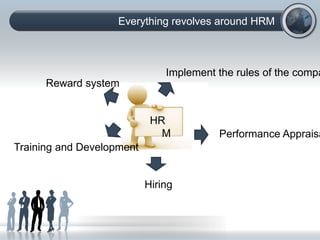
Everything revolves around HRM
HR
M
Hiring
Training and Development
Reward system
Implement the rules of the compa
Performance Appraisa
Research by Academics
Those who study and teach HRM is
devoted to identifying the most
effective and efficient methods for
meeting these HRM activities.
It is said that “if the companies are to survive
and prosper in information age competition,
they must use measurement and
management systems derived from their
strategies and capabilities” (Kaplan and
Norton)
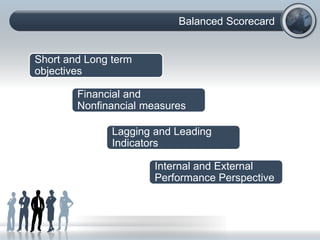
Balanced Scorecard
Short and Long term
objectives
Financial and
Nonfinancial measures
Lagging and Leading
Indicators
Internal and External
Performance Perspective
The Vision of HRM for the 21st century
1. Responsive to a highly competitive
marketplace and global business
structures.
2. Closely linked to business strategic
plans.
3. Jointly conceived and implemented by
line and HR managers.
4. Focused on quality, customer service,
productivity, employee involvement,
teamwork and workforce flexibility.
HRM and Corporate performance
High Performance Work
Systems:
Validatio
n:
Focus on core
competencies:
Core competencies
Core competency is a specific factor that
a business sees as central to the way the company or
its employees work.
It fulfills three key criteria:
1. It is not easy for competitors to imitate.
2. It can be reused widely for many products and
markets.
3. It must contribute to the end consumer's
experienced benefits and the value of the product or
service to its customers.
(Prahalad and Hamel, business
Discrepancies between academic research and HRM
practice
SHRM:
“Knowledge gap”:
Meta-analyses:
Research should drive HRM
practice:
Buros Mental Measurements
Yearbook:
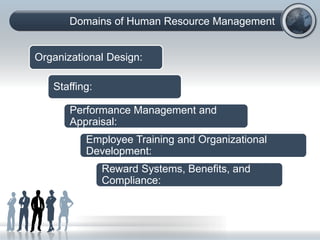
Domains of Human Resource Management
Organizational Design:
Staffing:
Performance Management and
Appraisal:
Employee Training and Organizational
Development:
Reward Systems, Benefits, and
Compliance:
Trends Enhancing the Importance of HRM
The Increased Globalization of the Economy:
Technological Changes, Challenges, and
Opportunities:
Increase in Litigation and Regulation related to HRM:
Changing Characteristics of the Workforce:
Trends Enhancing the Importance of HRM
(C) Copyright: Phillip J. Decker, Ph.D., 2006. All rights
reserved:
Trend #1: The Increased Globalization of the Economy
Development of a worldwide labor market for U.S. companies.
Decrease the cost of labor,
HRM is more complicated
Possible more union activity.
Corporate downsizing linked to new technology
Increasing international competition.
U.S. export jobs up 20% in last 10 years
U.S. firms are expanding in new countries and new markets
Reduced work forces by more than 10% in the last decade.
HRM specialists experts in organizational restructuring
Conduct vocational counseling for displaced
Assist in developing new staffing plans
Help in a legal defense against allegations of discrimination.
Trends Enhancing the Importance of HRM
(C) Copyright: Phillip J. Decker, Ph.D., 2006. All rights
reserved:
Trend #2: Technological Changes, Challenges and
Opportunities.
Optimal combination of people, software and
equipment.
User testing programs assess computer interface.
Maximize profit margins and sustained customer
value
What Will Be the Impact of the Internet on HRM
Activities?
Computer search of a potential applicant pool.
Standardized resumes in database.
Announcement and responses through
electronic mail.
Video computer conducts testing and
interviewing.
Trends Enhancing the Importance of HRM
(C) Copyright: Phillip J. Decker, Ph.D., 2006. All rights
reserved:
Trend #3: Need to Be Flexible in Response to
Changing Business Environments
Focus on core competencies leads to outsource
other work,
Use temporary or leased employees or
Independent contractors
Replace personnel with new technology.
Consulting is now a thriving business for HRM.
Trends Enhancing the Importance of HRM
(C) Copyright: Phillip J. Decker, Ph.D., 2006. All rights
reserved:
Trend #3: Need to Be Flexible in Response to
Changing Business Environments
Focus on core competencies leads to outsource
other work,
Use temporary or leased employees or
Independent contractors
Replace personnel with new technology.
Consulting is now a thriving business for HRM.
Trends Enhancing the Importance of HRM
(C) Copyright: Phillip J. Decker, Ph.D., 2006. All rights
reserved:
Trend #4: Increase in Litigation Related to HRM
Federal lawsuits increased over 125% since 1991.
State laws regarding corporate acquisitions and
mergers, AIDs victims and homosexuals, family leave
benefits, and video displays
Health and safety regulations, employee pensions and
other compensation programs, plant closures, mergers
and acquisitions, new immigration laws, and equal
opportunity laws and guidelines.
Trends Enhancing the Importance of HRM
(C) Copyright: Phillip J. Decker, Ph.D., 2006. All rights
reserved:
Trend #5: Changing Characteristics of the Workforce
Nearly 90% of U.S. workforce growth from 1995 to
2000 were women, immigrants, African-Americans,
Hispanic or Asian origin
Older and less likely to retire at 65
Increasing number of disabled workers
More programs on diversity, flexible work, better
training programs, childcare arrangements, and
career development strategies.
Phillip J. Decker, Ph.D.
The Importance of HRM Measurement in Strategy
Execution
The Workforce Scorecard argues that to
maximize the strategic contribution of the
workforce, organizations must meet three
challenges:
1. The need to support corporate productivity and
performance improvement efforts.
2. That employees play an expanded role in
employers’ performance improvement efforts.
3. HR must be more involved in designing-not just
executing-the company’s strategic plan.
MarkHuselid.com
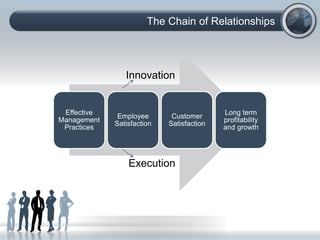
The Chain of Relationships
Effective
Management
Practices
Employee
Satisfaction
Customer
Satisfaction
Long term
profitability
and growth
Innovation
Execution
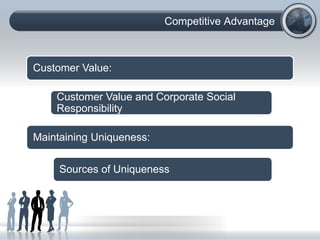
Competitive Advantage
Customer Value:
Customer Value and Corporate Social
Responsibility
Maintaining Uniqueness:
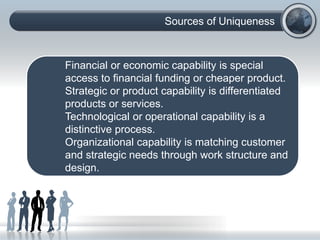
Sources of Uniqueness
Financial or economic capability is special
access to financial funding or cheaper product.
Strategic or product capability is differentiated
products or services.
Technological or operational capability is a
distinctive process.
Organizational capability is matching customer
and strategic needs through work structure and
design.
THANK YOU! 

Strategic human resource management in a changing environment

  • 1.
    Strategic Human ResourceManagement in a changing Environment Grace Madelliene Alcantara Human Resource Management John Bernardin
  • 2.
    A happy thoughtcan never make you fly. But it can make you smile. 
  • 3.
    What is HumanResource Management? “The process of hiring and developing employees so that they become more valuable to the organization.” Businessdictionary.com Extensive knowledge of the industry, leadership and effective negotiation skills are the examples of core qualities of HR management
  • 5.
    Strategic approach Started in90s and recently moved towards strategic approach which involves: 1. A direction for the company 2. Consideration where the company is planning to go 3. Development over the period of time Employ the best employees for the organizations to consideration of the needs of the people working in the organizations. (Alan Taylor, senior lecturer Cavendish
  • 6.
    Everything revolves aroundHRM HR M Hiring Training and Development Reward system Implement the rules of the compa Performance Appraisa
  • 7.
    Research by Academics Thosewho study and teach HRM is devoted to identifying the most effective and efficient methods for meeting these HRM activities. It is said that “if the companies are to survive and prosper in information age competition, they must use measurement and management systems derived from their strategies and capabilities” (Kaplan and Norton)
  • 8.
    Balanced Scorecard Short andLong term objectives Financial and Nonfinancial measures Lagging and Leading Indicators Internal and External Performance Perspective
  • 9.
    The Vision ofHRM for the 21st century 1. Responsive to a highly competitive marketplace and global business structures. 2. Closely linked to business strategic plans. 3. Jointly conceived and implemented by line and HR managers. 4. Focused on quality, customer service, productivity, employee involvement, teamwork and workforce flexibility.
  • 10.
    HRM and Corporateperformance High Performance Work Systems: Validatio n: Focus on core competencies:
  • 11.
    Core competencies Core competencyis a specific factor that a business sees as central to the way the company or its employees work. It fulfills three key criteria: 1. It is not easy for competitors to imitate. 2. It can be reused widely for many products and markets. 3. It must contribute to the end consumer's experienced benefits and the value of the product or service to its customers. (Prahalad and Hamel, business
  • 12.
    Discrepancies between academicresearch and HRM practice SHRM: “Knowledge gap”: Meta-analyses: Research should drive HRM practice: Buros Mental Measurements Yearbook:
  • 13.
    Domains of HumanResource Management Organizational Design: Staffing: Performance Management and Appraisal: Employee Training and Organizational Development: Reward Systems, Benefits, and Compliance:
  • 14.
    Trends Enhancing theImportance of HRM The Increased Globalization of the Economy: Technological Changes, Challenges, and Opportunities: Increase in Litigation and Regulation related to HRM: Changing Characteristics of the Workforce:
  • 15.
    Trends Enhancing theImportance of HRM (C) Copyright: Phillip J. Decker, Ph.D., 2006. All rights reserved: Trend #1: The Increased Globalization of the Economy Development of a worldwide labor market for U.S. companies. Decrease the cost of labor, HRM is more complicated Possible more union activity. Corporate downsizing linked to new technology Increasing international competition. U.S. export jobs up 20% in last 10 years U.S. firms are expanding in new countries and new markets Reduced work forces by more than 10% in the last decade. HRM specialists experts in organizational restructuring Conduct vocational counseling for displaced Assist in developing new staffing plans Help in a legal defense against allegations of discrimination.
  • 16.
    Trends Enhancing theImportance of HRM (C) Copyright: Phillip J. Decker, Ph.D., 2006. All rights reserved: Trend #2: Technological Changes, Challenges and Opportunities. Optimal combination of people, software and equipment. User testing programs assess computer interface. Maximize profit margins and sustained customer value What Will Be the Impact of the Internet on HRM Activities? Computer search of a potential applicant pool. Standardized resumes in database. Announcement and responses through electronic mail. Video computer conducts testing and interviewing.
  • 17.
    Trends Enhancing theImportance of HRM (C) Copyright: Phillip J. Decker, Ph.D., 2006. All rights reserved: Trend #3: Need to Be Flexible in Response to Changing Business Environments Focus on core competencies leads to outsource other work, Use temporary or leased employees or Independent contractors Replace personnel with new technology. Consulting is now a thriving business for HRM.
  • 18.
    Trends Enhancing theImportance of HRM (C) Copyright: Phillip J. Decker, Ph.D., 2006. All rights reserved: Trend #3: Need to Be Flexible in Response to Changing Business Environments Focus on core competencies leads to outsource other work, Use temporary or leased employees or Independent contractors Replace personnel with new technology. Consulting is now a thriving business for HRM.
  • 19.
    Trends Enhancing theImportance of HRM (C) Copyright: Phillip J. Decker, Ph.D., 2006. All rights reserved: Trend #4: Increase in Litigation Related to HRM Federal lawsuits increased over 125% since 1991. State laws regarding corporate acquisitions and mergers, AIDs victims and homosexuals, family leave benefits, and video displays Health and safety regulations, employee pensions and other compensation programs, plant closures, mergers and acquisitions, new immigration laws, and equal opportunity laws and guidelines.
  • 20.
    Trends Enhancing theImportance of HRM (C) Copyright: Phillip J. Decker, Ph.D., 2006. All rights reserved: Trend #5: Changing Characteristics of the Workforce Nearly 90% of U.S. workforce growth from 1995 to 2000 were women, immigrants, African-Americans, Hispanic or Asian origin Older and less likely to retire at 65 Increasing number of disabled workers More programs on diversity, flexible work, better training programs, childcare arrangements, and career development strategies. Phillip J. Decker, Ph.D.
  • 21.
    The Importance ofHRM Measurement in Strategy Execution The Workforce Scorecard argues that to maximize the strategic contribution of the workforce, organizations must meet three challenges: 1. The need to support corporate productivity and performance improvement efforts. 2. That employees play an expanded role in employers’ performance improvement efforts. 3. HR must be more involved in designing-not just executing-the company’s strategic plan. MarkHuselid.com
  • 22.
    The Chain ofRelationships Effective Management Practices Employee Satisfaction Customer Satisfaction Long term profitability and growth Innovation Execution
  • 23.
    Competitive Advantage Customer Value: CustomerValue and Corporate Social Responsibility Maintaining Uniqueness: Sources of Uniqueness
  • 24.
    Sources of Uniqueness Financialor economic capability is special access to financial funding or cheaper product. Strategic or product capability is differentiated products or services. Technological or operational capability is a distinctive process. Organizational capability is matching customer and strategic needs through work structure and design.
  • 25.