Human Resource
Management (HRM)
QSB2413 Management Science
Introduction
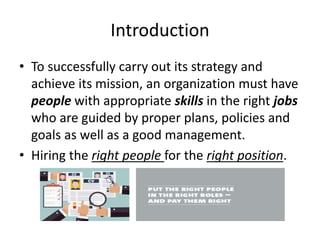
• To successfully carry out its strategy and
achieve its mission, an organization must have
people with appropriate skills in the right jobs
who are guided by proper plans, policies and
goals as well as a good management.
• Hiring the right people for the right position.
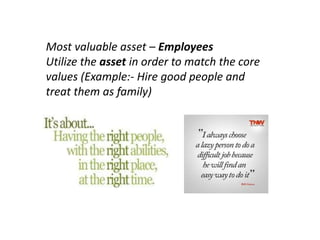
Most valuable asset – Employees
Utilize the asset in order to match the core
values (Example:- Hire good people and
treat them as family)
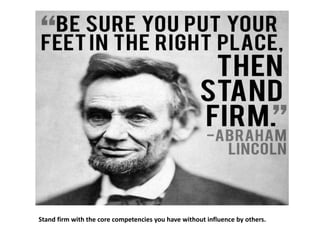
Stand firm with the core competencies you have without influence by others.
Facing the Challenge
• It’s challenging in selecting and hiring, the person
who will perform well in a particular job.
• The primary goal in choosing a person from
either inside or outside the organization is to find
someone who has skills and competencies to be
successful in that job.
• It is best to select a person who not only do well
in his/her job but also will have opportunities to
learn enough to be promoted to successive jobs
in the organization. (Example, management
trainee position)
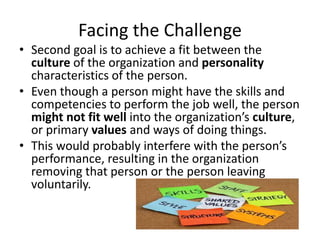
Facing the Challenge
• Second goal is to achieve a fit between the
culture of the organization and personality
characteristics of the person.
• Even though a person might have the skills and
competencies to perform the job well, the person
might not fit well into the organization’s culture,
or primary values and ways of doing things.
• This would probably interfere with the person’s
performance, resulting in the organization
removing that person or the person leaving
voluntarily.
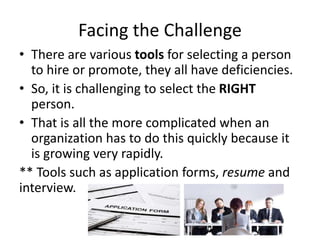
Facing the Challenge
• There are various tools for selecting a person
to hire or promote, they all have deficiencies.
• So, it is challenging to select the RIGHT
person.
• That is all the more complicated when an
organization has to do this quickly because it
is growing very rapidly.
** Tools such as application forms, resume and
interview.
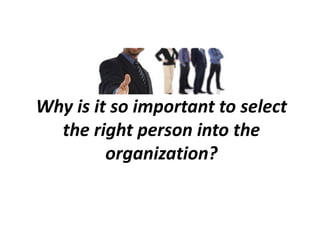
Why is it so important to select
the right person into the
organization?
Because …
• If you select the right person and guided them as
planned, the organization’s customers will be
satisfied.
• The organization will have a combination of
people with the right skills, motivation and
practices that may be impossible, or at least
difficult, to imitate by another organization.
• With this, the organization can achieve an
advantage over the competitors that could be
sustained over some time. (sustainable
competitive advantage – such as Walt Disney)
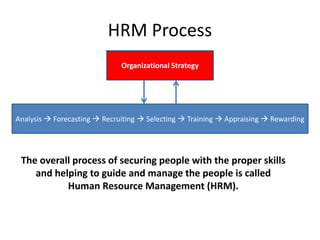
HRM Process
Organizational Strategy
Analysis  Forecasting  Recruiting  Selecting  Training  Appraising  Rewarding
The overall process of securing people with the proper skills
and helping to guide and manage the people is called
Human Resource Management (HRM).
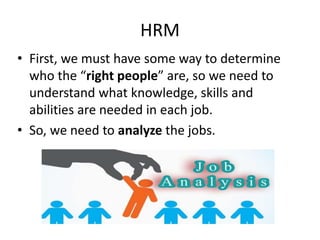
HRM
• First, we must have some way to determine
who the “right people” are, so we need to
understand what knowledge, skills and
abilities are needed in each job.
• So, we need to analyze the jobs.
Job Analysis
• Job analysis is studying a job to understand what
knowledge, skills, abilities, competencies and
attitudes are needed as a foundation for the
behaviors that would help a jobholder perform
the job successfully.
• To understand what behaviors are really required
by a job, rather than what one might assume to
be required.
• Example, hire a cheerful receptionist (not force to
be cheerful as required by the job).
Job Analysis
• A factory job might require skills needed to
successfully engage in groups, in addition to
being able to operate certain equipment
(behavior – knowledge of machine).
• A person’s attitude and other personality
characteristics may become more important
components of a job. This is because a person can
be more successful if he or she fits into the
organization’s culture (way things are done).
Job Analysis
• If a person really does not like working in
groups or with very flexible work rules
(culture), then a culture that thrives on group
work and flexible rules might not work well for
that person.
• Example, the person with reserved personality
might not work well in those organizations
with fun and group decision making culture
compared to those outgoing personality.
Remember!
If you are not selected, not because of
you are not good enough.
It is just because you are not the
RIGHT PERSON they are looking for.
Job Analysis
• From the job analysis, a job description is
established.
• Job description lists the tasks, behaviors,
responsibilities and other information that help
explain the job. (duties and responsibilities)
• Job specification lists the specific knowledge,
skills, abilities, competencies and other employee
characteristics that are needed to carry out the
tasks, behaviors and responsibilities of the job.
(qualities and qualifications required)
Job Analysis
• Job descriptions and job specifications provide
managers with a foundation for forecasting
the supply of, and demand for, employees
within the organization and for developing
programs to meet the organization’s human
resource requirements.
• These activities are usually coordinated by or
actually done by the human resource
manager.
Forecasting
• An important aspect of HRM is forecasting the
demand for and supply of human resources
for both short-term and long-term planning.
• Demand forecasting involves determining the
number of employees that the organization
will need at some point in the future as well as
the knowledge, skills and abilities that these
employees must possess.
Forecasting
• Rapid technological change (uses of IT) have resulted
almost all companies are using Internet for selling /
doing business. Therefore, requiring changes in a
company’s strategy (create a website) and operations
(develop a system).
• These changes affect the need for employees with
special skills. (creating website, skills in operating the
system)
• Demand is based on the organization’s strategic goals
and internal changes in the workforces, such as
retirements, resignations, terminations and leaves of
absence.
Forecasting
• Supply forecasting involves determining what
human resources will be available both inside
and outside the organization.
• Internal practices that affect promotions,
transfers, training and pay incentives are
designed to meet demand with existing
employees.
• To meet human resource demand, most
organizations must rely to some extent on
bringing in employees from the outside.
Forecasting
• Internal and external supply forecasts allow the
organization to estimate the number of people
who will enter and leave various organizational
jobs.
• After estimating the demand and supply of HR,
the HR manager must reconcile the two
forecasts.
• If a shortage is forecast, they should emphasize
employee hiring, promotions and training.
• If an excess is predicted, workforce reduction
must be implemented.
Recruiting
• Recruitment is the process of finding and
attracting job candidates who are qualified to
fill job vacancies.
• The qualifications are listed and explained in
the job descriptions and job specifications.
• Recruitment can occur in a variety settings,
both inside and outside the organization.
• Both approaches have advantages and
challenges.
Recruiting
• Internal recruitment involves identifying
candidates inside the organization and
encouraging them to apply for and be willing to
accept organizational jobs that are vacant.
• Many employees aspire to move up the ranks
through promotion. It becomes more feasible
/practical when companies invest in training and
development activities.
• Transfers can be an important development tool
for acquiring additional job knowledge, upward
mobility.
Recruiting
• External recruitment involves advertising for and
seeking applicants from outside the company.
• If internal sources do not produce an acceptable
candidate or if the best candidate would come
from the outside, a wide variety of external
sources are available.
• External sources includes walk-ins, public or
private employment agencies, temporary-help
agencies, referrals from current and past
employees, recruiting employees from
competitors, newspaper and the use of Internet.
Recruiting
• The source used will depend on the job skills
required and the current availability of those
skills in the labor market.
• For example, organizations frequently use
external placement firms and private
employment agencies to find applicants for
upper-level managerial positions.
Selecting
• Selection is the process of evaluating and
choosing the best-qualified candidate from the
pool of applicants available for the position.
• It entails the exchange of accurate information
between employers and job candidates to
optimize the person to job match.
• Although organizations usually make these
decisions, applicants also self-select into
organizations that meet their requirements or
choose to not join or to leave organizations that
they think don’t meet their needs.
Selection
• For example, a person with very strong
technical expertise was hired by the IT
department at Southwest Airlines.
• After a month he decided that he didn’t like
the outgoing, friendly, interacting culture.
• He preferred to stay in his cubicle and work.
Selection
• At the center of the selection process is the prediction
of whether or not a particular applicant is capable of
performing the job tasks associated with the position
for which he or she is being considered.
• A wrong decision in either choosing a candidate who is
not suited for the position or not choosing a candidate
who would be very successful is costly.
• A “wrong candidate” is not productive / cannot fit into
the organization’s culture and might have to be
replaced.
Selection Tools
Application Forms
• The application form and a resume are usually
the first sources of information about a potential
employee.
• Both usually record the applicant’s desired
position and job-related qualifications and
experience such as the applicant’s educational
background, previous job experience and other
information that may be useful in assessing the
individual’s ability to perform a job.
Selection Tools
• Both the application form and resume tend to
serve as prescreening devices to help determine
whether an applicant meets the minimum
requirements of a position and allow preliminary
comparisons with other candidates’ credentials /
evidences.
• Online tools and services are increasingly used to
assist the HRM process.
• You can submit your application and resume
online, both might be analyzed or processed by
computer software.
Selection Tools
• Employers sometimes conduct background
checks to evaluate the accuracy of information
on an application form and resume.
• Such as applicant’s credit history and criminal
record might be checked.
• Employers might contact references listed in a
resume, usually to check the past employment
or to ask for an appraisal of a candidate’s past
performance.
Selection Tools
Tests
• An employment-testing measure is a means of
assessing a job applicant’s knowledge, skills
and abilities.
• For example, through written responses (such
as math test), performance test (such as word-
processing test) or verbal responses (such as a
test of language skills).
Selection Tools
• We discussed three categories of tests – written
tests, performance tests and personality (or
personal characteristics) tests.
• Although the personality test can be written test,
personality and personal characteristics can also
be assessed through interviews and observations.
• Written tests usually are those that test
knowledge, ability, skills, intelligence or interest.
• They usually called paper-and-pencil tests, many
are now computerized.
Selection Tools
• Performance tests require the job candidate
to actually perform in the job, usually some
small part of the job or for a short time.
• There are two common types of performance
tests – work samples and assessment centers.
• Work samples are more appropriate for jobs
that might be more routine or more specific.
For example, to see whether a person can
install a computer.
Selection Tools
• To judge whether a person might write creative
and hopefully effective advertisements, have the
person prepare a portfolio of his or her work.
• If work samples are designed or selected well,
then a person’s performance in the work sample
should accurately predict the person’s
performance on the job.
• For example, Facebook publishes complex
puzzles that require in-depth programming
competencies to solve.
Selection Tools
• Assessment centers are usually more appropriate to
judge a candidate’s predicted performance in a more
complex job.
• For example, a candidate’s readiness (ready or not) to
be selected for managerial position or to be promoted
can be assessed by judging performance on a
simulation of a group of tasks that a manager might
actually do.
• The intent is to judge how a candidate would behave
and perform in the selected tasks to predict
performance as a manager. (to see how candidate
selects which tasks to do and which to ignore –
priority)
Selection Tools
• Personality tests are use to judge whether a
person “fits” and whether the organization hires
the “right” people.
• It is beneficial to hire people who already have
characteristics and attitudes that are in line with
the organization’s core values and culture.
• Teaching a person the details of a job is easier
than teaching him or her to change personality
characteristics / attitudes.
• Example, Southwest Airlines.
Selection
Interviews
• Interviews are formal, in-depth conversations
conducted for the purpose of assessing a candidate’s
knowledge, skills and abilities, as well as providing
information to the candidate about the organization
and potential jobs.
• Interviews permit a two-way exchange of information.
• Most interview questions are straightforward inquires
about the candidate’s experience or education.
• Some organizations ask job candidates to study a
situation and make a presentation that solves an
organizational challenge.
Selection
• An interview can also include a realistic job
preview.
• The interviewer can explain to the job
applicant what the job really requires rather
than give just the positive points of the job or
company and avoid the negative.
Training
• Employees must know what to do in their jobs to
perform well.
• Some or most of what they must know may have
been learned from education or training before
they got the job. (industrial training)
• The job might require tasks that are quite new to
them, so training is required. (Software)
• Training is a planned effort to assist employees in
learning job-related behaviors that will improve
their performance.
Training
• Rapidly changing technology requires that
employees possess the knowledge, skills and
abilities needed to cope with new processes
and production techniques.
• An organization’s training needs can be
identified through three types of needs
assessment: organizational, task and
individual.
Training
• Organizational assessment determines where
in the organization the training is needed.
(department)
• Task assessment covers what is to be trained.
(system / software)
• Individual assessment determines who needs
to be trained based on actual versus desired
skills.
Types of Training
• Once the organization’s training needs have been
assessed, training must be designed and
developed.
• The first step in the training process is to get new
employees off to a good start.
• This is generally accomplished through
orientation.
• Orientation is the formal process of familiarizing
new employees with the organization, their jobs
and their work units.
Types of Training
• The purpose is to enable new employees to fit in so
that they become productive members of the
organization. (Mission and strategy)
• Technical training programs are designed to provide
employees with specialized skills and knowledge.
• With advances in training technology, many
organizations are using computer-assisted instruction
and interactive video training.
• On-the-job training is conducted while employees
perform job-related tasks. (direct approach)
Types of Training
• Management development programs are
designed to improve the technical, interpersonal
and conceptual skills of supervisors, managers
and executives.
• On-the-job training for managers include rotating
through variety of positions, regular coaching and
mentoring by a supervisor, committee
assignments to involve individuals in decision-
making activities and staff meetings to help
managers to broaden their organizational
knowledge and experience.
Appraising
• Judging or appraising everyone’s performance in
an organization is necessary so that everyone’s
effort can be focused on achieving the
organization’s mission.
• Performance appraisal is a systematic process of
evaluating each employee’s job-related
achievements, strengths and weaknesses, as well
as determining ways to improve performance.
** KPI – Key Performance Indicator
Appraising
• Performance appraisals are valuable aids in making many
HRM decisions. They are essential for distinguishing
between good or poor performers.
• Managers can use performance appraisal information in
four ways:-
(1) Motivation (rewarding – good performance)
(2) Personnel movement (determine promotion,
transfer, dismissed)
(3) Training (poor performance – improvement)
(4) Feedback for improvement and personal development
(how well they have done, adjustment for better
performance)
Rewarding
• Organizations must reward employees for
doing a good job and for helping achieve the
organization’s goals and mission.
• Reward = Money
• Nonmonetary rewards like recognition,
encouragement from the manager, coaching
and mentoring from the manager and
supportive types of communication.
**Maslow’s hierarchy of needs
Rewarding
Compensation
• Compensation consists of monetary payments
and rewards that go to employees.
• This include direct financial payments such as
wages, salaries, incentives, bonuses and
commissions.
• Indirect payments in the form of benefits such
as insurance and vacation are forms of
compensation.
Rewarding
• To attract, retain and motivate employees,
organizations develop incentive programs.
• These incentives are designed to encourage
employees to produce results beyond expected
performance norms.
• Most incentives should be directly tied to
performance, such as profit-sharing plans and
some form of stock options.
**increase loyalty, decrease turnover, provide good
work-life balance.
Rewarding
Benefits
• Benefits are considered indirect compensation;
they are payments beyond wages or salaries that
are given to employees as a reward for
organizational membership.
• Organizations commonly provide health, dental
and life insurance coverage for employees and
sometimes for their families.
**Depends on the organizations and position held.
Summary
• HRM is critical element of the management
process and is essential for the long-term
organizational success.
• By managing HR well, the organization will
have the right people in the right jobs.
• The right people, guided and motivated to
achieve the organization’s goals and overall
strategy, are important assets of the
organization.

MS Lecture 6 human resource management

  • 1.
  • 2.
    Introduction • To successfullycarry out its strategy and achieve its mission, an organization must have people with appropriate skills in the right jobs who are guided by proper plans, policies and goals as well as a good management. • Hiring the right people for the right position.
  • 3.
    Most valuable asset– Employees Utilize the asset in order to match the core values (Example:- Hire good people and treat them as family)
  • 4.
    Stand firm withthe core competencies you have without influence by others.
  • 5.
    Facing the Challenge •It’s challenging in selecting and hiring, the person who will perform well in a particular job. • The primary goal in choosing a person from either inside or outside the organization is to find someone who has skills and competencies to be successful in that job. • It is best to select a person who not only do well in his/her job but also will have opportunities to learn enough to be promoted to successive jobs in the organization. (Example, management trainee position)
  • 6.
    Facing the Challenge •Second goal is to achieve a fit between the culture of the organization and personality characteristics of the person. • Even though a person might have the skills and competencies to perform the job well, the person might not fit well into the organization’s culture, or primary values and ways of doing things. • This would probably interfere with the person’s performance, resulting in the organization removing that person or the person leaving voluntarily.
  • 7.
    Facing the Challenge •There are various tools for selecting a person to hire or promote, they all have deficiencies. • So, it is challenging to select the RIGHT person. • That is all the more complicated when an organization has to do this quickly because it is growing very rapidly. ** Tools such as application forms, resume and interview.
  • 8.
    Why is itso important to select the right person into the organization?
  • 9.
    Because … • Ifyou select the right person and guided them as planned, the organization’s customers will be satisfied. • The organization will have a combination of people with the right skills, motivation and practices that may be impossible, or at least difficult, to imitate by another organization. • With this, the organization can achieve an advantage over the competitors that could be sustained over some time. (sustainable competitive advantage – such as Walt Disney)
  • 10.
    HRM Process Organizational Strategy Analysis Forecasting  Recruiting  Selecting  Training  Appraising  Rewarding The overall process of securing people with the proper skills and helping to guide and manage the people is called Human Resource Management (HRM).
  • 11.
    HRM • First, wemust have some way to determine who the “right people” are, so we need to understand what knowledge, skills and abilities are needed in each job. • So, we need to analyze the jobs.
  • 12.
    Job Analysis • Jobanalysis is studying a job to understand what knowledge, skills, abilities, competencies and attitudes are needed as a foundation for the behaviors that would help a jobholder perform the job successfully. • To understand what behaviors are really required by a job, rather than what one might assume to be required. • Example, hire a cheerful receptionist (not force to be cheerful as required by the job).
  • 13.
    Job Analysis • Afactory job might require skills needed to successfully engage in groups, in addition to being able to operate certain equipment (behavior – knowledge of machine). • A person’s attitude and other personality characteristics may become more important components of a job. This is because a person can be more successful if he or she fits into the organization’s culture (way things are done).
  • 14.
    Job Analysis • Ifa person really does not like working in groups or with very flexible work rules (culture), then a culture that thrives on group work and flexible rules might not work well for that person. • Example, the person with reserved personality might not work well in those organizations with fun and group decision making culture compared to those outgoing personality.
  • 15.
    Remember! If you arenot selected, not because of you are not good enough. It is just because you are not the RIGHT PERSON they are looking for.
  • 16.
    Job Analysis • Fromthe job analysis, a job description is established. • Job description lists the tasks, behaviors, responsibilities and other information that help explain the job. (duties and responsibilities) • Job specification lists the specific knowledge, skills, abilities, competencies and other employee characteristics that are needed to carry out the tasks, behaviors and responsibilities of the job. (qualities and qualifications required)
  • 17.
    Job Analysis • Jobdescriptions and job specifications provide managers with a foundation for forecasting the supply of, and demand for, employees within the organization and for developing programs to meet the organization’s human resource requirements. • These activities are usually coordinated by or actually done by the human resource manager.
  • 18.
    Forecasting • An importantaspect of HRM is forecasting the demand for and supply of human resources for both short-term and long-term planning. • Demand forecasting involves determining the number of employees that the organization will need at some point in the future as well as the knowledge, skills and abilities that these employees must possess.
  • 19.
    Forecasting • Rapid technologicalchange (uses of IT) have resulted almost all companies are using Internet for selling / doing business. Therefore, requiring changes in a company’s strategy (create a website) and operations (develop a system). • These changes affect the need for employees with special skills. (creating website, skills in operating the system) • Demand is based on the organization’s strategic goals and internal changes in the workforces, such as retirements, resignations, terminations and leaves of absence.
  • 20.
    Forecasting • Supply forecastinginvolves determining what human resources will be available both inside and outside the organization. • Internal practices that affect promotions, transfers, training and pay incentives are designed to meet demand with existing employees. • To meet human resource demand, most organizations must rely to some extent on bringing in employees from the outside.
  • 21.
    Forecasting • Internal andexternal supply forecasts allow the organization to estimate the number of people who will enter and leave various organizational jobs. • After estimating the demand and supply of HR, the HR manager must reconcile the two forecasts. • If a shortage is forecast, they should emphasize employee hiring, promotions and training. • If an excess is predicted, workforce reduction must be implemented.
  • 22.
    Recruiting • Recruitment isthe process of finding and attracting job candidates who are qualified to fill job vacancies. • The qualifications are listed and explained in the job descriptions and job specifications. • Recruitment can occur in a variety settings, both inside and outside the organization. • Both approaches have advantages and challenges.
  • 23.
    Recruiting • Internal recruitmentinvolves identifying candidates inside the organization and encouraging them to apply for and be willing to accept organizational jobs that are vacant. • Many employees aspire to move up the ranks through promotion. It becomes more feasible /practical when companies invest in training and development activities. • Transfers can be an important development tool for acquiring additional job knowledge, upward mobility.
  • 24.
    Recruiting • External recruitmentinvolves advertising for and seeking applicants from outside the company. • If internal sources do not produce an acceptable candidate or if the best candidate would come from the outside, a wide variety of external sources are available. • External sources includes walk-ins, public or private employment agencies, temporary-help agencies, referrals from current and past employees, recruiting employees from competitors, newspaper and the use of Internet.
  • 25.
    Recruiting • The sourceused will depend on the job skills required and the current availability of those skills in the labor market. • For example, organizations frequently use external placement firms and private employment agencies to find applicants for upper-level managerial positions.
  • 26.
    Selecting • Selection isthe process of evaluating and choosing the best-qualified candidate from the pool of applicants available for the position. • It entails the exchange of accurate information between employers and job candidates to optimize the person to job match. • Although organizations usually make these decisions, applicants also self-select into organizations that meet their requirements or choose to not join or to leave organizations that they think don’t meet their needs.
  • 27.
    Selection • For example,a person with very strong technical expertise was hired by the IT department at Southwest Airlines. • After a month he decided that he didn’t like the outgoing, friendly, interacting culture. • He preferred to stay in his cubicle and work.
  • 28.
    Selection • At thecenter of the selection process is the prediction of whether or not a particular applicant is capable of performing the job tasks associated with the position for which he or she is being considered. • A wrong decision in either choosing a candidate who is not suited for the position or not choosing a candidate who would be very successful is costly. • A “wrong candidate” is not productive / cannot fit into the organization’s culture and might have to be replaced.
  • 29.
    Selection Tools Application Forms •The application form and a resume are usually the first sources of information about a potential employee. • Both usually record the applicant’s desired position and job-related qualifications and experience such as the applicant’s educational background, previous job experience and other information that may be useful in assessing the individual’s ability to perform a job.
  • 30.
    Selection Tools • Boththe application form and resume tend to serve as prescreening devices to help determine whether an applicant meets the minimum requirements of a position and allow preliminary comparisons with other candidates’ credentials / evidences. • Online tools and services are increasingly used to assist the HRM process. • You can submit your application and resume online, both might be analyzed or processed by computer software.
  • 31.
    Selection Tools • Employerssometimes conduct background checks to evaluate the accuracy of information on an application form and resume. • Such as applicant’s credit history and criminal record might be checked. • Employers might contact references listed in a resume, usually to check the past employment or to ask for an appraisal of a candidate’s past performance.
  • 32.
    Selection Tools Tests • Anemployment-testing measure is a means of assessing a job applicant’s knowledge, skills and abilities. • For example, through written responses (such as math test), performance test (such as word- processing test) or verbal responses (such as a test of language skills).
  • 33.
    Selection Tools • Wediscussed three categories of tests – written tests, performance tests and personality (or personal characteristics) tests. • Although the personality test can be written test, personality and personal characteristics can also be assessed through interviews and observations. • Written tests usually are those that test knowledge, ability, skills, intelligence or interest. • They usually called paper-and-pencil tests, many are now computerized.
  • 34.
    Selection Tools • Performancetests require the job candidate to actually perform in the job, usually some small part of the job or for a short time. • There are two common types of performance tests – work samples and assessment centers. • Work samples are more appropriate for jobs that might be more routine or more specific. For example, to see whether a person can install a computer.
  • 35.
    Selection Tools • Tojudge whether a person might write creative and hopefully effective advertisements, have the person prepare a portfolio of his or her work. • If work samples are designed or selected well, then a person’s performance in the work sample should accurately predict the person’s performance on the job. • For example, Facebook publishes complex puzzles that require in-depth programming competencies to solve.
  • 36.
    Selection Tools • Assessmentcenters are usually more appropriate to judge a candidate’s predicted performance in a more complex job. • For example, a candidate’s readiness (ready or not) to be selected for managerial position or to be promoted can be assessed by judging performance on a simulation of a group of tasks that a manager might actually do. • The intent is to judge how a candidate would behave and perform in the selected tasks to predict performance as a manager. (to see how candidate selects which tasks to do and which to ignore – priority)
  • 37.
    Selection Tools • Personalitytests are use to judge whether a person “fits” and whether the organization hires the “right” people. • It is beneficial to hire people who already have characteristics and attitudes that are in line with the organization’s core values and culture. • Teaching a person the details of a job is easier than teaching him or her to change personality characteristics / attitudes. • Example, Southwest Airlines.
  • 38.
    Selection Interviews • Interviews areformal, in-depth conversations conducted for the purpose of assessing a candidate’s knowledge, skills and abilities, as well as providing information to the candidate about the organization and potential jobs. • Interviews permit a two-way exchange of information. • Most interview questions are straightforward inquires about the candidate’s experience or education. • Some organizations ask job candidates to study a situation and make a presentation that solves an organizational challenge.
  • 39.
    Selection • An interviewcan also include a realistic job preview. • The interviewer can explain to the job applicant what the job really requires rather than give just the positive points of the job or company and avoid the negative.
  • 40.
    Training • Employees mustknow what to do in their jobs to perform well. • Some or most of what they must know may have been learned from education or training before they got the job. (industrial training) • The job might require tasks that are quite new to them, so training is required. (Software) • Training is a planned effort to assist employees in learning job-related behaviors that will improve their performance.
  • 41.
    Training • Rapidly changingtechnology requires that employees possess the knowledge, skills and abilities needed to cope with new processes and production techniques. • An organization’s training needs can be identified through three types of needs assessment: organizational, task and individual.
  • 42.
    Training • Organizational assessmentdetermines where in the organization the training is needed. (department) • Task assessment covers what is to be trained. (system / software) • Individual assessment determines who needs to be trained based on actual versus desired skills.
  • 43.
    Types of Training •Once the organization’s training needs have been assessed, training must be designed and developed. • The first step in the training process is to get new employees off to a good start. • This is generally accomplished through orientation. • Orientation is the formal process of familiarizing new employees with the organization, their jobs and their work units.
  • 44.
    Types of Training •The purpose is to enable new employees to fit in so that they become productive members of the organization. (Mission and strategy) • Technical training programs are designed to provide employees with specialized skills and knowledge. • With advances in training technology, many organizations are using computer-assisted instruction and interactive video training. • On-the-job training is conducted while employees perform job-related tasks. (direct approach)
  • 45.
    Types of Training •Management development programs are designed to improve the technical, interpersonal and conceptual skills of supervisors, managers and executives. • On-the-job training for managers include rotating through variety of positions, regular coaching and mentoring by a supervisor, committee assignments to involve individuals in decision- making activities and staff meetings to help managers to broaden their organizational knowledge and experience.
  • 46.
    Appraising • Judging orappraising everyone’s performance in an organization is necessary so that everyone’s effort can be focused on achieving the organization’s mission. • Performance appraisal is a systematic process of evaluating each employee’s job-related achievements, strengths and weaknesses, as well as determining ways to improve performance. ** KPI – Key Performance Indicator
  • 47.
    Appraising • Performance appraisalsare valuable aids in making many HRM decisions. They are essential for distinguishing between good or poor performers. • Managers can use performance appraisal information in four ways:- (1) Motivation (rewarding – good performance) (2) Personnel movement (determine promotion, transfer, dismissed) (3) Training (poor performance – improvement) (4) Feedback for improvement and personal development (how well they have done, adjustment for better performance)
  • 48.
    Rewarding • Organizations mustreward employees for doing a good job and for helping achieve the organization’s goals and mission. • Reward = Money • Nonmonetary rewards like recognition, encouragement from the manager, coaching and mentoring from the manager and supportive types of communication. **Maslow’s hierarchy of needs
  • 49.
    Rewarding Compensation • Compensation consistsof monetary payments and rewards that go to employees. • This include direct financial payments such as wages, salaries, incentives, bonuses and commissions. • Indirect payments in the form of benefits such as insurance and vacation are forms of compensation.
  • 50.
    Rewarding • To attract,retain and motivate employees, organizations develop incentive programs. • These incentives are designed to encourage employees to produce results beyond expected performance norms. • Most incentives should be directly tied to performance, such as profit-sharing plans and some form of stock options. **increase loyalty, decrease turnover, provide good work-life balance.
  • 51.
    Rewarding Benefits • Benefits areconsidered indirect compensation; they are payments beyond wages or salaries that are given to employees as a reward for organizational membership. • Organizations commonly provide health, dental and life insurance coverage for employees and sometimes for their families. **Depends on the organizations and position held.
  • 52.
    Summary • HRM iscritical element of the management process and is essential for the long-term organizational success. • By managing HR well, the organization will have the right people in the right jobs. • The right people, guided and motivated to achieve the organization’s goals and overall strategy, are important assets of the organization.