Introduction


                               Project Summary
            1. Introduction


                               Purpose


                               Scope


Computer Department                                     Page 1
Introduction


                       Chapter – 1 INTRODUCTION


1.1 Project Summary


       To develop a software application that supports the application specific to the HR
automation in an intranet specific to a company there by allowing the integration of all the
employees pertaining to that organization. To keep track of all the other departments
related to that organization such as marketing, development etc.


       To allow the HR of an organization to update the employee details when ever there
is a change in the employee profile pertaining to that organization. To bring onto a string
the employee specific suggestions and make them free to post their requirements to the
HR thus bringing the organization more specific regarding the maintenance of the
organization.


       The function of Human Resources departments is generally administrative and
common to all organizations. Organizations may have formalized selection, evaluation,
and payroll processes. Efficient and effective management of "Human Capital" has
progressed to an increasingly imperative and complex process. The HR function consists
of tracking existing employee data which traditionally includes personal histories, skills,
capabilities, accomplishments and salary. To reduce the manual workload of these
administrative activities, organizations began to electronically automate many of these
processes by introducing specialized Human Resource Management Systems. Due HR
executives rely on internal or external IT professionals to develop and maintain an
integrated HRMS. Before the "client-server" architecture evolved in the late 1980s, many
HR automation processes were relegated to mainframe computers that could handle large
amounts of data transactions. In consequence of the high capital investment necessary to
purchase or program proprietary software, these internally-developed HRMS were limited
to organizations that possessed a large amount of capital


Computer Department                                                                   Page 2
Introduction


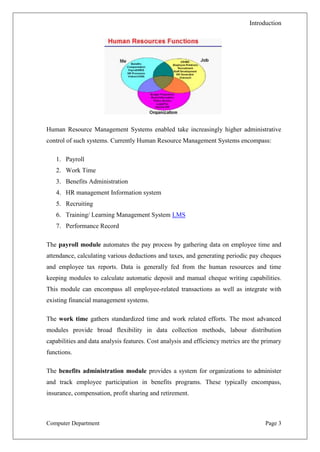
Human Resource Management Systems enabled take increasingly higher administrative
control of such systems. Currently Human Resource Management Systems encompass:

   1. Payroll
   2. Work Time
   3. Benefits Administration
   4. HR management Information system
   5. Recruiting
   6. Training/ Learning Management System LMS
   7. Performance Record

The payroll module automates the pay process by gathering data on employee time and
attendance, calculating various deductions and taxes, and generating periodic pay cheques
and employee tax reports. Data is generally fed from the human resources and time
keeping modules to calculate automatic deposit and manual cheque writing capabilities.
This module can encompass all employee-related transactions as well as integrate with
existing financial management systems.

The work time gathers standardized time and work related efforts. The most advanced
modules provide broad flexibility in data collection methods, labour distribution
capabilities and data analysis features. Cost analysis and efficiency metrics are the primary
functions.

The benefits administration module provides a system for organizations to administer
and track employee participation in benefits programs. These typically encompass,
insurance, compensation, profit sharing and retirement.


Computer Department                                                                   Page 3
Introduction


The HR management module is a component covering many other HR aspects from
application to retirement. The system records basic demographic and address data,
selection, training and development, capabilities and skills management, compensation
planning records and other related activities. Leading edge systems provide the ability to
"read" applications and enter relevant data to applicable database fields, notify employers
and provide position management and position control. Human resource management
function involves the recruitment, placement, evaluation, compensation and development
of the employees of an organisation.

The Human Resources functionality aids hospital executives and employees in the areas of
staff planning and recruitment, compensation, staff development, employee relations,
benefits administration, and reporting. The product allows for automated and integrated
workflow. It provides Web-based processing and servicing capabilities and includes event-
driven triggers. Report scheduling, within HR, also allows for timely and efficient
information flow to executives.

The Human Resources functionality helps both multiple- and single-facility health care
organizations to:

 • Track and analyze applications via on-line applicant submission
 • Maintain a complete employee file including comprehensive demographics
 • Train and develop staff with on-line class enrollment and automatic skill updates
 • Manage performance appraisals of employees via electronic performance reviews and

Notifications

 • Track health records including immunizations, physicals, and encounters
 • Increase employee satisfaction via self-service routines
 • On-line Benefit Enrollment.


Computer Department                                                                    Page 4
Introduction


1.2 PURPOSE:

              Most companies have introduced HR software to design, organize, and
   streamline an organization's human resources. While choosing a new HR software
   application, it is necessary to evaluate a company's needs and processes and determine
   if the functions of the software are relevant to it. Therefore, a list is to be made that is
   referred to as the requirements list, which would contain all the desired functions of
   the new software system.

              HR software facilitates various functions of the human resource department
   that deal with employee benefits, vacations, compensation, employee information, and
   performance. In fact, HR software can be customized to simplify the daily tasks
   involved in the HR department of an organization. It is generally web-based, user-
   friendly, and facilitates easy comprehension by HR personnel. A quality HR software
   system will seamlessly link staff to payroll, benefit providers, and other departments
   of the organization. As a result, it becomes an indispensable tool for the HR
   department.Major benefits of using HR sof twareSome of the major benefits of HR
   software are automatic processing of human resource functions, tracking and
   monitoring of human resource data, creation of templates, forms and customary
   reports. It also enables streamlining of essential data such as employee benefits and
   performance analysis, which in turn reduces the management cost considerably.

              HR software also enables users to view and compare benefits as well as
   make enrolment changes. It facilitates them to update personnel information, view
   current and previous payroll information, and generate real-time benefit statements at
   the touch of a button. There are a variety of HR software packages available these
   days.


   Many different versions of the HR software also offer templates for drafting offer
   letters, appointment letters, and dismissal letters. Customized HR software programs
   also provide templates of various frequently required HR documents.


Computer Department                                                                     Page 5
Introduction


1.3 SCOPE:

       This project can be used to identify a employee in the organization. The project
maintains the details of the entire employee. Each employee is given with different
employee Id. Allow a for the creation of an application specification to the human
resource that maintain the intranet automation of the HR software i.e., which contains the
data related to the employee.


Computer Department                                                                Page 6

HR Software

  • 1.
    Introduction  Project Summary 1. Introduction  Purpose  Scope Computer Department Page 1
  • 2.
    Introduction Chapter – 1 INTRODUCTION 1.1 Project Summary To develop a software application that supports the application specific to the HR automation in an intranet specific to a company there by allowing the integration of all the employees pertaining to that organization. To keep track of all the other departments related to that organization such as marketing, development etc. To allow the HR of an organization to update the employee details when ever there is a change in the employee profile pertaining to that organization. To bring onto a string the employee specific suggestions and make them free to post their requirements to the HR thus bringing the organization more specific regarding the maintenance of the organization. The function of Human Resources departments is generally administrative and common to all organizations. Organizations may have formalized selection, evaluation, and payroll processes. Efficient and effective management of "Human Capital" has progressed to an increasingly imperative and complex process. The HR function consists of tracking existing employee data which traditionally includes personal histories, skills, capabilities, accomplishments and salary. To reduce the manual workload of these administrative activities, organizations began to electronically automate many of these processes by introducing specialized Human Resource Management Systems. Due HR executives rely on internal or external IT professionals to develop and maintain an integrated HRMS. Before the "client-server" architecture evolved in the late 1980s, many HR automation processes were relegated to mainframe computers that could handle large amounts of data transactions. In consequence of the high capital investment necessary to purchase or program proprietary software, these internally-developed HRMS were limited to organizations that possessed a large amount of capital Computer Department Page 2
  • 3.
    Introduction Human Resource ManagementSystems enabled take increasingly higher administrative control of such systems. Currently Human Resource Management Systems encompass: 1. Payroll 2. Work Time 3. Benefits Administration 4. HR management Information system 5. Recruiting 6. Training/ Learning Management System LMS 7. Performance Record The payroll module automates the pay process by gathering data on employee time and attendance, calculating various deductions and taxes, and generating periodic pay cheques and employee tax reports. Data is generally fed from the human resources and time keeping modules to calculate automatic deposit and manual cheque writing capabilities. This module can encompass all employee-related transactions as well as integrate with existing financial management systems. The work time gathers standardized time and work related efforts. The most advanced modules provide broad flexibility in data collection methods, labour distribution capabilities and data analysis features. Cost analysis and efficiency metrics are the primary functions. The benefits administration module provides a system for organizations to administer and track employee participation in benefits programs. These typically encompass, insurance, compensation, profit sharing and retirement. Computer Department Page 3
  • 4.
    Introduction The HR managementmodule is a component covering many other HR aspects from application to retirement. The system records basic demographic and address data, selection, training and development, capabilities and skills management, compensation planning records and other related activities. Leading edge systems provide the ability to "read" applications and enter relevant data to applicable database fields, notify employers and provide position management and position control. Human resource management function involves the recruitment, placement, evaluation, compensation and development of the employees of an organisation. The Human Resources functionality aids hospital executives and employees in the areas of staff planning and recruitment, compensation, staff development, employee relations, benefits administration, and reporting. The product allows for automated and integrated workflow. It provides Web-based processing and servicing capabilities and includes event- driven triggers. Report scheduling, within HR, also allows for timely and efficient information flow to executives. The Human Resources functionality helps both multiple- and single-facility health care organizations to: • Track and analyze applications via on-line applicant submission • Maintain a complete employee file including comprehensive demographics • Train and develop staff with on-line class enrollment and automatic skill updates • Manage performance appraisals of employees via electronic performance reviews and Notifications • Track health records including immunizations, physicals, and encounters • Increase employee satisfaction via self-service routines • On-line Benefit Enrollment. Computer Department Page 4
  • 5.
    Introduction 1.2 PURPOSE: Most companies have introduced HR software to design, organize, and streamline an organization's human resources. While choosing a new HR software application, it is necessary to evaluate a company's needs and processes and determine if the functions of the software are relevant to it. Therefore, a list is to be made that is referred to as the requirements list, which would contain all the desired functions of the new software system. HR software facilitates various functions of the human resource department that deal with employee benefits, vacations, compensation, employee information, and performance. In fact, HR software can be customized to simplify the daily tasks involved in the HR department of an organization. It is generally web-based, user- friendly, and facilitates easy comprehension by HR personnel. A quality HR software system will seamlessly link staff to payroll, benefit providers, and other departments of the organization. As a result, it becomes an indispensable tool for the HR department.Major benefits of using HR sof twareSome of the major benefits of HR software are automatic processing of human resource functions, tracking and monitoring of human resource data, creation of templates, forms and customary reports. It also enables streamlining of essential data such as employee benefits and performance analysis, which in turn reduces the management cost considerably. HR software also enables users to view and compare benefits as well as make enrolment changes. It facilitates them to update personnel information, view current and previous payroll information, and generate real-time benefit statements at the touch of a button. There are a variety of HR software packages available these days. Many different versions of the HR software also offer templates for drafting offer letters, appointment letters, and dismissal letters. Customized HR software programs also provide templates of various frequently required HR documents. Computer Department Page 5
  • 6.
    Introduction 1.3 SCOPE: This project can be used to identify a employee in the organization. The project maintains the details of the entire employee. Each employee is given with different employee Id. Allow a for the creation of an application specification to the human resource that maintain the intranet automation of the HR software i.e., which contains the data related to the employee. Computer Department Page 6