EMPLOYEE
ATTRITION
Note:
This presentation is in
collaboration with 6
analysts. Authors can
be provided by
request..
IBM Dataset: Presentation
Background &
Objective
Direct Exit Cost
Recruiting
Training
Lost of Productivity
Disengagement
Domino Effect
Why Attrition Matters?
REPLACEMENT COST EMPLOYEE MORALE
Institutional Knowledge
External Relationships
Service Quality
KNOWLEDGE LOST
“For someone making $40K a year, replacement cost is $20K - $30K in recruiting and training expenses.”
-- Society of Human Resource Management
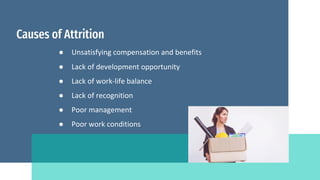
● Unsatisfying compensation and benefits
● Lack of development opportunity
● Lack of work-life balance
● Lack of recognition
● Poor management
● Poor work conditions
Causes of Attrition
Why do employees leave?
What factors characterize employee
attrition?
What can companies do to prevent losing
employees?
We want to answer...
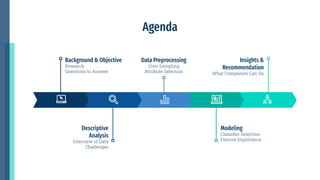
Agenda
Background & Objective
Research
Questions to Answer
Descriptive
Analysis
Overview of Data
Challenges
Modeling
Classifier Selection
Feature Importance
Data Preprocessing
Over Sampling
Attribute Selection
Insights &
Recommendation
What Companies Can Do
Descriptive Analysis
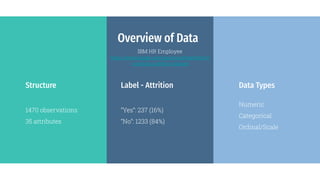
Data Types
Overview of Data
Structure
1470 observations
35 attributes
Label - Attrition
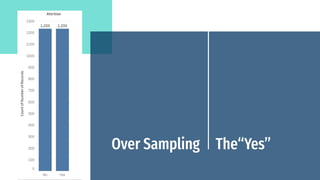
“Yes”: 237 (16%)
“No”: 1233 (84%)
Numeric
Categorical
Ordinal/Scale
IBM HR Employee
https://www.kaggle.com/pavansubhasht/ibm-h
r-analytics-attrition-dataset
Challenges
Biased Dataset
The numbers of
“Yes” and “No” are
unbalanced
Accuracy vs.
Precision
Need to focus on
the number of
‘Yes’, instead of
‘No’
Too Many
Attributes
Problem with
overfitting and
redundancy
237 Yes
1233 No
TP/(TP+FP)
35
attributes
Data Preprocessing
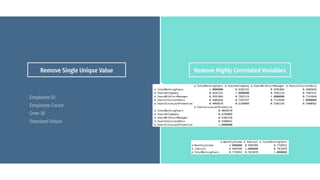
Employee ID
Employee Count
Over 18
Standard Hours
Remove Single Unique Value Remove Highly Correlated Variables
Over Sampling The“Yes”
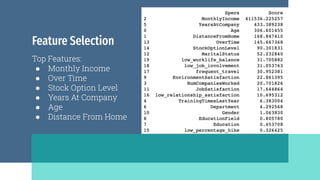
Feature Selection
Top Features:
● Monthly Income
● Over Time
● Stock Option Level
● Years At Company
● Age
● Distance From Home
Whole dataset
Modeling
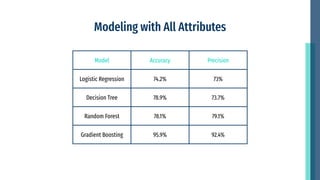
Modeling with All Attributes
Model Accuracy Precision
Logistic Regression 74.2% 73%
Decision Tree 78.9% 73.7%
Random Forest 78.1% 79.1%
Gradient Boosting 95.9% 92.4%
Modeling with Top Attributes from
Feature Selection
Model Accuracy Precision
Logistic Regression 69.4% 67%
Decision Tree 75.5% 78.3%
Random Forest 75.9% 77.7%
Gradient Boosting 92.9% 87.4%
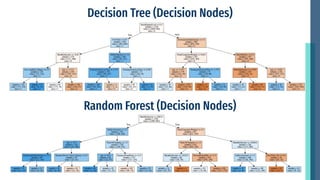
Decision Tree (Decision Nodes)
Random Forest (Decision Nodes)
Insights &
Recommendation
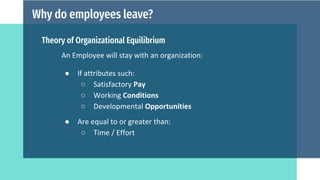
Why do employees leave?
An Employee will stay with an organization:
● If attributes such:
○ Satisfactory Pay
○ Working Conditions
○ Developmental Opportunities
● Are equal to or greater than:
○ Time / Effort
Theory of Organizational Equilibrium
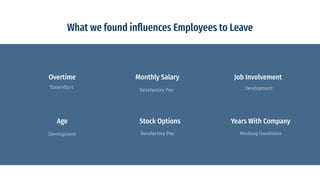
What we found influences Employees to Leave
Monthly Salary
Overtime Job Involvement
Stock Options
Age Years With Company
Time/effort
Satisfactory Pay
Satisfactory Pay Working Conditions
Development
Development
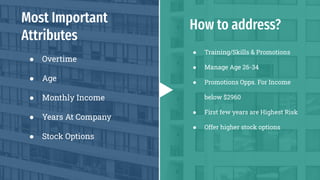
Most Important
Attributes
● Overtime
● Age
● Monthly Income
● Years At Company
● Stock Options
● Training/Skills & Promotions
● Manage Age 26-34
● Promotions Opps. For Income
below $2960
● First few years are Highest Risk
● Offer higher stock options
How to address?
Characteristics of Attrition by Department
Employees with technical
degrees are more likely to
leave when working for HR
Department.
Employees from all
departments are roughly
twice as likely to leave
when working overtime.
Insight 2
Insight 1
Employees from all
departments benefit from
High Job Involvement.
Insight 3
85% 2X
73%
/37%
Employees that show signs of leaving...will not only be
dealt with by managers and HR…. but by solutions
groups, something IBM is already using today.
IBM has saved nearly $300 million in retention costs
using similar AI and predictive techniques.
Future of Employee Management
Source: https://www.cnbc.com/2019/04/03/ibm-ai-can-predict-with-95-percent-accuracy-which-employees-will-quit.html
Q&A
THANKS
Appendix
Initial Modeling
Our Best Models:
1. Support Vector Machine
2. Random Forest
3. Decision Tree
4. Gradient Boosting
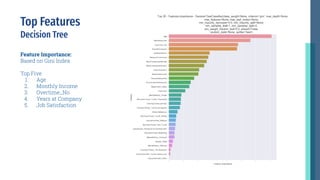
Top Features
Decision Tree
Feature Importance:
Based on Gini Index
Top Five
1. Age
2. Monthly Income
3. Overtime_No
4. Years at Company
5. Job Satisfaction
Feature Importance
Based on Gini Index
Top Five
1. Monthly Income
2. Overtime_No
3. Overtime_Yes
4. Years at Company
5. Age
Top Features
Random Forest
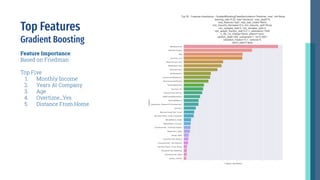
Top Features
Gradient Boosting
Feature Importance:
Based on Friedman
Top Five
1. Monthly Income
2. Years At Company
3. Age
4. Overtime_Yes
5. Distance From Home
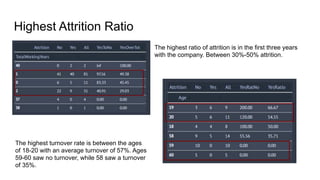
Highest Attrition Ratio
The highest ratio of attrition is in the first three years
with the company. Between 30%-50% attrition.
The highest turnover rate is between the ages
of 18-20 with an average turnover of 57%. Ages
59-60 saw no turnover, while 58 saw a turnover
of 35%.
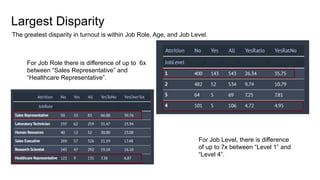
Largest Disparity
For Job Role there is difference of up to 6x
between “Sales Representative” and
“Healthcare Representative”.
For Job Level, there is difference
of up to 7x between “Level 1” and
“Level 4”.
The greatest disparity in turnout is within Job Role, Age, and Job Level.

IBM Attrition Presentation Deck.pdf

  • 1.
    EMPLOYEE ATTRITION Note: This presentation isin collaboration with 6 analysts. Authors can be provided by request.. IBM Dataset: Presentation
  • 2.
  • 3.
    Direct Exit Cost Recruiting Training Lostof Productivity Disengagement Domino Effect Why Attrition Matters? REPLACEMENT COST EMPLOYEE MORALE Institutional Knowledge External Relationships Service Quality KNOWLEDGE LOST “For someone making $40K a year, replacement cost is $20K - $30K in recruiting and training expenses.” -- Society of Human Resource Management
  • 4.
    ● Unsatisfying compensationand benefits ● Lack of development opportunity ● Lack of work-life balance ● Lack of recognition ● Poor management ● Poor work conditions Causes of Attrition
  • 5.
    Why do employeesleave? What factors characterize employee attrition? What can companies do to prevent losing employees? We want to answer...
  • 6.
    Agenda Background & Objective Research Questionsto Answer Descriptive Analysis Overview of Data Challenges Modeling Classifier Selection Feature Importance Data Preprocessing Over Sampling Attribute Selection Insights & Recommendation What Companies Can Do
  • 7.
  • 8.
    Data Types Overview ofData Structure 1470 observations 35 attributes Label - Attrition “Yes”: 237 (16%) “No”: 1233 (84%) Numeric Categorical Ordinal/Scale IBM HR Employee https://www.kaggle.com/pavansubhasht/ibm-h r-analytics-attrition-dataset
  • 9.
    Challenges Biased Dataset The numbersof “Yes” and “No” are unbalanced Accuracy vs. Precision Need to focus on the number of ‘Yes’, instead of ‘No’ Too Many Attributes Problem with overfitting and redundancy 237 Yes 1233 No TP/(TP+FP) 35 attributes
  • 10.
  • 11.
    Employee ID Employee Count Over18 Standard Hours Remove Single Unique Value Remove Highly Correlated Variables
  • 12.
  • 13.
    Feature Selection Top Features: ●Monthly Income ● Over Time ● Stock Option Level ● Years At Company ● Age ● Distance From Home Whole dataset
  • 14.
  • 15.
    Modeling with AllAttributes Model Accuracy Precision Logistic Regression 74.2% 73% Decision Tree 78.9% 73.7% Random Forest 78.1% 79.1% Gradient Boosting 95.9% 92.4%
  • 16.
    Modeling with TopAttributes from Feature Selection Model Accuracy Precision Logistic Regression 69.4% 67% Decision Tree 75.5% 78.3% Random Forest 75.9% 77.7% Gradient Boosting 92.9% 87.4%
  • 17.
    Decision Tree (DecisionNodes) Random Forest (Decision Nodes)
  • 18.
  • 19.
    Why do employeesleave? An Employee will stay with an organization: ● If attributes such: ○ Satisfactory Pay ○ Working Conditions ○ Developmental Opportunities ● Are equal to or greater than: ○ Time / Effort Theory of Organizational Equilibrium
  • 20.
    What we foundinfluences Employees to Leave Monthly Salary Overtime Job Involvement Stock Options Age Years With Company Time/effort Satisfactory Pay Satisfactory Pay Working Conditions Development Development
  • 21.
    Most Important Attributes ● Overtime ●Age ● Monthly Income ● Years At Company ● Stock Options ● Training/Skills & Promotions ● Manage Age 26-34 ● Promotions Opps. For Income below $2960 ● First few years are Highest Risk ● Offer higher stock options How to address?
  • 22.
    Characteristics of Attritionby Department Employees with technical degrees are more likely to leave when working for HR Department. Employees from all departments are roughly twice as likely to leave when working overtime. Insight 2 Insight 1 Employees from all departments benefit from High Job Involvement. Insight 3 85% 2X 73% /37%
  • 23.
    Employees that showsigns of leaving...will not only be dealt with by managers and HR…. but by solutions groups, something IBM is already using today. IBM has saved nearly $300 million in retention costs using similar AI and predictive techniques. Future of Employee Management Source: https://www.cnbc.com/2019/04/03/ibm-ai-can-predict-with-95-percent-accuracy-which-employees-will-quit.html
  • 24.
  • 25.
  • 26.
    Initial Modeling Our BestModels: 1. Support Vector Machine 2. Random Forest 3. Decision Tree 4. Gradient Boosting
  • 27.
    Top Features Decision Tree FeatureImportance: Based on Gini Index Top Five 1. Age 2. Monthly Income 3. Overtime_No 4. Years at Company 5. Job Satisfaction
  • 28.
    Feature Importance Based onGini Index Top Five 1. Monthly Income 2. Overtime_No 3. Overtime_Yes 4. Years at Company 5. Age Top Features Random Forest
  • 29.
    Top Features Gradient Boosting FeatureImportance: Based on Friedman Top Five 1. Monthly Income 2. Years At Company 3. Age 4. Overtime_Yes 5. Distance From Home
  • 30.
    Highest Attrition Ratio Thehighest ratio of attrition is in the first three years with the company. Between 30%-50% attrition. The highest turnover rate is between the ages of 18-20 with an average turnover of 57%. Ages 59-60 saw no turnover, while 58 saw a turnover of 35%.
  • 31.
    Largest Disparity For JobRole there is difference of up to 6x between “Sales Representative” and “Healthcare Representative”. For Job Level, there is difference of up to 7x between “Level 1” and “Level 4”. The greatest disparity in turnout is within Job Role, Age, and Job Level.