
1 | P a g e
MBA106-HUMAN RESOURCE MANAGEMENT ASSIGNMENT
FALL 2016
1. What is human resources management? Discuss the scope & functions of
HRM.
Human Resource Management (HRM) is the term used to describe formal systems devised
for the management of people within an organization. The responsibilities of a human
resource manager fall into three major areas: staffing, employee compensation and
benefits, and defining/designing work. Essentially, the purpose of HRM is to maximize the
productivity of an organization by optimizing the effectiveness of its employees.
HRM involves all management decisions and practices that directly affect or influence the
people or Human resources who work for the organization”.
Scope of Human Resource Management:
▪ HRM in personnel management – This is typically direct manpower management that
involves manpower planning, hiring (recruitment and selection), training and development,
induction and orientation, transfer, promotion, compensation, layoff and retrenchment, and
employee productivity. The overall objective is to ascertain individual growth, development
and effectiveness which indirectly contribute to organisational development.
It also includes performance appraisal, developing new skills, disbursement of wages,
incentives, allowances, travelling policies and procedures, and other related courses of
actions.
▪ HRM in employee welfare – This particular aspect of HRM deals with working conditions
and amenities at the workplace. This includes a wide array of responsibilities and services
such as safety services, health services, welfare funds, social security and medical services. It
also covers appointment of safety officers, making the environment conducive for working,
eliminating workplace hazards, support by top management, job safety, safeguarding
machinery, cleanliness, proper ventilation and lighting, sanitation, medical care, sickness
benefits, employment injury benefits, personal injury benefits, maternity benefits,
unemployment benefits and family benefits.
It also relates to supervision, employee counselling, establishing harmonious relationships
with employees, education and training. Employee welfare is about determining employees’
real needs and fulfilling them with active participation of both the management and the
employees. In addition to this, it also takes care of canteen facilities, crèches, rest and lunch
rooms, housing, transport, medical assistance, education, health and safety, recreation
facilities, etc.
▪ HRM in industrial relations – Since employment relationship is a highly sensitive area, it
needs careful interactions with labour or employee unions, address their grievances and
effectively settle the disputes in order to maintain peace and harmony in the organisation.
2 | P a g e
Industrial relations is the art and science of understanding the employment (union-
management) relations, joint consultations, disciplinary procedures, solving problems with
mutual efforts, understanding human behaviour and maintaining work relations, collective
bargaining and settlement of disputes.
Functions of Human Resource Management:
Human resource management involves blending the traditional administrative functions
along with the changing concepts of employee welfare in the organisation. Organisations
now regard employees as a precious resource and spend more efforts to retain them. The
retention of employees is dependent on how they are perceived and treated in the
organisation based on their performance, abilities and skills.
Human resource managers are involved right from identifying potential candidates for jobs
to their separation from the organisation. They encourage communication amongst the
employees and also promote better employer – employee relationship.
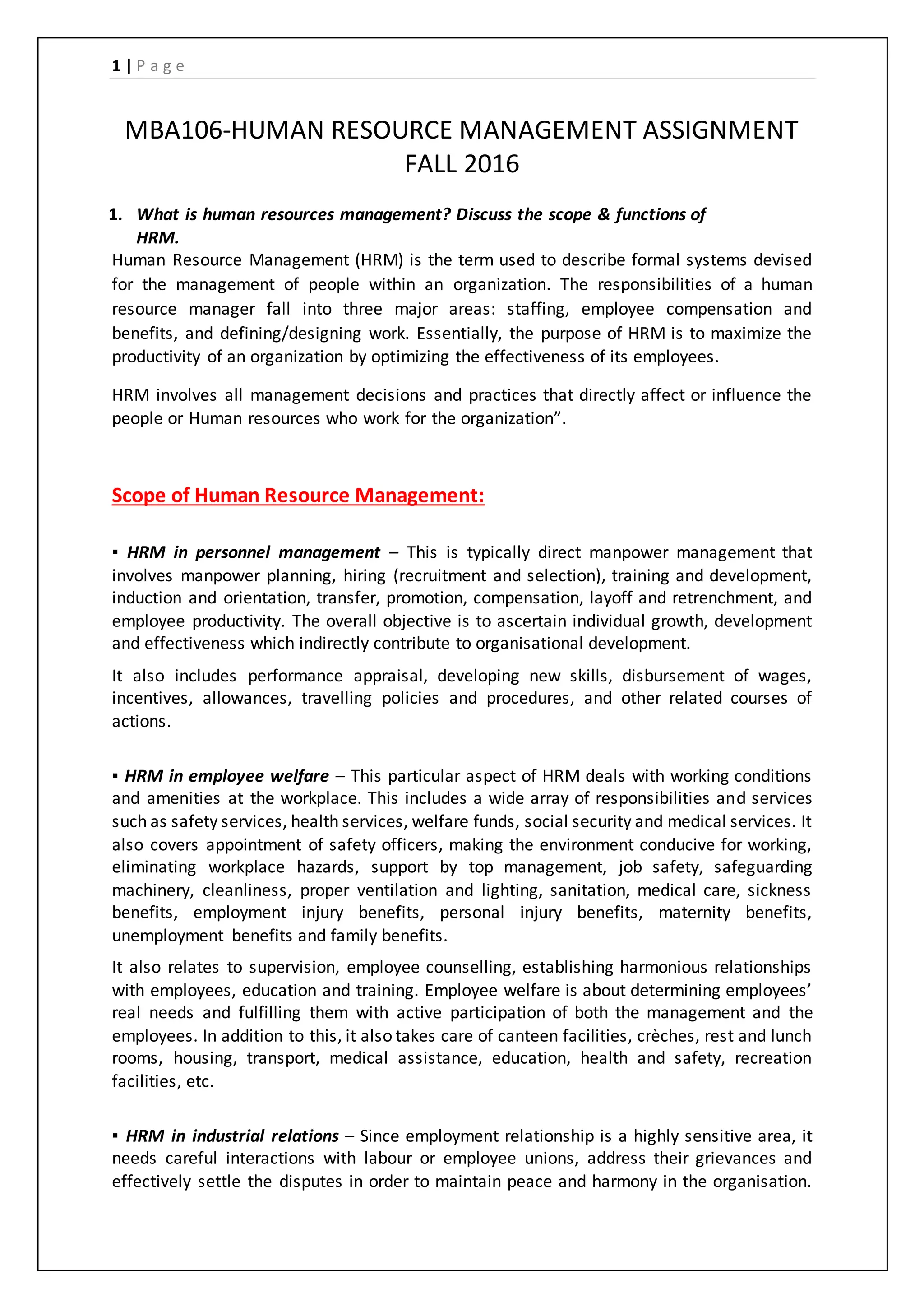
Figure 1 depicts the major functions that an HR manager has to carry out in any
organisation.
Fig. 1 : Flow Chart of Functions of HRM
HRM functions can be broadly classified into the following two categories:
1. Managerial functions
2. Operative functions
3 | P a g e
Managerial functions of HR department
The managerial functions of HR department include the following:
•Planning – Future course of action; it also includes identifying human resource
requirements and forecasting personnel needs.
•Organising – Division of labour; assignment of responsibility is part of the
organisation’s functions.
•Staffing – It is the process of obtaining and maintaining capable and competent
personnel in various positions at all levels, i.e., manpower planning, recruitment,
selection, placement and induction.
•Directing – It is the process of directing all the available resources towards the
common organisational goals.
•Controlling – It is the measurement and rectification of activities to ensure that the
events conform to plans.
Operative functions of HR department
Operative functions of HR department are those core functions that only the HR department
is assigned to perform. These include functions such as employment of new personnel,
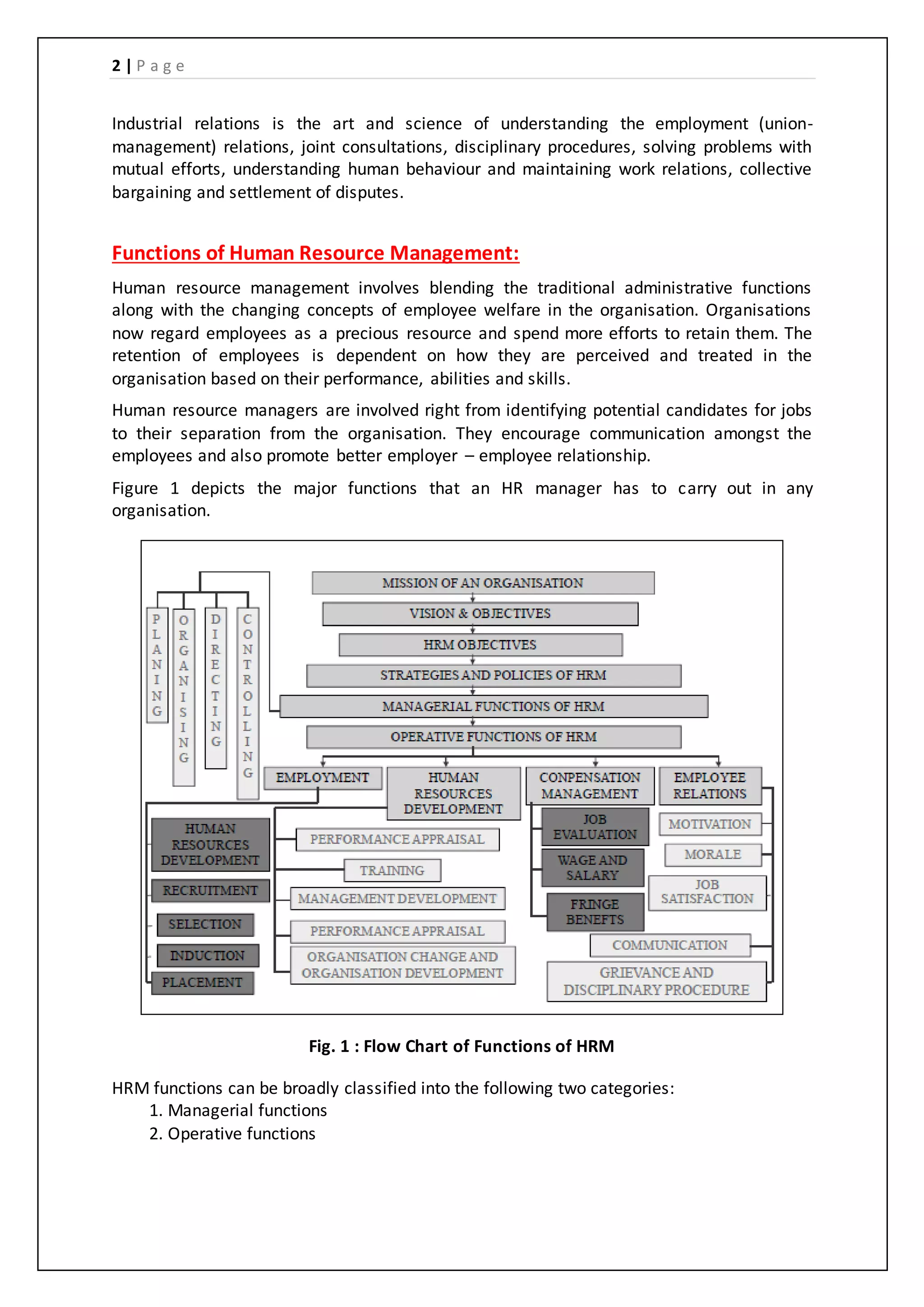
developing their skill sets, compensating them for their efforts and maintaining employee
relations. Figure 2 depicts the operative functions of HRM.
Fig. 2: Operative Functions of HRM
Let us now discuss the operative functions of HRM.
•Employment – Employment is the first operative function of HRM. This involves
procuring and employing individuals with suitable knowledge, skills, experience and
aptitude necessary to perform various jobs. It includes functions such as job analysis,
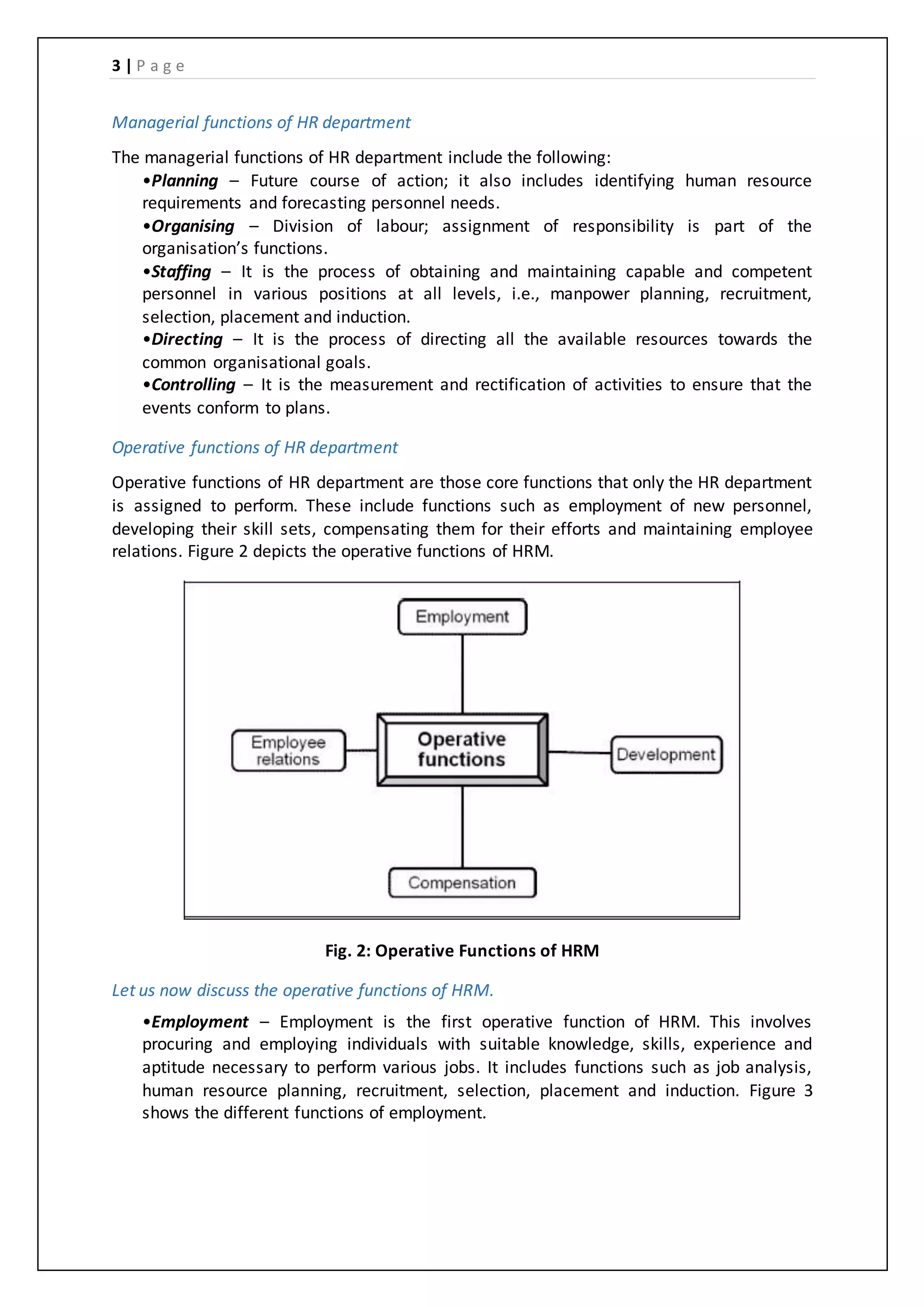
human resource planning, recruitment, selection, placement and induction. Figure 3
shows the different functions of employment.
4 | P a g e
Fig. 3: Functions of Employment
The various functions of employment are:
a)Job analysis – To ensure the satisfactory performance of an employee, his skills,
abilities and motives to perform a job must match the requirements of the job.Job
analysis is the process by which the tasks which comprise the job are determined and
the skills and abilities required to perform it successfully are identified.
b)HR planning – HR planning involves forecasting the human resource requirements of
an organisation and the future supply of human resources, and making suitable
adjustments between the two in correlation with the organisational plans.
c)Recruitment – Recruitment is the process of seeking and attracting prospective
candidates against a vacancy in the organisation.
d)Selection – The purpose of employment selection is to choose the right candidate for
a job.
e)Placement – After a selected candidate conveys his or her acceptance of the offer of
employment made by an organisation, his or her placement has to be decided based
on the needs of the organisation.
f)Induction – Introducing a new employee to the organisation, the organisation’s
business, its culture, values and beliefs, and practices and procedures is termed as
induction.
•HR development – HR development concentrates on developing the workforce so that
both the employees and the organisation in turn can achieve their goals. It focuses on
strengthening the skills, knowledge and aptitudes of the employees. This includes functions
starting with evaluating the performance of the employees, providing necessary training
and development programmes to fill the gaps between current performances to the
optimum performance of employees.
HR development involves functions such as:
a) Performance appraisal – This is the process of evaluating the performance of an
employee on the job and developing a plan for the employee’s improvement. This
includes an assessment of the strengths and weaknesses of the employee, and drawing
5 | P a g e
up a development plan in consultation with him or her to prepare him or her for future
tasks and responsibilities in the organisation.
b) Training – Training is the systematic development of knowledge, skills and attitudes
required to perform a given task or job successfully, in an individual.
c) Management development – It is the concept of developing the employees of an
organisation to meet future changes and challenges.
d) Career planning and development – Career planning and development refers to
identifying one’s career goals and formulating plans forachieving them through various
means such as education and work experience.
•Compensation – Compensation includes all the rewards that an employee receives during
the course of his or her job–for his or her contributions to the organisation. Compensation
encompasses base salary, incentives, bonus and benefits, and is based on job evaluation.
a) Job evaluation – Job evaluationis a systematic determination of the value of each job
in relation to other jobs in the organisation, in the industry and in the market.
b) Wage and salary administration – Wage and salary administration is the process of
formulating and operating a suitable wage and salary programme.
c) Incentives – Incentives are the rewards that an employee earns in addition to regular
wages or salary based on the performance of the individual, the team or the
organisation.
d) Fringe benefits – Fringe benefits are monetary and non-monetary benefits given to
employees during their employment, and sometimes, also in the post-employment
period. These include housing facilities, canteen facilities, conveyance facilities,
educational facilities for employees and their children, medical and welfare facilities,
company stores, etc.
•Employee relations – Employee relations deals with the employees, in the organisational
context, as a social group that contributes to the organisation. It includes:
a) Increasing employee productivity.
b) Keeping the employees satisfied and motivated.
c) Developing team building, team management, leadership skills in employees.
d) Designing and implementing a fast and suitable grievance management system.
e) Ensuring discipline among the employees by prompt action to correct deviations.
f) Supporting employees by counselling and developing them into complete individuals
and responsible citizens.
g) Enhancing the quality of both work and personal life of the employees.
2. Describe the process of HR Planning. Explain HR Forecasting
Techniques .
The process of Human Resource Planning
The process of Human Resource Planning is one of the most critical, difficult and continuing
managerial functions which, according to the Tata Electric and Locomotive Company (now
6 | P a g e
known as Tata Motors), "embraces organisation development, management development,
career planning and succession planning."
'Manpower planning consists of projecting future manpower requirements and developing
manpower plans for the implementation of the projections.'
Objectives of the human resource planning are:
•to maintain the required quantity and quality of human resource required for an even
and well-organised functioning of the organisation.
•to forecast the turnover/attrition rates.
•to plan to meet organisational human resource needs at the time of expansion or
diversification.
HRP may be rightly regarded as a multi-step process, including various issues such as:
• deciding goals or objectives.
• estimating future organisational structure and manpower requirements.
• auditing human resources both internally and externally.
• planning job requirements and job descriptions/person specifications.
• building a plan.
Steps in human resource planning
The basic steps of HRP include the following:
1. Considering the effect of organisational strategy and objectives on different units of
the organisation in terms of the human resource requirement.
2. Forecasting the manpower requirements of the organisation by involving the line
managers to decide and finalise the human resource needs of their respective
department. Forecasting may be carried out using mathematical projection tools or
judgements.
3. Forecasting the quality and quantity of human resource required by each
department/division.
4. Creating an inventory of present manpower resources.
5. Matching the current human resources position incumbents in the organisation with
the numbers required in the future.
6. Developing an action plan to meet the future requirements in terms of addition or
separation, in a planned and phased manner. It involves planning the necessary
programmes of recruitment, selection, training, development, utilisation, transfer,
promotion, motivation and compensation to ensure that future manpower
requirements are properly met.
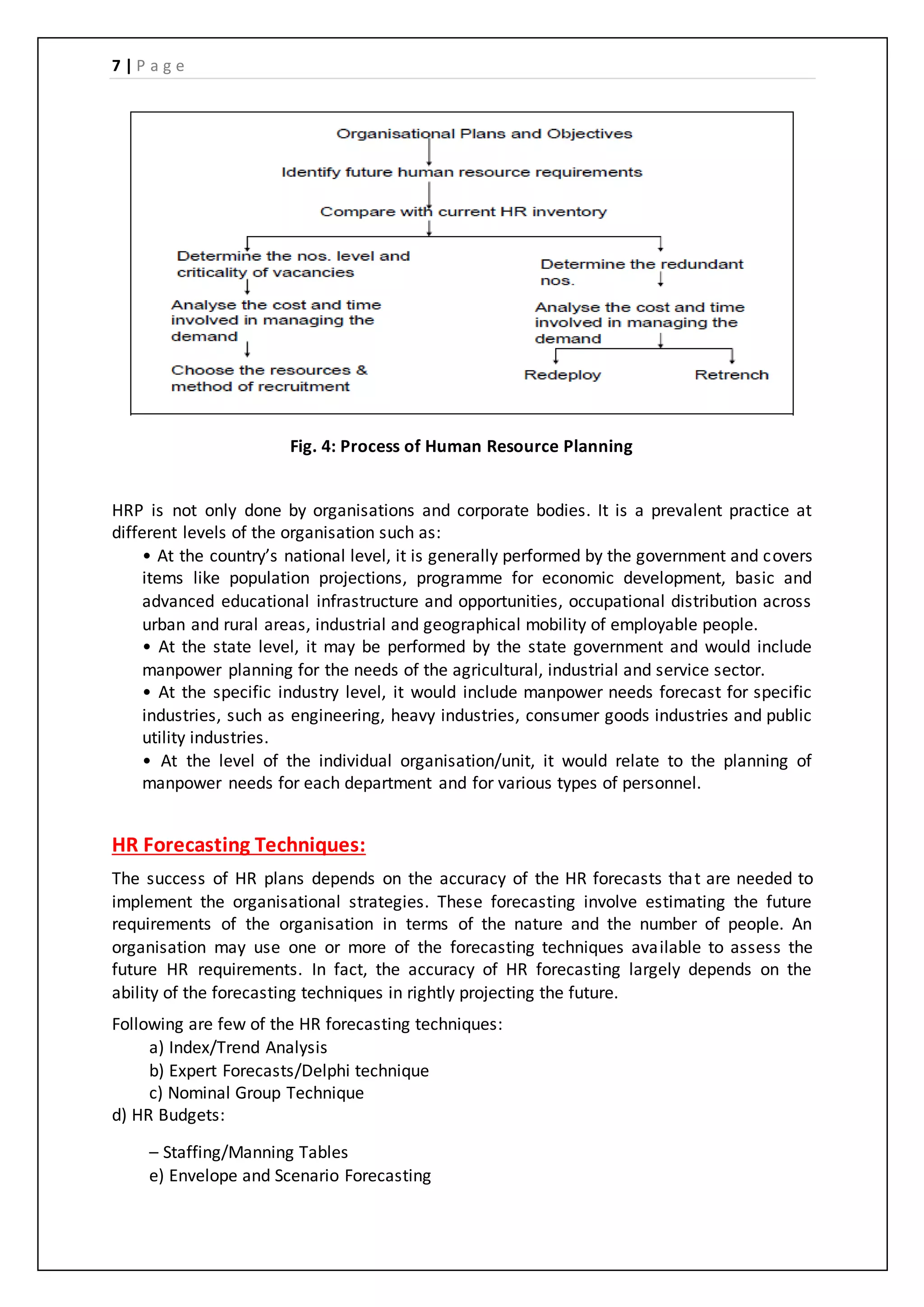
Figure 4 depicts the various steps involved in the process of HRP.
7 | P a g e
Fig. 4: Process of Human Resource Planning
HRP is not only done by organisations and corporate bodies. It is a prevalent practice at
different levels of the organisation such as:
• At the country’s national level, it is generally performed by the government and covers
items like population projections, programme for economic development, basic and
advanced educational infrastructure and opportunities, occupational distribution across
urban and rural areas, industrial and geographical mobility of employable people.
• At the state level, it may be performed by the state government and would include
manpower planning for the needs of the agricultural, industrial and service sector.
• At the specific industry level, it would include manpower needs forecast for specific
industries, such as engineering, heavy industries, consumer goods industries and public
utility industries.
• At the level of the individual organisation/unit, it would relate to the planning of
manpower needs for each department and for various types of personnel.
HR Forecasting Techniques:
The success of HR plans depends on the accuracy of the HR forecasts that are needed to
implement the organisational strategies. These forecasting involve estimating the future
requirements of the organisation in terms of the nature and the number of people. An
organisation may use one or more of the forecasting techniques available to assess the
future HR requirements. In fact, the accuracy of HR forecasting largely depends on the
ability of the forecasting techniques in rightly projecting the future.
Following are few of the HR forecasting techniques:
a) Index/Trend Analysis
b) Expert Forecasts/Delphi technique
c) Nominal Group Technique
d) HR Budgets:
– Staffing/Manning Tables
e) Envelope and Scenario Forecasting
8 | P a g e
f) Regression Analysis, etc.
g) Productivity Ration
h) Personal Ratio
i) Time Series
a) Index/Trend analysis
Trend analysis forecasts the requirement for additional manpower by projecting trends of
the past and present to the future. It makes use of operational indices for this.
• Historical relationship between the operational index and the Demand for Labour.
• Operational indices used are:
– Sales
– Number of units produced
– Number of clients serviced
– Production/Direct Labour Hours
Trend analysis can be used for forecasting overall Organisation, Aub-units, or Indirect (Staff)
and Direct (Line) Manpower requirements.
The Index/Trend analysis involves the following steps:
1.Select the appropriate business/operational index – Select a readily available
business index, sales level that is known to have direct influence on the organisational
demand for labour.
2.Track the index over time – Once the index has been selected, it is necessary to go
back in time for at least four or five most recent years.
3.Track the workforce size over time – Record the historical figures of the total number
of employees.
4.Calculate the average (or most recent) ratio of the business index to the workforce
size (‘Employee Requirement Ratio’) – In this step, the ratio of number of employees
required for each thousand rupees of sales is obtained by dividing each year’s number
of employees by the level of sales.
5.Calculate the forecasted HR demand – Multiply the annual forecasting for the
business index times the average employee requirement ratio for each future year to
arrive at forecasted annual demand for labour.
b) Expert forecasting or Delphi technique:
This method is essentially a group process to achieve a consensus forecast. This method
calls for selection of a panel of experts either from within or outside the organisation. A
series of questions is prepared from the responses received from a prior set of questions in
sequencing manner.
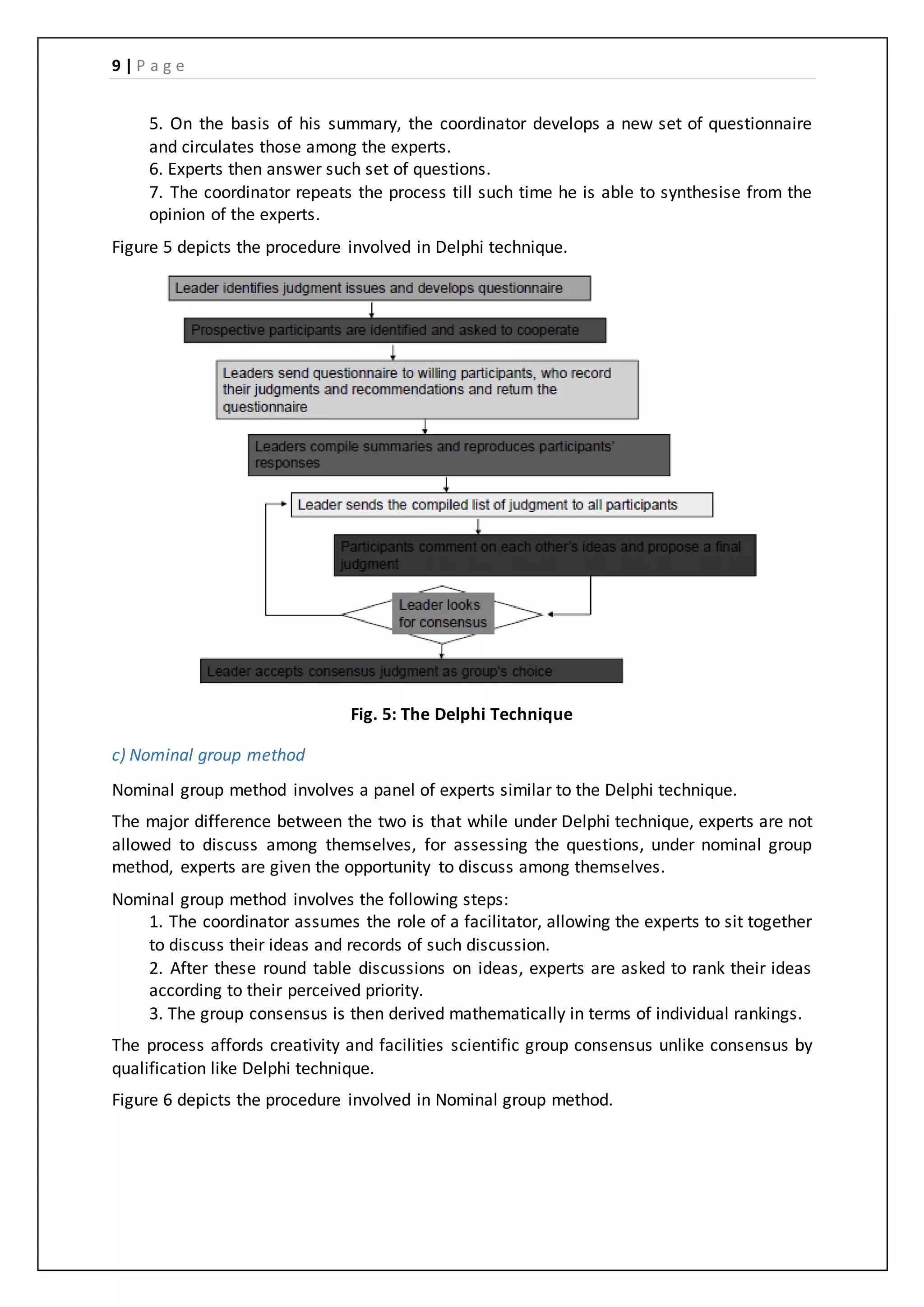
The procedure of Delphi technique involves the following steps:
1. To start with, it requires selection of a coordinator and a panel of experts from both
within and outside the organisation.
2. The coordinator then circulates questions in writing to each such expert.
3. The experts then write their observations.
4. The coordinator then edits those observations and summarises, without however
disclosing the majority opinion in his summary.
9 | P a g e
5. On the basis of his summary, the coordinator develops a new set of questionnaire
and circulates those among the experts.
6. Experts then answer such set of questions.
7. The coordinator repeats the process till such time he is able to synthesise from the
opinion of the experts.
Figure 5 depicts the procedure involved in Delphi technique.
Fig. 5: The Delphi Technique
c) Nominal group method
Nominal group method involves a panel of experts similar to the Delphi technique.
The major difference between the two is that while under Delphi technique, experts are not
allowed to discuss among themselves, for assessing the questions, under nominal group
method, experts are given the opportunity to discuss among themselves.
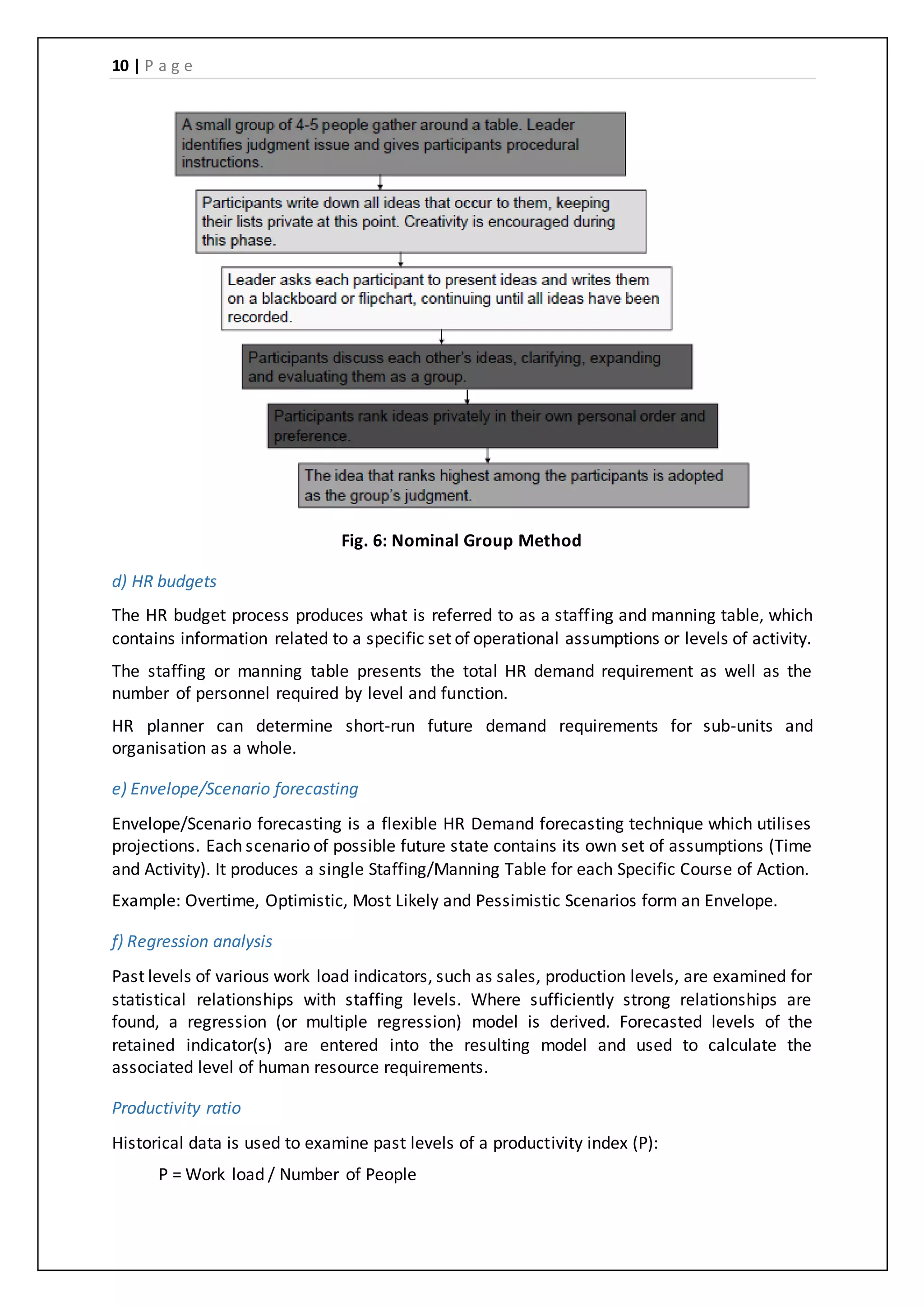
Nominal group method involves the following steps:
1. The coordinator assumes the role of a facilitator, allowing the experts to sit together
to discuss their ideas and records of such discussion.
2. After these round table discussions on ideas, experts are asked to rank their ideas
according to their perceived priority.
3. The group consensus is then derived mathematically in terms of individual rankings.
The process affords creativity and facilities scientific group consensus unlike consensus by
qualification like Delphi technique.
Figure 6 depicts the procedure involved in Nominal group method.
10 | P a g e
Fig. 6: Nominal Group Method
d) HR budgets
The HR budget process produces what is referred to as a staffing and manning table, which
contains information related to a specific set of operational assumptions or levels of activity.
The staffing or manning table presents the total HR demand requirement as well as the
number of personnel required by level and function.
HR planner can determine short-run future demand requirements for sub-units and
organisation as a whole.
e) Envelope/Scenario forecasting
Envelope/Scenario forecasting is a flexible HR Demand forecasting technique which utilises
projections. Each scenario of possible future state contains its own set of assumptions (Time
and Activity). It produces a single Staffing/Manning Table for each Specific Course of Action.
Example: Overtime, Optimistic, Most Likely and Pessimistic Scenarios form an Envelope.
f) Regression analysis
Past levels of various work load indicators, such as sales, production levels, are examined for
statistical relationships with staffing levels. Where sufficiently strong relationships are
found, a regression (or multiple regression) model is derived. Forecasted levels of the
retained indicator(s) are entered into the resulting model and used to calculate the
associated level of human resource requirements.
Productivity ratio
Historical data is used to examine past levels of a productivity index (P):
P = Work load / Number of People
11 | P a g e
Where constant, or systematic, relationships are found, human resource requirements can
be computed by diving predicted workloads by P.
g) Personnel ratio
Past personnel data is examined to determine historical relationships among the employees
in various jobs or job categories. Regression analysis or productivity ratios are then used to
project either total or key-group human resource requirements and personnel ratios are
used to allocate total requirements to various job categories or to estimate for non-key
groups.
h) Time series
Past staffing levels (instead of work load indicators) are used to project future human
resource requirements. Past staffing levels are examined to isolate cyclical variation, long-
tem terms, and random movement. Long-term trends are then extrapolated or projected
using moving average, exponential smoothing or regression technique.
3. What is succession planning? What are the benefits of having a formal
Succession Planning System in an organization?
SuccessionPlanning:
Succession planning involves an examination of strategic (long-range) plans and HR
forecasts for all identified key positions in an organisation. There are many benefits of
having a formal Succession Planning System that provides a clear framework to strategic
business planning: Aligning strategic goals and human resources, development of qualified
pools of candidates, providing stability in leadership, identifying workforce renewal needs,
helping individuals realise their career plans, improving employees’ ability to respond to
changing environmental demands, and the opportunity for timely corporate knowledge
transfer.
Following are the benefits of having a formal Succession Planning System in
an organisation:
•Provides a clear framework to strategic business planning as the key positions for the
business’s success are what are being planned for.
•Aligns strategic goals and human resources to enable the “right people in the right place at
the right time” to achieve desired business results.
•Develops qualified pools of candidates ready to fill critical or key positions.
•Provides stability in leadership and other critical positions to sustain a high-performing
service.
12 | P a g e
•Identifies workforce renewal needs as a means of targeting necessary employee training
and development.
•Helps individuals realise their career plans and aspirations within the organisation.
•Improves employees’ ability to respond to changing environmental demands.
•Provides opportunity for timely corporate knowledge transfer.
•Regardless of what type of succession planning programme is used (formal or informal),
most successful programmes obtain the support of top management.

Human resource management assignment

  • 1.
    1 | Pa g e MBA106-HUMAN RESOURCE MANAGEMENT ASSIGNMENT FALL 2016 1. What is human resources management? Discuss the scope & functions of HRM. Human Resource Management (HRM) is the term used to describe formal systems devised for the management of people within an organization. The responsibilities of a human resource manager fall into three major areas: staffing, employee compensation and benefits, and defining/designing work. Essentially, the purpose of HRM is to maximize the productivity of an organization by optimizing the effectiveness of its employees. HRM involves all management decisions and practices that directly affect or influence the people or Human resources who work for the organization”. Scope of Human Resource Management: ▪ HRM in personnel management – This is typically direct manpower management that involves manpower planning, hiring (recruitment and selection), training and development, induction and orientation, transfer, promotion, compensation, layoff and retrenchment, and employee productivity. The overall objective is to ascertain individual growth, development and effectiveness which indirectly contribute to organisational development. It also includes performance appraisal, developing new skills, disbursement of wages, incentives, allowances, travelling policies and procedures, and other related courses of actions. ▪ HRM in employee welfare – This particular aspect of HRM deals with working conditions and amenities at the workplace. This includes a wide array of responsibilities and services such as safety services, health services, welfare funds, social security and medical services. It also covers appointment of safety officers, making the environment conducive for working, eliminating workplace hazards, support by top management, job safety, safeguarding machinery, cleanliness, proper ventilation and lighting, sanitation, medical care, sickness benefits, employment injury benefits, personal injury benefits, maternity benefits, unemployment benefits and family benefits. It also relates to supervision, employee counselling, establishing harmonious relationships with employees, education and training. Employee welfare is about determining employees’ real needs and fulfilling them with active participation of both the management and the employees. In addition to this, it also takes care of canteen facilities, crèches, rest and lunch rooms, housing, transport, medical assistance, education, health and safety, recreation facilities, etc. ▪ HRM in industrial relations – Since employment relationship is a highly sensitive area, it needs careful interactions with labour or employee unions, address their grievances and effectively settle the disputes in order to maintain peace and harmony in the organisation.
  • 2.
    2 | Pa g e Industrial relations is the art and science of understanding the employment (union- management) relations, joint consultations, disciplinary procedures, solving problems with mutual efforts, understanding human behaviour and maintaining work relations, collective bargaining and settlement of disputes. Functions of Human Resource Management: Human resource management involves blending the traditional administrative functions along with the changing concepts of employee welfare in the organisation. Organisations now regard employees as a precious resource and spend more efforts to retain them. The retention of employees is dependent on how they are perceived and treated in the organisation based on their performance, abilities and skills. Human resource managers are involved right from identifying potential candidates for jobs to their separation from the organisation. They encourage communication amongst the employees and also promote better employer – employee relationship. Figure 1 depicts the major functions that an HR manager has to carry out in any organisation. Fig. 1 : Flow Chart of Functions of HRM HRM functions can be broadly classified into the following two categories: 1. Managerial functions 2. Operative functions
  • 3.
    3 | Pa g e Managerial functions of HR department The managerial functions of HR department include the following: •Planning – Future course of action; it also includes identifying human resource requirements and forecasting personnel needs. •Organising – Division of labour; assignment of responsibility is part of the organisation’s functions. •Staffing – It is the process of obtaining and maintaining capable and competent personnel in various positions at all levels, i.e., manpower planning, recruitment, selection, placement and induction. •Directing – It is the process of directing all the available resources towards the common organisational goals. •Controlling – It is the measurement and rectification of activities to ensure that the events conform to plans. Operative functions of HR department Operative functions of HR department are those core functions that only the HR department is assigned to perform. These include functions such as employment of new personnel, developing their skill sets, compensating them for their efforts and maintaining employee relations. Figure 2 depicts the operative functions of HRM. Fig. 2: Operative Functions of HRM Let us now discuss the operative functions of HRM. •Employment – Employment is the first operative function of HRM. This involves procuring and employing individuals with suitable knowledge, skills, experience and aptitude necessary to perform various jobs. It includes functions such as job analysis, human resource planning, recruitment, selection, placement and induction. Figure 3 shows the different functions of employment.
  • 4.
    4 | Pa g e Fig. 3: Functions of Employment The various functions of employment are: a)Job analysis – To ensure the satisfactory performance of an employee, his skills, abilities and motives to perform a job must match the requirements of the job.Job analysis is the process by which the tasks which comprise the job are determined and the skills and abilities required to perform it successfully are identified. b)HR planning – HR planning involves forecasting the human resource requirements of an organisation and the future supply of human resources, and making suitable adjustments between the two in correlation with the organisational plans. c)Recruitment – Recruitment is the process of seeking and attracting prospective candidates against a vacancy in the organisation. d)Selection – The purpose of employment selection is to choose the right candidate for a job. e)Placement – After a selected candidate conveys his or her acceptance of the offer of employment made by an organisation, his or her placement has to be decided based on the needs of the organisation. f)Induction – Introducing a new employee to the organisation, the organisation’s business, its culture, values and beliefs, and practices and procedures is termed as induction. •HR development – HR development concentrates on developing the workforce so that both the employees and the organisation in turn can achieve their goals. It focuses on strengthening the skills, knowledge and aptitudes of the employees. This includes functions starting with evaluating the performance of the employees, providing necessary training and development programmes to fill the gaps between current performances to the optimum performance of employees. HR development involves functions such as: a) Performance appraisal – This is the process of evaluating the performance of an employee on the job and developing a plan for the employee’s improvement. This includes an assessment of the strengths and weaknesses of the employee, and drawing
  • 5.
    5 | Pa g e up a development plan in consultation with him or her to prepare him or her for future tasks and responsibilities in the organisation. b) Training – Training is the systematic development of knowledge, skills and attitudes required to perform a given task or job successfully, in an individual. c) Management development – It is the concept of developing the employees of an organisation to meet future changes and challenges. d) Career planning and development – Career planning and development refers to identifying one’s career goals and formulating plans forachieving them through various means such as education and work experience. •Compensation – Compensation includes all the rewards that an employee receives during the course of his or her job–for his or her contributions to the organisation. Compensation encompasses base salary, incentives, bonus and benefits, and is based on job evaluation. a) Job evaluation – Job evaluationis a systematic determination of the value of each job in relation to other jobs in the organisation, in the industry and in the market. b) Wage and salary administration – Wage and salary administration is the process of formulating and operating a suitable wage and salary programme. c) Incentives – Incentives are the rewards that an employee earns in addition to regular wages or salary based on the performance of the individual, the team or the organisation. d) Fringe benefits – Fringe benefits are monetary and non-monetary benefits given to employees during their employment, and sometimes, also in the post-employment period. These include housing facilities, canteen facilities, conveyance facilities, educational facilities for employees and their children, medical and welfare facilities, company stores, etc. •Employee relations – Employee relations deals with the employees, in the organisational context, as a social group that contributes to the organisation. It includes: a) Increasing employee productivity. b) Keeping the employees satisfied and motivated. c) Developing team building, team management, leadership skills in employees. d) Designing and implementing a fast and suitable grievance management system. e) Ensuring discipline among the employees by prompt action to correct deviations. f) Supporting employees by counselling and developing them into complete individuals and responsible citizens. g) Enhancing the quality of both work and personal life of the employees. 2. Describe the process of HR Planning. Explain HR Forecasting Techniques . The process of Human Resource Planning The process of Human Resource Planning is one of the most critical, difficult and continuing managerial functions which, according to the Tata Electric and Locomotive Company (now
  • 6.
    6 | Pa g e known as Tata Motors), "embraces organisation development, management development, career planning and succession planning." 'Manpower planning consists of projecting future manpower requirements and developing manpower plans for the implementation of the projections.' Objectives of the human resource planning are: •to maintain the required quantity and quality of human resource required for an even and well-organised functioning of the organisation. •to forecast the turnover/attrition rates. •to plan to meet organisational human resource needs at the time of expansion or diversification. HRP may be rightly regarded as a multi-step process, including various issues such as: • deciding goals or objectives. • estimating future organisational structure and manpower requirements. • auditing human resources both internally and externally. • planning job requirements and job descriptions/person specifications. • building a plan. Steps in human resource planning The basic steps of HRP include the following: 1. Considering the effect of organisational strategy and objectives on different units of the organisation in terms of the human resource requirement. 2. Forecasting the manpower requirements of the organisation by involving the line managers to decide and finalise the human resource needs of their respective department. Forecasting may be carried out using mathematical projection tools or judgements. 3. Forecasting the quality and quantity of human resource required by each department/division. 4. Creating an inventory of present manpower resources. 5. Matching the current human resources position incumbents in the organisation with the numbers required in the future. 6. Developing an action plan to meet the future requirements in terms of addition or separation, in a planned and phased manner. It involves planning the necessary programmes of recruitment, selection, training, development, utilisation, transfer, promotion, motivation and compensation to ensure that future manpower requirements are properly met. Figure 4 depicts the various steps involved in the process of HRP.
  • 7.
    7 | Pa g e Fig. 4: Process of Human Resource Planning HRP is not only done by organisations and corporate bodies. It is a prevalent practice at different levels of the organisation such as: • At the country’s national level, it is generally performed by the government and covers items like population projections, programme for economic development, basic and advanced educational infrastructure and opportunities, occupational distribution across urban and rural areas, industrial and geographical mobility of employable people. • At the state level, it may be performed by the state government and would include manpower planning for the needs of the agricultural, industrial and service sector. • At the specific industry level, it would include manpower needs forecast for specific industries, such as engineering, heavy industries, consumer goods industries and public utility industries. • At the level of the individual organisation/unit, it would relate to the planning of manpower needs for each department and for various types of personnel. HR Forecasting Techniques: The success of HR plans depends on the accuracy of the HR forecasts that are needed to implement the organisational strategies. These forecasting involve estimating the future requirements of the organisation in terms of the nature and the number of people. An organisation may use one or more of the forecasting techniques available to assess the future HR requirements. In fact, the accuracy of HR forecasting largely depends on the ability of the forecasting techniques in rightly projecting the future. Following are few of the HR forecasting techniques: a) Index/Trend Analysis b) Expert Forecasts/Delphi technique c) Nominal Group Technique d) HR Budgets: – Staffing/Manning Tables e) Envelope and Scenario Forecasting
  • 8.
    8 | Pa g e f) Regression Analysis, etc. g) Productivity Ration h) Personal Ratio i) Time Series a) Index/Trend analysis Trend analysis forecasts the requirement for additional manpower by projecting trends of the past and present to the future. It makes use of operational indices for this. • Historical relationship between the operational index and the Demand for Labour. • Operational indices used are: – Sales – Number of units produced – Number of clients serviced – Production/Direct Labour Hours Trend analysis can be used for forecasting overall Organisation, Aub-units, or Indirect (Staff) and Direct (Line) Manpower requirements. The Index/Trend analysis involves the following steps: 1.Select the appropriate business/operational index – Select a readily available business index, sales level that is known to have direct influence on the organisational demand for labour. 2.Track the index over time – Once the index has been selected, it is necessary to go back in time for at least four or five most recent years. 3.Track the workforce size over time – Record the historical figures of the total number of employees. 4.Calculate the average (or most recent) ratio of the business index to the workforce size (‘Employee Requirement Ratio’) – In this step, the ratio of number of employees required for each thousand rupees of sales is obtained by dividing each year’s number of employees by the level of sales. 5.Calculate the forecasted HR demand – Multiply the annual forecasting for the business index times the average employee requirement ratio for each future year to arrive at forecasted annual demand for labour. b) Expert forecasting or Delphi technique: This method is essentially a group process to achieve a consensus forecast. This method calls for selection of a panel of experts either from within or outside the organisation. A series of questions is prepared from the responses received from a prior set of questions in sequencing manner. The procedure of Delphi technique involves the following steps: 1. To start with, it requires selection of a coordinator and a panel of experts from both within and outside the organisation. 2. The coordinator then circulates questions in writing to each such expert. 3. The experts then write their observations. 4. The coordinator then edits those observations and summarises, without however disclosing the majority opinion in his summary.
  • 9.
    9 | Pa g e 5. On the basis of his summary, the coordinator develops a new set of questionnaire and circulates those among the experts. 6. Experts then answer such set of questions. 7. The coordinator repeats the process till such time he is able to synthesise from the opinion of the experts. Figure 5 depicts the procedure involved in Delphi technique. Fig. 5: The Delphi Technique c) Nominal group method Nominal group method involves a panel of experts similar to the Delphi technique. The major difference between the two is that while under Delphi technique, experts are not allowed to discuss among themselves, for assessing the questions, under nominal group method, experts are given the opportunity to discuss among themselves. Nominal group method involves the following steps: 1. The coordinator assumes the role of a facilitator, allowing the experts to sit together to discuss their ideas and records of such discussion. 2. After these round table discussions on ideas, experts are asked to rank their ideas according to their perceived priority. 3. The group consensus is then derived mathematically in terms of individual rankings. The process affords creativity and facilities scientific group consensus unlike consensus by qualification like Delphi technique. Figure 6 depicts the procedure involved in Nominal group method.
  • 10.
    10 | Pa g e Fig. 6: Nominal Group Method d) HR budgets The HR budget process produces what is referred to as a staffing and manning table, which contains information related to a specific set of operational assumptions or levels of activity. The staffing or manning table presents the total HR demand requirement as well as the number of personnel required by level and function. HR planner can determine short-run future demand requirements for sub-units and organisation as a whole. e) Envelope/Scenario forecasting Envelope/Scenario forecasting is a flexible HR Demand forecasting technique which utilises projections. Each scenario of possible future state contains its own set of assumptions (Time and Activity). It produces a single Staffing/Manning Table for each Specific Course of Action. Example: Overtime, Optimistic, Most Likely and Pessimistic Scenarios form an Envelope. f) Regression analysis Past levels of various work load indicators, such as sales, production levels, are examined for statistical relationships with staffing levels. Where sufficiently strong relationships are found, a regression (or multiple regression) model is derived. Forecasted levels of the retained indicator(s) are entered into the resulting model and used to calculate the associated level of human resource requirements. Productivity ratio Historical data is used to examine past levels of a productivity index (P): P = Work load / Number of People
  • 11.
    11 | Pa g e Where constant, or systematic, relationships are found, human resource requirements can be computed by diving predicted workloads by P. g) Personnel ratio Past personnel data is examined to determine historical relationships among the employees in various jobs or job categories. Regression analysis or productivity ratios are then used to project either total or key-group human resource requirements and personnel ratios are used to allocate total requirements to various job categories or to estimate for non-key groups. h) Time series Past staffing levels (instead of work load indicators) are used to project future human resource requirements. Past staffing levels are examined to isolate cyclical variation, long- tem terms, and random movement. Long-term trends are then extrapolated or projected using moving average, exponential smoothing or regression technique. 3. What is succession planning? What are the benefits of having a formal Succession Planning System in an organization? SuccessionPlanning: Succession planning involves an examination of strategic (long-range) plans and HR forecasts for all identified key positions in an organisation. There are many benefits of having a formal Succession Planning System that provides a clear framework to strategic business planning: Aligning strategic goals and human resources, development of qualified pools of candidates, providing stability in leadership, identifying workforce renewal needs, helping individuals realise their career plans, improving employees’ ability to respond to changing environmental demands, and the opportunity for timely corporate knowledge transfer. Following are the benefits of having a formal Succession Planning System in an organisation: •Provides a clear framework to strategic business planning as the key positions for the business’s success are what are being planned for. •Aligns strategic goals and human resources to enable the “right people in the right place at the right time” to achieve desired business results. •Develops qualified pools of candidates ready to fill critical or key positions. •Provides stability in leadership and other critical positions to sustain a high-performing service.
  • 12.
    12 | Pa g e •Identifies workforce renewal needs as a means of targeting necessary employee training and development. •Helps individuals realise their career plans and aspirations within the organisation. •Improves employees’ ability to respond to changing environmental demands. •Provides opportunity for timely corporate knowledge transfer. •Regardless of what type of succession planning programme is used (formal or informal), most successful programmes obtain the support of top management.