HRD SCORECARD & BALANCED SCORECARD Presented By :
Topics Under Study Evolution of HR as a Strategic Partner What is HR Scorecard & its benefits How to Create an HR Scorecard Cost Benefit Analysis Principles of Good Measurement Measuring HR Alignment Competencies for HR Professionals Guidelines for Implementing HR Scorecard What is Balanced Scorecard ? Developing a Balanced Scorecard ? Applying BSC at the functional level ?
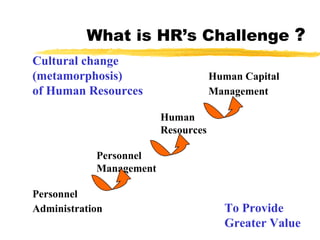
What is HR’s Challenge  ? Cultural change (metamorphosis)   Human Capital of Human Resources   Management Human  Resources Personnel Management Personnel  Administration To Provide Greater Value
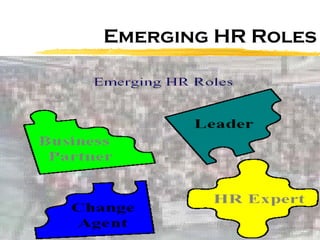
Emerging HR Roles
Business Partner Knows Mission Understands business processes Understands organizational culture Understands nature of public service Recommends alternative solutions Is innovative and creative Thinks strategically Communicates well
Change Agent Designs and implements change process Uses consultation and negotiation skills Builds relationships on trust Works well in teams Uses coalition building skills Demonstrates problem solving skills Willing to take risks
Leader Takes risks Manages conflicts Demonstrates ability to make a decision Effectively manages resources Models ethical behavior Applies coaching, mentoring, and Counseling skills to develop talent
THE EVOLUTION OF HR FROM PROFESSIONAL TO STRATEGIC PARTNER Initially : Administrative & Professional Focus on Individual Employee Incentive compensation In 1990, HR system to be linked with firm’s strategy – need for measurement system
What is HR Scorecard HR Scorecard = filling the gap between what is usually measured in HR, and what is actually essential to the firm. Too often “the cobbler’s children go barefoot” and HR lacks its own performance measurement system.
Benefits Of The HR Scorecard It reinforces the distinction between HR doables and HR deliverables It enables you to control costs and create value It measures leading indicators It assesses HR’s contribution to strategy implementation  It lets HR professionals effectively manage their strategic responsibilities It encourages flexibility and change
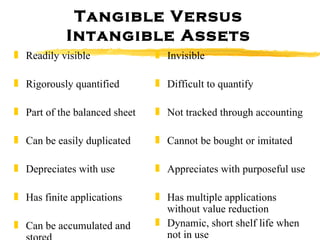
Readily visible Rigorously quantified Part of the balanced sheet Can be easily duplicated Depreciates with use Has finite applications Can be accumulated and stored Invisible Difficult to quantify Not tracked through accounting Cannot be bought or imitated Appreciates with purposeful use Has multiple applications without value reduction Dynamic, short shelf life when not in use Tangible Versus Intangible Assets
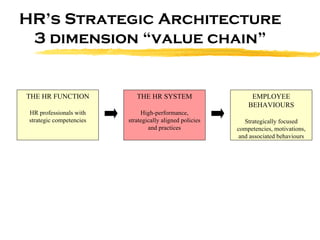
HR’s Strategic Architecture 3 dimension “value chain” THE HR FUNCTION HR professionals with strategic competencies THE HR SYSTEM High-performance, strategically aligned policies and practices EMPLOYEE BEHAVIOURS Strategically focused competencies, motivations, and associated behaviours
The Laws of Systems Thinking  Peter M. Senge Today’s Problems come from yesterday’s “solutions” .  The Easy Way Out Usually Leads Back In   Cause and Effect Are Not Closely Related in Time and  The Highest Leverage Points Are Often The Least Obvious   Cutting an Elephant in Half Doesn’t Get You Two Smaller Elephants; It gets You a Mess
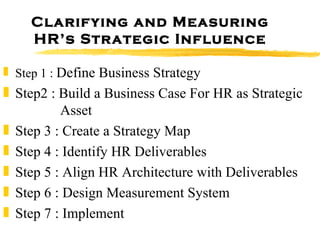
Clarifying and Measuring HR’s Strategic Influence Step 1 :  Define Business Strategy Step2 : Build a Business Case For HR as Strategic    Asset Step 3 : Create a Strategy Map Step 4 : Identify HR Deliverables Step 5 : Align HR Architecture with Deliverables Step 6 : Design Measurement System Step 7 : Implement
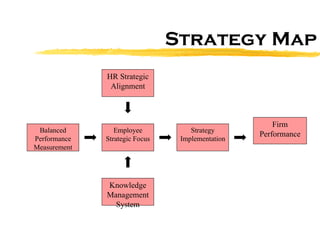
Strategy Map Firm Performance Balanced Performance Measurement Knowledge Management System HR Strategic Alignment Employee Strategic Focus Strategy Implementation
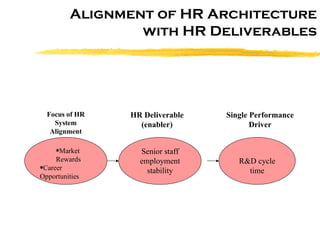
Alignment of HR Architecture with HR Deliverables Market Rewards Career Opportunities Senior staff employment stability R&D cycle time Focus of HR System Alignment HR Deliverable (enabler) Single Performance Driver
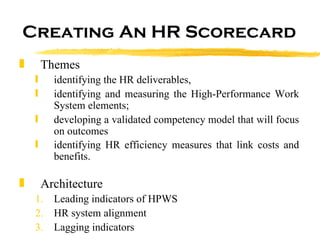
Creating An HR Scorecard Themes identifying the HR deliverables,  identifying and measuring the High-Performance Work System elements;  developing a validated competency model that will focus on outcomes identifying HR efficiency measures that link costs and benefits.   Architecture Leading indicators of HPWS HR system alignment Lagging indicators
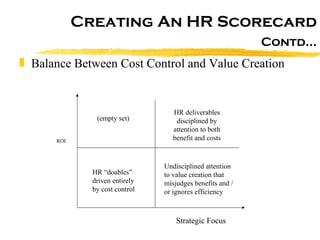
Creating An HR Scorecard Contd… Balance Between Cost Control and Value Creation ROI Strategic Focus (empty set) HR “doables” driven entirely by cost control HR deliverables disciplined by attention to both benefit and costs Undisciplined attention to value creation that misjudges benefits and / or ignores efficiency
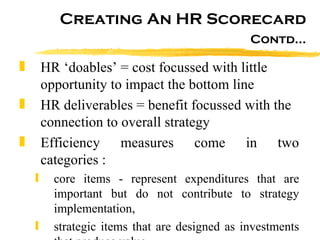
Creating An HR Scorecard Contd… HR ‘doables’ = cost focussed with little opportunity to impact the bottom line HR deliverables = benefit focussed with the connection to overall strategy Efficiency measures come in two categories : core items - represent expenditures that are important but do not contribute to strategy implementation,  strategic items that are designed as investments that produce value.
Re- Check Reinforce the distinction between doables and deliverables Enable cost control and value creation Measure leading indicators Assess contribution to the bottom line Let HR professionals effectively manage their strategic responsibilities Encourage flexibility and change
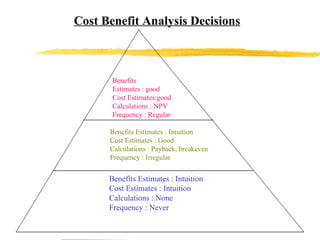
Benefits  Estimates : good Cost Estimates:good Calculations : NPV Frequency : Regular Benefits Estimates : Intuition Cost Estimates : Good Calculations : Payback, breakeven Frequency : Irregular Benefits Estimates : Intuition Cost Estimates : Intuition Calculations : None Frequency : Never Cost Benefit Analysis Decisions
Principles of Good Measurement Linking HR Deliverables to Strategy Implementation Focus on creating value Relationship between attributes and strategic outcome Measurement numbers to be compared with Historical data or to industry standards
Competencies For HR Professionals In 1988 – 98 ,  knowledge of the business,  delivery of HR practices, and  the ability to manage change.  In 1997 – 98  culture management and  personal credibility.  Strategic HR performance management.  process of orchestrating strategy implementation through performance measurement systems
The STRATEGIC PERFORMANCE MANAGEMENT Competencies Include : critical causal thinking,  understanding principles of good management,  estimating causal relationships, and communicating HR strategic performance results to senior line managers.
Five Core Competencies cultivating the performance of HR professionals,  assessing HR performance. rewarding it appropriately,  designing HR development programs .
Guidelines for Implementing an HR Scorecard “ Effective change = Quality x Acceptance (EC = Q x A)”…….Steve Kerr Linking strategy with HR architecture Acceptance of change Use of checklist
Leading change (who is responsible) Creating a shared need (why change) Shaping a vision (what will it look like when finished) Mobilizing commitment (who else needs to be involved) Building enabling systems (how will it be institutionalized) Monitoring and demonstrating (how will it be measured) Making it last (how will it be initialed and sustained)  Seven Keys & Processes for Making Change….
4 Critical Dimensions HRD systems maturity HRD competencies in the company HRD culture HRD linkage to business goals
HRD Systems Maturity The systems should be appropriate & relevant Focus and balance the culture & future needs HRD strategies to flow from corporate strategies Systems to be well designed Should be implemented & integrated (synergy) Should be adequate Eg : MPP, Training, PA, Job rotation etc.
HRD COMPETENCIES IN THE CORPORATION : Competencies include Knowledge, attitude, values and skills Categories assessed : The HRD staff The top management Line managers and supervisory staff Union and association leaders Workmen, operators and grass-root level employees
HRD CULTURE AND VALUES   Dimensions Assessed: Openness Collaboration Trust & Trustworthiness Authencity Proaction Confrontation Experimentation Learning Culture Listening
Evolution of Balanced Scorecard Developed in 1990’s – Robert Kaplan & David Norton WHY ??? Lack of clarity as to what should be measured and how should it be measured Provided feedback around internal and external
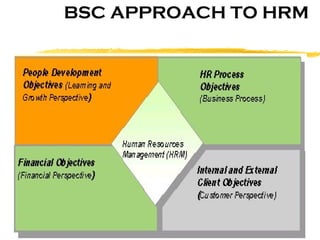
Balanced Scorecard Based on Vision & Strategy of the company Varies from company to company Through Identified Drivers, manage areas, Customer satisfaction  Internal business process  Strategic specific measures  Financial objectives
Four Key Areas : By Kaplan & Norton Learning and growth perspective Deals with people Emphasises on continous learning through Mentorship Tutorship Providing communication channels to focus on solving problems
Four Key Areas : By Kaplan & Norton Business process perspective Refers to internal business processes the mission-oriented process  - unique areas of business the support process – business processes, which are more repetitive in nature
Four Key Areas : By Kaplan & Norton Customer Perspective Critical predictor of future success of an organisation Financial Perspective Timely and accurate financial related data
BSC APPROACH TO HRM
Key Performance Indicators Performance measures also serve as a clear basis for aligning all HR objectives with the company’s business goals. KPI’s help in assessing the progress and introducing corrective action in a timely manner Need for “management by fact”  An organization’s internal and external customers  The performance of an organization’s products and services  Market competitive comparisons  Employee-related statistical data such as attrition rate, turn over costs, and labor cost   System integration and support
Developing A Balanced Scorecard Step  1: Identify clearly defined value drivers for the    audit function Step  2: Specify actions needed to support each of the    value drivers Step  3: Review categories and action steps with key    stakeholder Step  4: Implement a process for measuring what's    been accomplished  Step  5: Establish a system for reporting results to key    stakeholders
Developing A Balanced Scorecard Step  1: Identify clearly defined value drivers for the    audit function pinpointing the value drivers that major stakeholders agree are most vital to superior audit performance  Audit Committee/Board of Directors, executive management, regulators, line management, and even customers.
Developing A Balanced Scorecard Step 2: Specify actions needed to support each of the value drivers Refers to defining actions Eg : working more closely with Human Resources to attract a broader range of audit candidates, interacting with other departments etc.
Developing A Balanced Scorecard Step 3: Review categories and action steps with key stakeholders
Developing A Balanced Scorecard Step 4: Implement a process for measuring what's been accomplished For eg : the value driver on your scorecard is "Building expertise." Action steps aimed at meeting this goal might include:  1)  Promoting training and certification 2) Acquiring specialized skills 3) Expanding networking activities 4) Improving retention rates.
Developing A Balanced Scorecard Step 5: Establish a system for reporting results to key stakeholders Review Communicating Through interviews, surveys and team discussions
World-class companies are investing to ensure that their internal audit function delivers full value in high-impact areas such as risk management—and your company should consider pursuing the same route   Avoid the "silver bullet" syndrome and focus on identifying and developing best practices from within   A Final Glance….
A Final Glance…. Keep your scorecard simple   Stay focused and be prepared to fine-tune the process over time.
In Short… Converting the four perspectives into clear HR strategic business objectives that will align with an organization’s business objectives.  Having specific measurement criteria such as KPIs to measure and assess the effectiveness of the business objectives on an on-going basis.  Having a clear definition of information requirements, and factual data to support the performance measurement process and  Having the necessary system supports to provide relevant data, information and analysis.
Conclusion “ What Gets Measured….  Gets Managed…..”
Thank You

20678074 Hrd Scorecardgroup I

  • 1.
    HRD SCORECARD &BALANCED SCORECARD Presented By :
  • 2.
    Topics Under StudyEvolution of HR as a Strategic Partner What is HR Scorecard & its benefits How to Create an HR Scorecard Cost Benefit Analysis Principles of Good Measurement Measuring HR Alignment Competencies for HR Professionals Guidelines for Implementing HR Scorecard What is Balanced Scorecard ? Developing a Balanced Scorecard ? Applying BSC at the functional level ?
  • 3.
    What is HR’sChallenge ? Cultural change (metamorphosis) Human Capital of Human Resources Management Human Resources Personnel Management Personnel Administration To Provide Greater Value
  • 4.
  • 5.
    Business Partner KnowsMission Understands business processes Understands organizational culture Understands nature of public service Recommends alternative solutions Is innovative and creative Thinks strategically Communicates well
  • 6.
    Change Agent Designsand implements change process Uses consultation and negotiation skills Builds relationships on trust Works well in teams Uses coalition building skills Demonstrates problem solving skills Willing to take risks
  • 7.
    Leader Takes risksManages conflicts Demonstrates ability to make a decision Effectively manages resources Models ethical behavior Applies coaching, mentoring, and Counseling skills to develop talent
  • 8.
    THE EVOLUTION OFHR FROM PROFESSIONAL TO STRATEGIC PARTNER Initially : Administrative & Professional Focus on Individual Employee Incentive compensation In 1990, HR system to be linked with firm’s strategy – need for measurement system
  • 9.
    What is HRScorecard HR Scorecard = filling the gap between what is usually measured in HR, and what is actually essential to the firm. Too often “the cobbler’s children go barefoot” and HR lacks its own performance measurement system.
  • 10.
    Benefits Of TheHR Scorecard It reinforces the distinction between HR doables and HR deliverables It enables you to control costs and create value It measures leading indicators It assesses HR’s contribution to strategy implementation It lets HR professionals effectively manage their strategic responsibilities It encourages flexibility and change
  • 11.
    Readily visible Rigorouslyquantified Part of the balanced sheet Can be easily duplicated Depreciates with use Has finite applications Can be accumulated and stored Invisible Difficult to quantify Not tracked through accounting Cannot be bought or imitated Appreciates with purposeful use Has multiple applications without value reduction Dynamic, short shelf life when not in use Tangible Versus Intangible Assets
  • 12.
    HR’s Strategic Architecture3 dimension “value chain” THE HR FUNCTION HR professionals with strategic competencies THE HR SYSTEM High-performance, strategically aligned policies and practices EMPLOYEE BEHAVIOURS Strategically focused competencies, motivations, and associated behaviours
  • 13.
    The Laws ofSystems Thinking Peter M. Senge Today’s Problems come from yesterday’s “solutions” . The Easy Way Out Usually Leads Back In Cause and Effect Are Not Closely Related in Time and The Highest Leverage Points Are Often The Least Obvious Cutting an Elephant in Half Doesn’t Get You Two Smaller Elephants; It gets You a Mess
  • 14.
    Clarifying and MeasuringHR’s Strategic Influence Step 1 : Define Business Strategy Step2 : Build a Business Case For HR as Strategic Asset Step 3 : Create a Strategy Map Step 4 : Identify HR Deliverables Step 5 : Align HR Architecture with Deliverables Step 6 : Design Measurement System Step 7 : Implement
  • 15.
    Strategy Map FirmPerformance Balanced Performance Measurement Knowledge Management System HR Strategic Alignment Employee Strategic Focus Strategy Implementation
  • 16.
    Alignment of HRArchitecture with HR Deliverables Market Rewards Career Opportunities Senior staff employment stability R&D cycle time Focus of HR System Alignment HR Deliverable (enabler) Single Performance Driver
  • 17.
    Creating An HRScorecard Themes identifying the HR deliverables, identifying and measuring the High-Performance Work System elements; developing a validated competency model that will focus on outcomes identifying HR efficiency measures that link costs and benefits. Architecture Leading indicators of HPWS HR system alignment Lagging indicators
  • 18.
    Creating An HRScorecard Contd… Balance Between Cost Control and Value Creation ROI Strategic Focus (empty set) HR “doables” driven entirely by cost control HR deliverables disciplined by attention to both benefit and costs Undisciplined attention to value creation that misjudges benefits and / or ignores efficiency
  • 19.
    Creating An HRScorecard Contd… HR ‘doables’ = cost focussed with little opportunity to impact the bottom line HR deliverables = benefit focussed with the connection to overall strategy Efficiency measures come in two categories : core items - represent expenditures that are important but do not contribute to strategy implementation, strategic items that are designed as investments that produce value.
  • 20.
    Re- Check Reinforcethe distinction between doables and deliverables Enable cost control and value creation Measure leading indicators Assess contribution to the bottom line Let HR professionals effectively manage their strategic responsibilities Encourage flexibility and change
  • 21.
    Benefits Estimates: good Cost Estimates:good Calculations : NPV Frequency : Regular Benefits Estimates : Intuition Cost Estimates : Good Calculations : Payback, breakeven Frequency : Irregular Benefits Estimates : Intuition Cost Estimates : Intuition Calculations : None Frequency : Never Cost Benefit Analysis Decisions
  • 22.
    Principles of GoodMeasurement Linking HR Deliverables to Strategy Implementation Focus on creating value Relationship between attributes and strategic outcome Measurement numbers to be compared with Historical data or to industry standards
  • 23.
    Competencies For HRProfessionals In 1988 – 98 , knowledge of the business, delivery of HR practices, and the ability to manage change. In 1997 – 98 culture management and personal credibility. Strategic HR performance management. process of orchestrating strategy implementation through performance measurement systems
  • 24.
    The STRATEGIC PERFORMANCEMANAGEMENT Competencies Include : critical causal thinking, understanding principles of good management, estimating causal relationships, and communicating HR strategic performance results to senior line managers.
  • 25.
    Five Core Competenciescultivating the performance of HR professionals, assessing HR performance. rewarding it appropriately, designing HR development programs .
  • 26.
    Guidelines for Implementingan HR Scorecard “ Effective change = Quality x Acceptance (EC = Q x A)”…….Steve Kerr Linking strategy with HR architecture Acceptance of change Use of checklist
  • 27.
    Leading change (whois responsible) Creating a shared need (why change) Shaping a vision (what will it look like when finished) Mobilizing commitment (who else needs to be involved) Building enabling systems (how will it be institutionalized) Monitoring and demonstrating (how will it be measured) Making it last (how will it be initialed and sustained) Seven Keys & Processes for Making Change….
  • 28.
    4 Critical DimensionsHRD systems maturity HRD competencies in the company HRD culture HRD linkage to business goals
  • 29.
    HRD Systems MaturityThe systems should be appropriate & relevant Focus and balance the culture & future needs HRD strategies to flow from corporate strategies Systems to be well designed Should be implemented & integrated (synergy) Should be adequate Eg : MPP, Training, PA, Job rotation etc.
  • 30.
    HRD COMPETENCIES INTHE CORPORATION : Competencies include Knowledge, attitude, values and skills Categories assessed : The HRD staff The top management Line managers and supervisory staff Union and association leaders Workmen, operators and grass-root level employees
  • 31.
    HRD CULTURE ANDVALUES Dimensions Assessed: Openness Collaboration Trust & Trustworthiness Authencity Proaction Confrontation Experimentation Learning Culture Listening
  • 32.
    Evolution of BalancedScorecard Developed in 1990’s – Robert Kaplan & David Norton WHY ??? Lack of clarity as to what should be measured and how should it be measured Provided feedback around internal and external
  • 33.
    Balanced Scorecard Basedon Vision & Strategy of the company Varies from company to company Through Identified Drivers, manage areas, Customer satisfaction Internal business process Strategic specific measures Financial objectives
  • 34.
    Four Key Areas: By Kaplan & Norton Learning and growth perspective Deals with people Emphasises on continous learning through Mentorship Tutorship Providing communication channels to focus on solving problems
  • 35.
    Four Key Areas: By Kaplan & Norton Business process perspective Refers to internal business processes the mission-oriented process - unique areas of business the support process – business processes, which are more repetitive in nature
  • 36.
    Four Key Areas: By Kaplan & Norton Customer Perspective Critical predictor of future success of an organisation Financial Perspective Timely and accurate financial related data
  • 37.
  • 38.
    Key Performance IndicatorsPerformance measures also serve as a clear basis for aligning all HR objectives with the company’s business goals. KPI’s help in assessing the progress and introducing corrective action in a timely manner Need for “management by fact” An organization’s internal and external customers The performance of an organization’s products and services Market competitive comparisons Employee-related statistical data such as attrition rate, turn over costs, and labor cost  System integration and support
  • 39.
    Developing A BalancedScorecard Step 1: Identify clearly defined value drivers for the audit function Step 2: Specify actions needed to support each of the value drivers Step 3: Review categories and action steps with key stakeholder Step 4: Implement a process for measuring what's been accomplished Step 5: Establish a system for reporting results to key stakeholders
  • 40.
    Developing A BalancedScorecard Step 1: Identify clearly defined value drivers for the audit function pinpointing the value drivers that major stakeholders agree are most vital to superior audit performance Audit Committee/Board of Directors, executive management, regulators, line management, and even customers.
  • 41.
    Developing A BalancedScorecard Step 2: Specify actions needed to support each of the value drivers Refers to defining actions Eg : working more closely with Human Resources to attract a broader range of audit candidates, interacting with other departments etc.
  • 42.
    Developing A BalancedScorecard Step 3: Review categories and action steps with key stakeholders
  • 43.
    Developing A BalancedScorecard Step 4: Implement a process for measuring what's been accomplished For eg : the value driver on your scorecard is "Building expertise." Action steps aimed at meeting this goal might include: 1) Promoting training and certification 2) Acquiring specialized skills 3) Expanding networking activities 4) Improving retention rates.
  • 44.
    Developing A BalancedScorecard Step 5: Establish a system for reporting results to key stakeholders Review Communicating Through interviews, surveys and team discussions
  • 45.
    World-class companies areinvesting to ensure that their internal audit function delivers full value in high-impact areas such as risk management—and your company should consider pursuing the same route Avoid the "silver bullet" syndrome and focus on identifying and developing best practices from within A Final Glance….
  • 46.
    A Final Glance….Keep your scorecard simple Stay focused and be prepared to fine-tune the process over time.
  • 47.
    In Short… Convertingthe four perspectives into clear HR strategic business objectives that will align with an organization’s business objectives. Having specific measurement criteria such as KPIs to measure and assess the effectiveness of the business objectives on an on-going basis. Having a clear definition of information requirements, and factual data to support the performance measurement process and Having the necessary system supports to provide relevant data, information and analysis.
  • 48.
    Conclusion “ WhatGets Measured…. Gets Managed…..”
  • 49.