• FP15072 – Raghvendra Singh Rao.
• FP15073 – Siddharth Singh.
• FP15074 – Anikesh Gupta.
• FP15075 – Rachit Kumar Somani.
• FP15076 – Parichaya Thomare.
• FP15077 – Akash Budhadhara.
OBJECTIVES
• To know the core HR policies and strategy
management process that includes:
1. Job analysis and designing.
2. Recruitment policy
3. Planning and forecasting.
4. Wages policy.
5. Performance Appraisal.
6. Training Policy.
7. Annual leave policy.
8. Alcohol/Drug abuse policy.
9. Grievance handling.
10. Employee relation.
11. Feedback policy.
12. Time Management policy.
13. Compensation policy.
14. Insurance policy.
15. Termination policy.
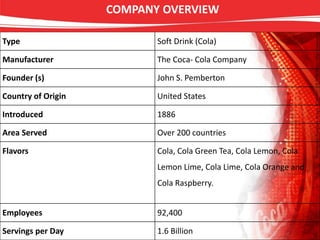
Type Soft Drink (Cola)
Manufacturer The Coca- Cola Company
Founder (s) John S. Pemberton
Country of Origin United States
Introduced 1886
Area Served Over 200 countries
Flavors Cola, Cola Green Tea, Cola Lemon, Cola
Lemon Lime, Cola Lime, Cola Orange and
Cola Raspberry.
Employees 92,400
Servings per Day 1.6 Billion
COMPANY OVERVIEW
Job Analysis and Design
• Job analysis is the procedure for determining the duties and skill
requirements of a job and the kind of a person who should be hired for
the job. job analysis is divided into 2 processes they are
• job description- a list of job duties, responsibilities, reporting relationship,
working conditions and supervisory responsibilities.
• Job specification-a list of a job’s human requirement that is education,
skills etc.
In coca-cola company
• Coca cola company’s hr department checks its own job description and job
analysis in which they get the information about the employees work
activities, human behaviour, performance standard, job context and
human requirements and also other information related to his conduct.
• Hr department of coca cola use this information for recruiting, selection,
compensation performance appraisal, training and employee relationship.
Planning and Forecasting
• The process of deciding what all positions should be
filled by the firm , and how to fill them.
• Coca Cola HR department involves in company
strategic planning and they also make sufficient
planning for hiring new employees in the future.
• Coca cola forecasts for the expected employees needs
in the organisation. Its basically done on the change of
technology and increasing in productivity.
• After planning, this report is sent to the head office for
the approval. If the approval is given from the head
office, the recruitment process is started
Recruitment Process
• Cokes recruitment process is well established 1st of all the company gives
ads in newspapers, company website, institutions etc.
• Once the company receives an application form from the candidate with
required document and CV, he will be called for the interview.
• Recruitment process is of two types
• Internal recruitment-recruiting source seeking applicants for positions
from among the ranks of those currently employed
• Advantages of internal recruitment
a. better assessment of candidates
b. Reduces training time
c. Faster
d. Cheaper
e. Motivates employees
 External Recruiting
◦ External recruiting—recruiting source seeking applicants for
positions from outside the organization.
◦ Advantages
 increases diversity
 facilitates growth
 shortens training time
◦ Disadvantages
 expensive
 slower
 less reliable data
Recruitment Sources
 That source which help the company in identifying and
attracting potential employees
 The major recruitment sources are following
1. Media Advertisement
2. E-recruitment
3. Employment agencies
4. Executive search firms
5. Special events recruiting
6. College Recruiting
7. Summer internships
Selection Process
• The selection process will vary depending on the position
the applicant is applying for, as one process cant fit all the
different roles we have here at CCE.
• However, in most cases a combination of any of the
following tools will me used.
a. Interview
b. Group exercises
c. Presentations
d. Psychometric tests
e. role-play's/situational exercises
f. Group discussion.
Performance Appraisal
• ‘Coca cola’s performance appraisal is annually done’ says HR manager
WAQAR MAHMOOD, the further tells that we appraise the employee on
their performance on achieving the goals of the organisation.
• we set goals at the beginning of the year and the employees are given
goals to achieve, if the employee meets the goals then we appraise
him/her.
• Steps in appraising performance
• Define the job
• Making sure that you and your subordinate agree on his or her duties and
job standard.
• Appraise performance
• Comparing your subordinates actual performance to the standards that
have been set.
• Provide feedback
• Means discuss the subordinate’s performance and progress, and make
plans for any development required.
Wages Policy
• Coca-cola is providing smart wages to its employees,
which are competitive and really satisfactory .With wages
lot of facilities and amenities are provided according to the
policy.
• Structure of wages can be described as:
1. Blue collar workers are offered wages along with
commission ,salesman are offered wages plus commission
pursuing certain criteria.
2. White collar workers who are the officers and the
executives draw a handsome amount salary with
incentives.
Training Policy
• There are many different types of activities that contribute to an
individual’s personal development and staff are encouraged to consider
the range of opportunities available to them.
• Some activities are undertaken with the specific aim of enhancing skills
and/or imparting information e.g. attending a seminar or training
programme, reading, work-shadowing and mentoring.
• Other activities offering the potential for development, may arise in the
course of normal work activity e.g. being involved in a secondment or
project where the individual acquires new skills or knowledge or
discussing how to deal with a particular problem with a colleague.
• The budget for HR training and development is managed within the HR
Strategy.
• The cost for HR Training and Development programmes are covered by the
HR budget and there is no charge to the individual for programmes offered
by HR Training and Development.
• However, a cancellation fee does apply to those who confirm they are
attending a programme and then cancel up to 10 days prior to the
programme taking place
Training Policy
• Key HR training and development process are:
1. Facilitation and Administration.
2. Orientation.
3. Development pathways.
4. Learning and Development programmes.
5. Coca Cola skills seminar.
6. Job specific training.
7. Policy development.
8. Leadership development.
9. Mentoring.
10. Coaching.
Annual Leave Policy
• Coca Cola believes that employees should have opportunities to enjoy
time away from work to help balance their professional and personal lives.
The Company encourages all employees to spend time with family for
leisure, taking care of personal work, or rest due to medical reasons.
• PRIVILLEGED LEAVE
• This has been designed to give you vacation periods for rest and relaxation
and to provide time off for your personal needs. You will however be
entitled to this leave @ 2 days per month Only on completion of 1 year of
your service. This can be carried forward too.
• SICK LEAVE
• Sick leave may be used when you--
• *Receive medical, dental, or optical treatment
• *Are incapacitated by physical or mental illness, injury, pregnancy, or
childbirth;
• *Would, because of exposure to a communicable disease, jeopardize the
health of others by your presence on the job etc.
• Sick Leave is @ 0.5 days per month
Annual Leave Policy
• HALF-DAY
• The half day period should either be the first 4 hours of the day or
the last 4 hours of the day & this will be adjusted towards Casual
leave or Sick Leave if your permission is due to health reasons.
• CASUAL LEAVE
• The period of such leave is limited to 6 days in a
• calendar year and is granted in such a manner that the total period
of absence including holidays (prefixed or suffixed) does not
ordinarily exceed 8 days. Casual Leave is @ 0.5 days per month
• COMP- OFF’S
• Employee can avail for the extra shift they have worked or for
having worked on a declared holiday. Part shifts or working for 2
hours extra does not entitle the employee for a Compensatory Off.
Alcohol/Drug Abuse Policy
• All employees are prohibited from consuming, soliciting, possessing, being
affected by or under the influence of alcohol or illegal drugs on company
premises or while on company business.
• The sale, possession, transfer, solicitation, or purchase of alcohol or illegal
drugs on company business is strictly prohibited. Where evidence warrants,
the company will notify the appropriate law enforcement authorities.
• No alcoholic beverage will be brought, possessed, or consumed on company
premises other than at an authorized company function where alcohol is
served through a food service. Employees who choose to drink alcoholic
beverages at such functions are expected to exercise due care and good
judgment.
• No prescription drug will be brought, possessed, solicited, or consumed on
company premises by any person other than the one for whom it is
prescribed. Legal drugs will be used only in the manner, combination, and
quantity prescribed.
• Employees are expected to cooperate with requests for medical or other
information or examinations, in furtherance of management's responsibility to
enforce this policy.
Grievance Handling
• Grievance is formal complaint which demonstrates any kind
of dissatisfaction in an employee, arising out of the factors
which are related to his job.
• The communication of grievances should be done formally.
It can be communicated via:
- A written document
- E-mail.
• Open door policy – Employees see the top level executive
directly with their grievances. Many employees feel
uncomfortable to approach directly.
• Step ladder policy – Employee is required to talk to his
immediate senior about his grievances, who offers a
solution or escalates the same.
• The other ways to discover a grievance are interviews,
suggestion boxes and opinion surveys.
Grievance Handling - Benefits
• Grievance handling process gives the aggrieved employees
an opportunity to communicate their feelings and problems
to the concerned people.
• This provides following benefits to an organisation:
a) It develops the trust of employees in the organization, its
motives and policies.
b) It helps in addressing the employee’s problems before
they become too big.
c) It helps in improving the over all work conditions and
atmosphere.
d) It helps in developing a committed work force and
improving the productivity.
e) It helps in identifying the areas of improvement and
taking the required actions
Grievance Handling – Steps & Causes
• The important steps in grievance handling procedure are:
1. Accepting the grievance and acknowledging it.
2. Carefully listening the problem.
3. Understanding the redefining the problem to ensure that
both the parties are at the same level of understanding.
4. Gathering the information – all facts and figures.
5. Offering the best solution.
6. Follow up.
• Causes:
1. Management policies.
2. Working conditions.
3. Interpersonal factors.
Features of Good Grievance Handling
1. It confirms with existing legislation.
2. It is fairly acceptable to all – it provides justice to the
employees, reasonable authority to the manager and
allows adequate participation of the union.
3. It is simple and easily understood by all. Employees have
sufficient information about the process and the
authorities who can be approached in case of a problem.
4. It is not a very long process.
5. It is prompt and quick – takes as little time as possible.
6. The supervisors and union leaders are well trained to
handle it.
Employee Relations
• Maintaining healthy employee relations in an organization is a
pre-requisite for organizational success.
• Strong employee relations are required for high productivity
and human satisfaction.
• Healthy employee relations lead to more efficient, motivated
and productive employees which further lead to increase in
sales level.
Despite the importance of strong and healthy employee
relations, there are circumstances in the life of every
organization when employee and management relations are
hampered. Instances of such circumstances are as follows-
• When the employees do not behave as per accepted norms
of behaviour, it is known as employee indiscipline.
• Similarly, the employees also expect from the management
to provide them a safe working environment, fair
treatment, proper incentives, participation in decisions,
and needs satisfaction. The failure on part of management
to meet these expectations is termed as employee
grievance.
• When the employees fail to meet their own expectations
whether in terms of personal goals, career goals,
performance, self-respect, etc it is referred to as employee
stress.
Improving Employee Relations
• Do not make the employees’ job monotonous.
Keep it interesting. Make it more challenging.
• Maintain a continuous interaction with the
employees.
• Employees must be rewarded and appreciated
for a well-done job or for achieving/over-
meeting their targets.
• Encourage employee feedback.
• Give the employees competitive salary.
Feedback Policy
360 degree feedback is also known as multi-
rater feedback or multi-dimensional feedback
or multi-source feedback. It is a very good
means of improving an individual’s effectiveness
(as a leader and as a manager). It is a system by
which an individual gets a
comprehensive/collective feedback from his
superiors, subordinates, peers/co-workers,
customers and various other members with
whom he interacts.
The feedback form is in a questionnaire format, which
contains questions that are significant to both individual as
well as organization from performance aspect. It is filled by
anonymous people. The number of people from whom
feedback is taken can range from 6 - 20. The individual’s
own feedback is also taken, i.e., he self-rates himself and
then his rating is compared with other individuals ratings.
Self ratings compel the individual to sit down and think
about his own strengths and weaknesses.
Based on a 360 degree feedback, the individual goals and
the group goals can be correlated to the organizational
strategy, i.e., the individual and the group can synchronize
their goals with the organizational goals.
Time Management Policy
• They are managing the working time in two
shifts. They can include some extra shift if there is
demand but normally there are two shifts, which
are explained in the following:
• 8 a.m. to 4 p.m. (all departments other then
technical departments),
• 4 p.m. to 12 p.m. (Technical department)
Compensation Policy
• Basic salary
• Bonus
• Medical facility
• Pick and drop
• Gratuity fund
• Social security
Insurance Policy
• Employee health insurance companies typically
cover medical benefits for insured (self), spouse,
children and dependent parents
• Some health insurance providers cover pre-
existing illness and maternity as well
• Employee health insurance offers cashless
hospitalization at network hospitals
• Group health insurance can cover ancillary
charges such as ambulance costs too.
• Some employee health insurance policies provide
fee reimbursements of specialists and other
medical practitioners for follow checkups
Termination Policy
• Termination for Poor Performance
• More than any other situation, terminations for poor
performance require thorough documentation over a
period of time.
• How does the employee’s performance match his/her
job description?
• Were there previous warnings?
• Were there previous suspensions?
• Was there progressive discipline and was the employee
notified of prior examples of poor performance that
were documented?
Continued……..
• Is the termination consistent with other
situations?
• Were other employees terminated for similar
poor performance under similar circumstances?
• Were other employees allowed to continue to
work when their performance was poor?
• Documentation on all of these points is crucial.
• Termination due to Misconduct:
• Some misconduct is so egregious that it may not
require much prior documentation.
• Some types of misconduct may not appear to be
so egregious.
• However, in many situations it may be necessary
to have previous documentation regarding such
conduct.
HR POLICY- COCA COLA

HR POLICY- COCA COLA

  • 1.
    • FP15072 –Raghvendra Singh Rao. • FP15073 – Siddharth Singh. • FP15074 – Anikesh Gupta. • FP15075 – Rachit Kumar Somani. • FP15076 – Parichaya Thomare. • FP15077 – Akash Budhadhara.
  • 2.
    OBJECTIVES • To knowthe core HR policies and strategy management process that includes: 1. Job analysis and designing. 2. Recruitment policy 3. Planning and forecasting. 4. Wages policy. 5. Performance Appraisal. 6. Training Policy. 7. Annual leave policy. 8. Alcohol/Drug abuse policy. 9. Grievance handling. 10. Employee relation. 11. Feedback policy. 12. Time Management policy. 13. Compensation policy. 14. Insurance policy. 15. Termination policy.
  • 3.
    Type Soft Drink(Cola) Manufacturer The Coca- Cola Company Founder (s) John S. Pemberton Country of Origin United States Introduced 1886 Area Served Over 200 countries Flavors Cola, Cola Green Tea, Cola Lemon, Cola Lemon Lime, Cola Lime, Cola Orange and Cola Raspberry. Employees 92,400 Servings per Day 1.6 Billion COMPANY OVERVIEW
  • 4.
    Job Analysis andDesign • Job analysis is the procedure for determining the duties and skill requirements of a job and the kind of a person who should be hired for the job. job analysis is divided into 2 processes they are • job description- a list of job duties, responsibilities, reporting relationship, working conditions and supervisory responsibilities. • Job specification-a list of a job’s human requirement that is education, skills etc. In coca-cola company • Coca cola company’s hr department checks its own job description and job analysis in which they get the information about the employees work activities, human behaviour, performance standard, job context and human requirements and also other information related to his conduct. • Hr department of coca cola use this information for recruiting, selection, compensation performance appraisal, training and employee relationship.
  • 5.
    Planning and Forecasting •The process of deciding what all positions should be filled by the firm , and how to fill them. • Coca Cola HR department involves in company strategic planning and they also make sufficient planning for hiring new employees in the future. • Coca cola forecasts for the expected employees needs in the organisation. Its basically done on the change of technology and increasing in productivity. • After planning, this report is sent to the head office for the approval. If the approval is given from the head office, the recruitment process is started
  • 6.
    Recruitment Process • Cokesrecruitment process is well established 1st of all the company gives ads in newspapers, company website, institutions etc. • Once the company receives an application form from the candidate with required document and CV, he will be called for the interview. • Recruitment process is of two types • Internal recruitment-recruiting source seeking applicants for positions from among the ranks of those currently employed • Advantages of internal recruitment a. better assessment of candidates b. Reduces training time c. Faster d. Cheaper e. Motivates employees
  • 7.
     External Recruiting ◦External recruiting—recruiting source seeking applicants for positions from outside the organization. ◦ Advantages  increases diversity  facilitates growth  shortens training time ◦ Disadvantages  expensive  slower  less reliable data
  • 8.
    Recruitment Sources  Thatsource which help the company in identifying and attracting potential employees  The major recruitment sources are following 1. Media Advertisement 2. E-recruitment 3. Employment agencies 4. Executive search firms 5. Special events recruiting 6. College Recruiting 7. Summer internships
  • 9.
    Selection Process • Theselection process will vary depending on the position the applicant is applying for, as one process cant fit all the different roles we have here at CCE. • However, in most cases a combination of any of the following tools will me used. a. Interview b. Group exercises c. Presentations d. Psychometric tests e. role-play's/situational exercises f. Group discussion.
  • 10.
    Performance Appraisal • ‘Cocacola’s performance appraisal is annually done’ says HR manager WAQAR MAHMOOD, the further tells that we appraise the employee on their performance on achieving the goals of the organisation. • we set goals at the beginning of the year and the employees are given goals to achieve, if the employee meets the goals then we appraise him/her. • Steps in appraising performance • Define the job • Making sure that you and your subordinate agree on his or her duties and job standard. • Appraise performance • Comparing your subordinates actual performance to the standards that have been set. • Provide feedback • Means discuss the subordinate’s performance and progress, and make plans for any development required.
  • 11.
    Wages Policy • Coca-colais providing smart wages to its employees, which are competitive and really satisfactory .With wages lot of facilities and amenities are provided according to the policy. • Structure of wages can be described as: 1. Blue collar workers are offered wages along with commission ,salesman are offered wages plus commission pursuing certain criteria. 2. White collar workers who are the officers and the executives draw a handsome amount salary with incentives.
  • 12.
    Training Policy • Thereare many different types of activities that contribute to an individual’s personal development and staff are encouraged to consider the range of opportunities available to them. • Some activities are undertaken with the specific aim of enhancing skills and/or imparting information e.g. attending a seminar or training programme, reading, work-shadowing and mentoring. • Other activities offering the potential for development, may arise in the course of normal work activity e.g. being involved in a secondment or project where the individual acquires new skills or knowledge or discussing how to deal with a particular problem with a colleague. • The budget for HR training and development is managed within the HR Strategy. • The cost for HR Training and Development programmes are covered by the HR budget and there is no charge to the individual for programmes offered by HR Training and Development. • However, a cancellation fee does apply to those who confirm they are attending a programme and then cancel up to 10 days prior to the programme taking place
  • 13.
    Training Policy • KeyHR training and development process are: 1. Facilitation and Administration. 2. Orientation. 3. Development pathways. 4. Learning and Development programmes. 5. Coca Cola skills seminar. 6. Job specific training. 7. Policy development. 8. Leadership development. 9. Mentoring. 10. Coaching.
  • 14.
    Annual Leave Policy •Coca Cola believes that employees should have opportunities to enjoy time away from work to help balance their professional and personal lives. The Company encourages all employees to spend time with family for leisure, taking care of personal work, or rest due to medical reasons. • PRIVILLEGED LEAVE • This has been designed to give you vacation periods for rest and relaxation and to provide time off for your personal needs. You will however be entitled to this leave @ 2 days per month Only on completion of 1 year of your service. This can be carried forward too. • SICK LEAVE • Sick leave may be used when you-- • *Receive medical, dental, or optical treatment • *Are incapacitated by physical or mental illness, injury, pregnancy, or childbirth; • *Would, because of exposure to a communicable disease, jeopardize the health of others by your presence on the job etc. • Sick Leave is @ 0.5 days per month
  • 15.
    Annual Leave Policy •HALF-DAY • The half day period should either be the first 4 hours of the day or the last 4 hours of the day & this will be adjusted towards Casual leave or Sick Leave if your permission is due to health reasons. • CASUAL LEAVE • The period of such leave is limited to 6 days in a • calendar year and is granted in such a manner that the total period of absence including holidays (prefixed or suffixed) does not ordinarily exceed 8 days. Casual Leave is @ 0.5 days per month • COMP- OFF’S • Employee can avail for the extra shift they have worked or for having worked on a declared holiday. Part shifts or working for 2 hours extra does not entitle the employee for a Compensatory Off.
  • 16.
    Alcohol/Drug Abuse Policy •All employees are prohibited from consuming, soliciting, possessing, being affected by or under the influence of alcohol or illegal drugs on company premises or while on company business. • The sale, possession, transfer, solicitation, or purchase of alcohol or illegal drugs on company business is strictly prohibited. Where evidence warrants, the company will notify the appropriate law enforcement authorities. • No alcoholic beverage will be brought, possessed, or consumed on company premises other than at an authorized company function where alcohol is served through a food service. Employees who choose to drink alcoholic beverages at such functions are expected to exercise due care and good judgment. • No prescription drug will be brought, possessed, solicited, or consumed on company premises by any person other than the one for whom it is prescribed. Legal drugs will be used only in the manner, combination, and quantity prescribed. • Employees are expected to cooperate with requests for medical or other information or examinations, in furtherance of management's responsibility to enforce this policy.
  • 17.
    Grievance Handling • Grievanceis formal complaint which demonstrates any kind of dissatisfaction in an employee, arising out of the factors which are related to his job. • The communication of grievances should be done formally. It can be communicated via: - A written document - E-mail. • Open door policy – Employees see the top level executive directly with their grievances. Many employees feel uncomfortable to approach directly. • Step ladder policy – Employee is required to talk to his immediate senior about his grievances, who offers a solution or escalates the same. • The other ways to discover a grievance are interviews, suggestion boxes and opinion surveys.
  • 18.
    Grievance Handling -Benefits • Grievance handling process gives the aggrieved employees an opportunity to communicate their feelings and problems to the concerned people. • This provides following benefits to an organisation: a) It develops the trust of employees in the organization, its motives and policies. b) It helps in addressing the employee’s problems before they become too big. c) It helps in improving the over all work conditions and atmosphere. d) It helps in developing a committed work force and improving the productivity. e) It helps in identifying the areas of improvement and taking the required actions
  • 19.
    Grievance Handling –Steps & Causes • The important steps in grievance handling procedure are: 1. Accepting the grievance and acknowledging it. 2. Carefully listening the problem. 3. Understanding the redefining the problem to ensure that both the parties are at the same level of understanding. 4. Gathering the information – all facts and figures. 5. Offering the best solution. 6. Follow up. • Causes: 1. Management policies. 2. Working conditions. 3. Interpersonal factors.
  • 20.
    Features of GoodGrievance Handling 1. It confirms with existing legislation. 2. It is fairly acceptable to all – it provides justice to the employees, reasonable authority to the manager and allows adequate participation of the union. 3. It is simple and easily understood by all. Employees have sufficient information about the process and the authorities who can be approached in case of a problem. 4. It is not a very long process. 5. It is prompt and quick – takes as little time as possible. 6. The supervisors and union leaders are well trained to handle it.
  • 21.
    Employee Relations • Maintaininghealthy employee relations in an organization is a pre-requisite for organizational success. • Strong employee relations are required for high productivity and human satisfaction. • Healthy employee relations lead to more efficient, motivated and productive employees which further lead to increase in sales level.
  • 22.
    Despite the importanceof strong and healthy employee relations, there are circumstances in the life of every organization when employee and management relations are hampered. Instances of such circumstances are as follows- • When the employees do not behave as per accepted norms of behaviour, it is known as employee indiscipline. • Similarly, the employees also expect from the management to provide them a safe working environment, fair treatment, proper incentives, participation in decisions, and needs satisfaction. The failure on part of management to meet these expectations is termed as employee grievance. • When the employees fail to meet their own expectations whether in terms of personal goals, career goals, performance, self-respect, etc it is referred to as employee stress.
  • 23.
    Improving Employee Relations •Do not make the employees’ job monotonous. Keep it interesting. Make it more challenging. • Maintain a continuous interaction with the employees. • Employees must be rewarded and appreciated for a well-done job or for achieving/over- meeting their targets. • Encourage employee feedback. • Give the employees competitive salary.
  • 24.
    Feedback Policy 360 degreefeedback is also known as multi- rater feedback or multi-dimensional feedback or multi-source feedback. It is a very good means of improving an individual’s effectiveness (as a leader and as a manager). It is a system by which an individual gets a comprehensive/collective feedback from his superiors, subordinates, peers/co-workers, customers and various other members with whom he interacts.
  • 25.
    The feedback formis in a questionnaire format, which contains questions that are significant to both individual as well as organization from performance aspect. It is filled by anonymous people. The number of people from whom feedback is taken can range from 6 - 20. The individual’s own feedback is also taken, i.e., he self-rates himself and then his rating is compared with other individuals ratings. Self ratings compel the individual to sit down and think about his own strengths and weaknesses. Based on a 360 degree feedback, the individual goals and the group goals can be correlated to the organizational strategy, i.e., the individual and the group can synchronize their goals with the organizational goals.
  • 26.
    Time Management Policy •They are managing the working time in two shifts. They can include some extra shift if there is demand but normally there are two shifts, which are explained in the following: • 8 a.m. to 4 p.m. (all departments other then technical departments), • 4 p.m. to 12 p.m. (Technical department)
  • 27.
    Compensation Policy • Basicsalary • Bonus • Medical facility • Pick and drop • Gratuity fund • Social security
  • 28.
    Insurance Policy • Employeehealth insurance companies typically cover medical benefits for insured (self), spouse, children and dependent parents • Some health insurance providers cover pre- existing illness and maternity as well • Employee health insurance offers cashless hospitalization at network hospitals • Group health insurance can cover ancillary charges such as ambulance costs too. • Some employee health insurance policies provide fee reimbursements of specialists and other medical practitioners for follow checkups
  • 29.
    Termination Policy • Terminationfor Poor Performance • More than any other situation, terminations for poor performance require thorough documentation over a period of time. • How does the employee’s performance match his/her job description? • Were there previous warnings? • Were there previous suspensions? • Was there progressive discipline and was the employee notified of prior examples of poor performance that were documented?
  • 30.
    Continued…….. • Is thetermination consistent with other situations? • Were other employees terminated for similar poor performance under similar circumstances? • Were other employees allowed to continue to work when their performance was poor? • Documentation on all of these points is crucial.
  • 31.
    • Termination dueto Misconduct: • Some misconduct is so egregious that it may not require much prior documentation. • Some types of misconduct may not appear to be so egregious. • However, in many situations it may be necessary to have previous documentation regarding such conduct.