HR PLANNING,
RECRUITMENT,
SELECTION AND
PLACEMENT

  NEDIE SAYAT-DAYAO
HUMAN RESOURCE PLANNING
- Isa dynamic management process of
 ensuring that all times a company or
 its units has in its employ the right
 number of people with the right
 skills, assigned to the right jobs
 where they can contribute
 effectively to the productivity and
 profitability of the company.
ELEMENTS OF HUMAN RESOURCE
PLANNING

Organizational Planning
 Selection and Placement
 Training
 Development
 Motivation of Employees
ASPECTS OF HUMAN RESOURCES
PLANNING

Systematic forecasting of
 manpower needs
 Performance Management
Career Management
 Management Development
ADVANTAGES IN USING THE ELEMENTS OF
HUMAN RESOURCE PLANNING
  Through a systematic planning of human
  resource, a company can be better assisted in
  attaining its goals and objectives.
 It helps the company determine its manpower
  needs and provides a method for meeting them.
 It can be an effective means of planning the
  development and growth of employees.
 It can assist in placing the employees properly in
  jobs where they can maximize the use of their
  skills and potentials.
 It can assist the company in attracting and
  retaining better-qualified employees.
FIVE STEPS IN HUMAN RESOURCE
PLANNING
1.   DETERMINING WORKLOAD- determining the
     business objectives of the company and analyzing
     their impact on each department operational function.
     FACTOR
        a. business development and assumptions
        b. corporate planning
        c. economic forecasts
        d. changes in plans and products
        e. new product lines
        f. mergers and consolidations
        g. other trends
2. STUDY OF JOBS IN THE COMPANY.- job
  description and job specification
3. FORECASTING HUMAN RESOURCE NEEDS.
 How many specialists, professionals or executives
  are needed?
 What is the level of each?

 What kind of specialization should each have?

 What level of expertise is required?

 What other production personnel are necessary
  and how many for each category?
4. INVENTORY   OF MANPOWER-
 inventory (audit) of available current
 manpower.

5. IMPROVEMENT PLAN- to tailor
 the implementation and improvement
 plans to meet the objectives of
 corporation or department.
IMPORTANCE OF A WELL
ORGANIZED SELECTION PROGRAM
   The main objectives of good employees
    selection is to acquire people who possess
    the ability and competence to accomplish
    successfully the duties and responsibility
    of the job to be filled and the potential
    to grow with the company.

    Finding the right man for a job and
    finding the right job for a man who is
    available are essential to sound employee
    selection and placement.
-   SELECTION- Implies the choice of the one best-
    qualified individual from among a number of
    available qualified candidates.
-   SELECTION RATIO- There should be relatively
    large number of candidates from which the final
    selectees are chosen. The ideal ratio is at least four
    or five candidates for each person finally selected.
REASON FOR PROPER SELECTION OF
EMPLOYEES
    Company objectives are better achieved by workers
    who have been properly selected.
    An incompetent worker is a liability to the company.
    Personnel requirement vary from job to job.
    People have varying degrees of intelligence, aptitudes
    and abilities.
    Labor laws protect employees, making it difficult to fire
    incompetent and problem employees.
    Individuals have different interest, goals and objectives
    in life.
    Careless hiring is costly and can cause problems to the
    company, especially to the supervisors and managers
    who have to deal with the workers.
AN INCOMPETENT WORKER IS A
LIABILITY TO THE COMPANY
  Longer job training and need for closer supervision
 Wasted materials or damaged tools and machines
  because of negligence, carelessness or
  incompetence
 Longer time for completion of an assignment and
  poorer quality of finished product
 Wages and fringe benefits paid by the company as
  a result of accidents in line of duty due to the
  employee’s carelessness, inattention to his work, or
  failure to follow safety rules.
  Customer dissatisfaction due to low quality of work,
  unsatisfactory or unpleasant associations with the
  incompetent worker, resulting in loss of patronage.
 Low employee morale and inefficiency.

 Problems of employee turnover, discipline.
  Grievances and even court litigation and above all
  the tension and strained relations with the
  supervisor and management who must deal with
  him.
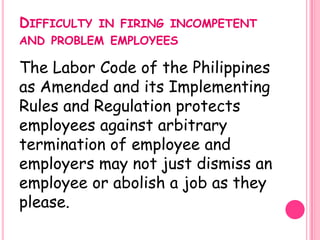
DIFFICULTY   IN FIRING INCOMPETENT
AND PROBLEM EMPLOYEES

The Labor Code of the Philippines
as Amended and its Implementing
Rules and Regulation protects
employees against arbitrary
termination of employee and
employers may not just dismiss an
employee or abolish a job as they
please.
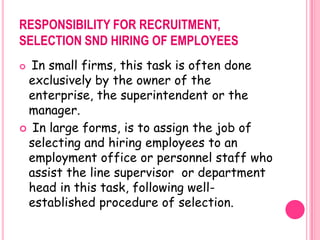
RESPONSIBILITY FOR RECRUITMENT,
SELECTION SND HIRING OF EMPLOYEES
 In small firms, this task is often done
 exclusively by the owner of the
 enterprise, the superintendent or the
 manager.
 In large forms, is to assign the job of
 selecting and hiring employees to an
 employment office or personnel staff who
 assist the line supervisor or department
 head in this task, following well-
 established procedure of selection.
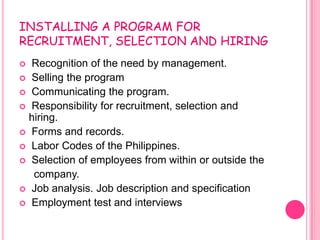
INSTALLING A PROGRAM FOR
RECRUITMENT, SELECTION AND HIRING
 Recognition of the need by management.
 Selling the program
 Communicating the program.
 Responsibility for recruitment, selection and
  hiring.
 Forms and records.
 Labor Codes of the Philippines.
 Selection of employees from within or outside the
   company.
 Job analysis. Job description and specification
 Employment test and interviews
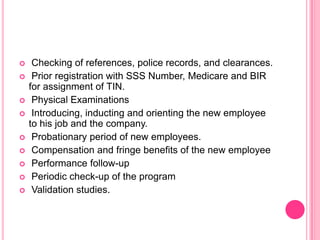
    Checking of references, police records, and clearances.
    Prior registration with SSS Number, Medicare and BIR
    for assignment of TIN.
    Physical Examinations
    Introducing, inducting and orienting the new employee
    to his job and the company.
    Probationary period of new employees.
    Compensation and fringe benefits of the new employee
    Performance follow-up
    Periodic check-up of the program
    Validation studies.
PROCEDURE IN RECRUITMENT, SELECTION
AND HIRING
1.   Study the different jobs in the company, job description and
     specification.
     The first requirement of the selection process is knowing what kind of
                     man the job needs.
                     a. exact nature of the job to be filled
                     b. primary duties and responsibility
                     c. steps taken to perform those duties and
                                responsibility
                     d. tools and equipment used
                     e. working conditions under which the
                                specific job is performed
                     f. amount of authority delegated to job
                                incumbent
                     g. supervision involved in the job
                     h. requirement of the job such as education, skill and
                                physical demand
                     j. environment of the job
2. Requisition of a new employee
    - To inform the employment office about the
    existence of a vacancy to be filled, the supervisor
    or the department head concern should
    accomplish a formal requisition form
3. Recruit qualified applicants.
    Recruitment is the process by which prospective
    applicants are attracted to apply to the company in
    order that their qualifications for present and
    anticipated vacancies can be evaluated through
    sound screening and selection process.
4. Sight-screen applicants
    Basis of rapid appraisal: age; height; years of
    experience, physical condition, educational
    attainment.
5. Have application form filled out.

     Screening is the process by which the applicants
    are interviewed and classified into two categories:
    those be given examination and further interviews
    and those should not be considered at all.
IMPORTANCE          OF APPLICATION FORM
  As a guide when interviewing the applicant
 As a basis for eliminating applicants with
  unfavorable personal data.
 For matching the qualifications of the applicant with
  the job requirements.
 For checking on the applicant’s school records,
  references and former employers.
 As a part of the employee’s permanent record and
  for communicating with the employee or his family.
6. Select those who will undergo testing.
       Tests are given to supplement the interviews
  and to determine the applicant’s abilities, which
  cannot be gauged through interviews.

       Tests are needed to discover mental ability,
  aptitude, proficiencies, potential ability, skills and
  knowledge of an applicant.
EMPLOYMENT TEST OFTEN USED IN
CHOOSING APPLICANTS

   Mental alertness Test
   Clerical Aptitude Test
   Shop Arithmetic Test
   Mechanical Aptitude Tests
   Space Relations Tests
   Proficiency, Trade or Achievement Tests
   Vocational Interest Tests
   Dexterity and Manipulation Tests
   Personality Test
7.  Check the applicant’s work experiences, school
    records and personal references.
        The application forms of those who pass the
    examination are separated and the information in them
    checked for veracity.
8. Interview
        Objectives of interview:
 to find out how well-qualified applicant is for the vacancy
 to give the applicant the information he needs to decide
  whether or not he will take the job if offered to him
 to create goodwill for the company
TYPES OF INTERVIEW
Directive Interview
 Non-directive
 interview
 Group Interview
 Team method
9. Match the applicant with the job.
        This steps involves matching the qualification of
   the applicant against the requirements of the job s
   indicated in the job description and job specification.
Danger Signals:
   a. stability of the job
   b. job-hopping or frequent changing of jobs
   c. bad habits
   d. his associates or gang
   e. financial habits
   f. environmental factors and external factors
   g. absenteeism prone; accident-prone
   h. tardiness
   i. physical handicaps
10.   Do the final selection of the best qualified.
          Employment involves three decisions:
      a. Management’s decision as to which of the
          applicants would best fit the job and
          therefore may be hired.
      b. The applicant’s decision as to whether or not
          the job is the right one for him after the
          supervisor has discussed the job duties.
      c. The supervisor must decide if the applicant is
         the right person who can work with in his
          team.
11. Have applicants undertake physical examinations and
    secure security clearances.
    The selected applicant is required to pass a physical
    examination and also to get the Police and NBI Clearance.
12. Hire the chosen candidate.
    a. Hiring papers are prepared.
    b. The company official responsible for confirming
    appointments makes the final approval.
    c. The employment contract is signed by the applicant.
    d. The permanent personnel records such as SSS, TIN,
    Medicare form and other forms required by the office are
    accomplished.
    e. The payroll section and the department where the new
    employee will work are notified of his having been hired.
FOLLOW         UP ON PLACEMENT
 When a new employee is placed on the job, his
  work should be followed up to ensure that this
  progress is not being hampered by certain
  problems affecting him or his job.
 The check also serves to measure the
  effectiveness of the selection and placement
  procedure.
 The final appraisal may be made before deciding
  whether or not to change the employee’s status
  probationary or temporary to regular.

human resource planning

  • 2.
  • 3.
    HUMAN RESOURCE PLANNING -Isa dynamic management process of ensuring that all times a company or its units has in its employ the right number of people with the right skills, assigned to the right jobs where they can contribute effectively to the productivity and profitability of the company.
  • 4.
    ELEMENTS OF HUMANRESOURCE PLANNING Organizational Planning  Selection and Placement  Training  Development  Motivation of Employees
  • 5.
    ASPECTS OF HUMANRESOURCES PLANNING Systematic forecasting of manpower needs  Performance Management Career Management  Management Development
  • 6.
    ADVANTAGES IN USINGTHE ELEMENTS OF HUMAN RESOURCE PLANNING  Through a systematic planning of human resource, a company can be better assisted in attaining its goals and objectives.  It helps the company determine its manpower needs and provides a method for meeting them.  It can be an effective means of planning the development and growth of employees.  It can assist in placing the employees properly in jobs where they can maximize the use of their skills and potentials.  It can assist the company in attracting and retaining better-qualified employees.
  • 7.
    FIVE STEPS INHUMAN RESOURCE PLANNING 1. DETERMINING WORKLOAD- determining the business objectives of the company and analyzing their impact on each department operational function. FACTOR a. business development and assumptions b. corporate planning c. economic forecasts d. changes in plans and products e. new product lines f. mergers and consolidations g. other trends
  • 8.
    2. STUDY OFJOBS IN THE COMPANY.- job description and job specification 3. FORECASTING HUMAN RESOURCE NEEDS.  How many specialists, professionals or executives are needed?  What is the level of each?  What kind of specialization should each have?  What level of expertise is required?  What other production personnel are necessary and how many for each category?
  • 9.
    4. INVENTORY OF MANPOWER- inventory (audit) of available current manpower. 5. IMPROVEMENT PLAN- to tailor the implementation and improvement plans to meet the objectives of corporation or department.
  • 10.
    IMPORTANCE OF AWELL ORGANIZED SELECTION PROGRAM  The main objectives of good employees selection is to acquire people who possess the ability and competence to accomplish successfully the duties and responsibility of the job to be filled and the potential to grow with the company.  Finding the right man for a job and finding the right job for a man who is available are essential to sound employee selection and placement.
  • 11.
    - SELECTION- Implies the choice of the one best- qualified individual from among a number of available qualified candidates. - SELECTION RATIO- There should be relatively large number of candidates from which the final selectees are chosen. The ideal ratio is at least four or five candidates for each person finally selected.
  • 12.
    REASON FOR PROPERSELECTION OF EMPLOYEES  Company objectives are better achieved by workers who have been properly selected.  An incompetent worker is a liability to the company.  Personnel requirement vary from job to job.  People have varying degrees of intelligence, aptitudes and abilities.  Labor laws protect employees, making it difficult to fire incompetent and problem employees.  Individuals have different interest, goals and objectives in life.  Careless hiring is costly and can cause problems to the company, especially to the supervisors and managers who have to deal with the workers.
  • 13.
    AN INCOMPETENT WORKERIS A LIABILITY TO THE COMPANY  Longer job training and need for closer supervision  Wasted materials or damaged tools and machines because of negligence, carelessness or incompetence  Longer time for completion of an assignment and poorer quality of finished product  Wages and fringe benefits paid by the company as a result of accidents in line of duty due to the employee’s carelessness, inattention to his work, or failure to follow safety rules.
  • 14.
     Customerdissatisfaction due to low quality of work, unsatisfactory or unpleasant associations with the incompetent worker, resulting in loss of patronage.  Low employee morale and inefficiency.  Problems of employee turnover, discipline. Grievances and even court litigation and above all the tension and strained relations with the supervisor and management who must deal with him.
  • 15.
    DIFFICULTY IN FIRING INCOMPETENT AND PROBLEM EMPLOYEES The Labor Code of the Philippines as Amended and its Implementing Rules and Regulation protects employees against arbitrary termination of employee and employers may not just dismiss an employee or abolish a job as they please.
  • 16.
    RESPONSIBILITY FOR RECRUITMENT, SELECTIONSND HIRING OF EMPLOYEES  In small firms, this task is often done exclusively by the owner of the enterprise, the superintendent or the manager.  In large forms, is to assign the job of selecting and hiring employees to an employment office or personnel staff who assist the line supervisor or department head in this task, following well- established procedure of selection.
  • 17.
    INSTALLING A PROGRAMFOR RECRUITMENT, SELECTION AND HIRING  Recognition of the need by management.  Selling the program  Communicating the program.  Responsibility for recruitment, selection and hiring.  Forms and records.  Labor Codes of the Philippines.  Selection of employees from within or outside the company.  Job analysis. Job description and specification  Employment test and interviews
  • 18.
    Checking of references, police records, and clearances.  Prior registration with SSS Number, Medicare and BIR for assignment of TIN.  Physical Examinations  Introducing, inducting and orienting the new employee to his job and the company.  Probationary period of new employees.  Compensation and fringe benefits of the new employee  Performance follow-up  Periodic check-up of the program  Validation studies.
  • 19.
    PROCEDURE IN RECRUITMENT,SELECTION AND HIRING 1. Study the different jobs in the company, job description and specification. The first requirement of the selection process is knowing what kind of man the job needs. a. exact nature of the job to be filled b. primary duties and responsibility c. steps taken to perform those duties and responsibility d. tools and equipment used e. working conditions under which the specific job is performed f. amount of authority delegated to job incumbent g. supervision involved in the job h. requirement of the job such as education, skill and physical demand j. environment of the job
  • 20.
    2. Requisition ofa new employee - To inform the employment office about the existence of a vacancy to be filled, the supervisor or the department head concern should accomplish a formal requisition form 3. Recruit qualified applicants. Recruitment is the process by which prospective applicants are attracted to apply to the company in order that their qualifications for present and anticipated vacancies can be evaluated through sound screening and selection process.
  • 21.
    4. Sight-screen applicants Basis of rapid appraisal: age; height; years of experience, physical condition, educational attainment. 5. Have application form filled out. Screening is the process by which the applicants are interviewed and classified into two categories: those be given examination and further interviews and those should not be considered at all.
  • 22.
    IMPORTANCE OF APPLICATION FORM  As a guide when interviewing the applicant  As a basis for eliminating applicants with unfavorable personal data.  For matching the qualifications of the applicant with the job requirements.  For checking on the applicant’s school records, references and former employers.  As a part of the employee’s permanent record and for communicating with the employee or his family.
  • 23.
    6. Select thosewho will undergo testing. Tests are given to supplement the interviews and to determine the applicant’s abilities, which cannot be gauged through interviews. Tests are needed to discover mental ability, aptitude, proficiencies, potential ability, skills and knowledge of an applicant.
  • 24.
    EMPLOYMENT TEST OFTENUSED IN CHOOSING APPLICANTS  Mental alertness Test  Clerical Aptitude Test  Shop Arithmetic Test  Mechanical Aptitude Tests  Space Relations Tests  Proficiency, Trade or Achievement Tests  Vocational Interest Tests  Dexterity and Manipulation Tests  Personality Test
  • 25.
    7. Checkthe applicant’s work experiences, school records and personal references. The application forms of those who pass the examination are separated and the information in them checked for veracity. 8. Interview Objectives of interview:  to find out how well-qualified applicant is for the vacancy  to give the applicant the information he needs to decide whether or not he will take the job if offered to him  to create goodwill for the company
  • 26.
    TYPES OF INTERVIEW DirectiveInterview  Non-directive interview  Group Interview  Team method
  • 27.
    9. Match theapplicant with the job. This steps involves matching the qualification of the applicant against the requirements of the job s indicated in the job description and job specification. Danger Signals: a. stability of the job b. job-hopping or frequent changing of jobs c. bad habits d. his associates or gang e. financial habits f. environmental factors and external factors g. absenteeism prone; accident-prone h. tardiness i. physical handicaps
  • 28.
    10. Do the final selection of the best qualified. Employment involves three decisions: a. Management’s decision as to which of the applicants would best fit the job and therefore may be hired. b. The applicant’s decision as to whether or not the job is the right one for him after the supervisor has discussed the job duties. c. The supervisor must decide if the applicant is the right person who can work with in his team.
  • 29.
    11. Have applicantsundertake physical examinations and secure security clearances. The selected applicant is required to pass a physical examination and also to get the Police and NBI Clearance. 12. Hire the chosen candidate. a. Hiring papers are prepared. b. The company official responsible for confirming appointments makes the final approval. c. The employment contract is signed by the applicant. d. The permanent personnel records such as SSS, TIN, Medicare form and other forms required by the office are accomplished. e. The payroll section and the department where the new employee will work are notified of his having been hired.
  • 30.
    FOLLOW UP ON PLACEMENT  When a new employee is placed on the job, his work should be followed up to ensure that this progress is not being hampered by certain problems affecting him or his job.  The check also serves to measure the effectiveness of the selection and placement procedure.  The final appraisal may be made before deciding whether or not to change the employee’s status probationary or temporary to regular.