RECRUITMENT
PRESENTED BY:
MICHELLE I. HERRERA
M.P.S. – Public Administration
SCREENING AND SELECTION
SCREENING AND SELECTION PROCESS
Screening is a formal procedure done by
the PSB in the evaluation of candidates for
appointment to vacancy.
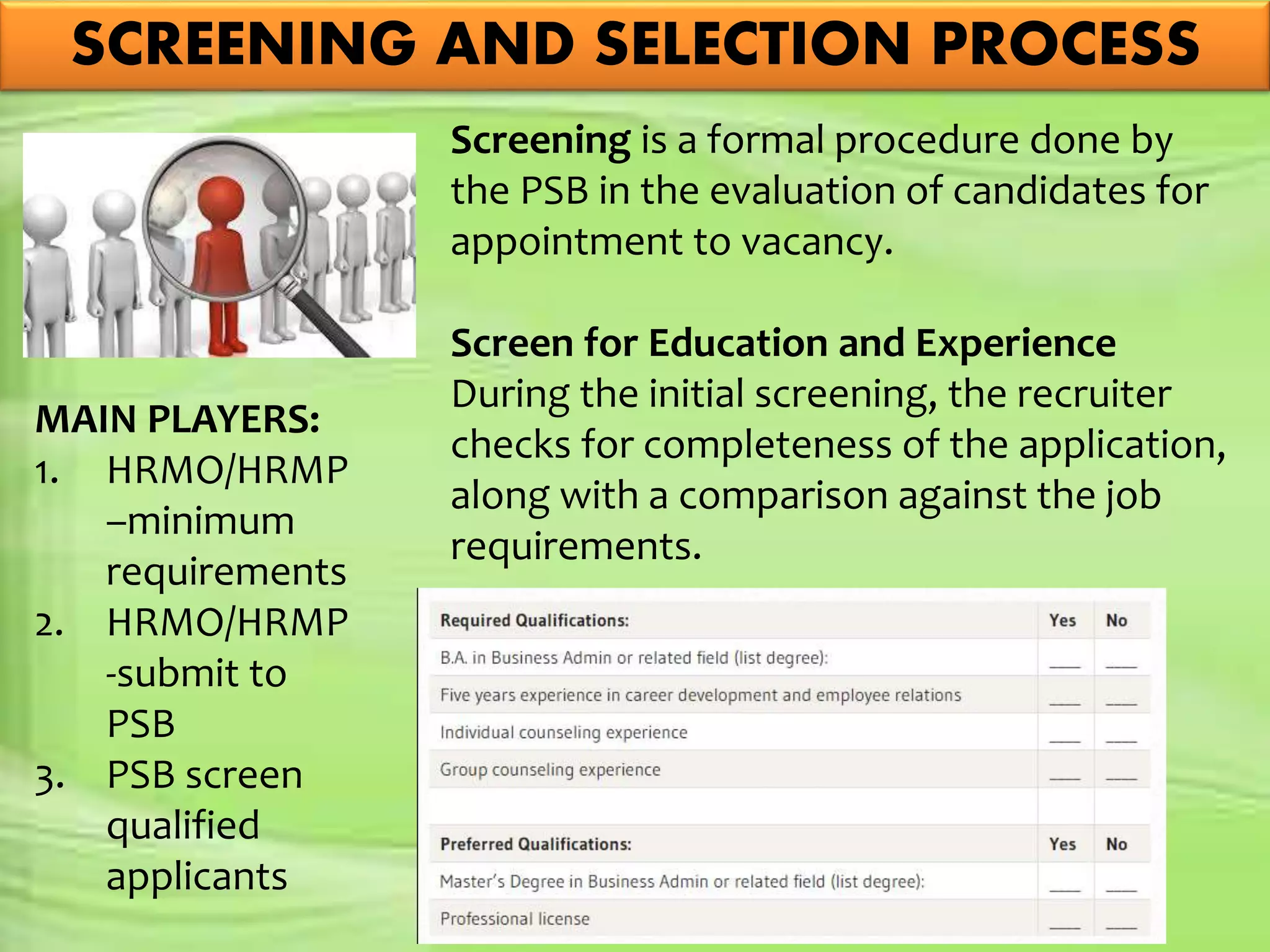
Screen for Education and Experience
During the initial screening, the recruiter
checks for completeness of the application,
along with a comparison against the job
requirements.
MAIN PLAYERS:
1. HRMO/HRMP
–minimum
requirements
2. HRMO/HRMP
-submit to
PSB
3. PSB screen
qualified
applicants
NO LONGER SUBJECT TO SCREENING
1. Candidates due to short duration
2. Appointment of faculty members and
academic staff of State University
3. Laborer Positions
4. Change of status from temporary to
permanent
1. SCREENING PRE-INTEVIEW
Many organizations prefer to do a
screening interview of those applicants
that appear qualified based on
information submitted on their résumé
and application.
2. TESTING
Tests- measure knowledge, skill, and
ability, as well as other
characteristics, such as personality
traits.
TEST
SAMPLE
1. Cognitive
Ability –
It measures the
learning,
understanding, and
ability to solve
problems. e.g.
Intelligence Tests.
2. Personality Test -
It measures the
patterns of thought,
emotion, and
behavior.
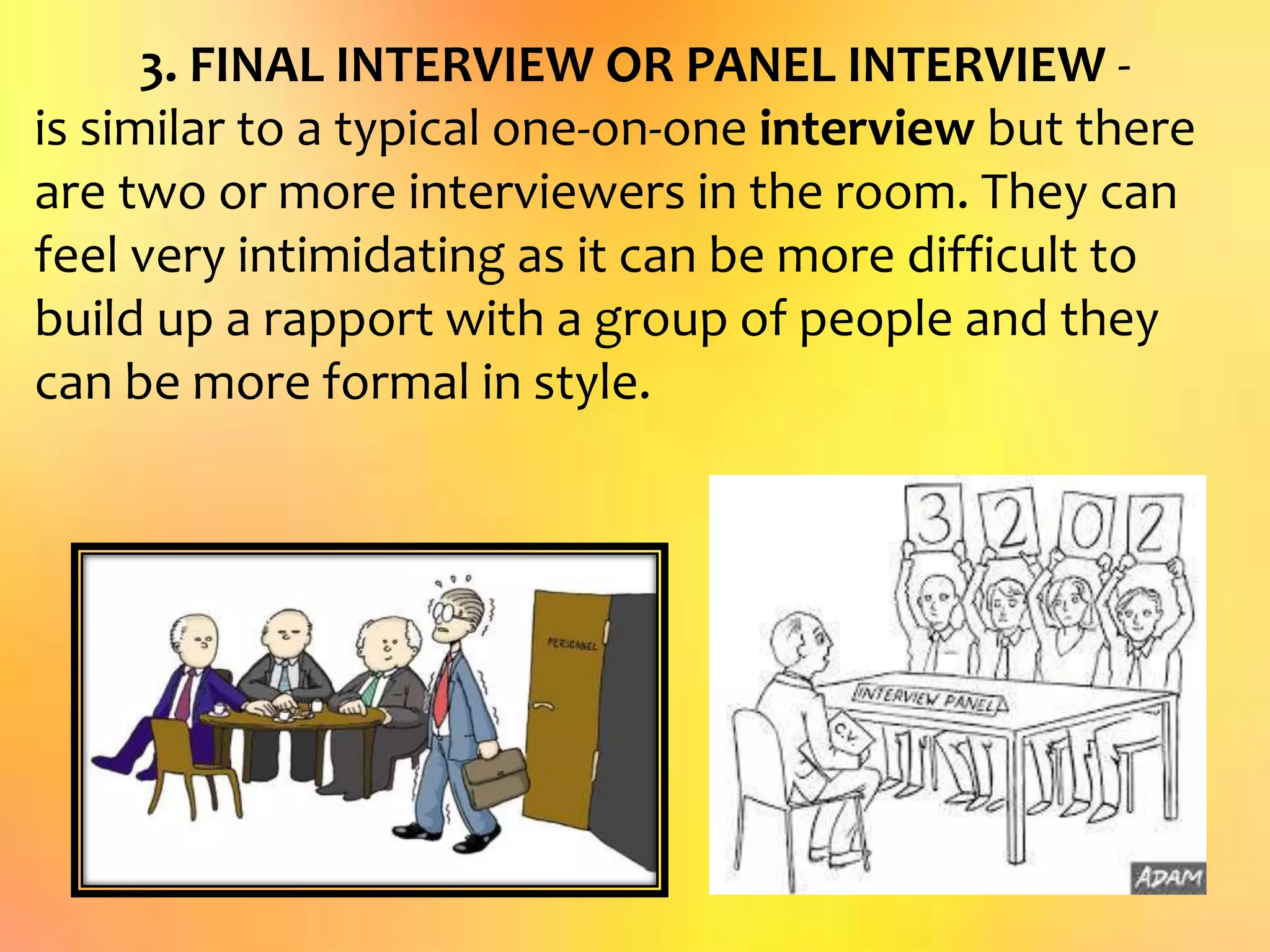
3. FINAL INTERVIEW OR PANEL INTERVIEW -
is similar to a typical one-on-one interview but there
are two or more interviewers in the room. They can
feel very intimidating as it can be more difficult to
build up a rapport with a group of people and they
can be more formal in style.
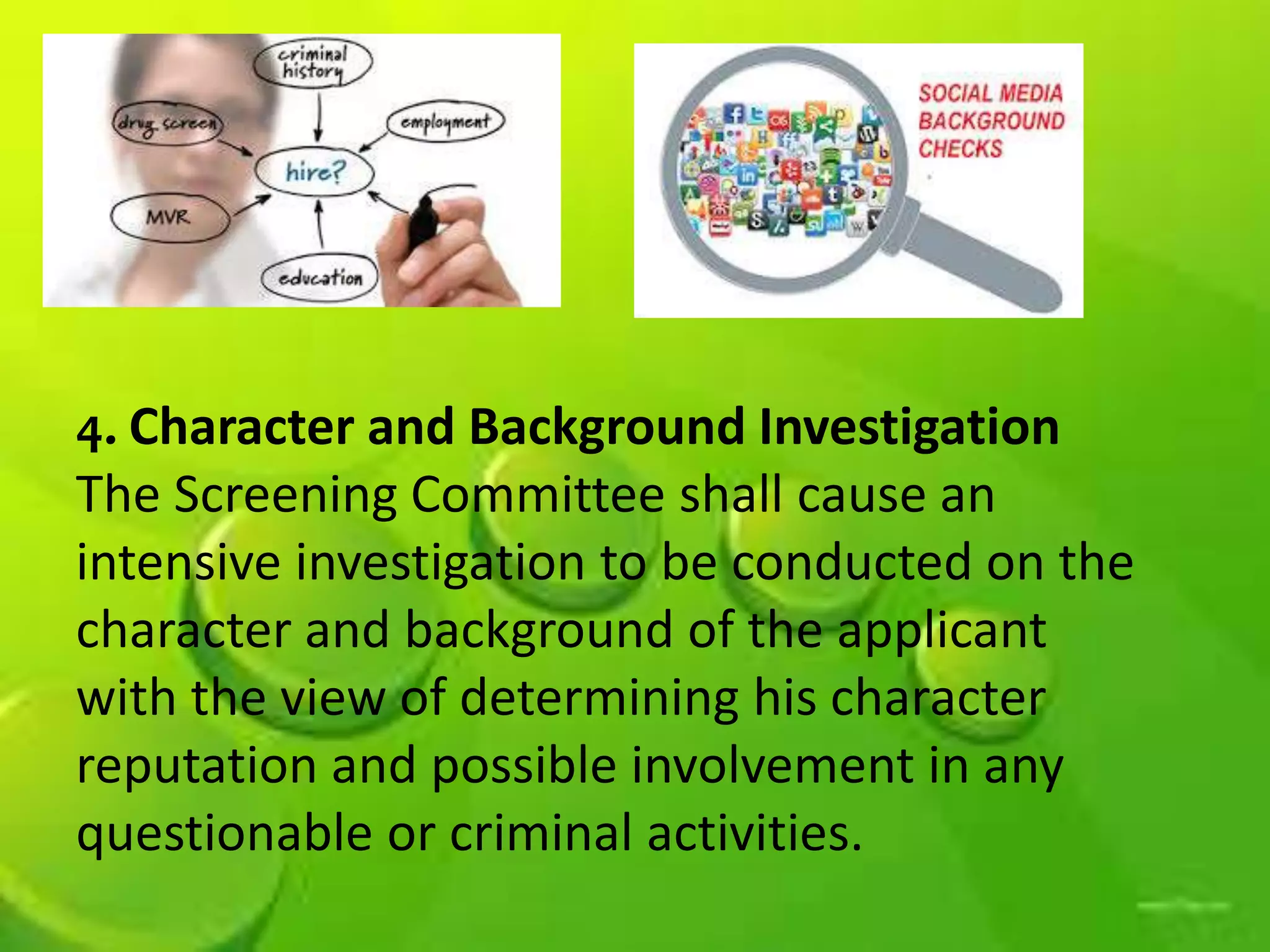
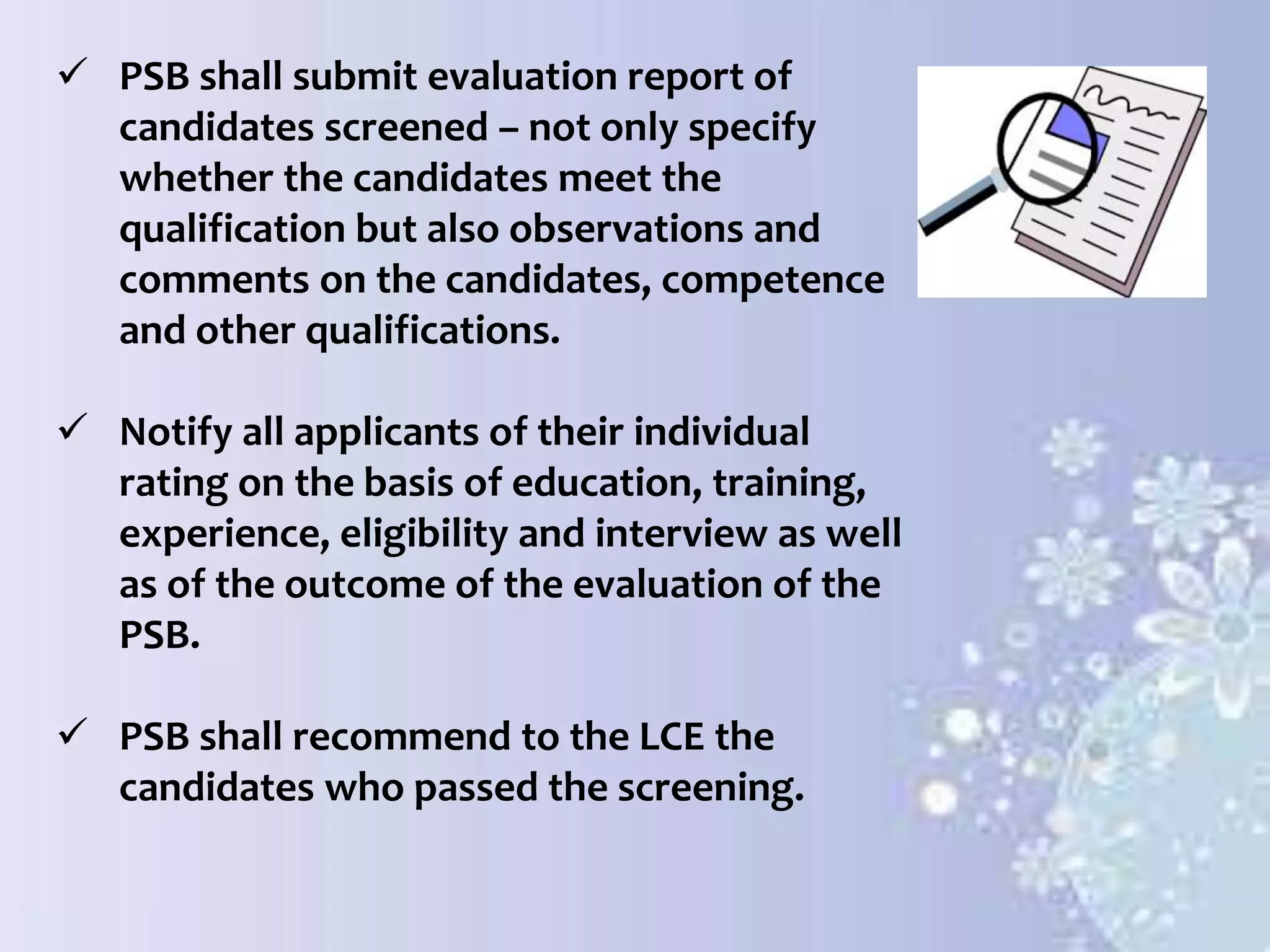
4. Character and Background Investigation
The Screening Committee shall cause an
intensive investigation to be conducted on the
character and background of the applicant
with the view of determining his character
reputation and possible involvement in any
questionable or criminal activities.
 PSB shall submit evaluation report of
candidates screened – not only specify
whether the candidates meet the
qualification but also observations and
comments on the candidates, competence
and other qualifications.
 Notify all applicants of their individual
rating on the basis of education, training,
experience, eligibility and interview as well
as of the outcome of the evaluation of the
PSB.
 PSB shall recommend to the LCE the
candidates who passed the screening.
Physical and Mental Examination
In order to determine whether or not the
applicant is in good health, free from any
contagious diseases, a physical and medical
examination must be conducted.
SELECTION
At this point, there usually
is one or two candidates
who clearly stand out as
the most qualified for the
job.
Do not forget to send letters to the candidates who did not get
the job. They deserve a sincere letter from you that thanks them
for their consideration and for interviewing for the job. Clearly
explain that another candidate most closely matched the
qualifications specified in the job description.
LCE shall issued Appointment
 an appointment is a document that gives
authority to discharge the functions of his/her
position
 Be guided by the CSC Law and Rules
 CS Form 33 shall be issued except for CASUAL
(Plantilla Appointment Form)
REQUIREMENTS FOR APPROVAL
ART. 168 (a) Rule 12 of the IRR LGC
“all appointments shall be made only according to merit
and fitness to be determined as far as practicable by
competitive examinations.”
“SHALL MEET ALL THE
REQUIREMENTS OF THE
POSITION”
GROUNDS FOR DISAPPROVAL
When the appointee does not meet the qualifications
for the position
Found guilty of a crime
Dismissed from the service for cause, unless clemency
has been granted
GROUNDS FOR DISAPPROVAL
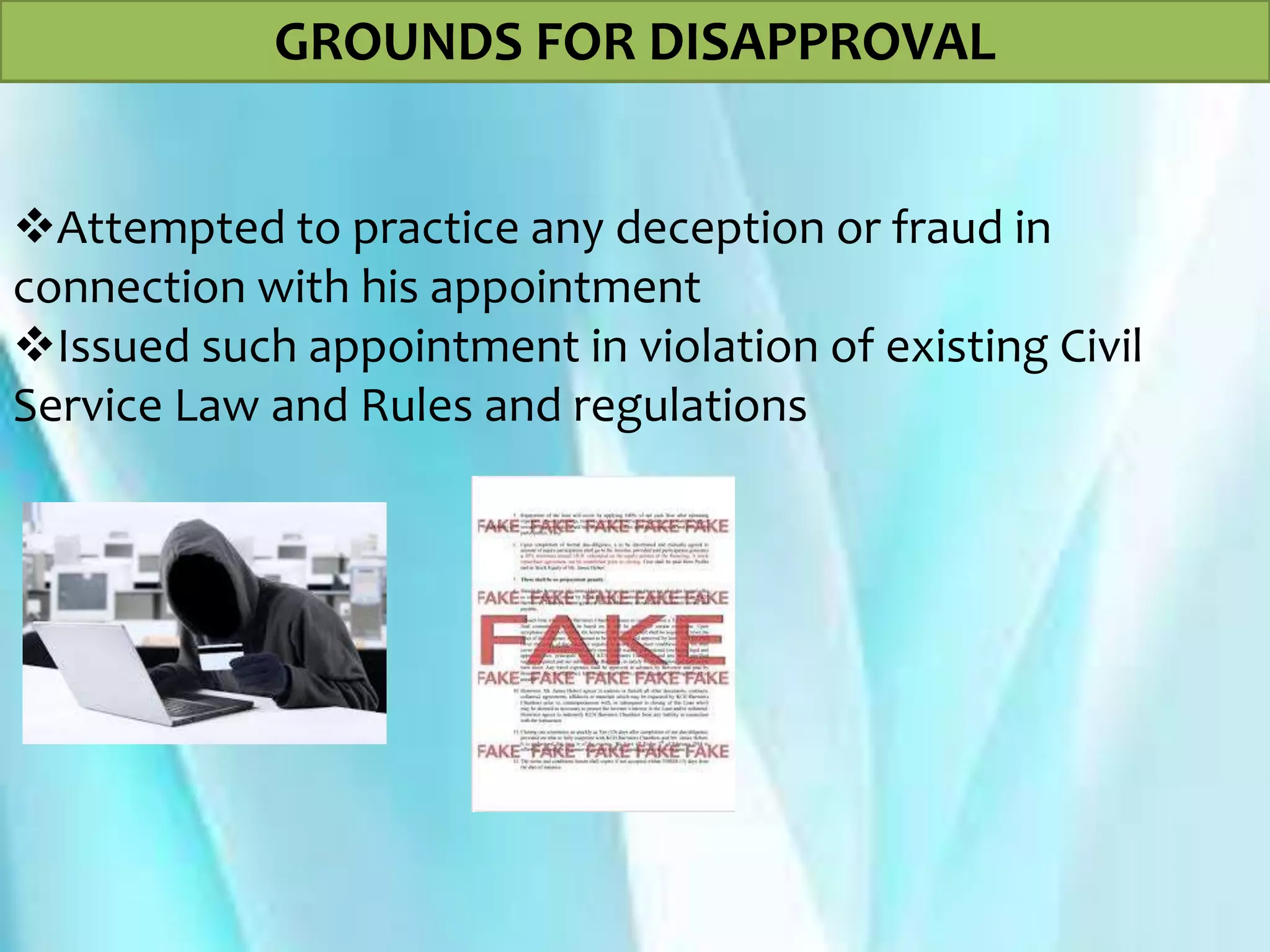
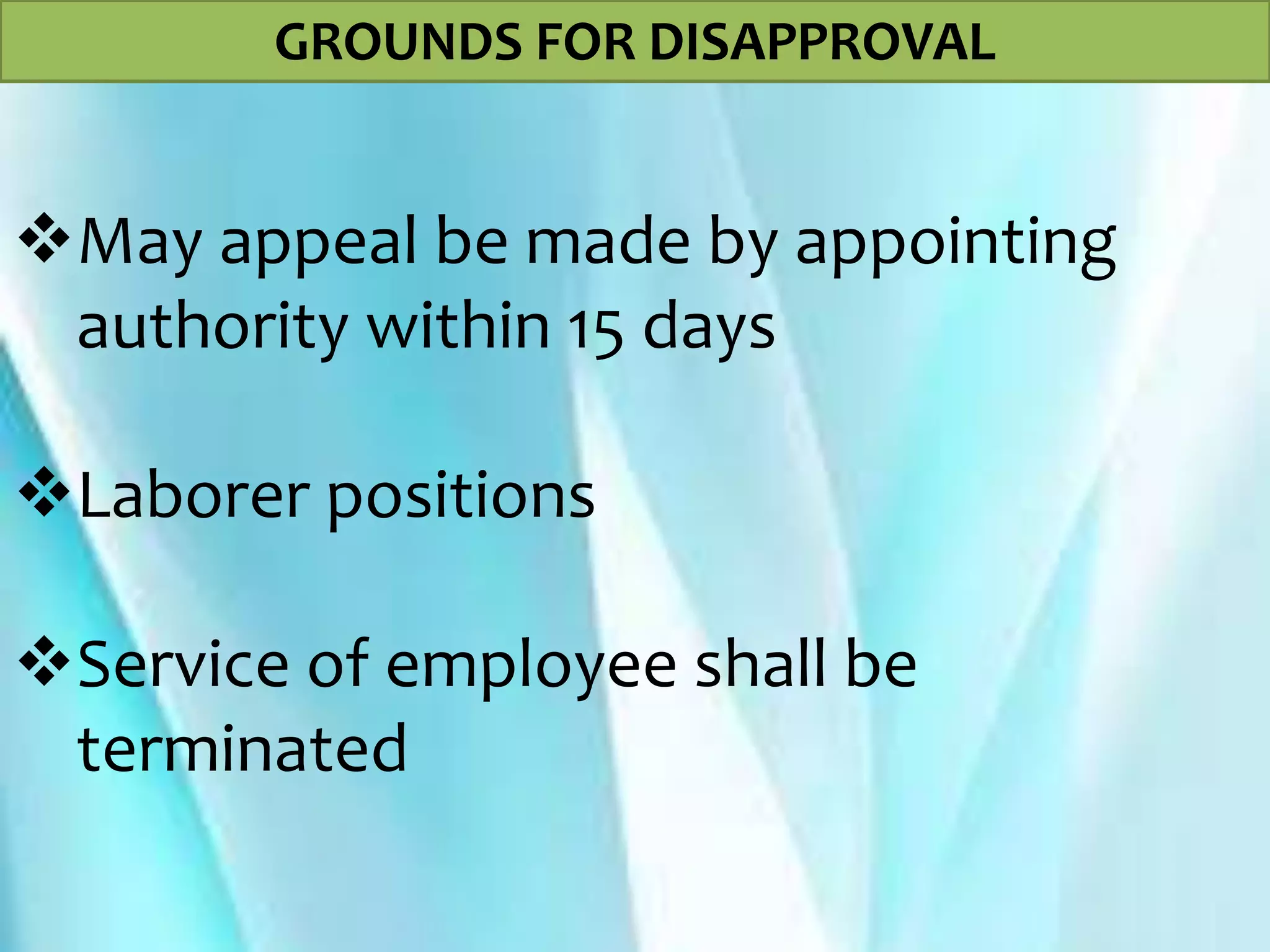
Attempted to practice any deception or fraud in
connection with his appointment
Issued such appointment in violation of existing Civil
Service Law and Rules and regulations
GROUNDS FOR DISAPPROVAL
May appeal be made by appointing
authority within 15 days
Laborer positions
Service of employee shall be
terminated
NEPOTIC APPOINTMENT
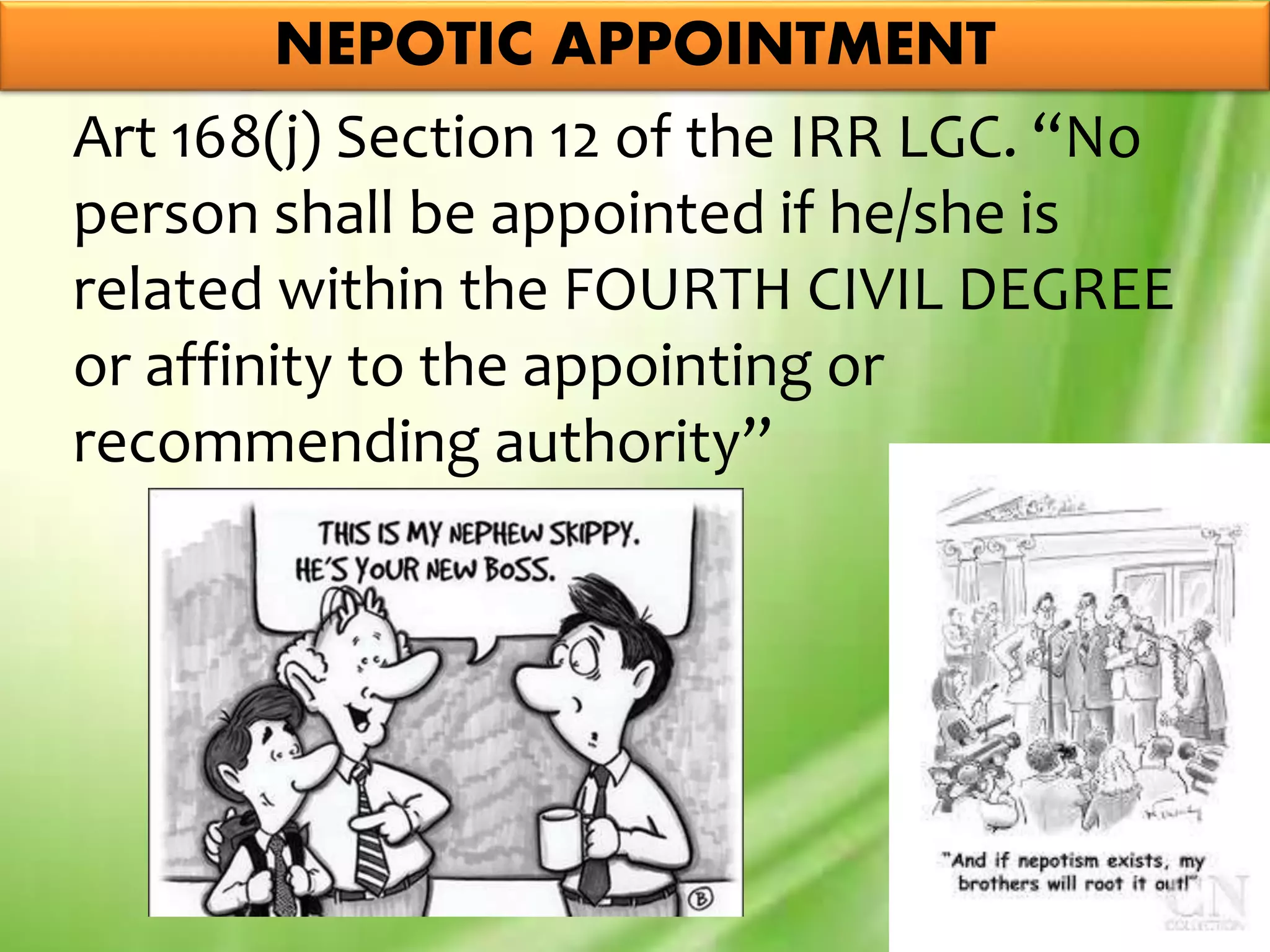
Art 168(j) Section 12 of the IRR LGC. “No
person shall be appointed if he/she is
related within the FOURTH CIVIL DEGREE
or affinity to the appointing or
recommending authority”
NEPOTISM RULE
Covers all kinds of
appointments whether original,
promotional, transfer and
reemployment regardless of
status including casuals and
contractual except consultants
KINDS OF APPOINTMENT
Permanent - issued to a person
who meets all the
minimum requirements including
education, experience and
training (if any) and appropriate
eligibility.
Only permanent appointees enjoy security
of tenure.
TEMPORARY - issued for a
period of not more than one
(1) year to a person who
meets the education,
experience and
training but not the
appropriate eligibility
prescribed but only
in the absence of a qualified
eligible.
SUBSTITUTE – issued when the regular
incumbent of a position is temporarily
unable to perform the duties of his/her
position, as when he/she is on approved
leave of absence or is under suspension
or is on scholarship grant or is on
secondment. This is effective only until
the return of the former incumbent. A
substitute appointment is issued only if
the leave of absence of the incumbent is
at least three (3) months.
Coterminous – issued to a person whose entrance and
continuity in the service is:
(1) coterminous with the appointing authority or head
of the organizational unit where assigned
(appointments to these positions are based on trust
and confidence and must be declared as primarily
confidential by the Commission);
(2) coterminous with the incumbent;
(3) coterminous with the project;
(4) coterminous with the life span of the agency
Over 65 years old – resolution of the
Commission granting the request of extension
- Absence of resolution, salaries will be made
for the personal account of the responsbible
official
• Over 65 years old – resolution of
the Commission granting the
request of extension
• Absence of resolution, salaries will
be made for the personal account
of the responsible official
• Extension is not credited as
government service
• Entitled to salary/allowance and
other compensation
Contractual – issued to a person to undertake a
specific work or job for a limited period not to
exceed one year. The appointing authority shall
indicate the inclusive period covered by the
appointment for purposes of crediting services.
Casual – issued to a person to do only essential
and necessary services where there are not
enough regular staff to meet the demands of the
services.
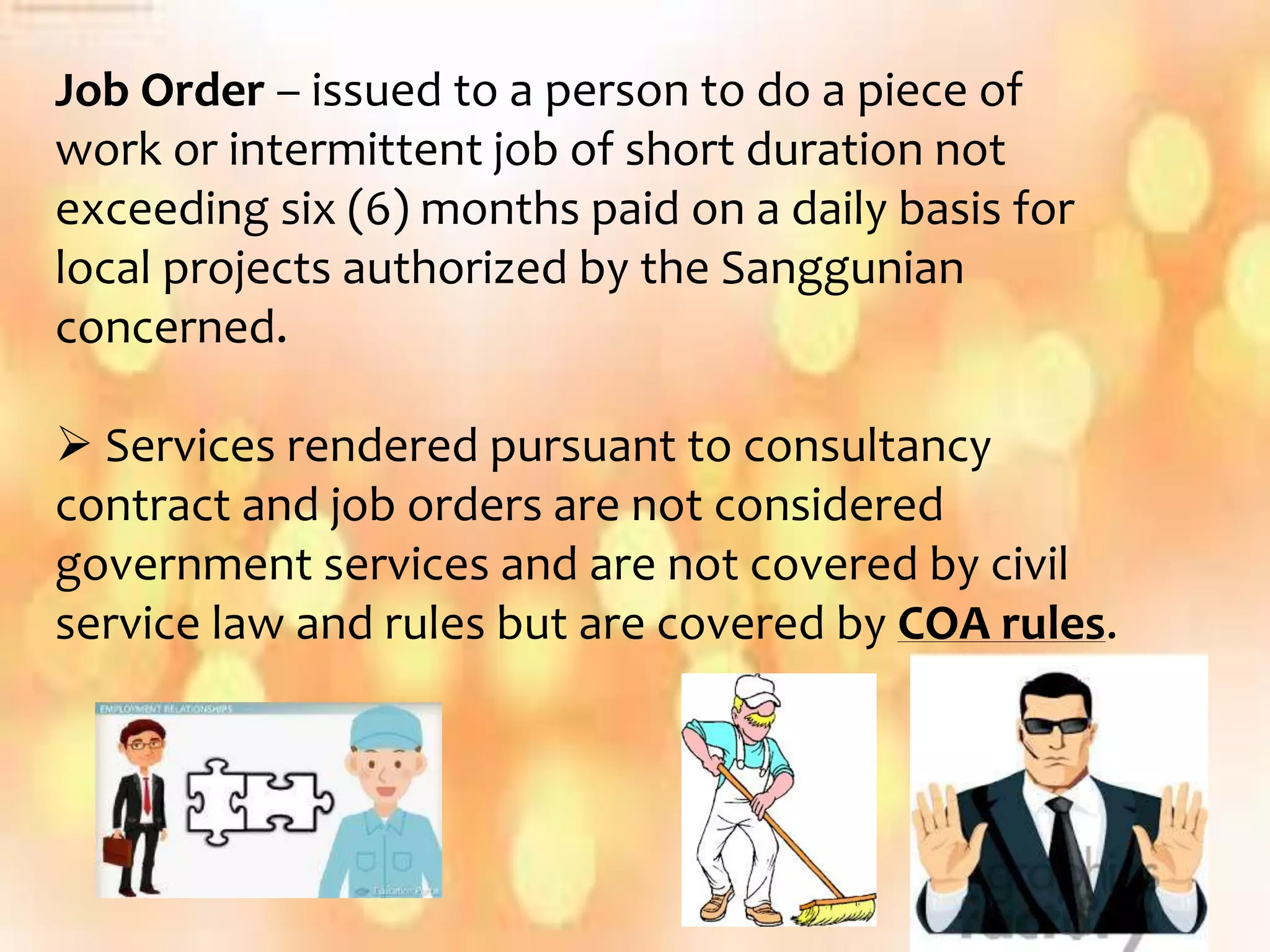
Job Order – issued to a person to do a piece of
work or intermittent job of short duration not
exceeding six (6) months paid on a daily basis for
local projects authorized by the Sanggunian
concerned.
 Services rendered pursuant to consultancy
contract and job orders are not considered
government services and are not covered by civil
service law and rules but are covered by COA rules.
EMPLOYMENT STATUS OF TEACHERS
REGULAR APPOINTMENT – issued to a teacher
who meets all the requirements of the position
PROVISIONAL – issued to a teacher who meets all
the requirements of the position except the
eligibility
SUBSITUTE – issued to a teacher when the
regular incumbent of the position is temporarily
unable to perform the duties of the position
CERTAIN MODE OF SEPARATION
Absence w/o Approved Leave – an officer/employee
w/o approved leave (AWOL) for at least 30 working
days shall be separated from the service or dropped
from the rolls.
Unsatisfactory or Poor Performance – an employee who
is given 2 consecutive unsatisfactory ratings.
Physically and Mentally Unfit – an officer/employee
who is intermittently absent of illness for at least 260
working days during 24 month period
- an employee who is behaving abnormally for an
extended period which undergo mental disorder
Recruitment Screening and Selection process in Philippine Government

Recruitment Screening and Selection process in Philippine Government

  • 1.
    RECRUITMENT PRESENTED BY: MICHELLE I.HERRERA M.P.S. – Public Administration SCREENING AND SELECTION
  • 2.
    SCREENING AND SELECTIONPROCESS Screening is a formal procedure done by the PSB in the evaluation of candidates for appointment to vacancy. Screen for Education and Experience During the initial screening, the recruiter checks for completeness of the application, along with a comparison against the job requirements. MAIN PLAYERS: 1. HRMO/HRMP –minimum requirements 2. HRMO/HRMP -submit to PSB 3. PSB screen qualified applicants
  • 3.
    NO LONGER SUBJECTTO SCREENING 1. Candidates due to short duration 2. Appointment of faculty members and academic staff of State University 3. Laborer Positions 4. Change of status from temporary to permanent
  • 4.
    1. SCREENING PRE-INTEVIEW Manyorganizations prefer to do a screening interview of those applicants that appear qualified based on information submitted on their résumé and application. 2. TESTING Tests- measure knowledge, skill, and ability, as well as other characteristics, such as personality traits.
  • 5.
    TEST SAMPLE 1. Cognitive Ability – Itmeasures the learning, understanding, and ability to solve problems. e.g. Intelligence Tests. 2. Personality Test - It measures the patterns of thought, emotion, and behavior.
  • 6.
    3. FINAL INTERVIEWOR PANEL INTERVIEW - is similar to a typical one-on-one interview but there are two or more interviewers in the room. They can feel very intimidating as it can be more difficult to build up a rapport with a group of people and they can be more formal in style.
  • 7.
    4. Character andBackground Investigation The Screening Committee shall cause an intensive investigation to be conducted on the character and background of the applicant with the view of determining his character reputation and possible involvement in any questionable or criminal activities.
  • 8.
     PSB shallsubmit evaluation report of candidates screened – not only specify whether the candidates meet the qualification but also observations and comments on the candidates, competence and other qualifications.  Notify all applicants of their individual rating on the basis of education, training, experience, eligibility and interview as well as of the outcome of the evaluation of the PSB.  PSB shall recommend to the LCE the candidates who passed the screening.
  • 9.
    Physical and MentalExamination In order to determine whether or not the applicant is in good health, free from any contagious diseases, a physical and medical examination must be conducted.
  • 10.
    SELECTION At this point,there usually is one or two candidates who clearly stand out as the most qualified for the job.
  • 11.
    Do not forgetto send letters to the candidates who did not get the job. They deserve a sincere letter from you that thanks them for their consideration and for interviewing for the job. Clearly explain that another candidate most closely matched the qualifications specified in the job description.
  • 12.
    LCE shall issuedAppointment  an appointment is a document that gives authority to discharge the functions of his/her position  Be guided by the CSC Law and Rules  CS Form 33 shall be issued except for CASUAL (Plantilla Appointment Form)
  • 13.
    REQUIREMENTS FOR APPROVAL ART.168 (a) Rule 12 of the IRR LGC “all appointments shall be made only according to merit and fitness to be determined as far as practicable by competitive examinations.” “SHALL MEET ALL THE REQUIREMENTS OF THE POSITION”
  • 14.
    GROUNDS FOR DISAPPROVAL Whenthe appointee does not meet the qualifications for the position Found guilty of a crime Dismissed from the service for cause, unless clemency has been granted
  • 15.
    GROUNDS FOR DISAPPROVAL Attemptedto practice any deception or fraud in connection with his appointment Issued such appointment in violation of existing Civil Service Law and Rules and regulations
  • 16.
    GROUNDS FOR DISAPPROVAL Mayappeal be made by appointing authority within 15 days Laborer positions Service of employee shall be terminated
  • 17.
    NEPOTIC APPOINTMENT Art 168(j)Section 12 of the IRR LGC. “No person shall be appointed if he/she is related within the FOURTH CIVIL DEGREE or affinity to the appointing or recommending authority”
  • 18.
    NEPOTISM RULE Covers allkinds of appointments whether original, promotional, transfer and reemployment regardless of status including casuals and contractual except consultants
  • 19.
    KINDS OF APPOINTMENT Permanent- issued to a person who meets all the minimum requirements including education, experience and training (if any) and appropriate eligibility. Only permanent appointees enjoy security of tenure.
  • 20.
    TEMPORARY - issuedfor a period of not more than one (1) year to a person who meets the education, experience and training but not the appropriate eligibility prescribed but only in the absence of a qualified eligible.
  • 21.
    SUBSTITUTE – issuedwhen the regular incumbent of a position is temporarily unable to perform the duties of his/her position, as when he/she is on approved leave of absence or is under suspension or is on scholarship grant or is on secondment. This is effective only until the return of the former incumbent. A substitute appointment is issued only if the leave of absence of the incumbent is at least three (3) months.
  • 22.
    Coterminous – issuedto a person whose entrance and continuity in the service is: (1) coterminous with the appointing authority or head of the organizational unit where assigned (appointments to these positions are based on trust and confidence and must be declared as primarily confidential by the Commission); (2) coterminous with the incumbent; (3) coterminous with the project; (4) coterminous with the life span of the agency Over 65 years old – resolution of the Commission granting the request of extension - Absence of resolution, salaries will be made for the personal account of the responsbible official
  • 23.
    • Over 65years old – resolution of the Commission granting the request of extension • Absence of resolution, salaries will be made for the personal account of the responsible official • Extension is not credited as government service • Entitled to salary/allowance and other compensation
  • 24.
    Contractual – issuedto a person to undertake a specific work or job for a limited period not to exceed one year. The appointing authority shall indicate the inclusive period covered by the appointment for purposes of crediting services. Casual – issued to a person to do only essential and necessary services where there are not enough regular staff to meet the demands of the services.
  • 25.
    Job Order –issued to a person to do a piece of work or intermittent job of short duration not exceeding six (6) months paid on a daily basis for local projects authorized by the Sanggunian concerned.  Services rendered pursuant to consultancy contract and job orders are not considered government services and are not covered by civil service law and rules but are covered by COA rules.
  • 26.
    EMPLOYMENT STATUS OFTEACHERS REGULAR APPOINTMENT – issued to a teacher who meets all the requirements of the position PROVISIONAL – issued to a teacher who meets all the requirements of the position except the eligibility SUBSITUTE – issued to a teacher when the regular incumbent of the position is temporarily unable to perform the duties of the position
  • 27.
    CERTAIN MODE OFSEPARATION Absence w/o Approved Leave – an officer/employee w/o approved leave (AWOL) for at least 30 working days shall be separated from the service or dropped from the rolls. Unsatisfactory or Poor Performance – an employee who is given 2 consecutive unsatisfactory ratings. Physically and Mentally Unfit – an officer/employee who is intermittently absent of illness for at least 260 working days during 24 month period - an employee who is behaving abnormally for an extended period which undergo mental disorder