SAP ABAP HR
AGENDA
 SAP HR Modules
 HR-ABAP Over view
 Difference b/w ABAP and ABAP HR
 Info types:
 Subtypes
 Characteristics
 Structure
 Common Info types
 Time Constraints
 Personnel Administration(PA)
 Create a custom info types
 Enhancements
The various Processes in SAP HR
 Recruitment
 Hiring
 Benefits Enrollment
 Employee Training
 Travel Expense Administration
 Time Reporting & Work
 Schedule Planning
 Payroll Administration
 Employee Development & Salary Administration
 Cost Planning & Reporting
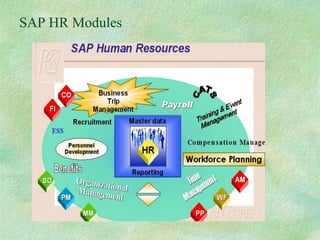
SAP HR Modules
Modules of the SAP HR System
 Organizational Management
 Personnel Administration
 Time Management
 Payroll
 Recruitment
 Training & Event Management
 Personnel Development
HR-ABAP Over view
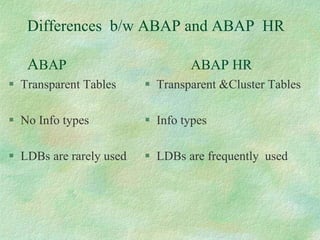
Differences b/w ABAP and ABAP HR
ABAP ABAP HR
 Transparent Tables
 No Info types
 LDBs are rarely used
 Transparent &Cluster Tables
 Info types
 LDBs are frequently used
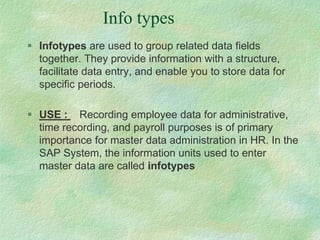
Info types
 Infotypes are used to group related data fields
together. They provide information with a structure,
facilitate data entry, and enable you to store data for
specific periods.
 USE : Recording employee data for administrative,
time recording, and payroll purposes is of primary
importance for master data administration in HR. In the
SAP System, the information units used to enter
master data are called infotypes
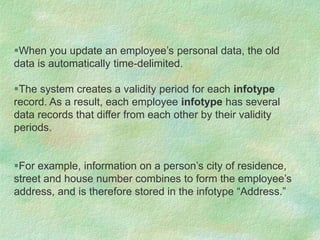
When you update an employee’s personal data, the old
data is automatically time-delimited.
The system creates a validity period for each infotype
record. As a result, each employee infotype has several
data records that differ from each other by their validity
periods.
For example, information on a person’s city of residence,
street and house number combines to form the employee’s
address, and is therefore stored in the infotype “Address.”
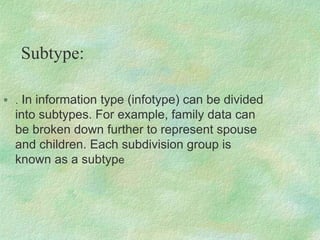
Subtype:
 . In information type (infotype) can be divided
into subtypes. For example, family data can
be broken down further to represent spouse
and children. Each subdivision group is
known as a subtype
Characteristics of Info types
 Each infotype has a 4 digit code and name.
 0000 - 8999 are controlled by SAP.
 Some infotypes are subdivided into Subtypes.
 Basic form:
INFOTYPES: nnnn.
 Effect:
Declares the HR info type nnnn. Creates an internal table as
follows:
DATA: BEGIN OF Pnnnn OCCURS 10,
INCLUDE STRUCTURE Pnnnn.
DATA: END OF Pnnnn,
VALID BETWEEN BEGDA AND ENDDA.
Infotype Naming Conventions
 0000 to 0999 – HR Master data / Applicant data(PA)
 1000 to 1999 – Organizational Management(OM)
 2000 to 2999 – Time data
 4000 to 4999 – Applicant data(Recruitment)
 9000 to 9999 – Customer defined
 3000 to 3999 and 5000 to 8999 – Not yet Defined
Structure of Info types
 The Data Dictionary contains a Pnnnn structure for each info type
nnnn.
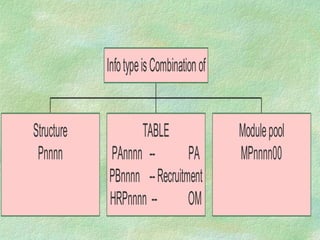
 The info type structure Pnnnn corresponds to the table PAnnnn.
 The info type is defined in the Data Dictionary as a structure
without a database.
 The Pnnnn structure of the info type is used as the field structure
for the info type entry screen.
 When you declare an info type using the INFOTYPES statement, an
internal table Pnnnn with the structure Pnnnn is created and all
records of the info type are transferred to this table.
Structure
Pnnnn
TABLE
PAnnnn -- PA
PBnnnn --Recruitment
HRPnnnn -- OM
Modulepool
MPnnnn00
InfotypeisCombinationof
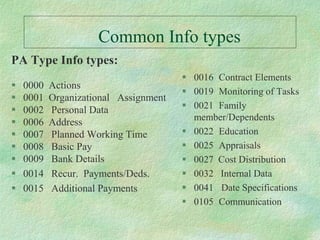
Common Info types
PA Type Info types:
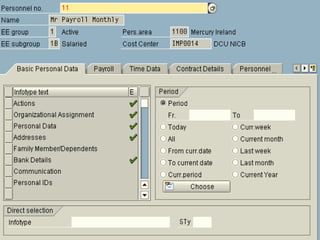
 0000 Actions
 0001 Organizational Assignment
 0002 Personal Data
 0006 Address
 0007 Planned Working Time
 0008 Basic Pay
 0009 Bank Details
 0014 Recur. Payments/Deds.
 0015 Additional Payments
 0016 Contract Elements
 0019 Monitoring of Tasks
 0021 Family
member/Dependents
 0022 Education
 0025 Appraisals
 0027 Cost Distribution
 0032 Internal Data
 0041 Date Specifications
 0105 Communication
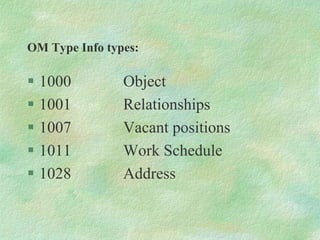
OM Type Info types:
 1000 Object
 1001 Relationships
 1007 Vacant positions
 1011 Work Schedule
 1028 Address
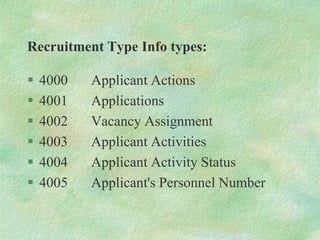
Recruitment Type Info types:
 4000 Applicant Actions
 4001 Applications
 4002 Vacancy Assignment
 4003 Applicant Activities
 4004 Applicant Activity Status
 4005 Applicant's Personnel Number
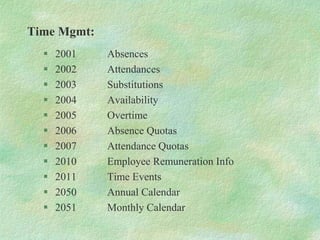
Time Mgmt:
 2001 Absences
 2002 Attendances
 2003 Substitutions
 2004 Availability
 2005 Overtime
 2006 Absence Quotas
 2007 Attendance Quotas
 2010 Employee Remuneration Info
 2011 Time Events
 2050 Annual Calendar
 2051 Monthly Calendar
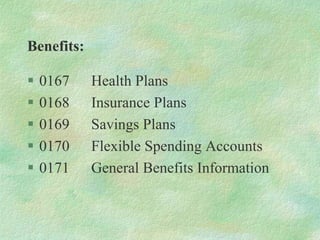
Benefits:
 0167 Health Plans
 0168 Insurance Plans
 0169 Savings Plans
 0170 Flexible Spending Accounts
 0171 General Benefits Information
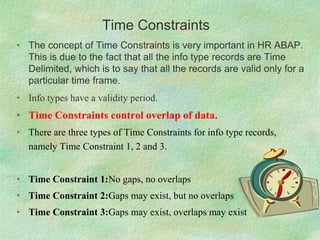
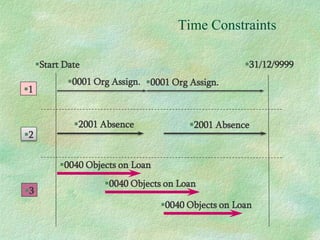
Time Constraints
• The concept of Time Constraints is very important in HR ABAP.
This is due to the fact that all the info type records are Time
Delimited, which is to say that all the records are valid only for a
particular time frame.
• Info types have a validity period.
• Time Constraints control overlap of data.
• There are three types of Time Constraints for info type records,
namely Time Constraint 1, 2 and 3.
• Time Constraint 1:No gaps, no overlaps
• Time Constraint 2:Gaps may exist, but no overlaps
• Time Constraint 3:Gaps may exist, overlaps may exist
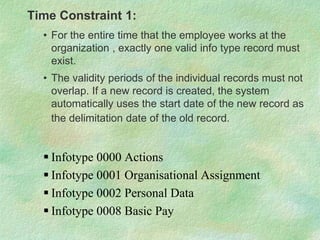
Time Constraint 1:
• For the entire time that the employee works at the
organization , exactly one valid info type record must
exist.
• The validity periods of the individual records must not
overlap. If a new record is created, the system
automatically uses the start date of the new record as
the delimitation date of the old record.
 Infotype 0000 Actions
 Infotype 0001 Organisational Assignment
 Infotype 0002 Personal Data
 Infotype 0008 Basic Pay
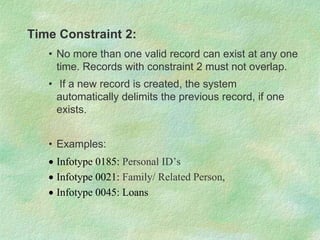
Time Constraint 2:
• No more than one valid record can exist at any one
time. Records with constraint 2 must not overlap.
• If a new record is created, the system
automatically delimits the previous record, if one
exists.
• Examples:
 Infotype 0185: Personal ID’s
 Infotype 0021: Family/ Related Person,
 Infotype 0045: Loans
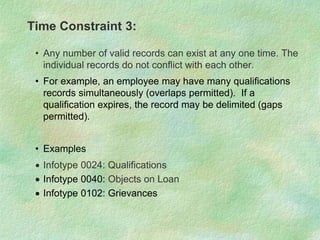
Time Constraint 3:
• Any number of valid records can exist at any one time. The
individual records do not conflict with each other.
• For example, an employee may have many qualifications
records simultaneously (overlaps permitted). If a
qualification expires, the record may be delimited (gaps
permitted).
• Examples
 Infotype 0024: Qualifications
 Infotype 0040: Objects on Loan
 Infotype 0102: Grievances
Start Date 31/12/9999
0001 Org Assign.
1
2001 Absence 2001 Absence
2
0040 Objects on Loan
3
0001 Org Assign.
Time Constraints
Personnel Administration(PA)
.
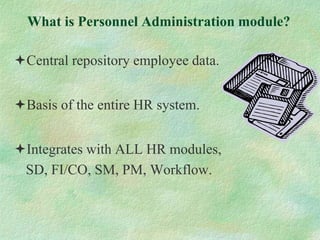
What is Personnel Administration module?
Central repository employee data.
Basis of the entire HR system.
Integrates with ALL HR modules,
SD, FI/CO, SM, PM, Workflow.
The Personnel Administration (PA) module is used for
creating, maintaining and processing employee data within
the organization. When an employee is hired their details
are stored in the PA module.
Once the employee is hired, the PA module is used to
perform a number of functions including updating
employee records.
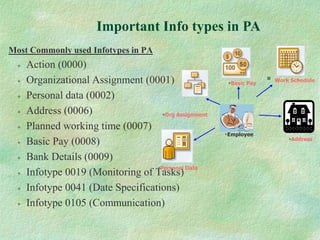
Most Commonly used Infotypes in PA
 Action (0000)
 Organizational Assignment (0001)
 Personal data (0002)
 Address (0006)
 Planned working time (0007)
 Basic Pay (0008)
 Bank Details (0009)
 Infotype 0019 (Monitoring of Tasks)
 Infotype 0041 (Date Specifications)
 Infotype 0105 (Communication)
 Work Schedule
Employee
Org Assignment
Personal Data
Basic Pay
Address
Important Info types in PA
Create a custom info types
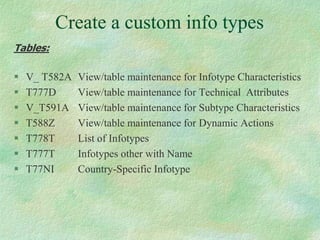
Tables:
 V_ T582A View/table maintenance for Infotype Characteristics
 T777D View/table maintenance for Technical Attributes
 V_T591A View/table maintenance for Subtype Characteristics
 T588Z View/table maintenance for Dynamic Actions
 T778T List of Infotypes
 T777T Infotypes other with Name
 T77NI Country-Specific Infotype
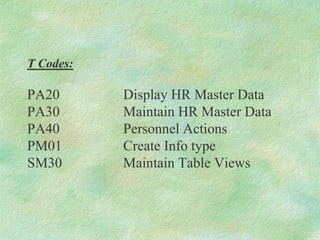
T Codes:
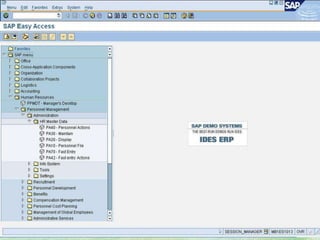
PA20 Display HR Master Data
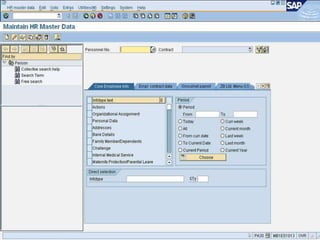
PA30 Maintain HR Master Data
PA40 Personnel Actions
PM01 Create Info type
SM30 Maintain Table Views
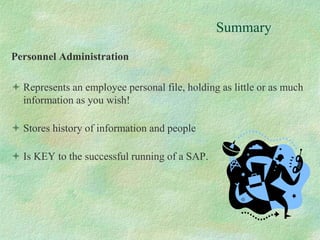
Personnel Administration
 Represents an employee personal file, holding as little or as much
information as you wish!
 Stores history of information and people
 Is KEY to the successful running of a SAP.
Summary
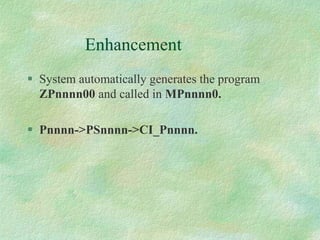
Enhancement
 System automatically generates the program
ZPnnnn00 and called in MPnnnn0.
 Pnnnn->PSnnnn->CI_Pnnnn.

HR ABAP

  • 1.
  • 2.
    AGENDA  SAP HRModules  HR-ABAP Over view  Difference b/w ABAP and ABAP HR  Info types:  Subtypes  Characteristics  Structure  Common Info types  Time Constraints  Personnel Administration(PA)  Create a custom info types  Enhancements
  • 3.
    The various Processesin SAP HR  Recruitment  Hiring  Benefits Enrollment  Employee Training  Travel Expense Administration  Time Reporting & Work  Schedule Planning  Payroll Administration  Employee Development & Salary Administration  Cost Planning & Reporting
  • 4.
  • 5.
    Modules of theSAP HR System  Organizational Management  Personnel Administration  Time Management  Payroll  Recruitment  Training & Event Management  Personnel Development
  • 6.
  • 7.
    Differences b/w ABAPand ABAP HR ABAP ABAP HR  Transparent Tables  No Info types  LDBs are rarely used  Transparent &Cluster Tables  Info types  LDBs are frequently used
  • 8.
    Info types  Infotypesare used to group related data fields together. They provide information with a structure, facilitate data entry, and enable you to store data for specific periods.  USE : Recording employee data for administrative, time recording, and payroll purposes is of primary importance for master data administration in HR. In the SAP System, the information units used to enter master data are called infotypes
  • 9.
    When you updatean employee’s personal data, the old data is automatically time-delimited. The system creates a validity period for each infotype record. As a result, each employee infotype has several data records that differ from each other by their validity periods. For example, information on a person’s city of residence, street and house number combines to form the employee’s address, and is therefore stored in the infotype “Address.”
  • 10.
    Subtype:  . Ininformation type (infotype) can be divided into subtypes. For example, family data can be broken down further to represent spouse and children. Each subdivision group is known as a subtype
  • 11.
    Characteristics of Infotypes  Each infotype has a 4 digit code and name.  0000 - 8999 are controlled by SAP.  Some infotypes are subdivided into Subtypes.  Basic form: INFOTYPES: nnnn.  Effect: Declares the HR info type nnnn. Creates an internal table as follows: DATA: BEGIN OF Pnnnn OCCURS 10, INCLUDE STRUCTURE Pnnnn. DATA: END OF Pnnnn, VALID BETWEEN BEGDA AND ENDDA.
  • 12.
    Infotype Naming Conventions 0000 to 0999 – HR Master data / Applicant data(PA)  1000 to 1999 – Organizational Management(OM)  2000 to 2999 – Time data  4000 to 4999 – Applicant data(Recruitment)  9000 to 9999 – Customer defined  3000 to 3999 and 5000 to 8999 – Not yet Defined
  • 13.
    Structure of Infotypes  The Data Dictionary contains a Pnnnn structure for each info type nnnn.  The info type structure Pnnnn corresponds to the table PAnnnn.  The info type is defined in the Data Dictionary as a structure without a database.  The Pnnnn structure of the info type is used as the field structure for the info type entry screen.  When you declare an info type using the INFOTYPES statement, an internal table Pnnnn with the structure Pnnnn is created and all records of the info type are transferred to this table.
  • 14.
    Structure Pnnnn TABLE PAnnnn -- PA PBnnnn--Recruitment HRPnnnn -- OM Modulepool MPnnnn00 InfotypeisCombinationof
  • 15.
    Common Info types PAType Info types:  0000 Actions  0001 Organizational Assignment  0002 Personal Data  0006 Address  0007 Planned Working Time  0008 Basic Pay  0009 Bank Details  0014 Recur. Payments/Deds.  0015 Additional Payments  0016 Contract Elements  0019 Monitoring of Tasks  0021 Family member/Dependents  0022 Education  0025 Appraisals  0027 Cost Distribution  0032 Internal Data  0041 Date Specifications  0105 Communication
  • 16.
    OM Type Infotypes:  1000 Object  1001 Relationships  1007 Vacant positions  1011 Work Schedule  1028 Address
  • 17.
    Recruitment Type Infotypes:  4000 Applicant Actions  4001 Applications  4002 Vacancy Assignment  4003 Applicant Activities  4004 Applicant Activity Status  4005 Applicant's Personnel Number
  • 18.
    Time Mgmt:  2001Absences  2002 Attendances  2003 Substitutions  2004 Availability  2005 Overtime  2006 Absence Quotas  2007 Attendance Quotas  2010 Employee Remuneration Info  2011 Time Events  2050 Annual Calendar  2051 Monthly Calendar
  • 19.
    Benefits:  0167 HealthPlans  0168 Insurance Plans  0169 Savings Plans  0170 Flexible Spending Accounts  0171 General Benefits Information
  • 20.
    Time Constraints • Theconcept of Time Constraints is very important in HR ABAP. This is due to the fact that all the info type records are Time Delimited, which is to say that all the records are valid only for a particular time frame. • Info types have a validity period. • Time Constraints control overlap of data. • There are three types of Time Constraints for info type records, namely Time Constraint 1, 2 and 3. • Time Constraint 1:No gaps, no overlaps • Time Constraint 2:Gaps may exist, but no overlaps • Time Constraint 3:Gaps may exist, overlaps may exist
  • 21.
    Time Constraint 1: •For the entire time that the employee works at the organization , exactly one valid info type record must exist. • The validity periods of the individual records must not overlap. If a new record is created, the system automatically uses the start date of the new record as the delimitation date of the old record.  Infotype 0000 Actions  Infotype 0001 Organisational Assignment  Infotype 0002 Personal Data  Infotype 0008 Basic Pay
  • 22.
    Time Constraint 2: •No more than one valid record can exist at any one time. Records with constraint 2 must not overlap. • If a new record is created, the system automatically delimits the previous record, if one exists. • Examples:  Infotype 0185: Personal ID’s  Infotype 0021: Family/ Related Person,  Infotype 0045: Loans
  • 23.
    Time Constraint 3: •Any number of valid records can exist at any one time. The individual records do not conflict with each other. • For example, an employee may have many qualifications records simultaneously (overlaps permitted). If a qualification expires, the record may be delimited (gaps permitted). • Examples  Infotype 0024: Qualifications  Infotype 0040: Objects on Loan  Infotype 0102: Grievances
  • 24.
    Start Date 31/12/9999 0001Org Assign. 1 2001 Absence 2001 Absence 2 0040 Objects on Loan 0040 Objects on Loan 0040 Objects on Loan 3 0001 Org Assign. Time Constraints
  • 25.
  • 26.
    What is PersonnelAdministration module? Central repository employee data. Basis of the entire HR system. Integrates with ALL HR modules, SD, FI/CO, SM, PM, Workflow.
  • 27.
    The Personnel Administration(PA) module is used for creating, maintaining and processing employee data within the organization. When an employee is hired their details are stored in the PA module. Once the employee is hired, the PA module is used to perform a number of functions including updating employee records.
  • 31.
    Most Commonly usedInfotypes in PA  Action (0000)  Organizational Assignment (0001)  Personal data (0002)  Address (0006)  Planned working time (0007)  Basic Pay (0008)  Bank Details (0009)  Infotype 0019 (Monitoring of Tasks)  Infotype 0041 (Date Specifications)  Infotype 0105 (Communication)  Work Schedule Employee Org Assignment Personal Data Basic Pay Address Important Info types in PA
  • 32.
    Create a custominfo types Tables:  V_ T582A View/table maintenance for Infotype Characteristics  T777D View/table maintenance for Technical Attributes  V_T591A View/table maintenance for Subtype Characteristics  T588Z View/table maintenance for Dynamic Actions  T778T List of Infotypes  T777T Infotypes other with Name  T77NI Country-Specific Infotype
  • 33.
    T Codes: PA20 DisplayHR Master Data PA30 Maintain HR Master Data PA40 Personnel Actions PM01 Create Info type SM30 Maintain Table Views
  • 34.
    Personnel Administration  Representsan employee personal file, holding as little or as much information as you wish!  Stores history of information and people  Is KEY to the successful running of a SAP. Summary
  • 35.
    Enhancement  System automaticallygenerates the program ZPnnnn00 and called in MPnnnn0.  Pnnnn->PSnnnn->CI_Pnnnn.