Developing a High Performance
Schools Protocol for
Integration in Energy Efficiency
Programs in the Northeast
Lead Author: Brian McCowan
Co-Authors: Gary Epstein
(ERS) Don Fudge (NEEP)
presented by

Brian McCowan
ERS
ACEEE Summer Study on Energy
Efficiency in Buildings
August 2006
What is
Northeast High Performance Schools Exchange
Established in 2003
Managed by Northeast Energy Efficiency
Partnerships (NEEP)
Participants Include All of the New England States
& NY, NJ, PA
Goal - Majority of New and Renovated Schools to
Implement High Performance Design,
Construction and Operation by 2010
Develop and Maintain a Regional High
Performance School Protocol that Promotes
Excellent Learning Environments that are Energy
Efficient, Cost-Effective and Utilize Sustainable
Technologies

ers

energy&resource solutions

© 2002 Energy and Resource Solutions, Inc.
Northeast Regional High Performance
Schools Protocol
Task:
Develop and Maintain a Regional High Performance
School Protocol that Promotes Excellent Learning
Environments that are Energy Efficient, CostEffective and Utilize Sustainable Technologies
Funding:
Henry P. Kendall Foundation
Massachusetts Technology Collaborative
Ratepayer-funded energy efficiency programs in
Connecticut, Vermont, Maine, Massachusetts and New
York.

ers

energy&resource solutions

© 2002 Energy and Resource Solutions, Inc.
Is a Regional Protocol Needed?

Five States in the Northeast have Officially Adopted a Voluntary
(Funding Incentives) or Mandatory High Performance Schools Program
The Following Documents Are Variously Used For Compliance
Collaborative for High Performance Schools CHPS
ASHRAE Standards 90.1 & 62
State Energy Code
LEED
Advanced Buildings Guidelines Benchmark
School Administrators and the Design Community Desire Some
Consistency

ers

energy&resource solutions

© 2002 Energy and Resource Solutions, Inc.
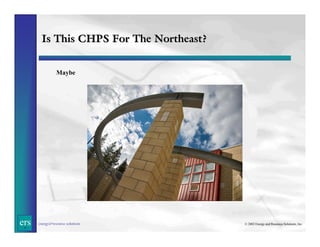
Is This CHPS For The Northeast?
Maybe

ers

energy&resource solutions

© 2002 Energy and Resource Solutions, Inc.
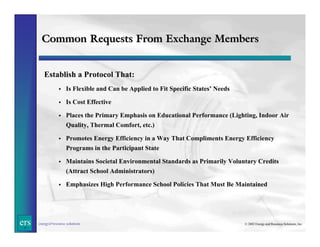
Common Requests From Exchange Members
Establish a Protocol That:
Is Flexible and Can be Applied to Fit Specific States’ Needs
Is Cost Effective
Places the Primary Emphasis on Educational Performance (Lighting, Indoor Air
Quality, Thermal Comfort, etc.)
Promotes Energy Efficiency in a Way That Compliments Energy Efficiency
Programs in the Participant State
Maintains Societal Environmental Standards as Primarily Voluntary Credits
(Attract School Administrators)
Emphasizes High Performance School Policies That Must Be Maintained

ers

energy&resource solutions

© 2002 Energy and Resource Solutions, Inc.
Concerns From Exchange Members

“Things are Different Here in fill in your state here”
Winter Heating Climate
Much of the Northeast is Rural
LEED and CHPS Seem to Give Equal Weight to
Environmental Issues, Educational Performance
and Energy Issues
LEED and CHPS Energy Efficiency Sections
Viewed as too Lenient and Difficult to Quantify
and Enforce

ers

energy&resource solutions

© 2002 Energy and Resource Solutions, Inc.
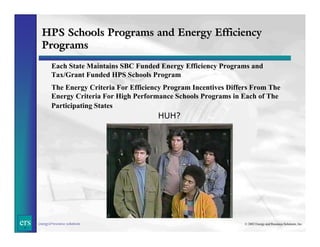
HPS Schools Programs and Energy Efficiency
Programs
Each State Maintains SBC Funded Energy Efficiency Programs and
Tax/Grant Funded HPS Schools Program
The Energy Criteria For Efficiency Program Incentives Differs From The
Energy Criteria For High Performance Schools Programs in Each of The
Participating States

HUH?

ers

energy&resource solutions

© 2002 Energy and Resource Solutions, Inc.
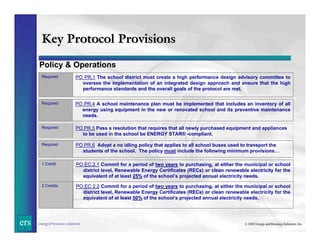
Key Protocol Provisions
Policy & Operations
Required

Required

PO PR.4 A school maintenance plan must be implemented that includes an inventory of all
energy using equipment in the new or renovated school and its preventive maintenance
needs.

Required

PO PR.5 Pass a resolution that requires that all newly purchased equipment and appliances
to be used in the school be ENERGY STAR® -compliant.

Required

PO PR.6 Adopt a no idling policy that applies to all school buses used to transport the
students of the school. The policy must include the following minimum provisions…

1 Credit

PO EC.2.1 Commit for a period of two years to purchasing, at either the municipal or school
district level, Renewable Energy Certificates (RECs) or clean renewable electricity for the
equivalent of at least 25% of the school’s projected annual electricity needs.

2 Credits

ers

PO PR.1 The school district must create a high performance design advisory committee to
oversee the implementation of an integrated design approach and ensure that the high
performance standards and the overall goals of the protocol are met.

PO EC 2.2 Commit for a period of two years to purchasing, at either the municipal or school
district level, Renewable Energy Certificates (RECs) or clean renewable electricity for the
equivalent of at least 50% of the school’s projected annual electricity needs.

energy&resource solutions

© 2002 Energy and Resource Solutions, Inc.
Key Protocol Provisions
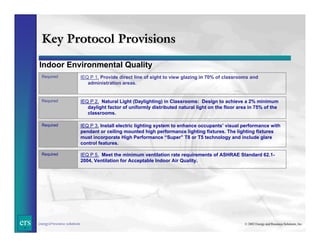
Indoor Environmental Quality
Required

Required

IEQ P 2. Natural Light (Daylighting) in Classrooms: Design to achieve a 2% minimum
daylight factor of uniformly distributed natural light on the floor area in 75% of the
classrooms.

Required

IEQ P 3. Install electric lighting system to enhance occupants’ visual performance with
pendant or ceiling mounted high performance lighting fixtures. The lighting fixtures
must incorporate High Performance “Super” T8 or T5 technology and include glare
control features.

Required

ers

IEQ P 1. Provide direct line of sight to view glazing in 70% of classrooms and
administration areas.

IEQ P 5. Meet the minimum ventilation rate requirements of ASHRAE Standard 62.12004, Ventilation for Acceptable Indoor Air Quality.

energy&resource solutions

© 2002 Energy and Resource Solutions, Inc.
Key Protocol Provisions
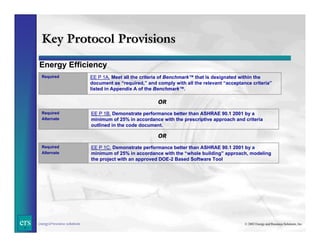
Energy Efficiency
Required

EE P 1A. Meet all the criteria of Benchmark™ that is designated within the
document as “required,” and comply with all the relevant “acceptance criteria”
listed in Appendix A of the Benchmark™.

OR
Required
Alternate

EE P 1B. Demonstrate performance better than ASHRAE 90.1 2001 by a
minimum of 25% in accordance with the prescriptive approach and criteria
outlined in the code document.

OR
Required
Alternate

ers

energy&resource solutions

EE P 1C. Demonstrate performance better than ASHRAE 90.1 2001 by a
minimum of 25% in accordance with the “whole building” approach, modeling
the project with an approved DOE-2 Based Software Tool

© 2002 Energy and Resource Solutions, Inc.
Key Protocol Provisions
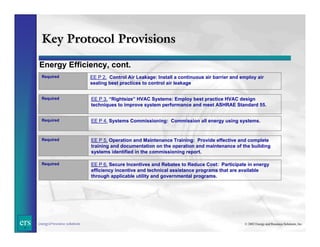
Energy Efficiency, cont.
Required

Required

EE P 3. “Rightsize” HVAC Systems: Employ best practice HVAC design
techniques to improve system performance and meet ASHRAE Standard 55.

Required

EE P 4. Systems Commissioning: Commission all energy using systems.

Required

EE P 5. Operation and Maintenance Training: Provide effective and complete
training and documentation on the operation and maintenance of the building
systems identified in the commissioning report.

Required

ers

EE P 2. Control Air Leakage: Install a continuous air barrier and employ air
sealing best practices to control air leakage

EE P 6. Secure Incentives and Rebates to Reduce Cost: Participate in energy
efficiency incentive and technical assistance programs that are available
through applicable utility and governmental programs.

energy&resource solutions

© 2002 Energy and Resource Solutions, Inc.
Protocol Compliance Documentation
Options
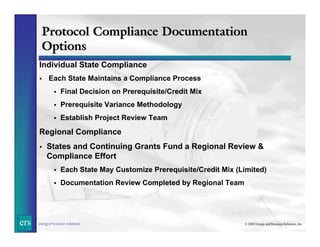
Individual State Compliance
Each State Maintains a Compliance Process
Final Decision on Prerequisite/Credit Mix
Prerequisite Variance Methodology
Establish Project Review Team

Regional Compliance
States and Continuing Grants Fund a Regional Review &
Compliance Effort
Each State May Customize Prerequisite/Credit Mix (Limited)
Documentation Review Completed by Regional Team

ers

energy&resource solutions

© 2002 Energy and Resource Solutions, Inc.
Conclusions

High performance buildings/schools programs and ratepayer funded
efficiency programs share many common goals
But – They do Not Share Common Methodologies or Requirements

A Regional Protocol with State-by-State Flexibility Allows Efficiency Program
Administrators and School Administrators to Work Toward Common Goals

Contacts: bmccowan@ers-inc.com 978-521-2550 ext. 301
csarno@neep.org 781-860-9177, ext. 19

ers

energy&resource solutions

© 2002 Energy and Resource Solutions, Inc.

Hpschoolsprotocolpresentation

  • 1.
    Developing a HighPerformance Schools Protocol for Integration in Energy Efficiency Programs in the Northeast Lead Author: Brian McCowan Co-Authors: Gary Epstein (ERS) Don Fudge (NEEP) presented by Brian McCowan ERS ACEEE Summer Study on Energy Efficiency in Buildings August 2006
  • 2.
    What is Northeast HighPerformance Schools Exchange Established in 2003 Managed by Northeast Energy Efficiency Partnerships (NEEP) Participants Include All of the New England States & NY, NJ, PA Goal - Majority of New and Renovated Schools to Implement High Performance Design, Construction and Operation by 2010 Develop and Maintain a Regional High Performance School Protocol that Promotes Excellent Learning Environments that are Energy Efficient, Cost-Effective and Utilize Sustainable Technologies ers energy&resource solutions © 2002 Energy and Resource Solutions, Inc.
  • 3.
    Northeast Regional HighPerformance Schools Protocol Task: Develop and Maintain a Regional High Performance School Protocol that Promotes Excellent Learning Environments that are Energy Efficient, CostEffective and Utilize Sustainable Technologies Funding: Henry P. Kendall Foundation Massachusetts Technology Collaborative Ratepayer-funded energy efficiency programs in Connecticut, Vermont, Maine, Massachusetts and New York. ers energy&resource solutions © 2002 Energy and Resource Solutions, Inc.
  • 4.
    Is a RegionalProtocol Needed? Five States in the Northeast have Officially Adopted a Voluntary (Funding Incentives) or Mandatory High Performance Schools Program The Following Documents Are Variously Used For Compliance Collaborative for High Performance Schools CHPS ASHRAE Standards 90.1 & 62 State Energy Code LEED Advanced Buildings Guidelines Benchmark School Administrators and the Design Community Desire Some Consistency ers energy&resource solutions © 2002 Energy and Resource Solutions, Inc.
  • 5.
    Is This CHPSFor The Northeast? Maybe ers energy&resource solutions © 2002 Energy and Resource Solutions, Inc.
  • 6.
    Common Requests FromExchange Members Establish a Protocol That: Is Flexible and Can be Applied to Fit Specific States’ Needs Is Cost Effective Places the Primary Emphasis on Educational Performance (Lighting, Indoor Air Quality, Thermal Comfort, etc.) Promotes Energy Efficiency in a Way That Compliments Energy Efficiency Programs in the Participant State Maintains Societal Environmental Standards as Primarily Voluntary Credits (Attract School Administrators) Emphasizes High Performance School Policies That Must Be Maintained ers energy&resource solutions © 2002 Energy and Resource Solutions, Inc.
  • 7.
    Concerns From ExchangeMembers “Things are Different Here in fill in your state here” Winter Heating Climate Much of the Northeast is Rural LEED and CHPS Seem to Give Equal Weight to Environmental Issues, Educational Performance and Energy Issues LEED and CHPS Energy Efficiency Sections Viewed as too Lenient and Difficult to Quantify and Enforce ers energy&resource solutions © 2002 Energy and Resource Solutions, Inc.
  • 8.
    HPS Schools Programsand Energy Efficiency Programs Each State Maintains SBC Funded Energy Efficiency Programs and Tax/Grant Funded HPS Schools Program The Energy Criteria For Efficiency Program Incentives Differs From The Energy Criteria For High Performance Schools Programs in Each of The Participating States HUH? ers energy&resource solutions © 2002 Energy and Resource Solutions, Inc.
  • 9.
    Key Protocol Provisions Policy& Operations Required Required PO PR.4 A school maintenance plan must be implemented that includes an inventory of all energy using equipment in the new or renovated school and its preventive maintenance needs. Required PO PR.5 Pass a resolution that requires that all newly purchased equipment and appliances to be used in the school be ENERGY STAR® -compliant. Required PO PR.6 Adopt a no idling policy that applies to all school buses used to transport the students of the school. The policy must include the following minimum provisions… 1 Credit PO EC.2.1 Commit for a period of two years to purchasing, at either the municipal or school district level, Renewable Energy Certificates (RECs) or clean renewable electricity for the equivalent of at least 25% of the school’s projected annual electricity needs. 2 Credits ers PO PR.1 The school district must create a high performance design advisory committee to oversee the implementation of an integrated design approach and ensure that the high performance standards and the overall goals of the protocol are met. PO EC 2.2 Commit for a period of two years to purchasing, at either the municipal or school district level, Renewable Energy Certificates (RECs) or clean renewable electricity for the equivalent of at least 50% of the school’s projected annual electricity needs. energy&resource solutions © 2002 Energy and Resource Solutions, Inc.
  • 10.
    Key Protocol Provisions IndoorEnvironmental Quality Required Required IEQ P 2. Natural Light (Daylighting) in Classrooms: Design to achieve a 2% minimum daylight factor of uniformly distributed natural light on the floor area in 75% of the classrooms. Required IEQ P 3. Install electric lighting system to enhance occupants’ visual performance with pendant or ceiling mounted high performance lighting fixtures. The lighting fixtures must incorporate High Performance “Super” T8 or T5 technology and include glare control features. Required ers IEQ P 1. Provide direct line of sight to view glazing in 70% of classrooms and administration areas. IEQ P 5. Meet the minimum ventilation rate requirements of ASHRAE Standard 62.12004, Ventilation for Acceptable Indoor Air Quality. energy&resource solutions © 2002 Energy and Resource Solutions, Inc.
  • 11.
    Key Protocol Provisions EnergyEfficiency Required EE P 1A. Meet all the criteria of Benchmark™ that is designated within the document as “required,” and comply with all the relevant “acceptance criteria” listed in Appendix A of the Benchmark™. OR Required Alternate EE P 1B. Demonstrate performance better than ASHRAE 90.1 2001 by a minimum of 25% in accordance with the prescriptive approach and criteria outlined in the code document. OR Required Alternate ers energy&resource solutions EE P 1C. Demonstrate performance better than ASHRAE 90.1 2001 by a minimum of 25% in accordance with the “whole building” approach, modeling the project with an approved DOE-2 Based Software Tool © 2002 Energy and Resource Solutions, Inc.
  • 12.
    Key Protocol Provisions EnergyEfficiency, cont. Required Required EE P 3. “Rightsize” HVAC Systems: Employ best practice HVAC design techniques to improve system performance and meet ASHRAE Standard 55. Required EE P 4. Systems Commissioning: Commission all energy using systems. Required EE P 5. Operation and Maintenance Training: Provide effective and complete training and documentation on the operation and maintenance of the building systems identified in the commissioning report. Required ers EE P 2. Control Air Leakage: Install a continuous air barrier and employ air sealing best practices to control air leakage EE P 6. Secure Incentives and Rebates to Reduce Cost: Participate in energy efficiency incentive and technical assistance programs that are available through applicable utility and governmental programs. energy&resource solutions © 2002 Energy and Resource Solutions, Inc.
  • 13.
    Protocol Compliance Documentation Options IndividualState Compliance Each State Maintains a Compliance Process Final Decision on Prerequisite/Credit Mix Prerequisite Variance Methodology Establish Project Review Team Regional Compliance States and Continuing Grants Fund a Regional Review & Compliance Effort Each State May Customize Prerequisite/Credit Mix (Limited) Documentation Review Completed by Regional Team ers energy&resource solutions © 2002 Energy and Resource Solutions, Inc.
  • 14.
    Conclusions High performance buildings/schoolsprograms and ratepayer funded efficiency programs share many common goals But – They do Not Share Common Methodologies or Requirements A Regional Protocol with State-by-State Flexibility Allows Efficiency Program Administrators and School Administrators to Work Toward Common Goals Contacts: bmccowan@ers-inc.com 978-521-2550 ext. 301 csarno@neep.org 781-860-9177, ext. 19 ers energy&resource solutions © 2002 Energy and Resource Solutions, Inc.