Main Headquarters: 120 Water Street, Suite 350, North Andover, MA 01845 With offices in: NY, ME, TX, CA, OR www.ers-inc.com
ENERGY CODE APPLICABILITY
IN INDUSTRIAL FACILITIES
presented by
Brian McCowan
and
Gary Epstein
ENERGY & RESOURCE SOLUTIONS
ENERGY CODE APPLICABILITY
IN INDUSTRIAL FACILITIES
 Recent Trends in Energy Codes
 Commercial Energy Code Technical Focus
 How Industrial Buildings are Different
 Typical Energy Code Jurisdiction
 Code Requirements with Limited
Applicability for Industry Sites
 Conclusions
 Recent Trends in Energy Codes
 Originally Developed for Commercial Sector including
Envelope, HVAC, Electrical and Lighting Systems
 Industrial Sectors Now Included Under Code Jurisdiction
 Codes Do Not Adequately Address Industrial &
Manufacturing Sectors
 Various State Modifications from ANSI/ASHRAE/IES 90.1
(1999)
or IECC Codes Create Further Challenges to Compliance
 Systematic Improvement Needed to Address Code Usage for
Industrial Energy Efficiency
ENERGY CODE APPLICABILITY
IN INDUSTRIAL FACILITIES
 Commercial Energy Code Technical Focus
 Three Primary Technology Focuses
• Building Envelope: Insulation, Glazing, Entry & Foundation
Requirements
 Modified Based on Construction Type (Masonry, Steel, Wood
Frame) with Typical Internal Gains
 Regionalized for Local Climatic Conditions
• Building Mechanical Systems (HVAC): Comfort Heating/Cooling and
Aux. Systems
 Load Calculations For System Sizing Based on Comfort Needs
 Minimum Efficiencies for Fans, Pumps, etc.
 Mandates for Economizers, Heat Recovery Ventilation
• Building Lighting Systems: Design/Spec, Lighting Power Densities,
Controls
 Maximum Lighting Power Densities
 Mandates for Automatic Controls
ENERGY CODE APPLICABILITY
IN INDUSTRIAL FACILITIES
 Industrial Buildings are Different
 Although Covered by the Same Energy Code Requirements; Differences
Include:
• Energy Usage Profiles
• Envelope, HVAC Design, Lighting, and Safety Needs
• Industrial Buildings Generate Much Higher Internal Heat Gains from
Auxiliary and Process Equipment as Compared to Commercial buildings
• Lighting Requirements are Process Specific
• Manufactures of Process Equipment Often Specify Certain Aspects of
Building Construction. Warrantee and Liability Issues May Conflict with
Code.
 Industrial Buildings Have Entirely Different End Use Breakdowns
• Largest Commercial Building Energy Users are the Building Systems:
Space Heating, Cooling, Ventilation, Lighting, Water Heating
• Largest Industrial Building Energy Users are Process Systems and
Material Handling
• Production Concerns vs. Occupancy Comfort
ENERGY CODE APPLICABILITY
IN INDUSTRIAL FACILITIES
ENERGY CODE APPLICABILITY
IN INDUSTRIAL FACILITIES
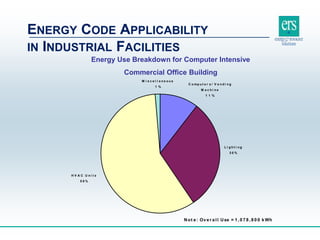
Not e : Ov e r a ll Use = 1 ,0 7 8 ,8 0 0 k Wh
L i g h t i n g
3 0 %
C o mp u t e r s / V e n d i n g
M a c h i n e
1 1 %
H V A C U n i t s
5 8 %
M i s c e l l a n e o u s
1 %
Energy Use Breakdown for Computer Intensive
Commercial Office Building
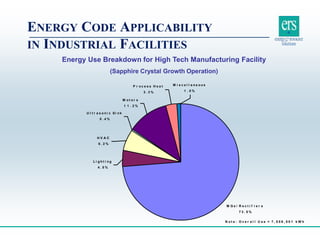
N o t e : O v e r a l l U s e = 7 , 5 5 9 , 5 0 1 k W h
M G s / R e c t i f i e r s
7 3 . 5 %
M o t o r s
1 1 . 2 %
U l t r a s o n i c Si n k
0 . 4 %
H V A C
6 . 2 %
P r o c e s s H e a t
3 . 3 %
L i g h t i n g
4 . 5 %
M i s c e l l a n e o u s
1 . 0 %
Energy Use Breakdown for High Tech Manufacturing Facility
(Sapphire Crystal Growth Operation)
ENERGY CODE APPLICABILITY
IN INDUSTRIAL FACILITIES
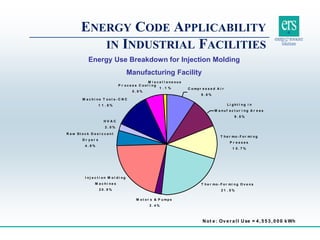
Not e : Ov e r a ll Use = 4 ,5 5 3 ,0 0 0 k Wh
C o mp r e s s e d A i r
9 . 6 %
L i g h t i n g i n
M a n u f a c t u r i n g A r e a s
9 . 5 %
T h e r mo - F o r mi n g
P r e s s e s
1 0 . 7 %
M a c h i n e T o o l s - C N C
1 1 . 6 %
R a w St o c k D e s i c c a n t
D r y e r s
4 . 9 %
H V A C
2 . 0 %
M o t o r s & P u mp s
2 . 4 %
I n j e c t i o n M o l d i n g
M a c h i n e s
2 0 . 9 %
T h e r mo - F o r mi n g O v e n s
2 1 . 5 %
M i s c e l l a n e o u s
1 . 1 %
P r o c e s s C o o l i n g
5 . 8 %
Energy Use Breakdown for Injection Molding
Manufacturing Facility
ENERGY CODE APPLICABILITY
IN INDUSTRIAL FACILITIES
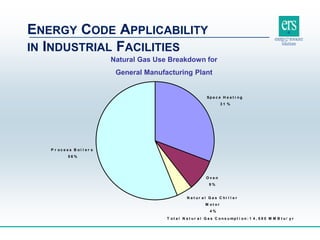
T o t a l N a t u r a l G a s C o n s u mp t i o n : 1 4 , 5 8 0 M M B t u / y r
Sp a c e H e a t i n g
3 1 %
O v e n
9 %
N a t u r a l G a s C h i l l e r
M o t o r
4 %
P r o c e s s B o i l e r s
5 6 %
ENERGY CODE APPLICABILITY
IN INDUSTRIAL FACILITIES
Natural Gas Use Breakdown for
General Manufacturing Plant
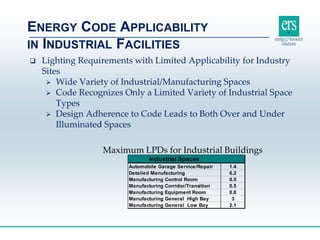
 Lighting Requirements with Limited Applicability for Industry
Sites
 Wide Variety of Industrial/Manufacturing Spaces
 Code Recognizes Only a Limited Variety of Industrial Space
Types
 Design Adherence to Code Leads to Both Over and Under
Illuminated Spaces
Maximum LPDs for Industrial Buildings
ENERGY CODE APPLICABILITY
IN INDUSTRIAL FACILITIES
Industrial Spaces
Automobile Garage Service/Repair 1.4
Detailed Manufacturing 6.2
Manufacturing Control Room 0.5
Manufacturing Corridor/Transition 0.5
Manufacturing Equipment Room 0.8
Manufacturing General High Bay 3
Manufacturing General Low Bay 2.1
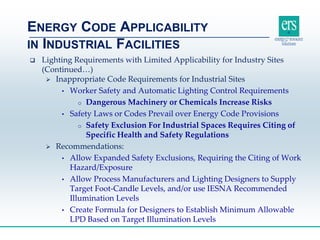
 Lighting Requirements with Limited Applicability for Industry Sites
(Continued…)
 Inappropriate Code Requirements for Industrial Sites
• Worker Safety and Automatic Lighting Control Requirements
o Dangerous Machinery or Chemicals Increase Risks
• Safety Laws or Codes Prevail over Energy Code Provisions
o Safety Exclusion For Industrial Spaces Requires Citing of
Specific Health and Safety Regulations
 Recommendations:
• Allow Expanded Safety Exclusions, Requiring the Citing of Work
Hazard/Exposure
• Allow Process Manufacturers and Lighting Designers to Supply
Target Foot-Candle Levels, and/or use IESNA Recommended
Illumination Levels
• Create Formula for Designers to Establish Minimum Allowable
LPD Based on Target Illumination Levels
ENERGY CODE APPLICABILITY
IN INDUSTRIAL FACILITIES
ENERGY CODE APPLICABILITY
IN INDUSTRIAL FACILITIES
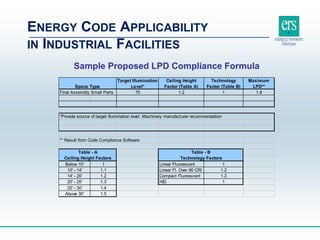
Sample Proposed LPD Compliance Formula
Final Assembly Small Parts 75 1.2 1 1.8
*Provide source of target illumination level: Machinery manufacturer recommendation
** Result from Code Compliance Software
Below 10' 1 Linear Fluorescent 1
10' - 14' 1.1 Linear Fl. Over 90 CRI 1.2
14' - 20' 1.2 Compact Fluorescent 1.2
20' - 25' 1.3 HID 1
25' - 30' 1.4
Above 30' 1.5
Maximum
LPD**Space Type
Target Illumination
Level*
Ceiling Height
Factor (Table A)
Technology
Factor (Table B)
Table - B
Technology Factors
Table - A
Ceiling Height Factors
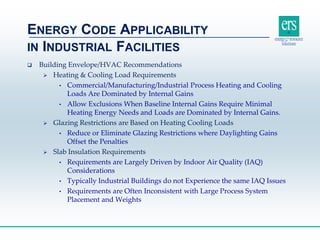
 Building Envelope/HVAC Recommendations
 Heating & Cooling Load Requirements
• Commercial/Manufacturing/Industrial Process Heating and Cooling
Loads Are Dominated by Internal Gains
• Allow Exclusions When Baseline Internal Gains Require Minimal
Heating Energy Needs and Loads are Dominated by Internal Gains.
 Glazing Restrictions are Based on Heating Cooling Loads
• Reduce or Eliminate Glazing Restrictions where Daylighting Gains
Offset the Penalties
 Slab Insulation Requirements
• Requirements are Largely Driven by Indoor Air Quality (IAQ)
Considerations
• Typically Industrial Buildings do not Experience the same IAQ Issues
• Requirements are Often Inconsistent with Large Process System
Placement and Weights
ENERGY CODE APPLICABILITY
IN INDUSTRIAL FACILITIES
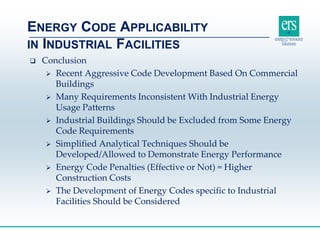
 Conclusion
 Recent Aggressive Code Development Based On Commercial
Buildings
 Many Requirements Inconsistent With Industrial Energy
Usage Patterns
 Industrial Buildings Should be Excluded from Some Energy
Code Requirements
 Simplified Analytical Techniques Should be
Developed/Allowed to Demonstrate Energy Performance
 Energy Code Penalties (Effective or Not) = Higher
Construction Costs
 The Development of Energy Codes specific to Industrial
Facilities Should be Considered
ENERGY CODE APPLICABILITY
IN INDUSTRIAL FACILITIES

Industrial approaches addressing new energy code

  • 1.
    Main Headquarters: 120Water Street, Suite 350, North Andover, MA 01845 With offices in: NY, ME, TX, CA, OR www.ers-inc.com ENERGY CODE APPLICABILITY IN INDUSTRIAL FACILITIES presented by Brian McCowan and Gary Epstein ENERGY & RESOURCE SOLUTIONS
  • 2.
    ENERGY CODE APPLICABILITY ININDUSTRIAL FACILITIES  Recent Trends in Energy Codes  Commercial Energy Code Technical Focus  How Industrial Buildings are Different  Typical Energy Code Jurisdiction  Code Requirements with Limited Applicability for Industry Sites  Conclusions
  • 3.
     Recent Trendsin Energy Codes  Originally Developed for Commercial Sector including Envelope, HVAC, Electrical and Lighting Systems  Industrial Sectors Now Included Under Code Jurisdiction  Codes Do Not Adequately Address Industrial & Manufacturing Sectors  Various State Modifications from ANSI/ASHRAE/IES 90.1 (1999) or IECC Codes Create Further Challenges to Compliance  Systematic Improvement Needed to Address Code Usage for Industrial Energy Efficiency ENERGY CODE APPLICABILITY IN INDUSTRIAL FACILITIES
  • 4.
     Commercial EnergyCode Technical Focus  Three Primary Technology Focuses • Building Envelope: Insulation, Glazing, Entry & Foundation Requirements  Modified Based on Construction Type (Masonry, Steel, Wood Frame) with Typical Internal Gains  Regionalized for Local Climatic Conditions • Building Mechanical Systems (HVAC): Comfort Heating/Cooling and Aux. Systems  Load Calculations For System Sizing Based on Comfort Needs  Minimum Efficiencies for Fans, Pumps, etc.  Mandates for Economizers, Heat Recovery Ventilation • Building Lighting Systems: Design/Spec, Lighting Power Densities, Controls  Maximum Lighting Power Densities  Mandates for Automatic Controls ENERGY CODE APPLICABILITY IN INDUSTRIAL FACILITIES
  • 5.
     Industrial Buildingsare Different  Although Covered by the Same Energy Code Requirements; Differences Include: • Energy Usage Profiles • Envelope, HVAC Design, Lighting, and Safety Needs • Industrial Buildings Generate Much Higher Internal Heat Gains from Auxiliary and Process Equipment as Compared to Commercial buildings • Lighting Requirements are Process Specific • Manufactures of Process Equipment Often Specify Certain Aspects of Building Construction. Warrantee and Liability Issues May Conflict with Code.  Industrial Buildings Have Entirely Different End Use Breakdowns • Largest Commercial Building Energy Users are the Building Systems: Space Heating, Cooling, Ventilation, Lighting, Water Heating • Largest Industrial Building Energy Users are Process Systems and Material Handling • Production Concerns vs. Occupancy Comfort ENERGY CODE APPLICABILITY IN INDUSTRIAL FACILITIES
  • 6.
    ENERGY CODE APPLICABILITY ININDUSTRIAL FACILITIES Not e : Ov e r a ll Use = 1 ,0 7 8 ,8 0 0 k Wh L i g h t i n g 3 0 % C o mp u t e r s / V e n d i n g M a c h i n e 1 1 % H V A C U n i t s 5 8 % M i s c e l l a n e o u s 1 % Energy Use Breakdown for Computer Intensive Commercial Office Building
  • 7.
    N o te : O v e r a l l U s e = 7 , 5 5 9 , 5 0 1 k W h M G s / R e c t i f i e r s 7 3 . 5 % M o t o r s 1 1 . 2 % U l t r a s o n i c Si n k 0 . 4 % H V A C 6 . 2 % P r o c e s s H e a t 3 . 3 % L i g h t i n g 4 . 5 % M i s c e l l a n e o u s 1 . 0 % Energy Use Breakdown for High Tech Manufacturing Facility (Sapphire Crystal Growth Operation) ENERGY CODE APPLICABILITY IN INDUSTRIAL FACILITIES
  • 8.
    Not e :Ov e r a ll Use = 4 ,5 5 3 ,0 0 0 k Wh C o mp r e s s e d A i r 9 . 6 % L i g h t i n g i n M a n u f a c t u r i n g A r e a s 9 . 5 % T h e r mo - F o r mi n g P r e s s e s 1 0 . 7 % M a c h i n e T o o l s - C N C 1 1 . 6 % R a w St o c k D e s i c c a n t D r y e r s 4 . 9 % H V A C 2 . 0 % M o t o r s & P u mp s 2 . 4 % I n j e c t i o n M o l d i n g M a c h i n e s 2 0 . 9 % T h e r mo - F o r mi n g O v e n s 2 1 . 5 % M i s c e l l a n e o u s 1 . 1 % P r o c e s s C o o l i n g 5 . 8 % Energy Use Breakdown for Injection Molding Manufacturing Facility ENERGY CODE APPLICABILITY IN INDUSTRIAL FACILITIES
  • 9.
    T o ta l N a t u r a l G a s C o n s u mp t i o n : 1 4 , 5 8 0 M M B t u / y r Sp a c e H e a t i n g 3 1 % O v e n 9 % N a t u r a l G a s C h i l l e r M o t o r 4 % P r o c e s s B o i l e r s 5 6 % ENERGY CODE APPLICABILITY IN INDUSTRIAL FACILITIES Natural Gas Use Breakdown for General Manufacturing Plant
  • 10.
     Lighting Requirementswith Limited Applicability for Industry Sites  Wide Variety of Industrial/Manufacturing Spaces  Code Recognizes Only a Limited Variety of Industrial Space Types  Design Adherence to Code Leads to Both Over and Under Illuminated Spaces Maximum LPDs for Industrial Buildings ENERGY CODE APPLICABILITY IN INDUSTRIAL FACILITIES Industrial Spaces Automobile Garage Service/Repair 1.4 Detailed Manufacturing 6.2 Manufacturing Control Room 0.5 Manufacturing Corridor/Transition 0.5 Manufacturing Equipment Room 0.8 Manufacturing General High Bay 3 Manufacturing General Low Bay 2.1
  • 11.
     Lighting Requirementswith Limited Applicability for Industry Sites (Continued…)  Inappropriate Code Requirements for Industrial Sites • Worker Safety and Automatic Lighting Control Requirements o Dangerous Machinery or Chemicals Increase Risks • Safety Laws or Codes Prevail over Energy Code Provisions o Safety Exclusion For Industrial Spaces Requires Citing of Specific Health and Safety Regulations  Recommendations: • Allow Expanded Safety Exclusions, Requiring the Citing of Work Hazard/Exposure • Allow Process Manufacturers and Lighting Designers to Supply Target Foot-Candle Levels, and/or use IESNA Recommended Illumination Levels • Create Formula for Designers to Establish Minimum Allowable LPD Based on Target Illumination Levels ENERGY CODE APPLICABILITY IN INDUSTRIAL FACILITIES
  • 12.
    ENERGY CODE APPLICABILITY ININDUSTRIAL FACILITIES Sample Proposed LPD Compliance Formula Final Assembly Small Parts 75 1.2 1 1.8 *Provide source of target illumination level: Machinery manufacturer recommendation ** Result from Code Compliance Software Below 10' 1 Linear Fluorescent 1 10' - 14' 1.1 Linear Fl. Over 90 CRI 1.2 14' - 20' 1.2 Compact Fluorescent 1.2 20' - 25' 1.3 HID 1 25' - 30' 1.4 Above 30' 1.5 Maximum LPD**Space Type Target Illumination Level* Ceiling Height Factor (Table A) Technology Factor (Table B) Table - B Technology Factors Table - A Ceiling Height Factors
  • 13.
     Building Envelope/HVACRecommendations  Heating & Cooling Load Requirements • Commercial/Manufacturing/Industrial Process Heating and Cooling Loads Are Dominated by Internal Gains • Allow Exclusions When Baseline Internal Gains Require Minimal Heating Energy Needs and Loads are Dominated by Internal Gains.  Glazing Restrictions are Based on Heating Cooling Loads • Reduce or Eliminate Glazing Restrictions where Daylighting Gains Offset the Penalties  Slab Insulation Requirements • Requirements are Largely Driven by Indoor Air Quality (IAQ) Considerations • Typically Industrial Buildings do not Experience the same IAQ Issues • Requirements are Often Inconsistent with Large Process System Placement and Weights ENERGY CODE APPLICABILITY IN INDUSTRIAL FACILITIES
  • 14.
     Conclusion  RecentAggressive Code Development Based On Commercial Buildings  Many Requirements Inconsistent With Industrial Energy Usage Patterns  Industrial Buildings Should be Excluded from Some Energy Code Requirements  Simplified Analytical Techniques Should be Developed/Allowed to Demonstrate Energy Performance  Energy Code Penalties (Effective or Not) = Higher Construction Costs  The Development of Energy Codes specific to Industrial Facilities Should be Considered ENERGY CODE APPLICABILITY IN INDUSTRIAL FACILITIES