Beyond
Design C t ti
D i & Construction:
Greening Your School through
Sustainable O
S t i bl Operations
                 ti

Josh Radoff
J h R d ff
jradoff@yrgsustainability.com


www.yrgsustainability.com
Twitter: @YRGreen
Facebook: YRG sustainability
Lesson Plan
Why sustainable operations in
schools?
  h l ?
A framework for what to do
A way to go about doing it
Borneo


         Operation Cat Drop


Systems Thinking: a Cautionary Tale
Better facility
                                        to teach


              Everything
              E    thi
More money for                          sustainability
books and
teachers


                    Green                         Greener homes

Happier teachers
                    School                        to go back to


          is connected
                   Better test scores
                                           Reduced absenteeism,
                                           healthier students
Definitions of Sustainability


                     +            +

      People             Planet       Profit


Triple Bottom Line
What does sustainability look like on a college campus?
Source: Metropolis Magazine
What does sustainability look like on a college campus?
Casey Middle School
The current paradigm:
                        Building     Design Team /
                        Operations   Developer
Good luck!
Measured Energy Use v LEED Certification Level


 Source: New Buildings Institute
Performance Is All That Matters
What Drives Building Performance?
                                          Computers
                                          Equipment
                                          Schedule
                                          Habits
        Staffing         Occupants
       Controls
   Maintenance
   M i t
 Commissioning                                           Layout
                                                         Integration
                                                         Installation
                                                         Components
                   Operation     Design


                                          Source: New Buildings Institute
Sustainable Operations


You’ve Decided to Go Green. Now What?
Money


   Time


                              People


Three things you don’t have
This is how you roll….
How to evaluate a school’s performance
Image: US Green
Building Council
Comparing LEED Rating Systems
LEED for Schools (NC)       LEED-EB:OM

  An event                   An ongoing process

  Design and construction    Life of the building

  Capital b d t
  C it l budgets             Operating b d t
                             O    ti budgets

             NC
                               EB:OM
LEED NC                LEED EBOM
     Model              Track & Benchmark
    Optimize             Ongoing Auditing
   Commission            Plans and Policies
                      Train Staff & Occupants
                   Plan for future needs / events


Getting to Performance: The EBOM Connection
Define Clear Priorities and Goals
Incentives to Sweeten the Deal?
  Xcel: Business Energy Efficiency Rebate Program
     Re-commissioning
     Lighting efficiency retrofits and redesign
     Energy audits
     Boiler upgrades
  Colorado Springs SD11: Resource Conservation Management program
      $500,000
      $500 000 available per year (t t li over $3 5 million over 7 years)
                   il bl          (totaling    $3.5 illi                )


Resources
Create Policies and Plans
Define/Highlight:
  Scope
  Performance Metric
  Goals
  Procedures and
  Strategies
  Responsible Parties
  Time Period


EB:OM Environmental Performance Gauges
Monitor and Implement Ongoing Tracking

  Regular collection and
  compilation of data
  Usually monthly
        y        y
  Pertains to energy
  consumption, recycling rates,
  materials purchases, etc.


EB:OM Environmental Performance Gauges
Benchmarking Quality Control
Consistent reporting of SF, occupancy, operation hours, etc
Identify appropriate space classifications
Download data entries and graph to quickly identify anomalous entries
Evaluate with One Time Testing / Assessment


  Verify building features and
  systems performance
  Water fixtures, access to daylight
  and views, light trespass,
  ventilation rates


EB:OM Environmental Performance Gauges
1. Energy Efficiency Initiatives
  Benchmark energy performance early, often, and accurately
  Conduct
  C d t an energy audit dit
  Purchase energy-efficient equipment
  Create
  C t a culture of sustainability
            lt    f     t i bilit


Focus Area for Green Schools
ENERGY STAR Portfolio Manager
  Simple format for benchmarking energy use at K-12 schools
  Enter space characteristics and monthly utility bill data
           p                            y       y
  Calculates Energy Star score (0-100) (must have >69 to meet EB:OM
  criteria


ENERGY STAR Portfolio Manager
Conduct an Energy Audit

   ASHRAE Level 1 Walkthrough
   (required for EB:OM
   certification)
   Review energy consumption
   and examine building
   mechanical systems
   Identify low-cost/no-cost ways
   to save energy
Energy Efficiency Strategies

     Operations & Maintenance – Occupant Behavior – Lighting – Controls – Equipment

Low Cost                                                                          Higher Cost


               Trumps                                  Trumps
Implement Low-Cost / No-Cost Operational
 Improvements
  Modifying chilled water temperature setpoints
        y g                   p          p
  Checking and correcting supply fan return dampers
  Adjusting temperatures by modifying heat recovery system operational
 temperatures
  Resetting zonal thermostats to better match occupied and unoccupied
 conditions
  Applying additional night setbacks
  Adding holiday schedules to building controls
        g       y                    g
  Shutting down unneeded computers at night


Case Study:
DOE PNNL National Laboratory
Light Pollution Will Kill You!


  Turn interior lights off at night (automatic controls can help)
  Shield exterior lights >50 watts
  Minimize light t
  Mi i i li ht trespass outside site b d
                                t id it boundary


Focus Area for Green Schools
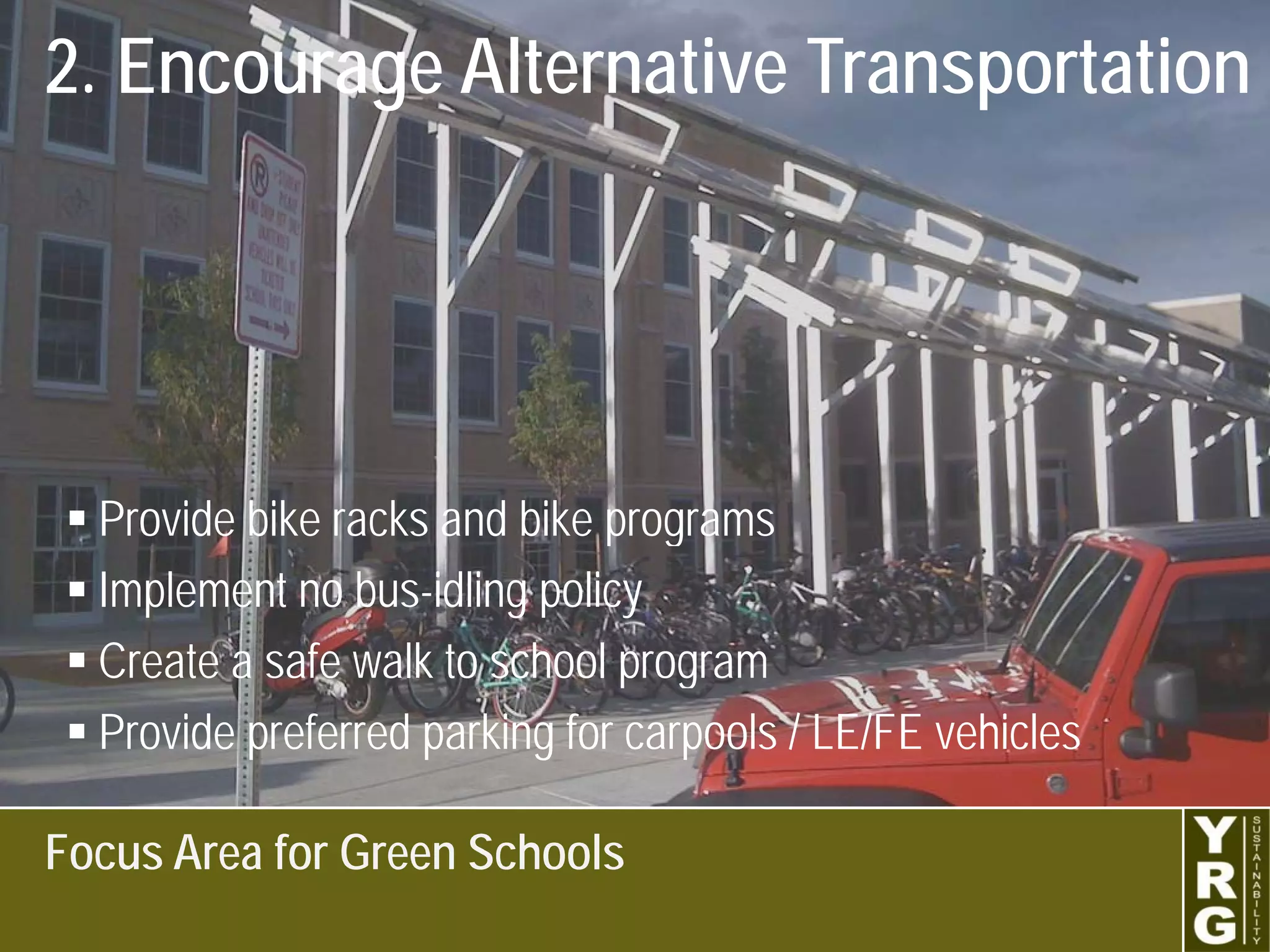
2. Encourage Alternative Transportation


  Provide bike racks and bike programs
                              p g
  Implement no bus-idling policy
  Create a safe walk to school program
                               p g
  Provide preferred parking for carpools / LE/FE vehicles

Focus Area for Green Schools
3. Water Conservation


                               Fixture U
                               Fi t Upgrades & R t fit
                                               d      Retrofits
                               Efficient irrigation practices
Focus Area for Green Schools
Interior Water Conservation
     40%-50% of a school’s water consumption
     occurs in the restrooms1
     Simple,
     Si l iinexpensive retrofits can reduce
                       i     t fit      d
     water consumption by up to 60%
         Faucet aerators (0.5 GPM)
                          (         )
         Urinal flushometers (0.5 GPF)
         Dual-Flush Toilets (1.35 GPF)
     Structural demolition/renovation not always
     required
     Test for leaks!

  1 – Source: City of San Jose, Environmental Services Department


Focus Area for Green Schools
4. Sustainable Purchasing
  Source Reduction: refillable printer cartridges, double-
  sided copy, cloth towels, reusable goods

  Reduced Packaging: bulk p
               g g        purchasing of supplies
                                   g      pp

  Green Products: recycled p p , non-toxic cleaners,
                      y    paper,                  ,
  Energy Star rated equipment and appliances

  Sustainable Food: local, organic produce

Focus Area for Green Schools
5. Solid Waste Management

  Know your trash – conduct a Waste Stream Audit
  Identify strategies to improve diversion rates
  Work with waste haulers
  Compost to engage students!


Focus Area for Green Schools
Waste Audit - Findings
Source: YRG Waste Audit
Conduct a Waste Stream Audit


 Identify opportunities to
 improve recycling rates
     Determine amount of
     “trash” that could have
     been recycled
     Great opportunity to get
     students involved – extra
     credit?
         dit?
Improve Recycling Rates
 Educate faculty and students
 Provide clear messaging and collection points
 Ask
 A k waste h l f help (
            haulers for h l (may provide consulting or educationall
                                        id     li       d    i
 assistance as part of regular service)
Make things convenient and obvious
Sticker =
Effective Tool?
6. Maintain Healthy Indoor Air Quality
                  y                  y
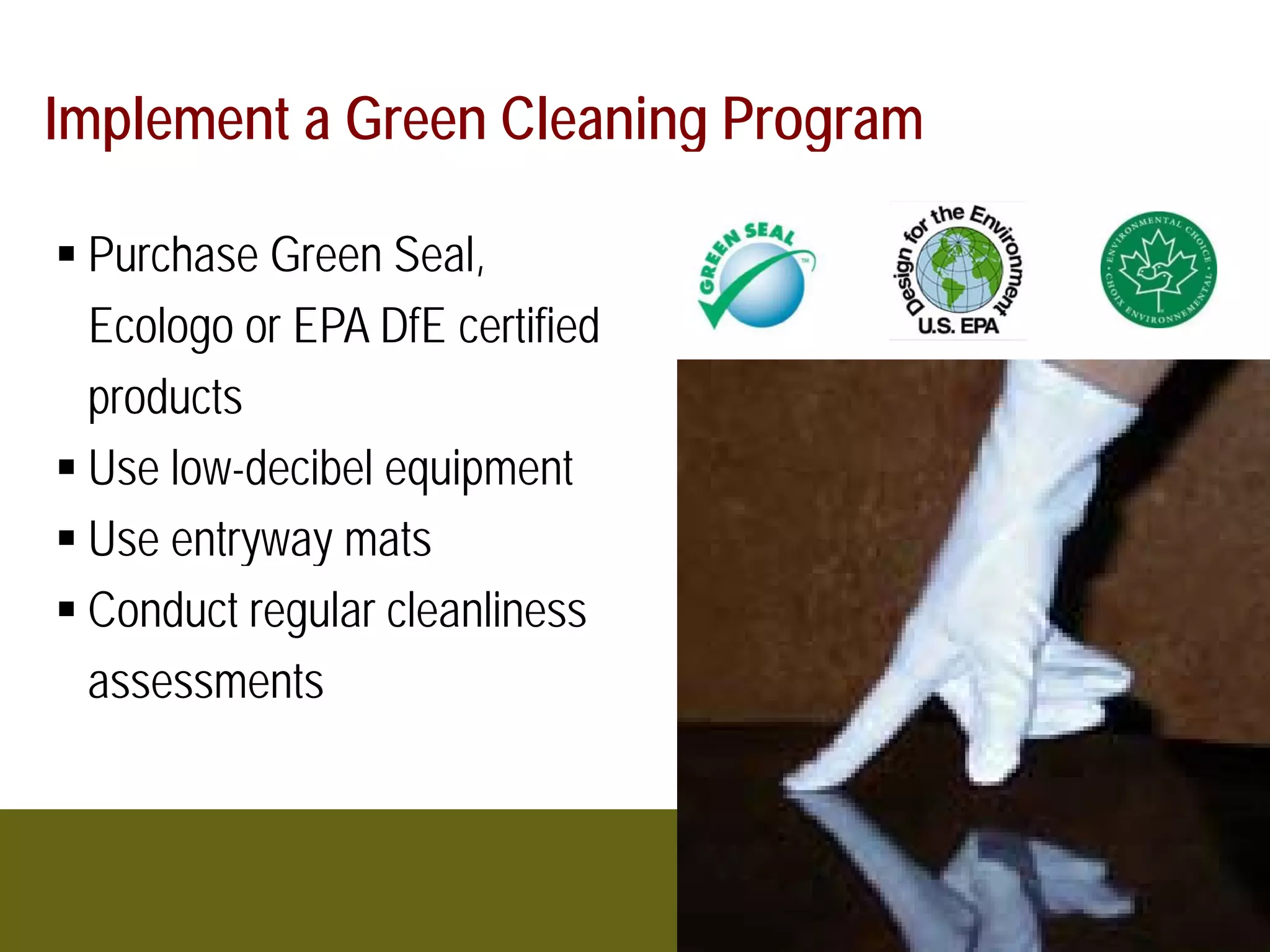
  Implement a Green Cleaning Program
  Reduce use of toxic pesticides with Integrated Pest
  Management
  Reduce use of fossil fuel based maintenance equipment
  Discourage engine idling from buses and cars, and delivery
  vehicles
  Provide adequate ventilation for healthy environment and mold
  prevention

Focus Area for Green Schools
Implement a Green Cleaning Program

 Purchase Green Seal, ,
 Ecologo or EPA DfE certified
 products
 Use low-decibel equipment
 Use entryway mats
 Conduct regular cleanliness
 assessments
Green Seal Product Search
http://www.greenseal.org/findaproduct/index.cfm
Reduce Fossil Fuel Use and Emissions
 Use electric-powered
 equipment or manual methods
 for landscaping
 Reduce/eliminate idling of
 vehicles
Provide Adequate Ventilation
Conduct preventive maintenance on all HVAC equipment
to ensure proper function
Test airflow annually to confirm that it meets minimum
requirements
Establish an ongoing IAQ Management Program
 Select
 S l t an IAQ Manager
               M
 Conduct regular inspections and make immediate repairs
 Provide occupant ffeedback system and respond quickly
 Free EPA “IAQ Tools for Schools” at
 http://www.epa.gov/iaq/schools/pubs.html
7. Maintain Good Acoustics

             “Excessive background noise or reverberation in
              Excessive
               classrooms interferes with speech communication
               and creates an acoustical barrier to learning With
                                                    learning.
               good classroom acoustics, learning is easier,
               deeper,
               deeper more sustained and less fatiguing ”
                                                fatiguing.


Focus Area for Green Schools
American National Standard (ANSI) Acoustical Performance Criteria, Design Requirements, and Guidelines for Schools
  ANSI S12.60-2002.
Guidelines for Acoustics
Increase area of absorptive materials
Reduce background noise from
HVAC systems
    Install acoustic liner in ducts
    Seal mechanical rooms to isolate
    sound and vibration
    If possible, move supply ducts,
    HVAC equipment
8. Healthy Food

   Buy healthy food for school cafeterias
       USDA Certified Organic
              C tifi d O     i
       Rainforest Alliance Certified
       Protected Harvest Certified
       Food purchased within 100 mile radius of school
   Consider community-supported agriculture (CSAs) as
              community supported
   a local, fun food source


Focus Area for Green Schools
9. B h i Ch
9 Behavior Change and Culture
                    d C lt
Understanding Occupant Behavior
Occupants – The Sabatuer
Tapping into Loss Aversion will Only Get You so Far
Remind People What You Want
“Seventy-five percent of the guests who stayed in this room ...
 used their towels more than once ”
                              once…


Flocking Instinct – Good Old Fashioned Peer Pressure
Occupant Feedback and Control


Source: Boora Architects
Lucid Design Displays
Building Dashboard
Source: Lucid Design Group
Competition
What makes people choose the stairs over the escalator?


                                      Source: The Fun Theory – www.thefuntheory.com
Have Some Fun
Questions?
Beyond
Design C t ti
D i & Construction:
Greening Your School through
Sustainable O
S t i bl Operations
                 ti

Josh Radoff
Co-Founder, Principal
jradoff@yrgsustainability.com
jradoff@yrgsustainability com


www.yrgsustainability.com
Twitter: @YRGreen
Facebook: YRG sustainability

Beyond Design & Construction: Greening Your School Through Sustainable Operations

  • 1.
    Beyond Design C tti D i & Construction: Greening Your School through Sustainable O S t i bl Operations ti Josh Radoff J h R d ff jradoff@yrgsustainability.com www.yrgsustainability.com Twitter: @YRGreen Facebook: YRG sustainability
  • 2.
    Lesson Plan Why sustainableoperations in schools? h l ? A framework for what to do A way to go about doing it
  • 3.
    Borneo Operation Cat Drop Systems Thinking: a Cautionary Tale
  • 4.
    Better facility to teach Everything E thi More money for sustainability books and teachers Green  Greener homes Happier teachers School to go back to is connected Better test scores Reduced absenteeism, healthier students
  • 5.
    Definitions of Sustainability + + People Planet Profit Triple Bottom Line
  • 6.
    What does sustainabilitylook like on a college campus? Source: Metropolis Magazine
  • 7.
    What does sustainabilitylook like on a college campus?
  • 10.
  • 11.
    The current paradigm: Building Design Team / Operations Developer Good luck!
  • 13.
    Measured Energy Usev LEED Certification Level Source: New Buildings Institute
  • 14.
    Performance Is AllThat Matters
  • 15.
    What Drives BuildingPerformance? Computers Equipment Schedule Habits Staffing Occupants Controls Maintenance M i t Commissioning Layout Integration Installation Components Operation Design Source: New Buildings Institute
  • 16.
  • 17.
    Money Time People Three things you don’t have
  • 18.
    This is howyou roll….
  • 19.
    How to evaluatea school’s performance
  • 21.
  • 22.
    Comparing LEED RatingSystems LEED for Schools (NC) LEED-EB:OM An event An ongoing process Design and construction Life of the building Capital b d t C it l budgets Operating b d t O ti budgets NC EB:OM
  • 23.
    LEED NC LEED EBOM Model Track & Benchmark Optimize Ongoing Auditing Commission Plans and Policies Train Staff & Occupants Plan for future needs / events Getting to Performance: The EBOM Connection
  • 24.
  • 25.
    Incentives to Sweetenthe Deal? Xcel: Business Energy Efficiency Rebate Program Re-commissioning Lighting efficiency retrofits and redesign Energy audits Boiler upgrades Colorado Springs SD11: Resource Conservation Management program $500,000 $500 000 available per year (t t li over $3 5 million over 7 years) il bl (totaling $3.5 illi ) Resources
  • 26.
    Create Policies andPlans Define/Highlight: Scope Performance Metric Goals Procedures and Strategies Responsible Parties Time Period EB:OM Environmental Performance Gauges
  • 27.
    Monitor and ImplementOngoing Tracking Regular collection and compilation of data Usually monthly y y Pertains to energy consumption, recycling rates, materials purchases, etc. EB:OM Environmental Performance Gauges
  • 28.
    Benchmarking Quality Control Consistentreporting of SF, occupancy, operation hours, etc Identify appropriate space classifications Download data entries and graph to quickly identify anomalous entries
  • 29.
    Evaluate with OneTime Testing / Assessment Verify building features and systems performance Water fixtures, access to daylight and views, light trespass, ventilation rates EB:OM Environmental Performance Gauges
  • 30.
    1. Energy EfficiencyInitiatives Benchmark energy performance early, often, and accurately Conduct C d t an energy audit dit Purchase energy-efficient equipment Create C t a culture of sustainability lt f t i bilit Focus Area for Green Schools
  • 31.
    ENERGY STAR PortfolioManager Simple format for benchmarking energy use at K-12 schools Enter space characteristics and monthly utility bill data p y y Calculates Energy Star score (0-100) (must have >69 to meet EB:OM criteria ENERGY STAR Portfolio Manager
  • 32.
    Conduct an EnergyAudit ASHRAE Level 1 Walkthrough (required for EB:OM certification) Review energy consumption and examine building mechanical systems Identify low-cost/no-cost ways to save energy
  • 33.
    Energy Efficiency Strategies Operations & Maintenance – Occupant Behavior – Lighting – Controls – Equipment Low Cost Higher Cost Trumps Trumps
  • 34.
    Implement Low-Cost /No-Cost Operational Improvements Modifying chilled water temperature setpoints y g p p Checking and correcting supply fan return dampers Adjusting temperatures by modifying heat recovery system operational temperatures Resetting zonal thermostats to better match occupied and unoccupied conditions Applying additional night setbacks Adding holiday schedules to building controls g y g Shutting down unneeded computers at night Case Study: DOE PNNL National Laboratory
  • 35.
    Light Pollution WillKill You! Turn interior lights off at night (automatic controls can help) Shield exterior lights >50 watts Minimize light t Mi i i li ht trespass outside site b d t id it boundary Focus Area for Green Schools
  • 36.
    2. Encourage AlternativeTransportation Provide bike racks and bike programs p g Implement no bus-idling policy Create a safe walk to school program p g Provide preferred parking for carpools / LE/FE vehicles Focus Area for Green Schools
  • 37.
    3. Water Conservation Fixture U Fi t Upgrades & R t fit d Retrofits Efficient irrigation practices Focus Area for Green Schools
  • 38.
    Interior Water Conservation 40%-50% of a school’s water consumption occurs in the restrooms1 Simple, Si l iinexpensive retrofits can reduce i t fit d water consumption by up to 60% Faucet aerators (0.5 GPM) ( ) Urinal flushometers (0.5 GPF) Dual-Flush Toilets (1.35 GPF) Structural demolition/renovation not always required Test for leaks! 1 – Source: City of San Jose, Environmental Services Department Focus Area for Green Schools
  • 39.
    4. Sustainable Purchasing Source Reduction: refillable printer cartridges, double- sided copy, cloth towels, reusable goods Reduced Packaging: bulk p g g purchasing of supplies g pp Green Products: recycled p p , non-toxic cleaners, y paper, , Energy Star rated equipment and appliances Sustainable Food: local, organic produce Focus Area for Green Schools
  • 40.
    5. Solid WasteManagement Know your trash – conduct a Waste Stream Audit Identify strategies to improve diversion rates Work with waste haulers Compost to engage students! Focus Area for Green Schools
  • 41.
    Waste Audit -Findings Source: YRG Waste Audit
  • 42.
    Conduct a WasteStream Audit Identify opportunities to improve recycling rates Determine amount of “trash” that could have been recycled Great opportunity to get students involved – extra credit? dit?
  • 43.
    Improve Recycling Rates Educate faculty and students Provide clear messaging and collection points Ask A k waste h l f help ( haulers for h l (may provide consulting or educationall id li d i assistance as part of regular service)
  • 44.
  • 45.
  • 46.
  • 47.
    6. Maintain HealthyIndoor Air Quality y y Implement a Green Cleaning Program Reduce use of toxic pesticides with Integrated Pest Management Reduce use of fossil fuel based maintenance equipment Discourage engine idling from buses and cars, and delivery vehicles Provide adequate ventilation for healthy environment and mold prevention Focus Area for Green Schools
  • 48.
    Implement a GreenCleaning Program Purchase Green Seal, , Ecologo or EPA DfE certified products Use low-decibel equipment Use entryway mats Conduct regular cleanliness assessments
  • 49.
    Green Seal ProductSearch http://www.greenseal.org/findaproduct/index.cfm
  • 50.
    Reduce Fossil FuelUse and Emissions Use electric-powered equipment or manual methods for landscaping Reduce/eliminate idling of vehicles
  • 51.
    Provide Adequate Ventilation Conductpreventive maintenance on all HVAC equipment to ensure proper function Test airflow annually to confirm that it meets minimum requirements
  • 52.
    Establish an ongoingIAQ Management Program Select S l t an IAQ Manager M Conduct regular inspections and make immediate repairs Provide occupant ffeedback system and respond quickly Free EPA “IAQ Tools for Schools” at http://www.epa.gov/iaq/schools/pubs.html
  • 53.
    7. Maintain GoodAcoustics “Excessive background noise or reverberation in Excessive classrooms interferes with speech communication and creates an acoustical barrier to learning With learning. good classroom acoustics, learning is easier, deeper, deeper more sustained and less fatiguing ” fatiguing. Focus Area for Green Schools American National Standard (ANSI) Acoustical Performance Criteria, Design Requirements, and Guidelines for Schools ANSI S12.60-2002.
  • 54.
    Guidelines for Acoustics Increasearea of absorptive materials Reduce background noise from HVAC systems Install acoustic liner in ducts Seal mechanical rooms to isolate sound and vibration If possible, move supply ducts, HVAC equipment
  • 55.
    8. Healthy Food Buy healthy food for school cafeterias USDA Certified Organic C tifi d O i Rainforest Alliance Certified Protected Harvest Certified Food purchased within 100 mile radius of school Consider community-supported agriculture (CSAs) as community supported a local, fun food source Focus Area for Green Schools
  • 56.
    9. B hi Ch 9 Behavior Change and Culture d C lt
  • 57.
  • 58.
  • 60.
    Tapping into LossAversion will Only Get You so Far
  • 61.
  • 62.
    “Seventy-five percent ofthe guests who stayed in this room ... used their towels more than once ” once… Flocking Instinct – Good Old Fashioned Peer Pressure
  • 63.
    Occupant Feedback andControl Source: Boora Architects
  • 64.
  • 65.
  • 66.
  • 69.
    What makes peoplechoose the stairs over the escalator? Source: The Fun Theory – www.thefuntheory.com Have Some Fun
  • 70.
  • 71.
    Beyond Design C tti D i & Construction: Greening Your School through Sustainable O S t i bl Operations ti Josh Radoff Co-Founder, Principal jradoff@yrgsustainability.com jradoff@yrgsustainability com www.yrgsustainability.com Twitter: @YRGreen Facebook: YRG sustainability