GOVT. HOLKAR SCIENCE COLLEGE
SESSION-2016
DEPARTMENT OF PHARMACEUTICAL CHEMESTRY
TOPIC- HIGHER PERFOMANCE LIQUID CHROMATOGRAPHY
SUBMITTED BY-
AMAN KAKNE
M.Sc Previous 2sem
Chromatography
In Chromatography the mixture is dissolve in a fluid called
mobile phase which carries it through a structure holding
another material called stationary phase.The various
constituent of mixture travelled at different speed causing
them to separate.The separation is based on a differential
partition between mobile phase and stationary phase.
Chroma – colour
Graphy - writing
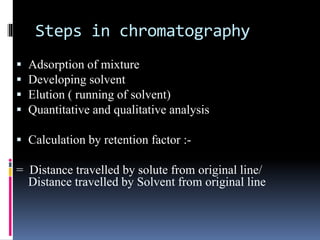
Steps in chromatography
 Adsorption of mixture
 Developing solvent
 Elution ( running of solvent)
 Quantitative and qualitative analysis
 Calculation by retention factor :-
= Distance travelled by solute from original line/
Distance travelled by Solvent from original line
H
P
igh
erformance
Liquid
Chromatography
Introduction of HPLC
HPLC (Higher Pressure Liquid Chromatography) is an
advance form of a liquid chromatography used to separate
compounds of a mixture (analyzes).
In HPLC chromatography the mixture is dissolved in a
solvent (mobile phase) and then force to flow through a
chromatographic column under a higher pressure (pump).
In a column the mixture is resolved into its components.
Principal of HPLC
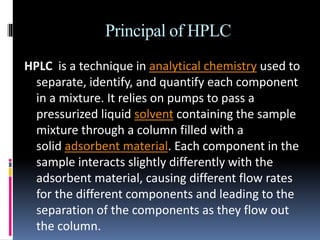
HPLC is a technique in analytical chemistry used to
separate, identify, and quantify each component
in a mixture. It relies on pumps to pass a
pressurized liquid solvent containing the sample
mixture through a column filled with a
solid adsorbent material. Each component in the
sample interacts slightly differently with the
adsorbent material, causing different flow rates
for the different components and leading to the
separation of the components as they flow out
the column.
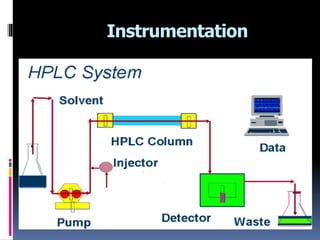
Instrumentation
Solvent reservoir
 Are used to store mobile phase.
 Made up of inert material like glass.
 It can be transparent or amber colored.
 The mobile phase is pumped under pressure
from reservoirs.
 Filtration is needed to eliminate suspended
particles and organic impurities.
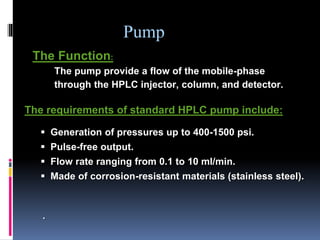
The Function:
The pump provide a flow of the mobile-phase
through the HPLC injector, column, and detector.
.
The requirements of standard HPLC pump include:
 Generation of pressures up to 400-1500 psi.
 Pulse-free output.
 Flow rate ranging from 0.1 to 10 ml/min.
 Made of corrosion-resistant materials (stainless steel).
Pump
 Advantages:
Simple, inexpensive, easy to operate, and free from
pulsations, resulting in smooth baselines.
 Disadvantages:
Flow rate must be monitored carefully and constantly.
Types of HPLC Pumps:
 Constant-Pressure Pump.
 Constant-Flow Pump.
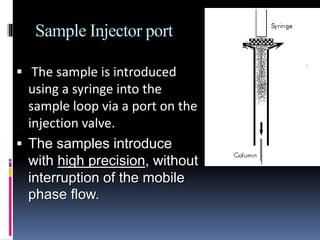
Sample Injector port
 The sample is introduced
using a syringe into the
sample loop via a port on the
injection valve.
 The samples introduce
with high precision, without
interruption of the mobile
phase flow.
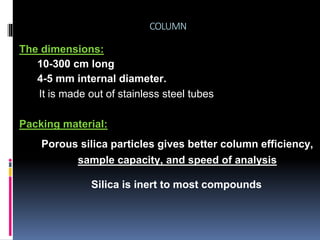
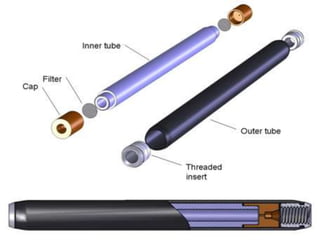
COLUMN
The dimensions:
10-300 cm long
4-5 mm internal diameter.
Packing material:
Porous silica particles gives better column efficiency,
sample capacity, and speed of analysis
It is made out of stainless steel tubes
Silica is inert to most compounds
Detectors
 The detector from HPLC consist of a photometric detector
fitted with a low volume flow cell.
function:
Monitoring the mobile phase
as it emerges from the column..
Some detector in HPLC
 Refractive index detector
 Ultraviolet detector
 Fluorescence detector
 Electrochemical detector
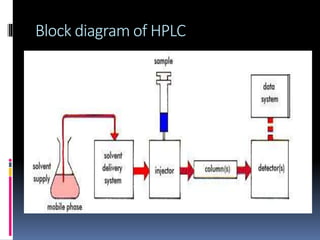
Working
17
Pump
Sample injection unit
(injector)
Column
Column Oven
(thermostatic colum
n chamber)
Detector
solvent
(mobile phase)
Drain
Data processor
Degasser
Block diagram of HPLC
GRAPH
THANKING YOU

HPLC

  • 1.
    GOVT. HOLKAR SCIENCECOLLEGE SESSION-2016 DEPARTMENT OF PHARMACEUTICAL CHEMESTRY TOPIC- HIGHER PERFOMANCE LIQUID CHROMATOGRAPHY SUBMITTED BY- AMAN KAKNE M.Sc Previous 2sem
  • 2.
    Chromatography In Chromatography themixture is dissolve in a fluid called mobile phase which carries it through a structure holding another material called stationary phase.The various constituent of mixture travelled at different speed causing them to separate.The separation is based on a differential partition between mobile phase and stationary phase. Chroma – colour Graphy - writing
  • 3.
    Steps in chromatography Adsorption of mixture  Developing solvent  Elution ( running of solvent)  Quantitative and qualitative analysis  Calculation by retention factor :- = Distance travelled by solute from original line/ Distance travelled by Solvent from original line
  • 4.
  • 5.
    Introduction of HPLC HPLC(Higher Pressure Liquid Chromatography) is an advance form of a liquid chromatography used to separate compounds of a mixture (analyzes). In HPLC chromatography the mixture is dissolved in a solvent (mobile phase) and then force to flow through a chromatographic column under a higher pressure (pump). In a column the mixture is resolved into its components.
  • 6.
    Principal of HPLC HPLCis a technique in analytical chemistry used to separate, identify, and quantify each component in a mixture. It relies on pumps to pass a pressurized liquid solvent containing the sample mixture through a column filled with a solid adsorbent material. Each component in the sample interacts slightly differently with the adsorbent material, causing different flow rates for the different components and leading to the separation of the components as they flow out the column.
  • 8.
  • 9.
    Solvent reservoir  Areused to store mobile phase.  Made up of inert material like glass.  It can be transparent or amber colored.  The mobile phase is pumped under pressure from reservoirs.  Filtration is needed to eliminate suspended particles and organic impurities.
  • 10.
    The Function: The pumpprovide a flow of the mobile-phase through the HPLC injector, column, and detector. . The requirements of standard HPLC pump include:  Generation of pressures up to 400-1500 psi.  Pulse-free output.  Flow rate ranging from 0.1 to 10 ml/min.  Made of corrosion-resistant materials (stainless steel). Pump
  • 11.
     Advantages: Simple, inexpensive,easy to operate, and free from pulsations, resulting in smooth baselines.  Disadvantages: Flow rate must be monitored carefully and constantly. Types of HPLC Pumps:  Constant-Pressure Pump.  Constant-Flow Pump.
  • 12.
    Sample Injector port The sample is introduced using a syringe into the sample loop via a port on the injection valve.  The samples introduce with high precision, without interruption of the mobile phase flow.
  • 13.
    COLUMN The dimensions: 10-300 cmlong 4-5 mm internal diameter. Packing material: Porous silica particles gives better column efficiency, sample capacity, and speed of analysis It is made out of stainless steel tubes Silica is inert to most compounds
  • 15.
    Detectors  The detectorfrom HPLC consist of a photometric detector fitted with a low volume flow cell. function: Monitoring the mobile phase as it emerges from the column..
  • 16.
    Some detector inHPLC  Refractive index detector  Ultraviolet detector  Fluorescence detector  Electrochemical detector
  • 17.
    Working 17 Pump Sample injection unit (injector) Column ColumnOven (thermostatic colum n chamber) Detector solvent (mobile phase) Drain Data processor Degasser
  • 18.
  • 20.
  • 21.