Classroom Activity
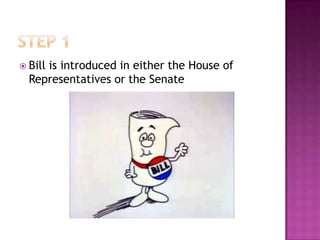
 Bill
     is introduced in either the House of
  Representatives or the Senate
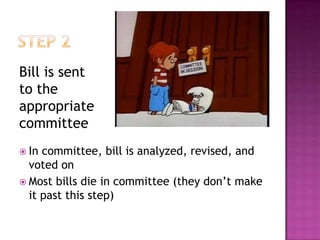
Bill is sent
to the
appropriate
committee
 In committee, bill is analyzed, revised, and
  voted on
 Most bills die in committee (they don’t make
  it past this step)
 In your committee circle, pass your bill to
  the left.
 Read the bill.
 Make any revisions you think would make the
  bill better
 On the back of the bill, write a check if you
  think it should move on, or an “X” if you do
  not think the bill is a good idea.
 Pass the bill to the left and repeat process
  until you have read and voted on every bill in
  your committee.
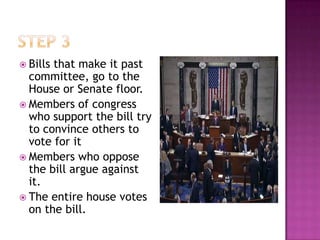
 Billsthat make it past
  committee, go to the
  House or Senate floor.
 Members of congress
  who support the bill try
  to convince others to
  vote for it
 Members who oppose
  the bill argue against
  it.
 The entire house votes
  on the bill.
 Combine    with the other committee from
  your house.
 All bills that got approved in committee
  should be read aloud to your entire house.
 One member should argue for each bill, and
  another member should argue against each
  bill.
 All members in your house will vote on each
  bill.
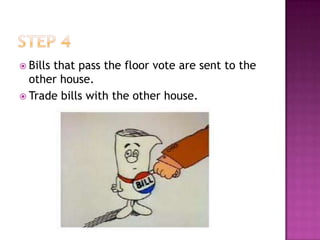
 Bills
      that pass the floor vote are sent to the
  other house.
 Trade bills with the other house.
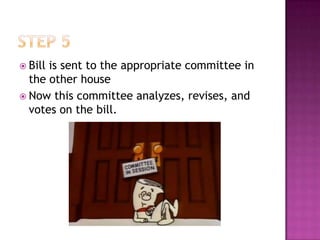
 Billis sent to the appropriate committee in
  the other house
 Now this committee analyzes, revises, and
  votes on the bill.
 In your committee circle, divide the new bills
  between your members.
 Read the bill you have been given.
 Make any revisions you think would make the
  bill better
 On the back of the bill, write a check if you
  think it should move on, or an “X” if you do
  not think the bill is a good idea.
 Pass the bill to the left and repeat process
  until you have read and voted on every bill in
  your committee.
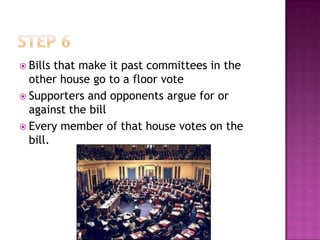
 Bills that make it past committees in the
  other house go to a floor vote
 Supporters and opponents argue for or
  against the bill
 Every member of that house votes on the
  bill.
 Combine    with the other committee from
  your house.
 All bills that got approved in committee
  should be read aloud to your entire house.
 One member should argue for each bill, and
  another member should argue against each
  bill.
 All members in your house will vote on each
  bill.
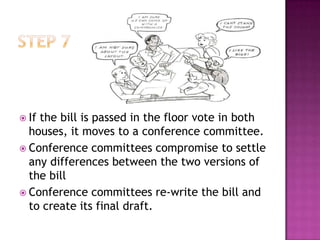
 Ifthe bill is passed in the floor vote in both
  houses, it moves to a conference committee.
 Conference committees compromise to settle
  any differences between the two versions of
  the bill
 Conference committees re-write the bill and
  to create its final draft.
 Get   into your conference committee group

 Ifyour bill has made it past both
  houses, bring it with you to the conference
  committee.

 Create the final draft of your bill by re-
  writing it to incorporate changes that
  everyone in your conference committee can
  agree on.
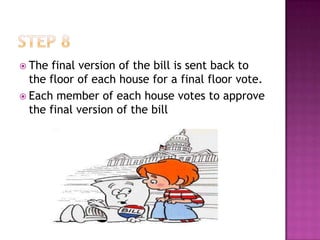
 The  final version of the bill is sent back to
  the floor of each house for a final floor vote.
 Each member of each house votes to approve
  the final version of the bill
 Go   back to your original house group.

 One  representative from each conference
 committee will read their final version of the
 bill to each house.

 Eachmember of your house will vote to
 either approve or deny the final version of
 the bill
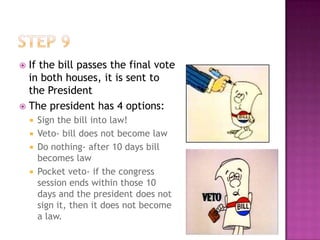
 If the bill passes the final vote
  in both houses, it is sent to
  the President
 The president has 4 options:
     Sign the bill into law!
     Veto- bill does not become law
     Do nothing- after 10 days bill
      becomes law
     Pocket veto- if the congress
      session ends within those 10
      days and the president does not
      sign it, then it does not become
      a law.
 Bring your bills that have passed the final
  vote to my desk (I am the president).

I   will either sign or veto your bill.

 IfI veto your bill, it can still become a law if
  2/3 of the class votes to override the veto.
 Ifyou made it through all 9 steps, your bill
  has become a law! 

Howabillbecomesalaw

  • 1.
  • 2.
     Bill is introduced in either the House of Representatives or the Senate
  • 3.
    Bill is sent tothe appropriate committee  In committee, bill is analyzed, revised, and voted on  Most bills die in committee (they don’t make it past this step)
  • 4.
     In yourcommittee circle, pass your bill to the left.  Read the bill.  Make any revisions you think would make the bill better  On the back of the bill, write a check if you think it should move on, or an “X” if you do not think the bill is a good idea.  Pass the bill to the left and repeat process until you have read and voted on every bill in your committee.
  • 5.
     Billsthat makeit past committee, go to the House or Senate floor.  Members of congress who support the bill try to convince others to vote for it  Members who oppose the bill argue against it.  The entire house votes on the bill.
  • 6.
     Combine with the other committee from your house.  All bills that got approved in committee should be read aloud to your entire house.  One member should argue for each bill, and another member should argue against each bill.  All members in your house will vote on each bill.
  • 7.
     Bills that pass the floor vote are sent to the other house.  Trade bills with the other house.
  • 8.
     Billis sentto the appropriate committee in the other house  Now this committee analyzes, revises, and votes on the bill.
  • 9.
     In yourcommittee circle, divide the new bills between your members.  Read the bill you have been given.  Make any revisions you think would make the bill better  On the back of the bill, write a check if you think it should move on, or an “X” if you do not think the bill is a good idea.  Pass the bill to the left and repeat process until you have read and voted on every bill in your committee.
  • 10.
     Bills thatmake it past committees in the other house go to a floor vote  Supporters and opponents argue for or against the bill  Every member of that house votes on the bill.
  • 11.
     Combine with the other committee from your house.  All bills that got approved in committee should be read aloud to your entire house.  One member should argue for each bill, and another member should argue against each bill.  All members in your house will vote on each bill.
  • 12.
     Ifthe billis passed in the floor vote in both houses, it moves to a conference committee.  Conference committees compromise to settle any differences between the two versions of the bill  Conference committees re-write the bill and to create its final draft.
  • 13.
     Get into your conference committee group  Ifyour bill has made it past both houses, bring it with you to the conference committee.  Create the final draft of your bill by re- writing it to incorporate changes that everyone in your conference committee can agree on.
  • 14.
     The final version of the bill is sent back to the floor of each house for a final floor vote.  Each member of each house votes to approve the final version of the bill
  • 15.
     Go back to your original house group.  One representative from each conference committee will read their final version of the bill to each house.  Eachmember of your house will vote to either approve or deny the final version of the bill
  • 16.
     If thebill passes the final vote in both houses, it is sent to the President  The president has 4 options:  Sign the bill into law!  Veto- bill does not become law  Do nothing- after 10 days bill becomes law  Pocket veto- if the congress session ends within those 10 days and the president does not sign it, then it does not become a law.
  • 17.
     Bring yourbills that have passed the final vote to my desk (I am the president). I will either sign or veto your bill.  IfI veto your bill, it can still become a law if 2/3 of the class votes to override the veto.
  • 18.
     Ifyou madeit through all 9 steps, your bill has become a law! 