Practical security
A half-day seminar for programmers
Copyright Danny Lieberman dl@software.co.il under Creative Commons Attribution License.
http://creativecommons.org/licenses/by/2.0/
V5.0 10/7/2014
Prerequisites
• Before the seminar you will need to read this
article and understand the concepts described
The NSA and Snowden: Securing the All-Seeing Eye
http://cacm.acm.org/magazines/2014/5/174340-
the-nsa-and-snowden/fulltext
Agenda
• Access control
• Least privilege enforcement
• Cryptography at work
• Security attacks
• Pen testing with Metasploit
Agenda
• Access control
• Least privilege enforcement
• Cryptography at work
• Security attacks
• Pen testing with Metasploit
Access control
• A security countermeasure for protecting data
at rest
– Necessary but not sufficient
• For data in motion over an insecure channel
we need stronger countermeasures
– Encryption
– One-time tokens
• Based on authorization and authentication
Authorization - I
• The process of authorization is distinct from
that of authentication.
– Authentication is the process of verifying that
“You are who you say you are”
– One-factor: Username/password
– Authorization is the process of verifying that
“You’re permitted to do what you’re trying to do".
– Read this file only
Authorization - II
• Hash functions are the basis for most methods of enforcing
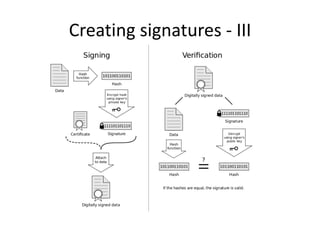
cryptographic data integrity
– Variable length input
– Fixed length output
• Effectiveness determined by:
– Determining the input from output should be computationally
infeasible
– Given input and output, generating input with same output
should be computationally infeasible
– Collision-free, same outputs with different inputs should be
computationally infeasible
• Examples – SHA-1, SHA-256 and MD5
• Example of password hashing coming up in 2 slides
Multi-factor authentication - I
• Something a user has and something the
user knows
– Credit card plus a PIN
– Password and a pseudorandom number from
a security token
• High-security systems
– Screen height, weight, facial, retinal and
fingerprint checks plus a PIN plus a day code
Multi-factor authentication - II
• Google Authenticator - 2-factor software token generator for iOS, Android
– Something user has and knows
• Her smartphone.
• One-time password (token)
– Server and client code agree on algorithms and secret key:
• Secret key is the seed value for hashing
• Algorithm used to verify the password
– Algorithms:
• RFC 4226 - HMAC-based one-time password
http://www.ietf.org/rfc/rfc4226.txt
• RFC 6238 - Time-based one-time password
http://tools.ietf.org/html/rfc6238
Multi-factor authentication - III
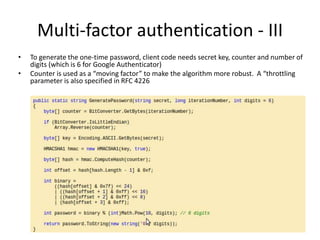
• To generate the one-time password, client code needs secret key, counter and number of
digits (which is 6 for Google Authenticator)
• Counter is used as a “moving factor” to make the algorithm more robust. A “throttling
parameter is also specified in RFC 4226
Multi-factor authentication - IV
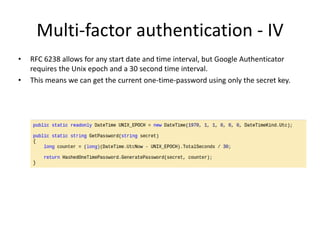
• RFC 6238 allows for any start date and time interval, but Google Authenticator
requires the Unix epoch and a 30 second time interval.
• This means we can get the current one-time-password using only the secret key.
Multi-factor authentication - V
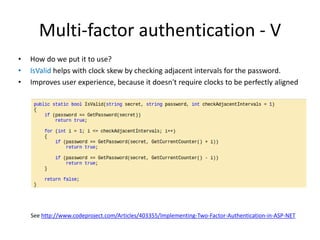
• How do we put it to use?
• IsValid helps with clock skew by checking adjacent intervals for the password.
• Improves user experience, because it doesn't require clocks to be perfectly aligned
See http://www.codeproject.com/Articles/403355/Implementing-Two-Factor-Authentication-in-ASP-NET
Access control - Design vulnerabilities
• As the name suggests – a software design will
often have vulnerabilities because of
assumptions
– Ignoring the fate of temporary files storage is a
bad design decision.
– Temp files are very often written into directories
with world read, write permissions for
convenience
• For example, log files.
Access control – Operational vulnerabilities
• Rooted in how the source code interacts with the
environment
– Using FTP to transfer files
– FTP users/anonymous FTP users may have access
rights to GET or even worse PUT files on to your
machine.
– FTP is problematic
• Most FTP uploads do not check the uploaded files for
malware.
• FTP credentials are passed in clear text
• FTP servers are frequently forgotten by IT operations
Password policy & account handling - I
• Baked into the design and implementation
• Enforce operational security:
– Follow Microsoft server guidelines
• http://technet.microsoft.com/en-us/library/cc526440.aspx
• http://technet.microsoft.com/en-us/security/jj720323.aspx
• Strength, Expiry
– Require strong passwords (AxCrl8N^)
– Expiry policy (changes every 90 days)
• SSO/federated login alternatives
• Social login for customer-facing Web services
Password & account handling - II
• So-called strong passwords and expiration
policies that force people to change frequently
are the main reason for:
• Users recycling their corporate passwords on ecommerce
and adult sites
– Which are frequently hacked and then exploited as a back-
channel to corporate networks
• Post Its
– It’s OK to write down a password, just treat it like cash!
• Credentials sharing
– January 24, 2008, Société Générale announced that a futures
trader at the bank had fraudulently lost the bank €4.9BN
Password & account handling - III
• Password management tools
– Free open source
• KeePass - http://keepass.info/
– Commercial closed source
• Sticky Password Pro - http://www.stickypassword.com/
• Roboform - http://www.roboform.com/
Password and account handling - IV
• Database connection strings
– Credentials should not be the database root user
– Should not be provided in clear text inside code
• An attacker (or security auditor) can grep the code and
pick up the credentials
– Should reference a hashed parameter file outside
the application path
Agenda
• Access control
• Least privilege enforcement
• Cryptography at work
• Security attacks
• Pen testing with Metasploit
Principle of least privilege - I
• A particular abstraction layer
– Code, users, process, people
• must be able to access only resources that are
necessary for legitimate purpose.
– A key security countermeasure for preventing data
loss and malicious code exploits
Principle of least privilege - II
• Users
– User credentials employed in a backup script run
by a job scheduler should not be able to install
software
Principle of least privilege - III
• Code
– Code that provides UI functionality should never
run as administrator (even if it is convenient…)
• Malicious code doesn’t have to elevate privilege
Principle of least privilege - IV
• Process and people
– People with access to sensitive data and a subset
of super user privileges should not be able to
upgrade their own permissions
– Two administrators need to execute and confirm
permissions update of another administrator
Agenda
• Access control
• Least privilege enforcement
• Cryptography at work
• Security attacks
• Pen testing with Metasploit
Cryptography at work
• Confidentiality
• Non-repudiation
Confidentiality
• Confidentiality is the expectation that only
authorized parties can view data
– For data in motion or in rest that is accessible over
an insecure channel, encryption is required
• Encryption has a long history, dating back to
ancient cultures.
– 2 major classes: symmetric and asymmetric
Symmetric encryption
• Symmetric encryption (or shared key) refers to
algorithms where all authorized parties share the
same key
– Simplest and most efficient
– Major weakness since partners have access to same
shared secret.
• May generate unique key for each relationship
– In a group of shared key users
• Key management becomes impossible
• No means for verifying the sender of a message
AES - I
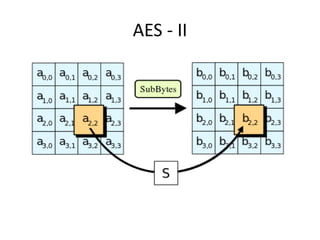
• AES is based on a design principle known as a
substitution-permutation network,
– Combining both substitution and permutation
– Fast in both software and hardware
• AES is a variant of Rijndael
– Fixed block size of 128 bits
– A key size of 128, 192, or 256 bits.
AES - II
AES - III
• Good support in all popular languages
– Crypto++ A comprehensive C++ semi-public-
domain implementation of encryption and hash
algorithms. FIPS validated
– .NET System.Security.Cryptography
– Java Cryptography Extension
– PHP mcrypt extension
– JavaScript - https://code.google.com/p/crypto-js/
and https://github.com/digitalbazaar/forge
Applications of symmetric encryption
• Protecting message confidentiality
• Protecting API payloads
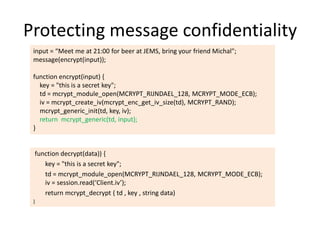
Protecting message confidentiality
input = “Meet me at 21:00 for beer at JEMS, bring your friend Michal";
message(encrypt(input));
function encrypt(input) {
key = "this is a secret key";
td = mcrypt_module_open(MCRYPT_RIJNDAEL_128, MCRYPT_MODE_ECB);
iv = mcrypt_create_iv(mcrypt_enc_get_iv_size(td), MCRYPT_RAND);
mcrypt_generic_init(td, key, iv);
return mcrypt_generic(td, input);
}
function decrypt(data)) {
key = "this is a secret key";
td = mcrypt_module_open(MCRYPT_RIJNDAEL_128, MCRYPT_MODE_ECB);
iv = session.read(‘Client.iv’);
return mcrypt_decrypt ( td , key , string data)
}
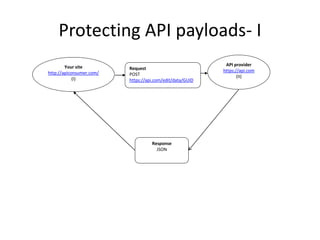
Protecting API payloads- I
Your site
http://apiconsumer.com/
(I)
API provider
https://api.com
(II)
Response
JSON
Request
POST
https://api.com/edit/data/GUID
Protecting API payloads - II
• Problem
– Encryption doesn’t prevent client-side attacks:
• URL hacking
• Manipulation of payload data using “shims”
• Unauthorized disclosure of payload
Protecting API payloads - III
• Solution
– Symmetric encryption critical payload fields such
as GUID
• Shared secret between API consumer and provider
• The usual problems and solutions of key exchange and
distribution
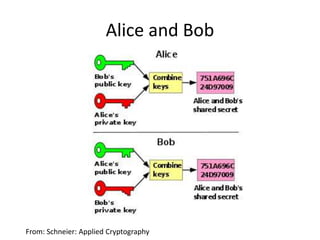
Asymmetric encryption
• Public and private key pair for each party
• Parties that communicate exchange public keys in
advance
– Message is encrypted by combining recipient public key
and sender private key.
• Message can only be decrypted using recipient private key
• Simplifies key management
– Doesn’t require exposing private keys
– Implicitly verifies sender
– Computationally intensive
– Used to exchange a symmetric key for the duration of
session
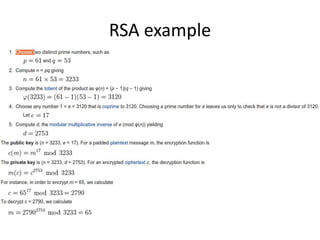
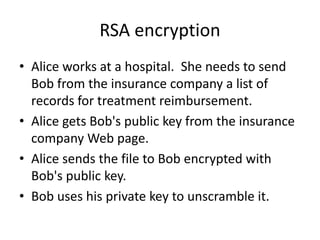
RSA encryption
• Alice works at a hospital. She needs to send
Bob from the insurance company a list of
records for treatment reimbursement.
• Alice gets Bob's public key from the insurance
company Web page.
• Alice sends the file to Bob encrypted with
Bob's public key.
• Bob uses his private key to unscramble it.
Alice and Bob
From: Schneier: Applied Cryptography
RSA example
Cryptography at work
• Confidentiality
• Non-repudiation
Non-repudiation - I
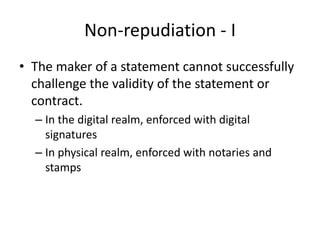
• The maker of a statement cannot successfully
challenge the validity of the statement or
contract.
– In the digital realm, enforced with digital
signatures
– In physical realm, enforced with notaries and
stamps
Non-repudiation - II
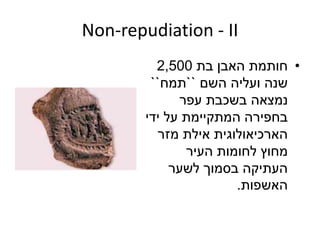
•‫בת‬ ‫האבן‬ ‫חותמת‬2,500
‫השם‬ ‫ועליה‬ ‫שנה‬``‫תמח‬``
‫עפר‬ ‫בשכבת‬ ‫נמצאה‬
‫ידי‬ ‫על‬ ‫המתקיימת‬ ‫בחפירה‬
‫מזר‬ ‫אילת‬ ‫הארכיאולוגית‬
‫העיר‬ ‫לחומות‬ ‫מחוץ‬
‫לשער‬ ‫בסמוך‬ ‫העתיקה‬
‫האשפות‬.
Creating RSA signature keys - I
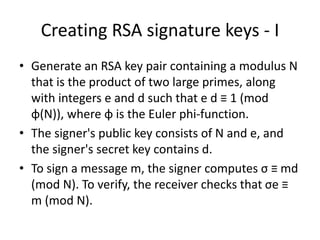
• Generate an RSA key pair containing a modulus N
that is the product of two large primes, along
with integers e and d such that e d ≡ 1 (mod
φ(N)), where φ is the Euler phi-function.
• The signer's public key consists of N and e, and
the signer's secret key contains d.
• To sign a message m, the signer computes σ ≡ md
(mod N). To verify, the receiver checks that σe ≡
m (mod N).
Creating signatures - II
• The message to be signed is first hashed to produce a
short digest that is then signed:
– Efficiency:
• Hashing is faster than signing
– Compatibility:
• Hash can convert an arbitrary input into the proper format.
• For example strings/integers
– Integrity:
• Without the hash function, the text "to be signed" may have to be
split (separated) in blocks small enough for the signature scheme
to act on them directly.
• Receiver of signed blocks cannot recognize if all the blocks are
present and in the right order.
Creating signatures - III
Agenda
• Access control
• Least privilege enforcement
• Cryptography at work
• Security attacks
• Pen testing with Metasploit
Security attack types
• Interception
– Passive tapping
• Interruption
– DOS
• Modification
– Active tapping/packet insertion
• Fabrication
– Man in the middle attacks
Typical countermeasures
• Interception/Modification
– Passive tapping / active tapping
• Physical security to prevent insertion of a tap in wiring cabinet
• Network segmentation
• Encrypt communications, including authentication credentials. This prevents sniffed
packets from being usable to an attacker. SSL and IPSec (Internet Protocol Security) are
examples of encryption solutions.
• Interruption
– DDOS
• Firewall, IPS/IDS and special purpose network appliances that detect anomalous traffic
and throttle it down
• Apply patches to TCP/IP stack for example MS13-065:
– https://technet.microsoft.com/en-us/library/security/ms13-065.aspx
• Fabrication
– Man in the middle attacks
• Use encrypted session negotiation (Well known DICOM vulnerability)
• Use encrypted communication channels.
• Patch TCP/IP stack vulnerabilities, such as predictable packet sequences.
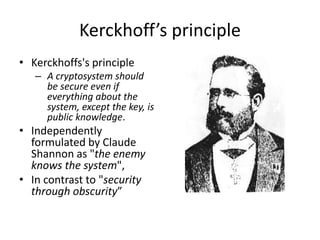
Kerckhoff’s principle
• Kerckhoffs's principle
– A cryptosystem should
be secure even if
everything about the
system, except the key, is
public knowledge.
• Independently
formulated by Claude
Shannon as "the enemy
knows the system",
• In contrast to "security
through obscurity”
Agenda
• Access control
• Least privilege enforcement
• Cryptography at work
• Security attacks
• Pen testing with Metasploit
PEN TESTING WITH METASPLOIT
A short introduction
Installation
• Download from www.metasploit.com for your
platform
• Prefer Linux 64 bit
• Note that the distribution comes with it’s own
RDBMS – PostgreSQL
The absolute basics
• Pre-engagement – set goals
• Intelligence gathering
– What defenses are in place?
– Expendable IP addresses
• Threat modeling
• Vulnerability analysis
• Exploitation
– Often brute force
• Post-exploitation
– What the systems do, what are user roles?
– IP and other sensitive data
Concepts
• Exploit
• Payload – code delivered by MSF to target system
– Reverse shell creates a connection from the target
back to attacker as command prompt
– Bind shell binds a command prompt to listener on
target machine in order to execute commands
• Shellcode – e.g. a Meterpreter shell after
executing the payload
• Module – exploit, auxiliary…
• Listener
Fundamentals
• Msfcli
• Msfconsole
– search
– show exploits, auxiliary, show options
– use scanner/smb/smb_version
– use windows/smb/ms08_067_netapi
• Databases
– Using the Database
• About Meterpreter
– Meterpreter Basics
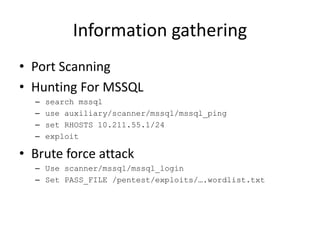
Information gathering
• Port Scanning
• Hunting For MSSQL
– search mssql
– use auxiliary/scanner/mssql/mssql_ping
– set RHOSTS 10.211.55.1/24
– exploit
• Brute force attack
– Use scanner/mssql/mssql_login
– Set PASS_FILE /pentest/exploits/….wordlist.txt
Vulnerability scanning
• SMB Login Check
• VNC Authentication
Fuzzing
• Fuzz testing or fuzzing
– Software testing technique,
– Automated or semi-automated
– Provide invalid, unexpected, or random data to
the program input devices/sockets.
– Process is then monitored
• Program exceptions
– Crashes, or failing built-in code assertions
• Finding potential memory leaks.
Summary - Snowden
• You’ve read the article and heard the material
in this talk
• What did NSA do wrong in your opinion?
My kind thanks to Raymond Ludwin for his comments.
Copyright Danny Lieberman dl@software.co.il under Creative Commons Attribution License.
http://creativecommons.org/licenses/by/2.0/

How to write secure code

  • 1.
    Practical security A half-dayseminar for programmers Copyright Danny Lieberman dl@software.co.il under Creative Commons Attribution License. http://creativecommons.org/licenses/by/2.0/ V5.0 10/7/2014
  • 2.
    Prerequisites • Before theseminar you will need to read this article and understand the concepts described The NSA and Snowden: Securing the All-Seeing Eye http://cacm.acm.org/magazines/2014/5/174340- the-nsa-and-snowden/fulltext
  • 3.
    Agenda • Access control •Least privilege enforcement • Cryptography at work • Security attacks • Pen testing with Metasploit
  • 4.
    Agenda • Access control •Least privilege enforcement • Cryptography at work • Security attacks • Pen testing with Metasploit
  • 5.
    Access control • Asecurity countermeasure for protecting data at rest – Necessary but not sufficient • For data in motion over an insecure channel we need stronger countermeasures – Encryption – One-time tokens • Based on authorization and authentication
  • 6.
    Authorization - I •The process of authorization is distinct from that of authentication. – Authentication is the process of verifying that “You are who you say you are” – One-factor: Username/password – Authorization is the process of verifying that “You’re permitted to do what you’re trying to do". – Read this file only
  • 7.
    Authorization - II •Hash functions are the basis for most methods of enforcing cryptographic data integrity – Variable length input – Fixed length output • Effectiveness determined by: – Determining the input from output should be computationally infeasible – Given input and output, generating input with same output should be computationally infeasible – Collision-free, same outputs with different inputs should be computationally infeasible • Examples – SHA-1, SHA-256 and MD5 • Example of password hashing coming up in 2 slides
  • 8.
    Multi-factor authentication -I • Something a user has and something the user knows – Credit card plus a PIN – Password and a pseudorandom number from a security token • High-security systems – Screen height, weight, facial, retinal and fingerprint checks plus a PIN plus a day code
  • 9.
    Multi-factor authentication -II • Google Authenticator - 2-factor software token generator for iOS, Android – Something user has and knows • Her smartphone. • One-time password (token) – Server and client code agree on algorithms and secret key: • Secret key is the seed value for hashing • Algorithm used to verify the password – Algorithms: • RFC 4226 - HMAC-based one-time password http://www.ietf.org/rfc/rfc4226.txt • RFC 6238 - Time-based one-time password http://tools.ietf.org/html/rfc6238
  • 10.
    Multi-factor authentication -III • To generate the one-time password, client code needs secret key, counter and number of digits (which is 6 for Google Authenticator) • Counter is used as a “moving factor” to make the algorithm more robust. A “throttling parameter is also specified in RFC 4226
  • 11.
    Multi-factor authentication -IV • RFC 6238 allows for any start date and time interval, but Google Authenticator requires the Unix epoch and a 30 second time interval. • This means we can get the current one-time-password using only the secret key.
  • 12.
    Multi-factor authentication -V • How do we put it to use? • IsValid helps with clock skew by checking adjacent intervals for the password. • Improves user experience, because it doesn't require clocks to be perfectly aligned See http://www.codeproject.com/Articles/403355/Implementing-Two-Factor-Authentication-in-ASP-NET
  • 13.
    Access control -Design vulnerabilities • As the name suggests – a software design will often have vulnerabilities because of assumptions – Ignoring the fate of temporary files storage is a bad design decision. – Temp files are very often written into directories with world read, write permissions for convenience • For example, log files.
  • 14.
    Access control –Operational vulnerabilities • Rooted in how the source code interacts with the environment – Using FTP to transfer files – FTP users/anonymous FTP users may have access rights to GET or even worse PUT files on to your machine. – FTP is problematic • Most FTP uploads do not check the uploaded files for malware. • FTP credentials are passed in clear text • FTP servers are frequently forgotten by IT operations
  • 15.
    Password policy &account handling - I • Baked into the design and implementation • Enforce operational security: – Follow Microsoft server guidelines • http://technet.microsoft.com/en-us/library/cc526440.aspx • http://technet.microsoft.com/en-us/security/jj720323.aspx • Strength, Expiry – Require strong passwords (AxCrl8N^) – Expiry policy (changes every 90 days) • SSO/federated login alternatives • Social login for customer-facing Web services
  • 16.
    Password & accounthandling - II • So-called strong passwords and expiration policies that force people to change frequently are the main reason for: • Users recycling their corporate passwords on ecommerce and adult sites – Which are frequently hacked and then exploited as a back- channel to corporate networks • Post Its – It’s OK to write down a password, just treat it like cash! • Credentials sharing – January 24, 2008, Société Générale announced that a futures trader at the bank had fraudulently lost the bank €4.9BN
  • 17.
    Password & accounthandling - III • Password management tools – Free open source • KeePass - http://keepass.info/ – Commercial closed source • Sticky Password Pro - http://www.stickypassword.com/ • Roboform - http://www.roboform.com/
  • 18.
    Password and accounthandling - IV • Database connection strings – Credentials should not be the database root user – Should not be provided in clear text inside code • An attacker (or security auditor) can grep the code and pick up the credentials – Should reference a hashed parameter file outside the application path
  • 19.
    Agenda • Access control •Least privilege enforcement • Cryptography at work • Security attacks • Pen testing with Metasploit
  • 20.
    Principle of leastprivilege - I • A particular abstraction layer – Code, users, process, people • must be able to access only resources that are necessary for legitimate purpose. – A key security countermeasure for preventing data loss and malicious code exploits
  • 21.
    Principle of leastprivilege - II • Users – User credentials employed in a backup script run by a job scheduler should not be able to install software
  • 22.
    Principle of leastprivilege - III • Code – Code that provides UI functionality should never run as administrator (even if it is convenient…) • Malicious code doesn’t have to elevate privilege
  • 23.
    Principle of leastprivilege - IV • Process and people – People with access to sensitive data and a subset of super user privileges should not be able to upgrade their own permissions – Two administrators need to execute and confirm permissions update of another administrator
  • 24.
    Agenda • Access control •Least privilege enforcement • Cryptography at work • Security attacks • Pen testing with Metasploit
  • 25.
    Cryptography at work •Confidentiality • Non-repudiation
  • 26.
    Confidentiality • Confidentiality isthe expectation that only authorized parties can view data – For data in motion or in rest that is accessible over an insecure channel, encryption is required • Encryption has a long history, dating back to ancient cultures. – 2 major classes: symmetric and asymmetric
  • 27.
    Symmetric encryption • Symmetricencryption (or shared key) refers to algorithms where all authorized parties share the same key – Simplest and most efficient – Major weakness since partners have access to same shared secret. • May generate unique key for each relationship – In a group of shared key users • Key management becomes impossible • No means for verifying the sender of a message
  • 28.
    AES - I •AES is based on a design principle known as a substitution-permutation network, – Combining both substitution and permutation – Fast in both software and hardware • AES is a variant of Rijndael – Fixed block size of 128 bits – A key size of 128, 192, or 256 bits.
  • 29.
  • 30.
    AES - III •Good support in all popular languages – Crypto++ A comprehensive C++ semi-public- domain implementation of encryption and hash algorithms. FIPS validated – .NET System.Security.Cryptography – Java Cryptography Extension – PHP mcrypt extension – JavaScript - https://code.google.com/p/crypto-js/ and https://github.com/digitalbazaar/forge
  • 31.
    Applications of symmetricencryption • Protecting message confidentiality • Protecting API payloads
  • 32.
    Protecting message confidentiality input= “Meet me at 21:00 for beer at JEMS, bring your friend Michal"; message(encrypt(input)); function encrypt(input) { key = "this is a secret key"; td = mcrypt_module_open(MCRYPT_RIJNDAEL_128, MCRYPT_MODE_ECB); iv = mcrypt_create_iv(mcrypt_enc_get_iv_size(td), MCRYPT_RAND); mcrypt_generic_init(td, key, iv); return mcrypt_generic(td, input); } function decrypt(data)) { key = "this is a secret key"; td = mcrypt_module_open(MCRYPT_RIJNDAEL_128, MCRYPT_MODE_ECB); iv = session.read(‘Client.iv’); return mcrypt_decrypt ( td , key , string data) }
  • 33.
    Protecting API payloads-I Your site http://apiconsumer.com/ (I) API provider https://api.com (II) Response JSON Request POST https://api.com/edit/data/GUID
  • 34.
    Protecting API payloads- II • Problem – Encryption doesn’t prevent client-side attacks: • URL hacking • Manipulation of payload data using “shims” • Unauthorized disclosure of payload
  • 35.
    Protecting API payloads- III • Solution – Symmetric encryption critical payload fields such as GUID • Shared secret between API consumer and provider • The usual problems and solutions of key exchange and distribution
  • 36.
    Asymmetric encryption • Publicand private key pair for each party • Parties that communicate exchange public keys in advance – Message is encrypted by combining recipient public key and sender private key. • Message can only be decrypted using recipient private key • Simplifies key management – Doesn’t require exposing private keys – Implicitly verifies sender – Computationally intensive – Used to exchange a symmetric key for the duration of session
  • 37.
    RSA encryption • Aliceworks at a hospital. She needs to send Bob from the insurance company a list of records for treatment reimbursement. • Alice gets Bob's public key from the insurance company Web page. • Alice sends the file to Bob encrypted with Bob's public key. • Bob uses his private key to unscramble it.
  • 38.
    Alice and Bob From:Schneier: Applied Cryptography
  • 39.
  • 40.
    Cryptography at work •Confidentiality • Non-repudiation
  • 41.
    Non-repudiation - I •The maker of a statement cannot successfully challenge the validity of the statement or contract. – In the digital realm, enforced with digital signatures – In physical realm, enforced with notaries and stamps
  • 42.
    Non-repudiation - II •‫בת‬‫האבן‬ ‫חותמת‬2,500 ‫השם‬ ‫ועליה‬ ‫שנה‬``‫תמח‬`` ‫עפר‬ ‫בשכבת‬ ‫נמצאה‬ ‫ידי‬ ‫על‬ ‫המתקיימת‬ ‫בחפירה‬ ‫מזר‬ ‫אילת‬ ‫הארכיאולוגית‬ ‫העיר‬ ‫לחומות‬ ‫מחוץ‬ ‫לשער‬ ‫בסמוך‬ ‫העתיקה‬ ‫האשפות‬.
  • 43.
    Creating RSA signaturekeys - I • Generate an RSA key pair containing a modulus N that is the product of two large primes, along with integers e and d such that e d ≡ 1 (mod φ(N)), where φ is the Euler phi-function. • The signer's public key consists of N and e, and the signer's secret key contains d. • To sign a message m, the signer computes σ ≡ md (mod N). To verify, the receiver checks that σe ≡ m (mod N).
  • 44.
    Creating signatures -II • The message to be signed is first hashed to produce a short digest that is then signed: – Efficiency: • Hashing is faster than signing – Compatibility: • Hash can convert an arbitrary input into the proper format. • For example strings/integers – Integrity: • Without the hash function, the text "to be signed" may have to be split (separated) in blocks small enough for the signature scheme to act on them directly. • Receiver of signed blocks cannot recognize if all the blocks are present and in the right order.
  • 45.
  • 46.
    Agenda • Access control •Least privilege enforcement • Cryptography at work • Security attacks • Pen testing with Metasploit
  • 47.
    Security attack types •Interception – Passive tapping • Interruption – DOS • Modification – Active tapping/packet insertion • Fabrication – Man in the middle attacks
  • 48.
    Typical countermeasures • Interception/Modification –Passive tapping / active tapping • Physical security to prevent insertion of a tap in wiring cabinet • Network segmentation • Encrypt communications, including authentication credentials. This prevents sniffed packets from being usable to an attacker. SSL and IPSec (Internet Protocol Security) are examples of encryption solutions. • Interruption – DDOS • Firewall, IPS/IDS and special purpose network appliances that detect anomalous traffic and throttle it down • Apply patches to TCP/IP stack for example MS13-065: – https://technet.microsoft.com/en-us/library/security/ms13-065.aspx • Fabrication – Man in the middle attacks • Use encrypted session negotiation (Well known DICOM vulnerability) • Use encrypted communication channels. • Patch TCP/IP stack vulnerabilities, such as predictable packet sequences.
  • 49.
    Kerckhoff’s principle • Kerckhoffs'sprinciple – A cryptosystem should be secure even if everything about the system, except the key, is public knowledge. • Independently formulated by Claude Shannon as "the enemy knows the system", • In contrast to "security through obscurity”
  • 50.
    Agenda • Access control •Least privilege enforcement • Cryptography at work • Security attacks • Pen testing with Metasploit
  • 51.
    PEN TESTING WITHMETASPLOIT A short introduction
  • 52.
    Installation • Download fromwww.metasploit.com for your platform • Prefer Linux 64 bit • Note that the distribution comes with it’s own RDBMS – PostgreSQL
  • 53.
    The absolute basics •Pre-engagement – set goals • Intelligence gathering – What defenses are in place? – Expendable IP addresses • Threat modeling • Vulnerability analysis • Exploitation – Often brute force • Post-exploitation – What the systems do, what are user roles? – IP and other sensitive data
  • 54.
    Concepts • Exploit • Payload– code delivered by MSF to target system – Reverse shell creates a connection from the target back to attacker as command prompt – Bind shell binds a command prompt to listener on target machine in order to execute commands • Shellcode – e.g. a Meterpreter shell after executing the payload • Module – exploit, auxiliary… • Listener
  • 55.
    Fundamentals • Msfcli • Msfconsole –search – show exploits, auxiliary, show options – use scanner/smb/smb_version – use windows/smb/ms08_067_netapi • Databases – Using the Database • About Meterpreter – Meterpreter Basics
  • 56.
    Information gathering • PortScanning • Hunting For MSSQL – search mssql – use auxiliary/scanner/mssql/mssql_ping – set RHOSTS 10.211.55.1/24 – exploit • Brute force attack – Use scanner/mssql/mssql_login – Set PASS_FILE /pentest/exploits/….wordlist.txt
  • 57.
    Vulnerability scanning • SMBLogin Check • VNC Authentication
  • 58.
    Fuzzing • Fuzz testingor fuzzing – Software testing technique, – Automated or semi-automated – Provide invalid, unexpected, or random data to the program input devices/sockets. – Process is then monitored • Program exceptions – Crashes, or failing built-in code assertions • Finding potential memory leaks.
  • 59.
    Summary - Snowden •You’ve read the article and heard the material in this talk • What did NSA do wrong in your opinion? My kind thanks to Raymond Ludwin for his comments. Copyright Danny Lieberman dl@software.co.il under Creative Commons Attribution License. http://creativecommons.org/licenses/by/2.0/

Editor's Notes

  • #11 First, we convert the iteration number to a byte[], which can be hashed using the HMAC-SHA-1 hash method. The iteration number should be incremented on the client and server every time authentication succeeds. We use the managed HMAC-SHA-1 hashing method available from the System.Security.Cryptography.HMACSHA1 class. Next we compute the hash for the current value of the counter. The next part of the code extracts the binary value of a 4 byte integer, then shrinks it to the number of digits required. That's it. The entire algorithm in 25 lines. RFC 4226 Section 5.4 has a good example and description of what is happening,
  • #12 RFC 6238 defines the time based implementation of the one time password generation. Time based one time password generation builds on the counter based approach above. It is exactly the same, except it automatically defines the counter based on intervals of time since the Unix epoch (Jan 1, 1970, 00:00 UTC). Technically, the RFC allows for any start date and time interval, but Google Authenticator requires the Unix epoch and a 30 second time interval. What this means is that we can get the current one-time-password using only the secret key. Here is how:
  • #33 Block cipher mode - MCRYPT_MODE_ECB (electronic codebook) is suitable for random data, such as encrypting other keys. Since data there is short and random, the disadvantages of ECB have a favorable negative effect.