Zerotrusting Serverless
Applications:
Protecting Microservices using Secure Design
Patterns
Trupti Shiralkar
About Me
• Principal Application Security Engineer, Illumio
• Mobile game developer turned security professional
- MS In Security Engineering, Johns Hopkins University
- Previously worked at Amazon, Q2Ebanking, HP & ATSEC
• When I am not doing security
- Travel
- Paint
• Yoga Alliance Certified Instructor
- Breathing exercises
- Meditation
Twitter: @tshiralkar
LinkedIn: https://www.linkedin.com/in/trupti-shiralkar-0a085a8/
Email: s.trupts@gmail.com
Agenda
● Understanding serverless applications and microservices
● Analyzing microservices security design patterns
● Securing serverless applications and microservices
Understanding
Serverless and
Microservices
● Evolution
● Security pain points
● Overall changing role of
security
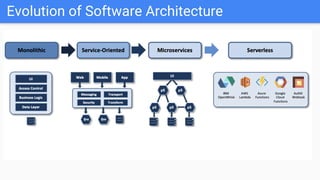
Evolution of Software Architecture
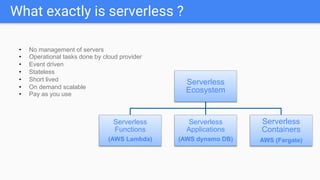
What exactly is serverless ?
Serverless
Ecosystem
Serverless
Functions
(AWS Lambda)
Serverless
Applications
(AWS dynamo DB)
Serverless
Containers
AWS (Fargate)
• No management of servers
• Operational tasks done by cloud provider
• Event driven
• Stateless
• Short lived
• On demand scalable
• Pay as you use
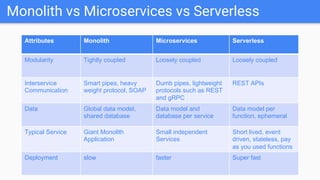
Monolith vs Microservices vs Serverless
Attributes Monolith Microservices Serverless
Modularity Tightly coupled Loosely coupled Loosely coupled
Interservice
Communication
Smart pipes, heavy
weight protocol, SOAP
Dumb pipes, lightweight
protocols such as REST
and gRPC
REST APIs
Data Global data model,
shared database
Data model and
database per service
Data model per
function, ephemeral
Typical Service Giant Monolith
Application
Small independent
Services
Short lived, event
driven, stateless, pay
as you used functions
Deployment slow faster Super fast
Microservices are not silver bullet!
Credit:
KRAZAM
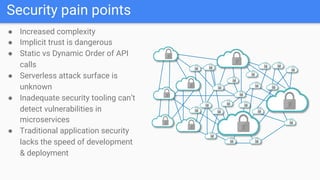
Security pain points
● Increased complexity
● Implicit trust is dangerous
● Static vs Dynamic Order of API
calls
● Serverless attack surface is
unknown
● Inadequate security tooling can’t
detect vulnerabilities in
microservices
● Traditional application security
lacks the speed of development
& deployment
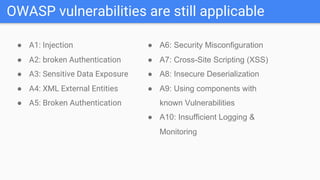
OWASP vulnerabilities are still applicable
● A1: Injection
● A2: broken Authentication
● A3: Sensitive Data Exposure
● A4: XML External Entities
● A5: Broken Authentication
● A6: Security Misconfiguration
● A7: Cross-Site Scripting (XSS)
● A8: Insecure Deserialization
● A9: Using components with
known Vulnerabilities
● A10: Insufficient Logging &
Monitoring
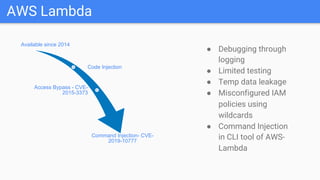
AWS Lambda
Available since 2014
Code Injection
Access Bypass - CVE-
2015-3373
Command Injection- CVE-
2019-10777
● Debugging through
logging
● Limited testing
● Temp data leakage
● Misconfigured IAM
policies using
wildcards
● Command Injection
in CLI tool of AWS-
Lambda
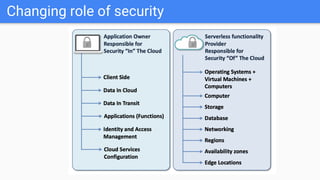
Changing role of security
Microservice
Design Patterns
● What are microservice
design patterns?
● Why do we need it?
● Can we leverage them to
achieve security goals?
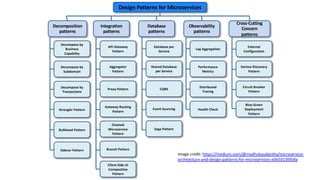
Design Patterns for Microservices
Decomposition
patterns
Integration
patterns
Database
patterns
Observability
patterns
Cross-Cutting
Concern
patterns
Decompose by
Business
Capability
Decompose by
Subdomain
Decompose by
Transactions
Strangler Pattern
Bulkhead Pattern
Sidecar Pattern
API Gateway
Pattern
Aggregator
Pattern
Proxy Pattern
Gateway Routing
Pattern
Chained
Microservice
Pattern
Branch Pattern
Client-Side UI
Composition
Pattern
Database per
Service
Shared Database
per Service
CQRS
Event Sourcing
Saga Pattern
Log Aggregation
Performance
Metrics
Distributed
Tracing
Health Check
External
Configuration
Service Discovery
Pattern
Circuit Breaker
Pattern
Blue-Green
Deployment
Pattern
Image credit: https://medium.com/@madhukaudantha/microservice-
architecture-and-design-patterns-for-microservices-e0e5013fd58a
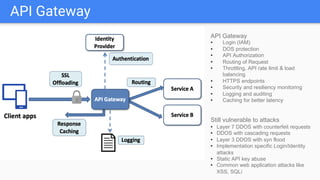
API Gateway
API Gateway
• Login (IAM)
• DOS protection
• API Authorization
• Routing of Request
• Throttling, API rate limit & load
balancing
• HTTPS endpoints
• Security and resiliency monitoring
• Logging and auditing
• Caching for better latency
Still vulnerable to attacks
• Layer 7 DDOS with counterfeit requests
• DDOS with cascading requests
• Layer 3 DDOS with syn flood
• Implementation specific Login/Identity
attacks
• Static API key abuse
• Common web application attacks like
XSS, SQLi
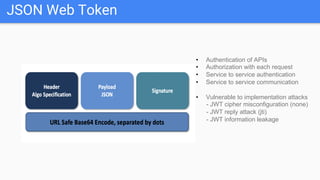
JSON Web Token
• Authentication of APIs
• Authorization with each request
• Service to service authentication
• Service to service communication
• Vulnerable to implementation attacks
- JWT cipher misconfiguration (none)
- JWT reply attack (jti)
- JWT information leakage
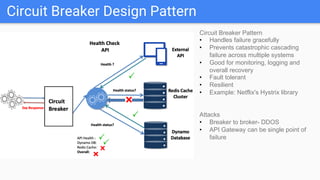
Circuit Breaker Design Pattern
Circuit Breaker Pattern
• Handles failure gracefully
• Prevents catastrophic cascading
failure across multiple systems
• Good for monitoring, logging and
overall recovery
• Fault tolerant
• Resilient
• Example: Netflix's Hystrix library
Attacks
• Breaker to broker- DDOS
• API Gateway can be single point of
failure
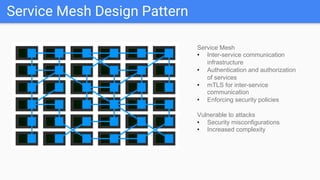
Service Mesh Design Pattern
Service Mesh
• Inter-service communication
infrastructure
• Authentication and authorization
of services
• mTLS for inter-service
communication
• Enforcing security policies
Vulnerable to attacks
• Security misconfigurations
• Increased complexity
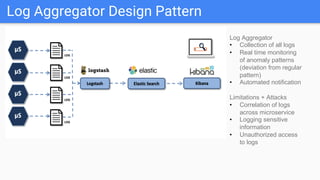
Log Aggregator Design Pattern
Log Aggregator
• Collection of all logs
• Real time monitoring
of anomaly patterns
(deviation from regular
pattern)
• Automated notification
Limitations + Attacks
• Correlation of logs
across microservice
• Logging sensitive
information
• Unauthorized access
to logs
Securing
Serverless
Applications
and
Microservices
● Security best practices
● Security scanning and tooling
Security best practices
● Zero trust everything (code, applications, inter-process
communications, configurations, networks )
● Select encryption at rest wisely
● Secure coding convention must be followed
● Generate logs, perform auditing and monitoring, use SIEM
● Stay on top of 3rd party known CVEs associated with open source
libraries
● Involve your security team early
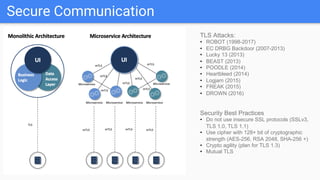
Secure Communication
TLS Attacks:
• ROBOT (1998-2017)
• EC DRBG Backdoor (2007-2013)
• Lucky 13 (2013)
• BEAST (2013)
• POODLE (2014)
• Heartbleed (2014)
• Logjam (2015)
• FREAK (2015)
• DROWN (2016)
Security Best Practices
• Do not use insecure SSL protocols (SSLv3,
TLS 1.0, TLS 1.1)
• Use cipher with 128+ bit of cryptographic
strength (AES-256, RSA 2048, SHA-256 +)
• Crypto agility (plan for TLS 1.3)
• Mutual TLS
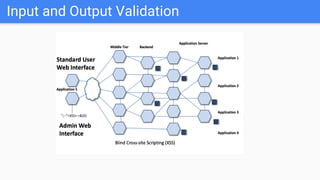
Input and Output Validation
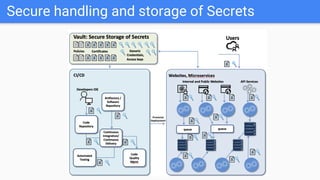
Secure handling and storage of Secrets
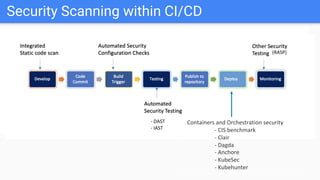
Security Scanning within CI/CD
Containers and Orchestration security
- CIS benchmark
- Clair
- Dagda
- Anchore
- KubeSec
- Kubehunter
(RASP)
- DAST
- IAST
Security Testing of Microservices
● Security unit test cases
● Perform threat model to abuse cases
● Build scanners for detecting common application security vulnerabilities
Conclusion
● Begin with Zerotrust by default
● Earn trust as you validate the authenticity of serverless applications
● Vetted microservice design patterns foster security
● Classic AppSec attacks are still applicable
● Be open minded about modern security tooling
● Automating AppSec tools promote shift left security transformation
● Threat Modeling is priceless
● Secure the complete stack and not just microservices
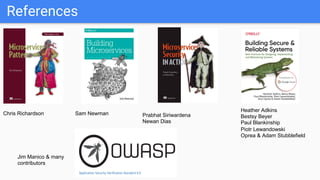
References
Chris Richardson Sam Newman Prabhat Siriwardena
Newan Dias
Jim Manico & many
contributors
Heather Adkins
Bestsy Beyer
Paul Blankinship
Piotr Lewandowski
Oprea & Adam Stubblefield
Questions?
Twitter: @tshiralkar
LinkedIn: https://www.linkedin.com/in/trupti-shiralkar-0a085a8/
Email: s.trupts@gmail.com

Zerotrusting serverless applications protecting microservices using secure design patterns 3.0

  • 1.
    Zerotrusting Serverless Applications: Protecting Microservicesusing Secure Design Patterns Trupti Shiralkar
  • 2.
    About Me • PrincipalApplication Security Engineer, Illumio • Mobile game developer turned security professional - MS In Security Engineering, Johns Hopkins University - Previously worked at Amazon, Q2Ebanking, HP & ATSEC • When I am not doing security - Travel - Paint • Yoga Alliance Certified Instructor - Breathing exercises - Meditation Twitter: @tshiralkar LinkedIn: https://www.linkedin.com/in/trupti-shiralkar-0a085a8/ Email: s.trupts@gmail.com
  • 3.
    Agenda ● Understanding serverlessapplications and microservices ● Analyzing microservices security design patterns ● Securing serverless applications and microservices
  • 4.
    Understanding Serverless and Microservices ● Evolution ●Security pain points ● Overall changing role of security
  • 5.
  • 6.
    What exactly isserverless ? Serverless Ecosystem Serverless Functions (AWS Lambda) Serverless Applications (AWS dynamo DB) Serverless Containers AWS (Fargate) • No management of servers • Operational tasks done by cloud provider • Event driven • Stateless • Short lived • On demand scalable • Pay as you use
  • 7.
    Monolith vs Microservicesvs Serverless Attributes Monolith Microservices Serverless Modularity Tightly coupled Loosely coupled Loosely coupled Interservice Communication Smart pipes, heavy weight protocol, SOAP Dumb pipes, lightweight protocols such as REST and gRPC REST APIs Data Global data model, shared database Data model and database per service Data model per function, ephemeral Typical Service Giant Monolith Application Small independent Services Short lived, event driven, stateless, pay as you used functions Deployment slow faster Super fast
  • 8.
    Microservices are notsilver bullet! Credit: KRAZAM
  • 9.
    Security pain points ●Increased complexity ● Implicit trust is dangerous ● Static vs Dynamic Order of API calls ● Serverless attack surface is unknown ● Inadequate security tooling can’t detect vulnerabilities in microservices ● Traditional application security lacks the speed of development & deployment
  • 10.
    OWASP vulnerabilities arestill applicable ● A1: Injection ● A2: broken Authentication ● A3: Sensitive Data Exposure ● A4: XML External Entities ● A5: Broken Authentication ● A6: Security Misconfiguration ● A7: Cross-Site Scripting (XSS) ● A8: Insecure Deserialization ● A9: Using components with known Vulnerabilities ● A10: Insufficient Logging & Monitoring
  • 11.
    AWS Lambda Available since2014 Code Injection Access Bypass - CVE- 2015-3373 Command Injection- CVE- 2019-10777 ● Debugging through logging ● Limited testing ● Temp data leakage ● Misconfigured IAM policies using wildcards ● Command Injection in CLI tool of AWS- Lambda
  • 12.
  • 13.
    Microservice Design Patterns ● Whatare microservice design patterns? ● Why do we need it? ● Can we leverage them to achieve security goals?
  • 14.
    Design Patterns forMicroservices Decomposition patterns Integration patterns Database patterns Observability patterns Cross-Cutting Concern patterns Decompose by Business Capability Decompose by Subdomain Decompose by Transactions Strangler Pattern Bulkhead Pattern Sidecar Pattern API Gateway Pattern Aggregator Pattern Proxy Pattern Gateway Routing Pattern Chained Microservice Pattern Branch Pattern Client-Side UI Composition Pattern Database per Service Shared Database per Service CQRS Event Sourcing Saga Pattern Log Aggregation Performance Metrics Distributed Tracing Health Check External Configuration Service Discovery Pattern Circuit Breaker Pattern Blue-Green Deployment Pattern Image credit: https://medium.com/@madhukaudantha/microservice- architecture-and-design-patterns-for-microservices-e0e5013fd58a
  • 15.
    API Gateway API Gateway •Login (IAM) • DOS protection • API Authorization • Routing of Request • Throttling, API rate limit & load balancing • HTTPS endpoints • Security and resiliency monitoring • Logging and auditing • Caching for better latency Still vulnerable to attacks • Layer 7 DDOS with counterfeit requests • DDOS with cascading requests • Layer 3 DDOS with syn flood • Implementation specific Login/Identity attacks • Static API key abuse • Common web application attacks like XSS, SQLi
  • 16.
    JSON Web Token •Authentication of APIs • Authorization with each request • Service to service authentication • Service to service communication • Vulnerable to implementation attacks - JWT cipher misconfiguration (none) - JWT reply attack (jti) - JWT information leakage
  • 17.
    Circuit Breaker DesignPattern Circuit Breaker Pattern • Handles failure gracefully • Prevents catastrophic cascading failure across multiple systems • Good for monitoring, logging and overall recovery • Fault tolerant • Resilient • Example: Netflix's Hystrix library Attacks • Breaker to broker- DDOS • API Gateway can be single point of failure
  • 18.
    Service Mesh DesignPattern Service Mesh • Inter-service communication infrastructure • Authentication and authorization of services • mTLS for inter-service communication • Enforcing security policies Vulnerable to attacks • Security misconfigurations • Increased complexity
  • 19.
    Log Aggregator DesignPattern Log Aggregator • Collection of all logs • Real time monitoring of anomaly patterns (deviation from regular pattern) • Automated notification Limitations + Attacks • Correlation of logs across microservice • Logging sensitive information • Unauthorized access to logs
  • 20.
  • 21.
    Security best practices ●Zero trust everything (code, applications, inter-process communications, configurations, networks ) ● Select encryption at rest wisely ● Secure coding convention must be followed ● Generate logs, perform auditing and monitoring, use SIEM ● Stay on top of 3rd party known CVEs associated with open source libraries ● Involve your security team early
  • 22.
    Secure Communication TLS Attacks: •ROBOT (1998-2017) • EC DRBG Backdoor (2007-2013) • Lucky 13 (2013) • BEAST (2013) • POODLE (2014) • Heartbleed (2014) • Logjam (2015) • FREAK (2015) • DROWN (2016) Security Best Practices • Do not use insecure SSL protocols (SSLv3, TLS 1.0, TLS 1.1) • Use cipher with 128+ bit of cryptographic strength (AES-256, RSA 2048, SHA-256 +) • Crypto agility (plan for TLS 1.3) • Mutual TLS
  • 23.
    Input and OutputValidation
  • 24.
    Secure handling andstorage of Secrets
  • 25.
    Security Scanning withinCI/CD Containers and Orchestration security - CIS benchmark - Clair - Dagda - Anchore - KubeSec - Kubehunter (RASP) - DAST - IAST
  • 26.
    Security Testing ofMicroservices ● Security unit test cases ● Perform threat model to abuse cases ● Build scanners for detecting common application security vulnerabilities
  • 27.
    Conclusion ● Begin withZerotrust by default ● Earn trust as you validate the authenticity of serverless applications ● Vetted microservice design patterns foster security ● Classic AppSec attacks are still applicable ● Be open minded about modern security tooling ● Automating AppSec tools promote shift left security transformation ● Threat Modeling is priceless ● Secure the complete stack and not just microservices
  • 28.
    References Chris Richardson SamNewman Prabhat Siriwardena Newan Dias Jim Manico & many contributors Heather Adkins Bestsy Beyer Paul Blankinship Piotr Lewandowski Oprea & Adam Stubblefield
  • 29.