Chitransh Goud
5th SEM CSE
Sagar Group
Content list :
What is Interviews & Why it is
Impotent?
Types of Interviews
Some interviews common questions
What is Interview why it is important?
An interview is a conversation where questions are asked and answers are
given. In common parlance, the word "interview“ refers to a one-on-one
conversation with one person acting in the role of the interviewer and the
other in the role of the interviewee. Interviews usually involve a transfer
of information from interviewee to interviewer, which is usually the
primary purpose of the interview, although information transfers can
happen in both directions simultaneously. One can contrast an interview
which involves bi-directional communication with a one-way flow of
information, such as a speech or oration.
After the assessment and pre-screening process, the interview is your last
chance to evaluate and gain critical information from a potential
employee. The question is what questions will you ask and what type of
answers do you desire. Beyond the experience and technical skill of the
position, what are you looking for? How do you determine attitude,
leadership skills, and the ability to work with your current team? How do
you determine that a candidate has the personality skills and habits that
you require?
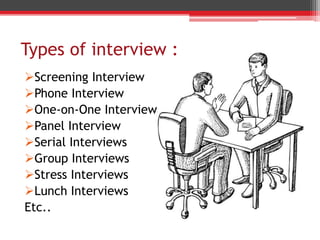
Types of interview :
Screening Interview
Phone Interview
One-on-One Interview
Panel Interview
Serial Interviews
Group Interviews
Stress Interviews
Lunch Interviews
Etc..
Why:
The introduction is the best opportunity
to convince your audience that you have something
worthwhile to say. An introduction can accomplish
this by fulfilling five important responsibilities: get
the audience's attention, introduce the topic,
explain its relevance to the audience, state a thesis
or purpose, and outline the main points. By the end
of the introduction, the audience should know where
you're headed and what your speech will cover.
How:
• Your introduction should be sort and do not contain unnecessary
information.
• Your introduction should be concise enough to hold the interest of
the interviewer.
• Avoid use of sort form.
• Prepare answers of Questions regarding your hobby.
Sample Answer:
Thank you for giving this opportunity to introducing myself.
Good afternoon sir.
My name is Chitransh Goud.
I belong to Bhopal. I am passed 12th from Bhopal.
My father is a farmer and my mother is a housewife.
I am pursuing Bachelor of Engineering in Sagar Goup campus in
Ratibar, Bhopal.
Thanks, sir.
Why:
It’s important to take the time to identify your strengths and
PRACTICE talking about them in advance. That way, you’ll be
ready when you walk into that interview for your dream job.
How:
• Sit down and make a list of your top strengths — aim for at least 10
and be creative.
• Develop at least one example or Interview Story to illustrate each of
your strengths.
• Choose specific strengths. Instead of “people skills” (too broad and
boring), go with “relationship building” or “persuasive
communication.
Experience - Experience with a certain software or type of task,
expertise in a particular industry, a track record of working with
similar products or clients, etc.
Talents — Abilities such as programming in a desired language,
writing proposals, selling widgets, litigating cases, organizing
events, translating from Mandarin, etc. (the possibilities here are
truly endless)
Soft skills — Competencies such as problem solving, influencing,
team building, negotiation, managing up, etc.
Education/training — Relevant background on topics critical to the
job — including college degrees, certifications, training seminars,
mentoring, internships, etc.
Why:
Refusing to answer the question. Some candidates will assert that
they can't think of a single weakness. This is probably because
they don't prepare for the question properly and freeze up, afraid
to say the wrong thing. This answer also makes you look like you
are hiding something
How:
• Should not tell him about negative weakness.
• Prepare the answer for what you are doing to improve your
weakness.
• Weakness must be less than your strength.
How:
• Learn about your career goals and how this position fits into your plan
• Make sure that you are sincerely interested in the job and will be
motivated to perform if hired
• Find out what you know about the company, industry, position (and if
you took the time to research)
• Understand your priorities and preferences — which aspects of the
company and/or job are appealing to you and why?
Why:
The interviewer is looking for similar things whether asking
about company or position. The hiring manager wants to: Learn
about your career goals and how this position fits into your plan.
Make sure that you are sincerely interested in the job and will be
motivated to perform if hired
Sample answer:
The interviewer is looking for similar things whether asking
about company or position. The hiring manager wants to: Learn
about your career goals and how this position fits into your plan.
Make sure that you are sincerely interested in the job and will be
motivated to perform if hired

Inteasdrview skill

  • 1.
    Chitransh Goud 5th SEMCSE Sagar Group
  • 2.
    Content list : Whatis Interviews & Why it is Impotent? Types of Interviews Some interviews common questions
  • 3.
    What is Interviewwhy it is important? An interview is a conversation where questions are asked and answers are given. In common parlance, the word "interview“ refers to a one-on-one conversation with one person acting in the role of the interviewer and the other in the role of the interviewee. Interviews usually involve a transfer of information from interviewee to interviewer, which is usually the primary purpose of the interview, although information transfers can happen in both directions simultaneously. One can contrast an interview which involves bi-directional communication with a one-way flow of information, such as a speech or oration. After the assessment and pre-screening process, the interview is your last chance to evaluate and gain critical information from a potential employee. The question is what questions will you ask and what type of answers do you desire. Beyond the experience and technical skill of the position, what are you looking for? How do you determine attitude, leadership skills, and the ability to work with your current team? How do you determine that a candidate has the personality skills and habits that you require?
  • 4.
    Types of interview: Screening Interview Phone Interview One-on-One Interview Panel Interview Serial Interviews Group Interviews Stress Interviews Lunch Interviews Etc..
  • 6.
    Why: The introduction isthe best opportunity to convince your audience that you have something worthwhile to say. An introduction can accomplish this by fulfilling five important responsibilities: get the audience's attention, introduce the topic, explain its relevance to the audience, state a thesis or purpose, and outline the main points. By the end of the introduction, the audience should know where you're headed and what your speech will cover.
  • 7.
    How: • Your introductionshould be sort and do not contain unnecessary information. • Your introduction should be concise enough to hold the interest of the interviewer. • Avoid use of sort form. • Prepare answers of Questions regarding your hobby. Sample Answer: Thank you for giving this opportunity to introducing myself. Good afternoon sir. My name is Chitransh Goud. I belong to Bhopal. I am passed 12th from Bhopal. My father is a farmer and my mother is a housewife. I am pursuing Bachelor of Engineering in Sagar Goup campus in Ratibar, Bhopal. Thanks, sir.
  • 8.
    Why: It’s important totake the time to identify your strengths and PRACTICE talking about them in advance. That way, you’ll be ready when you walk into that interview for your dream job. How: • Sit down and make a list of your top strengths — aim for at least 10 and be creative. • Develop at least one example or Interview Story to illustrate each of your strengths. • Choose specific strengths. Instead of “people skills” (too broad and boring), go with “relationship building” or “persuasive communication.
  • 9.
    Experience - Experiencewith a certain software or type of task, expertise in a particular industry, a track record of working with similar products or clients, etc. Talents — Abilities such as programming in a desired language, writing proposals, selling widgets, litigating cases, organizing events, translating from Mandarin, etc. (the possibilities here are truly endless) Soft skills — Competencies such as problem solving, influencing, team building, negotiation, managing up, etc. Education/training — Relevant background on topics critical to the job — including college degrees, certifications, training seminars, mentoring, internships, etc.
  • 10.
    Why: Refusing to answerthe question. Some candidates will assert that they can't think of a single weakness. This is probably because they don't prepare for the question properly and freeze up, afraid to say the wrong thing. This answer also makes you look like you are hiding something How: • Should not tell him about negative weakness. • Prepare the answer for what you are doing to improve your weakness. • Weakness must be less than your strength.
  • 11.
    How: • Learn aboutyour career goals and how this position fits into your plan • Make sure that you are sincerely interested in the job and will be motivated to perform if hired • Find out what you know about the company, industry, position (and if you took the time to research) • Understand your priorities and preferences — which aspects of the company and/or job are appealing to you and why? Why: The interviewer is looking for similar things whether asking about company or position. The hiring manager wants to: Learn about your career goals and how this position fits into your plan. Make sure that you are sincerely interested in the job and will be motivated to perform if hired
  • 12.
    Sample answer: The intervieweris looking for similar things whether asking about company or position. The hiring manager wants to: Learn about your career goals and how this position fits into your plan. Make sure that you are sincerely interested in the job and will be motivated to perform if hired