How to Write a Killer Marketing Plan e-Society Seminar March 11, 2010 Dr. Michael Merz Department of Marketing & Decision Sciences College of Business San Jose State University
Today’s Agenda What is a Marketing Plan? Why is it Important? How to Write a Marketing Plan?
What is a Marketing Plan? Why is it important?
Marketing Plan and Its Importance Marketing Plan is part of a business plan. A document that summarizes marketplace knowledge and the marketing strategies and specific plans to be used in achieving the new venture’s marketing and financial objectives.  Internal document  that helps a new venture flesh out its marketing activities and solidify its goals. It acts as an important road map for the new venture. External document  that helps a new venture present itself to potential investors, suppliers, business partners, and key job candidates.
How to Write a Marketing Plan?
Guidelines for Writing a  Marketing Plan First how NOT to write a Marketing Plan: Founders with none of their own money at risk. A poorly cited plan. Market size is defined too broadly (e.g., target is the $550 billion/year pharmaceutical industry). Overly aggressive financials -> loss of credibility Sloppiness in any area.
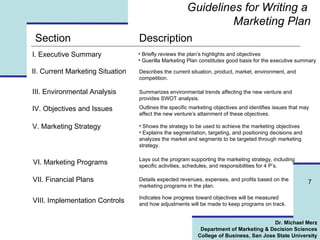
Guidelines for Writing a  Marketing Plan Section Description I. Executive Summary II. Current Marketing Situation IV. Objectives and Issues V. Marketing Strategy VI. Marketing Programs VII. Financial Plans VIII. Implementation Controls Briefly reviews the plan’s highlights and objectives Guerilla Marketing Plan constitutes good basis for the executive summary Summarizes environmental trends affecting the new venture and provides SWOT analysis. Outlines the specific marketing objectives and identifies issues that may affect the new venture’s attainment of these objectives. Shows the strategy to be used to achieve the marketing objectives Explains the segmentation, targeting, and positioning decisions and analyzes the market and segments to be targeted through marketing strategy.  Lays out the program supporting the marketing strategy, including specific activities, schedules, and responsibilities for 4 P’s. Details expected revenues, expenses, and profits based on the marketing programs in the plan. Indicates how progress toward objectives will be measured and how adjustments will be made to keep programs on track. III. Environmental Analysis Describes the current situation, product, market, environment, and competition.
I. The Executive Summary
Executive Summary Guerrilla Marketing Plan Guerrilla Marketing Plans are brief. The first sentence tells the  purpose  of the marketing strategy. The second tells  how  you’ll  achieve this purpose , focusing upon your benefits. The third tells your  target market  – or markets. The fourth tells the  marketing weapons  you’ll employ. The fifth tells your  niche  and  position . The sixth tells your  identity . The seventh tells your  budget , expressed as a percentage of your projected gross revenues. Levinson (2007), Guerilla Marketing
Executive Summary Guerrilla Marketing Plan – Example The  purpose  of Prosper Press is to sell the maximum number of books at the lowest possible selling cost per book.  This will be  accomplished  by positioning the books as being so valuable to free-lancers that they are guaranteed to be worth more to the reader than their selling price.  The  target market  will be people who can or do engage in free-lance earning activities.  Marketing tools  to be utilized will be a combination of classified advertising in magazines and newspapers, direct mail, sales at seminars, publicity in newspapers and on radio and television, direct sales calls to bookstores, and mail-order display ads in magazines.  The  niche  to be occupied is one that stands valuable information that helps free-lancers succeed, the ultimate authority for free-lancers.  Our  identity  will be one of expertise, readability, and quick response to customer requests.  Thirty percent of sales will be  allocated  to marketing.

II. Current Marketing Situation
Product Overview Description of  your  n ew venture product idea. Show that new venture idea constitutes an  opportunity  (durable, timely, attractive, valuable for customers). Show that  window of opportunity  is open. Describe how your new venture product idea creates value (solving a problem, finding a gap in the marketplace). Results from product/service feasibility analysis.
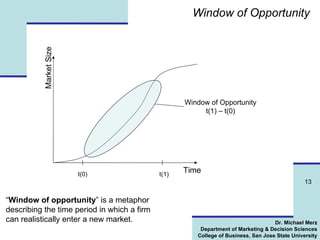
Window of Opportunity “ Window of opportunity ” is a metaphor describing the time period in which a firm can realistically enter a new market. Time Market Size t(0) t(1) Window of Opportunity t(1) – t(0)
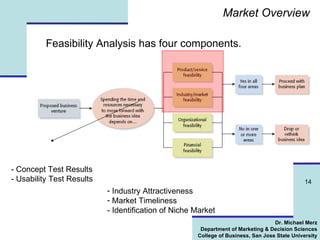
Market Overview Feasibility Analysis has four components. - Concept Test Results - Usability Test Results Industry Attractiveness Market Timeliness - Identification of Niche Market
III. Environmental Analysis
Environmental Analysis The  Marketing Environment  consists of actors and forces outside the organization that affect management’s ability to build and maintain relationships with target customers. Studying the environment allows marketers to take advantage of opportunities as well as to combat threats. Marketing environment is made up of a microenvironment and a macroenvironment.  Marketing intelligence and research are used to collect information about the environment (primary versus secondary research). Weigh the pros and cons of making a decision based on limited data, or waiting for research.
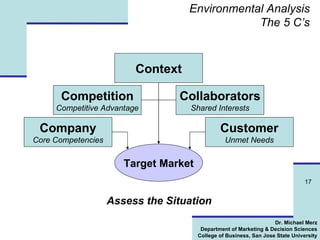
Environmental Analysis The 5 C’s Context Company Core Competencies Customer Unmet Needs Competition Competitive Advantage Collaborators Shared Interests Target Market Assess the Situation
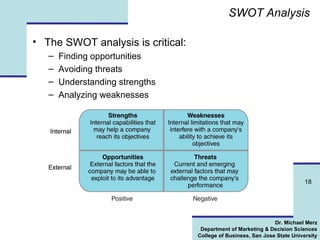
SWOT Analysis The SWOT analysis is critical: Finding opportunities Avoiding threats Understanding strengths Analyzing weaknesses
IV. Objectives and Issues
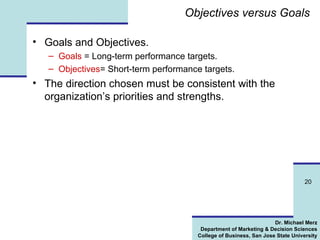
Objectives versus Goals Goals and Objectives. Goals  = Long-term performance targets. Objectives = Short-term performance targets. The direction chosen must be consistent with the organization’s priorities and strengths.
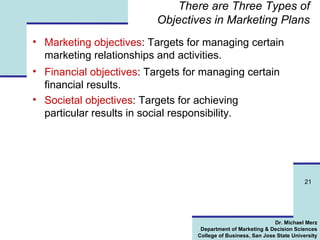
There are Three Types of Objectives in Marketing Plans Marketing objectives : Targets for managing certain marketing relationships and activities. Financial objectives : Targets for managing certain financial results. Societal objectives : Targets for achieving particular results in social responsibility.
Keys to Effective Objectives Specific, time-defined, and measurable. Realistic, but challenging. Consistent with the mission and overall goals. Consistent with internal environmental analysis. Appropriate in light of opportunities and threats.
V. Marketing Strategy
Mission (Statement) A statement of the organization’s purpose. What it wants to accomplish in the larger environment. Should be market oriented and defined in terms of customer needs.
Mission Example In 2002 Microsoft’s mission was  "To empower people through great software -- any time, any place, and on any device.” The mission statement now reads,  "At Microsoft, we work to help people and businesses throughout the world realize their full potential.”
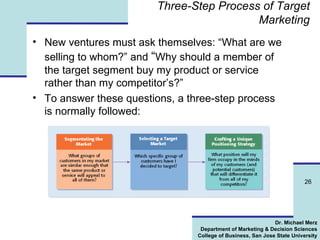
Three-Step Process of Target Marketing New ventures must ask themselves: “What are we selling to whom?” and  “ Why should a member of the target segment buy my product or service rather than my competitor’s?” To answer these questions, a three-step process is normally followed:
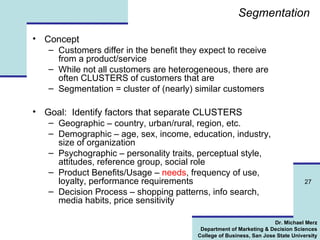
Segmentation Concept Customers differ in the benefit they expect to receive from a product/service While not all customers are heterogeneous, there are often CLUSTERS of customers that are Segmentation = cluster of (nearly) similar customers Goal:  Identify factors that separate CLUSTERS  Geographic – country, urban/rural, region, etc. Demographic – age, sex, income, education, industry, size of organization Psychographic – personality traits, perceptual style, attitudes, reference group, social role Product Benefits/Usage –  needs , frequency of use, loyalty, performance requirements Decision Process – shopping patterns, info search, media habits, price sensitivity
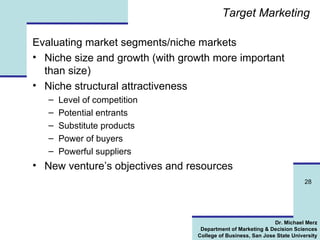
Target Marketing Evaluating market segments/niche markets Niche size and growth (with growth more important than size) Niche structural attractiveness Level of competition Potential entrants Substitute products Power of buyers Powerful suppliers New venture’s objectives and resources
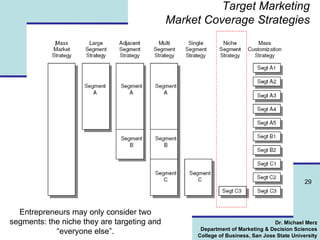
Target Marketing Market Coverage Strategies Entrepreneurs may only consider two segments: the niche they are targeting and “everyone else”.
Positioning  Positioning = What the target group perceives about your brand relative to how they perceive the competition.  Building a competitive advantage is key.  A new venture has a competitive advantage when customers  perceive  that its products/services are superior to those of its competitors. Find a position/niche and fill it. Strive to be unique. Positioning/perceptual maps  help identify a unique and attractive position.  Define a unique selling proposition (USP)
Positioning by Name or Slogan Entrepreneurs can save significant money in positioning their market offerings by:  (1) Choosing a name that connotes the appropriate    positioning.   E.g., Please Touch Museum in Philadelphia CDNow (CDs on the Internet) Netscape Communications (Internet browser) NetFlix (movie rentals on the Internet) Cars.com (cars on the Internet) 1-800-Flowers, 1-800-Diapers (2) Developing a “tagline”/slogan to reinforce the    position they have staked out in their market. E.g., Visa: “It’s everywhere you want to be” Michelin: “Because so much is riding on your tires” MySpace: “A place for friends” eBay: “The world’s online marketplace NetFlix: “There is always a movie to watch at home.” Google: “To organize the world’s information.”
Positioning by Features vs. Benefits One common mistake entrepreneurs make is that they position their market offering in terms of features. “ Customers don’t buy perceived features, they buy perceived benefits”. E.g.,  “ Our cell phones are equipped with sufficient memory to store 100 phone numbers”  (feature positioning)   vs.  “ Our cell phones lets you store up to 100 phone numbers, giving you the phone numbers of your family and your friends at your fingertips”   (benefit positioning)
How might a surgeon explain a new surgical procedure to a patient lying in a hospital bed, if only technical features (rather than benefits) were explained? “ Have I got an operation for you. Only three incisions and an Anderson Slash, a Ridgeway stubble-side fillip, and a standard dormer slip! Only five minutes with a scalpel; only thirty stitches! We can take out up to five pounds of your insides, have you back in your hospital bed in 75 minutes flat, and we can do ten of them in a day”. (McMath and Forbes (April 1998) in Entrepreneur, pp. 135-139)
VI. Marketing Programs
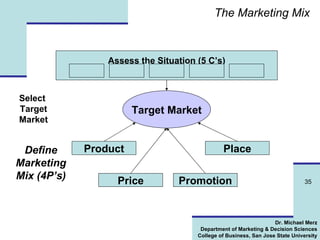
The Marketing Mix Assess the Situation (5 C’s) Target Market Select  Target Market Define Marketing Mix (4P’s) Product Price Promotion Place
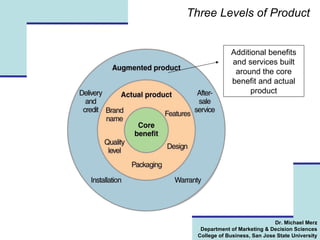
Three Levels of Product Additional benefits and services built around the core benefit and actual product
Product Describe, in detail, your product/service idea. Describe how your product/service fulfills unmet marketplace needs. Differentiate your product/service from the competition. Explain why and how customers will switch to your product or service. Describe how you will defend your product or service from competition.
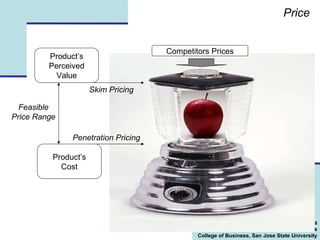
Price Product’s Cost Product’s Perceived Value Penetration Pricing Skim Pricing Competitors Prices Feasible Price Range
Price Describe and justify your pricing strategy. Provide evidence that your target market will accept your price (e.g., product feasibility analysis results). Position your strategy relative to current and potential competition.  NOTE:   Low price often (usually) is  NOT  a good strategy for a startup!
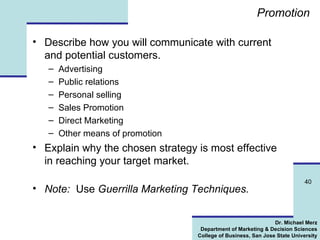
Promotion Describe how you will communicate with current and potential customers. Advertising Public relations Personal selling Sales Promotion Direct Marketing Other means of promotion Explain why the chosen strategy is most effective in reaching your target market.  Note:   Use  Guerrilla Marketing Techniques.
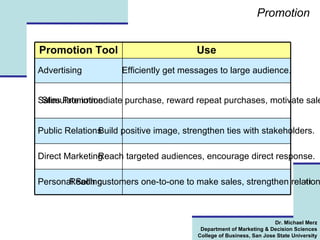
Promotion Promotion Tool Use Advertising Efficiently get messages to large audience. Sales Promotion Stimulate immediate purchase, reward repeat purchases, motivate sales personnel. Public Relations Build positive image, strengthen ties with stakeholders. Direct Marketing Reach targeted audiences, encourage direct response. Personal Selling Reach customers one-to-one to make sales, strengthen relationships.
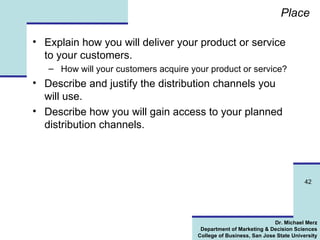
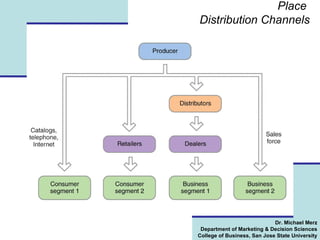
Place Explain how you will deliver your product or service to your customers. How will your customers acquire your product or service? Describe and justify the distribution channels you will use. Describe how you will gain access to your planned distribution channels.
Place  Distribution Channels
VII. Financial Plans
Financial Plans Sales/revenue  forecast . Marketing expense  budget(s) . Break-even analysis. Profit and loss analysis.
VIII. Implementation Controls
Measuring what Matters Measurement Schedules  identifying the timing of marketing tasks. Metrics  to gauge progress toward achieving objectives. Control Identify. Analyze. Correct.
Identifying Metrics Working backward from mission, goals, and objectives. Looking for key components or activities related to customer buying behavior. This includes metrics for each of the three key areas: Marketing objectives. Financial objectives. Societal objectives.
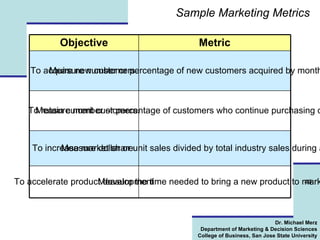
Sample Marketing Metrics Objective Metric To acquire new customers. Measure number or percentage of new customers acquired by month, quarter, year. To retain current customers. Measure number or percentage of customers who continue purchasing during a set period. To increase market share. Measure dollar or unit sales divided by total industry sales during a set period. To accelerate product development Measure the time needed to bring a new product to market.
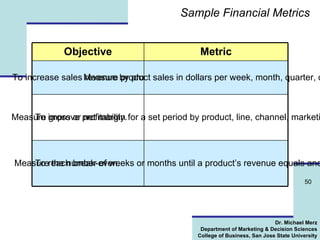
Sample Financial Metrics Objective Metric To increase sales revenue by product. Measure product sales in dollars per week, month, quarter, or year. To improve profitability. Measure gross or net margin for a set period by product, line, channel, marketing program, or customer. To reach break-even. Measure the number of weeks or months until a product’s revenue equals and begins to exceed costs.
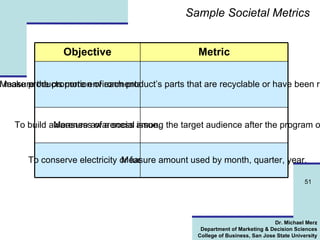
Sample Societal Metrics Objective Metric To make products more environmentally friendly. Measure the proportion of each product’s parts that are recyclable or have been recycled during a set period. To build awareness of a social issue. Measure awareness among the target audience after the program or a set period. To conserve electricity or fuel. Measure amount used by month, quarter, year.
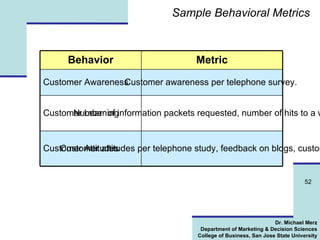
Sample Behavioral Metrics Behavior Metric Customer Awareness Customer awareness per telephone survey.  Customer Learning Number of information packets requested, number of hits to a website. Customer Attitudes Customer attitudes per telephone study, feedback on blogs, customer letters.
Contingency Plan Plans that organizations have ready to implement if their original strategies are disrupted by significant, unexpected changes, such as: Computer system outages Power outages Natural disasters Etc. Should be creative in terms of considering options, priorities, and resources.
Thank you! Now, follow your dreams! Q & A

How To Write A Killer Marketing Plan

  • 1.
    How to Writea Killer Marketing Plan e-Society Seminar March 11, 2010 Dr. Michael Merz Department of Marketing & Decision Sciences College of Business San Jose State University
  • 2.
    Today’s Agenda Whatis a Marketing Plan? Why is it Important? How to Write a Marketing Plan?
  • 3.
    What is aMarketing Plan? Why is it important?
  • 4.
    Marketing Plan andIts Importance Marketing Plan is part of a business plan. A document that summarizes marketplace knowledge and the marketing strategies and specific plans to be used in achieving the new venture’s marketing and financial objectives. Internal document that helps a new venture flesh out its marketing activities and solidify its goals. It acts as an important road map for the new venture. External document that helps a new venture present itself to potential investors, suppliers, business partners, and key job candidates.
  • 5.
    How to Writea Marketing Plan?
  • 6.
    Guidelines for Writinga Marketing Plan First how NOT to write a Marketing Plan: Founders with none of their own money at risk. A poorly cited plan. Market size is defined too broadly (e.g., target is the $550 billion/year pharmaceutical industry). Overly aggressive financials -> loss of credibility Sloppiness in any area.
  • 7.
    Guidelines for Writinga Marketing Plan Section Description I. Executive Summary II. Current Marketing Situation IV. Objectives and Issues V. Marketing Strategy VI. Marketing Programs VII. Financial Plans VIII. Implementation Controls Briefly reviews the plan’s highlights and objectives Guerilla Marketing Plan constitutes good basis for the executive summary Summarizes environmental trends affecting the new venture and provides SWOT analysis. Outlines the specific marketing objectives and identifies issues that may affect the new venture’s attainment of these objectives. Shows the strategy to be used to achieve the marketing objectives Explains the segmentation, targeting, and positioning decisions and analyzes the market and segments to be targeted through marketing strategy. Lays out the program supporting the marketing strategy, including specific activities, schedules, and responsibilities for 4 P’s. Details expected revenues, expenses, and profits based on the marketing programs in the plan. Indicates how progress toward objectives will be measured and how adjustments will be made to keep programs on track. III. Environmental Analysis Describes the current situation, product, market, environment, and competition.
  • 8.
  • 9.
    Executive Summary GuerrillaMarketing Plan Guerrilla Marketing Plans are brief. The first sentence tells the purpose of the marketing strategy. The second tells how you’ll achieve this purpose , focusing upon your benefits. The third tells your target market – or markets. The fourth tells the marketing weapons you’ll employ. The fifth tells your niche and position . The sixth tells your identity . The seventh tells your budget , expressed as a percentage of your projected gross revenues. Levinson (2007), Guerilla Marketing
  • 10.
    Executive Summary GuerrillaMarketing Plan – Example The purpose of Prosper Press is to sell the maximum number of books at the lowest possible selling cost per book. This will be accomplished by positioning the books as being so valuable to free-lancers that they are guaranteed to be worth more to the reader than their selling price. The target market will be people who can or do engage in free-lance earning activities. Marketing tools to be utilized will be a combination of classified advertising in magazines and newspapers, direct mail, sales at seminars, publicity in newspapers and on radio and television, direct sales calls to bookstores, and mail-order display ads in magazines. The niche to be occupied is one that stands valuable information that helps free-lancers succeed, the ultimate authority for free-lancers. Our identity will be one of expertise, readability, and quick response to customer requests. Thirty percent of sales will be allocated to marketing.
  • 11.
  • 12.
    Product Overview Descriptionof your n ew venture product idea. Show that new venture idea constitutes an opportunity (durable, timely, attractive, valuable for customers). Show that window of opportunity is open. Describe how your new venture product idea creates value (solving a problem, finding a gap in the marketplace). Results from product/service feasibility analysis.
  • 13.
    Window of Opportunity“ Window of opportunity ” is a metaphor describing the time period in which a firm can realistically enter a new market. Time Market Size t(0) t(1) Window of Opportunity t(1) – t(0)
  • 14.
    Market Overview FeasibilityAnalysis has four components. - Concept Test Results - Usability Test Results Industry Attractiveness Market Timeliness - Identification of Niche Market
  • 15.
  • 16.
    Environmental Analysis The Marketing Environment consists of actors and forces outside the organization that affect management’s ability to build and maintain relationships with target customers. Studying the environment allows marketers to take advantage of opportunities as well as to combat threats. Marketing environment is made up of a microenvironment and a macroenvironment. Marketing intelligence and research are used to collect information about the environment (primary versus secondary research). Weigh the pros and cons of making a decision based on limited data, or waiting for research.
  • 17.
    Environmental Analysis The5 C’s Context Company Core Competencies Customer Unmet Needs Competition Competitive Advantage Collaborators Shared Interests Target Market Assess the Situation
  • 18.
    SWOT Analysis TheSWOT analysis is critical: Finding opportunities Avoiding threats Understanding strengths Analyzing weaknesses
  • 19.
  • 20.
    Objectives versus GoalsGoals and Objectives. Goals = Long-term performance targets. Objectives = Short-term performance targets. The direction chosen must be consistent with the organization’s priorities and strengths.
  • 21.
    There are ThreeTypes of Objectives in Marketing Plans Marketing objectives : Targets for managing certain marketing relationships and activities. Financial objectives : Targets for managing certain financial results. Societal objectives : Targets for achieving particular results in social responsibility.
  • 22.
    Keys to EffectiveObjectives Specific, time-defined, and measurable. Realistic, but challenging. Consistent with the mission and overall goals. Consistent with internal environmental analysis. Appropriate in light of opportunities and threats.
  • 23.
  • 24.
    Mission (Statement) Astatement of the organization’s purpose. What it wants to accomplish in the larger environment. Should be market oriented and defined in terms of customer needs.
  • 25.
    Mission Example In2002 Microsoft’s mission was "To empower people through great software -- any time, any place, and on any device.” The mission statement now reads, "At Microsoft, we work to help people and businesses throughout the world realize their full potential.”
  • 26.
    Three-Step Process ofTarget Marketing New ventures must ask themselves: “What are we selling to whom?” and “ Why should a member of the target segment buy my product or service rather than my competitor’s?” To answer these questions, a three-step process is normally followed:
  • 27.
    Segmentation Concept Customersdiffer in the benefit they expect to receive from a product/service While not all customers are heterogeneous, there are often CLUSTERS of customers that are Segmentation = cluster of (nearly) similar customers Goal: Identify factors that separate CLUSTERS Geographic – country, urban/rural, region, etc. Demographic – age, sex, income, education, industry, size of organization Psychographic – personality traits, perceptual style, attitudes, reference group, social role Product Benefits/Usage – needs , frequency of use, loyalty, performance requirements Decision Process – shopping patterns, info search, media habits, price sensitivity
  • 28.
    Target Marketing Evaluatingmarket segments/niche markets Niche size and growth (with growth more important than size) Niche structural attractiveness Level of competition Potential entrants Substitute products Power of buyers Powerful suppliers New venture’s objectives and resources
  • 29.
    Target Marketing MarketCoverage Strategies Entrepreneurs may only consider two segments: the niche they are targeting and “everyone else”.
  • 30.
    Positioning Positioning= What the target group perceives about your brand relative to how they perceive the competition. Building a competitive advantage is key. A new venture has a competitive advantage when customers perceive that its products/services are superior to those of its competitors. Find a position/niche and fill it. Strive to be unique. Positioning/perceptual maps help identify a unique and attractive position. Define a unique selling proposition (USP)
  • 31.
    Positioning by Nameor Slogan Entrepreneurs can save significant money in positioning their market offerings by: (1) Choosing a name that connotes the appropriate positioning. E.g., Please Touch Museum in Philadelphia CDNow (CDs on the Internet) Netscape Communications (Internet browser) NetFlix (movie rentals on the Internet) Cars.com (cars on the Internet) 1-800-Flowers, 1-800-Diapers (2) Developing a “tagline”/slogan to reinforce the position they have staked out in their market. E.g., Visa: “It’s everywhere you want to be” Michelin: “Because so much is riding on your tires” MySpace: “A place for friends” eBay: “The world’s online marketplace NetFlix: “There is always a movie to watch at home.” Google: “To organize the world’s information.”
  • 32.
    Positioning by Featuresvs. Benefits One common mistake entrepreneurs make is that they position their market offering in terms of features. “ Customers don’t buy perceived features, they buy perceived benefits”. E.g., “ Our cell phones are equipped with sufficient memory to store 100 phone numbers” (feature positioning) vs. “ Our cell phones lets you store up to 100 phone numbers, giving you the phone numbers of your family and your friends at your fingertips” (benefit positioning)
  • 33.
    How might asurgeon explain a new surgical procedure to a patient lying in a hospital bed, if only technical features (rather than benefits) were explained? “ Have I got an operation for you. Only three incisions and an Anderson Slash, a Ridgeway stubble-side fillip, and a standard dormer slip! Only five minutes with a scalpel; only thirty stitches! We can take out up to five pounds of your insides, have you back in your hospital bed in 75 minutes flat, and we can do ten of them in a day”. (McMath and Forbes (April 1998) in Entrepreneur, pp. 135-139)
  • 34.
  • 35.
    The Marketing MixAssess the Situation (5 C’s) Target Market Select Target Market Define Marketing Mix (4P’s) Product Price Promotion Place
  • 36.
    Three Levels ofProduct Additional benefits and services built around the core benefit and actual product
  • 37.
    Product Describe, indetail, your product/service idea. Describe how your product/service fulfills unmet marketplace needs. Differentiate your product/service from the competition. Explain why and how customers will switch to your product or service. Describe how you will defend your product or service from competition.
  • 38.
    Price Product’s CostProduct’s Perceived Value Penetration Pricing Skim Pricing Competitors Prices Feasible Price Range
  • 39.
    Price Describe andjustify your pricing strategy. Provide evidence that your target market will accept your price (e.g., product feasibility analysis results). Position your strategy relative to current and potential competition. NOTE: Low price often (usually) is NOT a good strategy for a startup!
  • 40.
    Promotion Describe howyou will communicate with current and potential customers. Advertising Public relations Personal selling Sales Promotion Direct Marketing Other means of promotion Explain why the chosen strategy is most effective in reaching your target market. Note: Use Guerrilla Marketing Techniques.
  • 41.
    Promotion Promotion ToolUse Advertising Efficiently get messages to large audience. Sales Promotion Stimulate immediate purchase, reward repeat purchases, motivate sales personnel. Public Relations Build positive image, strengthen ties with stakeholders. Direct Marketing Reach targeted audiences, encourage direct response. Personal Selling Reach customers one-to-one to make sales, strengthen relationships.
  • 42.
    Place Explain howyou will deliver your product or service to your customers. How will your customers acquire your product or service? Describe and justify the distribution channels you will use. Describe how you will gain access to your planned distribution channels.
  • 43.
  • 44.
  • 45.
    Financial Plans Sales/revenue forecast . Marketing expense budget(s) . Break-even analysis. Profit and loss analysis.
  • 46.
  • 47.
    Measuring what MattersMeasurement Schedules identifying the timing of marketing tasks. Metrics to gauge progress toward achieving objectives. Control Identify. Analyze. Correct.
  • 48.
    Identifying Metrics Workingbackward from mission, goals, and objectives. Looking for key components or activities related to customer buying behavior. This includes metrics for each of the three key areas: Marketing objectives. Financial objectives. Societal objectives.
  • 49.
    Sample Marketing MetricsObjective Metric To acquire new customers. Measure number or percentage of new customers acquired by month, quarter, year. To retain current customers. Measure number or percentage of customers who continue purchasing during a set period. To increase market share. Measure dollar or unit sales divided by total industry sales during a set period. To accelerate product development Measure the time needed to bring a new product to market.
  • 50.
    Sample Financial MetricsObjective Metric To increase sales revenue by product. Measure product sales in dollars per week, month, quarter, or year. To improve profitability. Measure gross or net margin for a set period by product, line, channel, marketing program, or customer. To reach break-even. Measure the number of weeks or months until a product’s revenue equals and begins to exceed costs.
  • 51.
    Sample Societal MetricsObjective Metric To make products more environmentally friendly. Measure the proportion of each product’s parts that are recyclable or have been recycled during a set period. To build awareness of a social issue. Measure awareness among the target audience after the program or a set period. To conserve electricity or fuel. Measure amount used by month, quarter, year.
  • 52.
    Sample Behavioral MetricsBehavior Metric Customer Awareness Customer awareness per telephone survey. Customer Learning Number of information packets requested, number of hits to a website. Customer Attitudes Customer attitudes per telephone study, feedback on blogs, customer letters.
  • 53.
    Contingency Plan Plansthat organizations have ready to implement if their original strategies are disrupted by significant, unexpected changes, such as: Computer system outages Power outages Natural disasters Etc. Should be creative in terms of considering options, priorities, and resources.
  • 54.
    Thank you! Now,follow your dreams! Q & A

Editor's Notes

  • #14 “ Window of opportunity” is a metaphor describing the time period in which a firm can realistically enter a new market. Once the market for a new product is established, its window of opportunity opens, and new entrants flow in. At some point, the market matures, and the window of opportunity (for new entrants) closes.