The Ins & Outs of
Developing An Effective
   Marketing Plan
                     Presented by
                   Niambi Jarvis


 Funded in part through a cooperative agreement
   with the U.S. Small Business Administration
What is Marketing?
   The area of business that involves:
     • The determination of customer needs/problems

     • The development and offering of tailored services
       and/or products that have been developed to meet
       those needs

     • Capturing customers’ perceived value of
       product/service through optimal pricing strategies

     • The development and implementation of the
       promotional activities that are most likely to
       reach a business’ target market and stimulate
       purchase

     • Identifying the ideal point of contact for
       customers to access a business’ products and
       services
What is a marketing plan &
 why should I have one?
 A marketing plan is a business tool that outlines how a
  company will attract, acquire and retain its target
  market(s)

 An executable & effective marketing plan:
   • Identifies the best customer profile (i.e. those
     individuals who are most willing and able to purchase
     your products)
   • Identifies a business’ optimal niche market (area of
     specialization)
   • Links sales and profit goals to marketing efforts
   • Provides an action plan for accomplishing sales and
     marketing goals (e.g. brand awareness, increase in
     market share, product line extensions etc.)
   • Can substantially increase sales & company value
Common Marketing Myths

1. Everyone is our customer
2. Our products are so good, they sell themselves
3. Price is everything
4. All buyers are rational
5. We have no competition
6. Just make more sales calls
7. Good fences make good neighbors
8. Business is complex; therefore solutions are never easy
9. The future is out of our control
10. Follow the leader
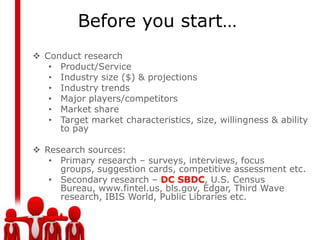
Before you start…
 Conduct research
   • Product/Service
   • Industry size ($) & projections
   • Industry trends
   • Major players/competitors
   • Market share
   • Target market characteristics, size, willingness & ability
     to pay

 Research sources:
   • Primary research – surveys, interviews, focus
     groups, suggestion cards, competitive assessment etc.
   • Secondary research – DC SBDC, U.S. Census
     Bureau, www.fintel.us, bls.gov, Edgar, Third Wave
     research, IBIS World, Public Libraries etc.
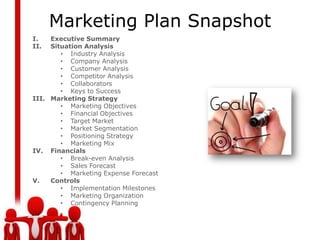
Marketing Plan Snapshot
I.   Executive Summary
II.  Situation Analysis
        • Industry Analysis
        • Company Analysis
        • Customer Analysis
        • Competitor Analysis
        • Collaborators
        • Keys to Success
III. Marketing Strategy
        • Marketing Objectives
        • Financial Objectives
        • Target Market
        • Market Segmentation
        • Positioning Strategy
        • Marketing Mix
IV. Financials
        • Break-even Analysis
        • Sales Forecast
        • Marketing Expense Forecast
V.   Controls
        • Implementation Milestones
        • Marketing Organization
        • Contingency Planning
I. Executive Summary

The Executive Summary should be written LAST, and
comprise a high level synopsis of:

   Company History
   Mission Statement
   Marketing Objectives
   Industry Trends
   Target Market
   Target Market Need(s)/Challenges
   Solutions – Your Products and/or Services
   Financial Feasibility (historical sales (if existing) and
    projections)
II. Situation Analysis
    Industry Analysis
    • Historical & projected industry sales (growth or decline)
    • Industry trends (e.g. market segmentation, new
      products, markets etc.)
    • Political/Legal, economic, social and technological
      environment

    Company Analysis
    • Company products/services
    • Company history &
      customers
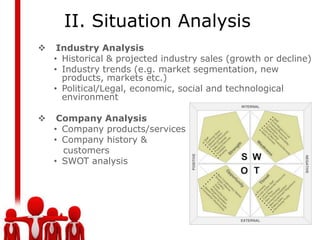
    • SWOT analysis
II. Situation Analysis
    Customer Analysis
    • Target market description & needs
    • Target market size, trends and growth
    • Value drivers
    Competitor Analysis
    • Major players (include market share %)
    • Market position
    • Strengths & weaknesses
    Collaborators
    • Subsidiaries, joint ventures, strategic alliances etc.
   Keys to Success
    • e.g. Location, effective networking, effective branding,
      increased top of mind awareness, consistent customer
      follow up & feedback, customized services/products,
      supplier relationships etc.
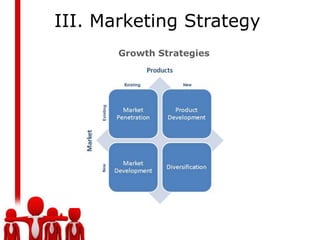
III. Marketing Strategy
       Growth Strategies
III. Marketing Strategy
   Marketing Objectives (2012)
     • Increase brand awareness
     • Increase market share by 10%
     • Launch two new products
     • Achieve an average customer satisfaction rating of 8
       out of 10
     • Increase customer retention by 10%

   Financial Objectives (2012)
       • Generate $500,000 in annual sales
       • Increase profit margin from 10% to 15%
III. Marketing Strategy
 Target Market
          Business to Consumer (B2C)
      •   Demographics
          (age, gender, income, education, generation)
      •   Geography (region, state, population size, density)
      •   Psychographics
          (activities, interests, opinions, attitudes, values)
      •   Behavior (usage patterns, frequency of use, benefits
          sought, brand loyalty)
      •   Target Market Size & Needs
        Business to Business (B2B)
      • Business/Organization
        Type, Revenue/Budget, Location, Number of
        Employees, Types of Services/Products
        Purchased, Frequency of Use
      • Target Market Size & Needs
III. Marketing Strategy
    Market segmentation – involves dividing the market
     into groups of individual sub-markets with different
     needs, wants and behavior.
Each segment must be:
Identifiable: the differentiating attributes of the segments must be
measurable so that they can be identified.
Accessible: the segments must be reachable through communication and
distribution channels.
Substantial: the segments should be sufficiently large to justify the
resources required to target them.
Unique: to justify separate offerings, the segments must respond
differently to the different marketing mixes.
Durable: the segments should be relatively stable to minimize the cost of
frequent changes.
III. Marketing Strategy
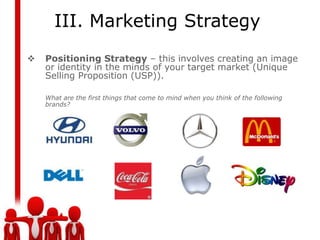
   Positioning Strategy – this involves creating an image
    or identity in the minds of your target market (Unique
    Selling Proposition (USP)).

    What are the first things that come to mind when you think of the following
    brands?
III. Marketing Strategy
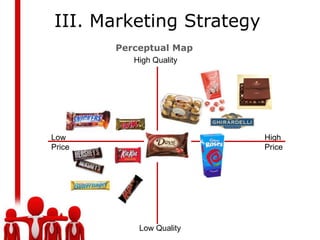
        Perceptual Map
           High Quality


Low                       High
Price                     Price


            Low Quality
III. Marketing Strategy
   Marketing Mix – The 4P’s
    Product/Service
       • Product Portfolio
       • Features & Benefits
       • Product Manufacture/Acquisition
       • Packaging
       • Unique value proposition – what sets my
         products/services apart from my competition?
III. Marketing Strategy
   Marketing Mix – The 4P’s continued
    Price
       • Price listing
       • Discounts, payment terms, bundling etc.
       • Cost factors and mark-up
       • Pricing Strategy & logic (penetration, skimming,
         competitive value-based)
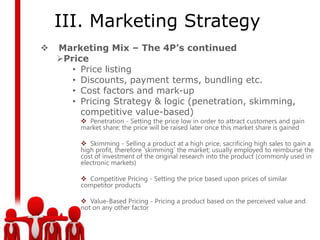
          Penetration - Setting the price low in order to attract customers and gain
         market share; the price will be raised later once this market share is gained

          Skimming - Selling a product at a high price, sacrificing high sales to gain a
         high profit, therefore ‘skimming’ the market; usually employed to reimburse the
         cost of investment of the original research into the product (commonly used in
         electronic markets)

          Competitive Pricing - Setting the price based upon prices of similar
         competitor products

          Value-Based Pricing - Pricing a product based on the perceived value and
         not on any other factor
III. Marketing Strategy
 Marketing Mix – The 4P’s continued

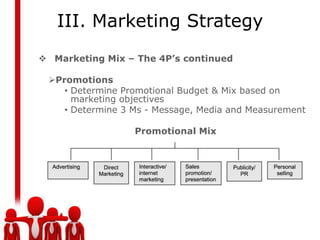
 Promotions
    • Determine Promotional Budget & Mix based on
      marketing objectives
    • Determine 3 Ms - Message, Media and Measurement

                  Promotional Mix
III. Marketing Strategy
Remember – Connect marketing objectives to
promotional strategy
Advertising - build general awareness/inquiries/traffic, encourage
product trial, shift awareness (e.g. change attitude), response to
competitor promotion, increase use or purchase rate, support other
market decisions (e.g. support sales force), general corporate/product
image building, etc.

Sales promotion - build inquires, increase product trial, encourage
repurchase, build traffic, support other promotions

Personal selling - new account development, account
support/maintenance, increase product trial, encourage
purchase/repurchase, build traffic, support other promotions

Public relations - build general awareness/inquiries/traffic, encourage
product trial, shift awareness (e.g., change attitude), respond to negative
news/perception, image building, prepare markets for future activity (e.g.
new product)
III. Marketing Strategy
Concepts to remember when developing promotional
 strategies:
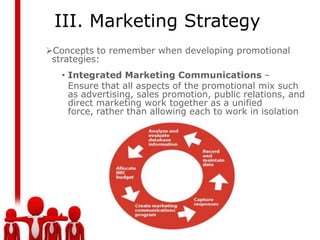
   • Integrated Marketing Communications –
     Ensure that all aspects of the promotional mix such
     as advertising, sales promotion, public relations, and
     direct marketing work together as a unified
     force, rather than allowing each to work in isolation
III. Marketing Strategy
 Concepts to remember when developing promotional
  strategies:

   • Customer Relationship Marketing
      Involves developing and maintaining long-term
       relationships with customers so that they will
       keep coming back to make repeat purchases.

      Small companies have an advantage over their
       larger rivals at relationship marketing.

      Requires a company to make customer service
       an all-encompassing part of its culture.
III. Marketing Strategy
   Concepts to remember when developing promotional
    strategies:

    • Developing a Competitive Edge
        Focus on the customer

       Devotion to quality

       Attention to convenience

       Concentration on innovation

       Dedication to service and customer satisfaction

       Emphasis on speed
III. Marketing Strategy
Why develop a customer centric approach to
  business?

 • 67% of customers who stop patronizing a business do so
   because an indifferent employee treated them poorly.
 • 96% of dissatisfied customers never complain about rude
   or discourteous service to the company, but...
 • 91% will not buy from that business again.
 • Treating customers indifferently or poorly costs the
   average company 15% to 30% of gross sales!
 • 100% will tell their “horror stories” to at least nine other
   people.
 • 13% of those unhappy customers will tell their stories to
   at least 20 other people.
III. Marketing Strategy
• Customer retention:

 Companies that are successful at retaining their
 customers constantly ask themselves (and their
 customers) these four questions:

         1.   What are we doing right?
         2.   How can we do that even better?
         3.   What have we done wrong?
         4.   What can we do in the future?
III. Marketing Strategy
 Marketing Mix – The 4P’s continued

 Place/Distribution
    • Location, location, location (accessibility, foot traffic,
      importance to customer, proximity to competition,
      parking, size, image)

    • Types of channels used
       o Direct (retail store, sales force, internet etc.)
       o Indirect (retailers, wholesalers, agents etc.)
       o Combination

    • Distribution costs (e.g. shipping, transportation, distributorship
      fee)

    • Sales Strategy (e.g. sales approach, based on geography)

    • Production & inventory capacities

    • Cyclical fluctuations or seasonal demands
IV. Financials
Break-even Analysis
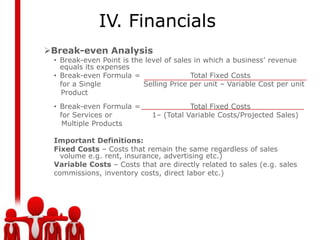
 • Break-even Point is the level of sales in which a business’ revenue
   equals its expenses
 • Break-even Formula =                  Total Fixed Costs
   for a Single           Selling Price per unit – Variable Cost per unit
   Product
 • Break-even Formula =                 Total Fixed Costs
   for Services or           1– (Total Variable Costs/Projected Sales)
    Multiple Products

 Important Definitions:
 Fixed Costs – Costs that remain the same regardless of sales
   volume e.g. rent, insurance, advertising etc.)
 Variable Costs – Costs that are directly related to sales (e.g. sales
 commissions, inventory costs, direct labor etc.)
IV. Financials
Sales Forecast
 • List assumptions/sales logic (e.g. seasonality, growth, increased
   capacity)
 • Estimated sales per product/service offering
 • Estimated sales per market segment
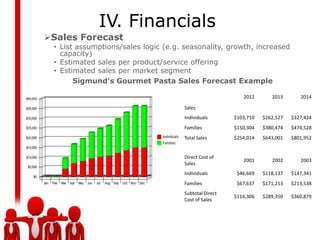
       Sigmund’s Gourmet Pasta Sales Forecast Example

                                                           2012       2013       2014

                                      Sales
                                      Individuals       $103,710   $262,527   $327,424
                                      Families          $150,304   $380,474   $474,528
                                      Total Sales       $254,014   $643,001   $801,952


                                      Direct Cost of
                                                           2001       2002       2003
                                      Sales
                                      Individuals        $46,669   $118,137   $147,341
                                      Families           $67,637   $171,213   $213,538
                                      Subtotal Direct
                                                        $114,306   $289,350   $360,879
                                      Cost of Sales
IV. Financials
 Marketing Expense Forecast
    • List assumptions/expense logic (e.g. outdoor ads during
      summer, sales promotions during slower months, advertising
      vehicle proportion)
    • Estimated marketing expense per product/service offering
    • Estimated marketing expense per market segment
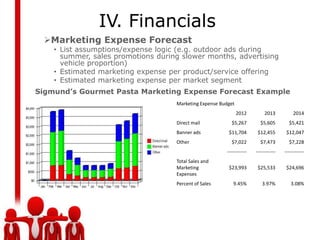
Sigmund’s Gourmet Pasta Marketing Expense Forecast Example
                                    Marketing Expense Budget
                                                               2012          2013           2014
                                    Direct mail            $5,267         $5,605         $5,421
                                    Banner ads            $11,704        $12,455        $12,047
                                    Other                  $7,022         $7,473         $7,228
                                                         ------------   ------------   ------------
                                    Total Sales and
                                    Marketing             $23,993        $25,533        $24,696
                                    Expenses
                                    Percent of Sales        9.45%          3.97%          3.08%
V. Controls
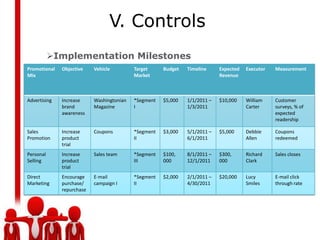
           Implementation Milestones
Promotional   Objective    Vehicle         Target     Budget   Timeline     Expected   Executor   Measurement
Mix                                        Market                           Revenue


Advertising   Increase     Washingtonian   *Segment   $5,000   1/1/2011 –   $10,000    William    Customer
              brand        Magazine        I                   1/3/2011                Carter     surveys, % of
              awareness                                                                           expected
                                                                                                  readership

Sales         Increase     Coupons         *Segment   $3,000   5/1/2011 –   $5,000     Debbie     Coupons
Promotion     product                      II                  6/1/2011                Allen      redeemed
              trial
Personal      Increase     Sales team      *Segment   $100,    8/1/2011 –   $300,      Richard    Sales closes
Selling       product                      III        000      12/1/2011    000        Clark
              trial
Direct        Encourage    E-mail          *Segment   $2,000   2/1/2011 –   $20,000    Lucy       E-mail click
Marketing     purchase/    campaign I      II                  4/30/2011               Smiles     through rate
              repurchase
V. Controls
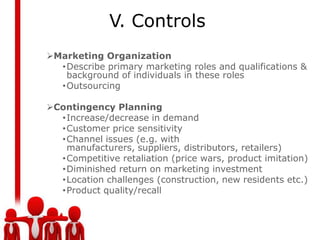
Marketing Organization
  •Describe primary marketing roles and qualifications &
   background of individuals in these roles
  •Outsourcing

Contingency Planning
  •Increase/decrease in demand
  •Customer price sensitivity
  •Channel issues (e.g. with
   manufacturers, suppliers, distributors, retailers)
  •Competitive retaliation (price wars, product imitation)
  •Diminished return on marketing investment
  •Location challenges (construction, new residents etc.)
  •Product quality/recall
Thank You!
Please Contact the DC SBDC for Consulting:
      DC Small Business Development Center
       GADGET Center, Howard University
            2801 Georgia Ave., NW
            Washington, DC 20001
               Office: 202.319.1393
                Twitter: @dcsbdc
               Facebook: dcsbdc

Ins & Outs of Developing a Marketing Plan | DCSBDC | Doing Business in DC

  • 1.
    The Ins &Outs of Developing An Effective Marketing Plan Presented by Niambi Jarvis Funded in part through a cooperative agreement with the U.S. Small Business Administration
  • 2.
    What is Marketing?  The area of business that involves: • The determination of customer needs/problems • The development and offering of tailored services and/or products that have been developed to meet those needs • Capturing customers’ perceived value of product/service through optimal pricing strategies • The development and implementation of the promotional activities that are most likely to reach a business’ target market and stimulate purchase • Identifying the ideal point of contact for customers to access a business’ products and services
  • 3.
    What is amarketing plan & why should I have one?  A marketing plan is a business tool that outlines how a company will attract, acquire and retain its target market(s)  An executable & effective marketing plan: • Identifies the best customer profile (i.e. those individuals who are most willing and able to purchase your products) • Identifies a business’ optimal niche market (area of specialization) • Links sales and profit goals to marketing efforts • Provides an action plan for accomplishing sales and marketing goals (e.g. brand awareness, increase in market share, product line extensions etc.) • Can substantially increase sales & company value
  • 4.
    Common Marketing Myths 1.Everyone is our customer 2. Our products are so good, they sell themselves 3. Price is everything 4. All buyers are rational 5. We have no competition 6. Just make more sales calls 7. Good fences make good neighbors 8. Business is complex; therefore solutions are never easy 9. The future is out of our control 10. Follow the leader
  • 5.
    Before you start… Conduct research • Product/Service • Industry size ($) & projections • Industry trends • Major players/competitors • Market share • Target market characteristics, size, willingness & ability to pay  Research sources: • Primary research – surveys, interviews, focus groups, suggestion cards, competitive assessment etc. • Secondary research – DC SBDC, U.S. Census Bureau, www.fintel.us, bls.gov, Edgar, Third Wave research, IBIS World, Public Libraries etc.
  • 6.
    Marketing Plan Snapshot I. Executive Summary II. Situation Analysis • Industry Analysis • Company Analysis • Customer Analysis • Competitor Analysis • Collaborators • Keys to Success III. Marketing Strategy • Marketing Objectives • Financial Objectives • Target Market • Market Segmentation • Positioning Strategy • Marketing Mix IV. Financials • Break-even Analysis • Sales Forecast • Marketing Expense Forecast V. Controls • Implementation Milestones • Marketing Organization • Contingency Planning
  • 7.
    I. Executive Summary TheExecutive Summary should be written LAST, and comprise a high level synopsis of:  Company History  Mission Statement  Marketing Objectives  Industry Trends  Target Market  Target Market Need(s)/Challenges  Solutions – Your Products and/or Services  Financial Feasibility (historical sales (if existing) and projections)
  • 8.
    II. Situation Analysis  Industry Analysis • Historical & projected industry sales (growth or decline) • Industry trends (e.g. market segmentation, new products, markets etc.) • Political/Legal, economic, social and technological environment  Company Analysis • Company products/services • Company history & customers • SWOT analysis
  • 9.
    II. Situation Analysis  Customer Analysis • Target market description & needs • Target market size, trends and growth • Value drivers  Competitor Analysis • Major players (include market share %) • Market position • Strengths & weaknesses  Collaborators • Subsidiaries, joint ventures, strategic alliances etc.  Keys to Success • e.g. Location, effective networking, effective branding, increased top of mind awareness, consistent customer follow up & feedback, customized services/products, supplier relationships etc.
  • 10.
    III. Marketing Strategy Growth Strategies
  • 11.
    III. Marketing Strategy  Marketing Objectives (2012) • Increase brand awareness • Increase market share by 10% • Launch two new products • Achieve an average customer satisfaction rating of 8 out of 10 • Increase customer retention by 10%  Financial Objectives (2012) • Generate $500,000 in annual sales • Increase profit margin from 10% to 15%
  • 12.
    III. Marketing Strategy Target Market  Business to Consumer (B2C) • Demographics (age, gender, income, education, generation) • Geography (region, state, population size, density) • Psychographics (activities, interests, opinions, attitudes, values) • Behavior (usage patterns, frequency of use, benefits sought, brand loyalty) • Target Market Size & Needs  Business to Business (B2B) • Business/Organization Type, Revenue/Budget, Location, Number of Employees, Types of Services/Products Purchased, Frequency of Use • Target Market Size & Needs
  • 13.
    III. Marketing Strategy  Market segmentation – involves dividing the market into groups of individual sub-markets with different needs, wants and behavior. Each segment must be: Identifiable: the differentiating attributes of the segments must be measurable so that they can be identified. Accessible: the segments must be reachable through communication and distribution channels. Substantial: the segments should be sufficiently large to justify the resources required to target them. Unique: to justify separate offerings, the segments must respond differently to the different marketing mixes. Durable: the segments should be relatively stable to minimize the cost of frequent changes.
  • 14.
    III. Marketing Strategy  Positioning Strategy – this involves creating an image or identity in the minds of your target market (Unique Selling Proposition (USP)). What are the first things that come to mind when you think of the following brands?
  • 15.
    III. Marketing Strategy Perceptual Map High Quality Low High Price Price Low Quality
  • 16.
    III. Marketing Strategy  Marketing Mix – The 4P’s Product/Service • Product Portfolio • Features & Benefits • Product Manufacture/Acquisition • Packaging • Unique value proposition – what sets my products/services apart from my competition?
  • 17.
    III. Marketing Strategy  Marketing Mix – The 4P’s continued Price • Price listing • Discounts, payment terms, bundling etc. • Cost factors and mark-up • Pricing Strategy & logic (penetration, skimming, competitive value-based)  Penetration - Setting the price low in order to attract customers and gain market share; the price will be raised later once this market share is gained  Skimming - Selling a product at a high price, sacrificing high sales to gain a high profit, therefore ‘skimming’ the market; usually employed to reimburse the cost of investment of the original research into the product (commonly used in electronic markets)  Competitive Pricing - Setting the price based upon prices of similar competitor products  Value-Based Pricing - Pricing a product based on the perceived value and not on any other factor
  • 18.
    III. Marketing Strategy Marketing Mix – The 4P’s continued Promotions • Determine Promotional Budget & Mix based on marketing objectives • Determine 3 Ms - Message, Media and Measurement Promotional Mix
  • 19.
    III. Marketing Strategy Remember– Connect marketing objectives to promotional strategy Advertising - build general awareness/inquiries/traffic, encourage product trial, shift awareness (e.g. change attitude), response to competitor promotion, increase use or purchase rate, support other market decisions (e.g. support sales force), general corporate/product image building, etc. Sales promotion - build inquires, increase product trial, encourage repurchase, build traffic, support other promotions Personal selling - new account development, account support/maintenance, increase product trial, encourage purchase/repurchase, build traffic, support other promotions Public relations - build general awareness/inquiries/traffic, encourage product trial, shift awareness (e.g., change attitude), respond to negative news/perception, image building, prepare markets for future activity (e.g. new product)
  • 20.
    III. Marketing Strategy Conceptsto remember when developing promotional strategies: • Integrated Marketing Communications – Ensure that all aspects of the promotional mix such as advertising, sales promotion, public relations, and direct marketing work together as a unified force, rather than allowing each to work in isolation
  • 21.
    III. Marketing Strategy Concepts to remember when developing promotional strategies: • Customer Relationship Marketing Involves developing and maintaining long-term relationships with customers so that they will keep coming back to make repeat purchases. Small companies have an advantage over their larger rivals at relationship marketing. Requires a company to make customer service an all-encompassing part of its culture.
  • 22.
    III. Marketing Strategy  Concepts to remember when developing promotional strategies: • Developing a Competitive Edge  Focus on the customer  Devotion to quality  Attention to convenience  Concentration on innovation  Dedication to service and customer satisfaction  Emphasis on speed
  • 23.
    III. Marketing Strategy Whydevelop a customer centric approach to business? • 67% of customers who stop patronizing a business do so because an indifferent employee treated them poorly. • 96% of dissatisfied customers never complain about rude or discourteous service to the company, but... • 91% will not buy from that business again. • Treating customers indifferently or poorly costs the average company 15% to 30% of gross sales! • 100% will tell their “horror stories” to at least nine other people. • 13% of those unhappy customers will tell their stories to at least 20 other people.
  • 24.
    III. Marketing Strategy •Customer retention: Companies that are successful at retaining their customers constantly ask themselves (and their customers) these four questions: 1. What are we doing right? 2. How can we do that even better? 3. What have we done wrong? 4. What can we do in the future?
  • 25.
    III. Marketing Strategy Marketing Mix – The 4P’s continued Place/Distribution • Location, location, location (accessibility, foot traffic, importance to customer, proximity to competition, parking, size, image) • Types of channels used o Direct (retail store, sales force, internet etc.) o Indirect (retailers, wholesalers, agents etc.) o Combination • Distribution costs (e.g. shipping, transportation, distributorship fee) • Sales Strategy (e.g. sales approach, based on geography) • Production & inventory capacities • Cyclical fluctuations or seasonal demands
  • 26.
    IV. Financials Break-even Analysis • Break-even Point is the level of sales in which a business’ revenue equals its expenses • Break-even Formula = Total Fixed Costs for a Single Selling Price per unit – Variable Cost per unit Product • Break-even Formula = Total Fixed Costs for Services or 1– (Total Variable Costs/Projected Sales) Multiple Products Important Definitions: Fixed Costs – Costs that remain the same regardless of sales volume e.g. rent, insurance, advertising etc.) Variable Costs – Costs that are directly related to sales (e.g. sales commissions, inventory costs, direct labor etc.)
  • 27.
    IV. Financials Sales Forecast • List assumptions/sales logic (e.g. seasonality, growth, increased capacity) • Estimated sales per product/service offering • Estimated sales per market segment Sigmund’s Gourmet Pasta Sales Forecast Example 2012 2013 2014 Sales Individuals $103,710 $262,527 $327,424 Families $150,304 $380,474 $474,528 Total Sales $254,014 $643,001 $801,952 Direct Cost of 2001 2002 2003 Sales Individuals $46,669 $118,137 $147,341 Families $67,637 $171,213 $213,538 Subtotal Direct $114,306 $289,350 $360,879 Cost of Sales
  • 28.
    IV. Financials MarketingExpense Forecast • List assumptions/expense logic (e.g. outdoor ads during summer, sales promotions during slower months, advertising vehicle proportion) • Estimated marketing expense per product/service offering • Estimated marketing expense per market segment Sigmund’s Gourmet Pasta Marketing Expense Forecast Example Marketing Expense Budget 2012 2013 2014 Direct mail $5,267 $5,605 $5,421 Banner ads $11,704 $12,455 $12,047 Other $7,022 $7,473 $7,228 ------------ ------------ ------------ Total Sales and Marketing $23,993 $25,533 $24,696 Expenses Percent of Sales 9.45% 3.97% 3.08%
  • 29.
    V. Controls Implementation Milestones Promotional Objective Vehicle Target Budget Timeline Expected Executor Measurement Mix Market Revenue Advertising Increase Washingtonian *Segment $5,000 1/1/2011 – $10,000 William Customer brand Magazine I 1/3/2011 Carter surveys, % of awareness expected readership Sales Increase Coupons *Segment $3,000 5/1/2011 – $5,000 Debbie Coupons Promotion product II 6/1/2011 Allen redeemed trial Personal Increase Sales team *Segment $100, 8/1/2011 – $300, Richard Sales closes Selling product III 000 12/1/2011 000 Clark trial Direct Encourage E-mail *Segment $2,000 2/1/2011 – $20,000 Lucy E-mail click Marketing purchase/ campaign I II 4/30/2011 Smiles through rate repurchase
  • 30.
    V. Controls Marketing Organization •Describe primary marketing roles and qualifications & background of individuals in these roles •Outsourcing Contingency Planning •Increase/decrease in demand •Customer price sensitivity •Channel issues (e.g. with manufacturers, suppliers, distributors, retailers) •Competitive retaliation (price wars, product imitation) •Diminished return on marketing investment •Location challenges (construction, new residents etc.) •Product quality/recall
  • 31.
    Thank You! Please Contactthe DC SBDC for Consulting: DC Small Business Development Center GADGET Center, Howard University 2801 Georgia Ave., NW Washington, DC 20001 Office: 202.319.1393 Twitter: @dcsbdc Facebook: dcsbdc

Editor's Notes

  • #3 4Ps – Product, Pricing Promotion, PlaceIdentifying Customer needs/problems that can be solvedDeveloping products/service to meet those needsPricing StrategiesPromotions Location
  • #4 How many people believe that a good product sells itself?Saves money & time!
  • #6 Whether the product already exists, major competitors, market needs, trends and size
  • #9 Give examplesMarket segmentation – gov’t, non-profits, and small businesses
  • #13 B2B – Demographics, Geography, Psychographics, Behavior, target market size & needs; Give examples
  • #14 What is the primary reason for segmenting the market? If you will need to market to each group differently.
  • #19 Budget & Mix, 3Ms
  • #21 Don’t confuse your target market with mixed messages
  • #22 Customers are most important – they drive sales
  • #30 Measurement - asking customers, website analytics, surveys, promotions codes, not doing all marketing activities at once