

























How to Truly Understand a Text - The Reading Process
This document discusses the intricacies of the reading process and how to effectively understand a text by grasping the author's intent and the tools used. It emphasizes the importance of forming a hypothesis, analyzing information, and refining one's understanding as the reading progresses. Overall, it highlights that successful reading requires active engagement and reflection on the material to comprehend deeper meanings and concepts.
A WORD
Is morethan a collection
of sounds.
It is a SYMBOL.
11
12.
“A writer usessymbols to make you
think of the world in a specific way
to show you new parts of it that will
change your concepts.
12
13.
13
The challenge ofreading
Is to understand all of the information being presented
To you and how it is both different and the same as the
information you already have.
14.
Every writer hasone Overall piece of information
He is trying to communicate
to you - usually called the
Main Idea, Point, or Argument.
14
15.
Once you findthe main idea
▸ It can become your Touchstone or Key.
▸ It will help you understand everything
else the writer shows you in the same
piece of writing.
The challenge is that you are shown everything else
first and can’t be sure of the Overall until you’ve read it.
15
“Gather all thebackground
information you can to have an idea
what the text is about.
22
23.
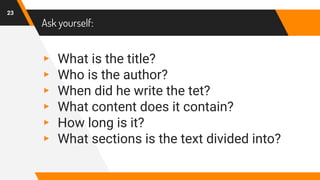
Ask yourself:
▸ Whatis the title?
▸ Who is the author?
▸ When did he write the tet?
▸ What content does it contain?
▸ How long is it?
▸ What sections is the text divided into?
23
Based on allyour knowledge of the book and subject
Come up with a proposed
Main Idea, Point, Argument, or
Theme of the text.
27
28.
28
This proposed Overall
Pieceof information will be the umbrella under which you
try to fit every other piece of information you learn while
reading it.
29.
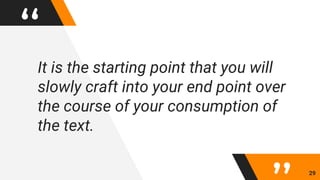
“It is thestarting point that you will
slowly craft into your end point over
the course of your consumption of
the text.
29
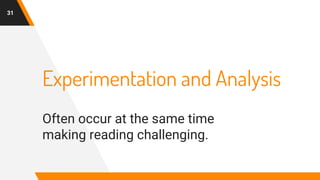
When reading, youare collecting data and analyzing it at the same time
32
33.
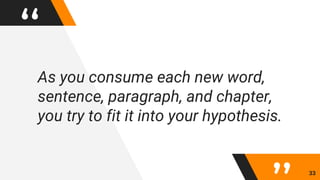
“As you consumeeach new word,
sentence, paragraph, and chapter,
you try to fit it into your hypothesis.
33
34.
34
If you canexplain
How it fits into your hypothesis, you can move one.
If not, you must change your hypothesis or create a new
one.
35.
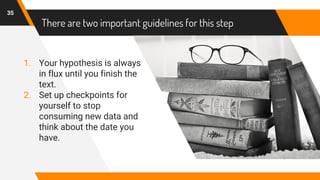
There are twoimportant guidelines for this step
1. Your hypothesis is always
in flux until you finish the
text.
2. Set up checkpoints for
yourself to stop
consuming new data and
think about the date you
have.
35
36.
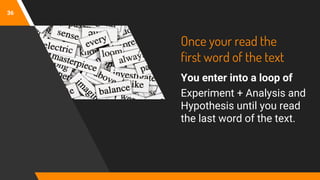
Once your readthe
first word of the text
You enter into a loop of
Experiment + Analysis and
Hypothesis until you read
the last word of the text.
36
Credits
Special thanks toall the people who made and
released these awesome resources for free:
▸ Presentation template by SlidesCarnival
▸ Photographs by Startupstockphotos
44