J U L Y 1 5 2 0 1 3
A C A D E M I C W R I T I N G W 9
P L E A S E R E A D A N D L I S T E N A L O N G T O T H E A U D I O
D U R I N G T H I S P R E S E N T A T I O N . N O T E T H A T N O T
A L L S L I D E S H A V E A U D I O . T H E O N E S W I T H A U D I O
H A V E A S M A L L Y E L L O W S P E A K E R O N T H E B O T T O M
R I G H T C O R N E R . Y O U C A N C L I C K O N T H E I C O N T O
H E A R M Y R E C O R D I N G , B U T I T S H O U L D
A U T O M A T I C A L L Y S T A R T I N A P R E S E N T A T I O N
Active reading, summarizing,
paraphrasing, and Paper 1
Before summary & analysis: Active Reading
 Reading is not a passive activity- it requires
everyone to think, make connections, infer, and
draw conclusions
 Some texts require more time and energy from us
 It takes a while to digest them!
 It is not always the goal to understand a text 100%
 Sometimes understanding the main idea, specific
examples, and implications is enough
Guidelines for active reading
 Break down the reading process into four steps:
1. Get the basics: features and structure
2. Mark details that surprise, confuse or interest you
3. Read everything, again
4. Dissect the visual aides. They are there for a reason
1. Getting the basics
 What kind of text am I reading?
 Essay, fiction, editorial
 Argumentative essay, expository essay
 Why did the author write this?
 To inform me or persuade me?
 Who is this intended for?
 Is this for a college student or a employee?
 What is the author’s thesis?
 What is this text going to explain?
 What evidence does the author give me to support
his/her thesis?
 Is s/he giving me numbers, facts, or anecdotes?
2. Mark details: Engage the text
 Write in the margins, highlight, underline, take a
screen shot, or star:
 Sentences that are confusing, interesting, or
questionable
 Parts of the reading you don’t understand and need to
re-read
 Make note of any contradictory evidence or ideas
the author gives
 Always refer the ideas, examples and statements to
your own life. Do you agree or disagree?
3. Read and re-read
 It may sound tedious, but often in order to
understand dense material you MUST re-read it
 Often when we re-read a text, we notice a
sentence or idea that we had not noticed before
 There are also techniques on how to skim
through a text, looking for key words and ideas
4. Dissect the visual aides
 Photos, graphs, and diagrams are all intentionally
put next to a text
 Use the visuals to your advantage: Find out how they help
your understanding of the text
 Try to think about what first strikes you when you
see the image
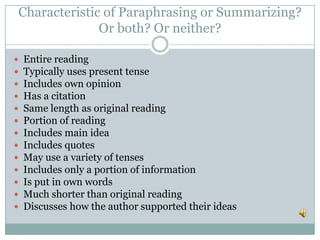
Characteristic of Paraphrasing or Summarizing?
Or both? Or neither?
 Entire reading
 Typically uses present tense
 Includes own opinion
 Has a citation
 Same length as original reading
 Portion of reading
 Includes main idea
 Includes quotes
 May use a variety of tenses
 Includes only a portion of information
 Is put in own words
 Much shorter than original reading
 Discusses how the author supported their ideas
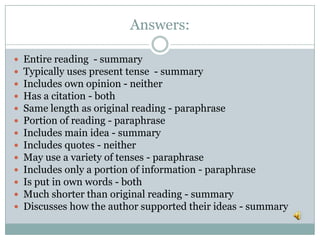
Answers:
 Entire reading - summary
 Typically uses present tense - summary
 Includes own opinion - neither
 Has a citation - both
 Same length as original reading - paraphrase
 Portion of reading - paraphrase
 Includes main idea - summary
 Includes quotes - neither
 May use a variety of tenses - paraphrase
 Includes only a portion of information - paraphrase
 Is put in own words - both
 Much shorter than original reading - summary
 Discusses how the author supported their ideas - summary
Summaries and summarizing
 What is a summary?
 Generally speaking, it is brief an account that explains
something:
 a speech, a report, or an article
 Specifically, it is a brief, clear statement of a work’s
main ideas and key points
 Why do we write summaries?
 Many reasons
 For others: Teachers, bosses, peers, friends
 To check our own comprehension
 To prove our understanding of a text
Components of a good summary
 Content:
 Main ideas
 Examples/points
 Title and author of the summarized text
 Length:
 Usually 1 paragraph or 7-10 sentences
 The longer the text, the longer the summary
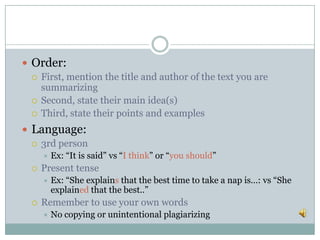
 Order:
 First, mention the title and author of the text you are
summarizing
 Second, state their main idea(s)
 Third, state their points and examples
 Language:
 3rd person
 Ex: “It is said” vs “I think” or “you should”
 Present tense
 Ex: “She explains that the best time to take a nap is…: vs “She
explained that the best..”
 Remember to use your own words
 No copying or unintentional plagiarizing
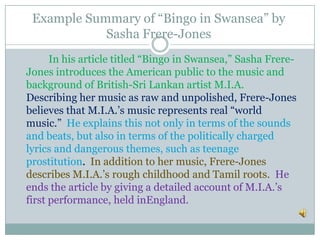
Example Summary of “Bingo in Swansea” by
Sasha Frere-Jones
In his article titled “Bingo in Swansea,” Sasha Frere-
Jones introduces the American public to the music and
background of British-Sri Lankan artist M.I.A.
Describing her music as raw and unpolished, Frere-Jones
believes that M.I.A.’s music represents real “world
music.” He explains this not only in terms of the sounds
and beats, but also in terms of the politically charged
lyrics and dangerous themes, such as teenage
prostitution. In addition to her music, Frere-Jones
describes M.I.A.’s rough childhood and Tamil roots. He
ends the article by giving a detailed account of M.I.A.’s
first performance, held inEngland.
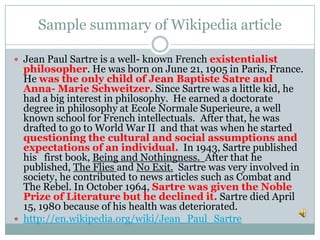
Sample summary of Wikipedia article
 Jean Paul Sartre is a well- known French existentialist
philosopher. He was born on June 21, 1905 in Paris, France.
He was the only child of Jean Baptiste Satre and
Anna- Marie Schweitzer. Since Sartre was a little kid, he
had a big interest in philosophy. He earned a doctorate
degree in philosophy at Ecole Normale Superieure, a well
known school for French intellectuals. After that, he was
drafted to go to World War II and that was when he started
questioning the cultural and social assumptions and
expectations of an individual. In 1943, Sartre published
his first book, Being and Nothingness. After that he
published, The Flies and No Exit. Sartre was very involved in
society, he contributed to news articles such as Combat and
The Rebel. In October 1964, Sartre was given the Noble
Prize of Literature but he declined it. Sartre died April
15, 1980 because of his health was deteriorated.
 http://en.wikipedia.org/wiki/Jean_Paul_Sartre
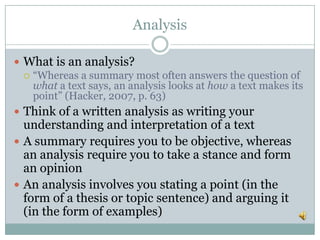
Analysis
 What is an analysis?
 “Whereas a summary most often answers the question of
what a text says, an analysis looks at how a text makes its
point” (Hacker, 2007, p. 63)
 Think of a written analysis as writing your
understanding and interpretation of a text
 A summary requires you to be objective, whereas
an analysis require you to take a stance and form
an opinion
 An analysis involves you stating a point (in the
form of a thesis or topic sentence) and arguing it
(in the form of examples)
Some questions to ask when analyzing a text
 What is the author’s thesis?
 Who is the audience?
 How does the author structure the text?
 What evidence does the author use to support the
thesis?
 Is the evidence credible?
 Where are his/her sources from?
 Does the author give faulty reasoning?
 Are the ideas plausible?
Did that sound familiar?
 Reading and analyzing go hand in hand
 In fact, these two actions often blend one into the
other
 You can’t really do one without the other
Quick Quiz: Main Ideas of .ppt
 What were the three main concepts of this
presentation?
 How do they relate to one another?
 What are the characteristics of each?
 How will you apply this to your writing?
Paper 1
 Paper 1 will be a summary and analysis of the main
ideas and concepts in the article on Desirable
Difficulties
 Follow guidelines from this .ppt and Writer’s Help
 Write a paragraph or two in which you summarize
the article
 Write a paragraph or two in which you offer up your
analysis of the ideas of Desirable Difficulties and
your opinion on how credible they sound based on
the evidence given by the author
 1.5-2 pages in length
 About 1/3 summary and 2/3 analysis
 Times New Roman
 12 point font
 Double spaced
 One inch margins
 Informative, descriptive title
 Clear distinction between summary and analysis/opinion
 Detailed examples to support claims in analysis
 Smooth transition from summary to analysis
Paper 1 Continue
 Go to bspace.berkeley,edu and click on the
Assignments tab
 Find the assignment for Paper 1 and read more
directions there carefully
 If you have questions, post them on the Forum
rather than email me
 When you have completed a draft, upload it under
Assignments
 Needs to be a .doc or .docx
What next?

7 15 presentation_summary_paraphrase_paper1

  • 1.
    J U LY 1 5 2 0 1 3 A C A D E M I C W R I T I N G W 9 P L E A S E R E A D A N D L I S T E N A L O N G T O T H E A U D I O D U R I N G T H I S P R E S E N T A T I O N . N O T E T H A T N O T A L L S L I D E S H A V E A U D I O . T H E O N E S W I T H A U D I O H A V E A S M A L L Y E L L O W S P E A K E R O N T H E B O T T O M R I G H T C O R N E R . Y O U C A N C L I C K O N T H E I C O N T O H E A R M Y R E C O R D I N G , B U T I T S H O U L D A U T O M A T I C A L L Y S T A R T I N A P R E S E N T A T I O N Active reading, summarizing, paraphrasing, and Paper 1
  • 2.
    Before summary &analysis: Active Reading  Reading is not a passive activity- it requires everyone to think, make connections, infer, and draw conclusions  Some texts require more time and energy from us  It takes a while to digest them!  It is not always the goal to understand a text 100%  Sometimes understanding the main idea, specific examples, and implications is enough
  • 3.
    Guidelines for activereading  Break down the reading process into four steps: 1. Get the basics: features and structure 2. Mark details that surprise, confuse or interest you 3. Read everything, again 4. Dissect the visual aides. They are there for a reason
  • 4.
    1. Getting thebasics  What kind of text am I reading?  Essay, fiction, editorial  Argumentative essay, expository essay  Why did the author write this?  To inform me or persuade me?  Who is this intended for?  Is this for a college student or a employee?  What is the author’s thesis?  What is this text going to explain?  What evidence does the author give me to support his/her thesis?  Is s/he giving me numbers, facts, or anecdotes?
  • 5.
    2. Mark details:Engage the text  Write in the margins, highlight, underline, take a screen shot, or star:  Sentences that are confusing, interesting, or questionable  Parts of the reading you don’t understand and need to re-read  Make note of any contradictory evidence or ideas the author gives  Always refer the ideas, examples and statements to your own life. Do you agree or disagree?
  • 6.
    3. Read andre-read  It may sound tedious, but often in order to understand dense material you MUST re-read it  Often when we re-read a text, we notice a sentence or idea that we had not noticed before  There are also techniques on how to skim through a text, looking for key words and ideas
  • 7.
    4. Dissect thevisual aides  Photos, graphs, and diagrams are all intentionally put next to a text  Use the visuals to your advantage: Find out how they help your understanding of the text  Try to think about what first strikes you when you see the image
  • 8.
    Characteristic of Paraphrasingor Summarizing? Or both? Or neither?  Entire reading  Typically uses present tense  Includes own opinion  Has a citation  Same length as original reading  Portion of reading  Includes main idea  Includes quotes  May use a variety of tenses  Includes only a portion of information  Is put in own words  Much shorter than original reading  Discusses how the author supported their ideas
  • 9.
    Answers:  Entire reading- summary  Typically uses present tense - summary  Includes own opinion - neither  Has a citation - both  Same length as original reading - paraphrase  Portion of reading - paraphrase  Includes main idea - summary  Includes quotes - neither  May use a variety of tenses - paraphrase  Includes only a portion of information - paraphrase  Is put in own words - both  Much shorter than original reading - summary  Discusses how the author supported their ideas - summary
  • 10.
    Summaries and summarizing What is a summary?  Generally speaking, it is brief an account that explains something:  a speech, a report, or an article  Specifically, it is a brief, clear statement of a work’s main ideas and key points  Why do we write summaries?  Many reasons  For others: Teachers, bosses, peers, friends  To check our own comprehension  To prove our understanding of a text
  • 11.
    Components of agood summary  Content:  Main ideas  Examples/points  Title and author of the summarized text  Length:  Usually 1 paragraph or 7-10 sentences  The longer the text, the longer the summary
  • 12.
     Order:  First,mention the title and author of the text you are summarizing  Second, state their main idea(s)  Third, state their points and examples  Language:  3rd person  Ex: “It is said” vs “I think” or “you should”  Present tense  Ex: “She explains that the best time to take a nap is…: vs “She explained that the best..”  Remember to use your own words  No copying or unintentional plagiarizing
  • 13.
    Example Summary of“Bingo in Swansea” by Sasha Frere-Jones In his article titled “Bingo in Swansea,” Sasha Frere- Jones introduces the American public to the music and background of British-Sri Lankan artist M.I.A. Describing her music as raw and unpolished, Frere-Jones believes that M.I.A.’s music represents real “world music.” He explains this not only in terms of the sounds and beats, but also in terms of the politically charged lyrics and dangerous themes, such as teenage prostitution. In addition to her music, Frere-Jones describes M.I.A.’s rough childhood and Tamil roots. He ends the article by giving a detailed account of M.I.A.’s first performance, held inEngland.
  • 14.
    Sample summary ofWikipedia article  Jean Paul Sartre is a well- known French existentialist philosopher. He was born on June 21, 1905 in Paris, France. He was the only child of Jean Baptiste Satre and Anna- Marie Schweitzer. Since Sartre was a little kid, he had a big interest in philosophy. He earned a doctorate degree in philosophy at Ecole Normale Superieure, a well known school for French intellectuals. After that, he was drafted to go to World War II and that was when he started questioning the cultural and social assumptions and expectations of an individual. In 1943, Sartre published his first book, Being and Nothingness. After that he published, The Flies and No Exit. Sartre was very involved in society, he contributed to news articles such as Combat and The Rebel. In October 1964, Sartre was given the Noble Prize of Literature but he declined it. Sartre died April 15, 1980 because of his health was deteriorated.  http://en.wikipedia.org/wiki/Jean_Paul_Sartre
  • 15.
    Analysis  What isan analysis?  “Whereas a summary most often answers the question of what a text says, an analysis looks at how a text makes its point” (Hacker, 2007, p. 63)  Think of a written analysis as writing your understanding and interpretation of a text  A summary requires you to be objective, whereas an analysis require you to take a stance and form an opinion  An analysis involves you stating a point (in the form of a thesis or topic sentence) and arguing it (in the form of examples)
  • 16.
    Some questions toask when analyzing a text  What is the author’s thesis?  Who is the audience?  How does the author structure the text?  What evidence does the author use to support the thesis?  Is the evidence credible?  Where are his/her sources from?  Does the author give faulty reasoning?  Are the ideas plausible?
  • 17.
    Did that soundfamiliar?  Reading and analyzing go hand in hand  In fact, these two actions often blend one into the other  You can’t really do one without the other
  • 18.
    Quick Quiz: MainIdeas of .ppt  What were the three main concepts of this presentation?  How do they relate to one another?  What are the characteristics of each?  How will you apply this to your writing?
  • 19.
    Paper 1  Paper1 will be a summary and analysis of the main ideas and concepts in the article on Desirable Difficulties  Follow guidelines from this .ppt and Writer’s Help  Write a paragraph or two in which you summarize the article  Write a paragraph or two in which you offer up your analysis of the ideas of Desirable Difficulties and your opinion on how credible they sound based on the evidence given by the author
  • 20.
     1.5-2 pagesin length  About 1/3 summary and 2/3 analysis  Times New Roman  12 point font  Double spaced  One inch margins  Informative, descriptive title  Clear distinction between summary and analysis/opinion  Detailed examples to support claims in analysis  Smooth transition from summary to analysis
  • 21.
    Paper 1 Continue Go to bspace.berkeley,edu and click on the Assignments tab  Find the assignment for Paper 1 and read more directions there carefully  If you have questions, post them on the Forum rather than email me  When you have completed a draft, upload it under Assignments  Needs to be a .doc or .docx
  • 22.