How To
Annotate -
Close Reading
Close
Reading
Is the process of slowing
down and think about what
we are reading.
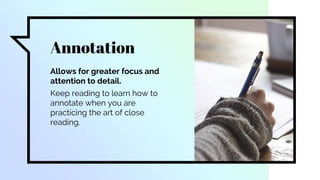
Annotation
Allows for greater focus and
attention to detail.
Keep reading to learn how to
annotate when you are
practicing the art of close
reading.
1.
Comprehension of
Key Ideas and Details
Unfamiliar Vocabulary
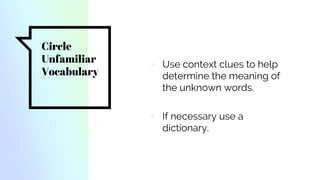
Circle
Unfamiliar
Vocabulary
▫ Use context clues to help
determine the meaning of
the unknown words.
▫ If necessary use a
dictionary.
Main Ideas
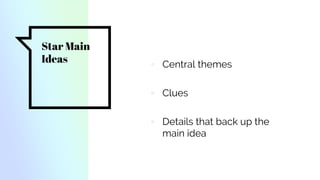
Star Main
Ideas ▫ Central themes
▫ Clues
▫ Details that back up the
main idea
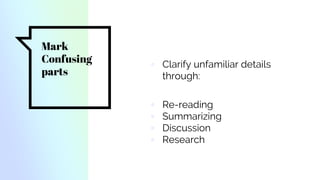
Confusing Parts
Mark
Confusing
parts
▫ Clarify unfamiliar details
through:
▫ Re-reading
▫ Summarizing
▫ Discussion
▫ Research
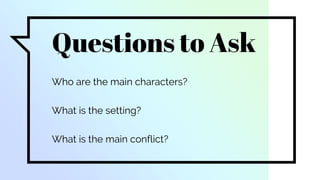
Questions to Ask
Who are the main characters?
What is the setting?
What is the main conflict?
2.
Cra t and Structure
Repeated Themes or Ideas
Bracket
Repeated
Themes or
Ideas
▫ Think about:
▫ Genre of the works
▫ Use of language
▫ Lesson or morals
Character or Author’s
Feelings
Note
Character
or Author’s
Feelings
▫ For fiction, take note of
how the author uses
dialogue, descriptions, or
things the character says
or does to develop
character.
▫ For non-fiction, pay
attention to how the
author talks about the
subject to determine his
or her feelings about the
topic.
Narrator’s Point of View
Annotate
the
Narrator’s
Point of
View
▫ Determine how the point
of view contributes to the
story.
Questions to Ask
Why do characters behave as they do?
How do their actions advance the plot?
How does the author’s word choice affect the
story’s tone?
3.
Integrate your
Knowledge
Connections
Highlight
Connections ▫ Compare and contrast
this work with:
▫ Other works you have
read
▫ Information you already
know
▫ Ways in which you can
relate to the story
Deeper Meaning
Underline
The Deeper
Meaning
▫ Find the important:
▫ Images
▫ Symbols
Effective Writing
Identify
Effective
Writing
▫ Look for:
▫ Literary devices
▫ Figurative language
▫ Powerful sentences
Questions to Ask
How has this work increased my knowledge of
the subject or author?
What is surprising about the story’s outcome?
What did I appreciate about the author’s style?
“Make your annotation
system your own - use
colored pens,
highlighters, or symbols
to annotate the previous
list of items.
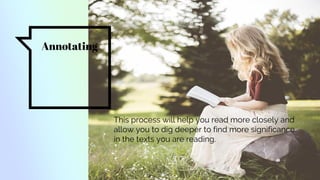
Annotating
This process will help you read more closely and
allow you to dig deeper to find more significance
in the texts you are reading.
Thanks!
Ready to sign up for tutoring?
Call Oxford Tutoring at
(949) 681-0388.
Or visit us online at
oxfordtutoring.com.
Credits
Special thanks to all the
people who made and
released these awesome
resources for free:
▫ Presentation template
by SlidesCarnival
▫ Photographs by
Unsplash

How to Annotate - Close Reading