Insights to Literacy Savvy
Strategies
Strategies to prove that you understand every word that
you read
Dr. Malini Ganapathy
School of Languages, Literacies & Translation
Universiti Sains Malaysia
We lead
Workshop Objectives
 To improve your reading comprehension
skills.
 To offer you a reading strategy.
 To improve your critical thinking skills and
contextual reading (reasoning).
 To help you understand the importance of
defining key terms when you read.
We lead
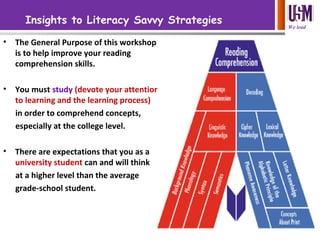
• The General Purpose of this workshop
is to help improve your reading
comprehension skills.
• You must study (devote your attention
to learning and the learning process)
in order to comprehend concepts,
especially at the college level.
• There are expectations that you as a
university student can and will think
at a higher level than the average
grade-school student.
Insights to Literacy Savvy Strategies
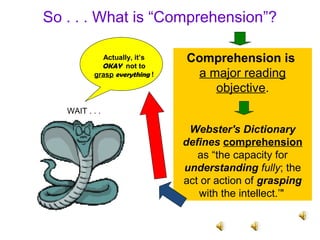
So . . . What is “Comprehension”?
Comprehension is
a major reading
objective.
Webster's Dictionary
defines comprehension
as “the capacity for
understanding fully; the
act or action of grasping
with the intellect.’"
Actually, it’s
OKAY not to
grasp everything !
WAIT . . .
We lead
Do you have to define every word to prove you
understand?
• No. Understanding every word you read does not require that you define every
word.
• If you tried to define every word, you would get bogged down in far too many
details and never completely read anything. You might give up in frustration.
• Understanding what you read requires you to think as a wise reader.
• A wise reader is someone who can make sensible, balanced judgments and
appropriately manage information as a resource (without wasting or under utilizing
information).
Example of information wasting/ overuse:
-- Citing long quotes instead of paraphrasing.
-- Presenting logical fallacies as if they are proven evidence.
• A wise reader is a critical reader – one able to apply critical thinking abilities: (1)
analysis (compartmentalize), (2) synthesis (innovate), and (2) evaluation (judge or
assess)
We lead
Defining key terms is critical to building
comprehension.
Key terms for this
presentation are:
1. Close Reading
2. University Reader
3. Key Terms
4. Contextual Reading
5. Critical Thinking
We leadClose Reading (Key Term 1)
• Close Reading is formal reading that requires more than just identifying
words correctly. The reader must also be able to respond critically to
the text.
• Close reading is concerned with what the language denotes (expresses
outright) and also what it connotes (implies based on how the writer
uses or presents information to readers).
So, when close reading, ask yourself these questions:
Is there dialogue or description presented? Is the tone humorous or
serious? Is the style unique or have you seen other writers use that
style? Is the language vague or straight to the point?
• Close reading does not require the reader to consider historical
background or an author’s writing motivations before reading.
We lead
Close Reading (cont.)
Close reading thus involves paying attention to . . .
 Patterns – occurrences that repeat or follow a sequence
 Polarities – conditions or situations that create opposition / differences
 Problems – difficult situations, matters or people; need for resolution.
 Puzzles – difficulties or mysteries that require work or effort to solve or
energy to make less complicated or manageable.
 Paradigms – changing courses of action or shifts in thought
 * Perception – application of senses (using the mind to process
information) * Thinking, Feeling, acknowledging, gaining
awareness *
We leadRemember: Close reading involves
perception.
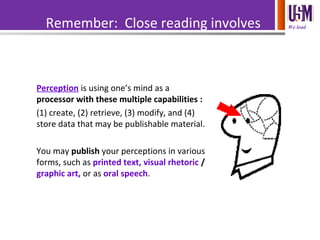
Perception is using one’s mind as a
processor with these multiple capabilities :
(1) create, (2) retrieve, (3) modify, and (4)
store data that may be publishable material.
You may publish your perceptions in various
forms, such as printed text, visual rhetoric /
graphic art, or as oral speech.
We lead
What is a “University Reader?”
(Key Term 2)
Quite possibly, you are a university reader, if you a
university student meeting one or more of these criteria (guidelines):
 You are a university student who enjoys reading.
 You are a subscriber: someone who contracts to receive and pay for a service or a certain
number of issues of a publication
 You are a person who can read; a literate person
 You are a reviewer: someone who reads manuscripts and judges their suitability for
publication
 You are a proofreader: someone who reads in order to find errors and mark corrections for
revision.
 You lecture: a public lecturer at certain universities
 You are one who writes, edits or publishes perceptions for others to read.
Source: http://www.google.com/search?hl=en&rlz=1T4GGIC_enUS225US225&defl=en&q=define:reader&sa=X&oi=glossary_definition&ct=title
We leadWhat are key terms?
(Key Term 3)• Key Terms are words that hint or indicate the focus of a speaker or writer.
• Key terms may also be referred to as a cue.
• A cue word should alert the mind to think in a particular direction.
• Cues have a predictive function in that they help the mind or heart anticipate
an outcome or expectation, as well as an approaching conflict or possible
resolution.
• The ability to spot cues makes you a powerful reader and writer.
It proves you are vigilant (observant, discerning, astute).
We lead
What is Contextual Reading?
(Key Term 4)
• Contextual Reading is reading in such a way that proves you have good
sensory discernment skills and the ability to read between the lines, as well
as separate facts from opinions.
• A contextual reader searches for a balanced truth, even in works of fiction or
poetry.
• An effective contextual reader displays detection skills, seeing flaws as well as
demonstrations of excellence in writing.
(Example of a notable flaw: weak character development)
(Example of notable excellence: Transitional flow of the language)
• An effective contextual reader with good sensory skills is one who looks for
what is plausible (believable or reasonable) within the text and recognizes
gaps in logic.
We lead
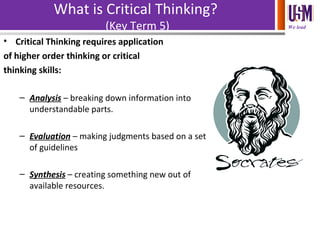
What is Critical Thinking?
(Key Term 5)
• Critical Thinking requires application
of higher order thinking or critical
thinking skills:
– Analysis – breaking down information into
understandable parts.
– Evaluation – making judgments based on a set
of guidelines
– Synthesis – creating something new out of
available resources.
We lead
How to Improve Critical Thinking & Reading
Skill
1. Learn to Identify Themes such as:
Family and Community
Coming of Age (Rites of Passage)
Politics and Society
Class and Society
Race and Society
Gender and Society
Culture and Myths
Love and Loss
Ethics and Value Systems
Life and Death
We lead
How to Improve Critical Thinking & Reading
Skill
2. Learn to Identify Common Rhetorical
Strategies that Writers Use, such as:
Narration (Storytelling; biography; autobiography)
Description (Observation and detailed expository writing)
Cause and Effect
Definition (Expounding, Exemplifying)
Persuasion (Argument or Rhetoric)
Process Analysis
Comparison/Contrast
Source:
Cain, K., Neulib, J., Ruffus, S., and Sharton, M. The Mercury Reader. Needhaam Heights, MA: Pearson, 2000.
We lead
How to Improve Critical Thinking & Reading
Skill
3. Study reading theories and perspectives such as:
• Michael Foucault * Deconstruction -- Foucault believed that whether we are aware of it or not,
literature is a reflection of the writers feelings and or even “hidden assumptions” about the world
during the time in which the literature is written.
• Feminist *Focuses on writing to evoke change in the perception of and way of life of women. (Feminist
theorist Helene Cixous)
• Karl Marx *– Marx believed that day-to-day occurrences in life impacted writers and publications.
People, therefore, write about what concerns them.
• New Historicism is the belief that there is not much difference between literature and history. It thus
focuses on the ideologies expressed in the text, such as, for example the expression of Marxist ideals in
the text.
Source: Cain, K., Neulib, J., Ruffus, S., and Sharton, M. The Mercury Reader. Needhaam Heights, MA: Pearson, 2000.
We lead
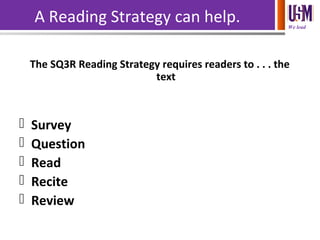
A Reading Strategy can help.
The SQ3R Reading Strategy requires readers to . . . the
text
 Survey
 Question
 Read
 Recite
 Review
We lead
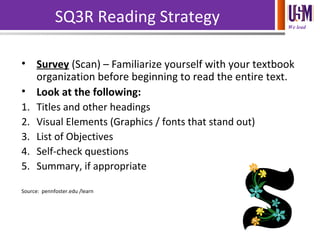
SQ3R Reading Strategy
• Survey (Scan) – Familiarize yourself with your textbook
organization before beginning to read the entire text.
• Look at the following:
1. Titles and other headings
2. Visual Elements (Graphics / fonts that stand out)
3. List of Objectives
4. Self-check questions
5. Summary, if appropriate
Source: pennfoster.edu /learn
We lead
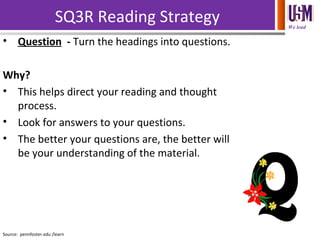
SQ3R Reading Strategy
• Question - Turn the headings into questions.
Why?
• This helps direct your reading and thought
process.
• Look for answers to your questions.
• The better your questions are, the better will
be your understanding of the material.
Source: pennfoster.edu /learn
We lead
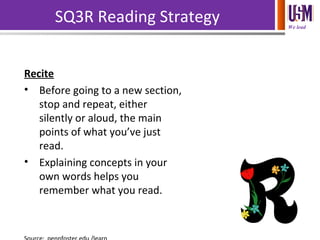
SQ3R Reading Strategy
Recite
• Before going to a new section,
stop and repeat, either
silently or aloud, the main
points of what you’ve just
read.
• Explaining concepts in your
own words helps you
remember what you read.
We lead
SQ3R Reading Strategy
• Read
• Begin to read the material slowly and
carefully, one section at a time.
• Use a highlighter or a ballpoint pen to
mark important points.
• Highlight (or underline) only important
words/ phrases; avoid marking entire
sentences.
Source: pennfoster.edu /learn
We lead
SQ3R Reading Strategy
Review what you have read as soon as
possible.
• Resurvey what you’ve read.
• Go over the notes you’ve written.
• Reread complicated or underlined/
highlighted passages.
Source: pennfoster.edu /learn
We leadWriting supports or proves
Reading Comprehension.• Explicate: Present detailed comments that reflect your
understanding of what you have read. Discuss the organization,
language presentation, and other elements of the writing. This
proves you have thought about and understand what you have
read.
• Journalize: Read and respond in writing to what you have read.
Write about how what you read makes you feel. Write
subjectively. This may prove you understand or can apply what
you have read.
• Critical Review: assesses the value of what you have read and
may prove that you understand what you read.
We leadUse A Dictionary
Why? To help you understand
what you read; It is a valuable study tool.
• Use a dictionary correctly.
• Survey it. Become familiar with what it has to offer you.
• Most dictionaries include the following information for each word:
1. Pronunciation
2. Part of speech
3. The etymology (Word’s history)
4. Origin date (date when the word first appeared in English)
5. Definition
6. Synonyms
7. Examples (sentences)
We lead
PRACTICE QUIZ
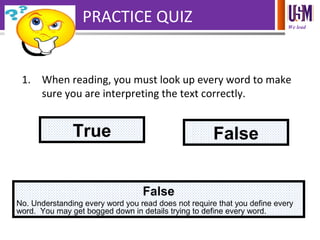
1. When reading, you must look up every word to make
sure you are interpreting the text correctly.
True False
False
No. Understanding every word you read does not require that you define every
word. You may get bogged down in details trying to define every word.
We lead
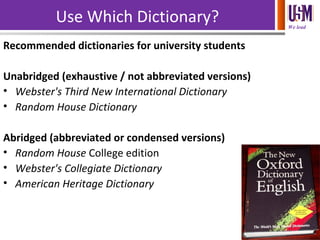
Use Which Dictionary?
Recommended dictionaries for university students
Unabridged (exhaustive / not abbreviated versions)
• Webster's Third New International Dictionary
• Random House Dictionary
Abridged (abbreviated or condensed versions)
• Random House College edition
• Webster's Collegiate Dictionary
• American Heritage Dictionary
We lead
PRACTICE QUIZ
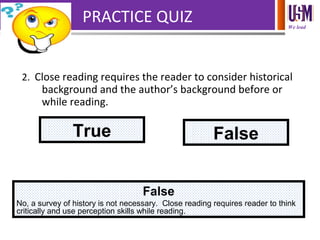
2. Close reading requires the reader to consider historical
background and the author’s background before or
while reading.
True False
False
No, a survey of history is not necessary. Close reading requires reader to think
critically and use perception skills while reading.
We lead
PRACTICE QUIZ
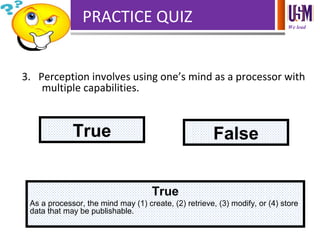
3. Perception involves using one’s mind as a processor with
multiple capabilities.
True False
True
As a processor, the mind may (1) create, (2) retrieve, (3) modify, or (4) store
data that may be publishable.
We lead
PRACTICE QUIZ
4. You may be a college reader if you are one who writes,
edits or publishes perceptions for others to read.
True False
True
We lead
PRACTICE QUIZ
5. Key terms can help readers predict outcomes or
expectations.
True False
True
Key terms or cue words can help readers anticipate conflicts and resolutions.
We lead
PRACTICE QUIZ
6. A vigilant reader pays attention to cues.
True False
True
A vigilant reader is observant, astute and discerning enough to pick up cues
when reading.
We lead
PRACTICE QUIZ
7. Context reading requires readers to (1) look for a balanced truth,
(2) read between the lines when necessary, and (3) find ways to
add their own ideas into what others have written.
True False
False
No. Context reading has as its goal seeking the balanced truth, not
trying to infuse one’s own ideas into other authors’ writings.
Quiz within a Quiz Question: What do you think the word “infuse”
means, based on context clues in the sentence?
Quiz within a Quiz Answer: To Add or include
We lead
PRACTICE QUIZ
8. Narration is a common rhetorical strategy that writers
use to draw readers’ attention.
True False
True
Writers use various rhetorical strategies to attract readers. Learning these
strategies helps with reading comprehension.
We lead
PRACTICE QUIZ
9. An abridged dictionary provides readers with an
uncondensed, exhaustive amount of information on
every word in the English language.
True False
False
An abridged dictionary is shortened or condensed and may have selected
information on selected words.
We lead
PRACTICE QUIZ
10. Writing can support or reflect reading comprehension.
True False
True
Writing journal entries, explications and reviews of literature can improve or
prove reading comprehension. Conversely, what you write can also indicate that
you do not understand what you have read.
We leadBonus Question
Read the following passage:
Writing journal entries, explications and reviews of literature can
often improve or support a university reader’s reading
comprehension skills. Conversely, what a university reader writes
and publishes may indicate that the reader does not truly
understand what he or she has written. Therefore, a confused
university reader may need to use a reading strategy such as the
SQ3R method, or a reader may simply need to read the text again,
underline key terms, and use a dictionary to locate definitions to
underlined terms. Once the reader understands the meanings of
key terms, he or she may choose to write and publish new journal
entries, explications and reviews that prove that the university
reader comprehends the text and wants to share his or her
comprehension with other readers.
(1) Based on your contextual reading of the above statements, what key terms would you
choose to underline in the passage?
(2) Also, define the word conversely based on your contextual reading of the passage.
We lead
The END
• Thank you for your attention.
• Have a great day and a great learning experience here at
University Sains Malaysia.

Reading workshop

  • 1.
    Insights to LiteracySavvy Strategies Strategies to prove that you understand every word that you read Dr. Malini Ganapathy School of Languages, Literacies & Translation Universiti Sains Malaysia
  • 2.
    We lead Workshop Objectives To improve your reading comprehension skills.  To offer you a reading strategy.  To improve your critical thinking skills and contextual reading (reasoning).  To help you understand the importance of defining key terms when you read.
  • 3.
    We lead • TheGeneral Purpose of this workshop is to help improve your reading comprehension skills. • You must study (devote your attention to learning and the learning process) in order to comprehend concepts, especially at the college level. • There are expectations that you as a university student can and will think at a higher level than the average grade-school student. Insights to Literacy Savvy Strategies
  • 4.
    So . .. What is “Comprehension”? Comprehension is a major reading objective. Webster's Dictionary defines comprehension as “the capacity for understanding fully; the act or action of grasping with the intellect.’" Actually, it’s OKAY not to grasp everything ! WAIT . . .
  • 5.
    We lead Do youhave to define every word to prove you understand? • No. Understanding every word you read does not require that you define every word. • If you tried to define every word, you would get bogged down in far too many details and never completely read anything. You might give up in frustration. • Understanding what you read requires you to think as a wise reader. • A wise reader is someone who can make sensible, balanced judgments and appropriately manage information as a resource (without wasting or under utilizing information). Example of information wasting/ overuse: -- Citing long quotes instead of paraphrasing. -- Presenting logical fallacies as if they are proven evidence. • A wise reader is a critical reader – one able to apply critical thinking abilities: (1) analysis (compartmentalize), (2) synthesis (innovate), and (2) evaluation (judge or assess)
  • 6.
    We lead Defining keyterms is critical to building comprehension. Key terms for this presentation are: 1. Close Reading 2. University Reader 3. Key Terms 4. Contextual Reading 5. Critical Thinking
  • 7.
    We leadClose Reading(Key Term 1) • Close Reading is formal reading that requires more than just identifying words correctly. The reader must also be able to respond critically to the text. • Close reading is concerned with what the language denotes (expresses outright) and also what it connotes (implies based on how the writer uses or presents information to readers). So, when close reading, ask yourself these questions: Is there dialogue or description presented? Is the tone humorous or serious? Is the style unique or have you seen other writers use that style? Is the language vague or straight to the point? • Close reading does not require the reader to consider historical background or an author’s writing motivations before reading.
  • 8.
    We lead Close Reading(cont.) Close reading thus involves paying attention to . . .  Patterns – occurrences that repeat or follow a sequence  Polarities – conditions or situations that create opposition / differences  Problems – difficult situations, matters or people; need for resolution.  Puzzles – difficulties or mysteries that require work or effort to solve or energy to make less complicated or manageable.  Paradigms – changing courses of action or shifts in thought  * Perception – application of senses (using the mind to process information) * Thinking, Feeling, acknowledging, gaining awareness *
  • 9.
    We leadRemember: Closereading involves perception. Perception is using one’s mind as a processor with these multiple capabilities : (1) create, (2) retrieve, (3) modify, and (4) store data that may be publishable material. You may publish your perceptions in various forms, such as printed text, visual rhetoric / graphic art, or as oral speech.
  • 10.
    We lead What isa “University Reader?” (Key Term 2) Quite possibly, you are a university reader, if you a university student meeting one or more of these criteria (guidelines):  You are a university student who enjoys reading.  You are a subscriber: someone who contracts to receive and pay for a service or a certain number of issues of a publication  You are a person who can read; a literate person  You are a reviewer: someone who reads manuscripts and judges their suitability for publication  You are a proofreader: someone who reads in order to find errors and mark corrections for revision.  You lecture: a public lecturer at certain universities  You are one who writes, edits or publishes perceptions for others to read. Source: http://www.google.com/search?hl=en&rlz=1T4GGIC_enUS225US225&defl=en&q=define:reader&sa=X&oi=glossary_definition&ct=title
  • 11.
    We leadWhat arekey terms? (Key Term 3)• Key Terms are words that hint or indicate the focus of a speaker or writer. • Key terms may also be referred to as a cue. • A cue word should alert the mind to think in a particular direction. • Cues have a predictive function in that they help the mind or heart anticipate an outcome or expectation, as well as an approaching conflict or possible resolution. • The ability to spot cues makes you a powerful reader and writer. It proves you are vigilant (observant, discerning, astute).
  • 12.
    We lead What isContextual Reading? (Key Term 4) • Contextual Reading is reading in such a way that proves you have good sensory discernment skills and the ability to read between the lines, as well as separate facts from opinions. • A contextual reader searches for a balanced truth, even in works of fiction or poetry. • An effective contextual reader displays detection skills, seeing flaws as well as demonstrations of excellence in writing. (Example of a notable flaw: weak character development) (Example of notable excellence: Transitional flow of the language) • An effective contextual reader with good sensory skills is one who looks for what is plausible (believable or reasonable) within the text and recognizes gaps in logic.
  • 13.
    We lead What isCritical Thinking? (Key Term 5) • Critical Thinking requires application of higher order thinking or critical thinking skills: – Analysis – breaking down information into understandable parts. – Evaluation – making judgments based on a set of guidelines – Synthesis – creating something new out of available resources.
  • 14.
    We lead How toImprove Critical Thinking & Reading Skill 1. Learn to Identify Themes such as: Family and Community Coming of Age (Rites of Passage) Politics and Society Class and Society Race and Society Gender and Society Culture and Myths Love and Loss Ethics and Value Systems Life and Death
  • 15.
    We lead How toImprove Critical Thinking & Reading Skill 2. Learn to Identify Common Rhetorical Strategies that Writers Use, such as: Narration (Storytelling; biography; autobiography) Description (Observation and detailed expository writing) Cause and Effect Definition (Expounding, Exemplifying) Persuasion (Argument or Rhetoric) Process Analysis Comparison/Contrast Source: Cain, K., Neulib, J., Ruffus, S., and Sharton, M. The Mercury Reader. Needhaam Heights, MA: Pearson, 2000.
  • 16.
    We lead How toImprove Critical Thinking & Reading Skill 3. Study reading theories and perspectives such as: • Michael Foucault * Deconstruction -- Foucault believed that whether we are aware of it or not, literature is a reflection of the writers feelings and or even “hidden assumptions” about the world during the time in which the literature is written. • Feminist *Focuses on writing to evoke change in the perception of and way of life of women. (Feminist theorist Helene Cixous) • Karl Marx *– Marx believed that day-to-day occurrences in life impacted writers and publications. People, therefore, write about what concerns them. • New Historicism is the belief that there is not much difference between literature and history. It thus focuses on the ideologies expressed in the text, such as, for example the expression of Marxist ideals in the text. Source: Cain, K., Neulib, J., Ruffus, S., and Sharton, M. The Mercury Reader. Needhaam Heights, MA: Pearson, 2000.
  • 17.
    We lead A ReadingStrategy can help. The SQ3R Reading Strategy requires readers to . . . the text  Survey  Question  Read  Recite  Review
  • 18.
    We lead SQ3R ReadingStrategy • Survey (Scan) – Familiarize yourself with your textbook organization before beginning to read the entire text. • Look at the following: 1. Titles and other headings 2. Visual Elements (Graphics / fonts that stand out) 3. List of Objectives 4. Self-check questions 5. Summary, if appropriate Source: pennfoster.edu /learn
  • 19.
    We lead SQ3R ReadingStrategy • Question - Turn the headings into questions. Why? • This helps direct your reading and thought process. • Look for answers to your questions. • The better your questions are, the better will be your understanding of the material. Source: pennfoster.edu /learn
  • 20.
    We lead SQ3R ReadingStrategy Recite • Before going to a new section, stop and repeat, either silently or aloud, the main points of what you’ve just read. • Explaining concepts in your own words helps you remember what you read.
  • 21.
    We lead SQ3R ReadingStrategy • Read • Begin to read the material slowly and carefully, one section at a time. • Use a highlighter or a ballpoint pen to mark important points. • Highlight (or underline) only important words/ phrases; avoid marking entire sentences. Source: pennfoster.edu /learn
  • 22.
    We lead SQ3R ReadingStrategy Review what you have read as soon as possible. • Resurvey what you’ve read. • Go over the notes you’ve written. • Reread complicated or underlined/ highlighted passages. Source: pennfoster.edu /learn
  • 23.
    We leadWriting supportsor proves Reading Comprehension.• Explicate: Present detailed comments that reflect your understanding of what you have read. Discuss the organization, language presentation, and other elements of the writing. This proves you have thought about and understand what you have read. • Journalize: Read and respond in writing to what you have read. Write about how what you read makes you feel. Write subjectively. This may prove you understand or can apply what you have read. • Critical Review: assesses the value of what you have read and may prove that you understand what you read.
  • 24.
    We leadUse ADictionary Why? To help you understand what you read; It is a valuable study tool. • Use a dictionary correctly. • Survey it. Become familiar with what it has to offer you. • Most dictionaries include the following information for each word: 1. Pronunciation 2. Part of speech 3. The etymology (Word’s history) 4. Origin date (date when the word first appeared in English) 5. Definition 6. Synonyms 7. Examples (sentences)
  • 25.
    We lead PRACTICE QUIZ 1.When reading, you must look up every word to make sure you are interpreting the text correctly. True False False No. Understanding every word you read does not require that you define every word. You may get bogged down in details trying to define every word.
  • 26.
    We lead Use WhichDictionary? Recommended dictionaries for university students Unabridged (exhaustive / not abbreviated versions) • Webster's Third New International Dictionary • Random House Dictionary Abridged (abbreviated or condensed versions) • Random House College edition • Webster's Collegiate Dictionary • American Heritage Dictionary
  • 27.
    We lead PRACTICE QUIZ 2.Close reading requires the reader to consider historical background and the author’s background before or while reading. True False False No, a survey of history is not necessary. Close reading requires reader to think critically and use perception skills while reading.
  • 28.
    We lead PRACTICE QUIZ 3.Perception involves using one’s mind as a processor with multiple capabilities. True False True As a processor, the mind may (1) create, (2) retrieve, (3) modify, or (4) store data that may be publishable.
  • 29.
    We lead PRACTICE QUIZ 4.You may be a college reader if you are one who writes, edits or publishes perceptions for others to read. True False True
  • 30.
    We lead PRACTICE QUIZ 5.Key terms can help readers predict outcomes or expectations. True False True Key terms or cue words can help readers anticipate conflicts and resolutions.
  • 31.
    We lead PRACTICE QUIZ 6.A vigilant reader pays attention to cues. True False True A vigilant reader is observant, astute and discerning enough to pick up cues when reading.
  • 32.
    We lead PRACTICE QUIZ 7.Context reading requires readers to (1) look for a balanced truth, (2) read between the lines when necessary, and (3) find ways to add their own ideas into what others have written. True False False No. Context reading has as its goal seeking the balanced truth, not trying to infuse one’s own ideas into other authors’ writings. Quiz within a Quiz Question: What do you think the word “infuse” means, based on context clues in the sentence? Quiz within a Quiz Answer: To Add or include
  • 33.
    We lead PRACTICE QUIZ 8.Narration is a common rhetorical strategy that writers use to draw readers’ attention. True False True Writers use various rhetorical strategies to attract readers. Learning these strategies helps with reading comprehension.
  • 34.
    We lead PRACTICE QUIZ 9.An abridged dictionary provides readers with an uncondensed, exhaustive amount of information on every word in the English language. True False False An abridged dictionary is shortened or condensed and may have selected information on selected words.
  • 35.
    We lead PRACTICE QUIZ 10.Writing can support or reflect reading comprehension. True False True Writing journal entries, explications and reviews of literature can improve or prove reading comprehension. Conversely, what you write can also indicate that you do not understand what you have read.
  • 36.
    We leadBonus Question Readthe following passage: Writing journal entries, explications and reviews of literature can often improve or support a university reader’s reading comprehension skills. Conversely, what a university reader writes and publishes may indicate that the reader does not truly understand what he or she has written. Therefore, a confused university reader may need to use a reading strategy such as the SQ3R method, or a reader may simply need to read the text again, underline key terms, and use a dictionary to locate definitions to underlined terms. Once the reader understands the meanings of key terms, he or she may choose to write and publish new journal entries, explications and reviews that prove that the university reader comprehends the text and wants to share his or her comprehension with other readers. (1) Based on your contextual reading of the above statements, what key terms would you choose to underline in the passage? (2) Also, define the word conversely based on your contextual reading of the passage.

  • 37.
    We lead The END •Thank you for your attention. • Have a great day and a great learning experience here at University Sains Malaysia.